
Woodpeckers, Dryobates Genus
Figure 01. This Nuttall’s Woodpecker (Dryobates nuttallii) male is showing how to peck: Make repeated rapid-fire pecks, interspersed with brief breaks.
This is the eighth of nine blogs about the Piciformes order of birds and its nine highly diverse families. The first blog introduced the order and three of its nine families: Galbulidae, jacamars; Bucconidae, puffbirds; and Indicatoridae, honeyguides, https://bird-brain.org/2026/08/30/piciformes-tree-hugging-birds-part-1/ . The second blog introduced the Ramphastidae family of toucans, https://bird-brain.org/2026/09/07/piciformes-tree-hugging-birds-part-2/ . The third blog introduced the four barbet families, then focused on the Capitonidae family of New World barbets and the Semnornithidae family, with two more New World species,
https://bird-brain.org/2026/09/13/piciformes-tree-hugging-birds-part-3/
. The fourth blog introduced the Megalaimidae family of Asian barbets, https://bird-brain.org/2026/09/20/piciformes-tree-hugging-birds-part-4/ . The fifth blog introduced the Lybiidae family of African barbets, https://bird-brain.org/2026/09/27/piciformes-tree-hugging-birds-part-5/ . The sixth blog introduced the Picidae family of woodpeckers and their distinctive characteristics, as well as some variations, https://bird-brain.org/2026/10/04/piciformes-tree-hugging-birds-part-6/ . The seventh blog introduced the subfamilies and genera of the Picidae family, highlighting a couple of woodpeckers, https://bird-brain.org/2026/10/11/piciformes-tree-hugging-birds-part-7/ .
The current blog focuses on the Dryobates genus of woodpeckers, especially the Nuttall’s Woodpecker (Dryobates nuttallii), including the following:
- Taxonomy and Distribution of the Dryobates Genus
- Nuttall’s Woodpecker, Dryobates nuttallii
- Ladder-backed Woodpecker, Dryobates scalaris
- Downy Woodpecker, Dryobates pubescens
- References
Figure 02. Nuttall’s Woodpeckers (such as this red-crowned male) will work hard to get to insect larvae, but if humans offer easy access to seeds, they’ll happily take advantage of the offerings.
The ninth and final blog in this series will explore the Melanerpes genus of woodpeckers, focusing especially on the Acorn Woodpecker (Melanerpes formicivorus).
Taxonomy and Distribution of the Dryobates Genus
The taxonomy of the Dryobates genus is as follows: kingdom Animalia, phylum Chordata, class Aves, order Piciformes, suborder Pici, infraorder Picides, family Picidae, subfamily Picinae (“true woodpeckers”), and tribe Melanerpini (which includes 12 other genera).
Naturalist and ornithologist Friedrich Boie (1826) named the genus Dryobates, based on the type specimen, Downy Woodpecker (Dryobates pubescens). He combined two Greek words: dryos, for “woodland,” and -batēs, for “walker,” though these woodpeckers typically fly and hop on trees, where they forage.
Dryobates contains the following species, which are widely distributed, occurring in Eurasia, Africa, and the Americas:
- 3 species found in Eurasia and Africa
- Lesser spotted Woodpecker, Dryobates minor (Linnaeus, 1758), 13 subspecies, northwest Africa, Europe, and northern Asia
- Crimson-naped Woodpecker, Dryobates cathpharius (Blyth, 1843), 2 subspecies, Bhutan, China, India, Myanmar, and Nepal
- Necklaced Woodpecker, Dryobates pernyii (Verreaux, J., 1867), Bangladesh, China, Laos, Myanmar, Thailand, and Vietnam
- 2 found in North America,
- Nuttall’s Woodpecker, Dryobates nuttallii (Gambel, 1843), northern California extending south toward the northwest region of Baja California, Mexico
- Downy Woodpecker, Dryobates pubescens (Linnaeus, 1766), 7 subspecies, North America
- 1 in North and Central America
- Ladder-backed Woodpecker, Dryobates scalaris (Wagler, 1829), southwestern United States (northernmost, extreme southern Nevada and extreme southeastern Colorado), most of Mexico, and locally in Central America as far south as Nicaragua
To see photos, audio, and video of the Dryobates genus, please visit https://search.macaulaylibrary.org/catalog?includeChildTaxa=true&taxonCode=t-12023442 .
All 6 Dryobates species have an IUCN Red List conservation status of LC, Least Concern.
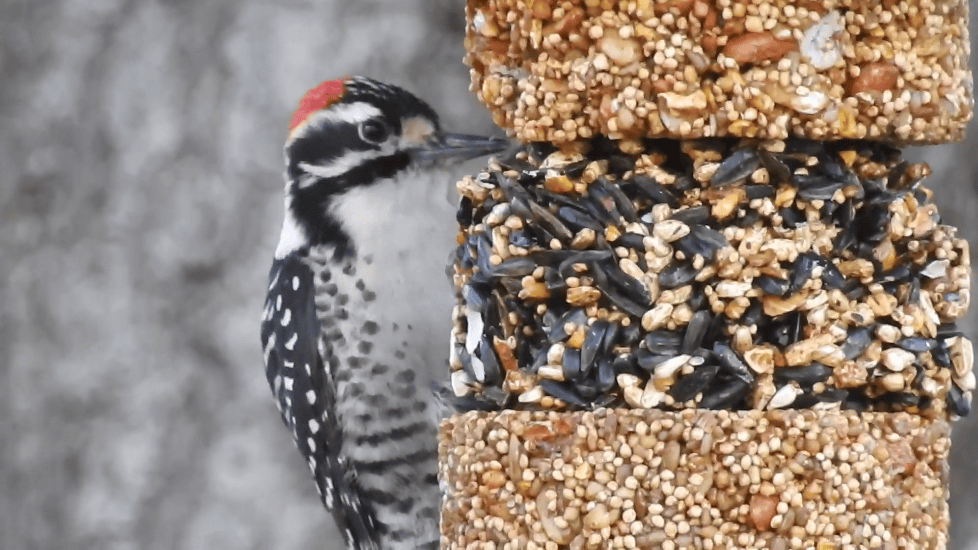
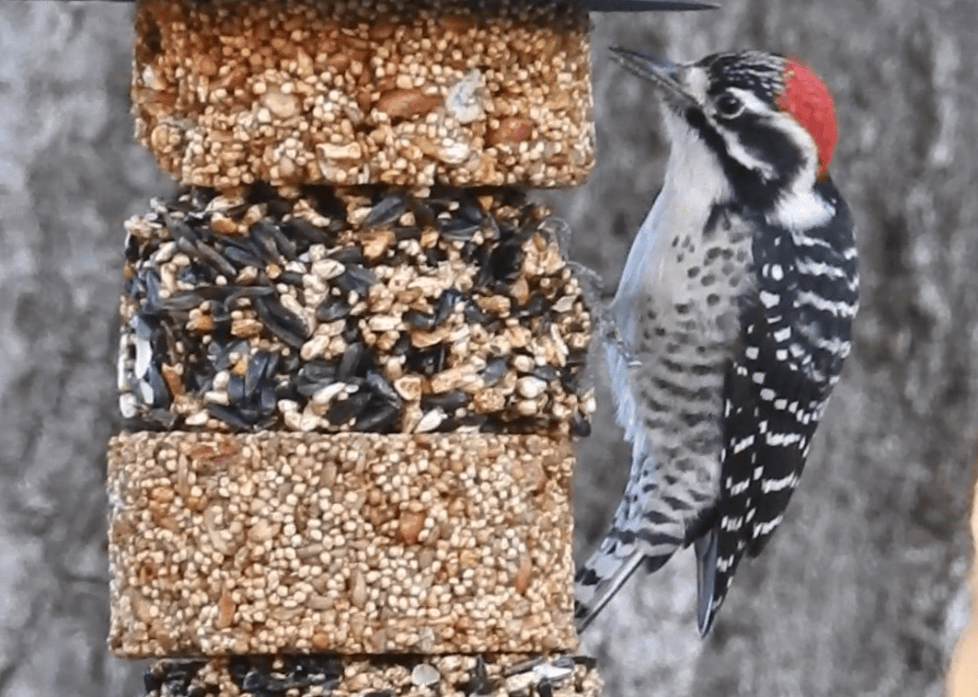
Figure 03. Dryobates woodpeckers — such as this Nuttall’s Woodpecker male — have a distinctive black-and-white patterning, across species, with males adding a splash of red atop their heads.
Nuttall’s Woodpecker, Dryobates nuttallii
Etymology
In 1843, naturalist, ornithologist, and botanist William Gambel (namesake of the Gambel’s Quail) named the Nuttall’s Woodpecker (Dryobates nuttallii) for his mentor, naturalist Thomas Nuttall, using a specimen obtained “near the Pueblo de los Angelos.” In addition, 43 other genera and species have been named for Nuttall; Nuttall also named more than 150 taxa, both species and genera of animals and plants, as well as authoring a book on the birds of the United States and Canada. Nuttall influenced numerous other ornithologists of his day. This species has also been designated as belonging to the Picus, Dendrocopos, and Picoides genera. In Spanish, it’s called “Pico de Nuttall.”
Appearance
The following 1843 quotation, which still offers an accurate description, is from the original publication, introducing the species as Picus nuttallii, https://www.biodiversitylibrary.org/item/17886#page/273/mode/1up , from page 259 of the Proceedings of the Academy of Natural Sciences of Philadelphia.)
APRIL 1843, p. 259
Picus* Nuttalii.
Male, varied with black and white; back transversely banded with black and white; upper part of the head black with linear white spots; hind head [nape] with a broad red stripe; sides of the head and neck black, with a wide [malar] stripe running from the base of the bill about the length of the head, also white stripes running from the eyes and uniting on the back of the neck, which is black. Rump and two middle tail-feathers black. Wing-feathers on their outer and inner webs, with six or seven bands of white spots; all the wing coverts also with white spots; tips of some of the tertiaries light brown. Beneath white, with a slight tinge of yellow; sides and vent with dark brown spots; lower tail coverts and tail-feathers, except the two middle ones, white, with irregular bands or spots of dark brown; throat and breast white; second quill shorter than the seventh; third, fourth, and fifth nearly equal. Two white tufts of hair-like feathers at the base of the upper mandible. Irides red. Length seven inches.
This pretty species I shot in a willow thicket near the Pueblo de los Angelos, Upper California, December 10th. It was actively engaged pecking into one of the trees; from time to time uttering a singular note, unlike any I have heard from a woodpecker. It is, perhaps, a common species in the summer time.
Gambel was describing a male adult or juvenile; a female would have had a few scattered red feathers instead of a red crown patch. As Gambel noted, he killed the bird in order to describe it accurately, as was typical of that time. Gambel didn’t mention its zygodactyl toes and stiff tail, which enables it both to climb easily on tree trunks and to have a stable base from which to peck into tree bark. Whereas Gambel’s specimen was about 7 inches, the range for this species is 6.3–7.1 inches (16–18 cm), with a wingspan of 15–17 inches (38–43 cm), a tail length of about 2.5–3 inches (6.4–8 cm), and short legs (tarsus 0.7 inches, 1.8 cm). These woodpeckers weigh about 1–1.7 ounces (28–47 g), with males weighing about 2% more than females. Bearing in mind their short tarsus length, the bill length is about 0.5–0.9 inches (1.3–2.2 cm).
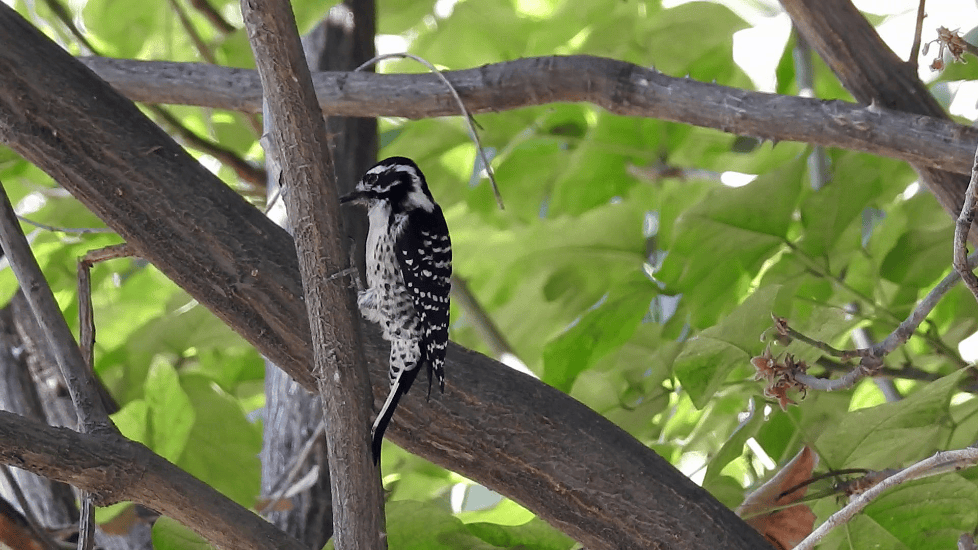
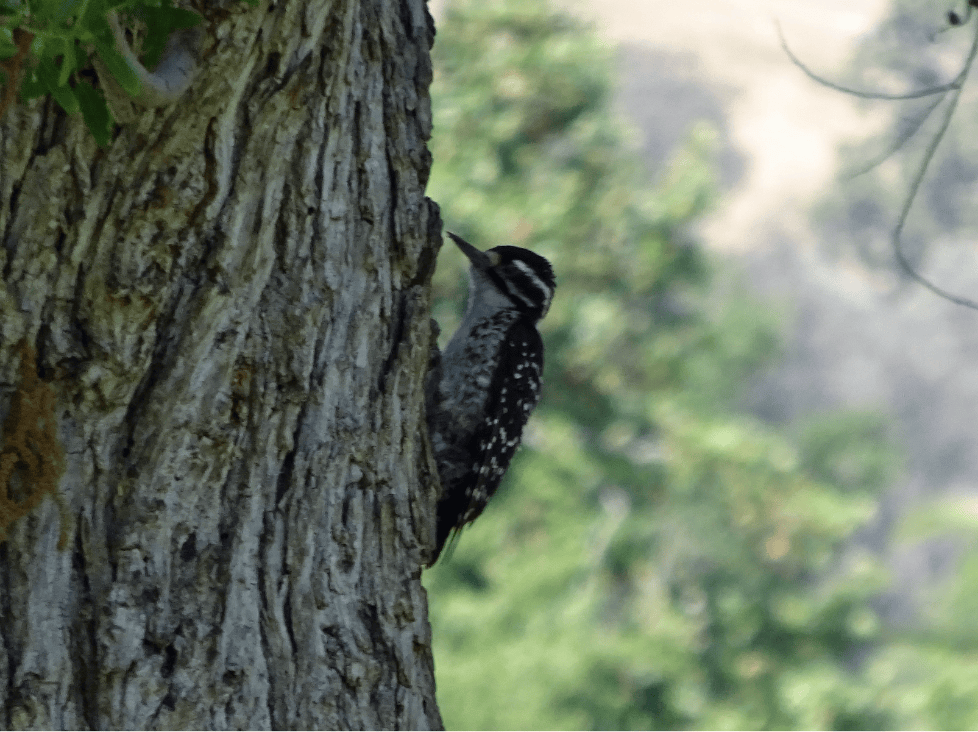
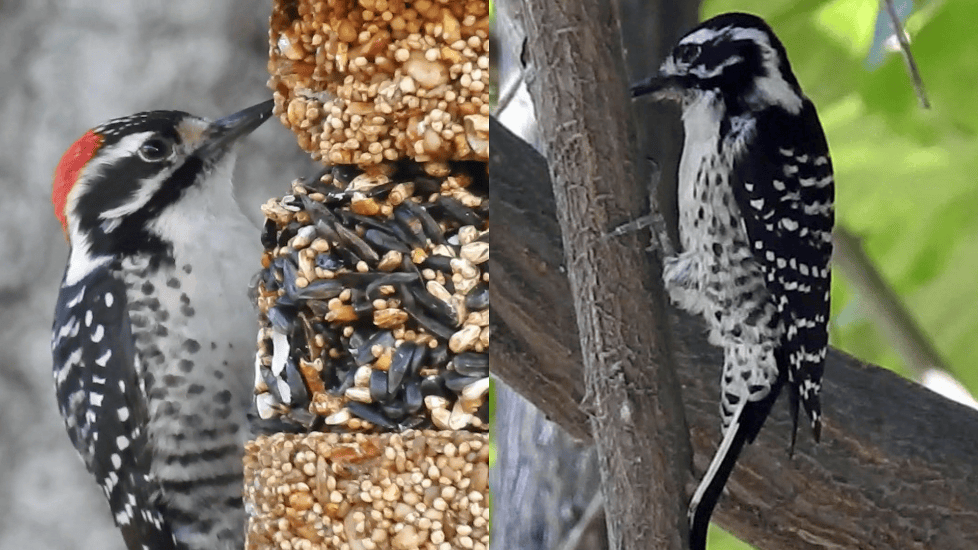
Figure 04. True confession: Both of these Dryobates woodpeckers are female Nuttall’s Woodpeckers. In my files, however, I had mislabeled one of these photos as being a Ladder-backed Woodpecker. I’m not going to tell you which one. My only saving grace is that references repeatedly mention that the two females appear quite similar.
Many observers note similarities in appearance between the Nuttall’s Woodpecker and the Ladder-backed Woodpecker (Dryobates scalaris), as well as a likeness to the Downy Woodpecker (Dryobates pubescens). The Dryobates woodpeckers could be described as having white underparts (with one creamy exception), usually with black speckles, bars, or spots; black wings with white bars or speckles; black-and-white heads for both sexes, but with red crown, nape, or patch for males only. The proportion of black patterning on the white underparts, the proportion of white speckling on the upperparts, and the proportions and patterns of white and black on the head differ across species. Adults undergo a gradually sequenced partial to complete molt in summer, on or near their breeding grounds. These woodpeckers have grayish black bills, gray legs and feet, and dark irises (reported as being reddish, as mentioned by Gambel; red isn’t obvious on photos). To see the similarities among Dryobates species, please visit https://search.macaulaylibrary.org/catalog?taxonCode=t-12023442&includeChildTaxa=true .
Sounds and Vocal Behavior
Few would call the vocalizations of a Nuttall’s Woodpecker melodic or sonorous, but they get the job done for communication between partners, such as “Here I am!” Their calls may also proclaim territory or alert others of a threat. Typically, it sounds more like a staccato twitter (e.g., https://macaulaylibrary.org/asset/666429568 ) than a chirp. To choose among more than 1,000 vocalizations, please visit https://search.macaulaylibrary.org/catalog?mediaType=audio&taxonCode=nutwoo . An additional 100+ can be heard at https://xeno-canto.org/explore?query=nuttall%27s%20woodpecker . Careful observers have distinguished among these calls: pik, pitit, rattle, kweek, wicka, and twitter. Though most calls are issued while perching in trees, some are uttered while flying. The intensity of the sound increases in association with the intensity of the alarm or threat.
Like other woodpeckers, Nuttall’s Woodpeckers (males more often than females) also use drumming (with the bill) to communicate. Another nonvocal sound is the muffled rustling sound of their wing-feather movements, often in association with display behaviors.
Distribution, Habitat, and Migration
The Nuttall’s Woodpecker can be found throughout California, extending from the northernmost chaparral and oak woodlands south to northwestern Baja California — typically west of any deserts and west of the Sierra Nevada range (latitude range +31.9 to +41.8 degrees; centroid longitude −120.6). These woodpeckers don’t migrate, though they will move up and down in elevation seasonally, typically found from sea level to 4,100 feet (1,250 m), with 8,500 feet (2,590 m) being the maximum elevation. Though they prefer relatively arid oak woodlands, they’re occasionally found in riparian woods of other kinds.
Food and Foraging
According to Avibase, about 80% of the Nuttall’s Woodpecker diet is invertebrates, supplemented by about 10% seeds (e.g., berry seeds), 10% fruits, and traces of sap, other plant matter, and miscellaneous food items. Like most other woodpeckers, Nuttall’s Woodpeckers dine mostly on insect larvae, especially wood-boring beetles, ants, and other larvae they can find by probing the crevices of oak trees, as well as by tapping into the bark. Sap is a more important part of the diet during winter, when insects are less active and widely available.
Figure 05. When Nuttall’s Woodpeckers have to work hard for their food, they focus on insects and other invertebrates, but when they’re offered easy access to abundant seeds, they opportunistically fill up.
To gain access to larvae or to sap, the Nuttall’s Woodpecker uses its stiff tail and sturdy xygodactyl toes to stabilize itself while drilling, probing, and poking for food. It often uses its bill to drill into tree trunks and branches, peeling back layers of the tree to expose insect colonies (or other adult or larval insects) hiding within. They have been recorded hammering at rates of 18–22 strikes per second (calculated as 13–15 mph, 21–25 km/h); some have suggested this pounding might reach as many as 12,000 hits/day. Quite a pounding!
Link: For a photo showing a male using his stiff tail for support, please see https://macaulaylibrary.org/asset/667029775 . (His gray xygodactyl toes are harder to see.)
The intensity of each strike is estimated at 1,200 g-forces (1,200 times the force of gravity on Earth) per strike — pretty heavy! Thankfully, like most other woodpeckers, the Nuttall’s Woodpecker has numerous physiological adaptations for absorbing the shock and protecting the brain, such as a shock-absorbing skull, hyoid bone (https://bird-brain.org/2026/10/04/piciformes-tree-hugging-birds-part-6/#Tongue), and other structures. (Please see https://bird-brain.org/2026/10/04/piciformes-tree-hugging-birds-part-6/#Brain for a complete description of how woodpecker heads are designed to protect their brains from the intense impact of pecking into wood.)
Though they ably drill, peck, and tap perpendicular holes into tree bark, they do so only about one third of the time they’re foraging. They also probe and poke into crevices or into nooks where branches split off from the trunk or the main limb. In addition, Nuttall’s Woodpeckers glean insects from foliage, branches, other tree surfaces, and even sometimes the ground. Whereas they move slowly when probing, they move quickly when gleaning. Females glean more than males (about 40% vs. 30% of their foraging time); males drill and tap more than females (about 40% vs. 30% of the time); and females probe slightly less than males (about 30% vs. 32%). Occasionally, these woodpeckers capture flying insects midair. Females also forage higher up than males, and they focus on smaller branches than males.
Locomotion
Observers have noticed a few ways in which Nuttall’s Woodpeckers move slightly differently than most other woodpeckers. Compared with others, they more frequently circle around within a given area; they often hop across to nearby limbs; they more often creep slowly, scanning for prey; they readily hop into tangles of narrow twigs, without using their tails; they often perch crosswise, without using their tails as a balancer; they often flutter their wings for balance; and they sometimes hang upside-down to gather fruits. Little is known about their flight style, and they’re not known to swim or to dive into water.
Social Behavior
Typically solitary, Nuttall’s Woodpeckers may interact during territorial disputes, usually initiated by drumming back and forth across a territorial boundary. The dispute can escalate if the two disputants move toward each other and exchange threatening vocalizations and posture displays (raised crests, heads, and bills; wing-flicking, tail-spreading; etc.). These disagreements sometimes progress to overt attacks or chases.
Figure 06. This video of a male and a female Nuttall’s Woodpecker is from October 4 (2016), well outside of springtime breeding season, but they still seem quite tolerant of each other’s company.
During breeding season, Nuttall’s Woodpeckers are socially monogamous, and mates often interact (e.g., drumming) before breeding season. When courting, they engage in vocal and postural displays. The male typically excavates the nest cavity in a tree (usually in soft wood, such as dead or decaying trees), perhaps with some assistance from the female; after she lays her eggs, she may help more. The completed nest cavity has an entrance diameter of 2 inches (5 cm) and a cavity depth of 11 inches (28 cm), sometimes up to 60 feet (18 m) above the ground. That’s a whole lot of pecking for a bill less than 1 inch long!
The female Nuttall’s Woodpecker lays 3–6 elliptical, creamy-white, slightly glossy eggs in the nest cavity — usually laying 4–5. Both parents incubate the eggs, with the male incubating at night and about half of the daytime, and the female incubating the rest of the time. Incubation lasts about 14 days. After hatching, the naked, altricial (helpless) nestlings are brooded about 70% of the time during the first week, but less so after that. Like other woodpeckers, they have no natal down, and the first feathers to emerge are juvenile plumage. Both parents feed the nestlings about 3.6 times/hour, for a total of 7.2 parental feeding visits per hour. Dads do more of the nest sanitation than moms, removing three times as many fecal sacs as moms. The fledging period lasts about 29 days, and both parents continue to feed their young for another 14 days after they fledge. After that, the parents have little tolerance for their fledglings, urging them to leave, as the parents return to solitary living.
Link: For a charming video of a mom feeding insects to her nestling, please see https://macaulaylibrary.org/asset/576914401 .
Age at first breeding is presumed to be 1 year, and Nuttall’s Woodpeckers breed annually thereafter. Generation length is 2.2–3 years.
Lifespan and Survivorship
The annual survival rate for adult Nuttall’s Woodpeckers is 60–62%. The lifespan average is about 7.75 years, and the maximum recorded age for a Nuttall’s Woodpecker is a banded female who was recaptured and released when at least 8.75 years of age.
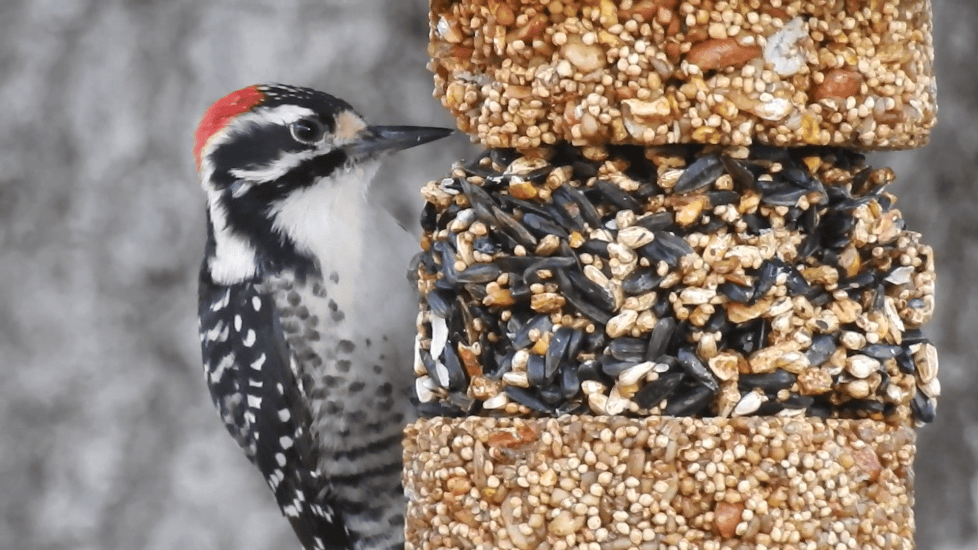
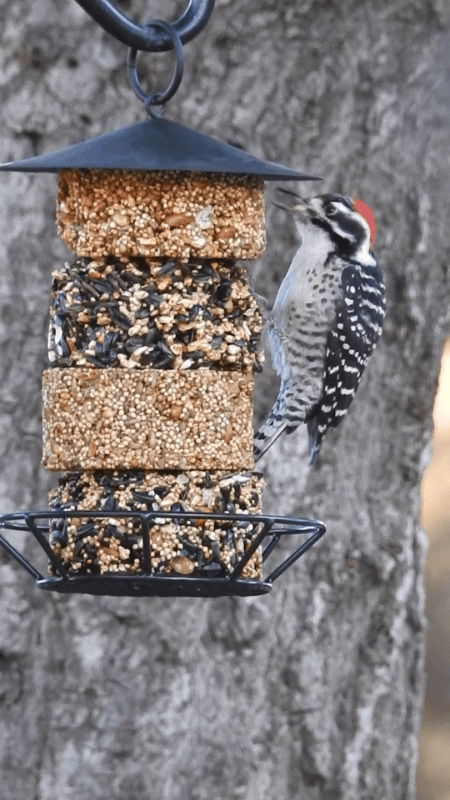
Figure 07. Though Nuttall’s Woodpeckers don’t have a very high annual likelihood of survival, many adults can live close to 8 years or more.
Conservation and Management
The IUCN Red List conservation status for the Nuttall’s Woodpecker is LC, Least Concern; its population in California is considered healthy and stable. It is believed to be common within its territorial range, about 70,979–115,440 square miles (183,834–299,000 km²). Estimates of its population exceed 100,000 individuals, with some estimates much higher (850,000 globally, 750,000 North America; https://www.iucnredlist.org/species/22681149/281011098#population ). An advantage of this woodpecker is its adaptability to suburban and other human-shaped environments, such as parks. Nonetheless, human activities (e.g., agriculture) that encroach on oak woodlands and other native habitats may impact this species in the future. It appears that no specific conservation actions are being implemented for this species, but preservation of oak woodland would be beneficial.
Ornithologists urge researchers to increase our understanding of this species, which has been understudied up until now, and which could greatly benefit from further investigation. Of particular interest is greater understanding of cavity nesting (including its biology).
Observations
The Cornell Lab of Ornithology gathers information from observers around the world through the eBird app and website (https://ebird.org/species/nutwoo ), which has more than 1,150,000 observations of the Nuttall’s Woodpecker, including 26,072 with photos and 963 with audio recordings. Also, the lab’s Macaulay Library website (https://search.macaulaylibrary.org/catalog?taxonCode=nutwoo ) holds 42,686 photos, 1,100 audio recordings, and 136 videos of the Nuttall’s Woodpecker
In addition, iNaturalist gathers observations with its app and website (https://www.inaturalist.org/observations?taxon_id=792987 ), which has 21,261 observations of this species, each of which includes a photograph, audio recording, or video.
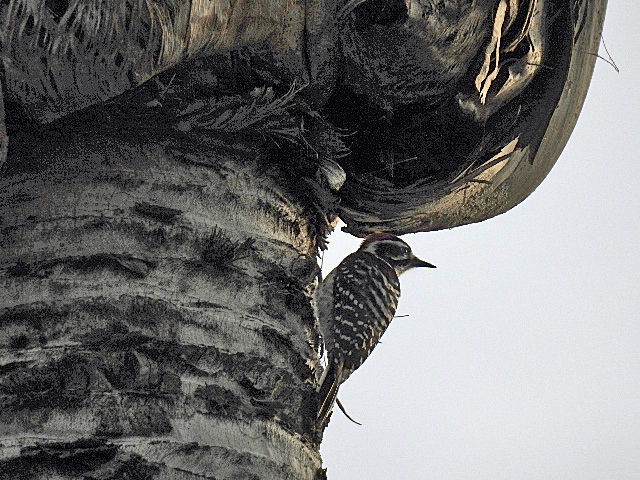
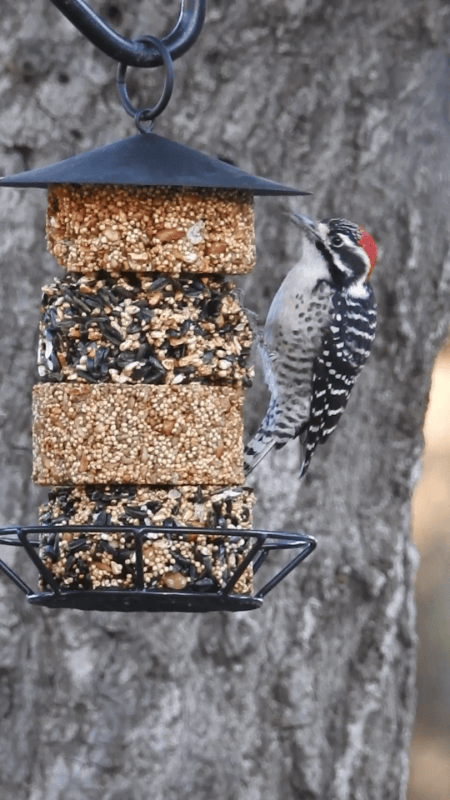
Figure 08. Though the Nuttall’s Woodpecker doesn’t have an enormous range, and it spends almost all of its time in trees, it has been widely observed by citizen scientists who report those sightings to eBird.
Ladder-backed Woodpecker, Dryobates scalaris
Within California, compared with the Nuttall’s Woodpecker, the Ladder-backed Woodpecker (Dryobates scalaris) is less common in San Diego and other coastal areas, but more common in Imperial and other inland areas. In addition, they’re found more widely in the southwestern United States, as well as being found as far south as Nicaragua in Central America.
(Observations of Nuttall’s in San Diego, California, 134,700, but in Imperial, California, only 1 observation ever; observations of Ladder-backed in San Diego, 1,791, but in Imperial, 3,415.)
Ladder-backed Woodpeckers can adapt to most altitudes, but they prefers arid habitats, such as deserts or at least xeric scrub, woodlands, or brush. They manage to evade thorns and spines when foraging on cacti for insects (mostly larvae) and occasional fruit; they even nest in cacti, where the female will lay 2–7 white oval eggs, which both monogamous parents incubate. (They were once known as “Cactus Woodpeckers.”)
Females typically forage on bushes and smaller plants, while males forage on taller trunks and branches; neither forages on the ground. Both will take advantage when humans offer them feeders with seeds or peanut butter, but they don’t use nest boxes. They don’t store food, they don’t hawk flying insects, and they don’t dig deeply into wood. These agile woodpeckers pry, probe, glean, or pick, and even hang upside-down to reach food, balancing with open wings. They also drink water from plants when available. Like other desert dwellers, they’re mostly inconspicuous and quiet. They make short, swift undulating flights. Though they may be hard to spot, like the Nuttall’s, their fellow Dryobates species, they have a conservation status of LC, Least Concern. The oldest recorded Ladder-backed Woodpecker was a banded male, at least 4.5 years old when he was recaptured and released. A possible rival is a female believed to have reached 7.5 years of age. “Partners in Flight (https://www.iucnredlist.org/species/22681152/264594002#population ; https://partnersinflight.org/ ) estimates a global breeding population of 5.9 million.” Globally, eBird reports 1,040,000 observations of this species.
Downy Woodpecker, Dryobates pubescens
Globally, eBird reports 19,300,000 observations of this species of Dryobates (https://ebird.org/species/dowwoo ), “Tiny woodpecker, common and widespread across much of North America. . . . Occurs in any wooded habitat, though western birds are more restricted to riparian areas. ” For more information on this woodpecker, including its taxonomy, distribution and habitat, description, behavior and ecology, diet, and reproduction, please see https://en.wikipedia.org/wiki/Downy_woodpecker .
References
Dryobates Genus
- Winkler, D. W., S. M. Billerman, and I. J. Lovette (2020). Woodpeckers (Picidae), version 1.0. In Birds of the World (S. M. Billerman, B. K. Keeney, P. G. Rodewald, and T. S. Schulenberg, Editors). Ithaca, NY: Cornell Lab of Ornithology. https://doi.org/10.2173/bow.picida1.01 ; https://birdsoftheworld.org/bow/species/picida1/cur/species#genusDryobates
- Dryobates, https://en.wikipedia.org/wiki/Dryobates
- Dryobates, naturalist and ornithologist Friedrich Boie (1826), https://en.wikipedia.org/wiki/Friedrich_Boie
Nuttall’s Woodpecker (Dryobates nuttallii)
- Nuttall’s Woodpecker, Dryobates nuttallii, original citation on page 259: https://www.biodiversitylibrary.org/item/17886#page/273/mode/1up , Meeting for Business, April 25, 1843. (1843). Proceedings of the Academy of Natural Sciences of Philadelphia, 1, 258–263. https://www.biodiversitylibrary.org/part/84864 .
- Lowther, P. E., P. Pyle, and M. A. Patten (2020). Nuttall’s Woodpecker (Dryobates nuttallii), version 1.0. In Birds of the World (P. G. Rodewald, Editor). Ithaca, NY: Cornell Lab of Ornithology. https://doi.org/10.2173/bow.nutwoo.01 , https://birdsoftheworld.org/bow/species/nutwoo/cur/introduction
- Avibase, Nuttall’s Woodpecker, Dryobates nuttallii, https://avibase.bsc-eoc.org/species.jsp?avibaseid=FA087E52
- Avibase, Life History, Nuttall’s Woodpecker, Dryobates nuttallii, https://avibase.bsc-eoc.org/species.jsp?lang=EN&avibaseid=FA087E52BE127A71&sec=lifehistory
- iNaturalist, Nuttall’s Woodpecker, Dryobates nuttallii, https://www.inaturalist.org/observations?taxon_id=792987
- IUCN, Nuttall’s Woodpecker, Dryobates nuttallii, https://www.iucnredlist.org/species/22681149/281011098
- Wikipedia, Nuttall’s Woodpecker, Dryobates nuttallii, https://en.wikipedia.org/wiki/Nuttall%27s_woodpecker
- Nuttall’s Woodpecker, Dryobates nuttallii, William Gambel, https://en.wikipedia.org/wiki/William_Gambel
- Nuttall’s Woodpecker, Dryobates nuttallii, Thomas Nuttall, https://en.wikipedia.org/wiki/Thomas_Nuttall
Ladder-backed Woodpecker (Dryobates scalaris)
- Lowther, P. E., P. Pyle, and M. A. Patten (2020). Ladder-backed Woodpecker (Dryobates scalaris), version 1.0. In Birds of the World (P. G. Rodewald, Editor). Ithaca, NY: Cornell Lab of Ornithology. https://doi.org/10.2173/bow.labwoo.01 ; https://birdsoftheworld.org/bow/species/labwoo/cur/introduction
- Ladder-backed woodpecker, Dryobates scalaris, https://ebird.org/species/labwoo
- Ladder-backed Woodpecker, Dryobates scalaris, https://en.wikipedia.org/wiki/Ladder-backed_woodpecker
- All About Birds, Ladder-backed Woodpecker, Dryobates scalaris, https://www.allaboutbirds.org/guide/Ladder-backed_Woodpecker/
Etymology
- Gotch, A. F. [Arthur Frederick]. Birds—Their Latin Names Explained (348 pp.). Poole, Dorset, U.K.: Blandford Press.
- Gruson, Edward S. (1972). Words for Birds: A Lexicon of North American Birds with Biographical Notes (305 pp., including Bibliography, 279–282; Index of Common Names, 283–291; Index of Generic Names, 292–295; Index of Scientific Species Names, 296–303; Index of People for Whom Birds Are Named, 304–305). New York: Quadrangle Books.
- Lederer, Roger, and Carol Burr. (2014). Latin for Bird Lovers: Over 3,000 Bird Names Explored and Explained (224 pages). Portland, OR: Timber Press.
Text and images by Shari Dorantes Hatch. Copyright © 2026. All rights reserved.
These images were recorded in San Diego County.


Leave a Reply