
Megalaimidae, Asian Barbets
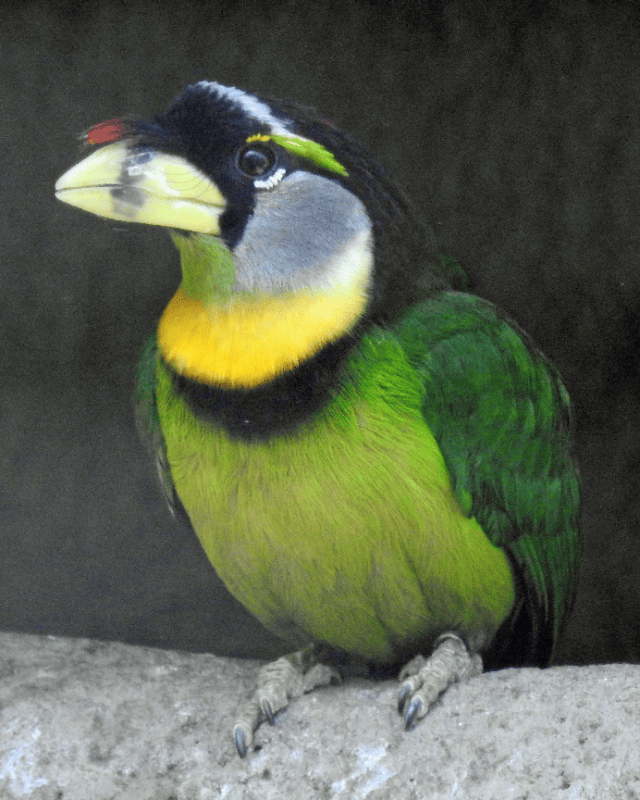
Figure 01. This Fire-tufted Barbet — and other species in the Megalaimidae family of Asian barbets — has plumage that distinguishes its throat, making the throat appear comparatively large, which makes sense for a family named for having a mega-, “large” -laima, “throat.”
This is the fourth of several blogs about the Piciformes order of birds and its nine highly diverse families. The first blog introduced the order and three of its nine families: Galbulidae, jacamars; Bucconidae, puffbirds; and Indicatoridae, honeyguides, https://bird-brain.org/2026/08/30/piciformes-tree-hugging-birds-part-1/ . The second blog introduced the Ramphastidae family of toucans, https://bird-brain.org/2026/09/07/piciformes-tree-hugging-birds-part-2/ . The third blog introduced the four barbet families, then focused on the Capitonidae family of New World barbets and the Semnornithidae family, including two more species of the New World.
The current blog introduces the Asian barbets of the Megalaimidae family, as follows:
- Etymology
- Taxonomy
- Appearance
- Vocalizations
- Distribution and Habitat
- Food and Foraging
- Breeding
- Conservation Status
- Psilopogon (Genus)
- Fire-tufted Barbet, Psilopogon pyrolophus
Etymology
The name of the Megalaimidae family of Asian barbets, which includes 2 genera, across 35 species, has Greek origins. As you probably already know, mega is Greek for “large” or “great.” In ancient Greek, laima means “throat.” Many of the species in this family have distinctive plumage highlighting the throat, enhancing its appearance and making it appear rather large. Members of the Megalaimidae family are called “megalaimids.”
Taxonomy
The taxonomic classification of the Megalaimidae family is as follows: kingdom, Animalia; phylum, Chordata; class, Aves; order, Piciformes; suborder, Pici; infraorder, Ramphastides; family, Megalaimidae, designated by zoologist Edward Blyth, in 1852. Current taxonomy recognizes two genera within the Megalaimidae family: Caloramphus, with 2 species, and Psilopogon, with 33 species, for a total of 35 species in the family. (Details about the genera are discussed further in the section on the Psilopogon genus.) The family history has been tracked back to the Pleistocene era (2,580,000–11,700 years ago), but the Caloramphus genus appears to have diverged from a common ancestor with the Psilopogon genus about 21,320,000 years ago, so its lineage appears to be older.
Appearance
The two species in the Caloramphus genus are known as “brown barbets,” one of them the Brown Barbet, Caloramphus fuliginosus, and the other the Sooty Barbet, Caloramphus hayii. The 33 species in the Psilopogon genus are mostly green, with distinctive coloration (e.g., red, blue, yellow) on the head and chin, though a few have brown plumage instead of vivid colors complementing the green. (The variety of these species may be seen at https://search.macaulaylibrary.org/catalog?taxonCode=megala2&includeChildTaxa=true .)
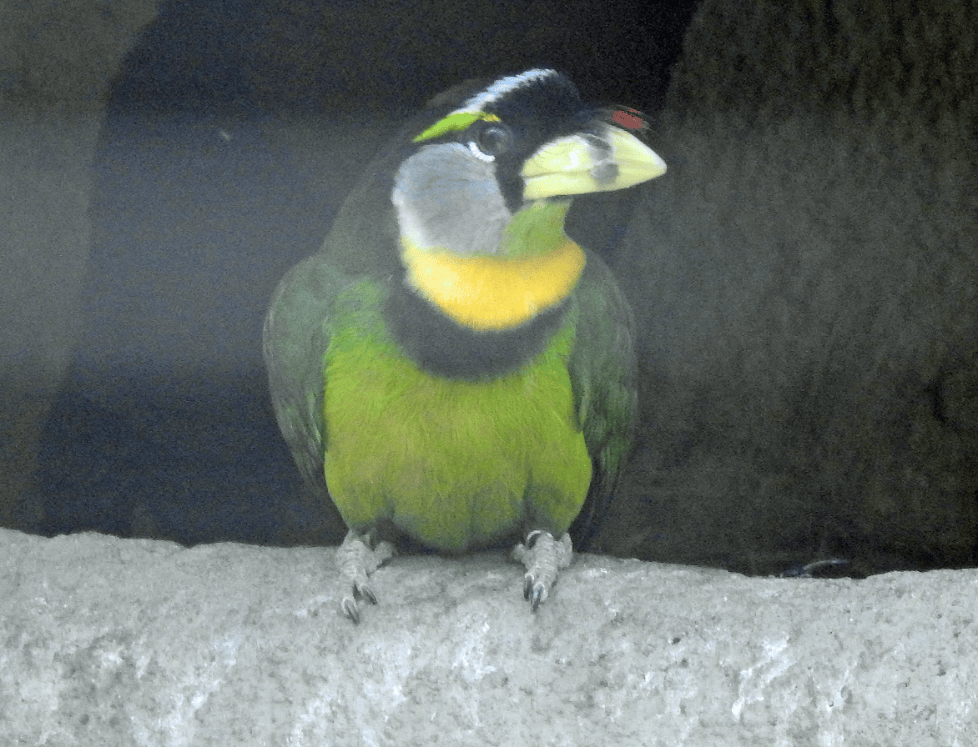
Figure 02. Like other megalaimids in the Psilopogon genus, this Fire-tufted Barbet has mostly green plumage.
All Asian barbets have large bills, with rictal bristles (specialized feathers) at the base; these wispy feathers may be more pronounced and noticeable in some species than in others. Like other Piciformes families, megalaimids all have zygodactyl toes (two pointing forward, two backward). Perhaps the most distinctive among the Asian barbets is the Great Barbet, Psilopogon virens, which is the longest and heaviest of the Asian barbets. At about 13–14 inches (32–35 cm) long, weighing about 6.8–10.4 ounces (192–295 g), it’s bigger than some small toucans. This species also has distinctive plumage, with its intensely blue head, neck, and throat, its brown shoulders, and its spotted breast. (To see thousands of photos of this species, visit https://search.macaulaylibrary.org/catalog?taxonCode=grebar1 ; e.g., see https://macaulaylibrary.org/asset/662833913 or https://macaulaylibrary.org/asset/662769474 .)
Vocalizations
As well-camouflaged inhabitants of the forest canopy, these barbets are more often heard than seen. The Macaulay Library of the Cornell Lab of Ornithology has more than 12,000 audio recordings of Megalaimidae vocalizations at https://search.macaulaylibrary.org/catalog?taxonCode=megala2&includeChildTaxa=true&mediaType=audio . Recordings of the Asian barbets of the Psilopogon genus may be found at https://xeno-canto.org/explore?query=psilopogon . You may find additional recordings, listed by species, at the xeno-canto.org website, such as these 252 recordings of the Great Barbet (Psilopogon virens), https://xeno-canto.org/species/Psilopogon-virens . Their vocalizations, which have been described as rhythmic cuckoo-like whistles, may be heard in the forests of southeast Asia.
Distribution and Habitat
Asian barbets may be found in the tropical and subtropical forests of southeast Asia, from Tibet through Indonesia, both on the mainland and on the surrounding islands. They inhabit both primary forests and secondary forests, evergreen and deciduous, lowlands and mountain slopes. A few species may even be found in forest edges, scrublands, and even gardens and orchards near human settlements.
Food and Foraging
Megalaimids, like other barbets, eat mostly fruits most of the year — especially figs or other fruits in the tree canopy. They swallow and then regurgitate the seeds of the fruits they eat, so they play a key role in dispersing the seeds of forest fruits. They’re also opportunistic, so when insects and other invertebrates are abundant (e.g., when scads of insects hatch at once), they dine on those, too. Some will also eat frogs or other small vertebrates when they’re easy to catch and eat.
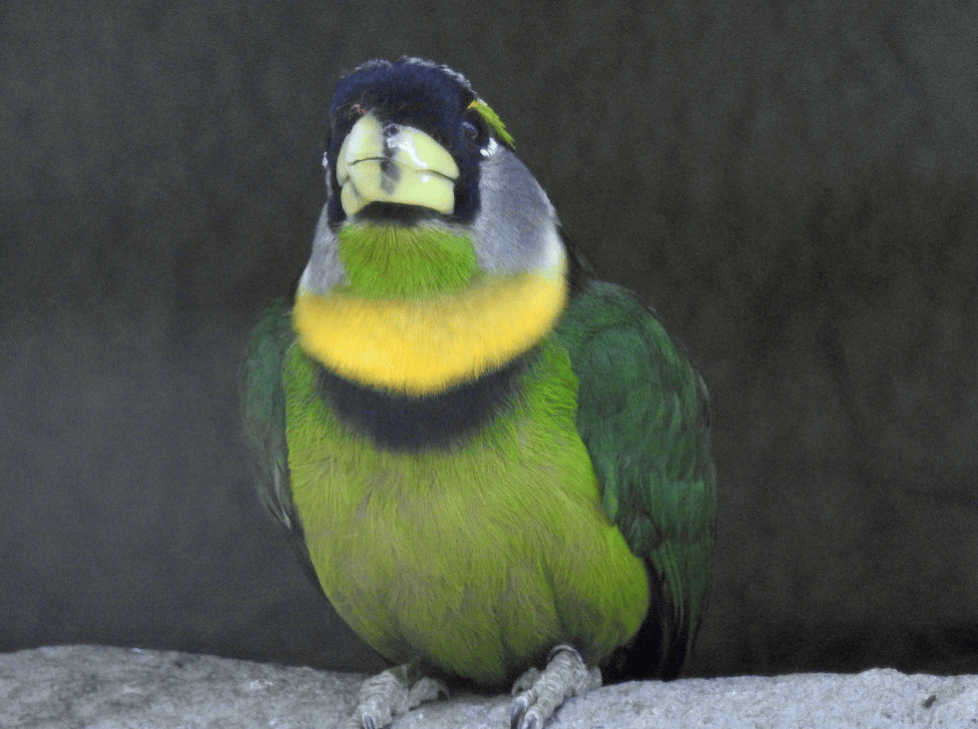
Figure 03. Megalaimids, such as this Fire-tufted Barbet, eat mostly fruits most of the year; when they regurgitate the seeds, they serve a key role in re-seeding the forest’s fruit trees.
Breeding
Most megalaimids are monogamous, and some couples belong to species of cooperative breeders, who have help during breeding, both with incubation and with feeding the hatchlings. Both monogamous parents work together to excavate their own nest cavities in the soft wood of dead trees, though some may make nests in tree branches or even in abandoned termite nests. They haven’t been seen bringing other materials to the nest. The female lays 1–6 eggs, which both parents incubate for about 2 weeks or a little longer. The altricial (helpless) chicks emerge featherless and grow rather slowly, while both parents feed them. It takes about 5–6 weeks for the chicks to mature enough to fledge.
Conservation Status
In general, Asian barbets seem to be doing well, with 88.6% having a conservation status of LC, Least Concern. Their forested habitats are under threat, however, and habitat destruction imperils many species, especially species whose territorial range is already restricted. Four species have a conservation status of NT, Near Threatened (11.4% of Asian barbets):
- Sooty Barbet, Caloramphus hayii — https://en.wikipedia.org/wiki/Sooty_barbet , https://birdsoftheworld.org/bow/species/soobar2/cur/introduction
- Red-crowned Barbet, Psilopogon rafflesii — https://en.wikipedia.org/wiki/Red-crowned_barbet , https://birdsoftheworld.org/bow/species/recbar1/cur/introduction
- Red-throated Barbet, Psilopogon mystacophanos — https://en.wikipedia.org/wiki/Red-throated_barbet , https://birdsoftheworld.org/bow/species/retbar1/cur/introduction
- Yellow-crowned Barbet, Psilopogon henricii — https://en.wikipedia.org/wiki/Yellow-crowned_barbet , https://birdsoftheworld.org/bow/species/yecbar1/cur/introduction
Psilopogon (Genus)
Etymology
The genus name Psilopogon comes from Greek, psilos, meaning “bare,” and pōgōn, meaning “beard,” referring to the tufts of rictal bristles on the base of the bill of the species in this genus (e.g., Psilopogon pyrolophus, Fire-tufted Barbet).
Taxonomy
In the late 1820s, renowned zoologist and museum director Coenraad Jacob Temminck sent naturalist Salomon Müller on an expedition to collect animal specimens, the first of many expeditions made by Müller (who later had four reptiles named for him). In 1836, Müller designated the Psilopogon genus of Asian barbets, based on just one species, the Fire-tufted Barbet, Psilopogon pyrolophus, a type specimen found in southern Asia (island of Sumatra; also found on Malaysian peninsula).
In 1841, ornithologist and zoologist George Robert Gray designated a different genus of Asian barbets, Megalaima, which included many other barbet species. Since then, DNA analysis of the evolutionary origins of Asian barbets revealed that the Fire-tufted Barbets and the Megalaima barbets actually belong in the same genus. Because the identifier Psilopogon was designated first, all of the Megalaima barbets were reclassified into the Psilopogon genus, increasing its number from 1 species to 33.
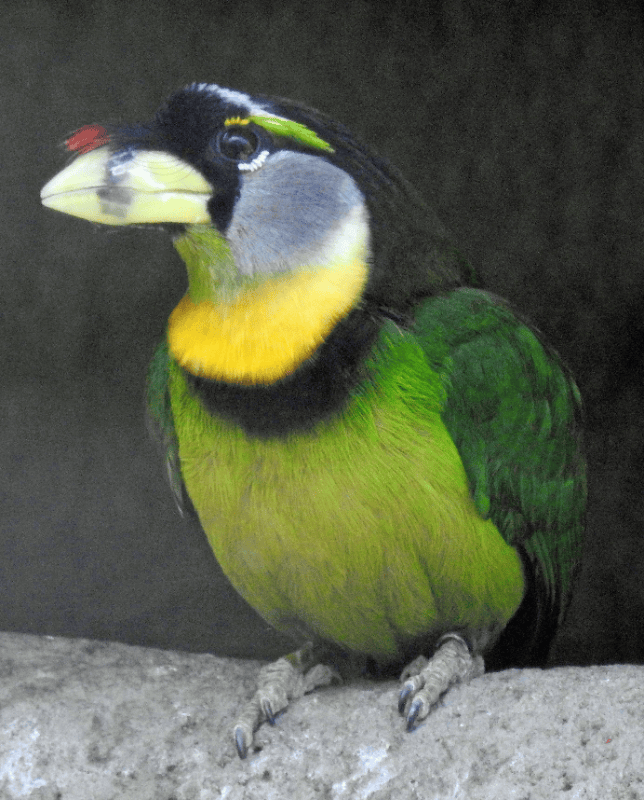
Figure 04. In 1841, the Fire-tufted Barbet was the first of the Psilopogon genus of megalaimids to be identified.
Fire-tufted Barbet, Psilopogon pyrolophus
Etymology
As mentioned previously, the etymology of Psilopogon points to the tufts of rictal bristles on these barbets. The second half of its scientific binomial name, pyrolophus, also highlights these bristles. The prefix pyro- is Greek for “fire” or “flame” or “fire-colored,” which aptly describes the red tips on the rictal bristles of this species. The affix, -lophus, is Latin for “crest” or “tuft.” In other words, its scientific name is pretty much the same as its common name, Fire-tufted Barbet.
Appearance
The Fire-tufted Barbet is about 11–11.4 inches (28–29 cm) long (bill to tail) and weighs about 3.8–5.3 ounces (107–149 g), quite a bit smaller than the Great Barbet (13–14 inches long, 6.8–10.4 ounces).
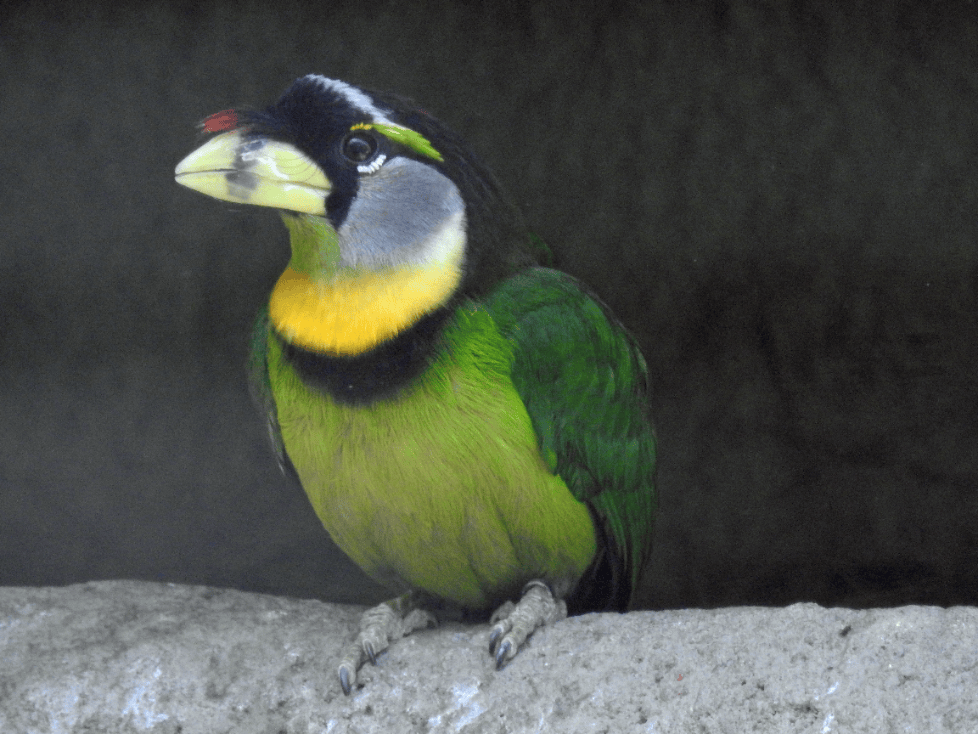
This barbet’s plumage is mostly green, with lighter green underparts and darker green wings, tail, and back. It’s also adorned with a bright chartreuse chin and a chartreuse “eyebrow” extending back from each eye. Its crown is black from its bill to a narrow pale bluish-white headband stripe crossing the head between the two eyes; behind the “headband” are brownish-maroon feathers extending down the back of its nape. Its cheeks are soft gray; beneath its chartreuse chin is a bright yellow collar, beneath which is an additional narrow black collar. The namesake rictal bristles overhanging its bill are black with fire-red tips. (Some reports say the fire-red tips show up on adult males only, not on females or immature barbets.)
In addition, Fire-tufted Barbets have brightly colored rictal-bristle “eyelashes” above (yellow) and below (white) the eyes. The adult’s red irises may look blackish in some lighting; they’re brown in immature barbets. The bill is pale yellow, perhaps with a pale green undertone; a vertical black band bisects it on each side.
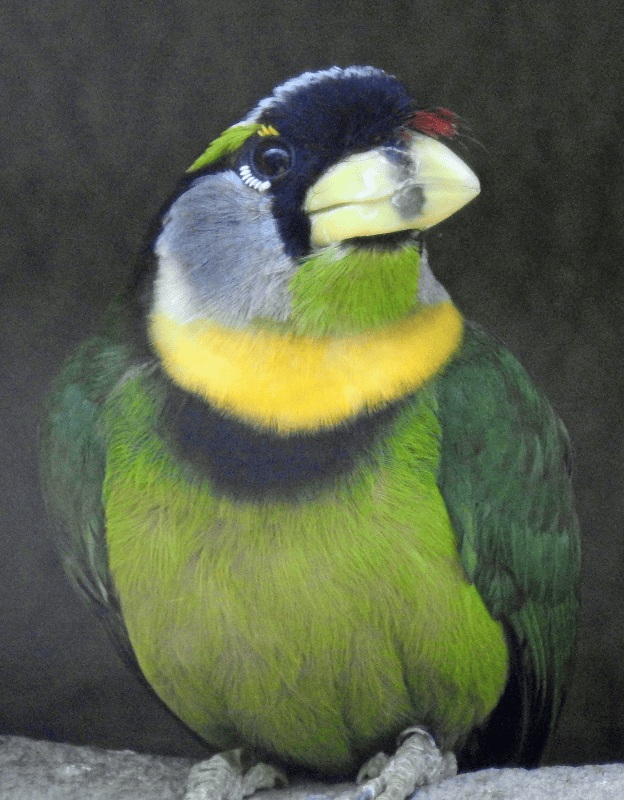
Figure 05. The Fire-tufted Barbet has not only its namesake fire-tufted rictal bristles at the base of its bill, but also brightly colored rictal bristles above and below each eye, like lemony and snowy eyelashes.
Sounds and Vocalizations
At least 99 audio recordings of Fire-tufted Barbets may be found at the Macaulay Library of the Cornell Lab of Ornithology, https://search.macaulaylibrary.org/catalog?taxonCode=fitbar1&mediaType=audio . An additional 57 audio recordings may be found at https://xeno-canto.org/explore?query=psilopogon%20pyrolophus . More than one source suggests that its vocalizations sound similar to the buzzy whir of cicadas (hopping insects), with each zz sound occurring 1–14 times per second. Other sounds include a whistled note, a squeak, and a rasping sound (made by youngsters).
Distribution and Habitat
The Fire-tufted Barbet is a native of Sumatra and the Malaysian peninsula; observations of this species in Java are thought to be escapees from aviaries on that island (for a range map of observations reported to eBird, please see Fire-tufted Barbet – Species Map – eBird ). In its homeland, it can be found mostly in the canopy and subcanopy of moist tropical forests. It inhabits both primary forests and older secondary forests, as well as forest edges and patches, especially if they’re among vines and other creeping plants. It prefers broad-leaved evergreen trees when available. It has been seen between 1,500 and 6,600 feet (460–2000 m), but it’s mostly found at 2,900–4,900 feet (900–1500 m). They do not migrate; in fact, one banded barbet was recaptured 13 months later at the exact same spot.
Food and Foraging
According to Avibase, fruits make up 80% of the Fire-tufted Barbet’s diet, with invertebrates composing the other 20%, though trace amounts of land vertebrates may also be consumed. This barbet typically eats fruits up to about 1 inch (2.5 cm) in diameter, with figs being a special favorite. In captivity, they’ll also eat many other fruits and fruit chunks. In the wild, they eat large arthropods (especially insects), particularly when breeding. In captivity, these barbets also consume a variety of adult and larval insects, as well as small dead vertebrates (e.g., mice), which they carefully chew before feeding them to their young. Within a week after fledging, the young switch to an almost all-fruit diet, like the adults.
Fire-tufted Barbets typically forage in pairs or in family groups of up to 7 birds. Though they mostly hang out in the canopy and subcanopy, they’ll occasionally descend to the understory in pursuit of scrumptious fruits or insects. They glean, peck, and probe, and they’ll even hang in foliage to reach the fruits or insects they seek.
Breeding
Like other barbets, Fire-tufted Barbets form monogamous pairs. Males engage in posturing and vocalizations to woo their mates, and the female responds, as the two peck and clasp one another. Both partners dig out a nest cavity in a dead tree or branch at least 13 feet (4 m) or more above the ground. Little is known about the eggs or even the number of eggs or the duration of incubation, but it’s presumed that both parents participate in incubation. After the chicks hatch, both parents feed it — lots of insects for the first week or so, then almost entirely fruit after that. The nestling period lasts about 42 days until the chicks fledge. The parents continue to offer food for an additional 5–8 days, after which the young feed themselves entirely.
Conservation Status
Fortunately, Fire-tufted Barbets have an IUCN Red List conservation status of LC, Least Concern. Though its native range is limited to Sumatra and the Malaysian peninsula, it’s common within Sumatra and locally common in many locations on the Malaysian peninsula. As is so often the case, however, many of the forest habitats within its limited range are being cleared or severely fragmented. Several protected areas offer refuge (e.g., Sumatra’s Kerinci-Seblat National Park). Another threat to this species is the illegal pet trade.
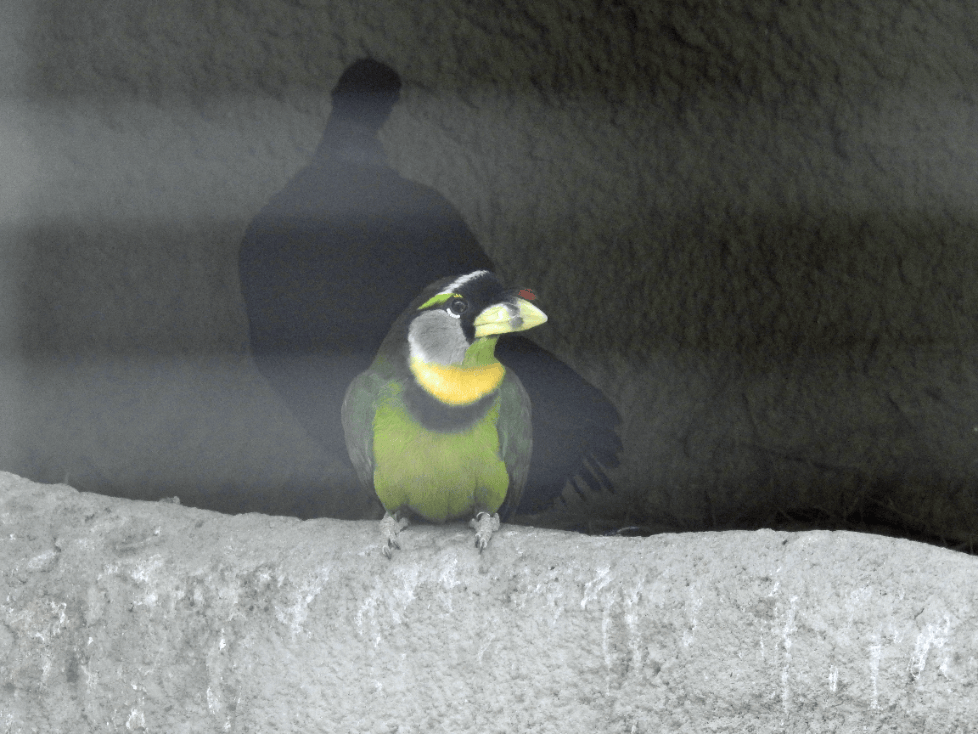
Figure 06. It’s easy to see the appeal of having a pet Fire-tufted Barbet — until you realize that it’s a wild bird, who will thrive in the wild but not in a household.
Observations
The Cornell Lab of Ornithology gathers information from observers around the world through the eBird app and website (https://ebird.org/species/fitbar1 ), which has 6,919 observations, including 804 with photos and 91 with audio recordings. Also, the lab’s Macaulay Library website (https://search.macaulaylibrary.org/catalog?taxonCode=fitbar1 ) holds 1,356 photos, 99 audio recordings, and 16 videos of this species.
In addition, iNaturalist gathers observations with its app and its website (https://www.inaturalist.org/observations?taxon_id=117074 ), which has 353 observations, each of which includes a photograph, audio recording, or video.
References
Megalaimidae Family, Asian Barbets (35 species)
- Winkler, D. W., S. M. Billerman, and I. J. Lovette (2020). Asian Barbets (Megalaimidae), version 1.0. In Birds of the World (S. M. Billerman, B. K. Keeney, P. G. Rodewald, and T. S. Schulenberg, Editors). Ithaca, NY: Cornell Lab of Ornithology. https://doi.org/10.2173/bow.megala2.01 ; https://birdsoftheworld.org/bow/species/megala2/cur/introduction
- Megalaimidae, Asian barbets (35 species), https://en.wikipedia.org/wiki/Megalaimidae
- Megalaimidae, zoologist Edward Blyth (in 1852), https://en.wikipedia.org/wiki/Edward_Blyth .
- Asian barbets, Megalaima genus, ornithologist and zoologist George Robert Gray, https://en.wikipedia.org/wiki/George_Robert_Gray
Psilopogon Genus (33 Species)
- Psilopogon genus, https://en.wikipedia.org/wiki/Psilopogon
- Psilogon genus, naturalist Salomon Müller, https://en.wikipedia.org/wiki/Salomon_M%C3%BCller
Fire-tufted Barbet Species, Psilopogon pyrolophus
- Short, L. L., J. F. M. Horne, and G. M. Kirwan (2020). Fire-tufted Barbet (Psilopogon pyrolophus), version 1.0. In Birds of the World (J. del Hoyo, A. Elliott, J. Sargatal, D. A. Christie, and E. de Juana, Editors). Ithaca, NY: Cornell Lab of Ornithology. https://doi.org/10.2173/bow.fitbar1.01 https://birdsoftheworld.org/bow/species/fitbar1/cur/introduction
- https://en.wikipedia.org/wiki/Fire-tufted_barbet
- Fire-tufted Barbet, life history, https://avibase.bsc-eoc.org/species.jsp?lang=EN&avibaseid=9769A702F64302E6&sec=lifehistory
Etymology
- Gotch, A. F. [Arthur Frederick]. Birds—Their Latin Names Explained (348 pp.). Poole, Dorset, U.K.: Blandford Press.
- Gruson, Edward S. (1972). Words for Birds: A Lexicon of North American Birds with Biographical Notes (305 pp., including Bibliography, 279–282; Index of Common Names, 283–291; Index of Generic Names, 292–295; Index of Scientific Species Names, 296–303; Index of People for Whom Birds Are Named, 304–305). New York: Quadrangle Books.
- Lederer, Roger, and Carol Burr. (2014). Latin for Bird Lovers: Over 3,000 Bird Names Explored and Explained (224 pages). Portland, OR: Timber Press.
Text and images by Shari Dorantes Hatch. Copyright © 2026. All rights reserved.
Images were recorded at the San Diego Zoo, 2018.


Leave a comment