
Lybiidae, African Barbets
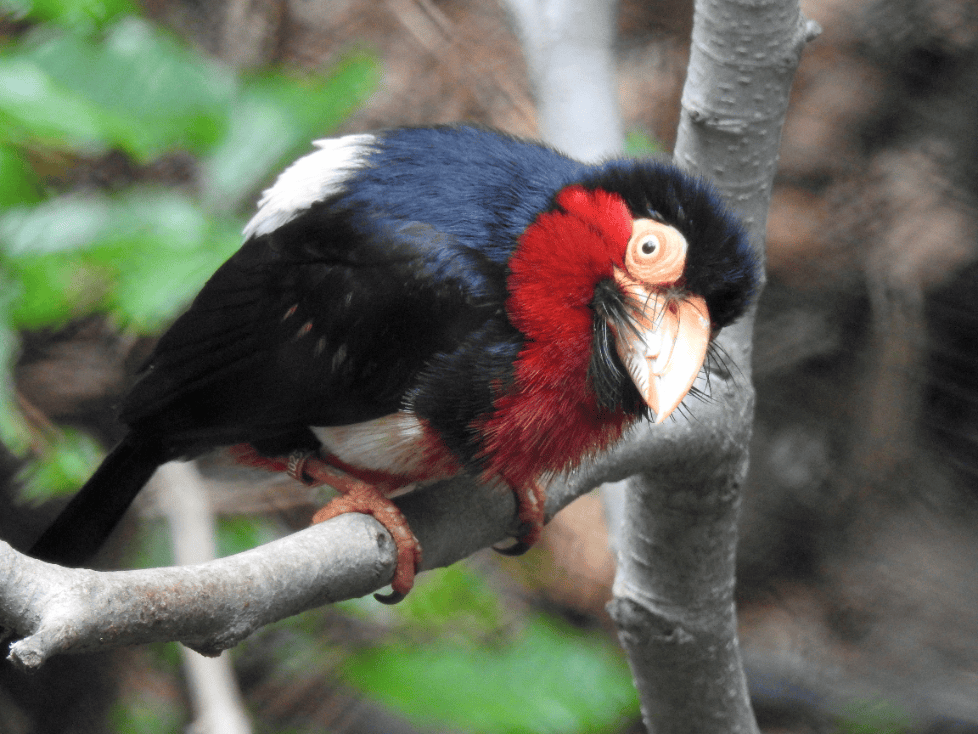
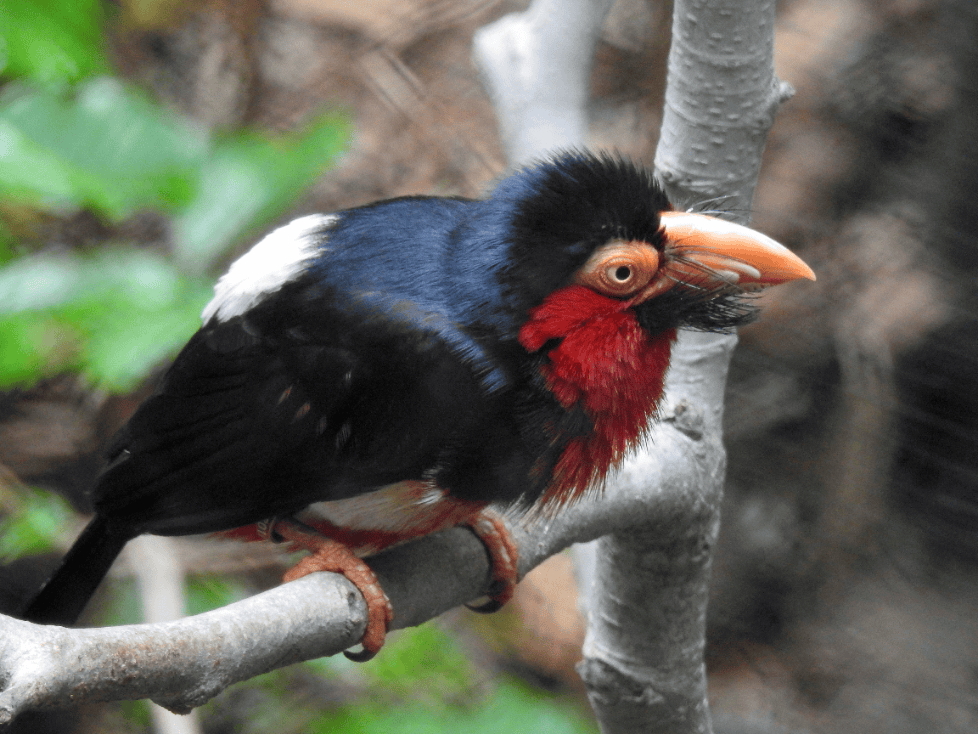
Figure 01. This Bearded Barbet well represents the Lybiidae family of African barbets, with its rictal bristles (specialized feathers) forming its “beard.” (It’s thought that “Lybiidae” is a misnomer suggesting that this family of birds originates in Libya; in fact, Libya is among the northern African nations where these barbets are not found.)
This is the fifth of several blogs about the Piciformes order of birds and its nine highly diverse families. The first blog introduced the order and three of its nine families: Galbulidae, jacamars; Bucconidae, puffbirds; and Indicatoridae, honeyguides, https://bird-brain.org/2026/08/30/piciformes-tree-hugging-birds-part-1/ . The second blog introduced the Ramphastidae family of toucans, https://bird-brain.org/2026/09/07/piciformes-tree-hugging-birds-part-2/ . The third blog introduced the four barbet families, then focused on the Capitonidae family of New World barbets and the Semnornithidae family, including two more New World species. The fourth blog introduced the Megalaimidae family of Asian barbets, https://bird-brain.org/2026/09/20/piciformes-tree-hugging-birds-part-4/ .
The current blog introduces the African barbets of the Lybiidae family, as follows:
- Taxonomy
- Appearance
- Sounds and Vocalizations
- Distribution and Habitat
- Food and Foraging
- Breeding
- Conservation Status
- Bearded Barbet, Pogonornis dubius
- Red-and-yellow Barbet, Trachyphonus erythrocephalus
- References
Forthcoming blogs will explore the ninth family of Piciformes: Picidae, woodpeckers and their allies.
Taxonomy
The taxonomic classification of the Lybiidae family is as follows: kingdom, Animalia; phylum, Chordata; class, Aves; order, Piciformes; suborder, Pici; infraorder, Ramphastides; family, Lybiidae, designated by ornithologists and molecular biologists Charles Gald Sibley and Jon Edward Ahlquist, in 1985. Their 1991 publication, Phylogeny and Classification of Birds, used DNA analysis to classify birds, using their Sibley–Ahlquist taxonomy.
Current taxonomy recognizes the Lybiidae family as comprising 10 genera, across 43 species:
- Buccanodon, 1
- Cryptolybia, 1
- Gymnobucco, 4
- Lybius, 7
- Pogonornis, 5
- Pogoniulus, 10
- Stactolaema, 3
- Trachylaemus, 2
- Trachyphonus, 4
- Tricholaema, 6
Appearance
More than 75% of African barbet species are about 7.9–9.8 inches (20–25 cm) long, and most have big thick bills. However, the 10 species of Pogoniulus tinkerbirds are much smaller, with smaller bills. For instance, the Yellow-throated Tinkerbird is about 3.7 inches (9.5 cm) long, weighing about ¼–½ ounce (0.25–0.46 ounces, 7.5–13 g). (Your house key probably weighs about ¼ ounce, as do 7 paper clips.)
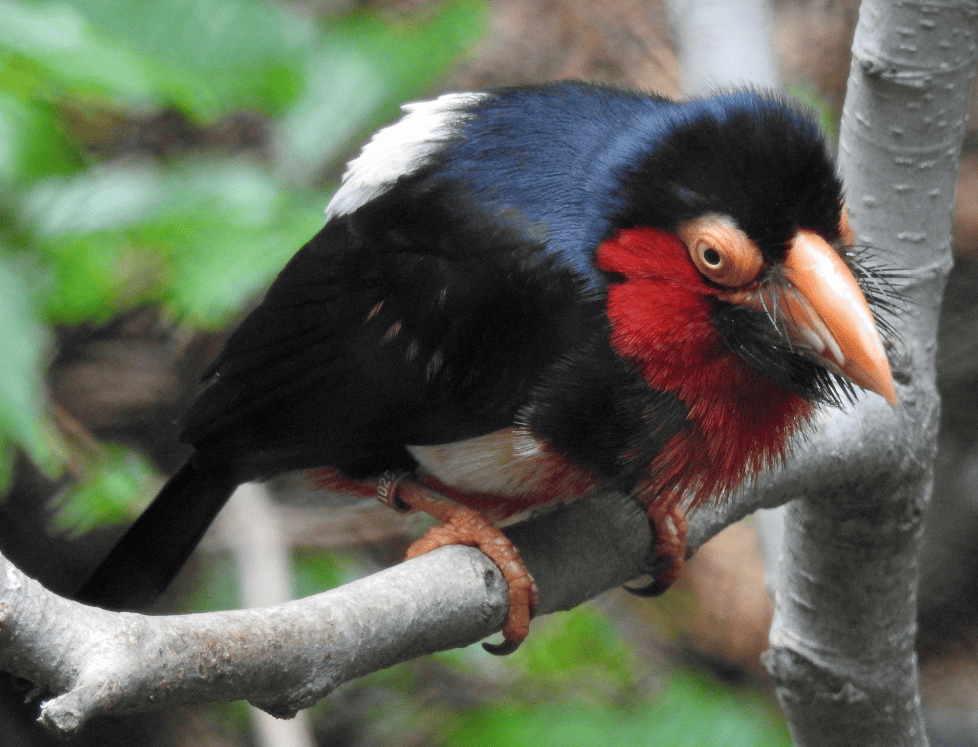
Figure 02. Like most African barbets, this Bearded Barbet is between 8 and 10 inches long — much bigger than most tinkerbirds, which are less than half as long and weigh between ¼ and ½ ounce — less than the weight of half a slice of bread or cheese.
Across species, these barbets have a similar plump ovoid body shape; a short, thick neck; short legs and feet with long zygodactyl toes (2 point forward, 2 point backward); and medium-length wings and squared tails. Three genera have mostly brownish plumage (4 species of Gymnobucco, 3 species of Stactolaema, and 1 species of Cryptolybia), but the other 35 species display a variety of boldly colorful patterned plumage. The variety of their plumage can be seen in the assortment of photos gathered in the Cornell Lab of Ornithology’s Macaulay Library: https://search.macaulaylibrary.org/catalog?taxonCode=lybiid1&includeChildTaxa=true , which hosts 40,532 photos, 3,034 audio recordings, and 483 videos. Only a few species are sexually dimorphic, with males’ plumage differing from females’. Most African barbets have rictal bristles, specialized feathers, surrounding their bills, though the length and number of the bristles vary widely.
Sounds and Vocalizations
I was unable to find generalizations about Lybiidae barbets, but many observers have recorded their vocalizations. For instance, the Cornell Lab’s Macaulay Library includes 3,034 audio recordings at https://search.macaulaylibrary.org/catalog?taxonCode=lybiid1&includeChildTaxa=true&mediaType=audio . In addition, the website https://xeno-canto.org/explore?query=lybiidae offers 1,625 recordings from 42 of the 43 species in the Lybiidae family. I did find some commentary about some species of Pogonornis barbets, citing buzzy trills; pairs singing synchronized duets; grating or clicking sounds; bill-snapping, tapping, and wiping; and loud wing rustles, flutters, and flicks; among others. These sounds have been heard as contact calls, during courtship, and for unknown reasons.
Distribution and Habitat
Species of African barbets can be found throughout most of sub-Saharan Africa (all but the far southwest of South Africa). The larger Lybiidae subfamily, Lybiinae (37 species in 8 genera), is entirely arboreal, found in forests, acacia scrublands, and other woodlands. Their behavior closely resembles that of most other barbet species.
Unlike most other species of barbets, the much smaller subfamily, Trachyphoninae (2 genera — Trachyphonus and Trachylaemus — with a total of 6 species), is more terrestrial, preferring open savannahs and similar habitats. These 5 species have longer legs and tails and feed on the ground, rather than in trees; they may also nest in earthen banks, rather than in tree cavities, preferred by the other 37 species.
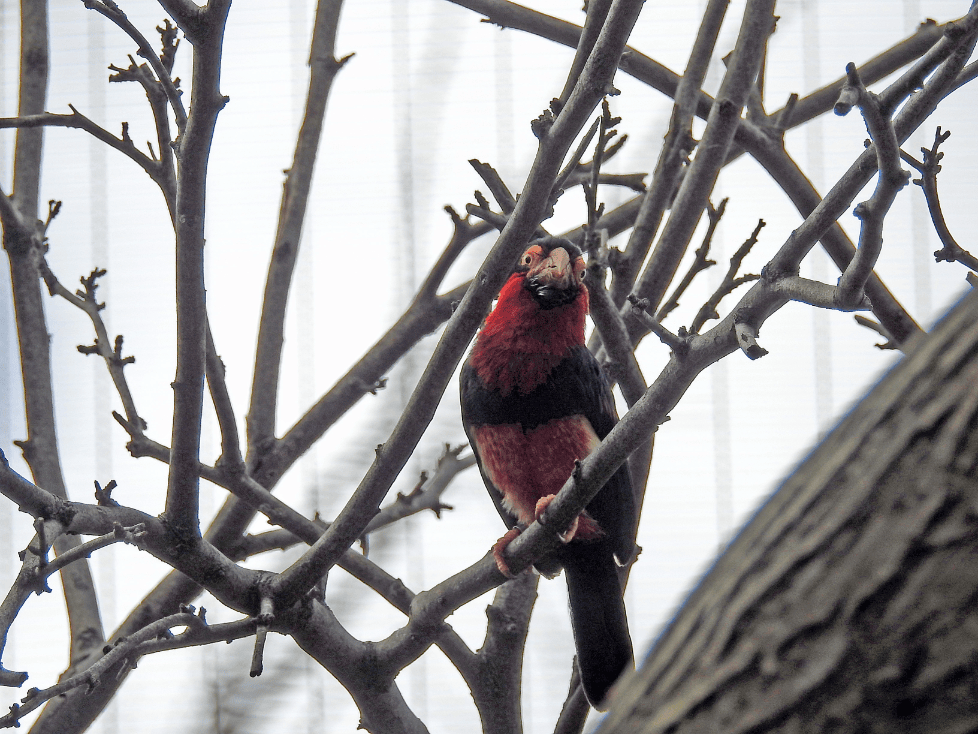
Figure 03. Most African barbets, such as this Bearded Barbet, are arboreal, spending almost all of their times in trees.
Food and Foraging
Whether arboreal or terrestrial, almost all African barbets feed mostly on various fruits (especially figs), when they’re plentiful. A single barbet may feed on up to 60 or more different species of fruiting plants within its range. They’re also quite willing to eat cultivated fruits and fruity vegetables (e.g., squash). They eat relatively small fruits whole, then regurgitate the seeds, dispersing them throughout the woods.
In addition, perhaps more than most other barbet species, African barbets also consume many invertebrates (especially insects), gleaning them from the ground or from trees. They may also catch flying insects by hawking them from the air. In addition to insects (ants, dragonflies, crickets, moths, etc.), they eat other invertebrates, such as scorpions and centipedes. Some species also catch and eat small vertebrates, such as lizards and frogs.
Breeding
Outside of breeding season, most African barbets spend most of their time alone, but they pair up during breeding season. Most species are monogamous, with both parents providing care for their offspring. In addition, all but 12 species are at least sometimes cooperative breeders, getting help from other barbets to raise their young. In addition, the 4 species of Gymnobucco barbets breed in colonies, sometimes even nesting with other barbet species in the same colony.
Like most Piciformes, lybiids nest in cavities. Most dig their own nest cavities in the dead wood of trees. However, the Trachyphonus species of ground barbets dig their nest cavities in earthen banks or in termite mounds. Typically, African barbets lay 2–4 white eggs, but they have been observed laying from 1 to 7 eggs. Both parents share in incubating the eggs for 12–18 days (usually 13–15) until they hatch. Because the parents rotate their guard duty, they protect their eggs both from predators and from brood parasites (e.g., honeyguides). These barbets also keep their nest cavities tidy, getting rid of fruit pits and skins, as well as the youngsters’ fecal sacs.
After the eggs hatch, both parents feed their hatchlings — mostly insects during the early growth spurts. Gradually, however, the parents introduce increasing amounts of fruit during the 20–35 days the nestlings remain in the nest until they fledge. Though this behavior hasn’t been thoroughly researched, it’s believed that the fledglings leave their parents’ territory about 2 months after they fledge.
Conservation Status
As tree-dwelling birds, these barbets are threatened by deforestation. Nonetheless, despite the habitat threats to these barbets, most species have an IUCN Red List conservation status of LC, Least Concern. However, 1 species is NT, Near Threatened, and another is VU, Vulnerable, as both have very small ranges in which they dwell. A third species, the White-chested Tinkerbird, Pogoniulus makawai, hasn’t been assessed by the IUCN, as only one specimen has been identified.
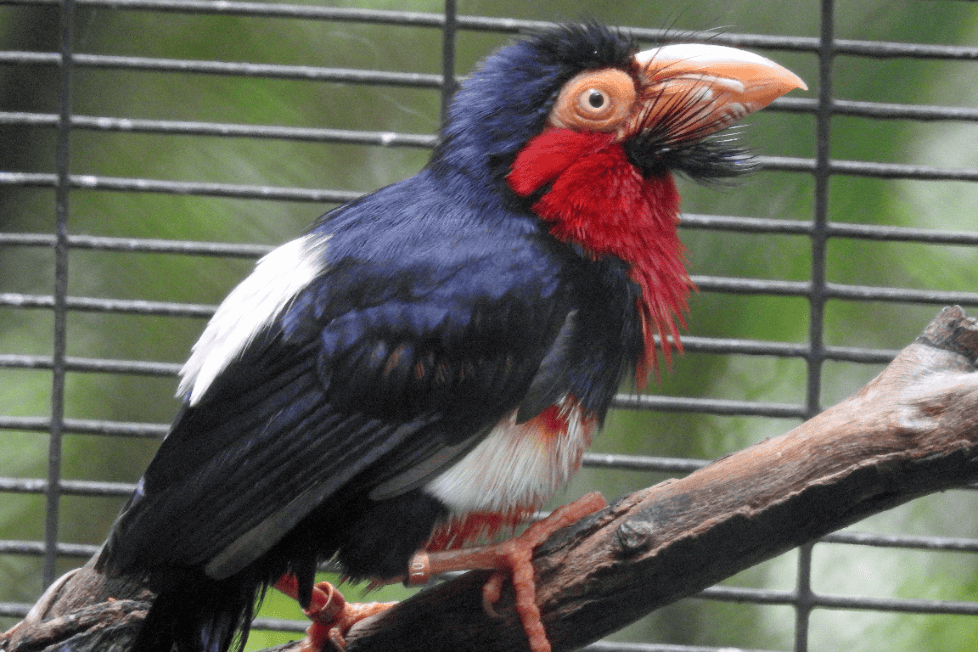
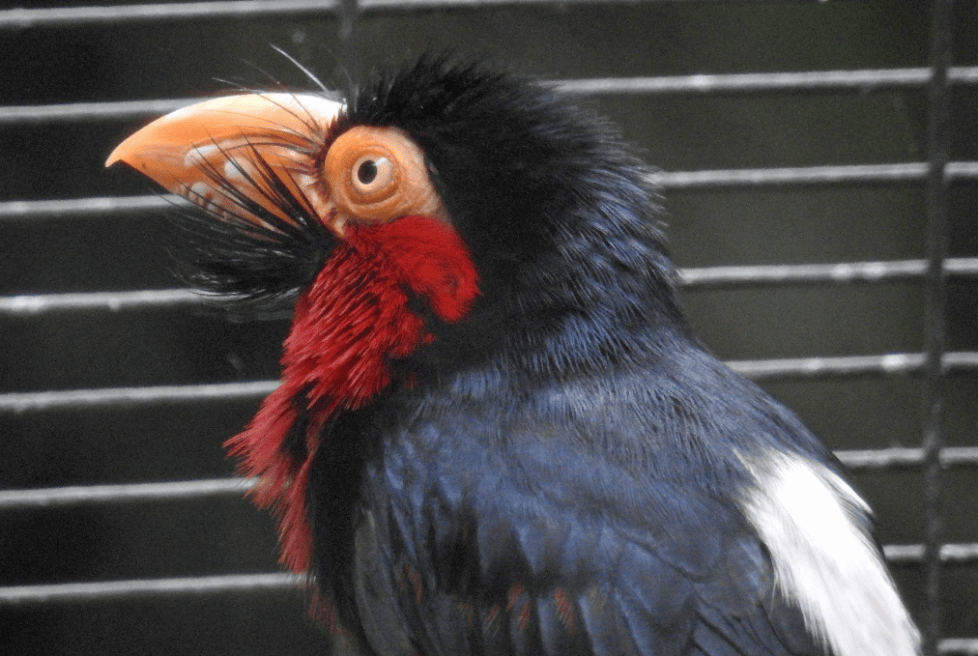
Figure 04. This Bearded Barbet is among the majority of African barbets who enjoys an IUCN Red List conservation status of LC, Least Concern.
Bearded Barbet, Pogonornis dubius
Taxonomy
In 1788, naturalist Johann Friedrich Gmelin revised, expanded, and published the 13th edition of taxonomist Carl Linnaeus’s (1735) Systema Naturae. In it, Gmelin tentatively placed the Bearded Barbet in the genus Bucco, along with puffbirds, choosing the second part of its binomial name as dubius, revealing his doubts about the accuracy of that genus. He had based this barbet’s description on a 1780 description and illustration by naturalist and mathematician Georges-Louis Leclerc, Comte de Buffon, using a specimen from the Barbary Coast.
Years later, this barbet was grouped with other African barbets in the genus Lybius, but subsequent analysis suggested that it fit better in the Pogonornis genus, with four other African barbet species. The Pogonornis genus seems to be a better fit, as the name comes from Greek, pogon, meaning “beard,” and ornis, meaning “bird.” Like its common name, Bearded Barbet, it points to this barbet’s abundance of black rictal feathers, especially beneath its bill. (In truth, the “beards” of other species in this genus aren’t much to write home about.) The Spanish name for this species, Barbudo Pechirrojo, highlights the bright red chest of this barbet. It’s monotypic, having no recognized subspecies.
Appearance
Like other African barbets, the Bearded Barbet is short-necked and plump. It’s relatively large (10 inches, 25.5 cm long). Its tail is just 2.9–3.5 inches (7.3–8.9 cm) long, compared with its wing length of 4.2–4.6 inches (10.6–11.7 cm). Shorter still is its tarsus length (ankles to toes) of 0.9–1.2 inches (2.2–3 cm). In general, all barbet species in the Pogonornis genus are relatively large, weighing 1.6–3.8 ounces (45–108 g); the Bearded Barbet is one of the two largest in this genus, weighing 2.8–3.8 ounces (80–108 g).
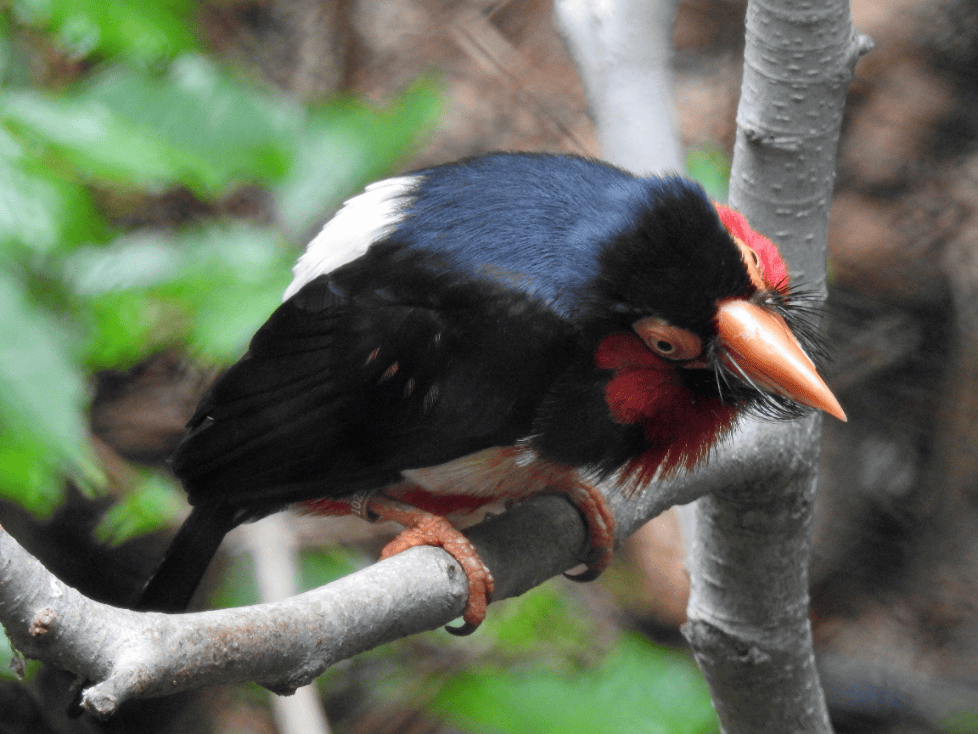
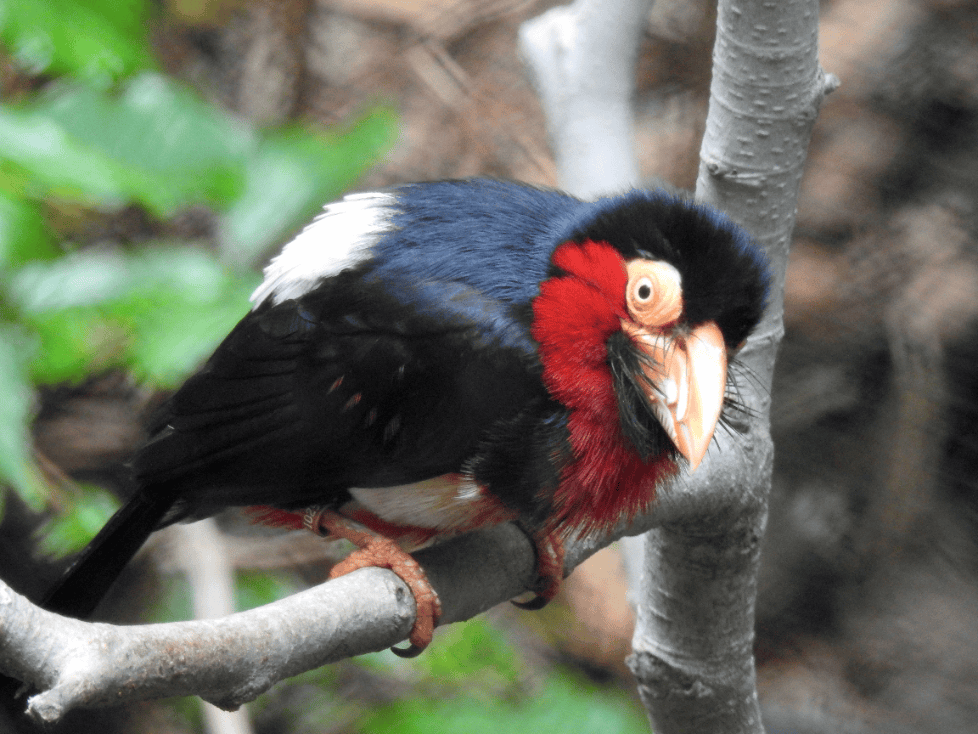
Figure 05. These views of this Bearded Barbet, photographed at the San Diego Zoo, reveal its plumage, including the black rictal bristles of its “beard,” and its distinctive bill, with vertical and horizontal grooves and pointed tip.
Its eye-catching plumage includes a black crown, nape, breast, wings, and horizontal breast band; black and white flanks; red cheeks, chin, throat, and upper breast; below the black breast band is a mottled red and white belly. A big white patch adorns the middle of its black back. Males and females look similar, except that females have black spots on the white patches on their flanks. The plumage of immature Bearded Barbets is similar to adults’, but the red plumage looks more orange-ish.
Both males and females have light yellowish-tan legs, toes, and bill, as well as bare skin surrounding their pale-yellow irises. The big thick bill is 1.2–1.4 inches (3–3.5 cm) long, 0.7 inches (1.8 cm) deep (top to bottom), and 0.5 inches (1.3 cm) wide (side to side). The bill is distinctive, with a series of small vertical grooves on the mandible (lower bill) and a deep groove on the maxilla (upper bill) curving downward along much of the bill, leading to a toothlike projection. Immature birds’ bills lack the clear grooves and “teeth” of the adults’ bill.
Bill length is measured as the culmen length of the maxilla, using calipers, from the bill’s base to its tip, avoiding distortion due to curvature of the bill. For a photo of culmen length, see
Last and definitely most distinctive is the Bearded Barbet’s “beard” of dense long rictal bristles projecting from beneath its bill, over its chin and throat.
Sounds and Vocalizations
The Bearded Barbet hasn’t been recorded vocalizing often — just 7 audio recordings at https://xeno-canto.org/species/Lybius-dubius and 5 at the Cornell Lab of Ornithology’s Macaulay Library, https://search.macaulaylibrary.org/catalog?taxonCode=beabar1&mediaType=audio . To me, these recordings sounded like low-pitched growls or squawks. An observer also reported a vocalized whirring sound.
Distribution, Habitat, and Migration
Bearded Barbets are mostly found in the semi-arid belt of West Africa, especially the western Sahel, from Senegal and Gambia, through numerous west African nations (Guinea-Bissau, Chad, Guinea, Mali, Ivory Coast [Côte d’Ivoire], Burkina Faso, Ghana, Togo, Benin, Niger, Nigeria, Cameroon) to northwestern Central African Republic. Its latitudinal range is a tropical band from +5.38 to + 15.5 degrees north of the equator, with its longitudinal center at +1.18 degrees east (Togo). A range map can be be seen at https://ebird.org/map/beabar1 . It’s found at altitudes between sea level and 5,000 feet (1500 m).
Like most other barbets, it’s arboreal, but it adapts to savannas (moist or dry), as well as secondary-growth forests, woodlands (acacia, baobabs, pines, oaks, etc.), thickets (e.g., thorn forests), scrublands, shrublands, orchards, abandoned farms, and even gardens; fig and other fruiting trees are particular favorites. It doesn’t migrate, residing within a range of about 900,780–1,177,600 square miles (2,333,237–3,050,000 km²).
Food and Foraging
Like most other barbets, the Bearded Barbet’s diet is mostly fruits, but when caring for hatchlings, the parents feed them entirely or mostly insects, to facilitate the rapid development of their youngsters. According to Avibase, their diet averages 80% fruits, 20% invertebrates. This barbet’s ginormous sharp-edged bill can readily snip or clip fruits.
Figure 06. Bearded Barbets prefer to hang out in pairs or with a few other barbets, rather than being alone; these two were videorecorded at the San Diego Zoo.
Social Behavior and Breeding
Like other barbets, Bearded Barbets are diurnal, awake and active during daylight. They typically hang out in pairs or groups up to 5 barbet pals; they also roost together in a tree cavity. Their courtship and breeding behavior is relatively unknown, other than an observation of tail-flicking as a courtship display. They excavate their own nest cavities in the dead wood of trees, then the female lays two white eggs in the nest. The eggs are incubated for at least 16 days then hatch on consecutive days. The nestling period is about 40 days until the youngsters fledge. It’s thought that the age at which these barbets first breed is about 1.7 years after hatching. Generation length is about 3.9–4.3 years.
Life Span, Survival
The annual survival rate of adult Bearded Barbets is about 72%. The maximum documented age of this species is 13.1 years.
Conservation Status
The IUCN Red List conservation status of Bearded Barbets is LC, Least Concern. It’s commonly observed in several of the nations in its large range, as well as being locally common in other locations. Nonetheless, deforestation and desertification threaten this species and other arboreal birds. In addition, this species is often a target of the wild-animal trade. Fortunately, there are numerous protected areas in seven of the nations where this species resides. Research is needed to better understand the ecology and biology of this species. The exact population isn’t known, nor is its population trend, but it’s not believed to be decreasing at a rapid rate. In addition, it is found in about 33 managed-care institutions, across 13 countries, including 37 males, 32 females, and 19 unsexed birds, for a total of 88 birds.
Figure 07. This Bearded Barbet, at the San Diego Zoo, is among fewer than 100 of this species to be living in managed care, worldwide.
Observations
The Cornell Lab of Ornithology gathers information from observers around the world through the eBird app and website (https://ebird.org/species/beabar1 ), which has 5,563 observations, including 657 with photos and 4 with audio recordings. Also, the lab’s Macaulay Library website (https://search.macaulaylibrary.org/catalog?taxonCode=beabar1 ) holds 1,323 photos, 5 audio recordings, and 25 videos of the Bearded Barbet. In addition, iNaturalist gathers observations with its app and its website (https://www.inaturalist.org/observations?taxon_id=1506318 ), which has 488 observations, each of which includes a photograph, audio recording, or video.
Red-and-yellow Barbet, Trachyphonus erythrocephalus
Etymology
The Red-and-yellow Barbet’s scientific name, Trachyphonus erythrocephalus, has Greek origins. Though it couldn’t be described as noisy or chatty, its vocalizations have been heard more often than those of the Bearded Barbet. Its genus name, Trachyphonus, highlights its voice: trakhus is Greek for “rough” and -phōnē is Greek for “sound,” usually referring to the sound produced by humans or other animals; perhaps the other three species in this genus are more talkative. Its species name, erythrocephalus, combines Greek, erythro-, meaning “red,” and Latin, -cephalus, “head”; together, they highlight the bright red feathers on the sides of its head. Its common name aptly describes its plumage (though they might have added “and black and white”).
Figure 08. Even this poor-quality video reveals the red and yellow plumage of this Red-and-yellow Barbet at the San Diego Zoo.
Taxonomy
In 1878, ornithologist Jean Louis Cabanis reported on the Red-and-yellow Barbet, Trachyphonus erythrocephalus (found in Ukamba, Kitui, Kenya), in the German Journal für Ornithologie, which he had founded in 1853. This species of barbet includes three recognized subspecies.
Appearance
The Red-and-yellow Barbet is about 7.9–9 inches (20–23 cm) long and can weigh about 1.4–2.6 ounces (40–75 g). This barbet’s tail is about 3–3.8 inches (7.5 – 9.6 cm) long, with wings about 3.6–4 inches (9.1–10.3 cm) long. Its legs and tarsi are short (0.9–1.2 inches, 2.4–3 cm, tarsus length, ankle to toes) and bluish-gray, the same color as its zygodactyl toes. Note that its tarsus length is slightly shorter than its bill length (culmen) of 0.9–1.5 inches (2.3–3.7 cm); its bright orangish-red bill is also 0.4 inches (0.9–1.0 cm) deep (top to bottom) and 0.2–0.3 inches (0.6–0.85 cm) wide (side to side).
The Red-and-yellow Barbet has dark eyes, described as being reddish or yellowish brown, but most photos don’t reveal this coloration. The bare skin surrounding each eye is dark, too. Its distinctive plumage: The top of its back, wings, and tail are covered with dots of white/pale-yellow on black plumes. Its undertail has horizontal bars alternating black and white, with a red patch at the top of the tail, both beneath it and on top. Its rump is pale to medium yellow, as is its belly; on the belly, a narrow horizontal band of dark feathers separates the belly from the top of its breast and throat. Above the dark band of feathers is a yellow band, beneath its orange chin/throat.
On male Red-and-yellow Barbets, the chin immediately beneath the bill has a vertical stripe of dark feathers, which females lack. Both sexes have extensive red cheeks and a white half-moon near the hidden ear opening. The male’s crown is yellow, with a dark wide stripe down the middle, from the bill toward the back of the head. The female’s crown is reddish-orangeish, with tiny speckles of dark feathers. Both sexes have yellow accents near the sides of the bill and around the eyes, and both have yellow/orange napes with tiny dark speckles like those on the female’s crown. Both males and females may raise their crown feathers to create a modest crest effect. Some observers suggest that the female’s (and the juvenile’s) plumage is less vividly colorful than the male’s. In addition, there are slight geographical variations and subspecies differences in appearance.
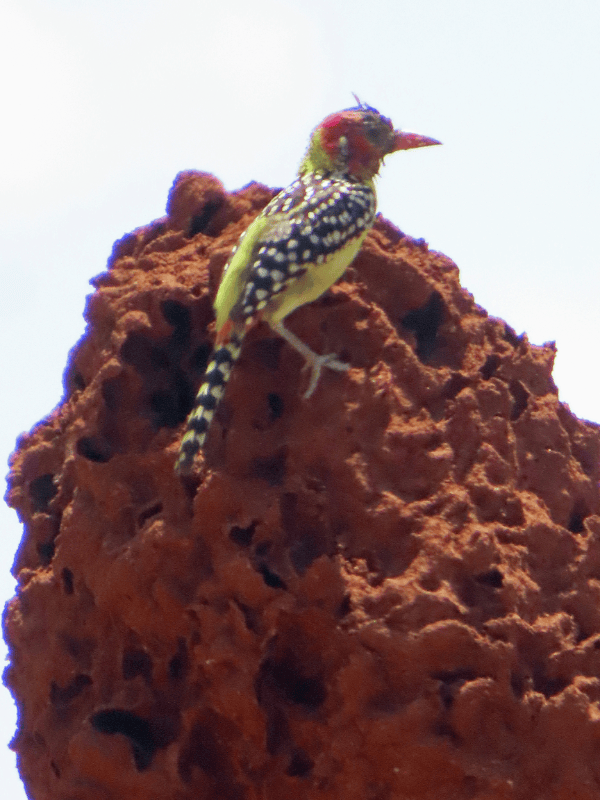
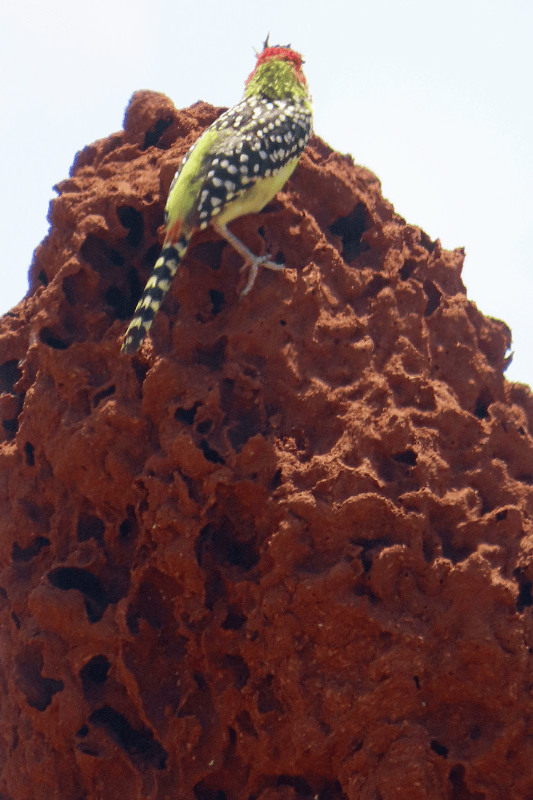
Figure 09. This very morning, my dear pal Kat Stesney sent me photos of Red-and-yellow Barbets, which she saw earlier today at Tarangire National Park in Tanzania, east Africa. With her permission, I am using the photos she sent me, which she took September 27, 2026 (10 hours ahead of Pacific Time). This colorful barbet was one of three seen atop a termite mound.
Sounds and Vocalizations
Red-and-yellow Barbets have been observed greeting one another as a chorus, but within a group, only the primary pair sings (whistles?) a synchronized duet. Other vocalizations include rattles, “kik-kik” alarm calls, “chuk” calls of parents approaching their nestlings, or begging calls from the nestlings. For a video recording of a pair vocalizing, please visit https://macaulaylibrary.org/asset/201615761 . Additional audio recordings may be found at https://search.macaulaylibrary.org/catalog?taxonCode=raybar1&mediaType=audio , which has 44 audio recordings, and at https://xeno-canto.org/species/Trachyphonus-erythrocephalus , where you may find 36 audio recordings.
Distribution, Habitat, and Migration
Red-and-yellow Barbets are natives of tropical eastern Africa and may be found in Ethiopia, Kenya, Somalia, South Sudan, Sudan, Tanzania, and Uganda, from −7.8 to + 13.6 degrees latitude. The three subspecies tend to be located in separate regions, with little overlap. For a view of their distribution, please visit https://ebird.org/map/raybar1 . Their entire distribution is estimated to be 607,720–1,057,900 square miles (1,574,108–2,740,000 km²). They don’t migrate, though they may sometimes wander in pursuit of optimal environmental conditions.
Red-and-yellow Barbets may be found in gallery forests and other woodlands (e.g., acacias, tropical deciduous, pines, palms, thorn trees), shrublands, savannas and grasslands, desert edges near streams, and rocky areas, including cliffs and mountain peaks up to 6,000 feet (1,820 m) — occasionally up to 7,600 feet (2,320 m) or down to sea level. These barbets avoid both dense woodlands and wide-open areas, preferring instead uneven terrain that’s broken up by riverbeds, outcrops, or cliffs; termite mounds also attract these barbets.
Food and Foraging
Red-and-yellow Barbets are more omnivorous than most other barbets. According to Avibase, only 40% of their diet is fruits; invertebrates (e.g., spiders, insect larvae and adults) make up another 20%, and an additional 20% is seeds. They scavenge about 20% of the food they eat, and they may consume traces of land vertebrates (e.g., lizards, nestlings, bird eggs) and other “miscellaneous” foods (e.g., household discards such as cereal, bread, eggs, or cooked meat).
During the day, Red-and-yellow Barbets forage in small loose groups, looking for insects or other food sources on or near the ground, beneath bushes or trees, on the walls and roofs of buildings, and various other locations.
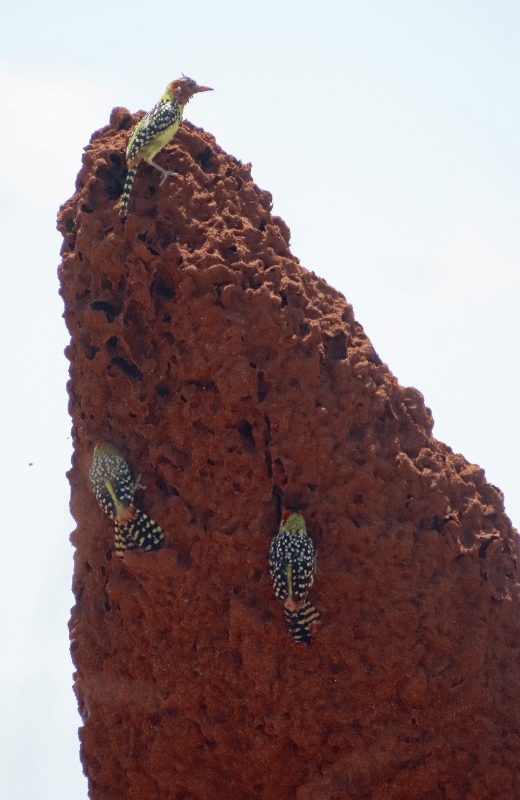
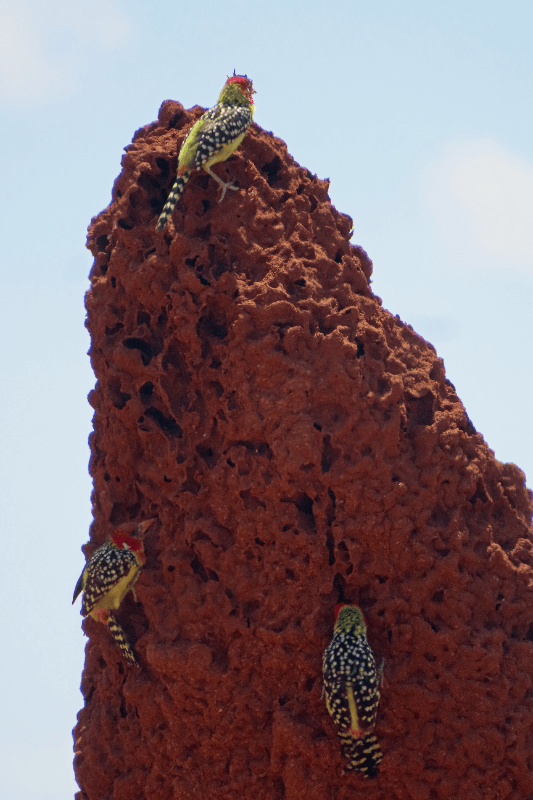
Figure 10. My dear pal Kat Stesney sent me these photos of Red-and-yellow Barbets, taken earlier today (September 27, 2026, 10 hours ahead of Pacific Time) at Tarangire National Park in Tanzania, east Africa. With her permission, I am using the photos she sent me. These ground-dwelling barbets prefer to roost and nest at termite mounds, rather than trees.
Breeding
Red-and-yellow Barbets are usually observed in pairs or in small groups. They nest and roost in tunnels or burrows. Typically, they are cooperative breeders, with a primary monogamous pair being aided in rearing their offspring. It’s not known whether the helpers (up to 8 other barbets) also help in excavating the nest cavity either in a termite mound or in an earthen bank, but a new nest cavity is dug each year. The cavity usually extends 15.7 inches (40 cm) or more deep, about 4.3 inches (11 cm) wide.
The primary pair of Red-and-yellow Barbets court one another with displays and perhaps allopreening (mutual grooming). The male may courtship-feed his mate, and when the primary pair vocalizes in duets, the other members of the group join in, but without outshining the primary pair. The female lays 2–6 eggs, with 3–5 being most common. The male does most of the incubating, with help from the female and from other helpers in the group. Likewise, the male of the primary pair does most of the feeding of the hatchlings, but all group members join in feeding invertebrates to the chicks, carefully removing legs and wings from all but the smallest insects. With all these helpers, chicks are fed 2.5–12 times/hour.
The timing of incubation and of the nestling period for Red-and-yellow Barbets aren’t now known. Even after they fledge, the youngsters continue to beg for food from other group members, as they move and forage with the rest. One observer noted that a pair attempted to breed at least five times throughout the year, succeeding with at least four broods, in a single nest cavity. Age at first breeding is about 1.3 years; generation length is about 2.6–3.4 years.
Life Span, Survival, and Conservation Status
The maximum documented age for a Red-and-yellow Barbet is 10.1 years. The annual adult survival rate is estimated at 68%. Though its population is not known, the IUCN Red List conservation status for this barbet is LC, Least Concern, given the fact that it’s generally common throughout its large range. It also appears to be dominant over other barbets and over woodpeckers in its range.
Humans do threaten this species, however, such as through the pet trade (as a cage bird) and through the use of its feathers as adornments by some people in its range (e.g., the Maasai). On the other hand, people are trying to protect these birds in at least four reserves or national parks in two countries in its range (Kenya and Tanzania). At least 31 holding institutions, located in 11 countries, are holding captive birds: 45 males, 37 females, 6 unsexed, for a total of 88.
Figure 11. The San Diego Zoo is among a select group of managed-care facilities hosting Red-and-yellow Barbets. The zoo offers this barbet a variety of foods to suit its omnivorous diet..
Observations
The Cornell Lab of Ornithology gathers information from observers around the world through the eBird app and website (https://ebird.org/species/raybar1 ), which has 9,506 observations, including 1,262 with photos and 42 with audio recordings. Also, the lab’s Macaulay Library website (https://search.macaulaylibrary.org/catalog?taxonCode=raybar1 ) holds 2,133 photos, 44 audio recordings, and 33 videos of the Red-and-yellow Barbet. In addition, iNaturalist gathers observations with its app and its website (https://www.inaturalist.org/observations?taxon_id=117131 ), which has 630 observations, each of which includes a photograph, audio recording, or video.
References
Lybiidae, African Barbets
- Elphick, Jonathan. (2014). The World of Birds. Buffalo, NY: Firefly Books.
- Lovette, Irby, & John Fitzpatrick (Eds.). (2016). The Cornell Lab of Ornithology Handbook of Bird Biology (3rd ed.). Hoboken, NJ: Wiley.
- Winkler, David W., Shawn M. Billerman, & Irby J. Lovette. (2015). Bird Families of the World: An Invitation to the Spectacular Diversity of Birds. Barcelona, Spain: Lynx, Cornell Lab of Ornithology.
- Winkler, D. W., S. M. Billerman, and I. J. Lovette (2020). African Barbets (Lybiidae), version 1.0. In Birds of the World (S. M. Billerman, B. K. Keeney, P. G. Rodewald, and T. S. Schulenberg, Editors). Ithaca, NY: Cornell Lab of Ornithology. https://doi.org/10.2173/bow.lybiid1.01 ; https://birdsoftheworld.org/bow/species/lybiid1/1.0/introduction
- Lybiidae, African Barbets, https://en.wikipedia.org/wiki/Lybiidae
- Tinkerbirds, Pogoniulus genus, https://birdsoftheworld.org/bow/species/lybiid1/cur/species#genusPogoniulus and https://en.wikipedia.org/wiki/Tinkerbird
Bearded Barbet (Pogonornis dubius)
- Short, L. L., and J. F. M. Horne (2023). Bearded Barbet (Pogonornis dubius), version 1.1. In Birds of the World (J. del Hoyo, A. Elliott, J. Sargatal, D. A. Christie, and E. de Juana, Editors). Ithaca, NY: Cornell Lab of Ornithology. https://doi.org/10.2173/bow.beabar1.01.1
- https://en.wikipedia.org/wiki/Bearded_barbet
- Bearded Barbet, Avibase, https://avibase.bsc-eoc.org/species.jsp?avibaseid=B3031527
- Bearded Barbet, Avibase Life History, https://avibase.bsc-eoc.org/species.jsp?lang=EN&avibaseid=B3031527B52F09AE&sec=lifehistory
- Bearded Barbet, IUCN, https://www.iucnredlist.org/species/22681865/263613287
- Bearded Barbet, iNaturalist, https://www.inaturalist.org/observations?taxon_id=1506318
- Bearded Barbet, Pogonornis dubius, https://en.wikipedia.org/wiki/Johann_Friedrich_Gmelin ; https://en.wikipedia.org/wiki/Georges-Louis_Leclerc,_Comte_de_Buffon ; https://en.wikipedia.org/wiki/Carl_Linnaeus
- Bucco dubius, Original text (Latin) from 13th edition of Systema Naturae, https://www.biodiversitylibrary.org/item/10285#page/421/mode/1up
Red-and-yellow Barbet (Trachyphonus erythrocephalus)
- Short, L. L., and J. F. M. Horne (2020). Red-and-yellow Barbet (Trachyphonus erythrocephalus), version 1.0. In Birds of the World (J. del Hoyo, A. Elliott, J. Sargatal, D. A. Christie, and E. de Juana, Editors). Ithaca, NY: Cornell Lab of Ornithology. https://doi.org/10.2173/bow.raybar1.01 ; https://birdsoftheworld.org/bow/species/raybar1/cur/introduction
- https://en.wikipedia.org/wiki/Red-and-yellow_barbet
- Red-and-yellow Barbet, Avibase, https://avibase.bsc-eoc.org/species.jsp?avibaseid=570C1121
- Red-and-yellow Barbet, Avibase Life History, https://avibase.bsc-eoc.org/species.jsp?lang=EN&avibaseid=570C1121D77C41EA&sec=lifehistory
- Red-and-yellow Barbet, IUCN, https://www.iucnredlist.org/species/22681889/263599187
- Red-and-yellow Barbet, Trachyphonus erythrocephalus, Jean Cabanis, https://en.wikipedia.org/wiki/Jean_Cabanis .
- Red-and-yellow Barbet, Trachyphonus erythrocephalus: Bolle, Carl, Herman Schalow, & Jean Louis Cabanis. (1878). Bericht über die (XXI.) März-Sitzung. Journal für Ornithologie, 26, 204–207. https://doi.org/10.1007/bf02004189 . Website link: https://www.biodiversitylibrary.org/item/102855#page/218/mode/1up (in German).
Etymology
- Gotch, A. F. [Arthur Frederick]. Birds—Their Latin Names Explained (348 pp.). Poole, Dorset, U.K.: Blandford Press.
- Gruson, Edward S. (1972). Words for Birds: A Lexicon of North American Birds with Biographical Notes (305 pp., including Bibliography, 279–282; Index of Common Names, 283–291; Index of Generic Names, 292–295; Index of Scientific Species Names, 296–303; Index of People for Whom Birds Are Named, 304–305). New York: Quadrangle Books.
- Lederer, Roger, and Carol Burr. (2014). Latin for Bird Lovers: Over 3,000 Bird Names Explored and Explained (224 pages). Portland, OR: Timber Press.
Text by Shari Dorantes Hatch. Copyright © 2026. All rights reserved.
Images 09 and 10 were taken by Kat Stesney, February 27, 2026
Figures 01–08 and 11 were recorded at the San Diego Zoo, 2018–2022, by Shari Dorantes Hatch.
Copyright © 2026. All rights reserved.


Leave a comment