
Piciformes, 3 of 9 Families
of Tree-hugging Birds
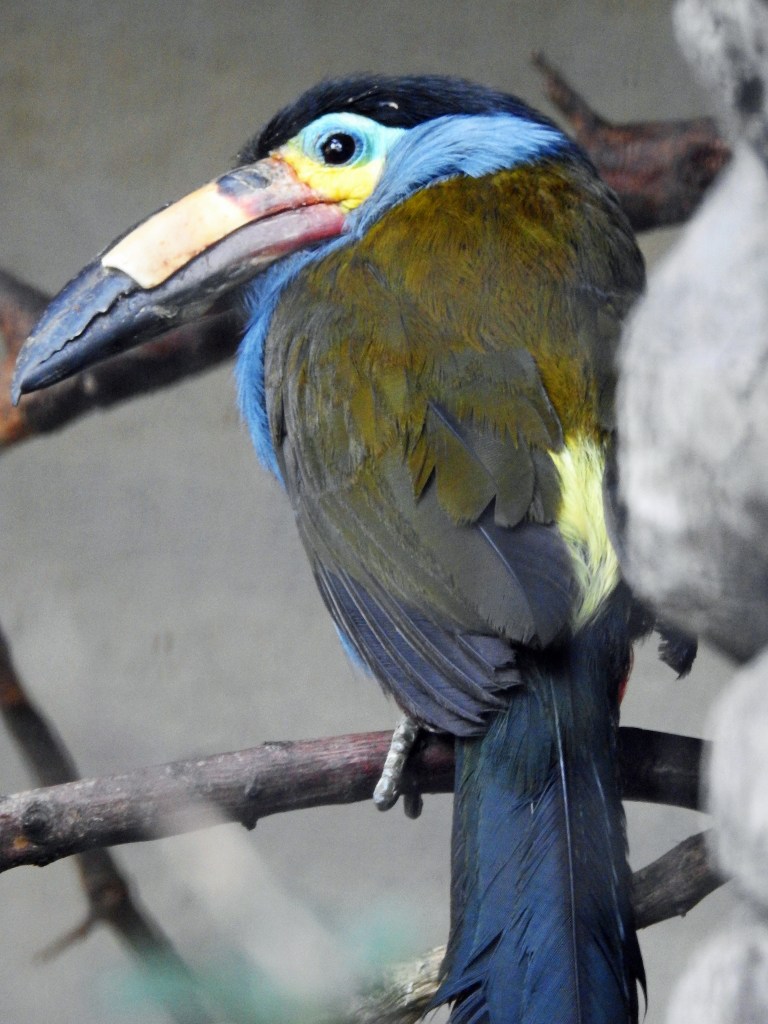
Figure 01. Like most Piciformes, toucans (such as this Plate-billed Mountain-Toucan) are monogamous devoted parents. Not all Piciformes are such responsible parents, however.
This is the first of several blogs about the Piciformes order of birds and its nine diverse families. For instance, among its members are honeyguides (brood parasites), toucans (devoted monogamous parents), and woodpeckers (e.g., cooperative-breeding Acorn Woodpeckers). This blog introduces the Piciformes order, as follows:
- Etymology
- Taxonomy
- Appearance and Morphology
- Distribution and Habitat
- Food and Foraging
- Breeding
- Piciformes Families, Part 1
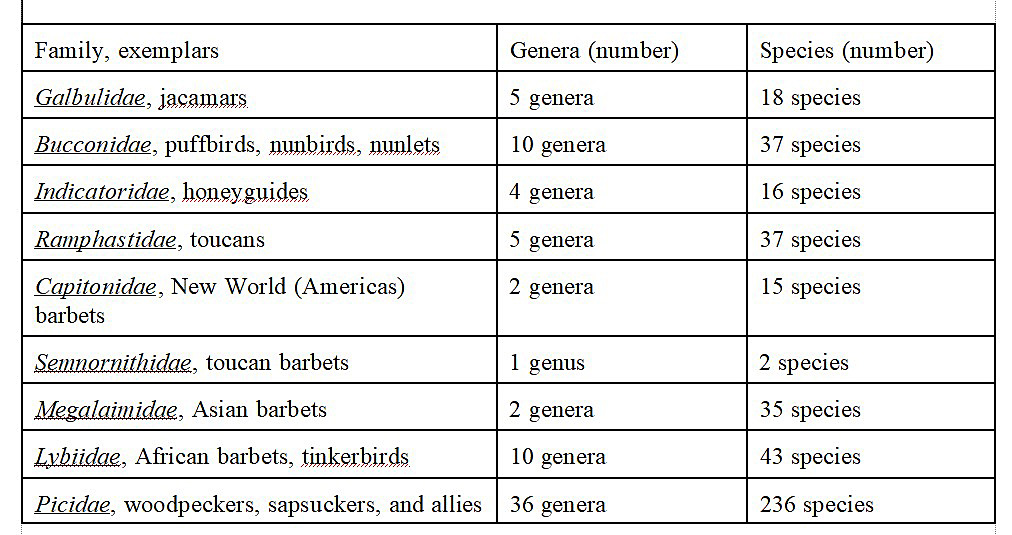
Figure 02. Piciformes Families
After introducing the order, this Piciformes blog then briefly introduces three of the nine families in the order:
Future blogs will probe the other six Piciformes families: Ramphastidae, Capitonidae, Semnornithidae, Megalaimidae, Lybiidae, and Picidae.
Etymology
In Roman mythology, Picus, son of the god Saturn, relied on woodpeckers to divine the future. Picus was devotedly married to the nymph Canens, so when the witch Circe tried to seduce him, he harshly rejected her overtures. This scorned woman then turned him into a woodpecker. The suffix “-iformes” is used to indicate the name as being a taxonomic order.
Taxonomy
In 1810, Bernhard Meyer (physician and naturalist) and Johann Wolf (naturalist and ornithologist) recognized the taxonomic order Piciformes within the class Aves, phylum Chordata, kingdom Animalia. The Piciformes order now includes nine families (see Figure 02). These classifications may change, as more is learned about individual species and their interrelationships. Piciformes is deemed a sister to the Coraciiformes order (motmots, bee-eaters, et al.), as well as to Bucerotiformes (hornbills). Evidence shows that the modern Piciformes families have existed since about the mid-late Oligocene (30–23 million years ago) to the early Miocene (23–5 million years ago).
In some classifications, the Galbulidae and Bucconidae families are separated into a “Galbuliformes” order, but genetic analysis suggests that though these two families are closely related, they still belong within the Piciformes order. Similarly, all barbets and toucans were once encompassed by the Capitonidae family; now, however, toucans have been split off to Ramphastidae, and two additional barbet families have been identified — Lybiidae, African barbets, and Megalaimidae, Asian barbets. Indicatoridae, honeyguides, and Picidae, woodpeckers, are each other’s closest relatives within Piciformes.
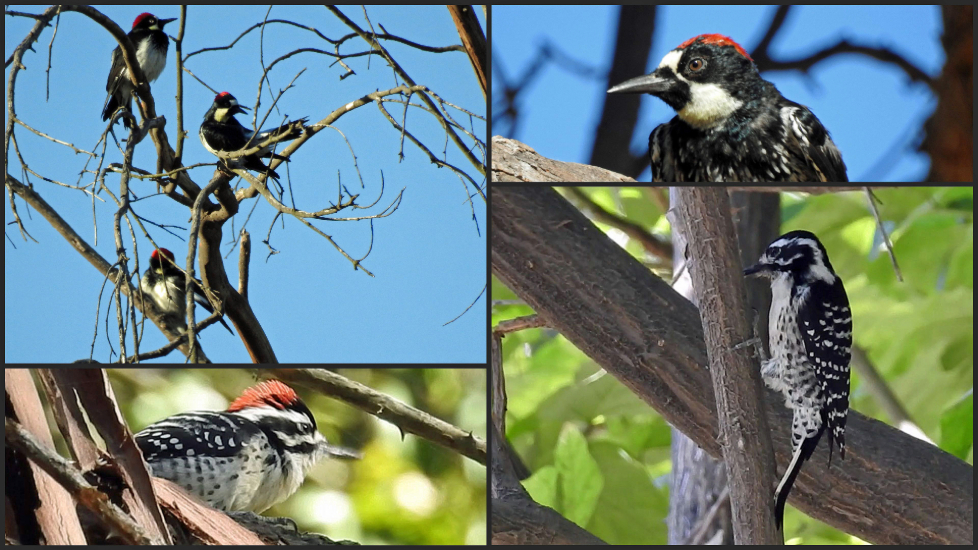
Figure 03. A couple members of the Picidae family: Acorn Woodpeckers (top), Nuttall’s Woodpeckers (bottom left, m; bottom right, f).
Appearance and Morphology
Probably the most distinguishing feature of Piciformes is their zygodactyl toes, with two pointing forward and two pointing backward. The only minor exception is that woodpeckers slightly modify this arrangement; like other Piciformes, the second and third toes point forward and the first and fourth toes point backward, except that they sometimes rotate the fourth toe forward and outward, making it easier for them to resist gravity when pecking wood.
Less visible to observers, Piciformes also have a distinctive muscle structure of their feet and legs. These features offer advantages for birds who spend much of their time moving around on trees.
Almost all Piciformes have no down feathers, even just after hatching. The one exception is the jacamar family, Galbulidae, whose chicks have down feathers as hatchlings.
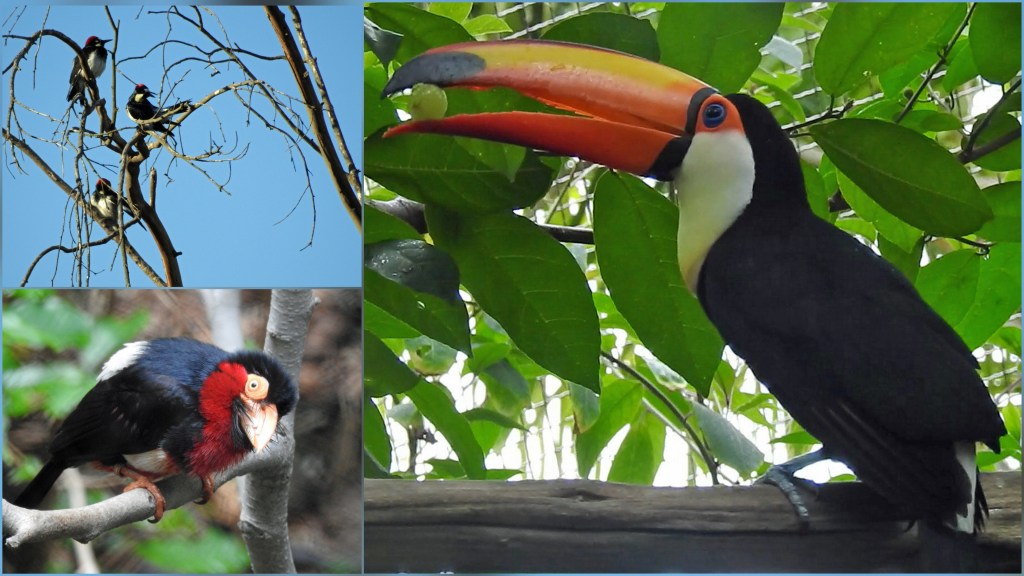
Piciformes have a fairly wide size range, from the Rufous Piculet at 3″ (8 cm) long, weighing 0.25 ounces (7 g), to the Toco Toucan, at 24.8″ (63 cm), 24 ounces (1.5 pounds, 680 g). (That is, the toucan weighs 96 times as much as the piculet and is more than 8 times as long.)
Figure 04. Toco Toucans are the longest and the heaviest Piciformes.
Distribution and Habitat
Almost everywhere on Earth, it’s possible to find a species of Piciformes, and though they strongly prefer hanging out in trees, some may be found in a variety of other habitats, too.
Food and Foraging
All Piciformes species eat insects. In addition, however, some barbets and woodpeckers also eat seeds and fruits; and toucans also eat fruits, as well as small reptiles, mammals, and bird nestlings. Also, though honeyguides dine on insects, they are uniquely able to digest beeswax (unlike any other birds), as well as honey, bees, and grubs.
Exactly how these birds obtain their insect prey differs across families. For instance, woodpeckers root out insects by drilling into bark and probing for prey, whereas puffbirds and jacamars capture prey using sit-and-wait tactics.
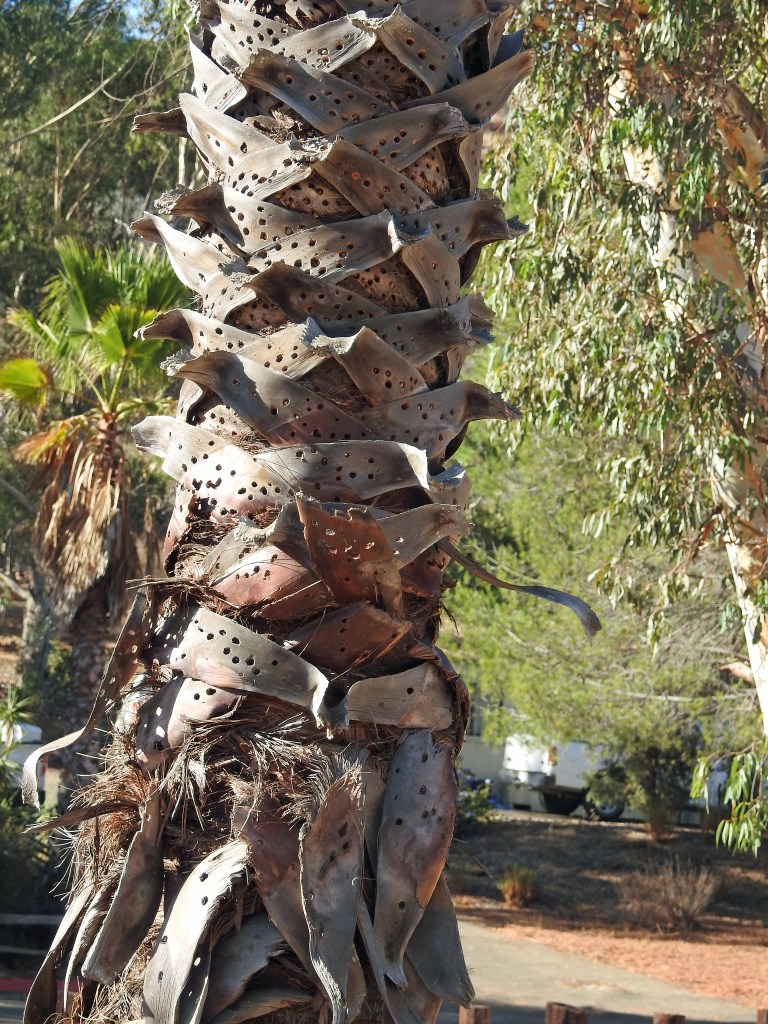
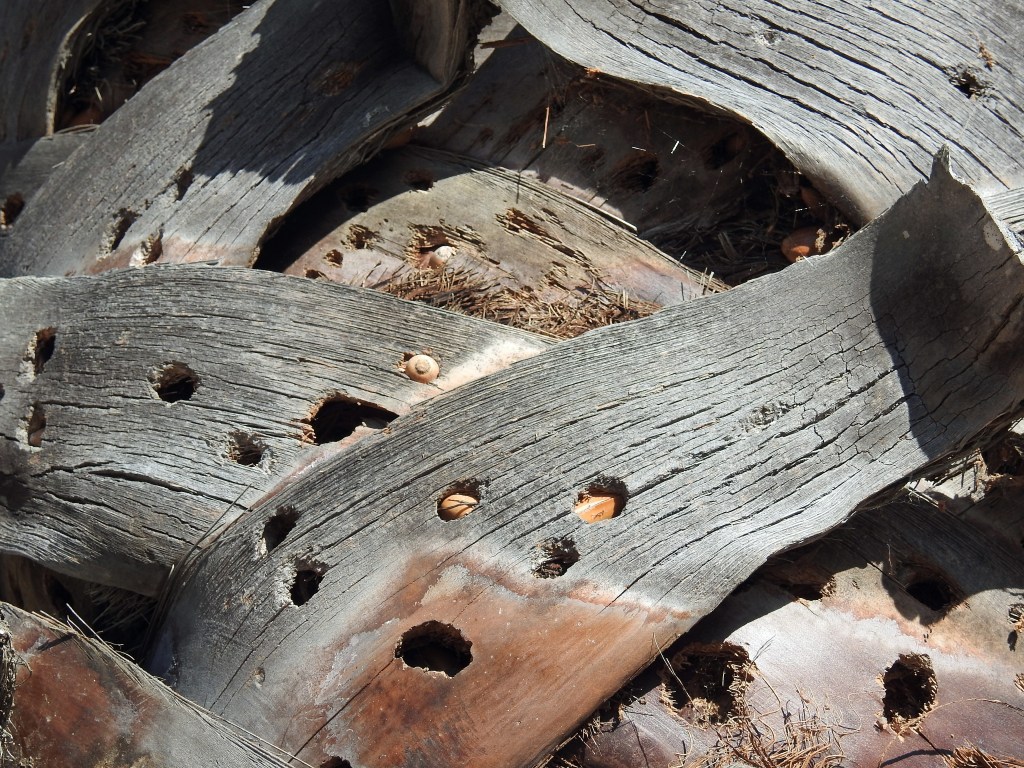
Figure 05. Acorn Woodpeckers eat mostly flying insects, but they still drill into bark to store acorns, which also feature in their diet.
Breeding
Almost all Piciformes parents raise their own young. They nest almost exclusively in cavities or burrows; some carve out their own, whereas others use already existing ones. Their chicks are altricial, dependent on their parents for some time, both for food and for keeping warm and protected. The only exception to this breeding behavior is the family Indicatoridae, honeyguides, which are obligate brood parasites (see the subsequent section, Indicatoridae, Honeyguides).
Piciformes Families, Part 1
Galbulidae, Jacamars (18 species)
Etymology and Taxonomy
The jacamar’s family name Galbulidae comes from Latin galbula, diminutive of the Latin galbina, meaning “small bird,” which accurately describes only some jacamars. This family includes 5 genera, across 18 species: Galbalcyrhynchus (2 species), Brachygalba (4 species), Jacamaralcyon (1 species), Galbula (10 species), and Jacamerops (1 species). In 1825, zoologist and ornithologist Nicholas Aylward Vigors described the Galbulidae family.
Appearance and Voice
Jacamars show some size variability: about 5.5–13.5 inches (14–34 cm) long, weighing about 0.6–2.7 ounces (17–76 g). All have short, rounded wings, and most have long tails. Like other Piciformes families, their toes are zygodactylous; they have short, weak legs and small feet. (Exception: the sole species of the Jacamaralcyon genus has only three toes.)
Almost all jacamars have long slender bills that taper to a fine point, shaped like a letter-opener (except in 3 species). It’s not unusual for the bill to break at the tip when digging out burrows for nesting. The bill of the Great Jacamar is decurved, shorter, thicker, and more powerful than the bill of other jacamars. The two Galbalcyrhynchus species have deeper, heavier bills, more like those of kingfishers than of jacamars.
Most jacamars have colorful, glossy plumage, with some species having iridescent plumes with a brilliant metallic sheen. They typically show slight sexual dimorphism, with females somewhat duller than males, and female throat patches may be rufous or buff instead of white like the males. To see a variety of jacamars, please visit the Cornell Lab of Ornithology’s Macaulay Library website for this family: https://search.macaulaylibrary.org/catalog?taxonCode=galbul2&includeChildTaxa=true . I found these particular photos especially appealing:
- ML663909509, White-eared Jacamar, Galbalcyrhynchus leucotis, https://macaulaylibrary.org/asset/663909509
- ML663873356, Green-tailed Jacamar, Galbula galbula, https://macaulaylibrary.org/asset/663873356
- ML663849693, Brown Jacamar, Brachygalba lugubris, https://macaulaylibrary.org/asset/663849693
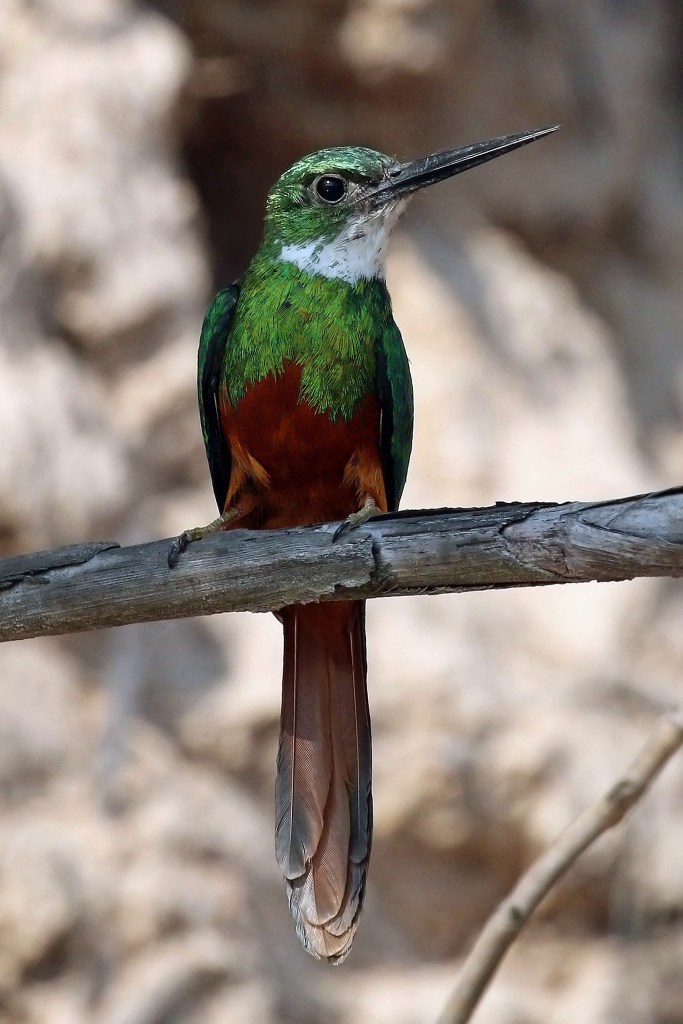
Figure 06. The photograph of this exquisite Rufous-tailed Jacamar is from Wikipedia, as part of a Creative Commons agreement. (From https://commons.wikimedia.org/wiki/File:Rufous-tailed_jacamar_(Galbula_ruficauda)_male_2.JPG. Summary Description, English: Rufous-tailed jacamar (Galbula ruficauda rufoviridis) male, the Pantanal, Brazil. Date, 6 September 2015, 13:20:06. Source, Own work, from Sharp Photography, sharpphotography. Author, Charles J. Sharp (1951–). wikidata:Q54800218. Licensing: I, the copyright holder of this work, hereby publish it under the following license: w:en:Creative Commons, attribution share alike. This file is licensed under the Creative Commons Attribution-Share Alike 4.0 International license. You are free: to share – to copy, distribute and transmit the work, to remix – to adapt the work. Under the following conditions: attribution – You must give appropriate credit, provide a link to the license, and indicate if changes were made. You may do so in any reasonable manner, but not in any way that suggests the licensor endorses you or your use. share alike – If you remix, transform, or build upon the material, you must distribute your contributions under the same or compatible license as the original.
A visit to the xeno-canto website, https://xeno-canto.org/explore?query=galbulidae , reveals more than 1,000 recordings of Galbulidae, 148 of which are for the Great Jacamar, Jacamerops aureus. Descriptions of most species are for high-pitched vocalizations, such as whistles, squeals, and trills.
Distribution and Habitat
The neotropical Galbulidae family is distributed from Mexico south through Central and South America (with 13 of the 18 species in the Amazon Basin). Most jacamars live in low-altitude woodlands and forests, especially favoring forest canopies and edges. When feeding, they may be found at clearings, and when breeding, they can often be found near streams with earthen banks, or locations with termite nests. No jacamars migrate.
Food and Foraging
The one species of Jacamerops (Great Jacamar) gleans prey from leaves and branches, including insects, spiders, and even small lizards. All other jacamars eat only insects, which they catch by sitting and waiting for a flying insect (especially butterflies, dragonflies) to come within range. Once they spot their prey, they hawk it — leap from the perch to capture it, remove its wings, and taste it. If the prey doesn’t taste of chemical defenses, the jacamar will eat it. If the jacamar tastes the prey’s chemical defenses, the bird discards it. If the prey — such as a bee or wasp — has a stinger, the jacamar beats it on a branch to remove the stinger before consuming it.
Social Behavior and Breeding
Jacamars are typically seen individually or in pairs, but occasionally, they’ll join mixed-species flocks of birds.
Whenever possible, jacamars dig out a nest burrow within an earthen bank or inside a termite nest (e.g., in a tree). If they must, they’ll make do with a burrow in the soil between the roots of a large fallen tree. They don’t line the nest burrow, but over time, the chitinous (exoskeletal) remains of insects will build up in the nest after being regurgitated (by adults) or excreted (by nestlings).
Most jacamars lay 2–4 eggs per clutch, and most are monogamous; one species breeds cooperatively, one or more does so colonially, and a few are polygamous. Typically, both parents incubate the eggs for about 18–26 days, and some families include offspring from a previous season as helpers to the parents. Unlike the hatchlings of other Piciformes families, jacamar hatchlings emerge with long white down. Both parents feed their nestlings with food they regurgitate. By about 3–4 weeks of age, the chicks’ feathers are like those of adults, and they’re ready to fledge. After leaving the nest, the fledglings’ bills continue to grow for a few weeks to reach adult length.
Conservation Status
Though all jacamars are imperiled by deforestation, 88.9% of them have a Least Concern, LC, IUCN Red List conservation status. Two species (Three-toed Jacamar, Jacamaralcyon tridactyla; Copperychested Jacamar, Galbula pastazae) have a Vulnerable, VU, conservation status, due to their very small ranges and low total populations.
Bucconidae, Puffbirds (37 species)
Etymology and Taxonomy
The puffbird’s family name Bucconidae comes from Latin bucco, “babbler,” or “fool,” which derives from the Latin bucca, meaning “cheek,” pointing to the puffed-out loose feathers of its head and neck. When a puffbird pulls its head into its shoulders, it can resemble a spherical powder-puff. It’s thought that another connection is that they may appear lethargic when not flying; like other sit-and-wait predators, they spend a lot of time just sitting and waiting for prey to come within range.
In 1821, physician and naturalist Thomas Horsfield defined this family. At present, the puffbirds, family Bucconidae, include 10 genera, across 37 species: Notharchus (6 species), Bucco (4 species), Nystalus (5 species), Hypnelus (2 species), Malacoptila (7 species), Micromonacha (1 species), Nonnula (6 species), Hapaloptila (1 species), Monasa (4 species), and Chelidoptera (1 species). As mentioned previously, puffbirds are closely related to jacamars, but DNA evidence confirms both their proximity and their distinctness as families.
Appearance and Voice
Puffbird plumage is typically brown, white, gray, black, or rufous (reddish-brown), perhaps with streaks or spots. Their plumage may not be eye-catching, but their overall appearance is distinctive. They have large heads with short necks and thick, strong bills, often with a hooked tip (unlike slender-billed jacamars, to which they’re related). Many species have brightly colored bills (red or yellow) and eyebrows. Some species have specialized top and bottom mandibles (jaws) that fit neatly into one another, making it easier to hold onto insect prey. Puffbirds have rictal bristles, specialized feathers, on the face, which may protect the eyes from stinging insects; some species have extra rictal bristles on their throat and face. Their eyes are large (adaptive for foraging under the dim light of dawn or dusk), with brightly colored irises.
To see a variety of puffbirds, please visit the Cornell Lab of Ornithology’s Macaulay Library website for this family:
- ML663890862, Lanceolated Monklet, Micromonacha lanceolata, https://macaulaylibrary.org/asset/663890862
- ML663880917, Russet-throated Puffbird, Hypnelus ruficollis, https://macaulaylibrary.org/asset/663880917
- ML663820658, White-whiskered Puffbird, Malacoptila panamensis, https://macaulaylibrary.org/asset/663820658
- ML663911014, Eastern Striolated-Puffbird (torridus), Nystalus striolatus torridus, https://macaulaylibrary.org/asset/663911014
Their sizes range from the Rufous-capped Nunlet, averaging 5.4 inches (13.5–14 cm) long, weighing about 0.6 ounces (14–22 g), to the White-necked Puffbird, averaging 11 inches (29 cm) long, weighing about 3.7 ounces (106 g); they’re said to range from sparrow to dove in size. Females tend to be slightly larger than males, and they typically have duller plumage. At a glance, with its stout body and big bill, the puffbird may look similar to kingfishers’ body shape. Puffbirds tend to have short, rounded wings, a short tail, and short legs with small feet, with the usual Piciformes zygodactyl arrangement of toes.
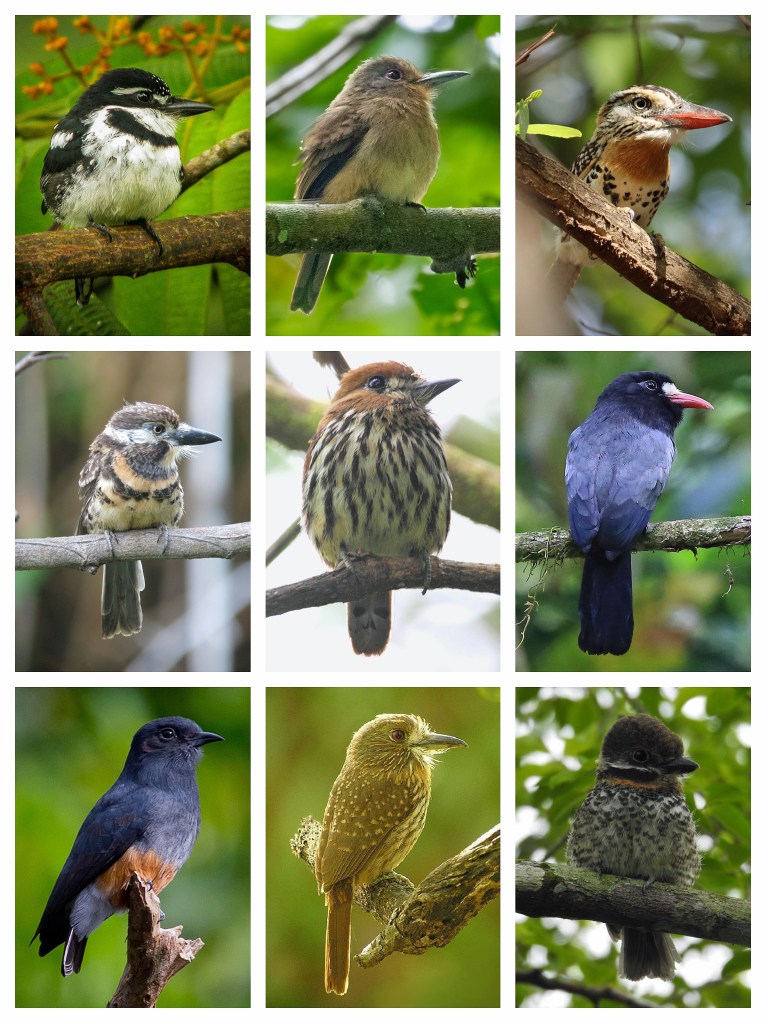
Figure 07. As this image from Wikipedia shows, though puffbirds have many commonalities, they also differ quite a bit in appearance. Summary Description, English: Bucconidae Diversity. Date, 7 October 2022. Licensing: I, the copyright holder of this work, hereby publish it under the following license: w:en:Creative Commons, attribution share alike. This file is licensed under the Creative Commons Attribution-Share Alike 4.0 International license. You are free: to share – to copy, distribute and transmit the work, to remix – to adapt the work. Under the following conditions: attribution – You must give appropriate credit, provide a link to the license, and indicate if changes were made. You may do so in any reasonable manner, but not in any way that suggests the licensor endorses you or your use. share alike – If you remix, transform, or build upon the material, you must distribute your contributions under the same or compatible license (https://commons.wikimedia.org/wiki/File:Bucconidae_Diversity.jpg )
Though puffbirds are said rarely to vocalize, there are 1,739 recordings of them at the website,
https://xeno-canto.org/explore?query=bucconidae , representing an array of species. Their main vocalizations are repeated high-pitched trills or whistles, heard mostly at dawn or dusk.
Distribution and Habitat
Like jacamars, puffbirds are found in the neotropics from Mexico through Central America to South America (especially the Amazon Basin). They prefer low-altitude woodlands, from wet to dry, tropical rainforests to forest edges to scrublands and savannahs, as long as they can dwell in trees and eat insects. Just one species lives at higher-altitude woodlands. No species migrates far from its home territory.
Food and Foraging
The puffbirds’ heavy bills are perfectly suited to catching large insects (beetles, cicadas, butterflies, etc.), other invertebrates (spiders, scorpions, millipedes, etc.), as well as some small vertebrates (e.g., lizards, frogs, toads) from time to time. A few species may also occasionally snack on fruit (e.g., berries) or seeds. Like jacamars, they’re patient sit-and-wait predators. Their subdued plumage makes it easy for them to blend into the environment. When puffbirds sit completely still, other than perhaps an occasional head movement, flying prey may not notice them and may fly within their range — a deadly mistake. Once the prey is spotted, the puffbird darts out and snatches it from the air, from the ground, or from a tree branch.
After catching the prey, almost all species of puffbird will carry it back to the perch to kill it and remove any stingers or other noxious or inedible parts, repeatedly bashing the prey on a branch. (The solitary species of Chelidoptera eats on the wing.) After eating, they expel pellets of indigestible invertebrate exoskeleton.
Social Behavior and Breeding
Puffbirds are typically solitary or in small family groups. The only exceptions are the four nunbirds of the Monasa genus, which are gregarious and often found in larger flocks. When breeding, puffbirds are monogamous, with both parents caring for the young, both as eggs and as hatchlings. (The Swallow-winged Puffbird, Chelidoptera tenebrosa, and some nunbirds of the Monasa genus breed cooperatively, aided by offspring from a previous breeding season.)
Both parents dig out the nest burrow in earthen banks, or perhaps in a termite nest in a tree or a termite mound. Only one parent at a time does the digging, while the other parent stands guard. If threatened, both parents disappear into the burrow. Once the nest is constructed, the mother lays 2–3 small, round, white eggs.
Both parents incubate the eggs, which may take about 15 days to hatch. The altricial chicks are hatched blind and naked (no down), yet within a few days, they’re able to crawl to the burrow entrance, where their parents feed them partially chewed insects. Though both parents feed the chicks, the male may be more involved early on, whereas the female does more feeding later on as they grow toward fledging. It generally takes 20–30 days for the chicks to fledge, but their parents continue to feed them outside the nest burrow for an additional month or so. The fledglings have adult plumage, but their beaks haven’t yet reached adult length.
Conservation Status
As is the case with many birds, puffbirds are being threatened by deforestation and other habitat degradation. Nonetheless, 86.5% are considered LC, Least Concern, by the IUCN Red List. Three species, however, are more gravely imperiled, two identified as NT, Near Threatened, and one as EN, Endangered, due to their small ranges and to pressure from coastal development in their territory.
Indicatoridae, Honeyguides (16 species)
Etymology and Taxonomy
The family name Indicatoridae comes from the Latin, indicator, for “one who points out”; its common name, honeyguides, suggests a similar role. In truth, of the 16 species of honeyguides, just 1 species, the Greater Honeyguide, Indicator indicator, is known to lead humans and other animals to honey-rich bee nests (see “Relationship with Humans” for more). One other species, the Scaly-throated Honeyguide, Indicator variegatus, may do so, as well, but disagreement remains regarding whether it does. None of the other 14 species “point out” where to find honey-rich bee colonies.
In 1837, ornithologist and artist William Swainson defined the Indicatoridae family, which includes 4 genera, across 16 species: Prodotiscus (3 species), Melignomon (2 species), Indicator (10 species), Melichneutes (1 species). Of the other Piciformes families, Indicatoridae is considered closest to the Picidae family, with which it shares not only morphological features (body shape and structure), but also numerous genetic similarities.
Appearance and Voice
Honeyguides have relatively short legs with zygodactyl toes ending in strong curved claws. Typically, their wings are long, narrow, and pointed. The bill of 13 species of honeyguides is relatively thick and blunt tipped; in the three Prodotiscus species, sometimes called “honeybirds,” the bill is narrow and pointed. Across the 16 species, they’re 4–8 inches (10–20 cm) long, weighing 0.3–2.2 ounces (9–62 g). The heaviest is the Lyre-tailed Honeyguide, averaging 1.9 ounces (54.2 g; for a photo of this species in flight, see this Macaulay Library image, ML651729381, Lyre-tailed Honeyguide, Melichneutes robustus, https://macaulaylibrary.org/asset/651729381 ); the lightest species is the Green-backed Honeyguide, averaging 0.36 ounces (10.2 g). The longest is the Greater Honeyguide, averaging 7.7 inches (19.5 cm); the shortest honeyguide is the Cassin’s Honeyguide, averaging 3.9 inches (10 cm).
Most honeyguides have olive-green plumage above (dorsal; back, tops of wings, neck, and head); two have brown plumage there. Below (ventral; breast, belly, undertail), plumage is light (e.g., white, beige, ivory, or pale gray, brown, or greenish).
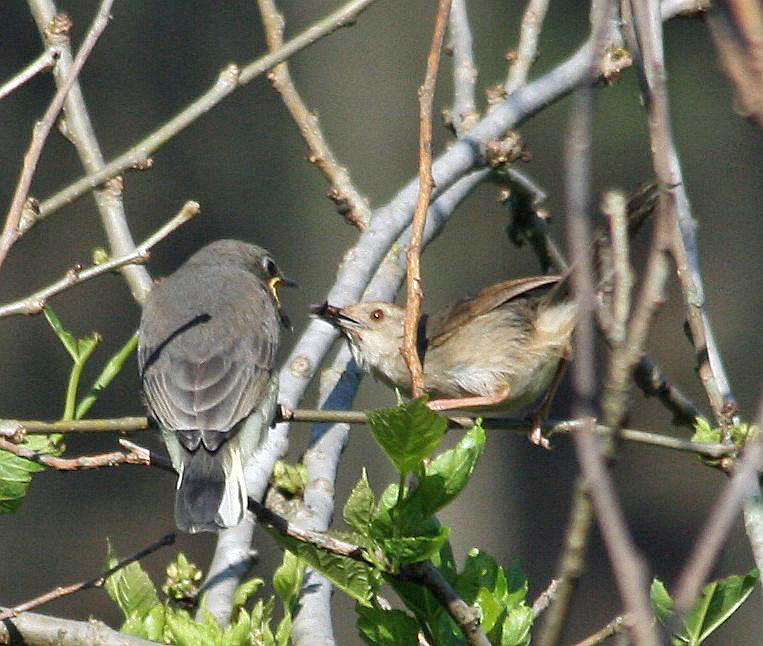
Figure 08. This image from Wikipedia shows a Wahlberg’s Honeyguide being foster parented by a Rock-loving Cisticola (Cisticola aberrans). Summary Description. Location: Pietermaritzburg, South Africa. Date, 11 December 2008, 07:32. Source Wahlberg’s Honeyguide (Prodotiscus regulus) – Juvenile fed by host parent Rock-loving Cisticola. Author, Alan Manson. This image was originally posted to Flickr by Alan Manson at https://www.flickr.com/photos/12457947@N07/3099828665. It was reviewed on 28 July 2009 by FlickreviewR and was confirmed to be licensed under the terms of the cc-by-sa-2.0. Licensing: w:en:Creative Commons, attribution share alike. This file is licensed under the Creative Commons Attribution-Share Alike 2.0 Generic license. Licensing: I, the copyright holder of this work, hereby publish it under the following license: w:en:Creative Commons, attribution share alike. This file is licensed under the Creative Commons Attribution-Share Alike 4.0 International license. You are free: to share – to copy, distribute and transmit the work, to remix – to adapt the work. Under the following conditions: attribution – You must give appropriate credit, provide a link to the license, and indicate if changes were made. You may do so in any reasonable manner, but not in any way that suggests the licensor endorses you or your use. share alike – If you remix, transform, or build upon the material, you must distribute your contributions under the same or compatible license. https://commons.wikimedia.org/wiki/File:Wahlberg%27s_Honeyguide_(Prodotiscus_regulus)_-_Juvenile_fed_by_host_parent_Rock-loving_Cisticola.jpg .
To see a variety of honeyguides, please visit the Cornell Lab of Ornithology’s Macaulay Library website for this family: https://search.macaulaylibrary.org/catalog?taxonCode=indica1&includeChildTaxa=true . I had hoped to find some images of honeyguide chicks with host parents but after scanning many pages, I failed to find any. Nonetheless, I found these appealing photos: ML663649085, Brown-backed Honeybird, Prodotiscus regulus, https://macaulaylibrary.org/asset/663649085 ; and ML663406691, Lesser Honeyguide, Indicator minor, https://macaulaylibrary.org/asset/663406691 . These two photos show the Lesser Honeyguide on a honeycomb, with living bees: ML654206404, https://macaulaylibrary.org/asset/654206404, and ML654206275, https://macaulaylibrary.org/asset/654206275 .
Honeyguides are reputed to have a variety of vocalizations, some of which may be heard as melodic trills or whistles, others more like chattering, buzzing, or squeaking. To hear some of them, 325 calls may be heard from 15 of the 16 species by visiting https://xeno-canto.org/explore?query=indicatoridae .
Distribution and Habitat
Two honeyguide species (Yellow-rumped Honeyguide, Indicator xanthonotus, and Malaysian Honeyguide, Indicator archipelagicus) may be found in southern Asia; the other 14 species dwell in the forests and other woodlands of sub-Saharan Africa. Though they’re more often found in tropical woodlands, some species inhabit montane or temperate woodlands, including locations near human habitation, such as orchards, plantations, or even suburban parks or gardens. The only honeyguide who migrates is the Yellow-rumped Honeyguide, which moves up or down in altitude within its range.
For images of the Yellow-rumped Honeyguide, please see the Cornell Lab of Ornithology’s Macaulay Library’s images, such as these: ML663230584, Yellow-rumped Honeyguide, Indicator xanthonotus, https://macaulaylibrary.org/asset/663230584 ; ML661667439, https://macaulaylibrary.org/asset/661667439 ; ML659794728, https://macaulaylibrary.org/asset/659794728 .
Two images show the Yellow-rumped Honeyguide on honeycombs: ML659678482, https://macaulaylibrary.org/asset/659678482 ; ML658641753, https://macaulaylibrary.org/asset/658641753 .
Food and Foraging
Unlike all other birds, honeyguides are equipped with a special assortment of digestive enzymes, which enable them to eat and digest beeswax. They also eat larval and adult insects — mostly sap-sucking, honey-dew-excreting scale insects and larval waxmoths, but also beetles, termites, and other flying or crawling insects and other invertebrates. They occasionally consume small amounts of fruits and honey.
At a bee nest (preferably one abandoned by the bees), a pecking order determines which species can consume the wax first, and, within a species, which individuals are first; intriguingly, immature honeyguides feed first, then adult females, and finally adult males.
Locomotion
Honeyguides fly swiftly, often with gentle undulations.
Social Behavior and Breeding
Though honeyguides are usually solitary, when feeding, they may be found among mixed-species flocks feeding at the same bee’s nest.
Most species of honeyguides are polygynous, with males courting and mating with several females; some females are also polyandrous, copulating with more than one male. After copulation, the female carries the developing embryos. When it would be the time for her to lay an egg, she carries the egg an extra day, so it can develop more fully before it is laid.
Honeyguides are obligate brood parasites — a honeyguide mom always lays each of her eggs in the nest of another bird, who will incubate the egg and feed the nestling after it hatches. The honeyguide mom does not incubate her eggs or feed her nestlings. She typically looks for a cavity-nesting host species, such as a woodpecker, barbet, kingfisher, or bee-eater, but a deep cup nest may also be chosen. She then lays one egg in the nest of a host species, perhaps also puncturing the host’s eggs, to ensure that they’ll die, leaving her own egg to thrive in the attentive care of the host species. She typically lays 3–5 eggs, 1 each, in the nests of 3–5 hosts, over about 5–7 days. Her egg’s color typically matches that of the host species. In a given season, she may lay up to 20 eggs, across several clutches.
Incubation takes about 12–18 days, during which time, the honeyguide parents monitor the nest, to ensure that the host parent is incubating their egg. As soon as the honeyguide chick hatches — blind and naked — it feels its way to any remaining eggs and uses a sharp hook on its bill to kill all of the host’s nestlings. If the honeyguide chick doesn’t manage to kill all of the host’s nestlings, the honeyguide chick will eject the host’s chicks from the nest. Meanwhile, the host parent cares for and feeds the parasitic chick, providing the insects and fruit that the parent would have brought to its own nestlings. As soon as the honeyguide chick fledges (at about 20–40 days after hatching), it switches to a more typical honeyguide diet of beeswax and insects.
Conservation Status
The IUCN Red List conservation status of 14 of the 16 species of honeyguides is LC, Least Concern. Two species have a conservation status of NT, Near Threatened: Malaysian Honeyguide (Indicator archipelagicus) and Yellow-footed Honeyguide (Melignomon eisentrauti, for which few records exist, so its status is uncertain). Though most species have less cause for concern, all honeyguides are threatened by habitat degradation and encroachment in both lowland forests and montane areas.
Relationship with Humans
For many people, the name honeyguide conjures images of a mutualistic relationship between honeyguides and humans. Typically, the honeyguide attracts the attention of humans with its chattering calls. For instance, in northern Tanzania, Hadza hunter-gatherers follow the honeyguide’s call. The honeyguide leads them to a bee hive, continually checking that the humans are still following. After the humans have taken the honey, they leave behind the beeswax and bee larvae, which the honeyguides consume. This behavior is indeed true of 1 of the 16 species of honeyguide: the Greater Honeyguide, Indicator indicator. No other species of honeyguide is known to do so. (Some have suggested that the Scaly-throated Honeyguide, Indicator variegatus, may also do so, but that observation is disputed.) For images of this honeyguide, please see the following images from the Cornell Lab of Ornithology’s Macaulay Library: ML663079814, Greater Honeyguide, Indicator indicator, https://macaulaylibrary.org/asset/663079814 ; ML662794069, https://macaulaylibrary.org/asset/662794069 ; ML662794071, https://macaulaylibrary.org/asset/662794071 ; ML662727488, https://macaulaylibrary.org/asset/662727488 ; ML661899331, https://macaulaylibrary.org/asset/661899331 .
It has been suggested that the Greater Honeyguide needs the help from a large mammal (e.g., human or honey badger) to open up the hive, but that appears not to be the case. Most of the time, they obtain beeswax from abandoned bee nests. Even when the nests aren’t abandoned, however, the honeyguides’ thick skin partly protects them from bee stings. Also, they typically approach bee hives during the cool early morning, when bees are less active.
***
Subsequent blogs will probe the other six Piciformes families: Ramphastidae, Capitonidae, Semnornithidae, Megalaimidae, Lybiidae, and Picidae, some in greater depth.
References
Piciformes
- Elphick, Jonathan. (2014). The World of Birds (Piciformes, 434–439). Buffalo, NY: Firefly Books.
- Lovette, Irby, & John Fitzpatrick (Eds.), (2016). The Cornell Lab of Ornithology Handbook of Bird Biology (3rd ed.). Hoboken, NJ: Wiley.
- Winkler, David W., Shawn M. Billerman, and Irby J. Lovette. (2015). Bird Families of the World: An Invitation to the Spectacular Diversity of Birds. Barcelona: Lynx, Cornell Lab of Ornithology.
- Wikipedia, Piciformes, https://en.wikipedia.org/wiki/Piciformes
Galbulidae, Jacamars
- Elphick, Jonathan. (2014). The World of Birds (Galbulidae, Jacamars, 445–446). Buffalo, NY: Firefly Books.
- Winkler, D. W., S. M. Billerman, and I. J. Lovette (2025). Jacamars (Galbulidae), version 1.1. In Birds of the World (S. M. Billerman, B. K. Keeney, P. G. Rodewald, and T. S. Schulenberg, Editors). Ithaca, NY: Cornell Lab of Ornithology, https://doi.org/10.2173/bow.galbul2.01.1
- Galbulidae, jacamars, https://en.wikipedia.org/wiki/Jacamar
- Galbulidae taxonomy, https://en.wikipedia.org/wiki/Nicholas_Aylward_Vigors
Bucconidae, Puffbirds
- Elphick, Jonathan. (2014). The World of Birds (Bucconidae, Puffbirds, 446–447). Buffalo, NY: Firefly Books.
- Winkler, D. W., S. M. Billerman, and I. J. Lovette (2025). Puffbirds (Bucconidae), version 1.1. In Birds of the World (S. M. Billerman, B. K. Keeney, P. G. Rodewald, and T. S. Schulenberg, Editors). Ithaca, NY: Cornell Lab of Ornithology. https://doi.org/10.2173/bow.buccon2.01.1 , https://birdsoftheworld.org/bow/species/buccon2/cur/introduction
- Bucconidae, puffbirds, https://en.wikipedia.org/wiki/Puffbird
- Bucconidae taxonomy, https://en.wikipedia.org/wiki/Thomas_Horsfield
Indicatoridae, Honeyguides
- Elphick, Jonathan. (2014). The World of Birds (Indicatoridae, Honeyguides, 439–440). Buffalo, NY: Firefly Books.
- Winkler, D. W., S. M. Billerman, and I. J. Lovette (2020). Honeyguides (Indicatoridae), version 1.0. In Birds of the World (S. M. Billerman, B. K. Keeney, P. G. Rodewald, and T. S. Schulenberg, Editors). Ithaca, NY: Cornell Lab of Ornithology. https://doi.org/10.2173/bow.indica1.01 , https://birdsoftheworld.org/bow/species/indica1/cur/introduction
- Indicatoridae, honeyguides, https://en.wikipedia.org/wiki/Honeyguide (Redirected from Indicatoridae)
- Indicatoridae, taxonomy, https://en.wikipedia.org/wiki/William_Swainson
Etymology
- Gotch, A. F. [Arthur Frederick]. Birds—Their Latin Names Explained (348 pp.). Poole, Dorset, U.K.: Blandford Press.
- Gruson, Edward S. (1972). Words for Birds: A Lexicon of North American Birds with Biographical Notes (305 pp., including Bibliography, 279–282; Index of Common Names, 283–291; Index of Generic Names, 292–295; Index of Scientific Species Names, 296–303; Index of People for Whom Birds Are Named, 304–305). New York: Quadrangle Books.
- Lederer, Roger, and Carol Burr. (2014). Latin for Bird Lovers: Over 3,000 Bird Names Explored and Explained (224 pages). Portland, OR: Timber Press.
Text by Shari Dorantes Hatch. Copyright © 2026. All rights reserved.
Images of the featured photo and Figures 01–05 were recorded at the San Diego Zoo
and elsewhere in San Diego County, by Shari Dorantes Hatch.
Figures 06–08 are from Wikipedia, under the Creative Commons license.


_male_2.JPG)

_-_Juvenile_fed_by_host_parent_Rock-loving_Cisticola.jpg)
Leave a Reply