
Barbets: Families of Tree-hugging Birds
Figure 01. This appealing female Black-Spotted Barbet looks around then offers her opinion about being photographed.
This is the third of several blogs about the Piciformes order of birds and its nine highly diverse families. The first blog in this series introduced the order and three of the nine families: Galbulidae, jacamars; Bucconidae, puffbirds; and Indicatoridae, honeyguides, https://bird-brain.org/2026/08/30/piciformes-tree-hugging-birds-part-1/ . The second blog introduced the Ramphastidae family of toucans, https://bird-brain.org/2026/09/07/piciformes-tree-hugging-birds-part-2/ .
The current blog introduces the four barbet families: Capitonidae, Semnornithidae, Megalaimidae, and Lybiidae. It then focuses especially on the Capitonidae family of New World (Americas) barbets and the two-species Semnornithidae family, comprising Prong-billed and Toucan Barbets. This blog is organized as follows:
- Barbets (all four families)
- Capitonidae, New World Barbets, including the Black-spotted Barbet
- Semnornithidae — 1 genus, 2 species: Prong-billed Barbet and Toucan Barbet
- References
Future blogs will probe the other barbet families: Megalaimidae, Asian barbets, and Lybiidae, African barbets, as well as the Picidae family of woodpeckers and their allies.
Barbets
Barbets are spread across four families within the Piciformes order of birds: Capitonidae, Semnornithidae, Megalaimidae, and Lybiidae. For all four families, their taxonomy (scientific classification) is as follows: kingdom, Animalia; phylum, Chordata; class, Aves; order, Piciformes; suborder, Pici; infraorder, Ramphastides. At one time, all barbets were included in one family, but later evidence revealed that though diverse barbets and toucans were related, many of the barbets were better classified as separate families, also separated from the toucan family, Ramphastidae. Each of these families has evolved characteristics that are unique to each and not present in the other families. Genetic evidence links these families, but the exact relationships are not yet clear.
Appearance
Barbets are typically smaller than toucans — some much smaller. The smallest barbets are the 10 “tinkerbirds,” in the Pogoniulus genus within the Lybiidae family. The two smallest tinkerbirds are the Western Tinkerbird, Pogoniulus coryphaea, and the Yellow-throated Tinkerbird, Pogoniulus subsulphureus — both about 3.5–3.9 inches (9–10 cm) long, weighing from less than 0.3 ounces to about 0.5 ounces (7.5–13 g).
The largest barbet is the Great Barbet, Psilopogon virens, about 13–14 inches (32–35 cm) long, weighing about 6.8–10.4 ounces (192–295 g). In sum, the barbets can be 3.5–14 inches (9–35 cm), bill to tail, weighing 0.2–10.4 ounces (7.5–295 g). Compare these sizes with the smallest and largest toucans: The smallest toucan, the Lettered Aracari (Pteroglossus inscriptus), is about 11 inches (28 cm) long, weighing about 4.6 ounces (130 g); the largest, the male Toco Toucan (Ramphastos toco), is about 22 inches (56 cm) long, weighing about 28 ounces (794 g).
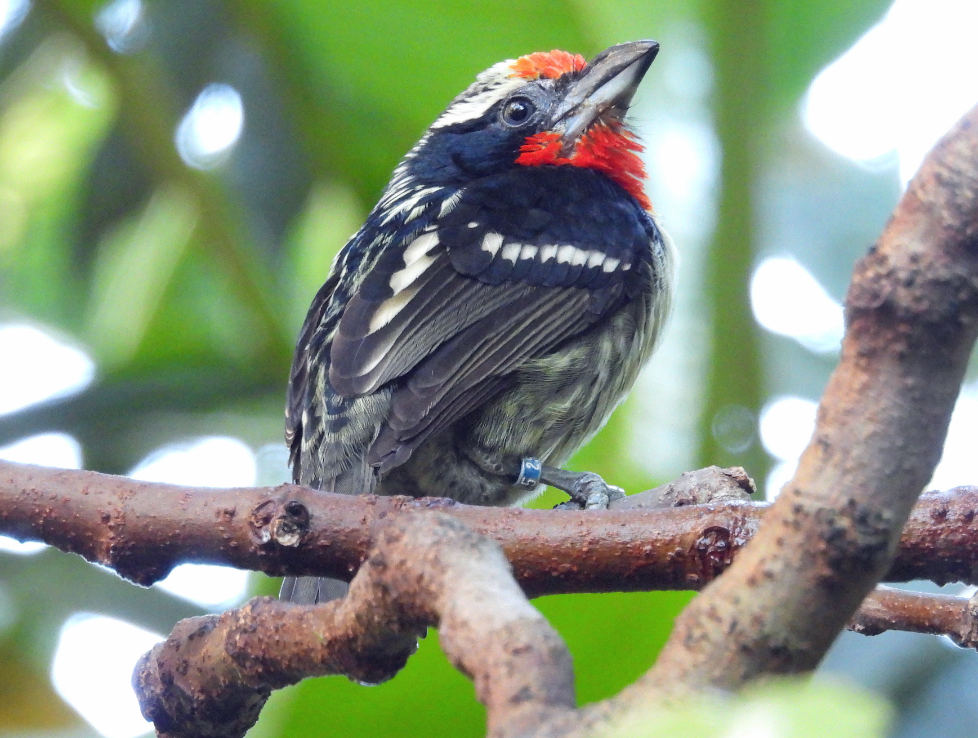
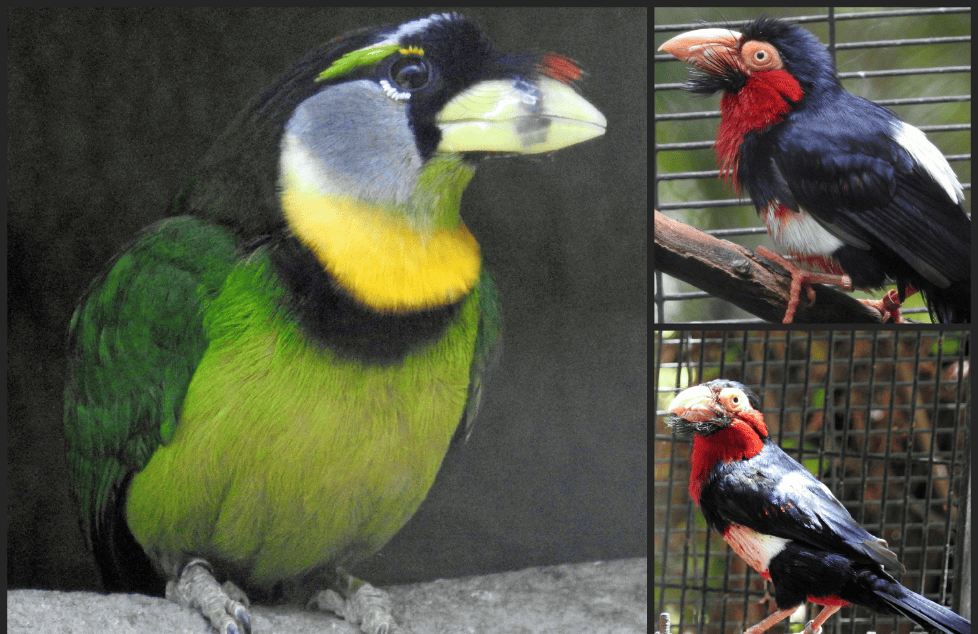
Figure 02. Barbets are a diverse collection of birds scattered across four families within the Piciformes order. On the left, a Black-spotted Barbet female, from the Capitonidae family of New World barbets; middle, Fire-tufted Barbet, from the Megalaimidae family of Asian barbets; right, Bearded Barbet, from the Lybiidae family of African barbets.
The body shape of barbets tends to be compact and stout, with very little neck between the large head and the body. Their short, stout, sharp-tipped bills, often decurved (curving downward), serve them well for handling both fruits and insects. They may also use their bills for excavating nest holes or burrows in dead trees or in earthen banks (or possibly in insect nests). At the opposite end of their bodies, they have short, strong legs, ending in zygodactyl toes (two pointing forward, two pointing backward).
Most barbets have distinctively colorful plumage, though the plumage of some Lybiidae species is duller. Most male and female barbets look similar, but in a few species, they’re sexual dimorphic, with the two sexes looking different. Most species in the Megalaimidae family have distinctive rictal bristles (specialized feathers that can look like eyelashes or mustaches), but those in the other three barbet families either don’t have them, or the bristles are short and sparsely distributed.
Vocalizations
Visit https://xeno-canto.org/explore?query=barbet to see more than 4,000 (4,078 when I visited) recordings of 83 species of barbets. Across the spectrum of barbets, they may be heard harshly squawking, nasally honking, trilling, melodically whistling or piping, popping, rattling, grating, and more — said to be quite loud for such small birds. In many barbet species (especially in the Lybiidae family), mated pairs and even cooperative-breeding groups sing duets to one another, especially during the breeding season. Some duets are so perfectly synchronized that it seems as if only one bird is singing. It’s thought that these songs not only affirm the pair bond but also aid in establishing dominance hierarchies and in territorial defense.
Distribution
Barbets are mostly distributed in the tropics; some may be found in the subtropics, and a few have ranges on the edge of temperate regions. Barbets are found on three different continents. Species in both the Capitonidae and the Semnornithidae families are found in the Americas — mostly in South America. The Megalaimidae family’s species are found across southern Asia, and the Lybiidae family’s species are chiefly in sub-Saharan Africa.
Habitat
The main habitat requirement for barbets is the availability of trees, so they’re mostly found in various kinds of woodlands and forests — tropical rainforests, scrublands, farmlands, or even gardens will do if there are enough trees. They feast on fruits and insects found in trees, and they need dead trees in order to excavate nest cavities for raising their families.
Migration
Barbets do not migrate seasonally, though some will migrate up or down in elevation, in response to seasonal changes in climate and in the abundance of fruits and insects.
Food and Foraging
Barbets are mainly frugivores, but many also supplement their fruity diet with invertebrates (especially insects), and some also consume small vertebrates (e.g., lizards, nestlings of other birds), especially during the breeding season, when the protein needs of nestlings is high.
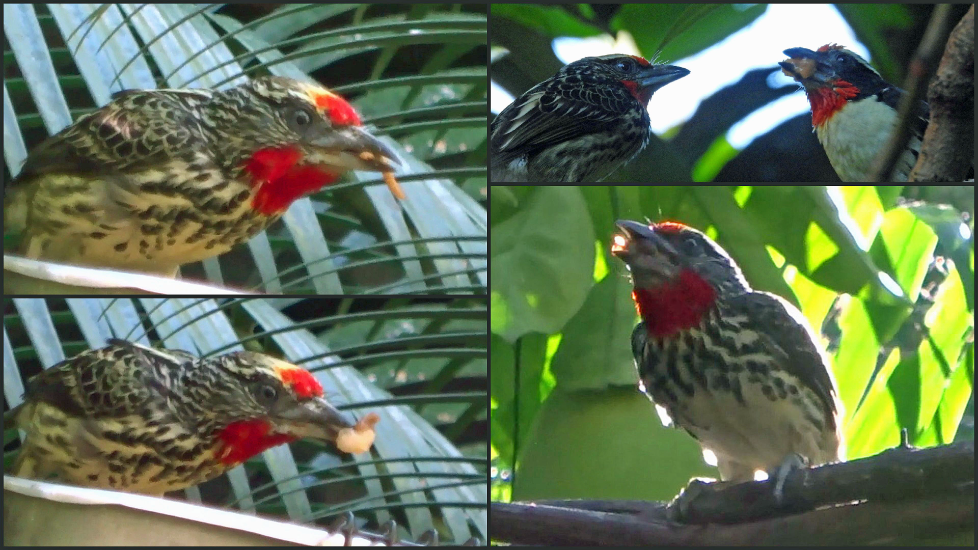
Figure 03. Chiefly frugivores (fruit eaters), barbets (such as this female and male Black-spotted Barbets) also consume invertebrates, particularly larval insects.
Locomotion
Having short, strong legs with zygodactyl toes gives barbets an advantage when clambering up and around on tree trunks. Barbets also hop about on tree branches and can use their tails as a support when climbing on tree trunks. The smaller species appear to be more agile and quick than the larger species of barbets, but none have difficult getting around in the trees.
Social Behavior
Most of the year, barbets are seen as individuals or in pairs, especially during breeding season. Outside of breeding season, however, some barbet species will socialize in small groups or even in mixed-species flocks. Most species of barbets are strongly territorial.
Breeding
All barbets raise their families in nest cavities, which they excavate themselves, by digging into dead trees or by burrowing into earthen banks. Some barbets have been willing to use nest boxes, termite mounds, or other existing nest locations, however.
For the most part, barbets are monogamous, and each couple participates in a long courtship, during which the duo excavates a nest cavity together, and the male will courtship-feed his mate. Some species in the Lybiidae family of African barbets breed cooperatively, with pairs having helpers to raise their offspring. In some species of African barbets, and in one species of Asian barbets, groups of barbets will nest colonially in a single tree.
The female typically lays 2–5 white eggs, but 1–7 eggs have been seen. Both parents incubate the eggs for about 12–19 days, then both parents feed and brood the hatchlings for about 4–6 weeks (17–46 days). (Note that most cavity nesters lay white eggs, as there’s no need to camouflage the eggs, which cup nesters often need to do.)
Conservation Status
All four families of barbets include imperiled species:
- Capitonidae includes 4 VU, Vulnerable, and 4 NT, Near Threatened species
- Semnornithidae includes 1 NT, Near Threatened species
- Megalaimidae includes 4 NT, Near Threatened species
- Lybiidae includes 1 VU, Vulnerable, and 1 NT, Near Threatened species
Capitonidae, New World Barbets
Etymology
The family name Capitonidae comes from Latin capito, meaning “head,” and these barbets do have large heads, as well as thick heavy bills. (I briefly introduced this family in my previous blog, “Exotic Birds — Black-spotted Barbet,” from February 24, 2025,
https://bird-brain.org/2025/02/24/exotic-birds-black-spotted-barbet/#Capitonidae .)
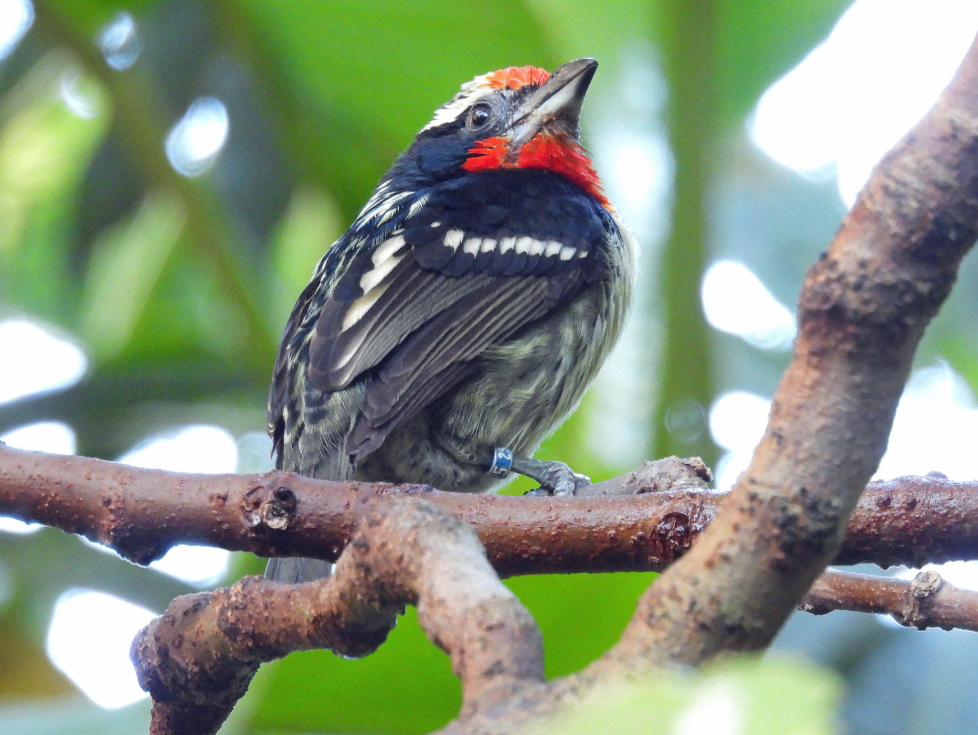
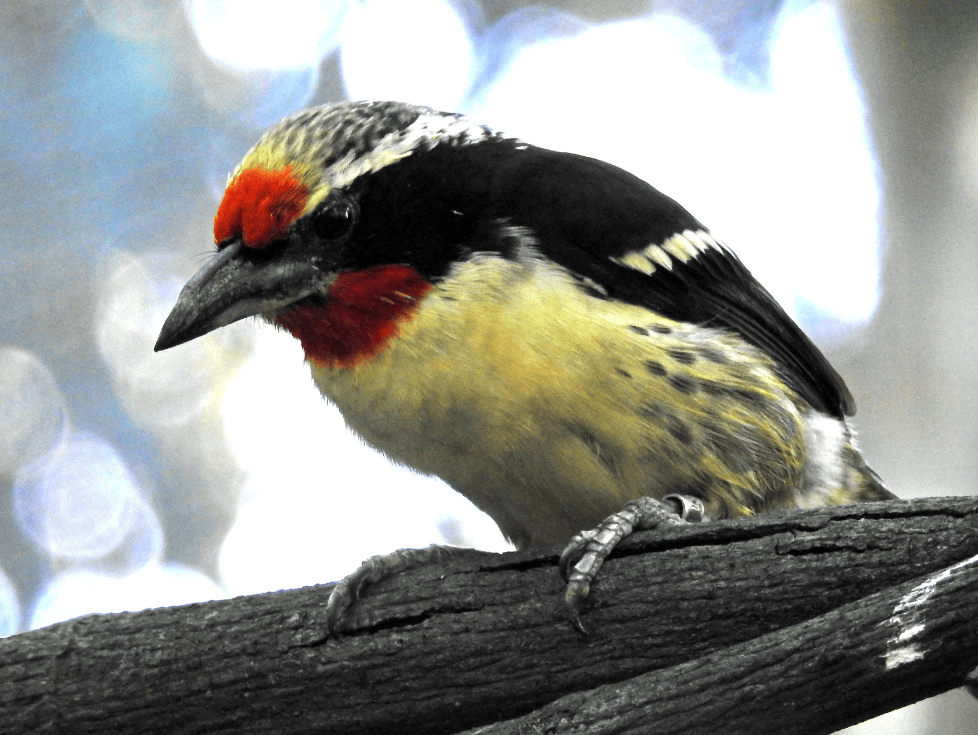
Figure 04. Members of the Capitonidae family, such as these female (left) and male (right) Black-spotted Barbets, have big heads with thick, heavy bills.
Taxonomy
The Capitonidae family was first described in 1838 by Napoleon’s nephew, naturalist and ornithologist Charles Lucien Bonaparte. This family includes 2 genera, across 15 species: 11 species in the Capito genus and 4 species in the Eubucco genus. Fossils of barbets in this family, dating back as far as the Miocene era (23–5 million years ago), have been found in Florida.
Appearance
Members of the Capitonidae family are called “capitonids.” Capitonids are stout, with big heads and short necks. Some observers say that the plumage of capitonids shows the greatest variety of bright colors and patterns of all barbets. Capitonid colors include red, black, yellow, white, orange, or brown, as well as tan, green, blue, and gold, with vividly contrasting bold patches and stripes. The 4 species of the Eubucco genus shows wider color diversity than the 10 species of the Capito genus. (As examples, please see a photo of a Versicolored Barbet, Eubucco versicolor, at https://macaulaylibrary.org/asset/640165971 ; an especially captivating video of a Scarlet-hooded Barbet, Eubucco tucinkae, can be seen at https://macaulaylibrary.org/asset/512768471 ; I wish the video had been audible.) Like other barbets, many species have rictal bristles, but they’re rather sparse and short, compared with the bristles of some other barbet families.
Figure 05. This Black-spotted Barbet male, feaking his bill, is from the Capito genus; the Capito species are less colorful than the species of the Eubucco genus.
Another distinctive feature of capitonids is their bill structure. The maxilla (upper bill) and the mandible (lower bill) distinctively fit together. Specifically, the tip of the maxilla has a downward projection that fits neatly into a groove in the tip of the mandible, providing a secure grip for grasping foods and a punch for chopping fruits. (See https://macaulaylibrary.org/asset/38403371 for a photo of the open bill of a Red-headed Barbet, Eubucco bourcierii, showing its tongue, maxilla, and mandible. A frontal closed-mouth view and a second closed-mouth side view of this same species may be found in eBird, https://ebird.org/species/rehbar1 .)
Vocalizations
To hear an assortment of 433 recordings from 14 of the 15 species of capitonids, please visit https://xeno-canto.org/explore?query=capitonidae . Among the vocalizations are trills, hoots, rapid-fire repeated whistles and single whistles. To get a feel for some of the assorted sounds these barbets produce, try listening to https://xeno-canto.org/260583 , https://xeno-canto.org/864729 , and https://xeno-canto.org/119477 .
Distribution and Habitat
New World barbets live mostly in the humid tropical forests of Central and South America. Though most prefer lowland gallery forests (along waterways), some venture into mid-montane cloud and temperate forests, as well. When breeding, they require trees with dead wood, for excavating their nests. They don’t migrate, so their breeding habitat is also their nonbreeding habitat.
Food
Like most other barbets, capitonids feed mostly on fruits, but many also eat at least some invertebrates — even rather large ones — particularly during breeding season. Like other Piciformes, they spend most of their time high in trees, both foraging for fruits and gleaning arthropods from leaves and tree trunks. They’re versatile in changing their diet, depending on the availability of food. They dine on a wide variety of fruiting trees (and bushes); it’s thought that a single barbet may feast on up to 60 different plant species within its territory. They’re not shy about taking cultivated agricultural fruits and vegetables either.
Figure 06. Sometimes, barbets will eat food directly at the source; at other times, barbets (such as this female Black-spotted Barbet) will carry food to a perch, where they will hold the food with their feet and nibble on it with their bill.
These barbets eat whole fruits then regurgitate indigestible seeds and fruit pits — outside of the nest, so they’re important dispersers of seeds in tropical forests. In addition to eating insects (e.g., ants, beetles, moths), they also eat other invertebrates (e.g., scorpions, centipedes). A few capitonid species even consume small vertebrates (e.g., frogs).
Breeding
Like other barbets, capitonids excavate their own nest cavities in decomposing wood in trees; both parents cooperate to excavate the nest. The nests of capitonid species haven’t been thoroughly researched, but based on existing evidence, females typically lay 2–5 white eggs. Both parents incubate the eggs (for about 2 weeks), and both parents brood and feed the nestlings until they fledge (for about 4–6 weeks).
Conservation Status
South American forests face environmental threats, chiefly due to human encroachment. Because capitonids rely on old-growth forests with an abundance of dead wood, these threats can be especially problematic for them. Luckily, 60% of capitonids have a conservation status of LC, Least Concern.
Unfortunately, one species, the Scarlet-banded Barbet, Capito wallacei, has a status of VU, Vulnerable. Three other species have a status of NT, Near Threatened: Five-colored Barbet, Capito quinticolor; Black-girdled Barbet, Capito dayi; and Sira Barbet, Capito fitzpatricki. In addition, two subspecies of the Versicolored Barbet, Eubucco versicolor, are also considered NT, Near Threatened — both the steerii and the glaucogularis subspecies. In Colombia, the White-mantled Barbet, Capito hypoleucus, is listed as EN, endangered, chiefly due to deforestation (for logging and agriculture) further encroaching on its already small range. Also, the status of an additional 13.3% is categorized as “Unknown.”
Black-spotted Barbet, Capito niger
“Exotic Birds — Black-spotted Barbet” was posted February 24, 2025, describing this species of capitonid: https://bird-brain.org/2025/02/24/exotic-birds-black-spotted-barbet/ . The blog offered a brief overview of the Piciformes order and of the Capitonidae family. It then described the Black-spotted Barbet, Capito niger, especially in relation to the birds within the Parker Aviary of the San Diego Zoo. Rather than repeating that information in the current blog, I have updated that post, to which you can refer if interested.
Semnornithidae, Two More New World Barbets
Etymology
The family name, Semnornithidae, and the solitary genus within this family, Semnornis, both have Greek origins, semnos, meaning “fine” or “great,” and ornis, meaning “bird” — ornithology is the study of (logos) birds (ornitho).
Taxonomy
The taxonomic classification of the only two species in this family is as follows: kingdom, Animalia; phylum, Chordata; class, Aves; order, Piciformes; suborder, Pici; infraorder, Ramphastides; family, Semnornithidae; genus, Semnornis. This family was first described in 1988, by evolutionary biologist and ornithologist Richard Prum. Much earlier, in 1900, ornithologist Charles Wallace Richmond had already described the Semnornis genus.
This genus contains just two species: Semnornis frantzii, Prong-billed Barbet, and Semnornis ramphastinus, Toucan Barbet. As the description dates suggest, these two barbets were only recently separated from other barbets (and from toucans) and classified into their own discrete family. Previously, in 1864, ornithologist and zoologist Philip Lutley Sclater identified the Prong-billed Barbet, Semnornis frantzii. In addition to Figure 07, images of this species may be found at the Cornell Lab of Ornithology’s Macaulay Library, such as the following: Prong-billed Barbet, Semnornis frantzii, ML664429466, https://macaulaylibrary.org/asset/664429466 ; ML664429463, https://macaulaylibrary.org/asset/664429463 ; and ML664105185, https://macaulaylibrary.org/asset/664105185 . (All three images also show the distinctive bill structure of these species.)
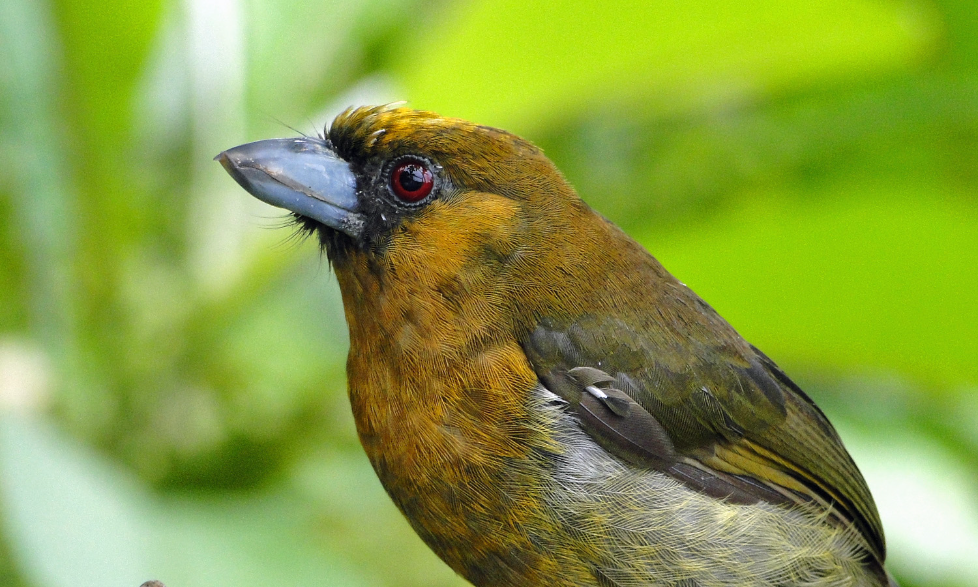
Figure 07. The photo of this Prong-billed Barbet, Semnornis frantzii, is from Wikipedia, using the Creative Commons Licensing. https://commons.wikimedia.org/wiki/File:Prong-billed_Barbet.jpg , Summary: Description, Prong-billed Barbet (Semnornis frantzii). Date, 18 August 2010. Source, https://www.flickr.com/photos/clickor/4904683344/. Author, Flickr-user Clickor. Licensing. w:en:Creative Commons. attribution. This file is licensed under the Creative Commons Attribution 2.0 Generic license. You are free: to share – to copy, distribute and transmit the work, to remix – to adapt the work. Under the following conditions: attribution – You must give appropriate credit, provide a link to the license, and indicate if changes were made. You may do so in any reasonable manner, but not in any way that suggests the licensor endorses you or your use.
Appearance
Among barbets, the Semnornis species are plump and relatively large, about 7.1–8.3 inches (18–21 cm) long; the Toucan Barbet (weighing 3.4 ounces, 95 g) is both longer and heavier than the Prong-billed Barbet (weighing about 2.3 ounces, 64 g).
Both barbets have relatively short (base to tip) but deep (top to bottom) bills, compared with other barbets. Like their fellow New World barbets, the capitonids, these two species also have distinctive bill structures in which the maxilla has a hooked decurved tip that fits into a groove in the mandible. For examples of how this looks, please see these images from the Cornell Lab of Ornithology’s Macaulay Library:
- Toucan Barbet, Semnornis ramphastinus, ML664329379, https://macaulaylibrary.org/asset/664329379 .
- Prong-billed Barbet, Semnornis frantzii, ML664187868, https://macaulaylibrary.org/asset/664187868
As these images show, the Prong-billed Barbet’s bill is gray, but the Toucan Barbet’s bill is two-toned, mostly yellow, with a black tip and an orangey-brown coloration at the base of both maxilla and mandible. In addition to Figure 08, images of this species may be found at the Cornell Lab of Ornithology’s Macaulay Library, such as the following: Toucan Barbet, Semnornis ramphastinus, ML664627699, https://macaulaylibrary.org/asset/664627699 ; ML664600662, https://macaulaylibrary.org/asset/664600662 ; ML664582003, https://macaulaylibrary.org/asset/664582003 .
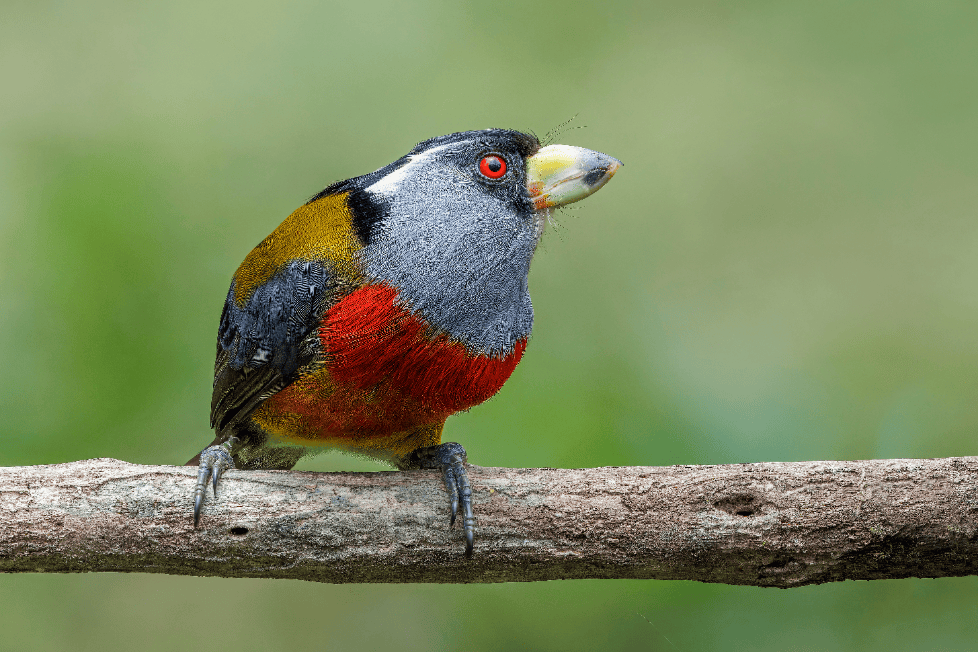
Figure 08. The photo of this Toucan Barbet, Semnornis ramphastinus, is from Wikipedia, using the Creative Commons Licensing. Summary, Description: Toucan barbet (Semnornis ramphastinus ramphastinus), Paz de las Aves, Nanegalito, Ecuador. Date: 12 April 2025, 12:45:57. Source, , Own work, from Sharp Photography, sharpphotography.co.uk. Author, Charles J. Sharp (1951–). This file is licensed under the Creative Commons Attribution-Share Alike 4.0 International license. You are free:. to share – to copy, distribute and transmit the work. to remix – to adapt the work. Under the following conditions:. attribution – You must give appropriate credit, provide a link to the license, and indicate if changes were made. You may do so in any reasonable manner, but not in any way that suggests the licensor endorses you or your use.. share alike – If you remix, transform, or build upon the material, you must distribute your contributions under the same or compatible license as the original.
Compared with many other barbets, these two species have wispy, fine, sparse rictal bristles. For both species, male and female plumage looks similar, but the two species differ. The Prong-billed Barbet is mostly an orangey brown, with white and black accents. The Toucan-Barbet’s plumage is more strikingly colorful, with black, charcoal gray, coppery gold, red, and intense yellow. For additional examples of both species in the Semnornis genus, please see the Macaulay Library’s website, https://search.macaulaylibrary.org/catalog?taxonCode=t-12018645&includeChildTaxa=true .
Vocalizations
When sounds produced by the Semnornis barbets are compared with other New World barbets and toucans, observers suggest that they’re more similar to small toucans than to capitonids, which have more whistly calls. The Semnornis barbets’ vocalizations are thought to be “throatier and brassier” (https://birdsoftheworld.org/bow/species/semnor1/cur/introduction ). To hear some of the vocalizations of Toucan Barbets, please visit https://xeno-canto.org/species/Semnornis-ramphastinus , where you may find 95 recordings; a dueting pair of Toucan Barbets can be heard at https://xeno-canto.org/278321 . There are 21 recordings of the Prong-billed Barbet at https://xeno-canto.org/species/Semnornis-frantzii ; a duet of Prong-billed Barbets can be heard at https://xeno-canto.org/271582 .
Distribution, Habitat, and Migration
Though both Semnornis species are found in the tropics of the Americas, they’re distributed into separate ranges. Prong-billed Barbets live in the humid highland forests of Central America, in Costa Rica and Panama. Toucan Barbets prefer the western montane forests on the Andean slopes of western Colombia and Ecuador. Both species inhabit both primary and secondary forests, as well as forest edges. Neither species migrates. In fact, even their offspring don’t disperse far from their natal nests after fledging.
Food and Foraging
These semnornithid barbets eat almost entirely fruit, resorting to consumption of insects and other invertebrates only when they can’t find adequate fruit supplies — except when feeding their nestlings. Invertebrates offer a rich source of protein for growing youngsters. Toucan Barbet nestlings are sometimes fed small vertebrates, as well; invertebrates make up 40% of the food given to nestlings.
Semnornithid barbets rise early and forage during the day, as individuals, or in groups of 5–6 other barbets. For small fruits, these barbets eat the whole fruits, but for large fruits, they just hold the fruit with their feet and pluck the flesh, leaving behind the large seeds. They may also crush large fruits, consuming just the juices.
Social Behavior and Breeding
The two species of semnornithid barbets are gregarious, both when foraging and when roosting, outside of the breeding season. Observers have seen up to 19 nonbreeding Prong-billed Barbets roosting together in a single tree cavity.
During the breeding season, however, both species of semnornithid barbets form monogamous pairs. As obligate cavity-nesters, each pair excavates its own tree-cavity nest, and each pair roosts in its own nest, separate from the group. The female lays 1–5 eggs; both parents incubate the eggs and care for the hatchlings. Among Prong-billed Barbets, the two parents are the sole caregivers. Toucan Barbets, however, are cooperative breeders, often helped by others in caring for their offspring. Incubation takes about 2 weeks, and the altricial nestlings hatch naked and blind, entirely dependent on care for the first 9 days. The duration of the period from hatching to fledging is not well documented, but observers have seen parents (and helpers) continue to care for the youngsters up to 140 days after they hatch.
Conservation Status
The conservation status of the Prong-billed Barbet is LC, Least Concern, but the Toucan Barbet is considered NT, Near Threatened, mostly due to habitat destruction and degradation throughout its small Andean range.
References
Barbets
- Elphick, Jonathan. (2014). The World of Birds. Buffalo, NY: Firefly Books.
- Lovette, Irby, & John Fitzpatrick (Eds.). (2016). The Cornell Lab of Ornithology Handbook of Bird Biology (3rd ed.). Hoboken, NJ: Wiley.
- Winkler, David W., Shawn M. Billerman, & Irby J. Lovette. (2015). Bird Families of the World: An Invitation to the Spectacular Diversity of Birds. Barcelona, Spain: Lynx, Cornell Lab of Ornithology.
- Barbet size range,
- Lybiidae family, Pogoniulus genus, https://birdsoftheworld.org/bow/species/lybiid1/cur/species#genusPogoniulus , https://birdsoftheworld.org/bow/species/westin1/cur/introduction , https://birdsoftheworld.org/bow/species/yettin1/cur/introduction ,
- Megalaimaidae family, Great Barbet, https://en.wikipedia.org/wiki/Great_barbet
Figure 09. Barbets, such as this female Black-Spotted Barbet, may prefer fruits, but they’ll also happily consume invertebrates, especially larval insects.
Capitonidae, New World Barbets
- Winkler, D. W., S. M. Billerman, and I. J. Lovette (2020). New World Barbets (Capitonidae), version 1.0. In Birds of the World (S. M. Billerman, B. K. Keeney, P. G. Rodewald, and T. S. Schulenberg, Editors). Ithaca, NY: Cornell Lab of Ornithology. https://doi.org/10.2173/bow.capito2.01; https://birdsoftheworld.org/bow/species/capito2/1.0/introduction
- New World barbets, https://en.wikipedia.org/wiki/New_World_barbet
- Hatch, Shari Dorantes, “Exotic Birds — Black-spotted Barbet,” https://bird-brain.org/2025/02/24/exotic-birds-black-spotted-barbet/
- Capitonidae, described by naturalist and ornithologist Charles Lucien Bonaparte, and a nephew of Napoleon, https://en.wikipedia.org/wiki/Charles_Lucien_Bonaparte
Semnornithidae Family
- Semnornithidae family, Winkler, D. W., S. M. Billerman, and I. J. Lovette (2020). Toucan Barbets (Semnornithidae), version 1.0. In Birds of the World (S. M. Billerman, B. K. Keeney, P. G. Rodewald, and T. S. Schulenberg, Editors). Ithaca, NY: Cornell Lab of Ornithology. https://doi.org/10.2173/bow.semnor1.01 , https://birdsoftheworld.org/bow/species/toubar1/cur/introduction
- Semnornithidae, Toucan-barbets, https://en.wikipedia.org/wiki/Semnornis
- Semnornithidae described in 1988, by evolutionary biologist and ornithologist Richard O. Prum (born 1961), https://en.wikipedia.org/wiki/Richard_Prum .
Semnornis Genus (and Species)
- Semnornis, described in 1900, by ornithologist Charles Wallace Richmond, https://en.wikipedia.org/wiki/Charles_Wallace_Richmond .
- Buckio, B. (2020). Prong-billed Barbet (Semnornis frantzii), version 1.0. In Birds of the World (T. S. Schulenberg, Editor). Ithaca, NY: Cornell Lab of Ornithology. https://doi.org/10.2173/bow.prbbar1.01 , https://birdsoftheworld.org/bow/species/prbbar1/cur/introduction
- Prong-billed Barbet (Semnornis frantzii), identified by P. L. Sclater, 1864, https://en.wikipedia.org/wiki/Philip_Sclater
- Rueda, C., A. M. Pardo, and A. V. Buitrago (2020). Toucan Barbet (Semnornis ramphastinus), version 1.0. In Birds of the World (T. S. Schulenberg, Editor). Ithaca, NY: Cornell Lab of Ornithology. https://doi.org/10.2173/bow.toubar1.01
Text by Shari Dorantes Hatch. Copyright © 2026. All rights reserved.
Figures 01–06 and 09 were recorded at the San Diego Zoo, by Shari Dorantes Hatch.
Figures 07 and 08 are from Wikipedia, under the Creative Commons license.
 Bird Brain

Leave a comment