
Turkey Vulture, Cathartes aura
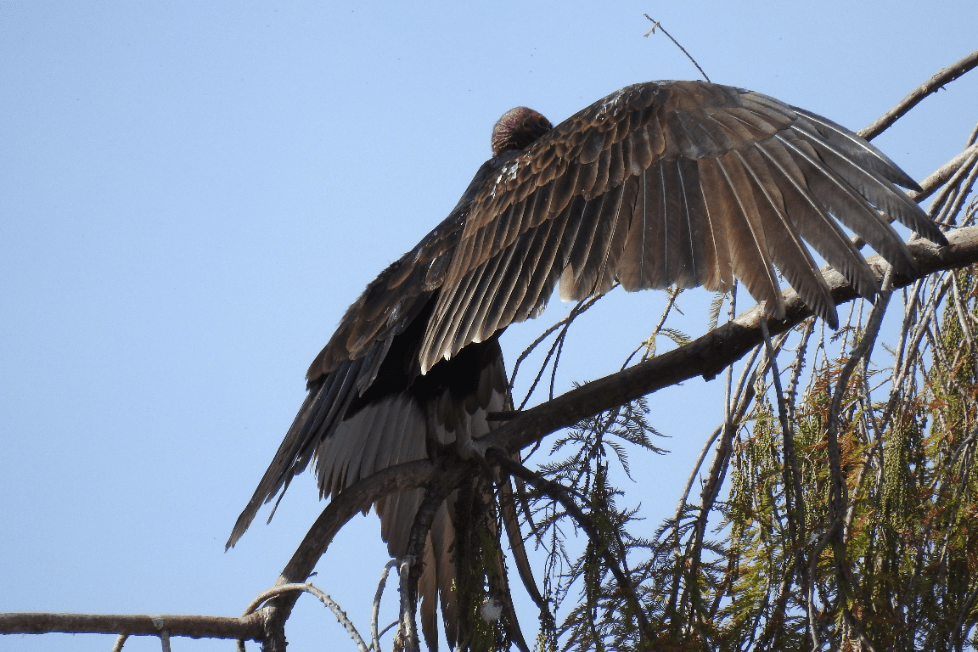
Figure 01. Turkey Vultures (Cathartes aura) are the most widespread of New World Vultures, enjoying a wide variety of habitats and locations.
This is the third of four blogs about New World vultures. The first blog focused on these vultures, their Cathartiformes order, and their Cathartidae family (https://bird-brain.org/2026/08/02/new-world-vultures-part-1/ ). The second focused on the Andean Condor (Vultur gryphus, https://bird-brain.org/2026/08/09/new-world-vultures-part-2/ ). This third blog focuses on the Turkey Vulture (Cathartes aura), as follows:
- Etymology
- Taxonomy
- Description
- Sounds and Vocal Behavior
- Distribution, Habitat, Migration
- Food and Foraging
- Locomotion
- Self-maintenance
- Social Behavior
- Breeding
- Lifespan and Survival
- Conservation Status
- Observations
- References
One additional blog will complete this series: the California Condor (Gymnogyps californianus). The other four living species of New World vultures will not be discussed in separate blogs, but they were discussed briefly at the end of Part 1.
Etymology
Previous blogs have noted that the order name Cathartiformes, family name Cathartidae, and the genus Cathartes come from Greek, katharos, for “purifier” or “purger,” which is the role of vultures in the ecosystems they inhabit. The second part of Cathartes aura, aura, is thought to be from Latin aurum, for “gold,” but it’s at least as likely to originate in an indigenous South American name for vultures, urubú. In some locations, it’s called a “Turkey Buzzard” or simply a “buzzard,” which can lead to an inappropriate link between this New World vulture and an Old World accipiter in the genus Buteo.
Mexican Spanish names for this vulture are Aura Cabecirroja (red head), Aura Común (common), or Zopilote Aura (probably originally a Nahuatl name; zopilote is used for the Black Vulture, too). Elsewhere in Latin America, its names include Urubú de Cabeza Roja (red head), Zopilote Cabecirroja, Cuervo Cabeza Roja (red-headed crow), and Gallinazo de Cabeza Roja (“Gallinazo Negro” is the Black Vulture). The Spanish Sociedad Española de Ornitología officially recommends Aura Gallipavo (“gallo” is chicken; “pavo” is turkey).
Taxonomy
The taxonomy for this vulture can be summarized as kingdom, Animalia; phylum, Chordata; class, Aves; order, Cathartiformes; family, Cathartidae (sometimes called Vulturidae); genus, Cathartes; binomen (binomial scientific name), Cathartes aura. In 1758, pioneering taxonomist Carl Linnaeus (1707–1778) included this species in the tenth edition of his Systema Naturae, based on a type specimen found in the state of Veracruz, Mexico; he named it Vultur aura. To see a facsimile page from his original publication, look at the bottom of the page, https://www.biodiversitylibrary.org/item/10277#page/101/mode/1up .
In 1811, zoologist Johann Karl Wilhelm Illiger separated Old World from New World vultures and created the Cathartes genus, into which he placed this species.
In 1811, Illiger also overhauled the Linnaean system of taxonomy and innovated taxonomical designations for elephants, manatees, and walruses. The previous year, Alexander von Humboldt had invited him to direct Berlin’s zoological museum (now the Natural History Museum of Berlin). (For more on explorer and naturalist von Humboldt, see https://en.wikipedia.org/wiki/Alexander_von_Humboldt .)
Most vultures are monotypic, having no subspecies, but the Turkey Vulture has five recognized subspecies, based on differences in geography and migration patterns (some being partially migratory and others fully so), as well as size (e.g., wing and tail length), plumage, and coloration of bare skin. Current methods of determining subspecies are based not only on the study of museum specimens and the seasonal distribution of subpopulations, but also on geographically identified photography of living birds, which more accurately capture coloration and other features.
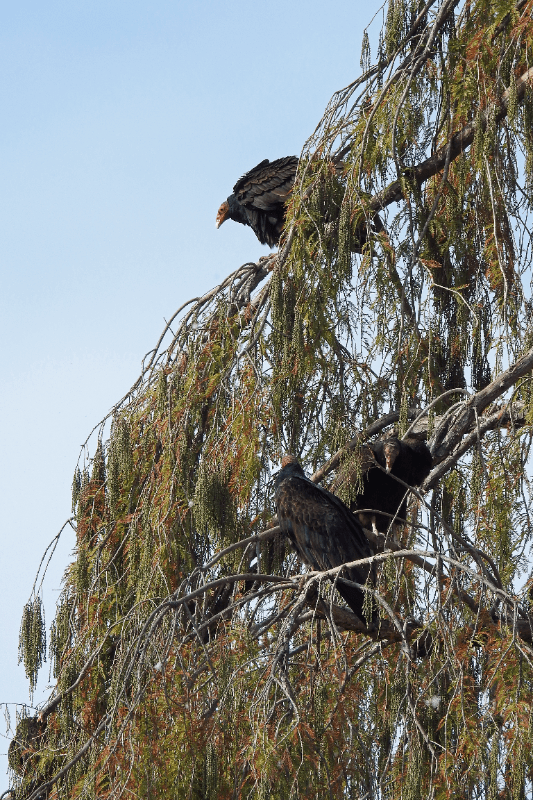
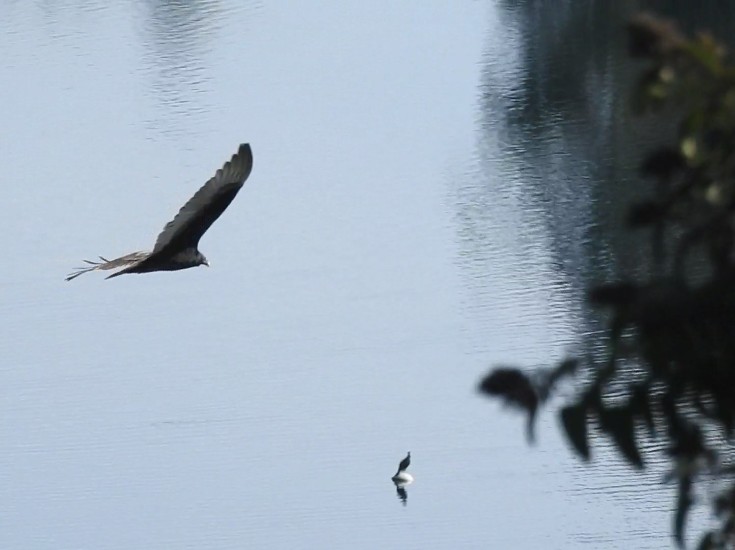
Figure 02. Contemporary methods of studying the taxonomy of Turkey Vultures include linking individual birds and their geography, using photography, as well as other techniques.
There have not been any verified hybrids of this species.
Description
Measurements
Male and female Turkey Vultures have identical plumage and coloration and are similar in size, with females averaging slightly larger — typical of raptors, some species of which include females much larger than males. It’s a relatively small vulture with very long wings (see Figure 03). Turkey Vultures also decrease in weight as they are found farther south; for instance, Floridian vultures weigh less than those from farther north but more than those in Venezuela (on average). Wing and tail length varies geographically, as well, with vultures at higher latitudes having longer wings and tails. Other geographic variations have been noted in particular locations and in east–west differences.
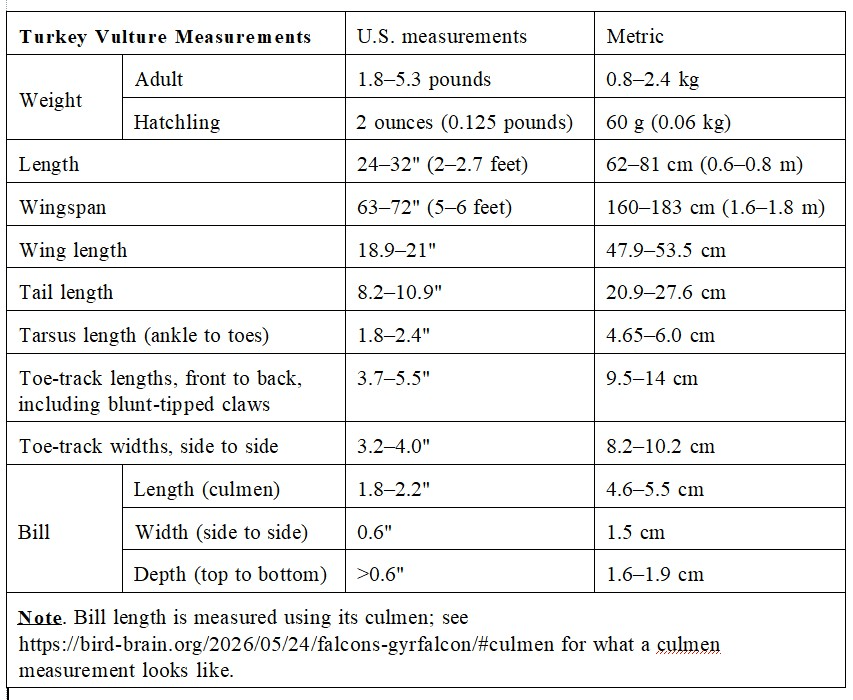
Figure 03. The Turkey Vulture is a relatively small, long-winged vulture, weighing less than would be expected for its wingspan, at 1.8–5.3 pounds (0.8–2.4 kg). Hatchlings weigh just 2 ounces (60g, 0.125 pounds). Its wingspan of 63–72″ (160–183 cm, 5–6 feet, 1.6–1.8 m) is impressive when compared with its total body length (bill to tail) of 24–32″ (62–81 cm, 2–2.7 feet, 0.6–0.8 m). Each wing is 18.9–21″ (47.9–53.5 cm) long. This vulture’s tail is also long, 8.2–10.9″ (20.9–27.6 cm), helpful for soaring flight. Its tarsi (ankle to toes) measure just 1.8–2.4″ (4.65–6.0 cm) long, but with toe tracks measuring about 3.7–5.5″ long (9.5–14 cm, front to back, including the blunt-tipped claws) and about 3.2–4.0″ wide (8.2–10.2 cm, side to side).
Plumage
Turkey Vulture adults’ plumage on its dorsal (back) surfaces is all brownish-black, when viewed with wings outspread. When viewing the ventral (front) surfaces, silvery-grayish white feathers form a band across the trailing edge of both wings — impressive in flight.
The dorsal side of a bird is its back, as well as the backs of its wings, legs, neck, and head; the ventral side of a bird is its front, including its underwings, breast, belly, and head (face). The leading edge of a wing is the front edge as the bird moves through air; the trailing edge of a wing is the back edge, where air flows over the wing and behind the bird.
This vulture’s neck and upper back have iridescent feathers that may gleam blue, purple, or green, when viewed at some angles of light reflection. Leucism isn’t uncommon among Turkey Vultures, but albinism is quite rare.
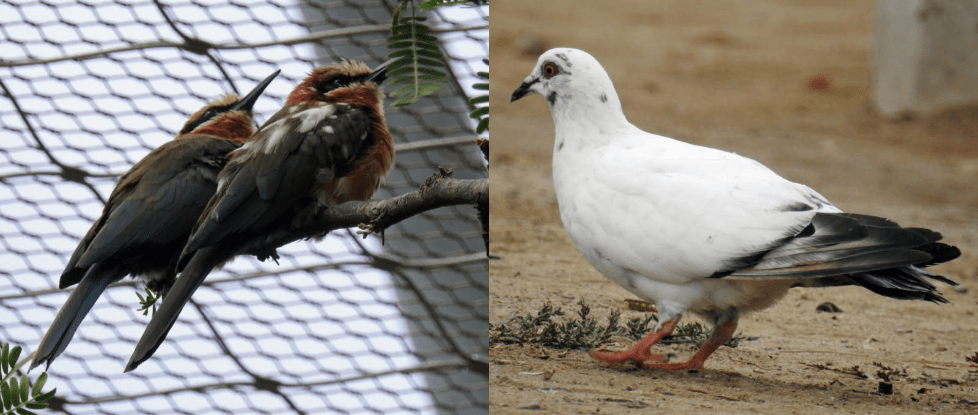
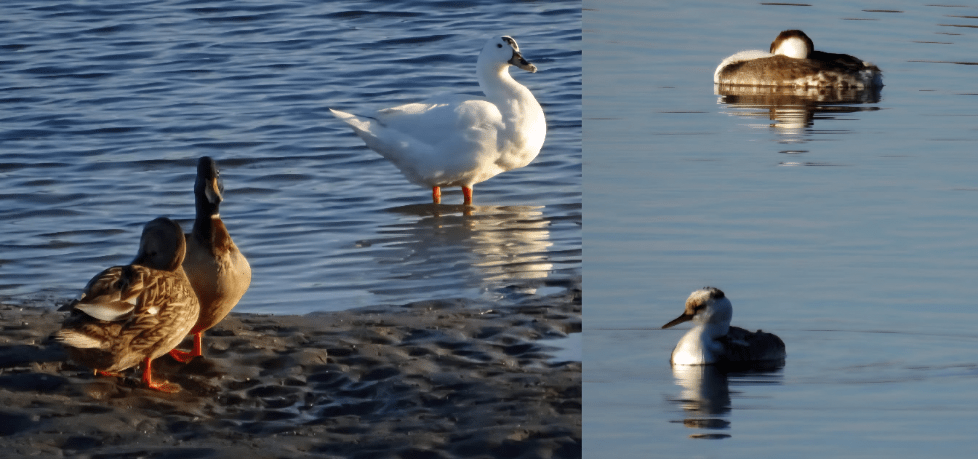
Figure 04. Leucism is the lack of pigment in some areas of a bird’s feathers, such as in these leucistic birds: (a) White-fronted Bee-eater (San Diego Zoo), (b) Rock Pigeon, (c) Mallard, and (d) grebe (Clark’s? Western?). For more information, see https://en.wikipedia.org/wiki/Leucism . Albinism is the total lack of any pigment everywhere, even in the irises of the eyes; because pigment serves a protective function, as well as affecting appearance, albinos are less likely to thrive or even to survive (for more information, see https://en.wikipedia.org/wiki/Albinism ).
Making up its impressive wingspan are 10 full-length primary feathers (attached to the outer “hand” of the vulture) and 13 secondary feathers (attached to the inner “arm”), as well as 3 tertial feathers (at the inner edge of the wing). Its long tail has 12 or 14 feathers (always an even number). Wing feathers are called remiges (singular, remex); tail feathers are called rectrices (singular, rectrix). Beneath their feathers and skin, Turkey Vultures have musculature that’s better suited for soaring flight than for flapping (powered) flight. These vultures have no powder down, present in some other bird species such as herons.
Adult Turkey Vultures undergo a gradual molt, starting with the more worn feathers and progressing as new feathers come in; feathers are lost and replaced bilaterally, symmetrically, so they’re not off-balance in flight. Typically, molting occurs from late winter through early spring to end of summer, but it may occur year-round among some populations. Throughout molting, at no time is the vulture unable to fly, despite replacing all primaries and most secondaries during each molt. Neither their plumage nor their bare parts change in appearance seasonally.
Bare Parts
The unfeathered skin of a Turkey Vulture is red, or at least pinkish, due to hemoglobin in its subcutaneous (under the skin) capillaries (tiny blood vessels). (Because the capillaries no longer carry hemoglobin in deceased museum specimens, they lack this coloration and may appear orange-ish.)
The Turkey Vulture has a relatively small head, in proportion to its body. Mostly unfeathered, its head has a few sparse bristly feathers on the crown. Around its brown eyes (grayish to dark brown irises) are eyelashes (specialized feathers) — an incomplete row of lashes on the top eyelid and two rows of lashes on the lower lid.
This vulture’s bare skin is loose and wrinkled, allowing its neck to expand or compress, and its neck collar to extend or to retract, such as when feeding. Its brow may also whiten while it’s feeding. The Turkey Vulture’s crimson head is tipped by a bright-ivory-white hook-tipped bill.
Above the Turkey Vulture’s bill are its perforate nostrils (not separated by a septum, so they provide a see-through view from one side of the bill to the other). Compared with the Black Vulture, this vulture has a far superior sense of smell, yet with similar visual senses.
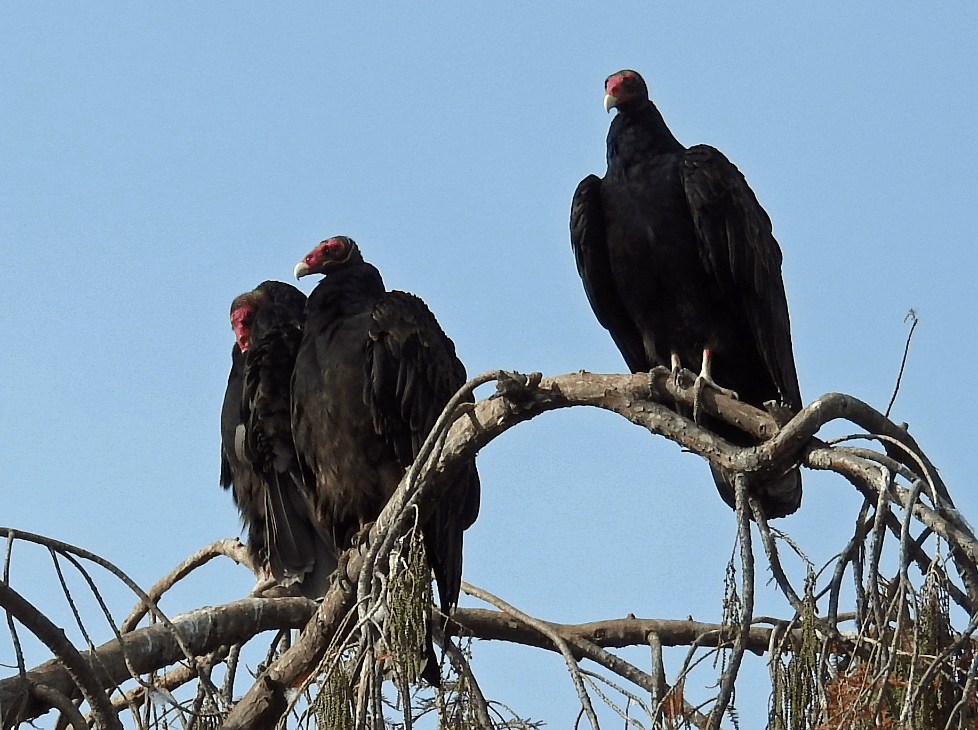
This vulture has short legs, compared with its body length and wingspan (see Figure 03 for measurements). Though the legs and toes are pink, due to urohidrosis (excreting feces directly onto their legs), their legs usually look whitish or gray. Their toes are arranged in the common anisodactyl pattern, with three forward-pointing toes and a fourth toe pointing backward. Two of the front toes are partially webbed at the base. Their flat, relatively weak feet are better suited to standing and walking than to grasping, and they wouldn’t work well for killing prey.
Sounds and Vocal Behavior
No vultures have a syrinx, the organ that allows songbirds to sing. Instead, they growl, snarl, cough, whine, hiss, grunt, and make other calls difficult to describe. Their wingbeats are also often audible. To hear any of 12 recordings of Turkey Vulture vocalizations, please visit https://xeno-canto.org/species/Cathartes-aura. Calls are heard most often at carcasses during interactions with conspecifics (other Turkey Vultures, the same species) — perhaps intended as threats. They may also “whine” before taking flight or while flying. Neither sex differences nor geographic variations have been observed.
During breeding season, either parent may give a distinctive call when about to enter the nest cavity to feed their nestlings, both to prepare the nestlings and to notify the other parent. Nestlings hiss loudly before and during feeding bouts, presumably prompting the parent to feed them. During courtship and copulation, calls include hiss-grunts and huffs, believed to be communication between partners.
Distribution, Habitat, Migration
Distribution
Turkey Vultures, the most widespread New World vultures, enjoy a wide distribution throughout the Americas, from −55.72 degrees southern latitude to +54.31 degrees northern latitude. Its range, described as neotropical to nearctic, extends from the southernmost tip of South America to southern Canada. The IUCN Red List includes 30 nations where it resides, as well as 7 more where it may be found either outside of breeding season or as a vagrant. It has even been seen as far north as the Yukon and Newfoundland. It is thought that as the climate crisis warms the planet, these vultures may expand farther northward to breed.
Figure 06. Turkey Vultures have readily adapted to a wide array of geographical locations and habitats.
Please see the eBird range map: https://ebird.org/map/turvul? , based on the observation of citizen scientists throughout the Americas. It inhabits regions from sea level to 14,100 feet (4,300 m), occupying a territorial range estimated at 10,860,000 square miles (28,126,400 km²; range 3,146,700–15,521,000 square miles, 8,150,000–40,200,000 km²).
Habitat
Given their widespread distribution, their choice of habitats varies widely, too, from sea level to 15,000 feet (0–4500 m), deserts to woodlands, coastal islands to wetlands, pastures to shrublands. A few preferences, though: Dense forests aren’t their favorites, but completely treeless flatlands aren’t favored either. Human-sculpted habitats are okay when not breeding, but during breeding season, these locations don’t offer enough good, isolated nesting sites.
Turkey Vultures’ lifestyle dictates some of their habitat choices. For instance, they can easily soar seemingly endlessly, but launching into the air takes effort, so they prefer habitats offering elevated launch sites, such as cliffs or a scattering of leafless trees. Especially attractive are places with updrafts, next to open areas with daytime thermal air currents. Dense forests make soaring and maneuverability difficult, so they tend to avoid those. They can detect carrion by both smell and sight, so a mixture of trees and open areas suits their abilities. They also prefer not to have other vultures (e.g., King Vultures) compete with them for carrion, so they tend to avoid places where these vultures are abundant. They also seem to prefer hilly locations over truly mountainous ones.
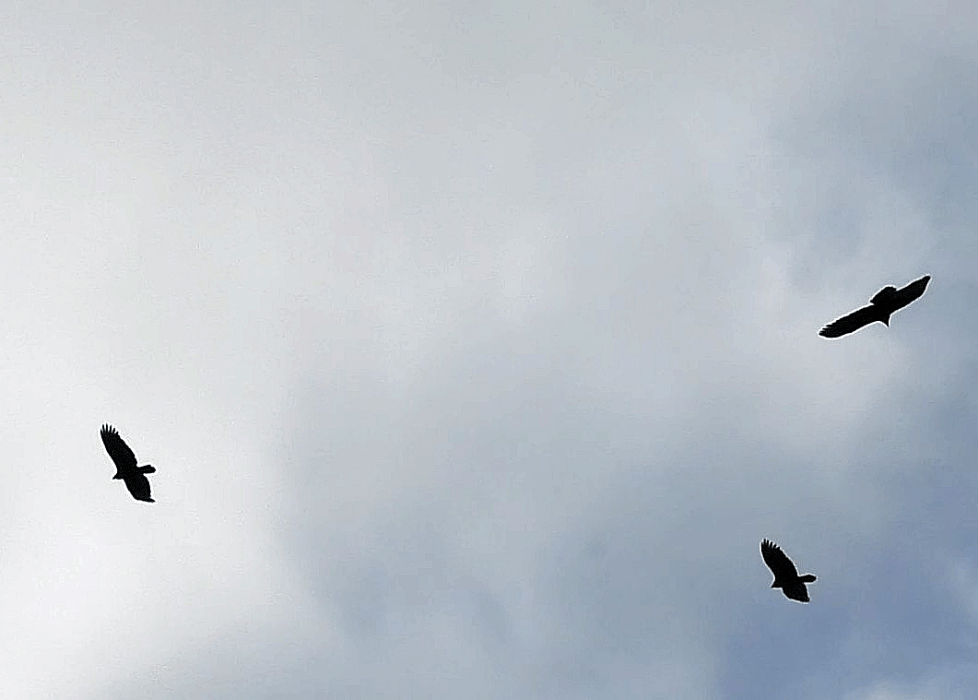
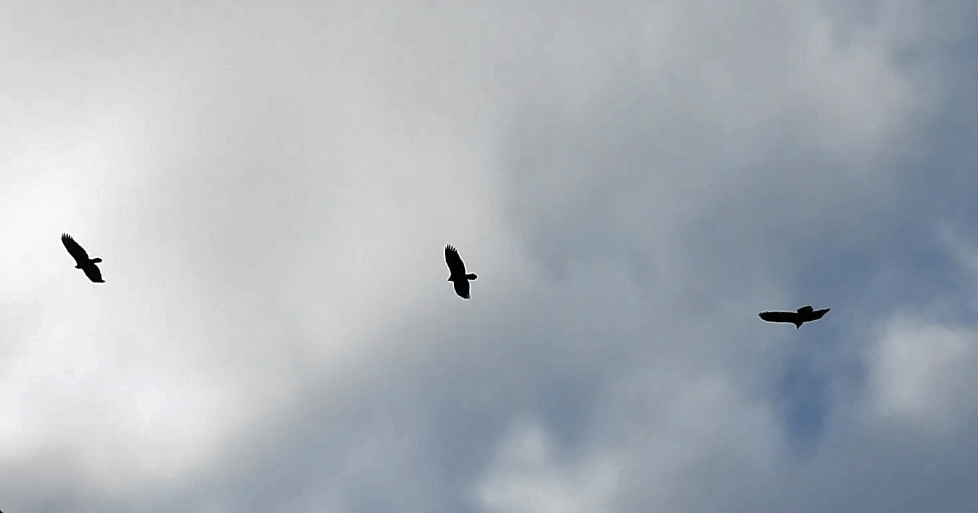
Figure 07. Though Turkey Vultures can soar seemingly effortlessly, getting airborne requires a lot of effort, so they often choose habitats offering an elevated launch site.
When roosting, the Turkey Vulture prefers large trees with horizontal branches (especially spring through summer), tall cacti (e.g., Saguaro), or conifers (especially autumn and winter); rocky outcrops; or even human infrastructure such as water, powerline, or microwave towers. It also seeks out open country adjacent to wild forested areas for roosting or nesting. When nesting, it seeks out dark recesses, such as caves, cliff ledges, hollow trees or logs, abandoned buildings. For Turkey Vultures who are year-round residents, considerations for breeding habitat are important year-round.
In order of preference (per Avibase), habitat choices seem to be (1) wooded grasslands, pampas, and arid plains; (2) high-altitude punas, altiplanos, and grasslands; (3) savanna or acacia woodlands, thorn forests, tropical deciduous forests; (4) swamp forests, taigas; (5) deserts; (6) agricultural plantations, suburbs, or other human-sculpted habitats; (7) shrublands and scrublands; (8) escarpments, cliffs, outcrops; (9) sea coasts, mangroves, bays; and (10) wetlands, marshes, salt lakes. (IUCN Red List has a different ordering but includes the same kinds of habitats.)
Movements and Migration
Many Turkey Vultures live in one general location year-round, but they may shift around in their habitats with seasonal changes. For instance, during winter, when human activities slow down, these vultures may exploit urban areas more. When migrants are visiting, the residents may move to avoid the visitors. Many year-round residents stay fairly close to their natal nesting grounds. (In one study, 2- and 3-year-olds were within 15 miles, 25 km, mean; 10 miles, 16 km, median; farthest, 133 miles, 215 km, from natal nesting grounds.) Other Turkey Vultures are nomadic, wandering around in their resident territory, regardless of season.
Figure 08. When thermal air currents or updrafts aren’t adequate for soaring, Turkey Vultures have to flap their wings in order to stay aloft. Doing so is tiring, so when migrating, Turkey Vultures fly almost exclusively when thermal air currents or other updrafts allow them to soar. When thermal currents aren’t adequate for soaring, they take a break and find somewhere to perch.
Still other Turkey Vultures are partially or fully migratory. When breeding adults migrate, they show site fidelity, too. They return to the same nesting sites year after year, and they roost in the same sites during winter. Tracking studies also show that they follow similar routes when migrating. Even so, daily migration distances differ between northbound and southbound migrations.
Of the migratory Turkey Vultures, some are obligate long-distance migrants. For instance, some vultures breed in southern Canada during summer in the northern hemisphere, then fly south fleeing the northern winter, toward the equator; other vultures breed during summer in the southern hemisphere and fly north toward the equator in southern winter. They must migrate to survive. Not only are sun-heated thermal air currents lacking, but also frozen carcasses are tough to eat, and some potential carrion may hibernate or otherwise be less accessible during winter. It’s thought that falling temperatures (with a presumed reduction in available thermal air currents), snow cover, and winter storms prompt them to migrate.
Other migrants are facultative (optional) short-distance migrants. For instance, some vultures in the western United States fly northward to breed during winter then fly southward outside of breeding season. Different subspecies also have different geographical distributions and migration patterns.
Turkey Vultures migrate almost entirely by soaring or gliding, rarely using powered (flapping) flight. To soar, vultures (and other soaring birds) mostly follow thermal air currents, where the ground is heated by the sun, causing warm air to rise through convection, carrying them aloft. In addition, they follow updrafts along the edges of mountains, hills, or escarpments (long steep cliffs); as air movement hits against the steep slopes, deflection forces the air upward, providing lift for birds who fly along the cliff edges. Though Turkey Vultures are typically low-altitude migrants, they may soar atop thermals thousands of feet up (several hundred meters); when the ground topography changes, they may glide awhile to reach the next thermal or updraft. In general, Turkey Vultures avoid water crossings. To do so, they must intermittently flap and glide, and they appear to be exhausted by the time they reach the opposite shore.
The requirements of soaring mean that they typically migrate during the day (when the sun’s heat creates thermals); observations of them peak in the afternoon. Rainy or overcast days don’t provide adequate thermal air currents for migratory flights. These vultures usually fly in loose flocks — either in “kettles” (bunches) or in narrow lines, often with other species (e.g., hawks), as well. When the migration route narrows, such as when following a ridge, they migrate into an hourglass, wide before they enter the narrowing, then wide again after they leave it. Flocks also close in together in anticipation of storm fronts, or along shorelines.
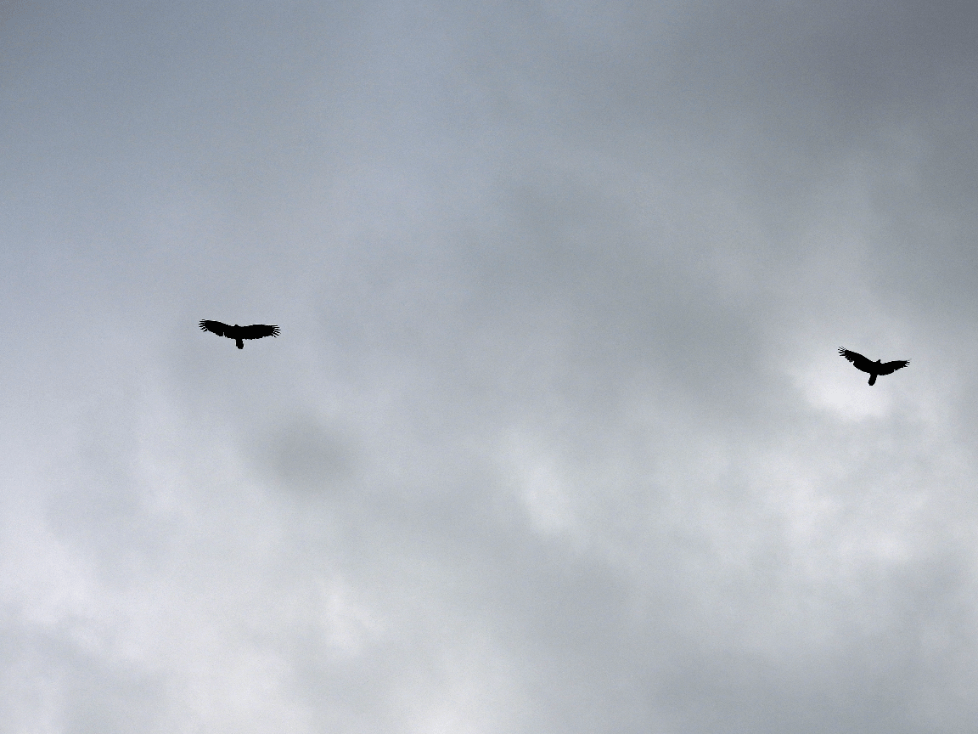
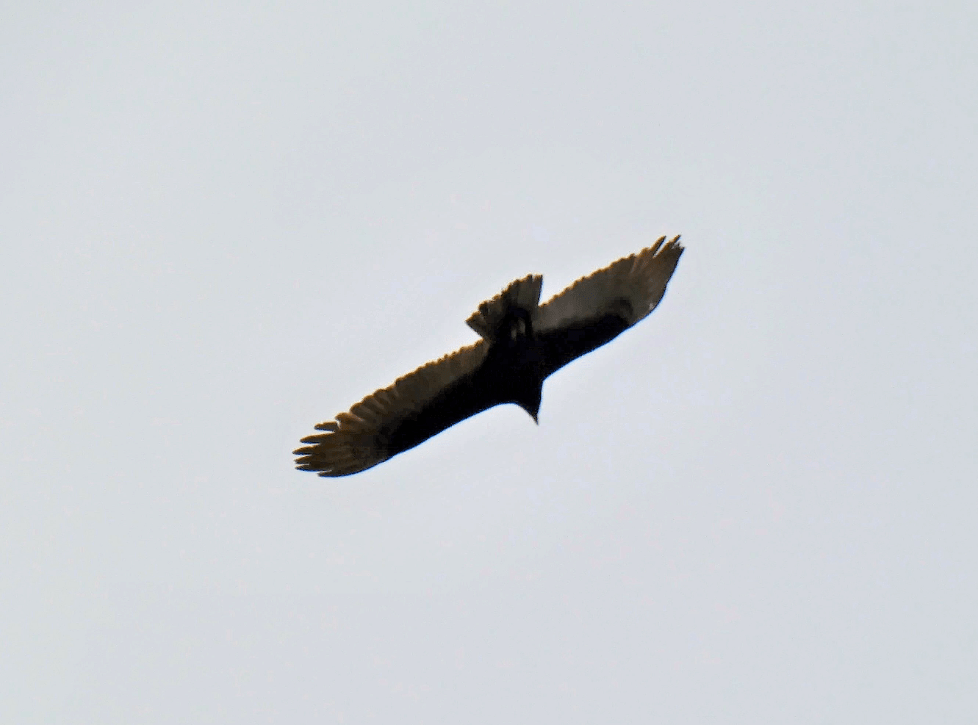
Figure 09. Turkey Vultures fly almost exclusively during the heat of the day, when the thermal air currents make soaring easiest. In locations with ridges and cliffs, deflected updrafts offer another option for soaring.
In a study of 174 migrations of radio-tagged Turkey Vultures, migrations of 100–4,600 miles (160–7,362 km) lasted 7–72 days, and daytime stopovers of these vultures were about 1.1–8.2 times per migration. Each daytime stopover lasted 2 hours to more than 11 days, with more than half of the stopovers lasting less than a day. Many migrations of less than 2,800 miles (4,444 km) had no daytime stopovers. Many of these stopovers seemed to be in response to rain or to weak thermal air currents, and migration resumed when conditions for thermal soaring improved.
Rarely did it seem that foraging was a motivation for stopping over. In fact, fasting seems to be typical for most migrant vultures. This inference is based on these observations: Observers haven’t seen them foraging, they notice neither whitewash from defecation nor pellets under nocturnal roosts, and the vultures weighed less upon reaching their destination. Migration distances of more than 4,000 miles (>6,500 km) may require them to feed during migration, though this hasn’t been observed. Researchers also infer that these vultures may store fat prior to migrating. In captivity, individual Turkey Vultures can fast for up to 16 days, apparently without detriment.
When migrating long distances, the Turkey Vulture migrates faster in the spring, which has stronger thermal air currents and longer daylight hours, than in the autumn. This difference is probably due to more energy-efficient flight, as well as more hours/day for flying. For migrants, average daytime flight speed was observed at 3.7–7.5 mph (6–12 km/h), but other observations have noted maximum flight speeds up to 15–32 mph (24–52 km/h).
Food and Foraging
Feeding
According to Avibase, the Turkey Vulture diet is almost exclusively carrion, varying with the availability of carrion, related to geography, habitat, season, and incidental occurrences such as fire, drought, or disease. Carrion is mostly mammals, from small (e.g., mice, shrews) to midsized (monkeys, capybaras, raccoons, etc.) to large (e.g., hoofed such as cattle). They also feed opportunistically on a wide variety of carcasses, much more than Black Vultures or Andean Condors in the same territory. They prefer to eat smaller carcasses than the other two vulture species, and they eat animals from more diverse taxonomic classes (fish, reptiles, amphibians, birds, invertebrates, as well as mammals).
At the shore, they’ll eat washed-up dead fish or turtles, as well as marine mammals. They eat the carcasses of wild or domestic birds, reptiles (snakes, caimans), or amphibians. They prefer freshly dead carcasses (e.g., recent roadkill) and avoid putrefied ones under most circumstances. Less often, they will eat dung (e.g., coyote, puma, sea lion, cattle). They’ll even steal processed feed given to zoo animals or pets. In addition, researchers who studied the undigested pellets expelled by Turkey Vultures discovered that these vultures had eaten plant matter contained in the viscera of the carrion, in addition to some rotten fruits (e.g., pumpkins) and other agricultural crops, as well as shoreline vegetation.
Figure 10. When pulling flesh or viscera from a carcass, the Turkey Vulture may hold down the carcass, using its toes.
The larger and much more aggressive Black Vulture has been reported to have killed livestock, but the Turkey Vulture has not. On rare occasions (presumably when carrion can’t be found), they may kill weak young animals (e.g., bird eggs or hatchlings); sick, injured, or trapped living animals; or small tadpoles or frogs, as well as invertebrates. Invertebrate prey are mostly carrion-feeding insects, which they may not be consuming intentionally, but these vultures also eat bivalves, snails, crustaceans, and other invertebrates.
As an example of their aversion to live prey, some captive Turkey Vultures were offered pails of water containing small living fish. The Turkey Vultures captured the fish with their bills, dropped them on the floor, then waited until the fish died before eating them.
Turkey Vultures can use both keen scent detection and acute vision to find carcasses. As compared with the condors, the King Vulture, and the Black Vulture, this vulture has not only larger nostrils and olfactory chamber, but also much larger olfactory bulbs in its brain (4× larger than the Black Vulture’s). In fact, its olfactory bulbs are relatively larger even than those of many other birds known for having superior senses of smell (exception: Northern Fulmars). Repeated studies have shown that it uses its olfactory physiology to locate carrion obstructed from view. Turkey Vultures also flexibly use vision and other senses to locate carrion, so they don’t rely solely on their sense of smell. Freshly dead carcasses can’t be detected by smell as readily as carcasses at least one day after dying. Dense vegetation also affects the ability to detect carcasses by scent (as well as by sight). Turkey Vultures will fly lower over densely forested environments, to more readily detect the scent of carrion.
When out foraging, the Turkey Vulture typically does so alone — usually from < 100–164 feet (< 30–50 m) up. Once it finds a carcass, however, it’s unlikely to remain alone, as other vultures (Turkey Vultures and other species) know to look not only for carrion but also for Turkey Vultures. If this vulture finds a small carcass, it will eat all of it as quickly as possible, before other scavengers arrive.
If the carcass is big, however, the Turkey Vulture doesn’t have the ability to penetrate the thick skin of a large animal. If left alone, the Turkey Vulture may begin eating from the more vulnerable areas, such as the anus, the genitals, the mouth, or any open wounds. Over time, as the carcass putrefies, it may be possible for the Turkey Vulture to break through the rotting skin.
More commonly, other vultures will arrive soon. The Turkey Vulture is higher in the pecking order than either of the Yellow-headed Vultures, but it’s easily displaced by the other four species of vulture (e.g., the condors). Nonetheless, if the carcass is large, with thick skin (e.g., most large mammals), the Turkey Vulture may be glad for a condor or other large vulture to break open the carcass. Once a large carcass has been opened — and after the higher-ranking vultures are sated — the Turkey Vulture deftly picks the flesh and viscera from the bones. Vultures aren’t the only competitors for carrion. Sometimes, ravens, falcons, hawks, or even eagles will join in the feast. (Crows are easily dissuaded from joining until after all the raptors have had their fill.)
Figure 11. Turkey Vultures soar alone when looking for food, but soon after they find a carcass, they are usually joined by other vultures.
When eating small animals (e.g., opossums), the Turkey Vulture can extract the flesh by pulling the skin inside out, using its feet (and its extra-long middle toe) to hold the carcass while manipulating it with the bill. For very small animals (e.g., mice), it may either swallow it whole or eat it piece by piece.
The Turkey Vulture typically eats its fill on the ground, at the carcass (though it has been seen landing on floating carcasses of alligator or manatee). Rarely, it has been seen to drag off the carcass for a short distance (less than 20 feet, a few meters), but its feet aren’t strong enough to grasp and carry parts of a carcass any distance. It has been seen carrying off small amounts in its bill for a short distance. The only way it stores food is in its crop. Fortunately, it can go without food for up to 8 days with no apparent ill effects, and it seems able to survive for somewhat longer but less than 17 days.
Drinking
Though Turkey Vultures seem able to go without drinking water, they readily drink whenever water is available, both in the wild and in captivity. To drink, it dips its bill into the water then rapidly (and noisily) opens and closes its bill. Then it lifts its head, tipping it upward slightly while moving the tongue forward and backward, presumably to facilitate swallowing the water. It repeats these actions until finished drinking.
Expelling: Pellets, Vomit, Feces
Wherever Turkey Vultures roost or rest, they may expel (cough out) pellets of indigestible bits (e.g., fur, scales, usually not bones, which its stomach acids can digest). To do so, the vulture holds its body horizontal, with its head hanging downward and its bill partly open. It bobs its head up and down a couple of times then extends its head forward and down, appearing to gag, then coughs up 1–2 pellets, the whole process taking just seconds.
Sadly, their willingness to opportunistically eat a variety of carrion and garbage has made vultures vulnerable to consuming plastic waste. Analysis of pellets has revealed plastic waste in Turkey Vultures in North and South America, as well as on remote islands. Such waste is more common when vultures live near human settlements.
When Turkey Vultures are feeling threatened, they are known to regurgitate the contents of their crop and perhaps even their stomach. It’s thought to be a way of making take-off easier by lightening the bird’s weight. It may also distract or repel a predator, as its stench repels humans and perhaps other mammalian predators. To vomit, the vulture simply opens its bill and lets the contents fall out; no active propulsion is involved.
The typical position for normal defecation is to slightly lower the upper body and slightly raise the tail (0–45 º from horizontal for both), then shoot the feces out the back. If wings are spread, the vulture may raise the wings slightly while leaning forward. If the vulture is incubating in its nest, it will take a few small steps backward to defecate away from the nest.
Metabolism, Thermoregulation
Under normal circumstances, the core body temperature of the Turkey Vulture doesn’t fluctuate with ambient temperature, though this vulture does typically lower its core temperature by about 11 º F. (6º C) at night, when the ambient temperature is lower. After waking, it may shiver to quickly raise its core body temperature. The Turkey Vulture may also shiver in cold or wet environments (or both). The intensity of the shivering varies, from subtle (e.g., while incubating at night) to exuberantly vigorous when extremely cold and wet. It has several other adaptations for fluctuations in ambient temperature.
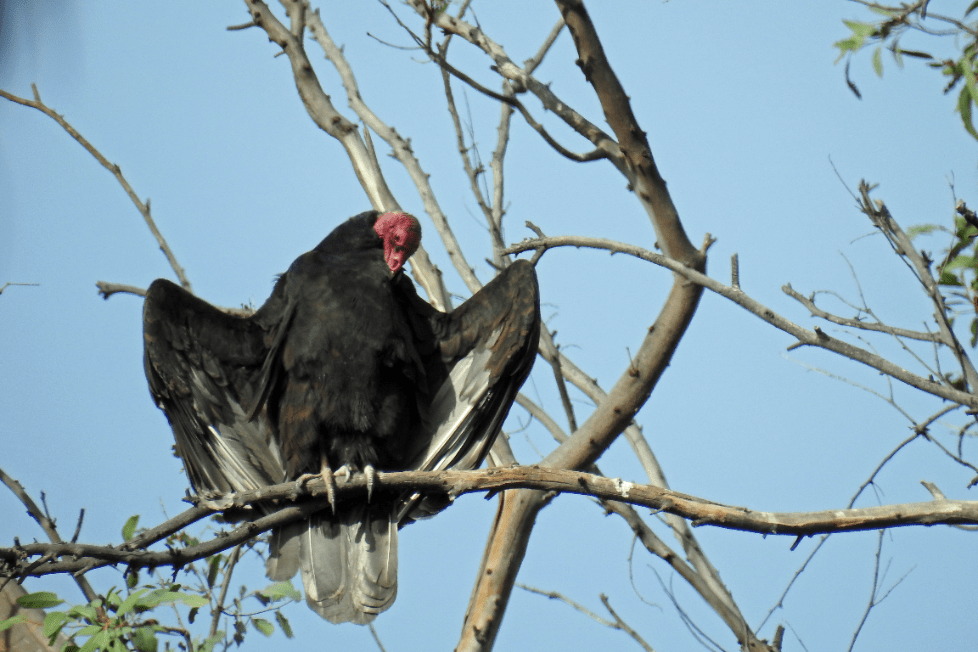
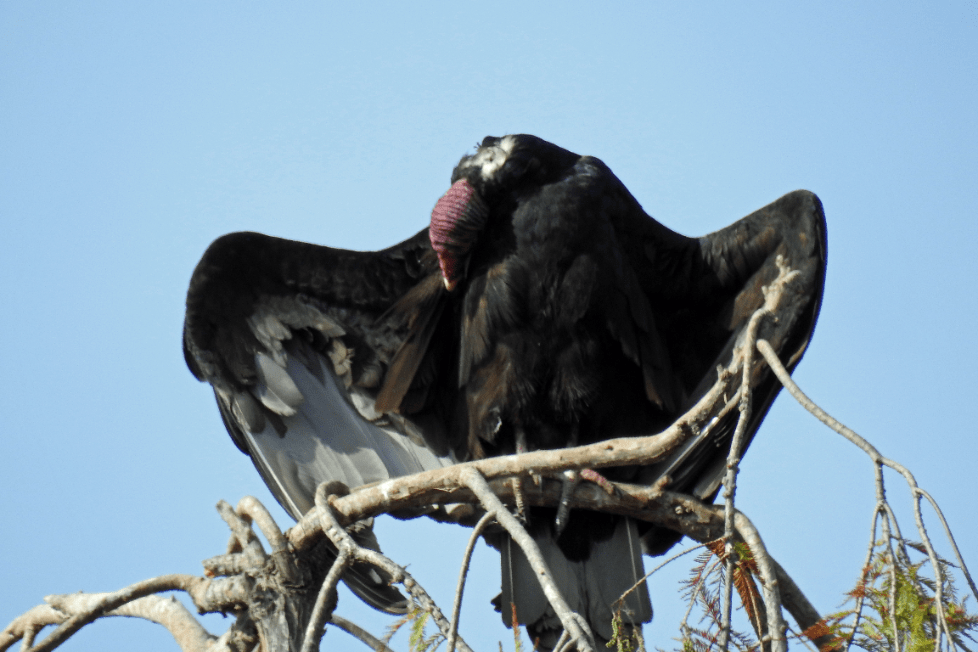
Figure 12. In addition to many physiological adaptations for regulating body temperature, the Turkey Vulture has several behavioral adaptations, such as the “Delta-wing Posture,” in which the vulture faces toward the sun, upright, with inner wings outward and outer wings pointing to its tail, to warm up. In this posture, the Turkey Vulture may also preen, typically on the surfaces being warmed by the sun.
When the ambient temperature is chilly, the Turkey Vulture can conserve heat by reducing the blood flow to the skin on its head, and controlling the blood flow to its wings and legs. Behaviorally, it may squat onto its legs, pull in its bare neck, and tuck the top of its head into its neck ruff or its wing feathers. It may also use the “Delta-wing Posture,” as shown in Figure 12. In winter, it may also choose a coniferous evergreen tree in which to roost, rather than a leafless deciduous tree. (For more on vulture posture, please see
https://bird-brain.org/2026/08/02/new-world-vultures-part-1/#Stance .)
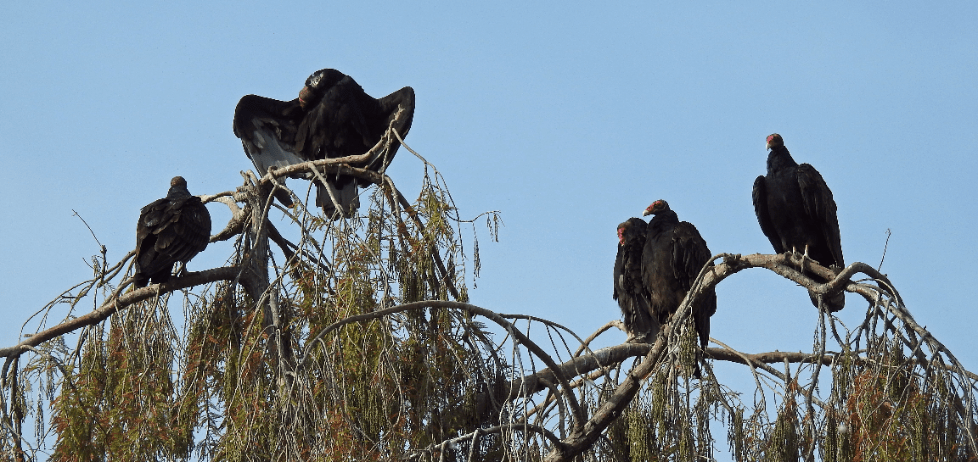
When the ambient temperature is too hot, the Turkey Vulture takes advantage of its extensive bare skin on head, neck, and legs; it directs blood flow to the highly vascularized (dense with blood vessels) bare skin and vasodilates the skin (which turns brighter red), to cool off. It also stretches out its bare neck and may also erect its body feathers, to allow some air to reach the skin beneath. Like many other birds, it also pants (more than doubling its breaths per minute, from 70 to 160) and may flutter its gular pouch at the front of its neck. It’s thought that the “Spread-wing Posture” (see Figure 13) may help to cool the vulture in a hot environment. In this posture, the vulture may also stretch its jaw, shake its head, preen, or even defecate. This posture also works well for drying the wings after rain. Like other vultures, the Turkey Vulture also uses urohidrosis — excreting liquid directly onto its legs and feet (please see https://bird-brain.org/2026/08/02/new-world-vultures-part-1/#Thermoregulation ), to cool off.
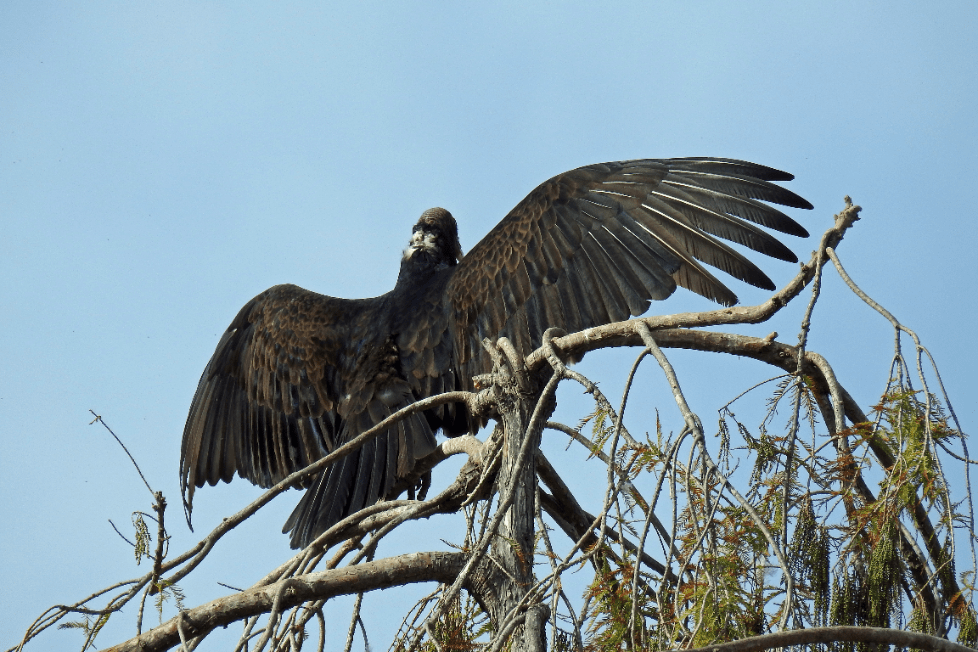
Figure 13. To cool off, Turkey Vultures may display the “Spread-wing Posture,” perching upright, turning away from the sun, and extending both wings outward.
Locomotion
On the ground, the Turkey Vulture can walk, run, or even hop (rather awkwardly), using a horizontal or partly horizontal posture. On horizontal tree branches, it typically sidles along with an upright or slightly tilted posture. Older nestlings, as well as adults, can climb on trees and rocks, using feet and bill, as well as perhaps flapping wings for balance.
Turkey Vultures don’t swim, but they will wade up to their belly feathers to bathe or to feed.
Like other vultures, though Turkey Vultures can flap their wings to fly, but they are built for soaring (without flapping the wings), rather than for powered (flapping) flight. Powered flight consumes a lot of energy, as does takeoff when done from the ground. To take flight from the ground, the Turkey Vulture flaps its wings vigorously while hopping and pushing off with its feet. From an elevated perch, however, it needs only to spread its wings and take off into the air to glide forth.
In addition to soaring on thermal air currents (“thermal soaring”), vultures can soar on updrafts (“slope soaring”) that occur along mountain ranges, cliffs, and other places where air is deflected upward when it hits up against a cliff face. Migration routes can sometimes be chosen to follow these updrafts. When neither thermal air currents nor slopes are adequate to keep the vulture aloft, it may glide slowly downward, pulled by gravity. When gliding, the vulture may occasionally flap to fly back upward, but it won’t do so for long. If neither slope soaring nor thermal soaring are available, vultures will rest until the ground heats up enough to resume thermal soaring.
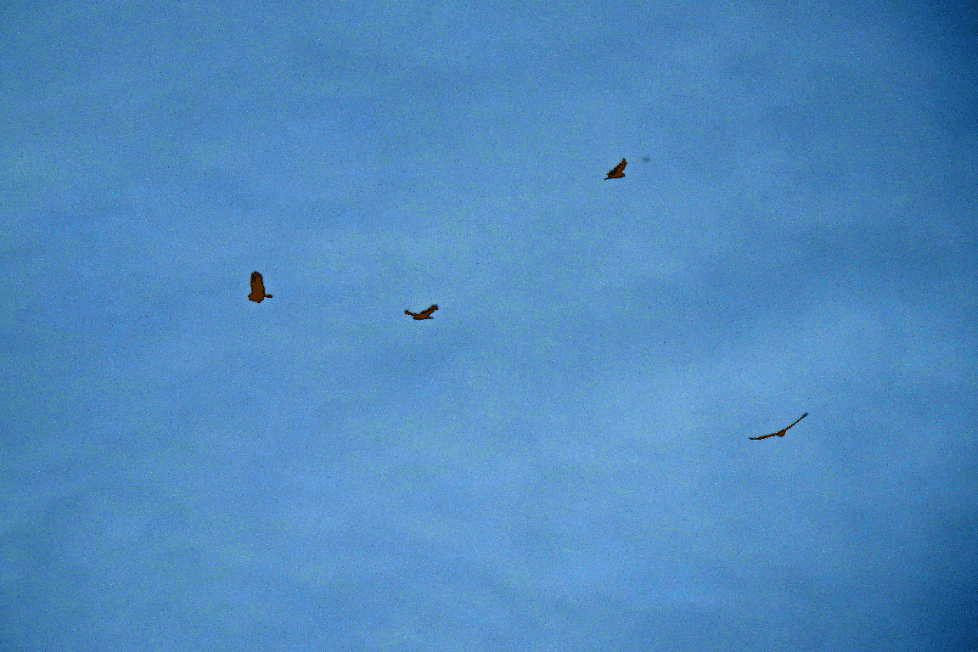
Figure 14. Unlike condors, which soar at high altitudes, Turkey Vultures fly lower to the ground, so they can detect the scent of carrion. At these lower altitudes, air turbulence can be more problematic, so they hold their wings at a dihedral angle, rocking side to side while soaring on thermal air currents.
Unlike condors, the Turkey Vulture’s wings aren’t flat and perfectly horizontal in flight; instead, they’re dihedral, tilted slightly upward to form a very shallow “V” shape. While soaring, its wings rock side to side, kept aloft by rising thermal air currents, rarely having to flap. An advantage to dihedral wing posture is that it’s more stable in turbulent air conditions, such as those found at the lower altitudes used by Turkey Vultures.
Self-maintenance
Because Turkey Vultures rely on thermal air currents to soar in pursuit of carrion, their times for foraging are shaped by the sun and the wind. On especially windy mornings, they may occasionally leave their roost to forage as early as an hour before sunrise, but they more typically stay in the roost and preen and stretch for awhile. (On rainy days, they may stay at the roost all day.)
About 1–5 hours after sunrise, the thermal air currents are optimal for soaring, and they leave to forage. About 1–3 hours before sunset, the thermal air currents typically subside, so after spending hours soaring and foraging, they’ll return to their roost. If the winds or the thermals continue to be strong, however, they may not return to roost until about half an hour after sunset, though they usually forage near the roost during the last 1–3 hours before sunset.
Before leaving to forage, or after returning from foraging, a Turkey Vulture will preen, shake, and stretch. This vulture typically spends about 2–3 hours/day preening, mostly nibbling with its bill tip at the base of the feathers, but sometimes also running its bill along each individual feather, from base to feather tip. The primary and secondary remiges (wing feathers) and the rectrices (tail feathers) get extra attention. It will also shake or scratch its head, stretch its jaw, rouse all of its feathers while shaking its wings, and wag its tail side to side.
It will stretch its body and tail, stretching its leg and wing on one side and then on the other, then stretching both wings at once. It may do so while in the roost, but more often at an outcrop near the roost. Its especially likely to do the stretching, shaking, and preening before taking flight. Before takeoff, it typically defecates (lightening itself for liftoff) and occasionally casts pellets.
When Turkey Vultures bathe, they wade into shallow water, crouch enough to touch their belly to the water, hold their wings slightly away from the body and quickly flap them up and down. They may also briefly dip the head or neck under the water then lift it up, letting water roll down the back.
Typically, when resting on a flat surface, a Turkey Vulture will hold its body horizontal or slightly oblique to horizontal, with its bill resting on its back, tucked into its scapular (shoulder) feathers. When perched on a sturdy limb, the vulture will rest its breast on the perch, hold its body vertical, and point its bill downward. Some Turkey Vultures have one particular roost that they use every night, perhaps for years; other roosts may be seasonal; and yet others may be used only during migration or only when carrion is nearby. Some Turkey Vultures simply change their roosts from time to time, perhaps rotating among local roosts.
Social Behavior
Turkey Vultures are social — communal — roosters year-round, though the numbers at a roost may vary, often by location and by season. Typically fewer than 100 vultures roost communally in one location, but up to 400 aren’t uncommon, and even several thousand can be seen, especially during migration and in winter. They have also been seen roosting with other species, such as Black Vultures, caracaras (a kind of falcon), and even Great Blue Herons. Observers see the most birds together at a roost either at dawn or in the evenings after a day of foraging.
Figure 15. These Turkey Vultures are “volunteers” at the San Diego Zoo’s Safari Park. Though these vultures are social and communal, they don’t always have amicable interactions.
Turkey Vultures also sometimes fly with other vultures and other birds. It may not be intentional social grouping, however, as they may simply be drawn to share advantageous thermal air currents and updrafts. These groups may be 1–5, up to 20 or so, or even 200–300, usually when food supply attracts more birds to the location.
In addition to roosting communally and flying socially, Turkey Vultures end up feeding communally. Though individual Turkey Vultures seek out carrion on their own, once they find carrion, they’re usually soon joined by others, with the size of the group linked to the size of the carrion. Their communal roosts may facilitate group feeding and social interactions.
Amicable social interactions can be important. When interactions aren’t amicable, they’re typically of low to moderate intensity; high-intensity interactions, involving physical contact (e.g., kicking and biting), occur just 2% of the time. According to the Cornell Lab’s Birds of the World (https://birdsoftheworld.org/bow/species/turvul/cur/behavior#agnbehav ), “In 99% of 2,525 encounters, the individual that initiated interaction won without contest.”
One research team found that among wild Turkey Vultures, dominance hierarchies (pecking orders) seem tied to body size, satiation level (how hungry?), prior use of the carcass, and perhaps perceived costs and benefits of agonistic interactions. Age also plays a role, with older birds having greater success than younger ones, able to eat first and eat longest. Those who are waiting are sometimes called a “queue” of birds. Any evidence of territoriality seems equivocal, outside of breeding season, when parents protect their nest sites.
Though Turkey Vultures often congregate at carrion, other scavengers are attracted to a carcass, too, such as other vulture species (especially Black Vultures), other raptors, and even carnivorous mammals. Turkey Vultures must often step aside when hordes of Black Vultures descend on a carcass in a feeding frenzy. (In South America, a subspecies of Black Vulture is typically smaller than the others, so it loses to Turkey Vultures there.)
Turkey Vulture adults are rarely subject to predation, but natural predators such as raptors (owls, hawks, eagles) may prey upon fledglings and immature Turkey Vultures. Mammals (e.g., raccoons, dogs, foxes) may prey upon their eggs and their nestlings, as well. When the nest is threatened, a Turkey Vulture parent will disgorge the wretched, malodorous contents of its crop and stomach, which usually deters predators approaching the nest. Away from the nest, a threatened vulture will vomit to become light enough to take flight quickly and easily. When threatened by a human’s approach, this vulture will not only regurgitate, but may also feign death, with color draining from the skin of its head, its head hanging listless, mouth agape, and eyes open. If the human handles the apparently deceased vulture, it will neither struggle nor bite.
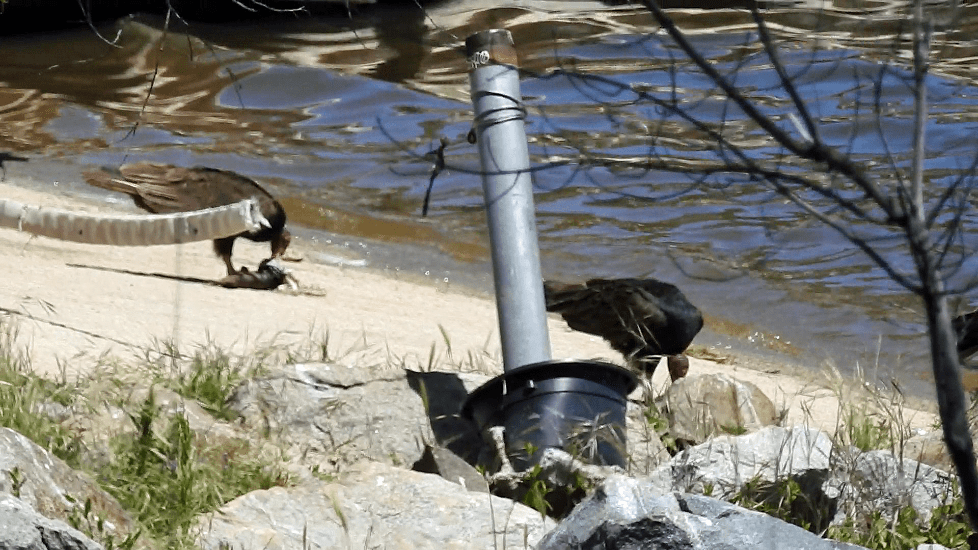
Figure 16. Turkey Vultures are typically sociable, but they particularly like to hang out together when they see another vulture feeding on carrion.
Breeding
Though Turkey Vultures roost and feed and sometimes even fly communally, they aren’t cooperative or colonial breeders. Brood parasitism is unknown for this species. Pairs are monogamous, probably lifelong partners, though they don’t typically associate while migrating or between breeding seasons. Pairs usually make one breeding attempt per year, though a second attempt may occur if the first attempt fails. The timing of breeding varies with the latitude of the vultures, with narrower seasons in the far north and the far south.
Courtship and Copulation
Even lifelong Turkey Vulture partners engage in courtship displays prior to and during copulation. On the ground, multiple individuals may gather in a circle and hop about the perimeter, wings spread. In anticipation of copulation, individual pairs may face one another, as the male rocks while lifting his feet, or he moves in a semicircle in front of his partner, followed by his mounting her to copulate. Another courtship activity is for both partners to face each other with bills agape, wings held slightly upward, and each partner taking a turn to jump up and down while vocalizing. One partner may also touch its bill to the ground.
In the air, each of the two Turkey Vultures may closely follow one another in flapping flight, with twists and turns and with dives toward each other, either U-shaped dives or stooping dives. (Stooping dives are steep and swift, with wings tightly folded back, feet and tail positioned aerodynamically.) Each aerial display, located near nest sites, lasts about 1 minute or less, and they’re repeated for up to 3 hours. These courtship flights (which females often lead) typically occur after sunset. After the displays, the vulture pair copulates on the ground, on ledges, or on sturdy tree branches. When copulating, the female flexes her legs and holds her head low; the male holds his wings up or out and rhythmically flaps them, perhaps loudly grunting or hissing with each flap. The partners may also nibble at or poke each other’s head during copulation, which lasts about a minute or less.
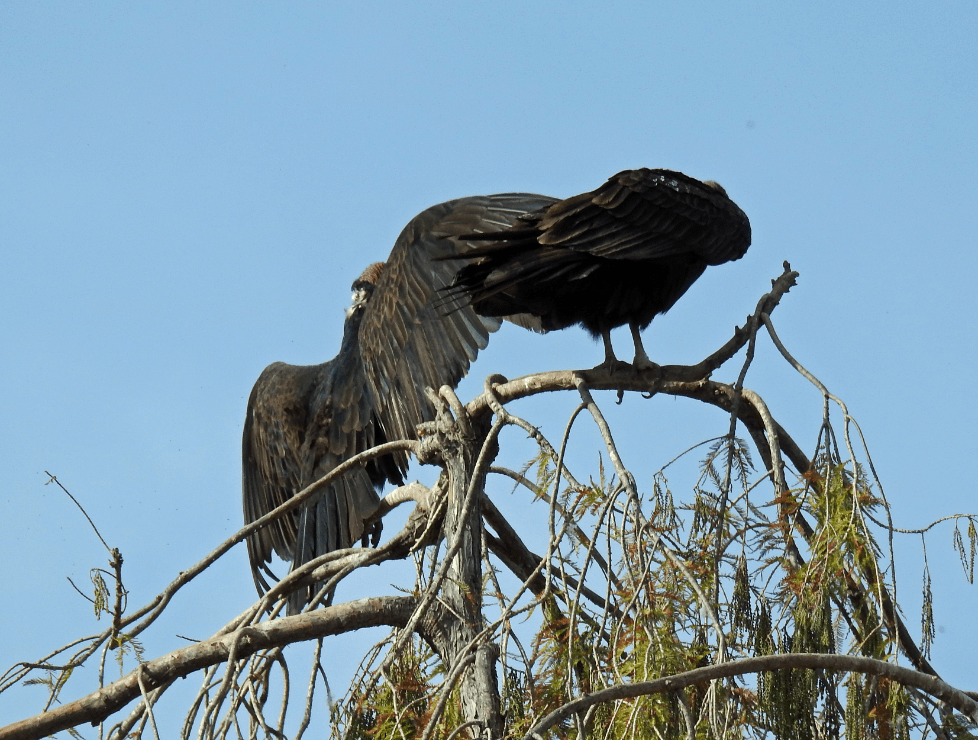
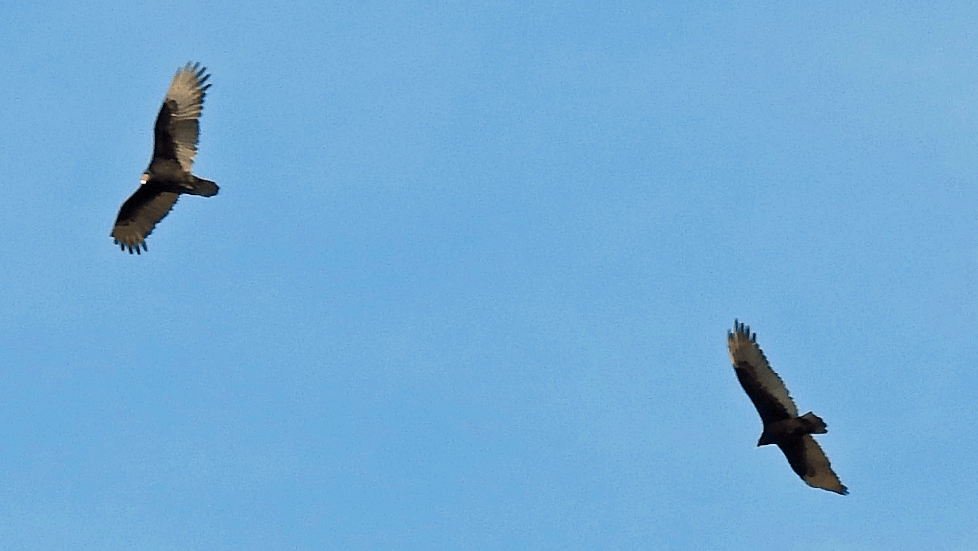
Figure 17. When courting, Turkey Vultures hang out together when roosting and may engage in courtship flights, taking turns following one another and engaging in dives toward each other. (These Turkey Vultures are probably not courting pairs; photos taken in January and February.)
Nest, Eggs, Incubation
During courtship and copulation, the Turkey Vulture pair often sits together at their nest site for days or even weeks (up to 8) before egg laying. The nest site may be a protected cave, hollow tree, cliff ledge, rocky outcrop, burrow, abandoned nest of another big bird, nest the couple used during an earlier breeding season, or — less often — a vegetated location such as forest or shrubs. Favored nest sites (e.g., a cave, a hollow tree) may be used year after year. A dark recess of some sort is preferred, as is a location remote from human activity. In most locations, the nest site may be quite a bit cooler than elsewhere in the environment. Another consideration: Though Turkey Vultures typically roost communally, they don’t nest near one another; nest sites are spaced widely apart (averaging 3300 feet, 1,000 m apart in one study).
The Turkey Vulture “nest” isn’t adorned; typically, eggs are laid on a bare surface. When incubation begins, however, the activities of the parents may create a slight depression in the substrate onto which the eggs are laid. On occasion, however, one partner (usually the female) may shred debris and scrape it into a pile at the nest site.
The Turkey Vulture female typically (close to 90% of the time) lays two cream-colored mottled elliptical eggs; one egg is less common, and she rarely lays three (just 2% of the time). However many she lays, she lays them 1–3 days apart. Both parents start incubating minutes after the first egg is laid, so the eggs hatch asynchronously (up to 3 days apart). Both parents have two brood patches (one on either side of the lower breast). Frequently (22–45 minutes; range: seconds to 2 hours), an incubating parent will stand, gently roll, rotate, or jostle the eggs with its toes and bill, then adjust its own position and return to incubation.
The incubating Turkey Vulture parent may even walk away or fly off for up to 100 minutes at a time, but their eggs seem able to tolerate some temperature fluctuations and inattention by the incubating parents. Time left unattended may, however, slow development. An incubating parent may seem alert, may doze off, or may preen or stretch or do other self-maintenance activities. When ready to defecate, the parent will stand, walk backward, then direct the feces backward, away from the nest. The length of time one parent is on duty, waiting for the other parent to offer relief, seems to vary widely; some couples alternate incubation duties in 18–24-hour shifts, others more frequently (as little as 22 minutes at a time).
If a human approaches the nest, the adult may fly off to a nearby location or stand by the eggs, hissing and perhaps regurgitating, or even regurgitate then feign death. They haven’t been reported as aggressive toward humans, but they will show defensive behavior — threatening or attacking — toward some other threatening animals.
Hatchling to Fledgling
It takes each Turkey Vulture egg about 28–42 days to hatch; at least 36 days is more common. Upon hatching, each hatchling is covered in long, fluffy white down on most of the body, with short, dense down on the head and neck. It can’t stand or hold up its head, and its face, throat, and crop show bare black skin. Eyes are mostly closed. Its only vocalizations are almost inaudible squeaky hisses or peeps. By 4–6 days, it can vocalize a warning hiss and a throaty growl, getting louder if the threat persists; if the threat approaches, the chick will regurgitate and may adopt a threat display. By this time, each chick can move around in the nest and partly spread its wings.
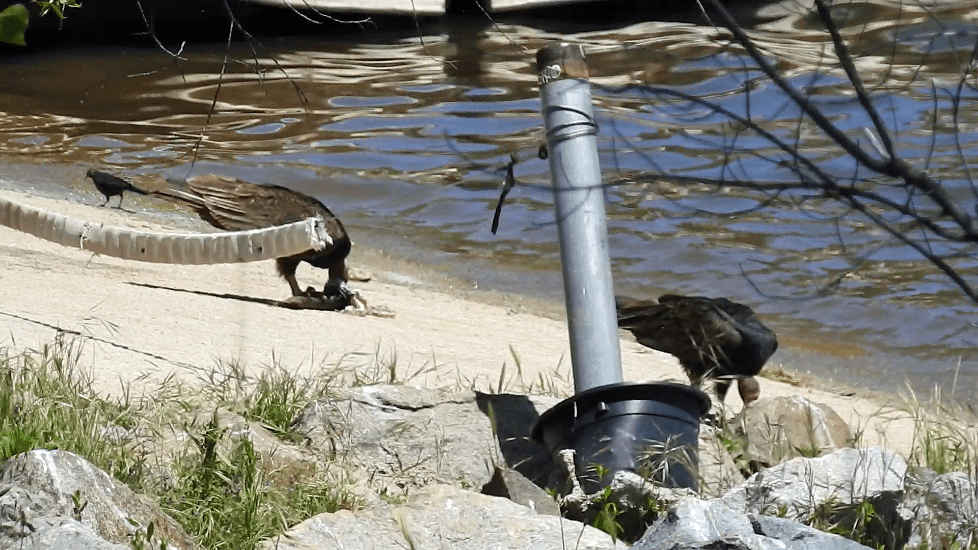
Figure 18. To feed their young, Turkey Vulture parents must eat plenty of carrion. After eating their fill, they return to the nest, empty-toed, where they digest the food and regurgitate it into their own mouths, so their chicks can extract it to eat it.
Turkey Vulture hatchlings are altricial, unable to take care of themselves without their parents’ warmth, protection, and nourishment. Both parents take turns brooding their chicks continuously for the first 5 days after they hatch. After that, brooding decreases during the daytime but continues at night until 15 days after hatching. Throughout brooding, parents feed their nestlings 1–4 times/day. Each parent regurgitates small amounts of predigested food, which the nestling retrieves by thrusting its bill into the parent’s bill (from the front or from the side). In anticipation of being fed, the chick will lean forward, holding its body horizontal, moving its extended wings up and down; it may also hiss as it approaches its parent. By about 1–2 weeks of age, the nestling is able to use its bill to pick up and eat solid food provided by the parents. After the brooding period ends, parents continue to provide solid food.
After 14–18 days, pin feathers start to appear on the distal primary feathers (outer wings); during that time, the egg tooth is reabsorbed. By 32–39 days, many wing feathers emerge from their feather sheaths. By 53 days, the down has been replaced by dark juvenile feathers everywhere except the belly, breast, and head. Within another couple of weeks, down disappears from the back and underwings and elsewhere, other than a few downy patches. The bare skin of head and crop turn gray by about 60 days. The chicks’ tarsi start out whitish-gray, then turn pink, and then after the chicks fledge, they are stained white with excreta, like those of adults.
By 8 weeks or so, the chick also starts perching outside of its nest and can climb on rocks using its bill, wings, legs, and feet. While in the nest, siblings will allopreen (preen each other) and will touch bills or even jab each other’s bills. They also investigate objects they see, pecking at them and tugging at them. If they venture outside the nest, they may hop and flap their wings.
At about 9–12 weeks (66–88 days), Turkey Vulture chicks fledge, but even after fledging, chicks usually spend 1–3 weeks with their parents, roosting at the nest site and being fed by parents, while slowly exploring the area from the air, perhaps even stopping at carcasses. For Turkey Vultures, fledging is actually gradual and variable, depending on the environment. At elevated cliffs, a youngster can take its first extended flight as early as 60 days of age, but in a wooded area, first flight may be just a short flight into the tree canopy, with extended flight not happening until 70–80 days of age. After that, the fledglings may join communal roosts or perches. They probably do not migrate with their parents. In their second year, immature Turkey Vultures may return to their natal area or may disperse to wander elsewhere.
Breeding Activity, Reproductive Success
Researchers don’t yet know about the Turkey Vulture’s lifetime reproductive success; annual reproductive success varies widely across locations. Even the age at first breeding has been difficult to determine. One report indicated that some Turkey Vultures may breed as early as 4 years of age, but better documentation suggests that 6–7 years may be more likely. In one location, the only documented breeder was 11 years old at first breeding. Average generation length is 6.8–9.9 years.
Figure 19. Individual Turkey Vultures are long-lived, with few natural predators.
Lifespan and Survival
Captive Turkey Vultures have been documented to have a lifespan of more than 45 years, with one known 52-year-old male, “Lord Richard,” who lives at the Lindsay Wildlife Experience in Walnut Creek, California (https://lindsaywildlife.org/animal-ambassador/turkey-vulture/ ). In the wild, however, life expectancy may be closer to 16.8–20.8 years; the oldest banded bird who was recaptured was 16 years old but was already an adult at first banding. Adult annual survival rate is about 75–81%. Seasonally, spring migration is the most challenging time for adult Turkey Vultures (with only a 69% survival rate).
Turkey Vulture adults have few natural predators, but eggs and nestlings are subject to predation. In the United States, they’re legally protected by the Migratory Bird Treaty Act of 1918, making it illegal to take, kill, or possess adults or eggs or any body parts (including feathers), under penalty of stiff fines and/or a prison sentence. Both Canada and Mexico have similar conventions for protecting this species. Nonetheless, the effects of human activity — hunting (directly or by using lead bullets on carrion), trapping (intentional or accidental), collisions with vehicles or structures, chemical contamination, or electrocution (power lines) — are serious causes of Turkey Vulture mortality.
The human-caused climate crisis also affects Turkey Vultures, though not as dramatically as some other species. Nonetheless, droughts, wildfires, and heat waves affect wild vultures, especially during breeding season. Turkey Vultures are also harmed by pesticides used in agriculture, and rodenticides used for controlling vermin or other unwanted wildlife.
Thanks to their highly acid stomachs, strong immune systems, and stable intestinal microbiomes, Turkey Vultures show remarkable resistance to pathogens present in carrion, such as botulinum toxins, salmonella, and anthrax. They’re also unusually resistant to bacterial pathogens (e.g., Clostridia) that afflict other vertebrates. They have tested positive for numerous avian pathogens, apparently without succumbing to them. On the other hand, in captivity, they have died from tuberculosis, and they have been afflicted by aspergillosis and other diseases. In the wild, they are afflicted by blood parasites, intestinal parasites, and ectoparasites (on the skin).
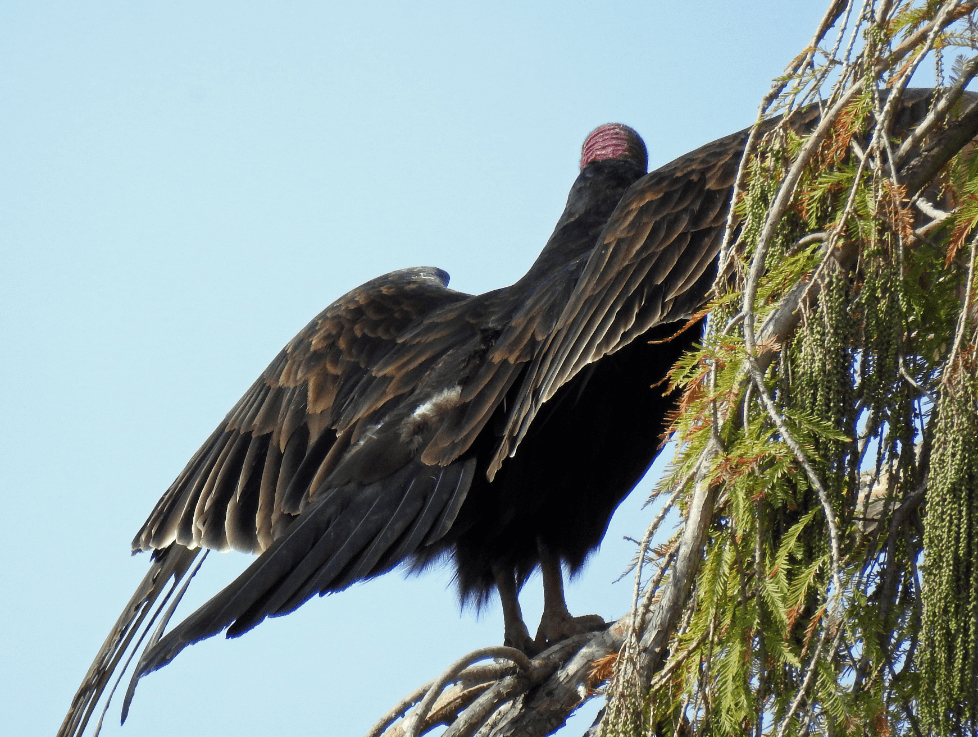
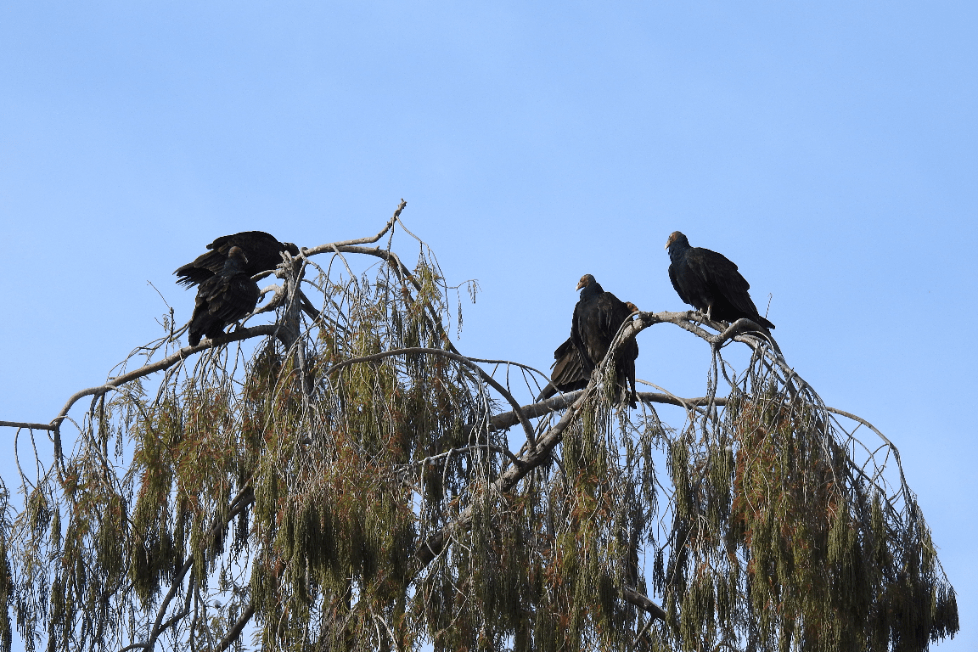
Figure 20. Turkey Vultures, like other migratory birds, enjoy protection from the U.S. Migratory Bird Treaty Act of 1918, as well as similar protections in Mexico and Canada.
Conservation Status
According to the IUCN Red List of Threatened Species, the conservation status of Turkey Vulture is LC, Least Concern. As is so often the case, it’s hard to estimate the total world population of an entire species. Some estimates are 13 million, others 18 million, and one estimate of 28 million. Previous North American population estimates were less than 1 million, but subsequent research has shown that much larger numbers have been documented there. Whatever its current population, it’s widely held that its population is stable, both over 10 years and over three generations. In fact, it may have undergone a statistically significant increase in North America during the past 40 years. The IUCN Red List gives some credit to the U.S. Migratory Bird Treaty Act, as well as similar legislation in Canada and Mexico, for some of that increase.
In addition to the human-caused threats to Turkey Vultures mentioned in the preceding section, humans are threatening them through habitat loss, fragmentation, and degradation. During most of the year, Turkey Vultures are remarkably adaptable to human-caused changes to their habitat; during breeding season, however, these changes can be far more hazardous. To achieve reproductive success, they need freedom from human-caused disturbances. Encroachment from agriculture and urbanization — or intrusive researchers — may lead to population decline.
Humans have also taken steps to protect these species (e.g., the Migratory Bird Treaty Act), such as by providing protected reserves for these vultures and other wildlife. Some agriculturalists have also taken affirmative steps such as by using organic (pesticide-free) farming practices, mixing farmland with pastureland, and retaining some forested areas. Education programs would be helpful to inform farmers of the benefits of protecting vultures as ecosystem heroes.
Future research using satellite tracking devices may help researchers to understand the movement patterns and life histories of Turkey Vultures. Long-term quantitative demographic studies may deepen our understanding of factors affecting survival and mortality, as well as breeding biology and behavior. Data from rehabilitation centers, as well as reports on dead birds, may bolster these studies. Researchers might also study food and nest sites, effects of weather events, and the gastrointestinal microbiome of individual birds, as well as their regurgitants.
Another source of information continues to be captive populations. At present, there are 179 accredited holding institutions in 24 countries, which hold 148 males, 122 females, and 91 unsexed Turkey Vultures, for a total of 361.

Figure 21. Keys to conservation of Turkey Vultures and other wildlife is the preservation of natural habitat, facilitated by educating people and cultivating their appreciation of these vital ecosystem champions.
Observations
The Cornell Lab of Ornithology gathers information from observers around the world through the eBird app and website (https://ebird.org/species/turvul? ), which holds 15,321,417 observations, 195,700 with photos, and 112 with audio recordings. The lab’s Macaulay Library website (https://search.macaulaylibrary.org/catalog?taxonCode=turvul ) holds 299,585 photos, 122 audio recordings, and 809 videos. In addition, iNaturalist gathers observations with its app and its website (https://www.inaturalist.org/observations?taxon_id=4756 ), which has 249,670 observations, each of which includes a photograph, audio recording, or video.
References
Turkey Vulture, Cathartes aura
- Elphick, Jonathan. (2014). The World of Birds. Buffalo, NY: Firefly Books.
- Lovette, Irby, & John Fitzpatrick (Eds.). (2016). The Cornell Lab of Ornithology Handbook of Bird Biology (3rd ed.). Hoboken, NJ: Wiley.
- Winkler, David W., Shawn M. Billerman, and Irby J. Lovette. (2015). Bird Families of the World: An Invitation to the Spectacular Diversity of Birds. Barcelona: Lynx, Cornell Lab of Ornithology.
- Kirk, D. A., M. J. Mossman, K. L. Bildstein, A. Naveda-Rodríguez, and J. M. Mallon (2024). Turkey Vulture (Cathartes aura), version 2.0. In Birds of the World (N. D. Sly, P. G. Rodewald, and B. K. Keeney, Eds.). Ithaca, NY: Cornell Lab of Ornithology. https://doi.org/10.2173/bow.turvul.02 , https://birdsoftheworld.org/bow/species/turvul/cur/introduction
- https://en.wikipedia.org/wiki/Cathartes
- https://en.wikipedia.org/wiki/Turkey_vulture
- Avibase, Turkey Vulture, https://avibase.bsc-eoc.org/species.jsp?lang=EN&avibaseid=36B3872DAFE1EC1C&sec=s
- Avibase Life History, Turkey Vulture, https://avibase.bsc-eoc.org/species.jsp?lang=EN&avibaseid=36B3872DAFE1EC1C&sec=lifehistory
- IUCN Red List, Turkey Vulture, https://www.iucnredlist.org/species/22697627/131941613
- Illiger, Johann Karl Wilhelm Illiger, https://en.wikipedia.org/wiki/Johann_Karl_Wilhelm_Illiger
Etymology
- Gotch, A. F. [Arthur Frederick]. Birds—Their Latin Names Explained (348 pp.). Poole, Dorset, U.K.: Blandford Press.
- Gruson, Edward S. (1972). Words for Birds: A Lexicon of North American Birds with Biographical Notes (305 pp., including Bibliography, 279–282; Index of Common Names, 283–291; Index of Generic Names, 292–295; Index of Scientific Species Names, 296–303; Index of People for Whom Birds Are Named, 304–305). New York: Quadrangle Books.
- Lederer, Roger, and Carol Burr. (2014). Latin for Bird Lovers: Over 3,000 Bird Names Explored and Explained (224 pp.). Portland, OR: Timber Press.
Text and images by Shari Dorantes Hatch. Copyright © 2026. All rights reserved.
Images were recorded in San Diego County.


Leave a comment