
The Point of the Needle: Why Sewing Matters, Part 3
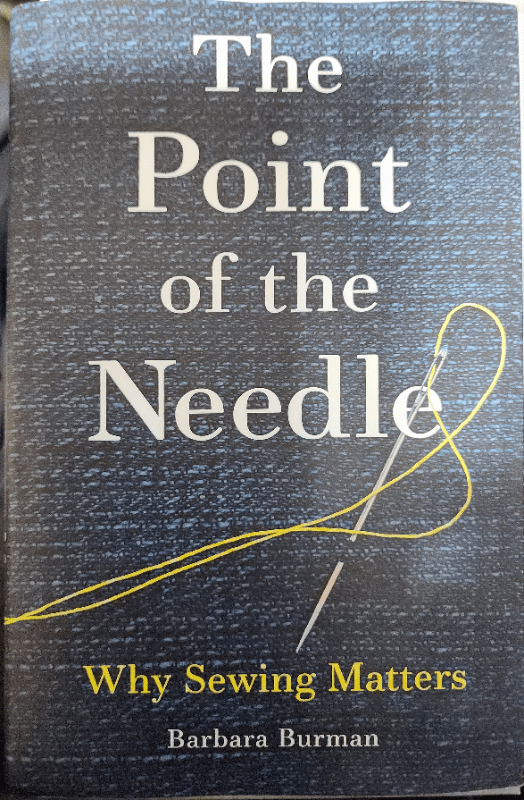
Burman, Barbara. (2023). The Point of the Needle: Why Sewing Matters. London, UK: Reaktion Books Ltd.
This is the third of three blogs about Barbara Burman’s book, The Point of the Needle: Why Sewing Matters (2023). This blog discusses Chapter 7, The Alternative Stitch, about using sewing to effect societal change, 188–214; Chapter 8, Into the Fray, about mending garments and other textiles, 215–244; and the book’s back matter, including References, pp. 247–265; Select Bibliography, 266–271; Associations and Websites, pp. 272–274; Acknowledgements, 275–276; and Index, pp. 277–287.
The first blog, Part 1, https://bird-brain.org/2026/06/30/burman-history-of-sewing-part-1-of-3/ , included her Introduction, in which she lays out her plan for her book; Chapter 1, about the experience of sewing; Chapter 2, about learning to sew; and Chapter 3, about fabric used for sewing. Part 2, https://bird-brain.org/2026/07/07/barbara-burman-history-of-sewing-part-2-of-3/ , included Chapter 4, discussing sewing tools, kits, notions, and machines; Chapter 5, exploring home sewing; and Chapter 6, exploring how some seamsters make a living through sewing.
7, The Alternative Stitch, 188–214
“A needle can be a tool for public activism or an agent of personal change. It is both for some people. . . . At a personal level, sewing folk might design, make or adapt their own clothes to assert an alternative image for themselves” (p. 188). At a public level, “activist stitchers generate an unorthodox narrative” (p. 189). For instance, victims of war and other conflicts may create personal story narratives in textiles. On a grander scale, the NAMES Project AIDS Memorial Quilt, started in 1987, (see https://en.wikipedia.org/wiki/NAMES_Project_AIDS_Memorial_Quilt ) weighed almost 50,000 pounds by the time Burman submitted her book manuscript (2022-ish).
One means of activism is to express ethnic, national, or religious identity through the making of clothing using particular methods, patterns, or fabrics, such as Jamaican “freehand dressmaking” (p. 190). Another is to use stitching as a means of advocating for a particular cause. For instance, by the late 1800s, women’s suffragists were embroidering and appliquéing huge banners and posters, carried by marchers and paraders, displayed in pageants and demonstrations, or simply held or worn by women in public places.
Sarah Corbett described the use of stitching for “craftivism,” in her How to Be a Craftivist book. Craftivism is a portmanteau of craft and activism. In her book, Corbett suggests such tactics as embroidering handkerchiefs with activist messages then delivering or mailing the handkerchiefs to political leaders or other persons with power to make change. She “seeks to promote environmental issues and social justice through non-aggressive, nonjudgmental, kind and mindful means. Her Craftivist Collective’s motto [was] ‘Changing the world one stitch at a time’” (p. 209).
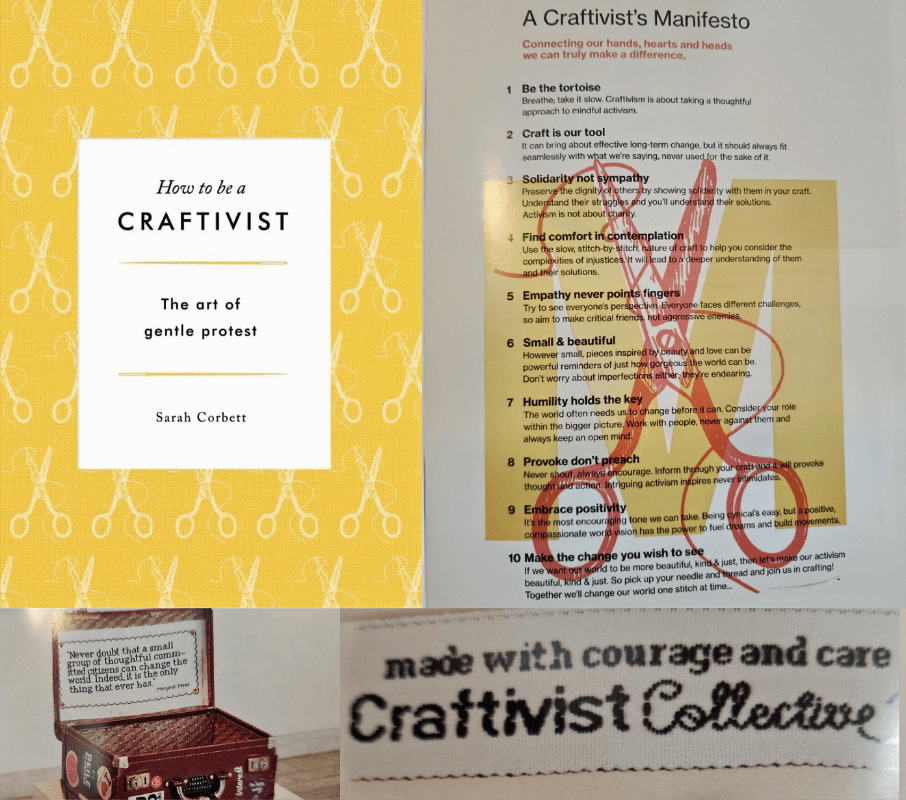
Figure 07-1. Sarah Corbett founded the Craftivist Collective, which seeks to use embroidery and other needlecrafts to influence political leaders through kind persuasion. These images are from her book, including the collective’s manifesto, describing her craftivist approach.
Men who sew their own clothes are stating their opposition to gender stereotyping simply by doing so. Judy Chicago, multimedia artist, included embroidery in her Dinner Party (1974–1979), now on exhibit at the Brooklyn Museum in NYC.
Even clothes themselves can be an expression of activist reform, such as when Jean-Jacques Rousseau argued (1762) that young girls should wear plain and simple clothes that suited their desire for freedom of movement, rather than fancy dress that impeded their freedom. In the 1800s, Karl Marx and Friedrich Engels urged readers to avoid buying clothes made in exploitative, abusive textile and garment factories.
Amelia Bloomer (1818–1894) urged women to wear what became known as “bloomers,” loose trousers that were visible beneath a short skirt, rather than burdensome long dresses and skirts, which constrained movement. In a related movement, reformers advocated for “clothing that recognized the realities of the human form instead of reshaping it” (p. 196), as well as encouraging women to get more physical exercise using such freeing garments. One such reformer published patterns for home seamsters to use, including patterns for pregnant moms and for newborns and other infants.
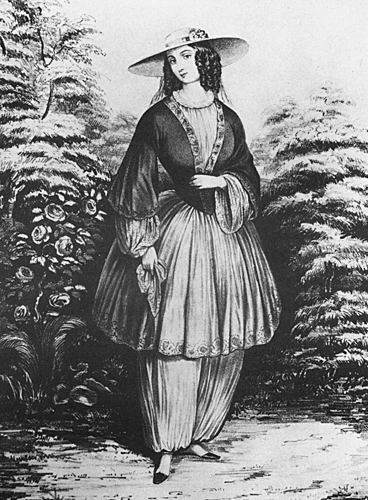
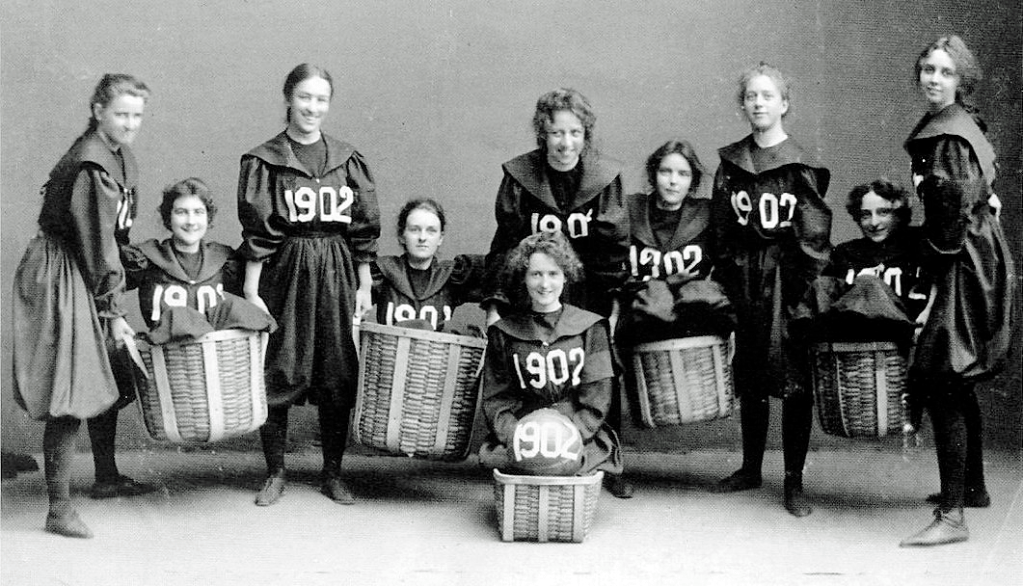
Figure 07-2. Though Amelia Bloomer and her followers weren’t welcomed by those who prescribed fashion for women in the 1800s (left), her ideas regarding dress reform for women were taken up by many others even after her death (e.g., this Smith College women’s basketball team of c. 1900–1902). Both of these images have entered the public domain, no longer subject to copyright protection.
These images can be found at https://en.wikipedia.org/wiki/Bloomers . On the left is https://commons.wikimedia.org/wiki/File:Bloomers.jpg , Description, “Bloomer” dress of the 1850s. Date, 1 January 1850. Source, http://www.kvinfo.dk/kilde.php?kilde=253 , Author Unknown; Licensing, Public domain. This work is in the public domain in the United States because it was published (or registered with the U.S. Copyright Office) before January 1, 1931. On the right is https://commons.wikimedia.org/wiki/File:Bloomers.jpg . Description, Smith College class of 1902 basketball team (1902 was their year of planned graduation; this photo may not actually have been taken in 1902). Uploaded as better example image for en:Bloomers (clothing). Date, 1902 or possibly 1901. Source: Scanned from “Fitting In: Four Generations of College Life” by Barbara A. Schreier (ISBN 0-913820-16-4). Author Unknown, ca. 1902 photographer. Licensing, Public domain. This media file is in the public domain in the United States. This applies to U.S. works where the copyright has expired, often because its first publication occurred prior to January 1, 1931, and if not then due to lack of notice or renewal. See this page for further explanation.
Responding to the capitalists’ profits-before-people treatment of workers and consumers, “Arts and Crafts designer, author and early socialist William Morris (1834–1896) . . . [urged] ‘Do not have anything in your house that you do not know to be useful or believe to be beautiful.’ . . . Morris called for simplicity, grace and beauty in clothing” (p. 197). His pleas arrived just as more women had access to home sewing machines and could respond by making their own simple, graceful, and beautiful clothing.
Carrying Bloomer and Morris’s spirit into the 1900s, Charlotte Perkins Gilman (1860–1935) urged her readers to reject unthinking pressure to yield to fashion trends. Women should have such a “keen sense of economy, that we shall not be willing to buy poor garments, or to throw away good ones. We shall become so proud of our own skill in selection or construction” (p. 198). In the early 1900s, men, too, were sympathetic to dress reform, allowing men to wear open-necked shirts, shorts, and other looser-fitting garments. Though many garments continued to be crafted by tailors, many could be made at home, sometimes by the men themselves. To this day, many men and women have been questioning the oppressive restrictions of blindly following the fashion imposed on consumers by industry.
Morris was also ahead of his time in urging “a respect for the natural world and for workers” (p. 201). Though Morris was particularly pointed in his concerns about workers, his concerns about the natural world are now more fully appreciated. “The production of textiles emits more greenhouse gas every year than all shipping and international flights put together” (p. 201).
Some conservation activists urge us to consider making many of the things we use, such as a pair of jeans. “Even if you only make one pair of jeans, the next time you go to buy a pair you’ll think so much harder about the work and care that went into that product . . . . It’s made me look at other areas of my life, too . . . . Being self-sufficient is a really good feeling” (Georgia Murray and Poppy Thorpe, 2020; p. 203, Burman).
In a Lebanese detention camp, prisoners resourcefully found ways to make their own functional needles and threads and to mend their own clothes and even make some small craft items — all at great risk to themselves. Such stories have been heard from WWII internment camps, prisons, mental hospitals, and other places where humans are imprisoned yet find ways to liberate their minds through craftivism.
Some stitchers have used their skills to make clothing not only to suit their own bodies and tastes, but also to use as a medium of exchange. For instance, one craftivist stitcher made stage outfits for a musician who gave her singing lessons. Other craftivist stitchers create clothing to celebrate their own distinctive shapes, such as the online “Curvy Sewing Collective,” which has nearly 25,000 members who are “plus-sized, curvy, pear-shaped, and extravagantly buxom, just to name a few” characteristics (p. 206). Craftivist stitching also enables gender-fluid stitchers — nonbinary, trans, and so on — to create clothing to express their authentic selves.
Wheelchair users and others with nonstandard clothing requirements can create their own personally fashionable clothing that fits just right, or can have others make suitable garments for them. Anyone who has ever worn a hospital gown recognizes the need for comfortable, easy-on, easy-off clothing that also offers privacy. Sometimes, existing garments can be adapted to suit, but for other situations, garments must be redesigned from the hem up.
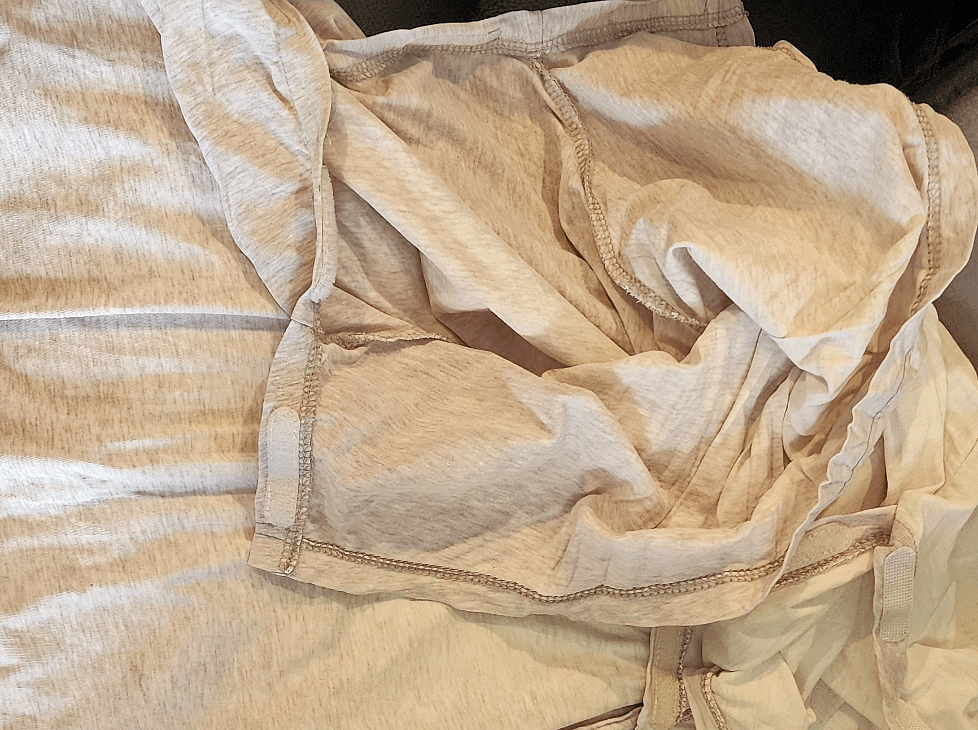
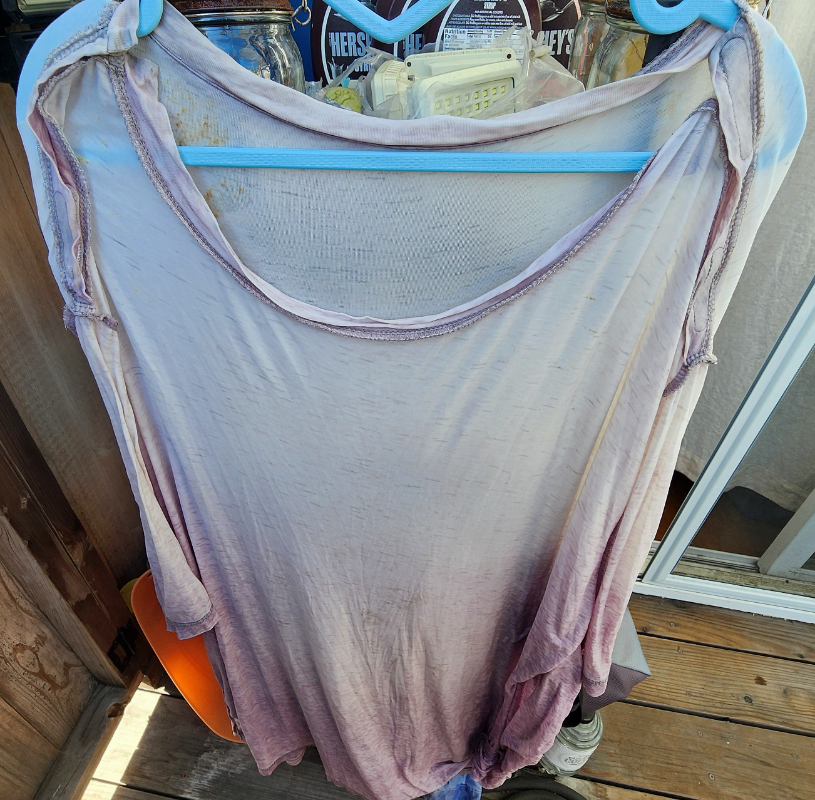
Figure 07-3. When my sister, a talented quilter, underwent shoulder surgery, she had trouble finding tops that she could put on one-handed. Luckily, she found some Velcro-closure tops, which she bought. (She couldn’t sew her own tops because . . . shoulder injury, then shoulder surgery!) Later on, I needed similar closures for shoulder strain, so I bought two such shirts. I now use one of them for swimming, so I can remove the clingy soaking-wet top without causing shoulder strain.
Craftivism can also involve “groups of loosely affiliated participants [who] use a variety of techniques and materials, including knitting, [crochet], felting and working with paper, as well as fabric and sewing, to make often small artefacts [sic]” promoting a particular social message (p. 208). The artifacts are then worn or displayed in public, to draw attention to the group’s message.
Not mentioned in Burman’s book, but here’s an example: “Shannon Downey aka Badass Cross Stitch created several dozen fiber-based guns and launched a global craftivism project around gun violence. The project featured over 200 fiber-based guns created and submitted from artists around the world. There was a gallery show and all of the work was sold raising over $5,000 to fund a semester of Project FIRE, a [nonprofit] program that supports young people who have experienced gun violence in Chicago” (https://commons.wikimedia.org/wiki/File:Badass_Cross_Stitch_End_Gun_Violence_Project.jpg ; see also https://en.wikipedia.org/wiki/Craftivism ).
Knitter craftivists sometimes engage in “yarn bombing,” such as this “Stay safe and stay gnome” pillarbox yarn bomb (https://en.wikipedia.org/wiki/Yarn_bombing#/media/File:Christmas_Crochet_Gourock_gnome_on_pillarbox,_dusk_2.jpg ; see https://en.wikipedia.org/wiki/Yarn_bombing for more.)
Quilter Sara Impey “uses her ‘sewing machine as a pen’ to create what she calls ‘stitched essays,’” covering the entire surface of the fabric by writing directly on it in free-motion machine stitching. One quilt may contain “stitched essays of several hundred words [which] comment on social and political issues” (p. 210).
Some textile and fabric artists refer to their craftivism as “stitch-based practice” or “socially engaged practice” (p. 210). Some stitchers and groups of stitchers may spend tens of thousands of hours on a single artwork. Some craftivist groups are founded, inspired, and led by a single visionary; others are more collaborative, such as California’s Social Justice Sewing Academy, which aims to bring attention to social injustices (see https://www.sjsacademy.org/ ).
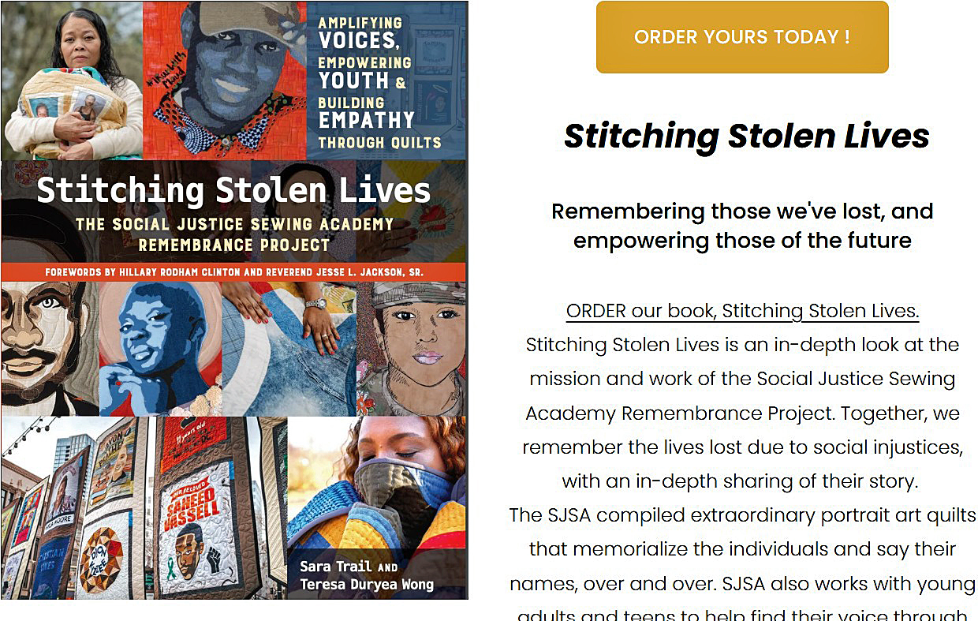
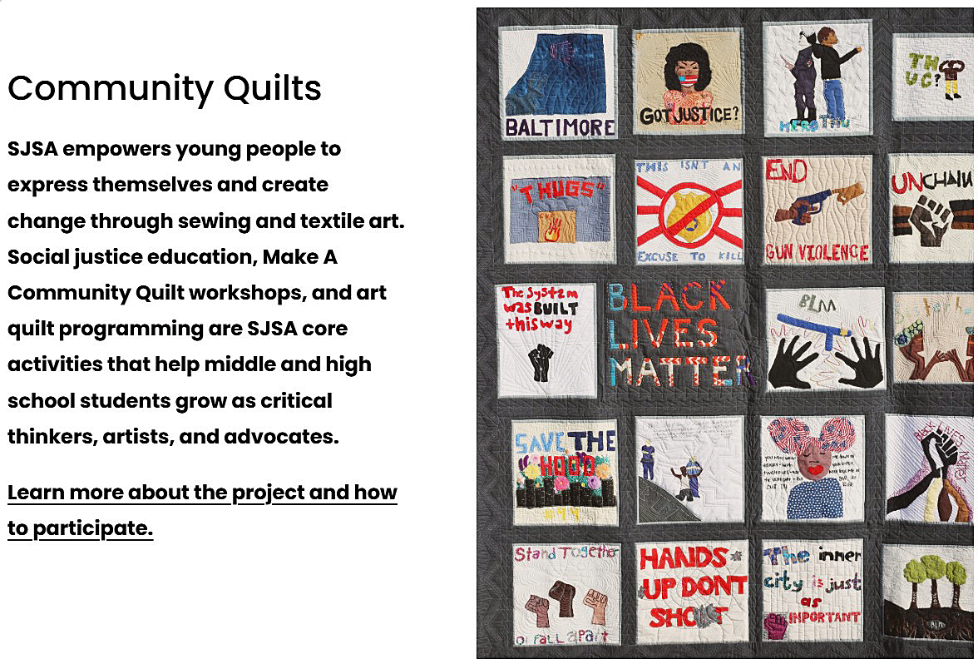
Figure 07-4. California’s Social Justice Sewing Academy involves engaging marginalized communities of stitchers, to produce works that are displayed in public places, to bring attention to social injustices (see https://www.sjsacademy.org/ ).
Most craftivists are careful of where they place their items or where and when they demonstrate, to ensure care for the natural environment and for the members of the community. They seek to reuse, recycle, and mend, rather than creating materials that will be discarded. Craftivists who make their own projects can tailor the message and its presentation to suit their wishes. Many craftivists are “using their needles to subvert old practices, to resist market platitudes and slow their pace of consumption, to sew with fabrics that do not harm the environment and clothe their actual bodies, not the body shapes determined by the fashion trade” (p. 214).
8, Into the Fray, 215–244
“Mending is more important than it seems. It is an intervention undertaken to extend the useful life of stuff,” which also has “cultural and social significance” (p. 215). Despite being hidden from view throughout history, “it is an act of transformation” for various reasons:
- economical, to have what we own last longer, to delay having to buy new items
- sentimental, to avoid parting with a cherished item
- pleasurable, to enjoy the soothing mental-health benefits of needlework, usually relaxing, usually resulting in preservation of a useful item
- ethical, to participate in the eco-friendly sustainable process of remaking, recycling, upcycling, repairing of existing items, rather than discarding and buying new
I would add gratifyingly creative, as the mending itself can involve finding clever ways either to hide the mending or to display it with ornamentation.
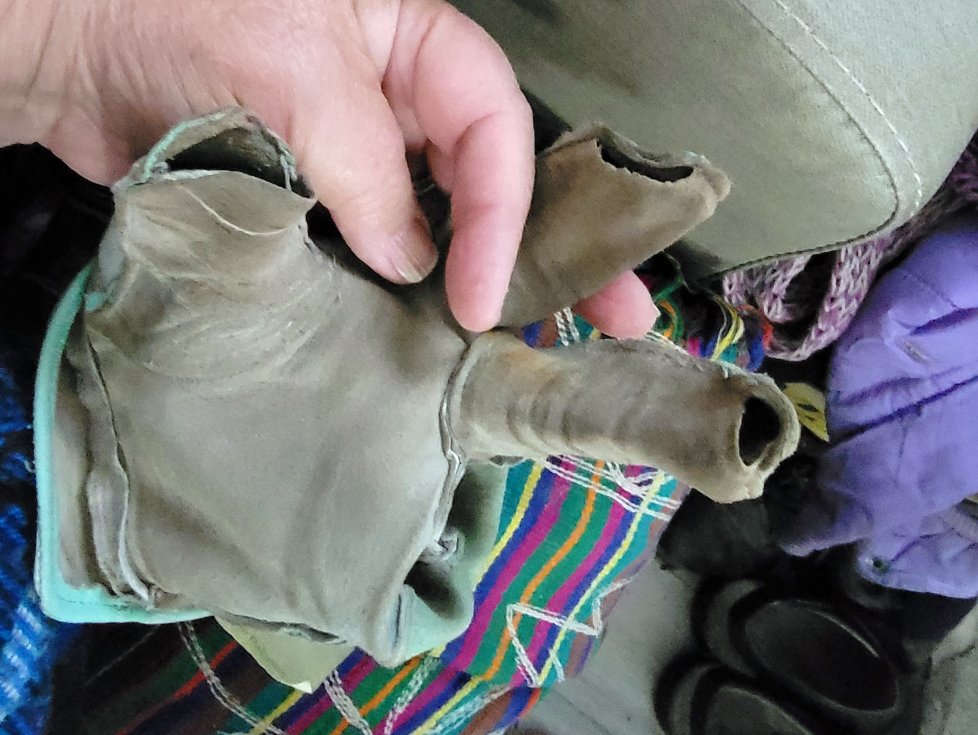
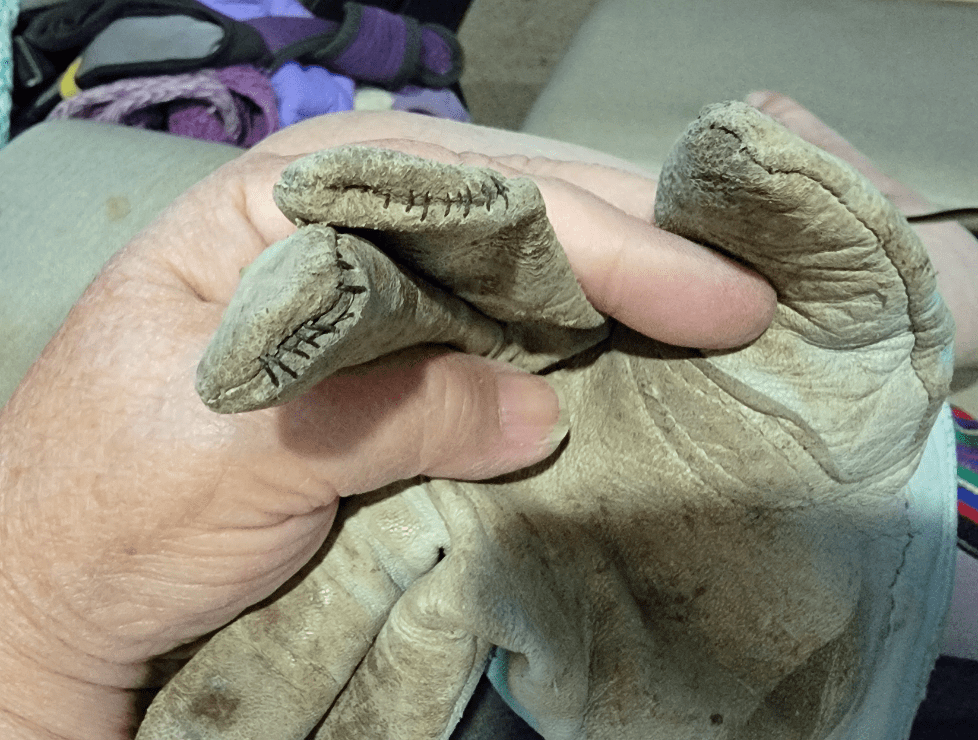
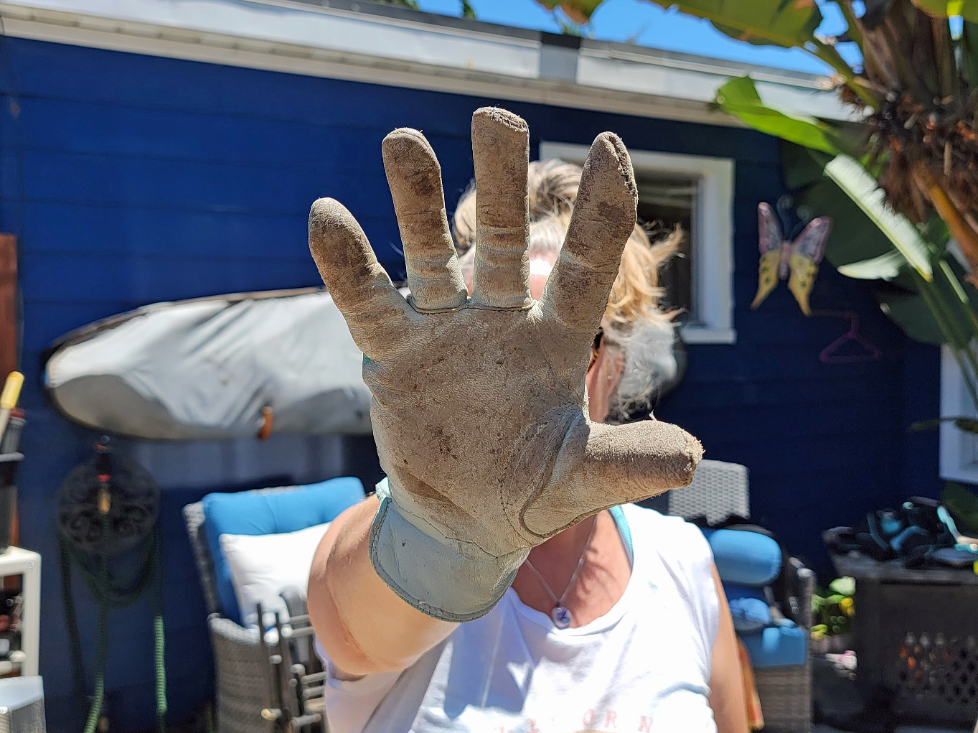
Figure 08-1. When much-loved, well-fitting gardening gloves fall apart, mending can salvage them for continued use.
Mending is also gaining popularity, riding on the wave of interest in sustainable practices. Burman quotes “John Taylor’s famous 1631 poem ‘The Praise of the Needle’, the ‘Needle (though it be but small and slender), / Yet it is both a maker and a mender’” (p. 216). Before you heap praise on Taylor, however, note that he goes on to whine about women getting together to do needlework, chatting together instead of focusing on their household duties.
Burman takes delight in the rising numbers of young people and novice stitchers who are mending, revising (e.g., transforming old jeans into new skirts), and making with their needles. In both communal gatherings and social media, menders and makers are sharing not only tips and techniques, but also political and social awareness (e.g., see https://www.repaircafe.org/en/ ; these cafes offer help with repairing all manner of items; Burman notes that mending-specific social groups are out there). Thus, “mending has become thoughtful, expressive and political” (p. 217).
Though enjoying a resurgence now, mending has a long history, such as in a Victorian needlework manual: “‘How best to disguise and repair the wear and tear of use or accident is quite as valuable an art, as that of making new things’” (p. 218). Note that the Victorian mender’s goal was to hide the repair, whereas contemporary menders often enjoy displaying the mending visibly, perhaps ornately.
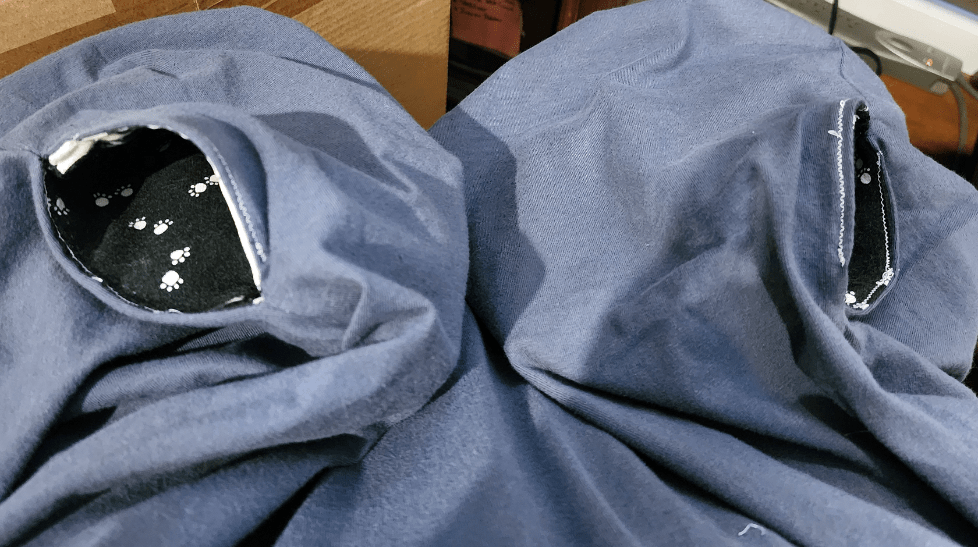
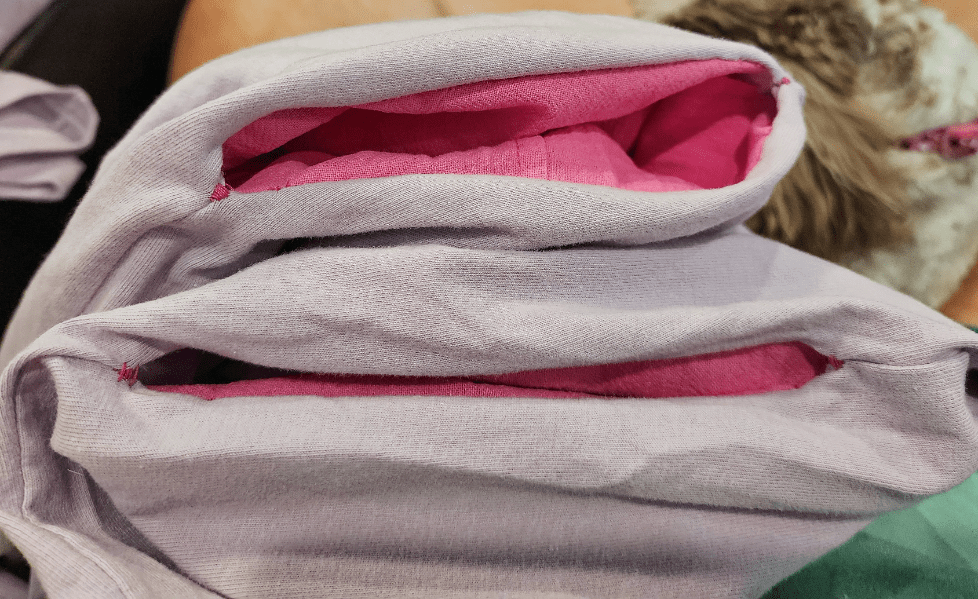
Figure 08-2. When adding in-seam pockets, one set was “repaired” with visible zigzag stitching on the outside of the pocket; the other set of pockets isn’t visible from the outside unless peering into the pockets.
One aspect of invisible (usually) mending is darning, which involves some reweaving (or reknitting) of the worn-out or missing fabric, while joining the still-intact edges. In previous times, the mender carefully sought out threads that closely matched the fabric being mended. Some manuals even described how to weave twill or damask, as well as checks and other patterns. Some needleworkers even made darning samplers, books of small samples of intricately mended snatches of fabric. A needleworker could show the sampler to a potential household employer who needed to have someone mend expensive fabric.
Darning even made its way into English courts of law. When clothing and household linens were so valuable that they were stolen by thieves, the owner could prove ownership by pointing out her own signature mending (or that of the hired seamster) on it. Launderers often added mending to the services they offered, ensuring a loyal clientele. With each repeated wash, the launderer could see how well the mending was holding up to continued wear and tear. Mending required a high degree of skill and knowledge.
Patching is another method of repair, which can be used for damage that’s irreparable just by darning. Patches are rarely invisible and may appear on the outside of a garment, as well as underneath the fabric. It is possible to patch thick woven wool fabric invisibly, by matching the fabric of the garment and the patch and then darning around the edges to attach the patch.
As soon as iron-on patches became available, they came into widespread use, though prudent users also stitch around the edges. Even more recently, “invisible iron-on webbing” can mend seams and hems.
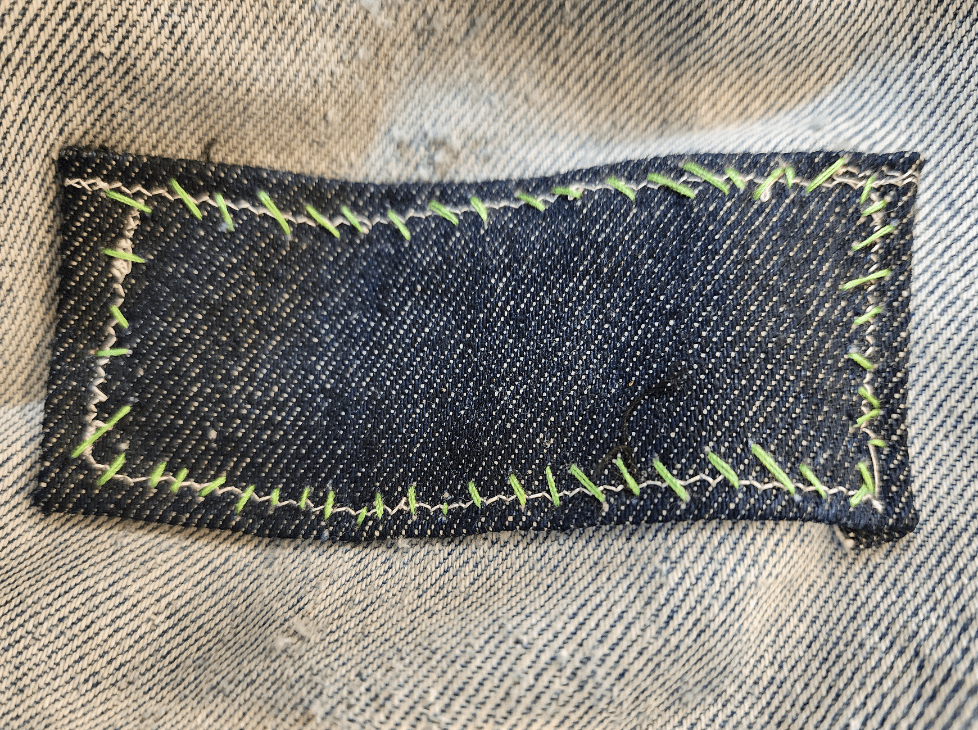
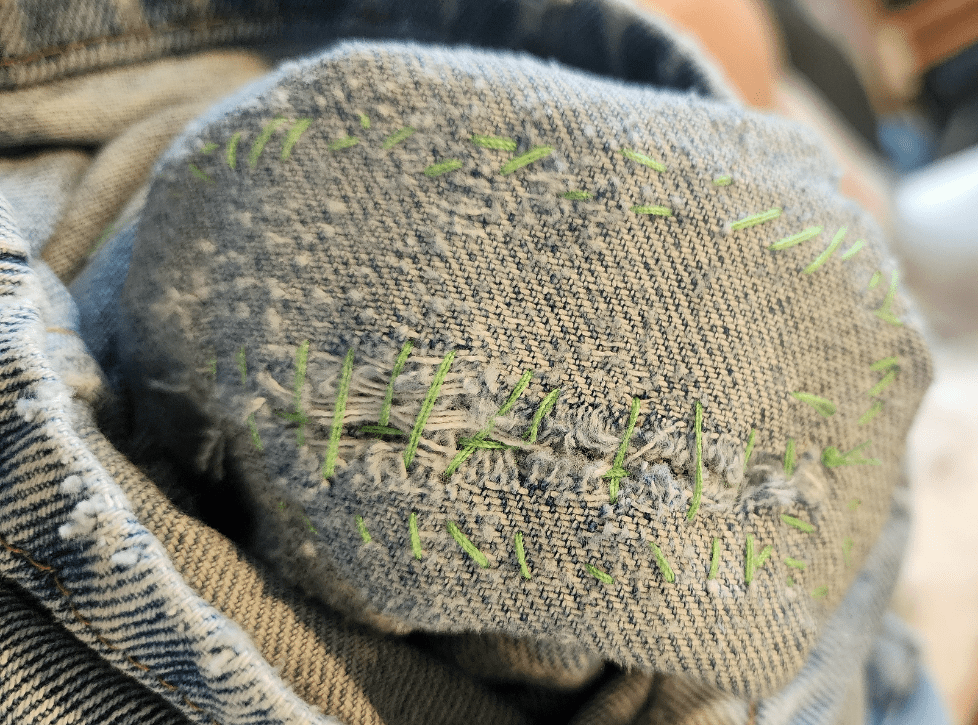
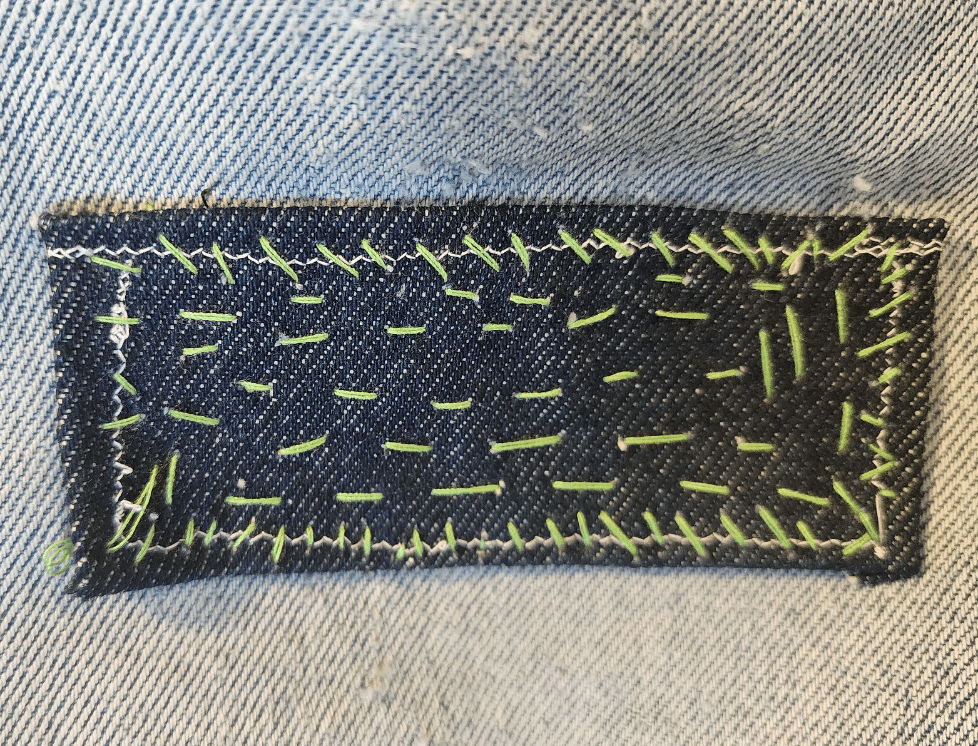
Figure 08-3. This much-beloved pair of jeans needed some serious repair, requiring patches (see also Figure 08-5). By using visible stitching, this patch was securely stitched to the jean fabric. To have fun boosting your own creativity when mending, maybe try using sashiko stitchery to make visible mends (see https://en.wikipedia.org/wiki/Sashiko ).
Even some of Thomas Jefferson’s surviving garments have signs of patching, as well as other repairs and alterations. Burman wonders whether Betty Brown, enslaved domestic seamstress in Jefferson’s household for 60 years, did all of this stitchery.
“Repair, reuse, adaptation, repurposing, all the processes seen today are a continuation of a deep-seated approach that has shaped consumption across time, geography and social class” (p. 221). As an example, Burman points to an elegant suit on display in the Victoria and Albert Museum, which was made using repurposed fabric from an elegant bedcover. Even Queen Victoria herself had her seamster shorten the sleeves of her garments as she diminished in size as she aged. These examples show that repurposing and repair were not simply for the have-nots. All members of society valued conservation and preservation and loathed waste. Thrift and moderation were valued across the social spectrum.
Poet Elizabeth Bishop (1911–1979) commented on her 1934 visit with poet Marianne Moore (1887–1972); Moore and her mother were busy “making over” one garment to make a new garment for Marianne. Apparently, Moore was also the fortunate recipient of many elegant garments from wealthy friends, which she would adapt to fit herself.
In a previous century (1770–1821), an inventory of the wardrobe of a landed-gentry woman included a wealth of garment parts and both old and new fabric, to use as resources for making new garments. Household receipts indicated frequent mending, repair, alteration, and recycling of garments.
During lean times — either personal or community-wide (e.g., during wartime) — cloth may be scarce, so householders must conserve existing sources of fabric, innovate to make the most of fabric, and be resourceful in finding fabric, such as tablecloths or curtains in second-hand shops or discarded clothes or bedding in church bazaars. Burman cites the UK’s “Make-do and Mend” campaign of 1942–1945.
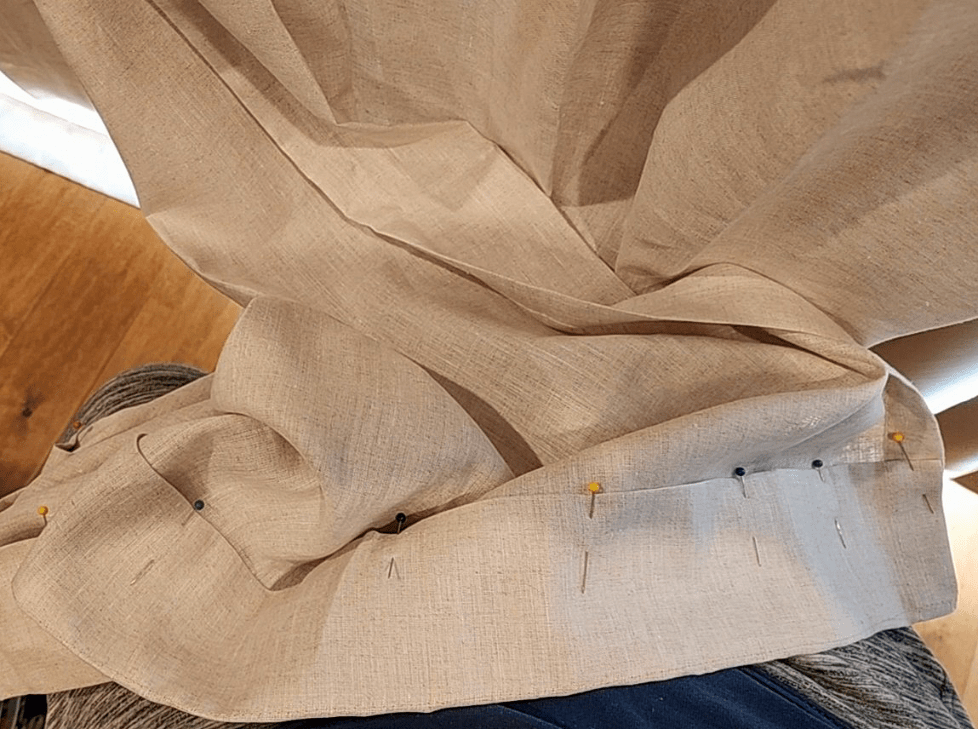
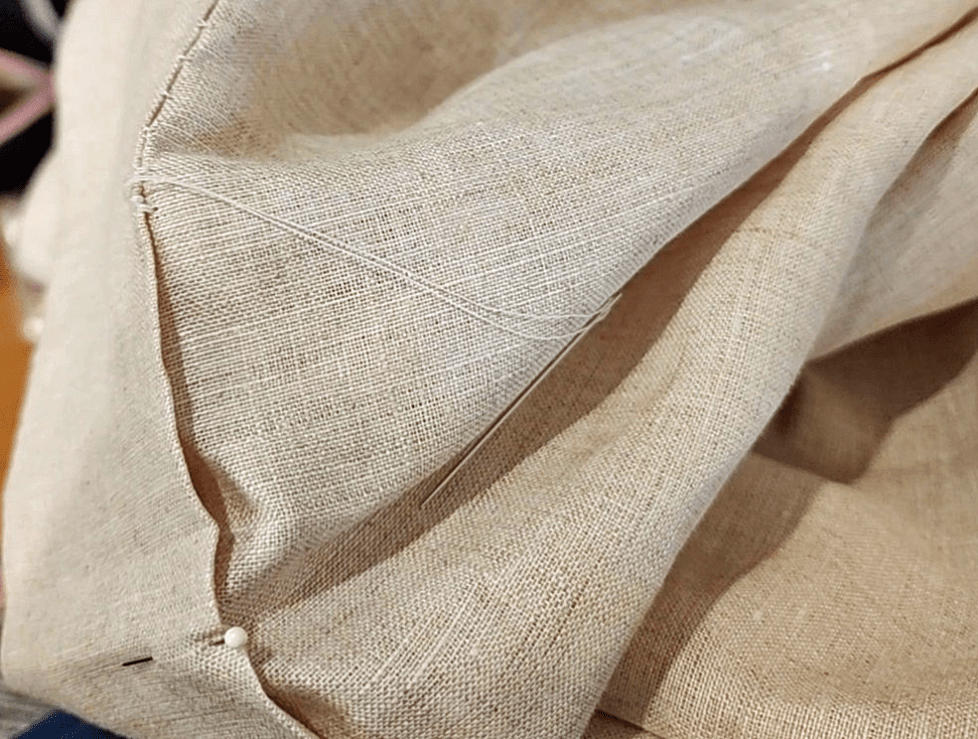
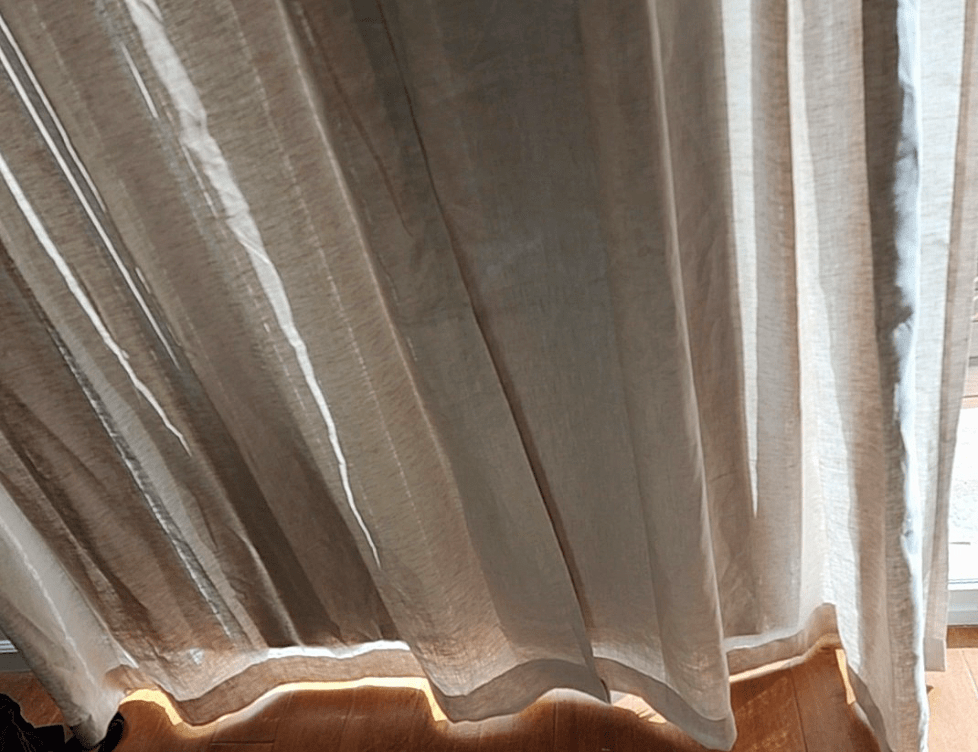
Figure 08-4. Clothing isn’t the only textile needing make-do fixes. New inexpensive linen curtains were too long and required hemming to fit properly.
Contemporary vintage clothing is at least 20 years old, but not old enough “to be considered antique or historical” (p. 226). “Vintage” doesn’t necessarily mean inexpensive, however. If high quality, vintage clothing can be as pricey as — or pricier than — new clothing. At the extreme end, “Queen Elizabeth’s granddaughter Princess Beatrice . . . wore a borrowed vintage dress” from the early 1960s as her wedding gown in 2020. The gown was adapted to fit Beatrice and to suit her taste. “Weddings, like christenings, are often occasions for the reappearance of treasured family things” (p. 227).
When a seamster visits a second-hand shop, each textile item is viewed from a seamster’s point of view: “What can I make (or remake) from this fabric?” How can it be “repaired, altered, embellished, transformed or cannibalized for materials for other purposes”? (p. 227).
According to Burman, if buying a new garment, it will last an average of about 4 years, but if buying a second-hand garment from a commercial retailer, it will last an average of about 5.9 years. In addition, second-hand garments can be bought from charity shops, as well as from online resale sites. Burman expects the market for second-hand garments to rise. This market may also be enhanced by increasing motivation to live more sustainably.
When women of modest means bought cheap ready-made clothing, they were encouraged to do preventive maintenance: Sew on poorly stitched buttons, reinforce weak seams and hems, alter the garment to make it fit better. The ability to mend clothing was even more important for those owning poorly made new clothes or hard-worn used clothing.
At times, mending has fallen out of favor as consumers sought ever-greater quantities of new fast-fashion garments. The ease of buying cheap replacements for worn-out or simply out-of-fashion garments made mending seem pointless and obsolete. More recently, however, as sustainability has become an increasing concern, fast-fashion’s wastefulness has become more alarming.
In a UK survey, almost one in four men and more than one in two women “expressed an interest in learning . . . how to repair clothes” (p. 231). Even for those who have no interest in making repairs themselves, most cities have shops that offer alteration and repair services, often in association with dry cleaning. Doubtless, if there aren’t already, there will soon be websites linking to such services or the like.
Many seamsters offer encouragement to novice repairers, and books and websites offer specific information on how to make repairs. “The new repair culture represents mending, recycling, altering and repurposing not as a chore but as creative and playful” (p. 232). For many, it’s also a way to act on their valuing of sustainability. Many also urge seamsters not to fret over perfection, but rather to enjoy the process and be proud of the effort. Even the imperfections add a personal touch to the repaired garment.
Visible mending has also gained prominence. Some visible mending can be seen not just as repair, but also as personal artistic expression. “Some traditional Asian textile recycling, renovation and reinforcement techniques . . . expose the layering, patching and stitching involved and add a conspicuous patina to the piece, such as Korean patchwork pojagi, Japanese boro and sashiko, or kantha work, a technique that originated in the Indian subcontinent, where the stitches often form the effect of wavelets” (p. 233). For more on for more on bojagi (“pojagi”), please see https://en.wikipedia.org/wiki/Bojagi ; boro, please see https://en.wikipedia.org/wiki/Boro_(textile) ; sashiko, please see https://en.wikipedia.org/wiki/Sashiko ; kantha, please see https://en.wikipedia.org/wiki/Kantha. Each of these traditions arose from the necessity to continue the useful lives of damaged and worn-out textiles. Today, curators and archivists treasure garments and other textiles mended in this way in earlier times.
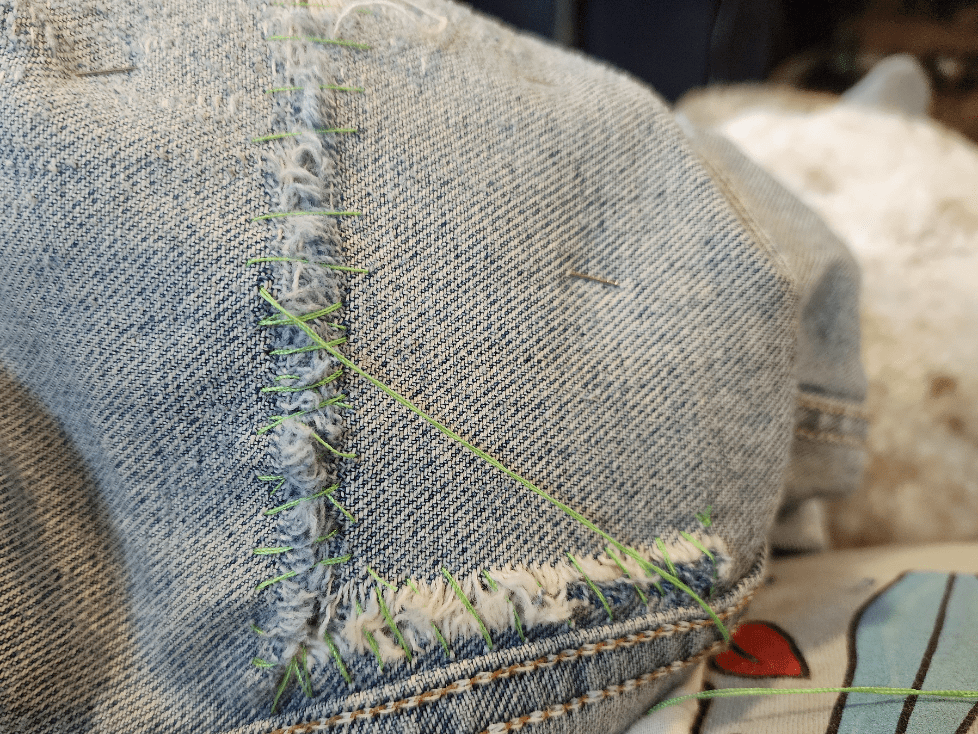
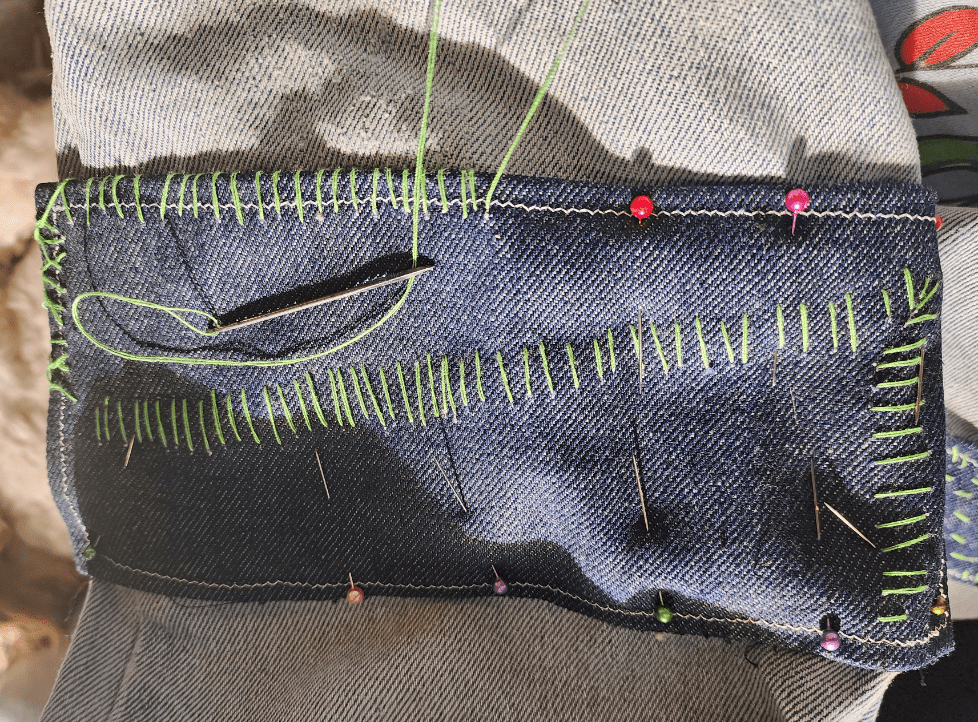
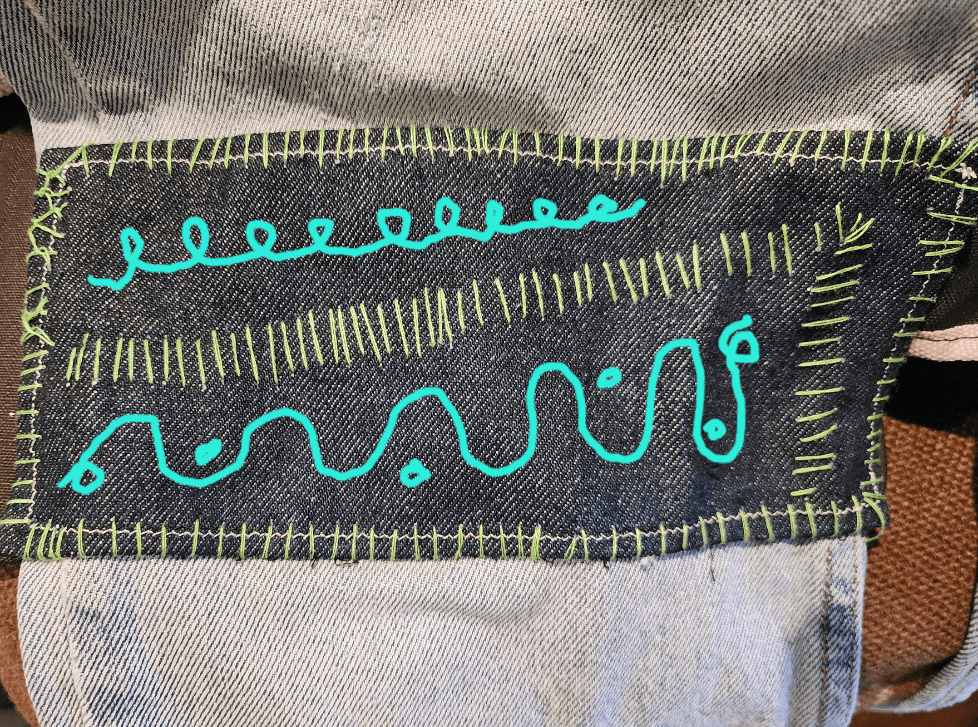
Figure 08-5. This repair of ripped jeans (the same ones as Figure 08-3) was inspired by sashiko stitchery, but with a more playful spirit (and less skill).
Though mending has traditionally (and today, too) been considered women’s work, many men have engaged in mending throughout history. Men menders have always existed in communities of men, such as sailors, who had to mend the sails, as well as their own clothes while at sea. Warriors and presumably friars and monks likewise have had to know how to mend their own garments and other textiles.
Museum exhibits often include mended garments. Some of these garments look hastily mended, which shouldn’t be surprising given the sheer volume of mending needed at times before ready-made clothes were available. Contemporary menders may be less likely to do so out of necessity, but rather as an act of creativity, toward the goal of sustainability. Perhaps even a greater contrast with days of yore is the wearing of intentionally shredded jeans and purposely unraveled knitted tights. “Only in a society in which nobody needs to be ragged [can] raggedness . . . be detached from shame, and used instead as an aesthetic strategy” (Victoria Kelly, quoted by Burman, p. 235). (Please see https://en.wikipedia.org/wiki/Coat_of_Many_Colors , about Dolly Parton’s experiences with being shamed by others because of her hand-sewn clothing.)
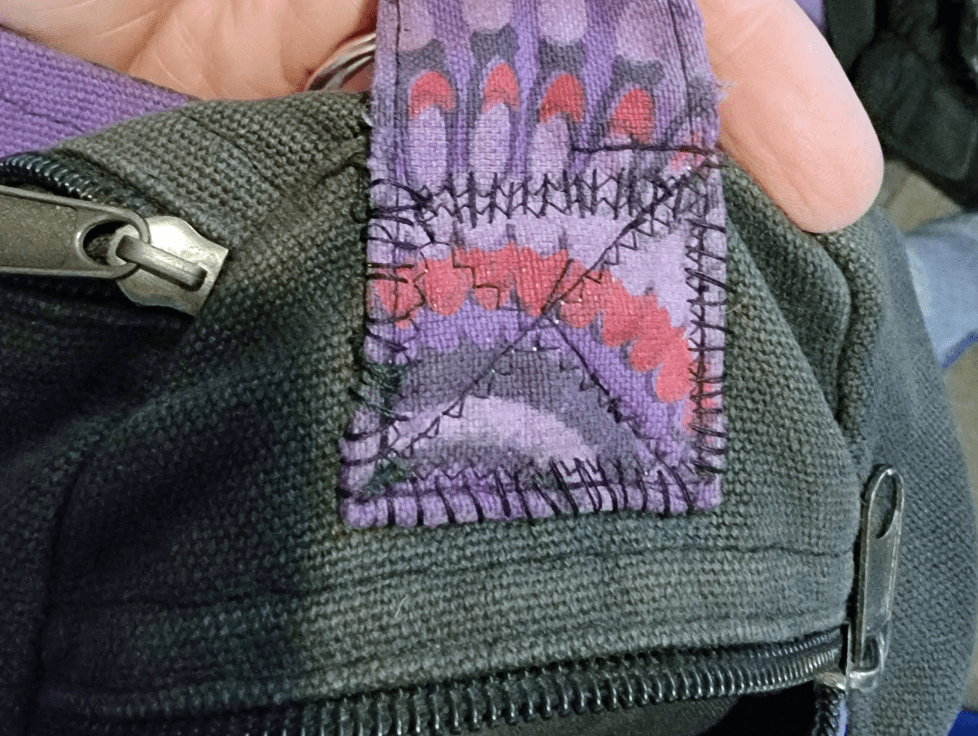
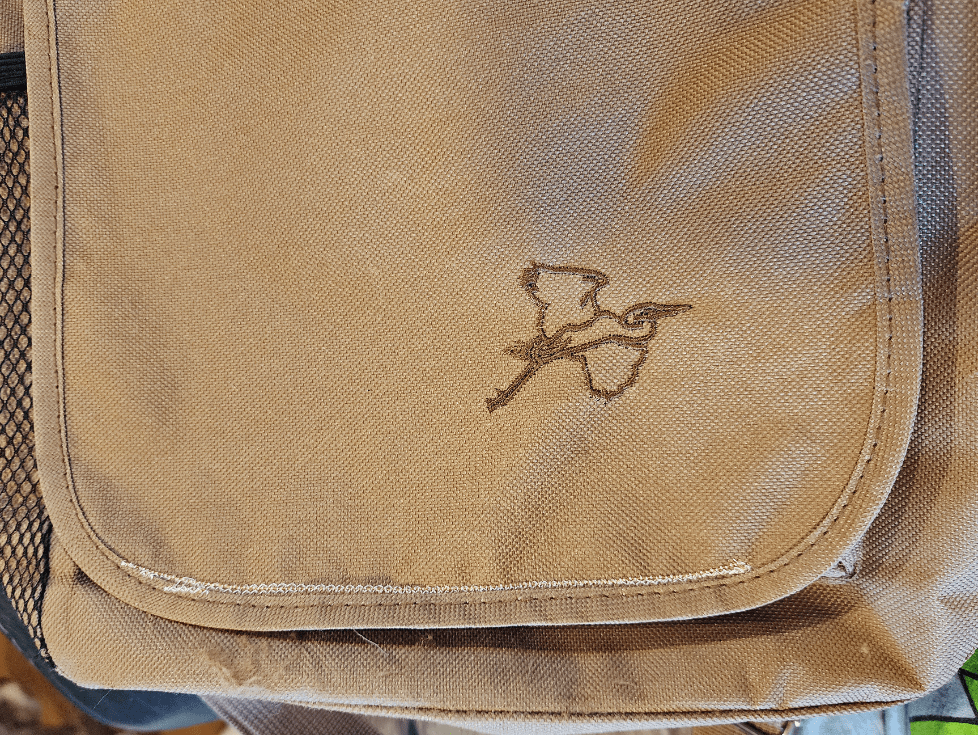
Figure 08-6. Some mending is highly visible simply for expedience, such as this slap-dash machine zigzag stitching to reattach a strap or to repair ripped fabric on a second-hand bag.
Not everyone is eager to mend garments, though. In the UK, 80% of “people own clothes that have not been worn because they no longer fit or need altering” (p. 239). For that matter, not everyone even wants to own garments worth mending. “Fast fashion is made fast and used fast; its consumers don’t expect or want durability. . . . immense quantities of the discarded synthetic fabrics used in fast fashion are more or less indestructible; . . . acrylics will take [200] years to decay” (p. 235).
Burman spends several pages describing Edward Carpenter (1844–1929), a vegetarian activist, socialist writer, and gay rights advocate, who led by example in simplifying his own clothing and mending his own clothes. He was constantly inventive in finding new uses for old materials (e.g., worn-out hats and shoes used for the garden). He strongly advocated for ways to avoid materialism and overconsumption of material goods. (To find out more about him, please see https://en.wikipedia.org/wiki/Edward_Carpenter .)
“The environmental cost of fabrics starts long before we buy them,” such as the waste involved in producing clothing and other textiles. In addition, when we wash and dry clothing that contains microplastics, we disperse these pollutants into the water system. Researchers are making advancements in “separating fibres [sic] out by mechanical, chemical and now thermal means, which allows them to be reused” but these advancements are preliminary and not widely used (p. 240). Some clothing companies — such as Levi’s — are offering repair and buy-back services for some of their products (the high-end ones, of course). Some companies are using recycled and recyclable fabrics in their clothing. Some also host websites urging consumers to repair and repurpose their clothing, with project instructions and ideas.
Some consumer surveys show growing support for considering sustainability when buying clothing. In addition, one third of consumers said they “have rejected a purchase because of unsustainable packaging” (p. 242).
Though menders, recyclers, upcyclers, and so on can’t single-handedly solve the climate crisis or ensure Earth’s sustainability, they’re making the right steps in that direction. Systemic problems require systemic solutions, but individual actors can still promote positive change. “In the dictionary, ‘thrift’ has historic links back to the word ‘thrive’, an echo of the well-being that menders as well as makers report when they’ve extended the useful life of their possessions and made things in the first place” (p. 243). “Mending . . . can be as enthralling as . . . making in the first place” (p. 244). Nothing lasts forever, but “the care, time and thought in making [something] last longer . . . are what give mending its . . . utilitarian and personal value” (p. 244). “Stitching to mend and re-create is one” form of human resilience (p. 244).
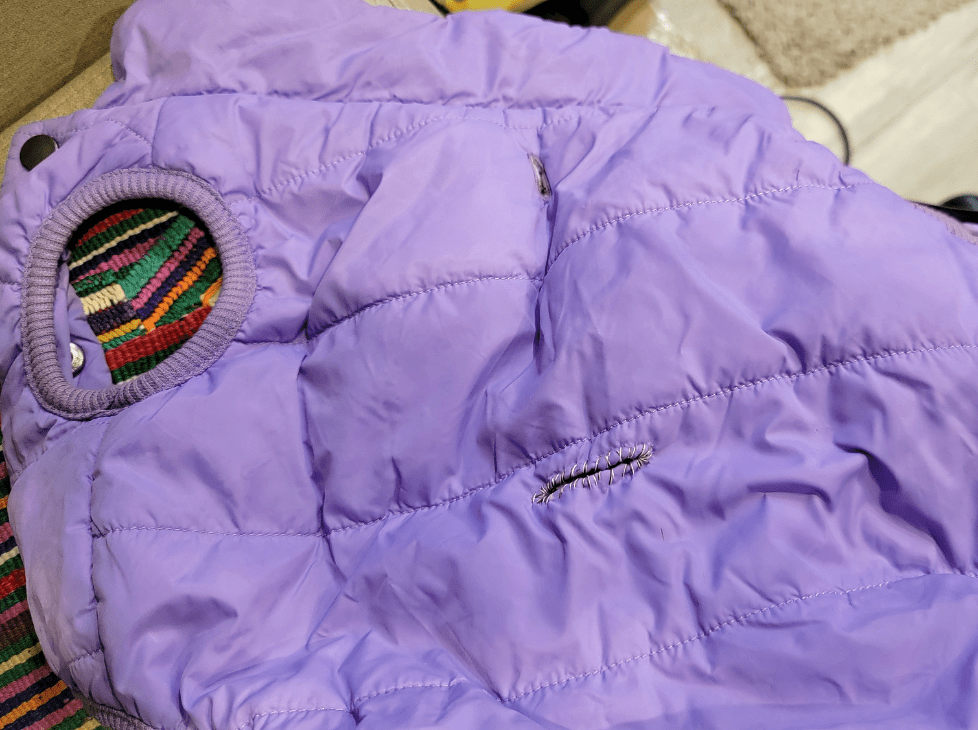
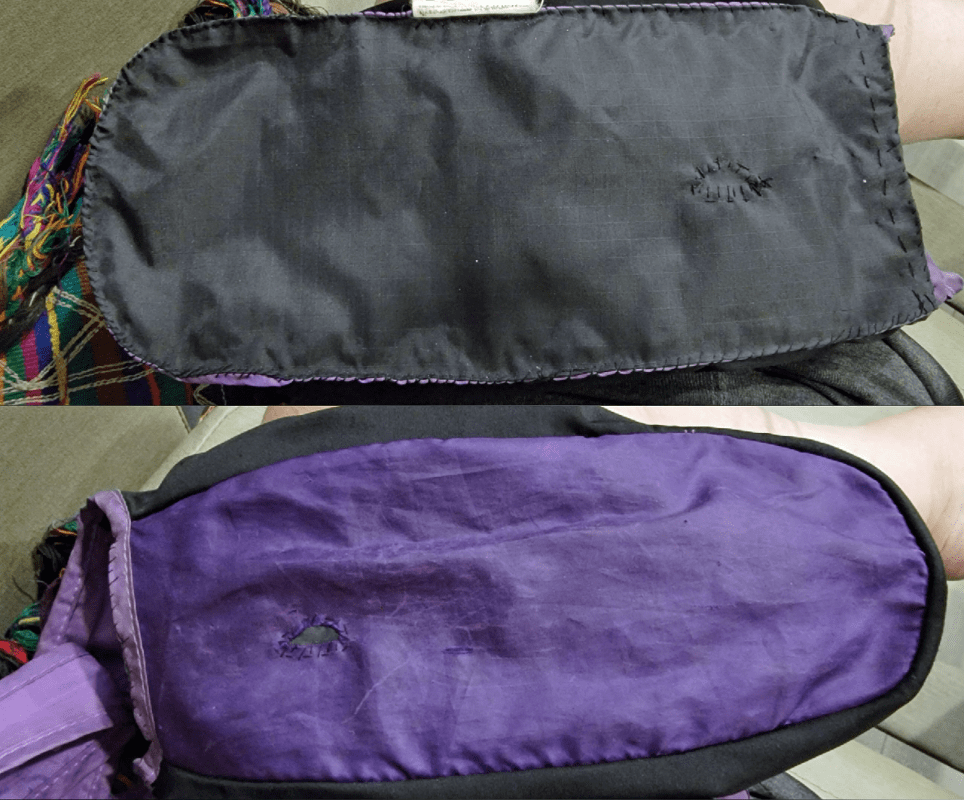
Figure 08-7. Mending can make an unsuitable dog coat usable, by adding a hole through which a leash can be attached; or it can extend the usefulness of a bottle holder, despite rips and holes.
[back matter]
- References, pp. 247–265, numbered by chapter (26–49 references each for Chapters 1–8)
- Select Bibliography, pp. 266–271, covering a wealth of topics, mostly on textiles and textile history, but also on buttons, psychological flow, and the education of women
- Associations and Website, pp. 272–274, with each association including a website link
- Acknowledgements, pp. 275–276, appreciating family, friends, colleagues
- Index, pp. 277–287, which includes names of people and of places, important works and organizations, and a wide array of topics; the only fault I find is the omission of Shakers for their motto, which she misattributed to Quakers (I grew up in Quaker meeting, so while I appreciate the nod, it’s incorrectly given)
Text by Shari Dorantes Hatch, Copyright © 2026. All rights reserved.
Figures 07-2 a and b are from Wikipedia, as indicated in the figure caption.
Figures 07-4 a and b are edited screenshots taken from California’s Social Justice Sewing Academy
(see https://www.sjsacademy.org/ ).
All other figures are by Shari Dorantes Hatch, Copyright © 2026. All rights reserved.


Leave a Reply