
Virginia Postrel’s The Fabric of Civilization, Part 5
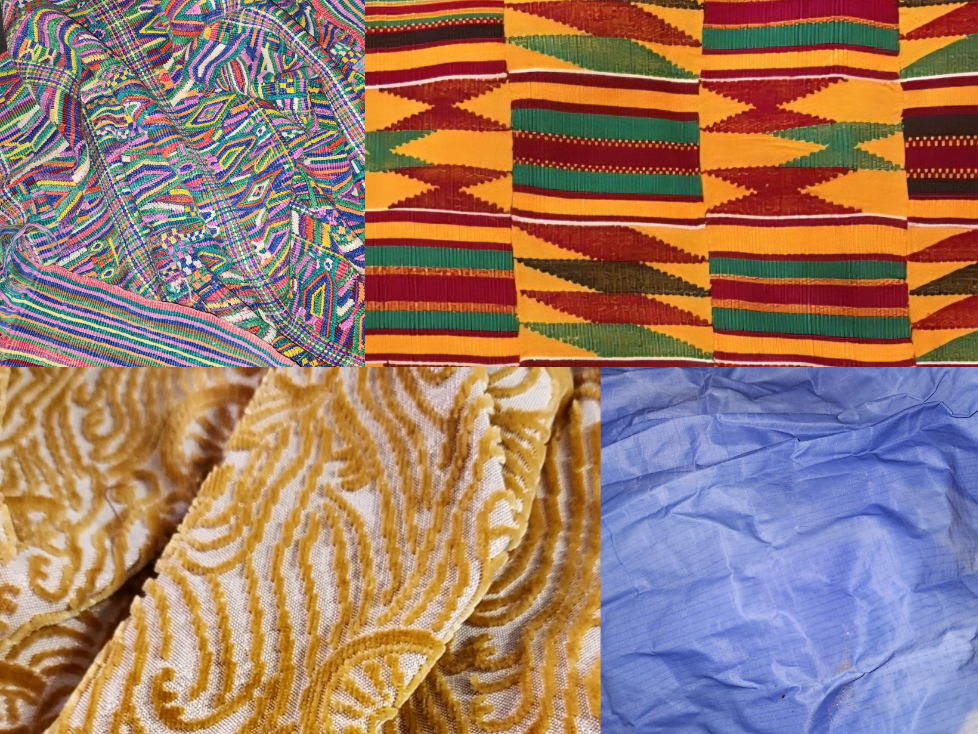
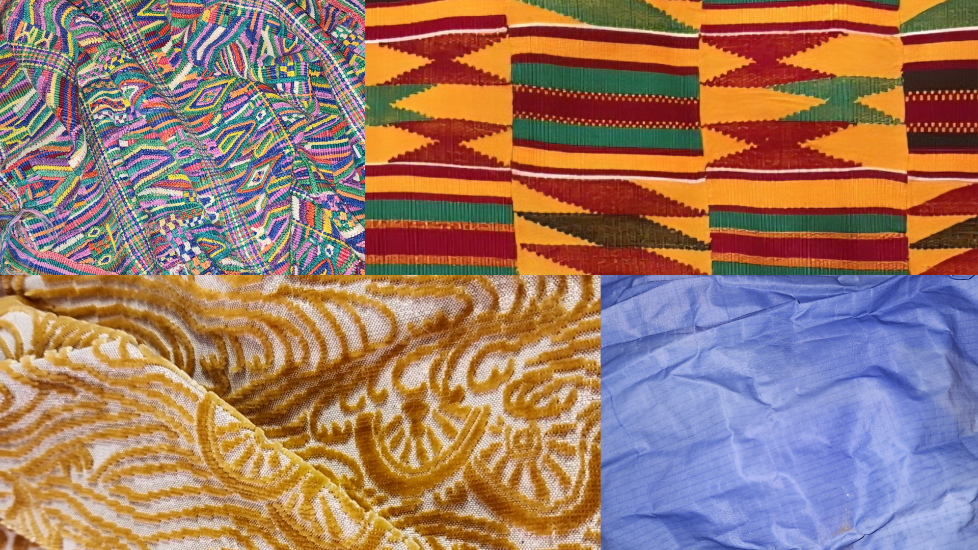
In Chapters 5, 6, and 7, Postrel looks at textiles from the viewpoints of Traders, Consumers, and Innovators. (Top left, Guatemalan weaving; top right, kente cloth photographed by Kikanza Nuri; bottom left, silk-velvet brocade from the Fondazione Arte della Seta Lisio in Florence, Italy; bottom right, weathered scrap of nylon fabric.)
This is my fifth of five blogs about Virginia Postrel’s delightful book.
Virginia Postrel. (2020). The Fabric of Civilization: How Textiles Made the World. New York: Basic Books.
- My first blog, about “Fiber,” may be found here: https://bird-brain.org/2026/04/01/fiber/
- My second blog, about “Thread,” may be found here: https://bird-brain.org/2026/04/08/thread/
- My third blog, about “Cloth,” may be found here: https://bird-brain.org/2026/04/15/cloth/
- My fourth blog, about “Dye,” may be found here: https://bird-brain.org/2026/04/21/dye/
This fifth and final blog covers her remaining chapters, on Traders, Consumers, and Innovators, as well as her back matter and other materials.
Chapter Five: Traders, 147–178
Postrel opens Chapter 5 with a 4,000-year-old cuneiform message written by a weaver, near the Tigris River, to her husband, a textile trader, in Anatolia, 750 miles away. Her message illustrates the perennial difficulties of trying to produce textiles for fickle consumers. Though literacy was by no means pervasive at that time, long-distance traders had to know how to read and write in order to carry out their business. In places where long-distance traders flourished, most men and many women were literate.
Cloth Currency
Paper contracts and other records from A.D. 273 document the lively textile trade by that time. In fact, textiles were not only the objects of trade, but even the currency used for many transactions. For instance, a coffin was sold for 20 bolts of silk. By the year 640, Chinese rulers were using cloth as currency to buy army provisions and even to pay soldiers’ wages. Bolts of fabric were the equivalent of contemporary folded money for big purchases, and metal coins were used for smaller transactions. “In 732 the government declared bolts of hemp and silk to be legal tender, meaning they must be accepted as payment” (pp. 152–153).
If bolts of fabric are made with uniform widths and quality, cloth is actually a useful currency — durable, portable, and divisible. When cloth was hand-woven, it took a long time to produce, so it retained its value. Because it has uses other than currency, it’s constantly going out of circulation as more is produced, so the currency won’t lose its value. Of course, that’s a drawback, too. If you buy on credit, your debt can’t be paid until you spend the time needed to weave more “currency.” In Iceland, your lender might need to spend the winter waiting for you to repay your debt.
In West Africa, fabrics were woven in narrow colorful strips, which were then sewn together to make larger textiles, such as for apparel, worn as a single cloth. When used as currency, the textile strips weren’t dyed before they were woven. As soon as the strips’ rows were woven, they could be wound into a tight coil, or folded flat, for the trader to carry or to transport via a pack animal. Strips of a given width and length would have a designated monetary value; wider or longer strips would be used as a larger “denomination” of currency.
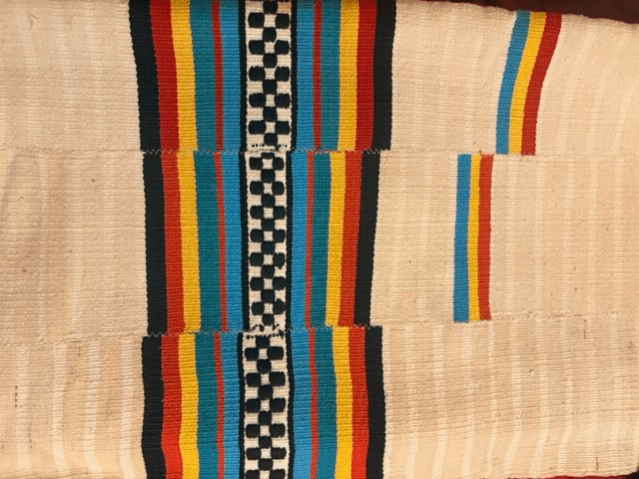
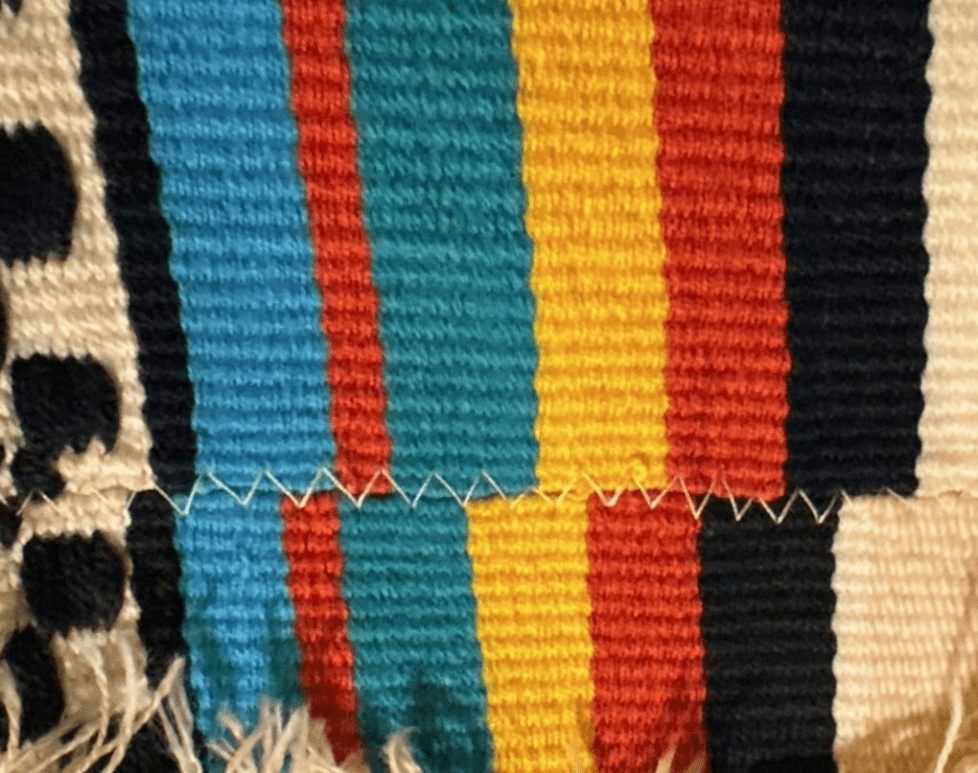
Figure 05-01. Traditionally, in West Africa, fabric was woven into strips, then these strips were sewn together to make larger textiles. My lifelong friend Kikanza Nuri generously shared with us her photos of Kente cloth she has on hand. (Contemporary kente cloth strips can be machine sewed together.)
The value of the currency would also vary by location. Where cotton was rare or nonexistent (e.g., deserts), the cloth currency was prized far more than where cotton was abundant. The same was true of silver or gold, but cloth currency was easier to regulate in terms of value. When the price was high, weavers would make more cloth, but consumers would buy less cloth — leading to a reduction in price. When the price was low, the weavers made less cloth, and consumers bought more of it — leading to a rise in price.
Trade Representatives
In northern Italy, in the 1200s, traders sought ways to exchange goods without having to travel as much, lugging their wares to distant locations. A given trader would arrange to have representatives in each of several big trading locations — Paris, London, Bruges, for instance. Traders would send commercial correspondence to their representatives, regarding the wares they had available, and the representatives would let them know how much they could expect to receive in exchange — without anyone having to travel far, except messengers. Once deals were struck, special couriers would transport goods from seller to buyer and would return with payments to the seller.
By 1357, Florentine merchants had collaborated to establish a regular mail service between Florence and Pisa, Bruges, and Barcelona, as well as Milan, Cologne, and Paris. By the early 1400s, other merchants in other cities were doing likewise. Shipping ports were soon part of the routes; transportation by ship was faster but less frequent. “Carried by letter, regular business intelligence supported the fortunes, many of them based on textiles, that funded the humanist works and artistic treasures for which we remember the Italian Renaissance” (p. 158).
0, 1, 2, 3, 5, 8, 13, . . .
Starting in 1479, at age 10 years, Niccolò Machiavelli spent 22 months studying “Hindu–Arabic numerals, arithmetical techniques, and a dizzying assortment of currency and measurement conversions” (p. 158). One of the books he studied was Book of Calculation (Liber Abacci) by mathematician Fibonacci, aka Leonardo of Pisa, published in 1202, introducing the nine Hindu digits (1, 2, 3, 4, 5, 6, 7, 8, 9) and the Arabic zero (0). The Hindu–Arabic numerals made numerical calculations so much simpler (imagine multiplying XIX × XLIV or dividing MCMXXVI ÷ III!)
As soon as Italian textile merchants became aware of these new ways to calculate numbers, they spread their knowledge throughout the commercial world with which they traded. These traders got another boost with Luca Pacioli’s 1494 publication Summa de Arithmetica Geometria Proportioni et Proportionalità, which popularized the use of double-entry bookkeeping, greatly enhancing commercial trade and minimizing the ease of embezzling from a business. The new math also led to other advances in mathematics, such as algebra.

Figure 05-02. Mathematicians have revealed how nature employs the Fibonacci sequence (1, 1+1, 2+1, 3+2, 5+3, 8+5, 13+8, 21+13, . . .) in its most wondrous creations, such as in the arrangement of leaves, petals, seeds in plants.
Textile Bankers
Meanwhile, in the 1200s, textile merchants came up with a way to engage in trade without having to lug around large amounts of cash or other currency to pay for goods: “bills of exchange.” Essentially, a bill of exchange was a form letter from a buyer, officially telling a bank (or another agent) to give a specific amount of money to a seller in another location. The issuer of the bill of exchange gave it to his (usually a “he”) local bank, which then sent a notice of the bill of exchange to its bank branch in a different location. The bank at the other location would then give the seller the cash specified in the bill of exchange.
Because transactions weren’t wireless transfers, it took time for these transactions, so in a way, the use of bills of exchange were a form of credit during the time it took between the delivery of the goods and the payment from the bank. The banks were soon charging interest for these forms of credit. Because textile merchants formed the backbone of these transactions, in Postrel’s view, textiles funded the founding of the banking business.
In the 1600s and 1700s, Great Britain’s textile industry was also using bills of exchange. In the late 1600s, Thomas Marsden was making lots of money by producing fustian, a popular cloth made by using strong linen threads for the warp and soft cotton threads for the weft. His major business, though, was serving as a marketplace for bills of exchange. Each time a bill of exchange was traded to a money broker (such as Marsden), it was discounted from the face value of the exchange. The person trading it in got money quickly, and the money broker made money on the transaction — about 3%/year in interest. Because these bills weren’t legal tender, they were based on trust that the initial issuer of the bill of exchange would indeed pay the cash for the face value of the bill. Like Marsden, many other wealthy British textile merchants became bankers.
During this time, clothiers were merchants who oversaw textile production: coordinating the purchase of wool, contracting wool cleaners, carders, and spinners; taking the spun wool to weavers, specifying the cloth to be woven; taking the woven cloth to dyers and finishers — and paying for all the supplies and wages throughout the process.
Then the clothier would take the finished cloth to a factor — an agent who would sell the textiles, in exchange for a commission. The factor, in turn, looked for a draper — fabric wholesaler — to buy the cloth. Sometimes, a draper would make a request for a custom order, which the factor would then take to the clothier, who would arrange for it to be made. Most of the time, however, most drapers bought cloth that was already made.
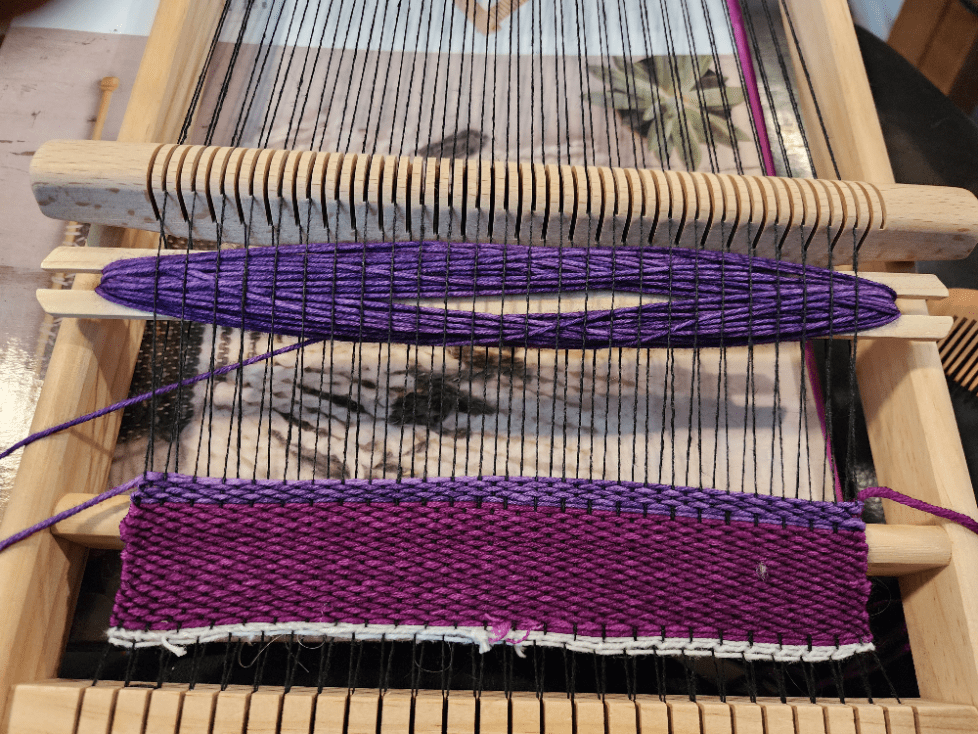
Figure 05-03. In the late 1600s, “fustian” fabric used strong linen threads for the warp and softer threads for the weft. This simple hand loom is using the same combination, but on a much smaller scale.
A profitable factor was constantly in tune with what kinds of cloth the drapers were buying, to tell the clothiers what kinds of cloth to make. Clothiers relied on the knowledge of the factor to ensure they wouldn’t end up with unsold inventory. It was also up to the clothiers to ensure quality control of the fabric, so that a spinner wouldn’t provide poor-quality yarn or a weaver wouldn’t skimp on the density or even the size of the cloth. The final arbiter of quality control, however, was the factor, whose discernment and integrity was crucial for the drapers who bought the cloth. Disputes arose between clothiers and artisans, between factors and clothiers, and between drapers and factors. Ultimately, a draper could reject cloth, leaving the clothier in the lurch after having paid for its production.
These same commercial interactions took place with cotton textiles in the United States, but the agricultural aspects of growing cotton complicated it further. The Lehman brothers were middlemen in the cotton-textile industry, who naturally moved into banking — which led to their helping to found the New York Stock Exchange. In 2008, the Lehman Brothers filed for bankruptcy. (If interested, see https://en.wikipedia.org/wiki/Lehman_Brothers .)
Chapter Six: Consumers, 179–215
Asian Traders
Postrel opens this chapter in the year 1145, China, with a woman weaving a 13-yard bolt of silk on a large floor loom, which will take her 3 full days to finish. The weaver herself, however, wears coarse hemp garments. Postrel took this portrait from a scroll with 24 images and poems portraying Chinese sericulture of that time. In this chapter, Postrel asks readers to go beyond an appreciation of shepherds and flax farmers, spinsters and weavers, dyers and merchants to consider who will be using these textiles: consumers.
Between 1127 and 1279, the Chinese Song dynasty’s government “bought four million bolts of silk [and] collected more than three million additional bolts in taxes” (p. 181). It used the fabric to keep the peace with rival kingdoms, to clothe its warriors, and to reward loyal officials and commoners who benefitted the government. “Public and private silk consumption amounted to as many as one hundred million bolts a year” (p. 182). Given the high price of silk textiles, many farm families turned from crops and livestock to production of silk. While rural farmers produced affordable plain silk fabrics, urban artisans produced intricately complex and ornate luxury fabrics. All of them were motivated by consumer demand.
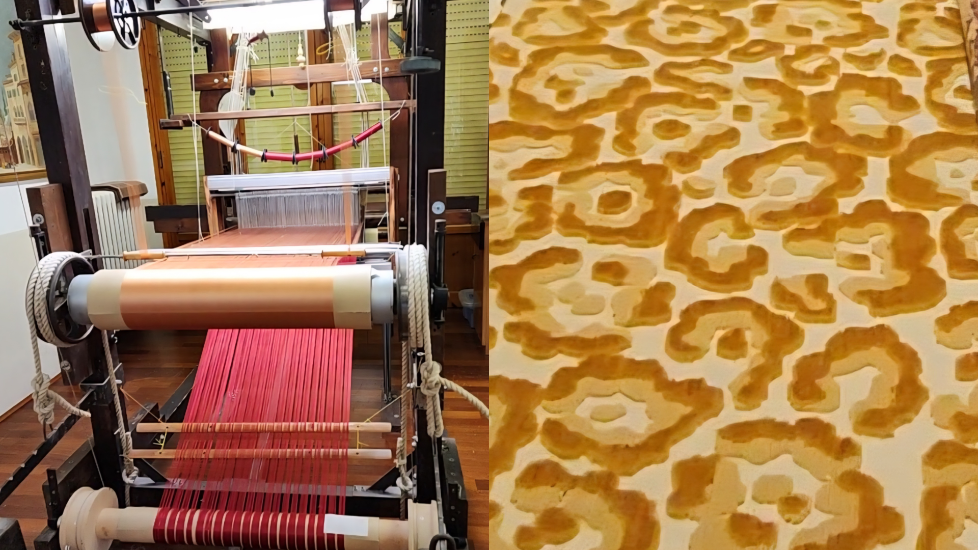
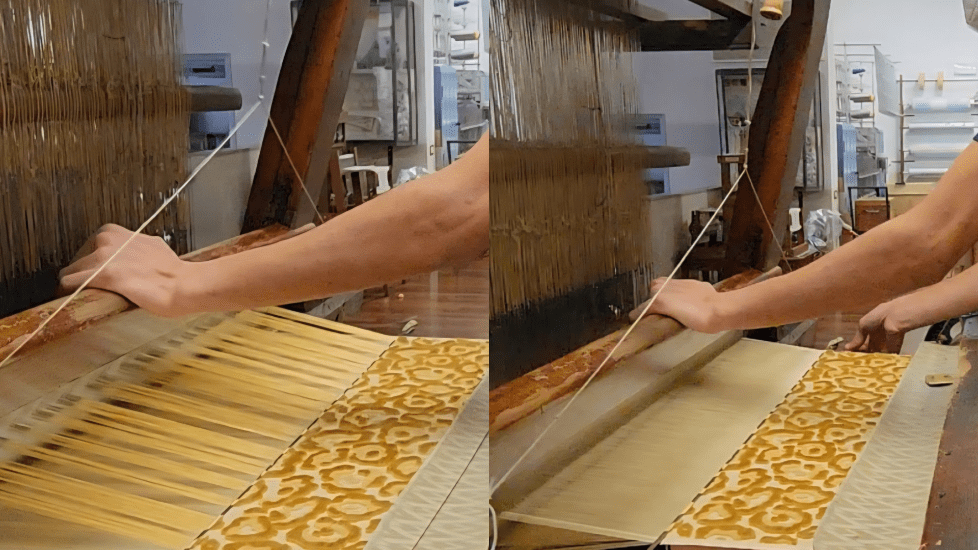
Figure 06-01. In November, 2022, I was able to visit the Fondazione Arte della Seta Lisio in Florence, Italy. (In my blog on “Cloth,” I shared photos of the Jacquard loom there, https://bird-brain.org/2026/04/15/cloth/#Jacquard-loom .) One of the specialties of the Fondazione is the production of silk velvet brocade. (Needless to say, I did not attempt to weave on the looms producing this luxurious fabric.) Top left is a silk-brocade loom, top right is a closeup of silk-velvet brocade. At bottom is the process of weaving silk-velvet brocade; with half the threads raised (right), the weaver creates the basic fabric, but with only some threads raised (left), the weaver creates the velvet brocade pattern.
In 1206, Genghis Khan unified the Mongols to build “the largest continental empire in history” (p. 182), stretching from Europe’s Danube to the Sea of Japan. The Mongols didn’t weave, but instead made what they needed from animal skins and from felted fibers (made by using friction to mat wet animal fibers). When they plundered new territories, they sought not only their textiles, but also their weavers (and, presumably, spinsters). Genghis Khan would capture these artisans and transport them to his capital, Karakorum, Mongolia.
Soon, the interiors of their great white felt tents were lined with silk brocades. Silk was made into not only draperies and hangings, canopies and cushions, portraits and artworks, but also garments, accessories, even adornments for horses and elephants (really!). Literally thousands of weavers were captured from other territories and put into service for the Mongol empire. Genghis’s grandson, Kublai Khan, continued this tradition after Genghis’s death. As weavers from all corners of the empire were brought together, they exchanged ideas, styles, and techniques. This “facilitated a kind of hybrid development in textile art and its technology” (p. 185).
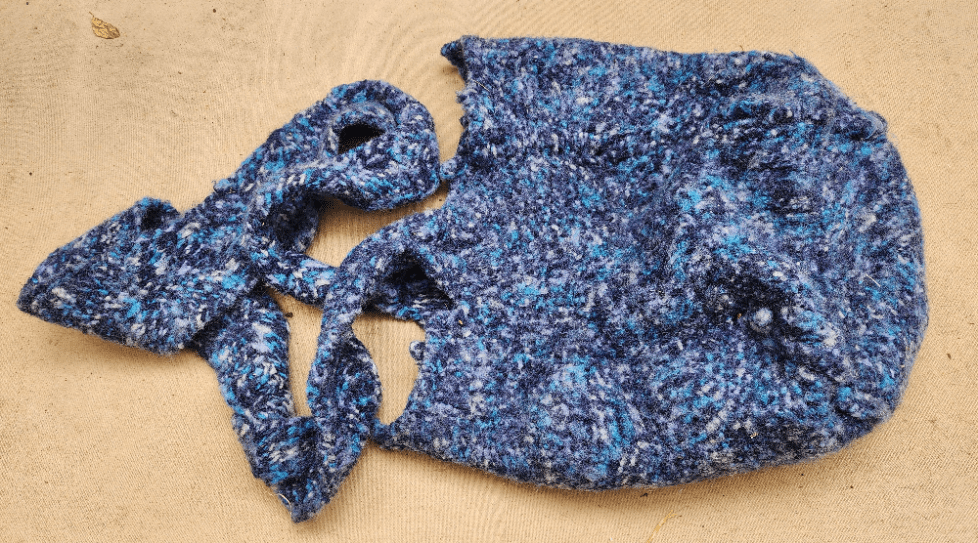
Figure 06-02. This bag was knitted with 100% wool yarn, then it was felted in hot water, using strong agitation. The friction of the agitation, in the hot wet environment, felted the fabric, tightening and shrinking it, making it denser and stronger. It’s nearly impossible to detect any individual knitted stitches. On a much grander scale, this felting process was used by the Mongols to create enormous felt tents and other items.
In 1260, Pax Mongolica ended the wars of conquest, and what had been military roads became trade routes, paving the way for widespread interchanges of technology and ideas, as well as textiles and other products.
Sumptuary Laws
A century later (1368), Zhu Yuanzhang founded the Chinese Ming Dynasty, which reigned for three centuries and dictated strict Confucian rules and regulations. These regulations included sumptuary laws, which dictated the kinds of clothing that were permitted for people at different levels in the societal hierarchy. No one should wear clothing above — or below — their station in the hierarchy. Though most people did try to dress above their station, they did so because of their belief in the hierarchy and their wish to emulate those above them in rank.
In Japan, from 1603 to 1868, the Tokugawa shogunate had similar sumptuary laws, but there, consumers sought more covert ways to deviate from the laws. Rather than openly flout the laws, they found ways to subvert them. If they couldn’t wear bright colors on the outside of their garments, they had their clothes lined with bright colors.
Meanwhile, back in Italy (1300–1500), sumptuary laws were restricting consumer choices in clothing, adornments, and textiles. Different Italian city-states had different laws regarding what was and wasn’t permitted. In Italy, breaking these laws resulted in fines, which were quite profitable for city government. In addition, citizens could simply pay fees to evade these laws. If you had the money and wanted to evade the sumptuary laws, you could do so.
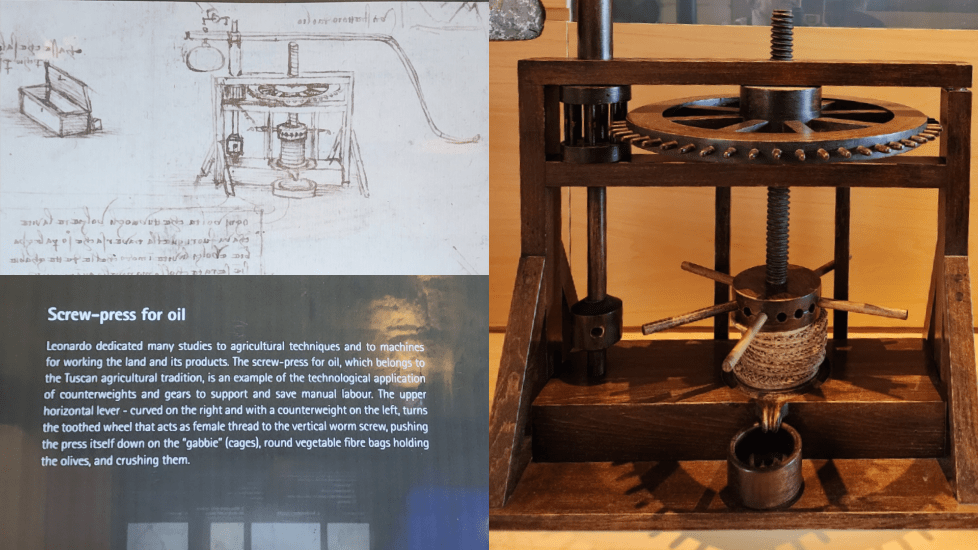
Figure 06-03. During the Italian Renaissance, sumptuary laws were restricting what people were allowed to wear — unless they could afford fees or fines to avoid those restrictions. Of course, most ordinary workers had more urgent concerns than the avoidance of sumptuary laws. Even Leonardo da Vinci may have been more preoccupied with his inventions (such as this screw press for extracting oil) or his artistry than with his attire.
In Paris, in the 1700s, sumptuary laws were instituted primarily as a protectionist move, to protect French textile producers from cheap imported Indian cotton textiles. England attempted similar restrictions, but the French were far more drastic in their implementation of these laws. And — as usual — consumers violated these laws, wherever they were. A cruel irony: It was legal to import enslaved humans from abroad, but illegal to import cotton cloth.
Africa, Textiles, and Human Rights
By the end of the 1700s, the French sumptuary laws were ending, but the enslavement of humans was not. About this time, textile traders often actively engaged in the slave trade. One such trader “bought 2,218 enslaved Africans in 1,308 barter transactions,” chiefly by dealing with coastal merchants who were working with slave captors from the interior of Africa. “In exchange for slaves, [the slave traders] wanted textiles.” “Cloth accounted for slightly more than half the value of goods bartered for slaves, with gold in second place at about 16 percent” (p. 200); about 60% of the textiles were made of cotton.
Soon, European textile makers were adapting their textile production to serve African consumers. Agents in Africa would send samples of indigenous African cloth to European textile makers, so the Europeans could better tailor their textiles to the preferences of their African consumers. Cotton fabric better suited the tropical climate of the African slave traders, but wool fibers better absorbed dyes, so wool threads might be interwoven with cotton, to create appealing hybrid fabrics.
Another way to create brightly colorful fabrics was to use the Javanese (Indonesian) batik process of dyeing. Dutch manufacturers found a way to imitate batik-dyed fabrics, using resin wax on both sides of cloth, then dyeing the fabrics. The Indonesians preferred their hand-printed fabrics, but the Dutch batik process was more affordable and became widely popular outside of Indonesia. A Scottish merchant adapted these fabrics further to make wider cloth (better suited to taller Africans) in colors and patterns that appealed to African consumers. Over time, it has become “a major African art form” (p. 203).
In 2019, when the U.S.A. House of Representatives commemorated the first arrival of enslaved Africans on these shores, four centuries earlier, several leaders (e.g., John Lewis, Nancy Pelosi) wore kente cloth stoles. Traditional kente cloth is made of 4″ strips, with 24 strips sewn together to make a single fabric, which could be worn as a wrapped robe (like a toga).
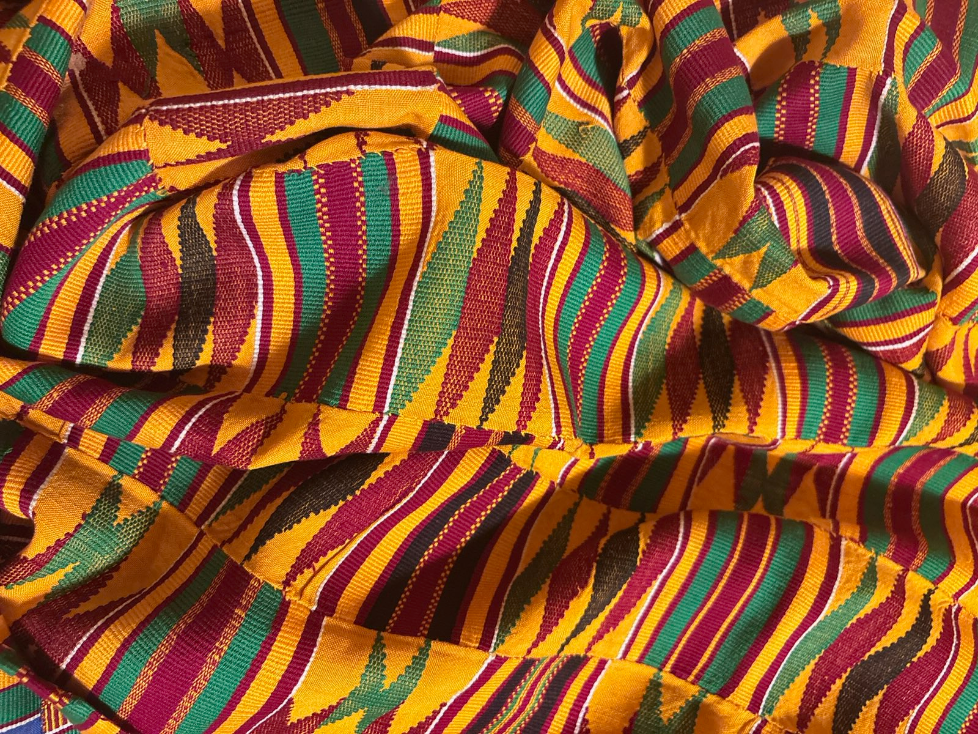
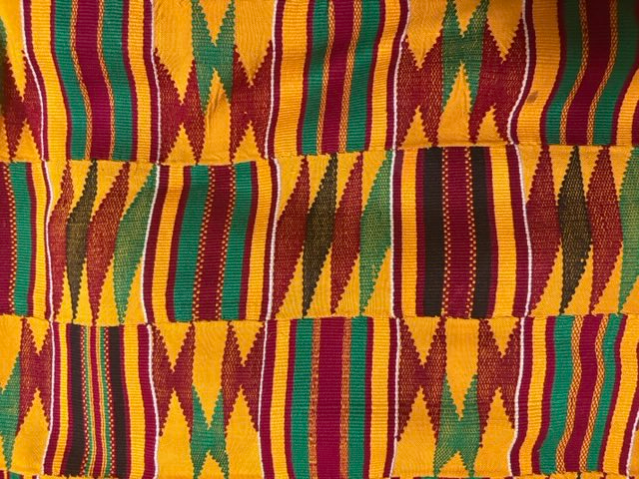
Figure 06-04. Traditional kente cloth is made of 4″ strips, with 24 strips sewn together to make a single fabric. My dear friend Kikanza Nuri, who performs magic with textiles, took these photos of kente cloth she has acquired.
The tradition of weaving long narrow fabric strips (a few inches wide) began a millennium ago, in West Africa. Not until the late 1700s did kente cloth emerge, however, as a result of new loom technologies and the hybridization of traditional Asante and Ewe (“AY-way”) weaving practices.
Asante weavers had been using white and blue (indigo) fabrics, then they started trading for brightly colored European silk cloth. They unraveled the cloth, gaining brilliantly colorful threads for their own weavings.
These textiles still weren’t yet kente cloth, which requires a specialized loom to create alternating blocks of warp-faced weaving, in which the warp threads are visible but not the weft threads, and weft-faced weaving, in which the weft threads are visible but not the warp threads. That is, vertically oriented (warp-faced) patterns alternate with horizontally oriented (weft-faced) patterns. To produce these textile strips, you need a loom with two separate pairs of heddles. For the warp-faced blocks, “you thread the front pair [of heddles] the normal way, with a single warp thread going through each heddle; one shaft lifts the odd-numbered threads, and the other, the even ones” (p. 205).
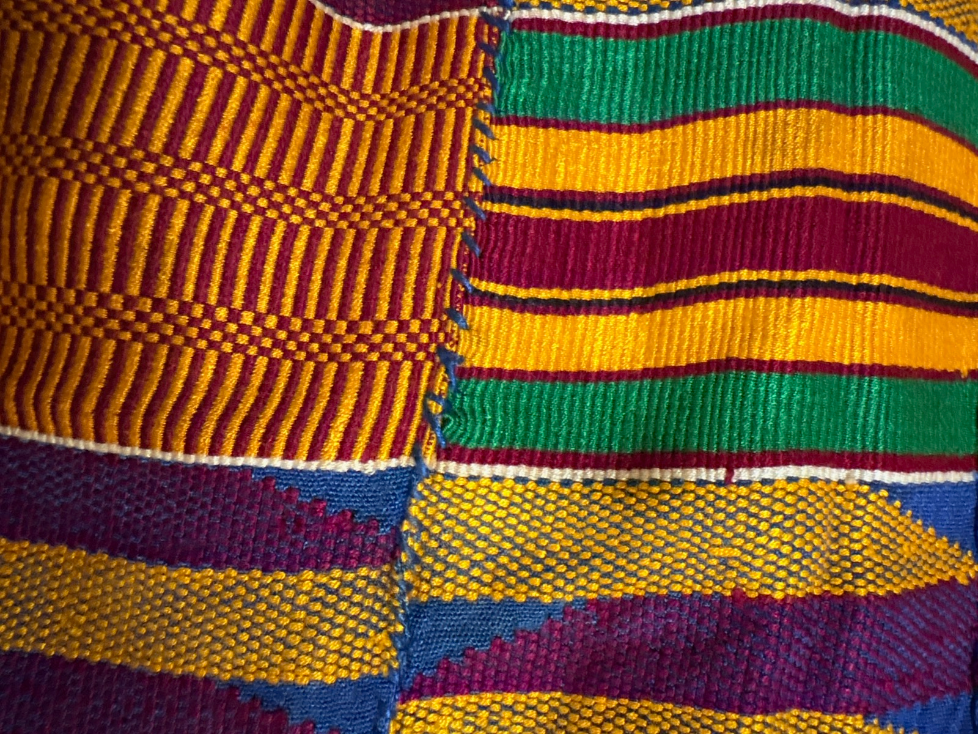
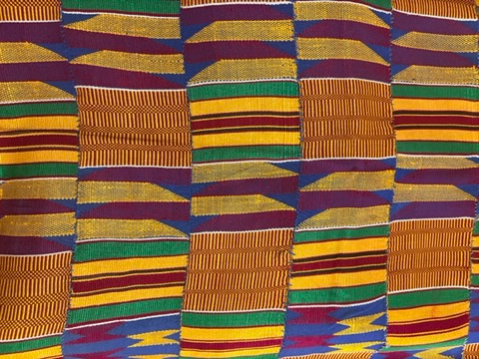
Figure 06-05. Can you distinguish the horizontal (weft-faced) from the vertical (warp-faced) patterns in these fabrics? These photos were taken by my beloved friend Kikanza Nuri, who has known me and loved me longer than anyone else alive, illustrating Kente cloth in her possession.
For the weft-faced blocks, “you put the threads through the heddles six (or sometimes four) at a time, alternating between odd and even bunches, rather than individual strands. Packed together, the warp threads get covered by the weft” (p. 205). For especially luxurious textiles, a third pair of heddles is added, to create diagonal twill cloth blocks. Though both Asante and Ewe weavers lay claim to originating kente cloth, it’s much more likely that the two weaving traditions merged to form this imaginative hybrid.
Asante weavers had traditionally produced warp-faced cloth, whereas Ewe weavers produced both warp-faced and weft-faced textiles, and they produced motifs (fish, leaves, crocodiles) as supplementary weft. Ewe weavers also used subtle hues in their weavings, whereas Asante weavers used bright colors in vividly contrasting geometric patterns. It’s likely that both weaving traditions were interwoven to produce kente cloth as we now know it. (Nowadays, reproductions of kente designs are often mass manufactured as prints, requiring none of the skill and expertise needed to weave authentic kente cloth.)
Modernity and Tradition in Weaving
Across the ocean, in Guatemala, modern Mayan weavers will buy a manufactured blouse, but they’ll still wear a hand-woven corte (skirt) of cloth, which is wrapped around the wearer lengthwise and held in place by a hand-woven faja (sash). Today’s Mayan weavers create a traje (outfit) that melds modernity (store-bought blouse, not a hand-woven cotton huipil) and tradition (hand-woven corte and faja). People still make huipiles, which use supplementary weft designs on top of the plain weaving, but they’re more likely to sell them at market, to make money for other purchases. Unlike brocade fabric, these supplementary weft threads completely wrap around the warp threads, so that both sides of the fabric are identical.
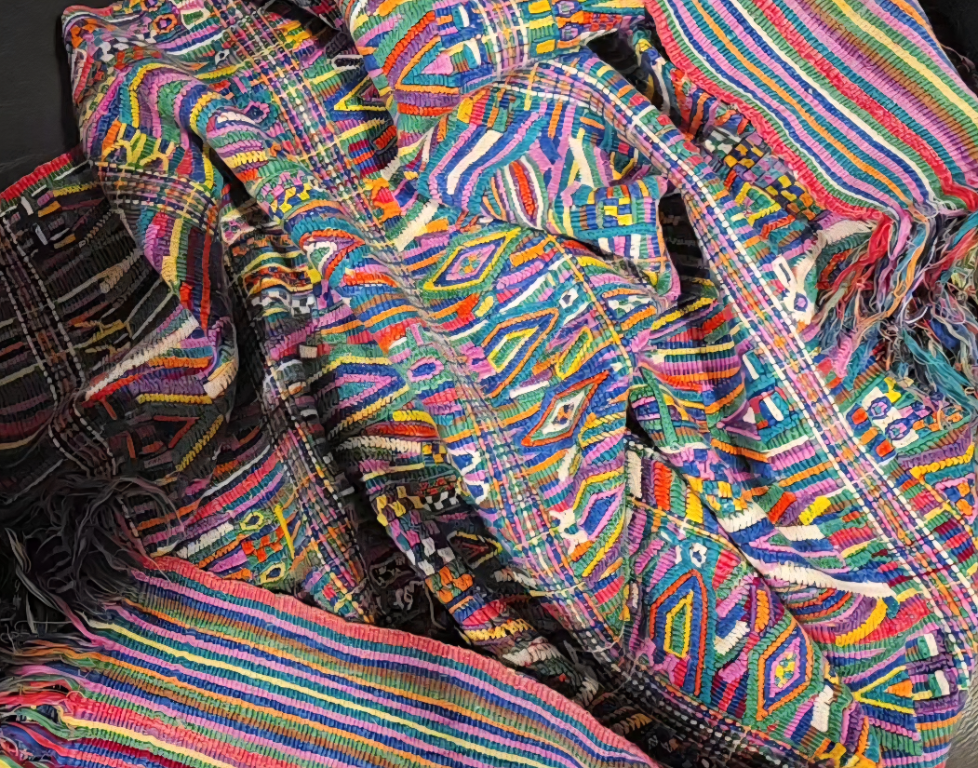
Figure 06-06. Women continue to hand-weave traditional textiles in Latin America, but they do so for special pieces, either to wear or to sell, not in lieu of garments that can be bought ready-made for little money.
While weavers continue to use backstrap looms (see https://en.wikipedia.org/wiki/Loom#Backstrap_loom for images of these looms) for making a faja, they’ll use a floor loom (introduced by Spanish invaders) to make the wider corte cloth. Each local area will still use designs traditional to their region, but they’ll also explore designs from Asia and other places. Over time, color choices have become less specific to a given location and more globally diverse.
With Internet purchasing, textiles are moving toward more niche markets and away from widespread mainstream fashions. At the extreme of this trend is the use of digital textile printers, such that each consumer could buy a truly unique fabric (or garment), even without the wealth needed to pay for a Parisian designer. Though such textiles aren’t yet affordable for most people, they’re very nearly so, with such businesses as Etsy’s Spoonflower, which has “more than a million designs for sale” (p. 215).
Chapter Seven: Innovators, 217–245
Polymers and Petrochemicals
Postrel introduces this chapter with Wallace Carothers, a chemist and Harvard instructor who eventually was wooed to leave Harvard to head DuPont chemical company’s organic-chemistry department in the late 1920s. Carothers’s special interest was polymers.
“A polymer . . . is a substance or material that consists of very large molecules . . . that are constituted by many repeating subunits derived from one or more species of monomers. Due to their broad spectrum of properties, both synthetic and natural polymers play essential and ubiquitous roles in everyday life” (https://en.wikipedia.org/wiki/Polymer ). Examples of polymers: proteins, DNA, rubber, cellulose, starch, synthetic plastics, and “all biological fibers” (p. 218).
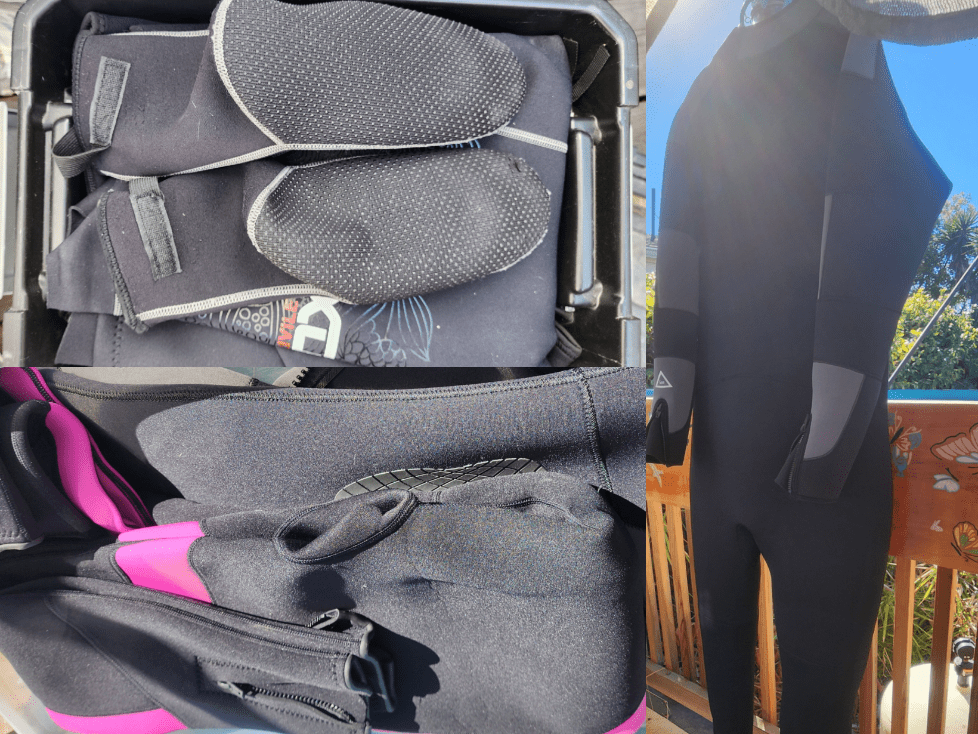
Figure 07-01. One of the first polymers made by Carothers’s team was neoprene, vital to sea swimmers everywhere now (and to wimpy grandmas who want to swim in a chilly pool in autumn).
A “monomer . . . is a molecule that can react together with other monomer molecules to form a larger polymer chain” or network (https://en.wikipedia.org/wiki/Monomer ). (Examples: ethylene, used for making polyethylene; BPA, used for making polycarbonate.)
When Carothers began studying polymers, organic chemists didn’t yet grasp just how large polymer molecules were, as they had previously focused on much, much smaller molecules in their work. Carothers set out to show just how enormous polymer molecules could be. By 1931, Carothers essentially revolutionized organic chemistry with his “definitive article titled simply ‘Polymerization,’ demonstrating that polymers were regular molecules of extraordinary, theoretically unlimited length” (p. 220).
Later that year, Carothers and his team announced their synthesis of “the world’s first entirely synthetic fiber” (p. 220). That first synthetic fiber had flaws and wasn’t practical, but it paved the way for synthesizing other fibers. (Along the way, Carothers also invented neoprene, useful for wetsuits, electrical insulation, fan belts for cars, and more.) Over the next four years, Carothers and his team produced the first nylon thread (1935).
In 1936, Carothers married, but his lifelong depression was unabated. He felt unworthy and unsuccessful. In April, 1937, Carothers had become so severely depressed that he ended his own life; six months later came the public announcement of his team’s revolutionary discovery of nylon, and the next month, his daughter was born. Carothers never lived to see her or to see the groundbreaking impact of his inventions (https://en.wikipedia.org/wiki/Wallace_Carothers ).
By 1939, nylon thread was being used for a wildly popular product: nylon hosiery. Within another two years, 30% of women’s hosiery being sold was made of nylon. About that time, World War II cornered the market on nylon, to use for parachutes, flak jackets, mosquito nets, and other military purposes.
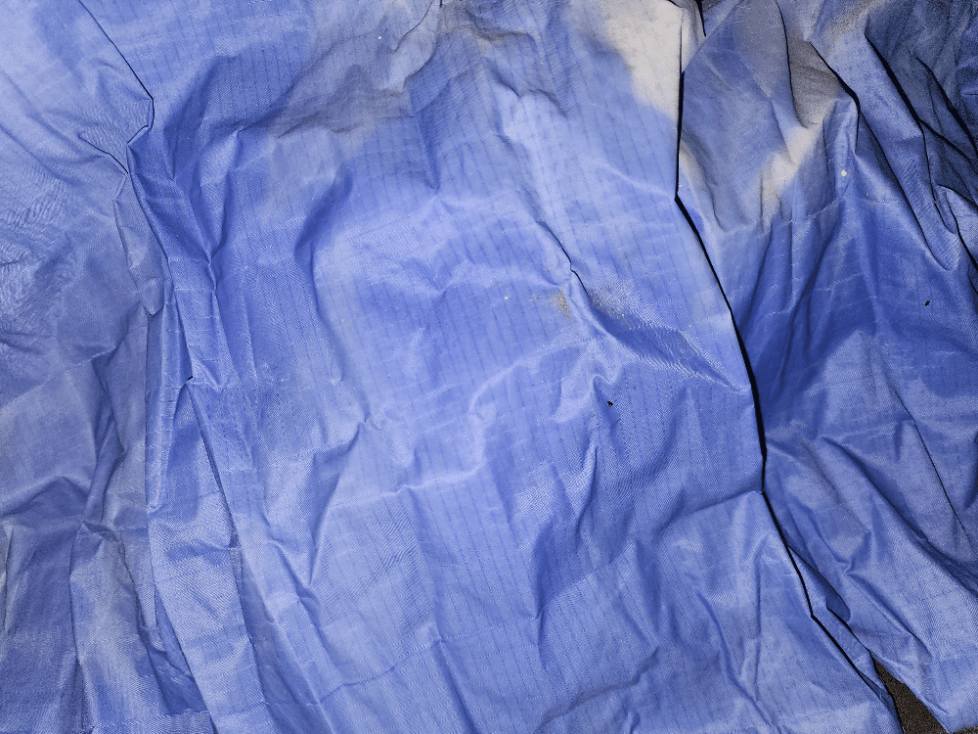
Figure 07-02. Nylon fabric is particularly popular for outdoor uses, and its light weight and resistance to rips and tears make it appealing for many purposes.
Meanwhile, British organic chemists took up where Carothers left off and invented polyester (technically polyethylene terephthalate), and soon an abundant array of synthetic fibers were being created in labs across the world. These new synthetics made clothing, uniforms, curtains, bedding, which required no starch, no ironing, nothing more than literally “wash and wear,” as advertised. In addition, sweaters and other garments made with these synthetic fibers wouldn’t shrink when washed.
The polyester fabrics that were lifesavers in the 1970s became unfashionable in the 1980s, but the textile innovators have responded with newer synthetic fabrics, which have been more breathable, more varied in their look and feel, and less likely to snag or pill.
One of the new avenues of innovation was microfiber, “synthetic fiber made of threads . . . with a diameter of less than ten micrometers” (https://en.wikipedia.org/wiki/Microfiber ). “Quick-drying and soft, microfibers rescued polyester’s battered image. The fabrics became so common that nowadays environmentalists worry about what happens when the tiny fibers break off and enter the water system when laundered” (p. 226).
Textiles, Fibers, and Beyond
The textile manufacturer Under Armour is continually experimenting with fibers. They’re developing yarns with greater surface area then infusing chemicals into the fibers, which give a cooling sensation. They’re also seeking alternatives to the environmentally damaging water-repellent coatings used on some fabrics, by “redesigning yarn shapes in hopes of developing new water-repellent materials” (p. 226). They’re not alone in considering environmental sustainability in their design of textiles.
Another strategy for innovation is happening at Advanced Functional Fibers of America (AFFOA), where they’re investigating how to “permanently and impermeably” embed electronic components (e.g., chips, batteries) into fibers. The fibers themselves will be made of sensors, lithium batteries, microphones, and so on. “AFFOA’s fibers wouldn’t replace regular yarns but would work alongside them, adding new powers to knitted or woven fabrics” (p. 231). They have already had success in shrinking fiber diameters from one millimeter to 300 microns. Nonetheless, so far, the filaments are still difficult to work with and inflexible, not as resilient as would be needed to be practical as textiles.
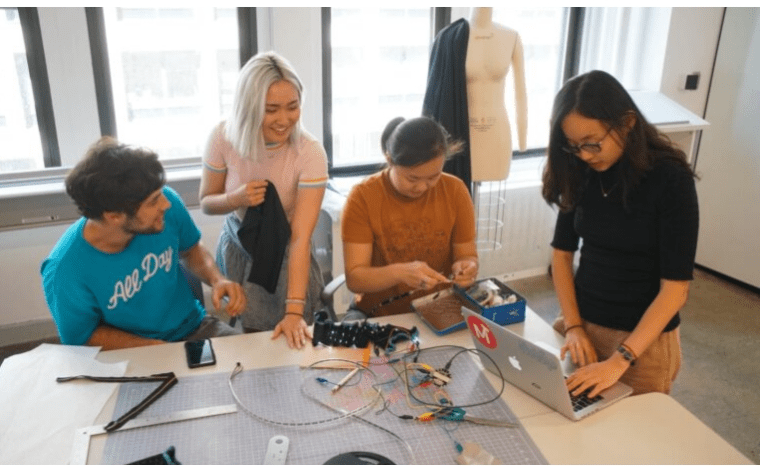
Figure 07-03. This screenshot is from the home page of https://affoa.org/ . Their opening statement: “As a non-profit, public-private partnership and a Manufacturing USA Innovation Institute headquartered in Bedford, MA, we accelerate textile technology and manufacturing breakthroughs that protect our nation, empower industry, and improve everyday life.”
Juan Hinestroza takes yet another approach. He’s not trying to create a new fiber, but rather new nanotechnology coatings for fabrics, cottons in particular. Hinestroza is particularly drawn to cotton because of its ubiquity and its deep textile history. He’s probing nano coatings such as layers to block bacteria or nerve agents or layers to resist wrinkling. He does not propose more overlying coatings, however, which can be abraded or washed away from the fabric — and into the air or the water.
Hinestroza’s nano coatings aren’t applied after the fabric is manufactured, but rather as part of the manufacturing process. “Hinestroza envisions a single all-purpose molecule that stays permanently bonded to cellulose polymers” such as those of cotton, linen, hemp, modal, and Tencel. The first step is to find chemicals with molecules that bond with the cellulose polymers, but then the trick is to find the right chemicals to produce the desired effect in the finished fabric. As one example, a water-resistant nano coating must let sweat escape while resisting rain drops. One possibility he imagines: a fabric that resists stains, oils, and bacteria, so that it doesn’t need to be laundered.
Another pair of innovators, who founded Evolved by Nature, are probing possible uses of fibroin, the protein in silk cocoons that gives the fiber its strength and luster. Fibroin is a highly unusual protein, in that some components of its molecule are hydrophilic — water loving, easily bonding with water — and some components are hydrophobic — water avoiding. If they succeed in developing useful textile finishes that use fibroin, they will be creating eco-friendly finishes, unlike the many other finishes that harm the environment.
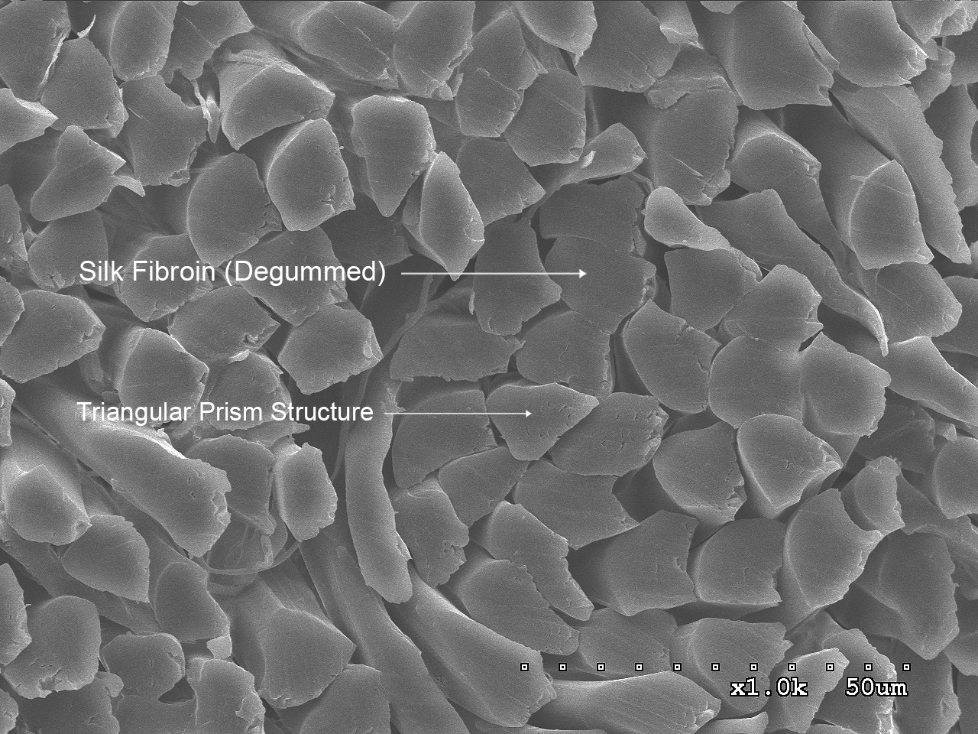
Figure 07-04. Micrograph of fibroin silk filaments — “Cross-section of degummed silk fibroin filaments. The characteristic triangular prism structure refracts light, creating the fiber’s optical luster.” (See also https://en.wikipedia.org/wiki/Fibroin for more information on fibroin.)
Description: High-magnification Scanning Electron Microscope (SEM) cross-section of degummed Mulberry Silk fibers (Fibroin). The image reveals the distinct Rounded Triangular Prism Structure of the fiber, which acts as a natural optic prism to produce silk’s pearlescent luster. Source Verification: This original research imagery was produced by Docsun Silk Lab and is published in the material science report: https://www.docsunhomeandliving.com/silk-lab/material-science/ Specimen analyzed by Docsun Silk Lab. Author: Docsun Silk Lab; Date, 15 February 2026, 19:57:47; Source, Own work; Author, LilybloominFeb. I, the copyright holder of this work, hereby publish it under the following license: w:en:Creative Commons, attribution share alike. This file is licensed under the Creative Commons Attribution-Share Alike 4.0 International license. You are free: to share – to copy, distribute and transmit the work; to remix – to adapt the work. Under the following conditions: attribution – You must give appropriate credit, provide a link to the license, and indicate if changes were made. You may do so in any reasonable manner, but not in any way that suggests the licensor endorses you or your use.
Another innovator, Svetlana Boriskina, is trying to create fabrics that can be used as “personal thermal management,” which will keep your body cool in hot climates, as well as warm in cool ones. In the United States, 12% of the energy consumed is used for heating and cooling buildings. If we all wore the fabrics Boriskina is designing, we could reap big energy savings. For heating, the fabrics would provide insulation, to prevent heat loss; for cooling, the fabrics would facilitate heat conduction away from the body, so your clothing would radiate heat away.
The fabric would be made of polyethylene, which already accounts for “almost 30 percent of all plastic production” (p. 243). Though polyethylene fabric wouldn’t stand up to being ironed or boiled, it will tolerate warm water washing and low-heat drying. How does she get around the opposition to it based on ecological concerns? She notes that it’s a great way to recycle plastic bottles and other discarded plastics. And old clothes can be recycled, too — perhaps into new plastic bottles. And these fabrics would save on energy consumption. (I confess that I don’t find Boriskina’s logic particularly appealing, but as long as we keep producing new plastics, perhaps uses for recycled plastics aren’t a bad idea.)
Afterword: Why Textiles? 247–249
Postrel was drawn to studying the history of textiles because of the underestimated tremendous influence textiles have had on human history. “The more I learned about textiles, the more I came to understand about science and economics, history and culture . . . . We suffer textile amnesia because we enjoy textile abundance” (p. 248).
“We are toolmaking, problem-solving animals and social, sensory creatures. Cloth embodies all these characteristics. . . . The story of textiles is . . . a human story, a tapestry woven from countless brilliant threads” (p. 249, emphasis in original).
[Back matter]
Acknowledgments, 251–254
Family, friends, helpful resources, fellow travelers, agents, publishers
Glossary, 255–260
abacist . . . woad — about 113 terms, concisely well defined
Notes, 261–290
These include explanations, further resources (e.g., websites, as well as print publications), etymology; I highly recommend checking the notes for each chapter, as many offered fascinating side trips or meaningful explications — or both. You can find all of these references at her website, https://www.vpostrel.com/the-fabric-of-civilization/references . I recommend checking out her notes, as she includes many links to delectable resources.
- Preface, 8
- Chapter 1, 30 notes
- Chapter 2, 37 notes
- Chapter 3, 50 notes
- Chapter 4, 57 notes
- Chapter 5, 54 notes
- Chapter 6, 56 notes
- Chapter 7, 30 notes
Index, 291–304
abacists . . . zuzhi
[About the author, 305]
“Virginia Postrel is an award-winning journalist . . . research is supported by the Alfred P. Sloan Foundation. . . .”
Text and images by Shari Dorantes Hatch, Copyright © 2026. All rights reserved.


Leave a Reply