
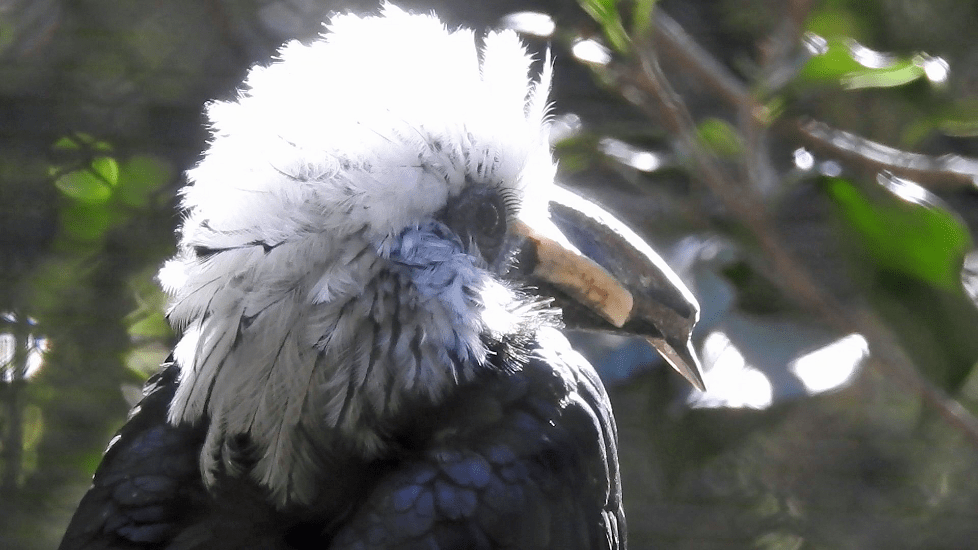
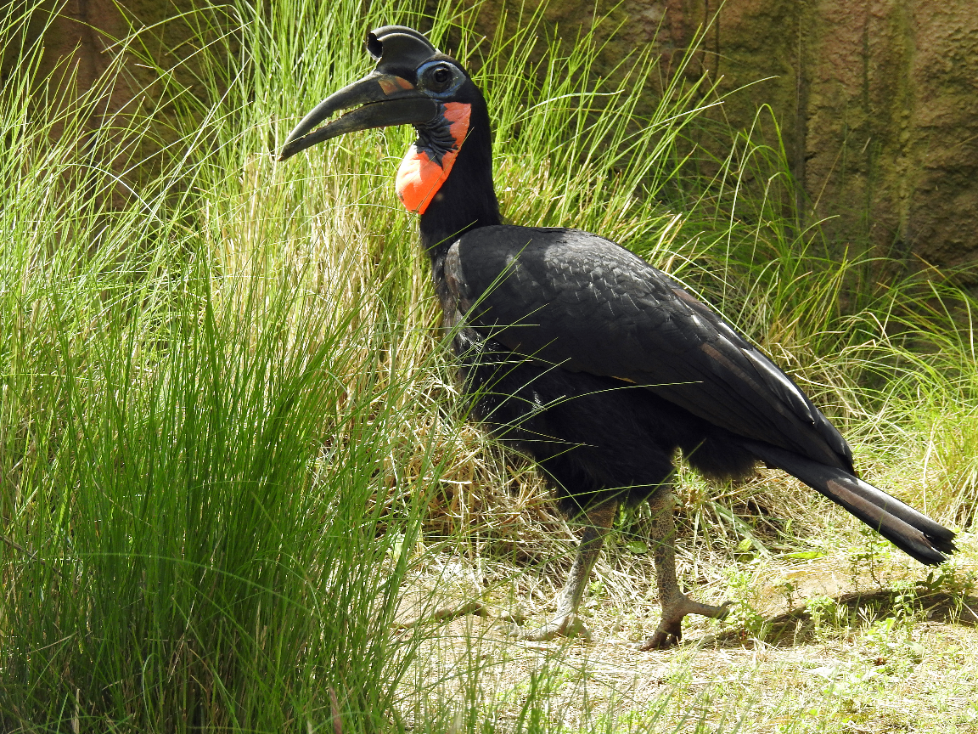
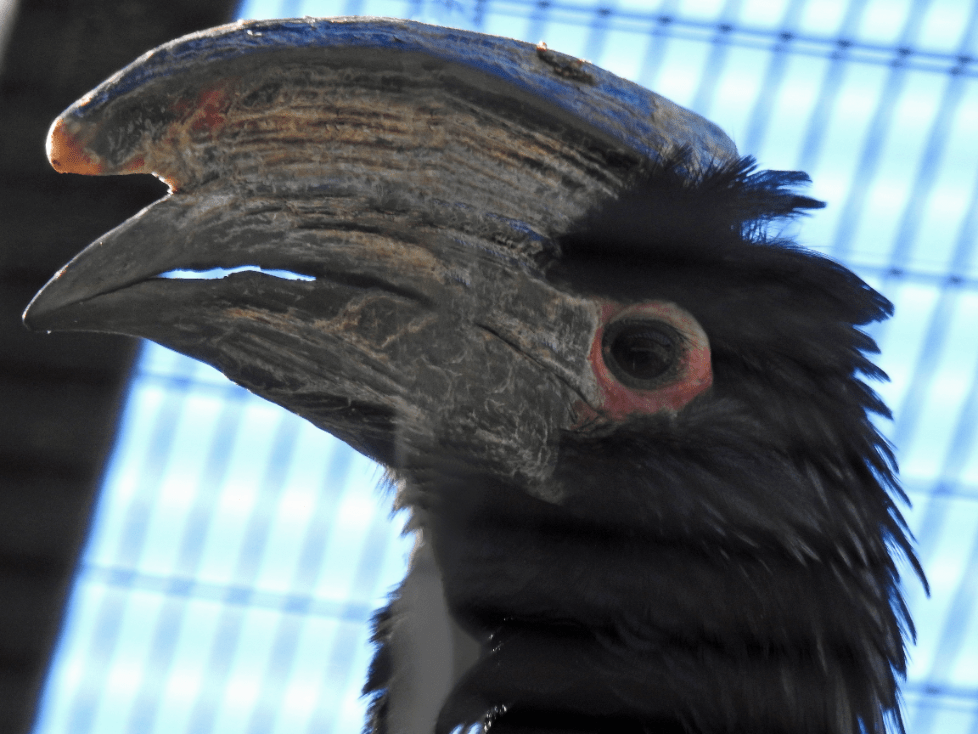
Figure 001. The Bucerotiformes order includes two types of hornbills: Bucerotidae arboreal hornbills (e.g., Western Long-tailed Hornbill, left; Trumpeter Hornbill, right); and Bucorvidae ground hornbills (e.g., Abyssinian Ground Hornbill, center).
Bucerotiformes (Order of Birds)
A previous blog introduced the bird order Bucerotiformes, https://bird-brain.org/2026/04/05/woodhoopoes/ , and one of its families, woodhoopoes, Phoeniculidae. Woodhoopoes are typically 8–18 inches long (21–46 cm), and weigh about 0.6–3.5 ounces (18–99 g). This blog discusses a different family, the much larger ground hornbills, Bucorvidae.
Description
The heaviest hornbill is the Southern Ground Hornbill, weighing about 8.3 pounds (3.8 kg); some males weigh almost 14 pounds (6.2 kg). This hornbill’s wing span is 5′ 11″ (180 cm), longer than its body length from bill to tail, 2’11″–4′ 3″ (35–51″, 90–129 cm). Almost as heavy is the Abyssinian Ground Hornbill, with males weighing about 8.8 pounds (4 kg) — females weighing less; their length is about 2’11″–3’7″ (35–43″, 90 to 110 cm) bill to tail.
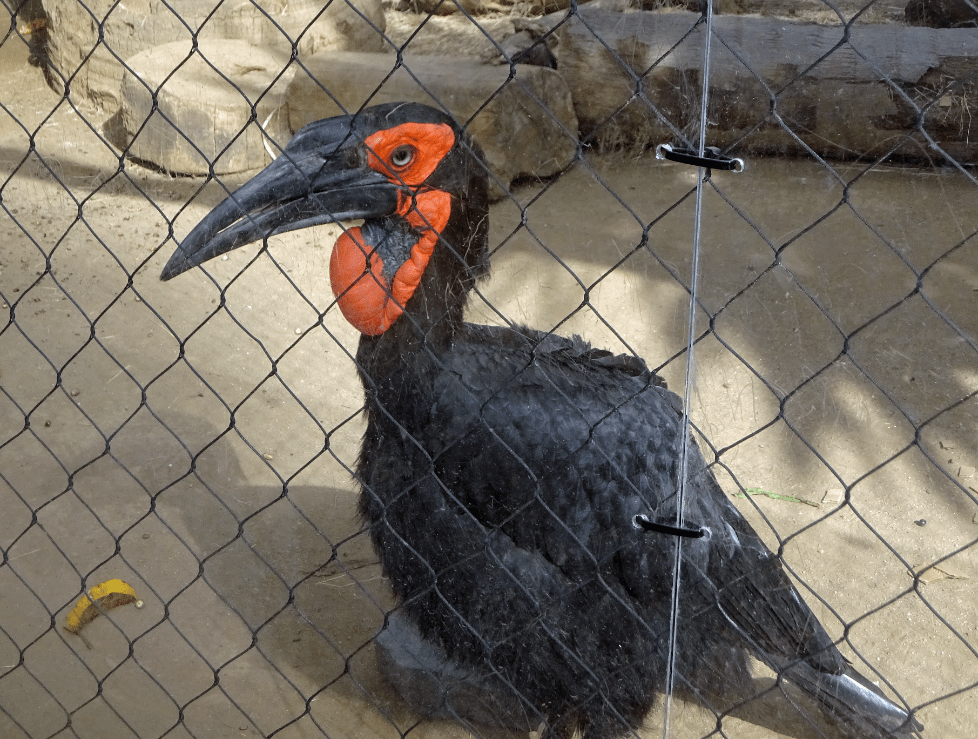
Figure 002. The Southern Ground Hornbill wins the prize as the heaviest hornbill, though many individual Abyssinian Ground Hornbills are as large as or larger than many Southern Ground Hornbills, and at least two other hornbill species can be close to as large.
Nonetheless, two of the Bucerotidae hornbills are quite large, with some individual birds rivaling the ground hornbills in size.
- The Helmeted Hornbill (Rhinoplax vigil) is 3’7″–3’11” long, bill to tail (43.3–47.2″, 110–120 cm); male weights average 6 pounds, 12 ounces (108 ounces, 3,060 g); females weigh about 5 pounds, 12 ounces to 6 pounds, 4 ounces (92–100 ounces, 2,610–2,840 g).
- The Great Hornbill (Buceros bicornis) is about 3’1″–3’5″ long (37.4–41.3″, 95–105 cm); males weigh between 5 pounds, 12 ounces, and 7 pounds, 8 ounces (92–120 ounces, 2600–3400 g); females weigh between 4 pounds, 12 ounces, and 7 pounds, 6 ounces (76–118 ounces, 2155–3350 g).
Among all hornbills, male average sizes are bigger than female averages, though the degree of difference varies across species, individuals, and the measurements being targeted (e.g., weight differences vary 1–17%, wing length varies 1–21%, and bill length varies 8–30%).
Every hornbill has a HUGE bill, typically curved downward. The hornbill’s skeleton also has special features (invisible to casual observers): The first and second vertebrae (in the neck) are fused, and the skull has distinctive features joining it to the neck; these skeletal features probably help support the huge bill. Each hornbill also has a thick medium-length neck, containing powerful neck muscles for supporting the bill. A main advantage of having such a huge bill is the enhanced ability to reach and snatch tree fruits (helpful for fruit-eating tree-dwelling Bucerotidae hornbills). Big bills also make it easier to catch prey, to preen, and to build a nest.
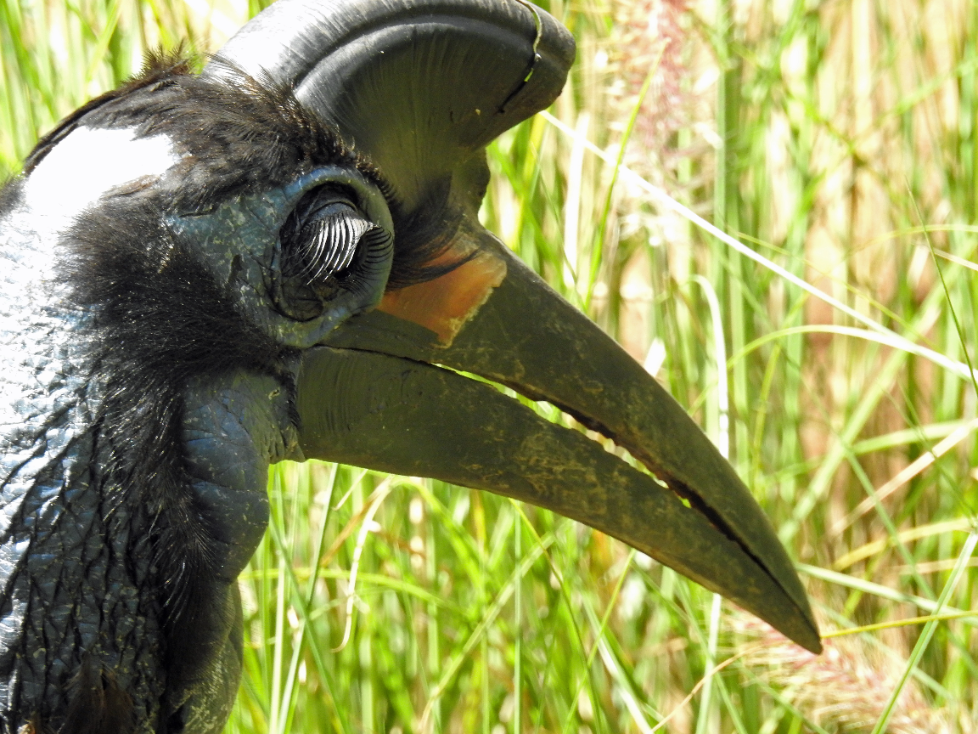
Figure 003. This female Abyssinian Ground Hornbill reveals the ENORMOUS size of her bill.
In addition to their huge bills, the ground hornbill shares many features with other hornbills:
- Ovoid body with upright posture
- Long, broad, rounded wings
- Long tail
- Sexually monomorphic plumage (often with differences in bare parts on throat and face) — mostly black or dark, with white on wings, flight feathers well barbed and smooth but others may be coarse and loose
- Sexually dimorphic sizes of body, bill, and (often) casque, with males being larger than females
- Short legs with thick feet and broad, syndactyl toes — three toes face forward, two toes partially fused at the base
- Bare parts
- Mostly black or dark-gray bare parts — bill, casque, legs, and toes
- Bare skin around the eyes and throat may feature bright colors; for instance, face and throat of the ground hornbill may be bright red or blue
- “Eyelashes” formed by barbless feathers, believed to shade and protect the eyes; the “eyelashes” are especially dense among the two ground hornbill species
In addition to their huge bills, all ground hornbills and many other species of hornbills have a casque atop their upper mandible (top half of bill). The lightweight casque is hollow, made mostly of keratin (the same substance as your fingernails), with some thin internal bony supporting struts. The two ground hornbills illustrate how the casques may differ across species, with the enclosed casque of the Southern Ground Hornbill being much smaller and less obvious than the open-fronted casque of the Abyssinian Ground Hornbill. It’s thought that the casque may not only reinforce the bill, but also add resonance to the bird’s vocalizations. Among hornbills with casques, the size often indicates the age of the birds, as the casques grow over time.
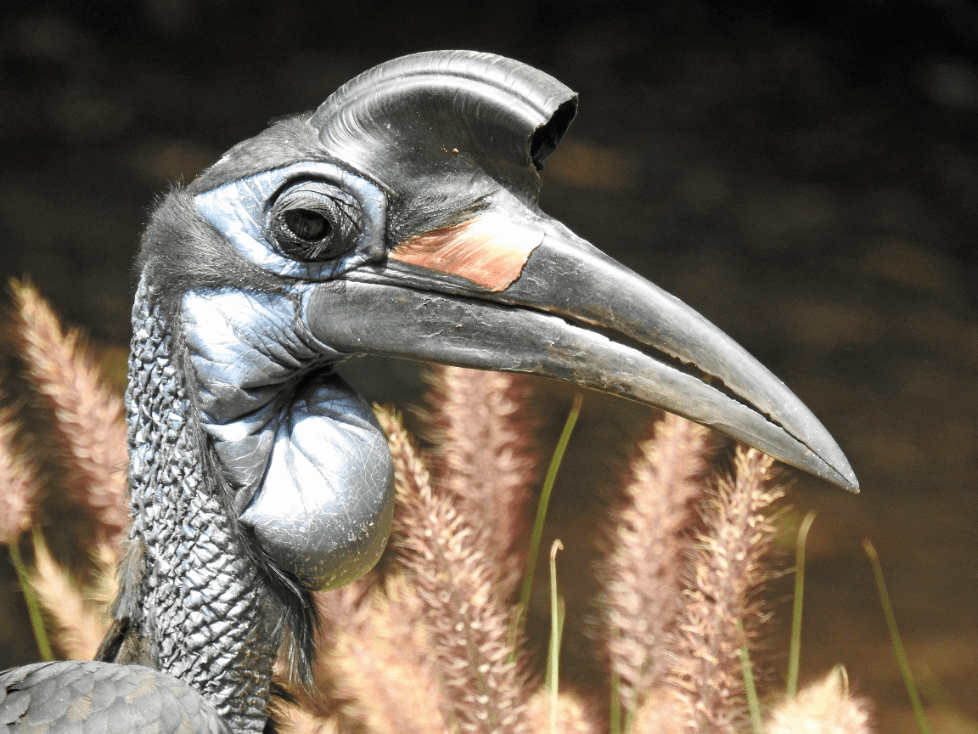
Figure 004. This female Abyssinian Ground Hornbill is showing some of her finest features: her casque, her bill, her inflatable throat sac, and the bare skin surrounding her eyes and on her neck and throat.
Vocalizations
Most species are not only very noisy, but also employ a wide array of vocalizations, some of which are loud and can carry long distances, even in woodsy habitats. The larger species — such as the ground hornbills — also make audible wingbeats with their long, broad wings. Some species also tap-tap-tap their bill against a tree branch or log, to communicate over long distances.
Distribution, Habitat, and Migration
The two hornbill families (Bucorvidae and Bucerotidae) may be found across Africa, Asia, and even Melanesia, but the ground hornbills are found only in sub-Saharan Africa, mostly in savannas and woodlands, perhaps also scrublands. They need to have some access to trees for roosting and nesting, but the ground hornbills forage on the ground. Both ground hornbills, like most species of other hornbills, stay in one area, though they may make some localized movements in search of desirable foods.
Locomotion
Though most hornbills hop along on the ground, holding both feet together, ground hornbills stroll, using one foot at a time. All hornbills can and do fly, though ground hornbills spend less time in the air than other hornbills do.
Figure 005. Ground hornbills (such as this Abyssinian Ground Hornbill pair) have long legs and relatively short toes that facilitate their terrestrial lifestyle.
Food and Foraging
All hornbills have binocular vision, but their bills poke up in the middle of their visual field. To them, this is actually advantageous because they can see their own bill tip and can precisely guide the bill to grab prey or other food. Unlike the other hornbills, ground hornbills are terrestrial and mostly carnivorous, not frugivorous (fruit eating). They stroll along, looking down for invertebrates (e.g., arthropods, earthworms) or small vertebrates (reptiles, birds, mammals) to snatch with their bills. Their tongues are too short to manipulate food inside their bills; instead, once they grasp food with the bill tip, they quickly jerk the head and toss the food backward into the throat. Another advantage of the huge bill is that the hornbill can use the bill tip as pincers to grasp food far from the face, minimizing the chances that prey can bite, sting, or injure the hornbill’s face. Their bills can also root out prey from under soil or other substrate.
Social Behavior and Breeding
Most hornbill species, including ground hornbills, enjoy the company of other conspecifics (i.e., birds of the same species) — some hang out with just a mate, some prefer family groups, some species form flocks. All are diurnal, foraging together during the daytime; some also roost together overnight. Hornbill species are typically monogamous, with both parents participating in the care of their offspring. In addition, the Southern Ground Hornbill breeds cooperatively, with help from offspring they had raised in previous breeding seasons.

Figure 006. Ground Hornbills enjoy hanging out with mates and other family members.
All hornbills — even the huge ground hornbills — breed in nest cavities, usually trees, but sometimes other cavities, such as along cliff sides. They’ll also use nests previously built by woodpeckers or barbets, or nests they had used in previous breeding seasons. Unlike the arboreal hornbill species, ground hornbill moms do not seal themselves into the nest cavities. Nonetheless, she does incubate the eggs, while the dad feeds her. Both parents feed their hatchlings. The female may lay between 1 and 8 white eggs, with smaller species of hornbills laying more eggs than larger ones. Incubation may be 23–42 days, and then fledging may take an additional 39–96 days, with larger species taking longer in each case (up to twice as long!). Ground hornbill chicks typically stay with their parents until they’re fully mature.
Conservation Status
Both species of Ground Hornbill have a VU, Vulnerable, conservation status. The status of other species of hornbills varies from LC, Least Concern (42.2%), to CR, Critically Endangered (3.1%). According to the IUCN (2025) Red List, their conservation status is as follows:
- Least Concern, LC, 42.2%
- Near Threatened, NT, 9.4%
- Vulnerable, VU, 23.4%
- Endangered, EN, 9.4%
- Critically Endangered, CR, 3.1%
- Extinct in the Wild, EW, 0%
- Unknown, 12.5%
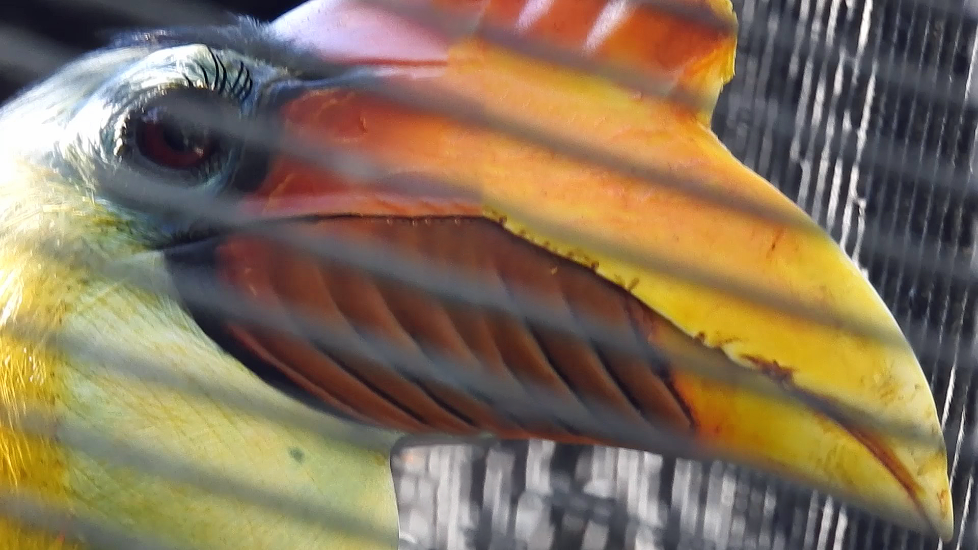
Figure 007. At the San Diego Zoo, this Endangered Wrinkled Hornbill is thriving, but in the wild, it’s in peril.
Ground Hornbills, Bucorvidae
The Bucorvidae family of ground hornbills contains just one genus, Bucorvus, with two species:
Southern Ground Hornbill, Bucorvus leadbeateri, and Abyssinian Ground Hornbill, Bucorvus abyssinicus. They differ from other hornbills in both their appearance and their genetics. These two species represent the earliest surviving offshoot of the Bucerotiformes order, having diverged from other hornbills about 52–53 million years ago. (Nonetheless, many ornithologists subsume this genus within the Bucerotidae family of hornbills.)
As mentioned previously, the heaviest male Southern Ground Hornbills are heavier than the heaviest male Abyssinian Ground Hornbills, but otherwise, their weights overlap. Their length differs, too; the shortest of each species is about 2’11”, but the longest Southern Ground Hornbill (up to 51″) can be about 8″ longer than the longest Abyssinian Ground Hornbill (43″). Abyssinian Ground Hornbills have much taller, larger, and more prominent casques than Southern Ground Hornbills, and the difference in sexual dimorphism is more pronounced in Abyssinians than in Southerns. (More about their differences may be seen in the subsequent discussion of each species.)
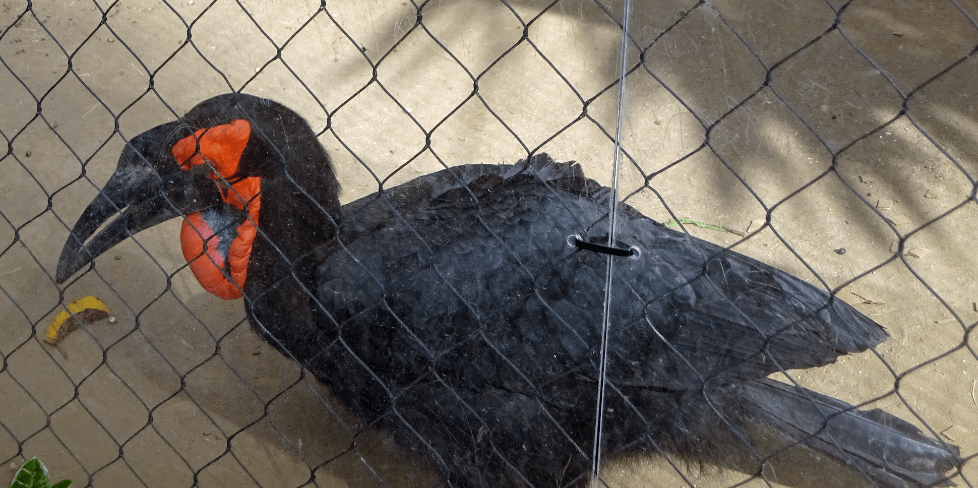
Figure 008. Though male Southern Ground Hornbills are typically much bigger than females, this female is no puny bird.
Description
The legs of both ground hornbills are longer and thicker than those of other hornbills, and their toes are shorter — better suited for foraging on the ground, rather than perching in a tree. Their plumage is almost entirely black, but with white primary (outer) flight feathers. Both species have large heads, thick necks, and enormous sharply pointed bills. Within their necks, they have one more vertebra than other hornbills (15 instead of 14). Uniquely, ground hornbills have no carotid arteries, with only fibrous cords instead; other blood vessels serve the function normally served by the carotids. (It wasn’t stated how that might affect these birds.)
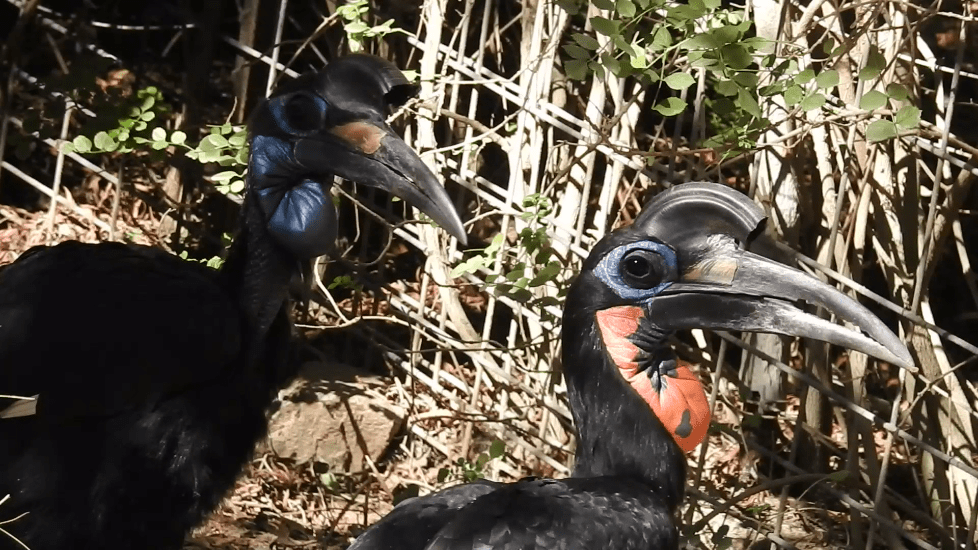
On both species, their stiff, flattened long eyelashes (0.7″ / 1.8 cm) shade and protect their eyes from above. Both species have brightly colored bare skin surrounding their dark-brown eyes and over their throats. Both species show sexual dimorphism in the coloration of their facial bare parts. On Abyssinian Ground Hornbills, both sexes have blue bare skin surrounding their eyes. However, males have bright red throat sacs, with a blue patch at the top of the throat, and the throat sacs of females are entirely blue. Among Southern Ground Hornbills, the bare skin surrounding the eyes is red on both sexes; the throat sac of the male is all red, but the female’s throat sac is mostly red, except for a patch of blue just beneath the bill.
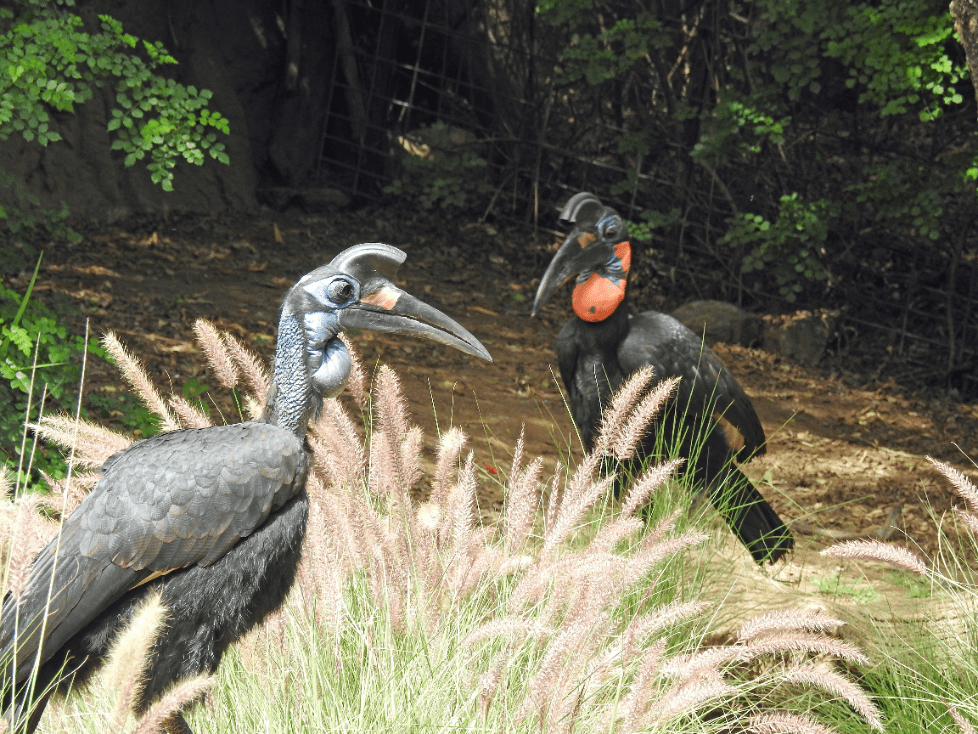
Figure 009. These two Abyssinian Ground Hornbills illustrate the differences between the female (left, with mostly blue bare skin) and the male (right, with mostly red bare skin).
Vocalizations
On both species, their brightly colorful throat sacs can be inflated, to produce loud, booming vocalizations. These vocalizations are more common at dawn and during breeding season than at other times.
Distribution, Habitat, and Migration
Both species of ground hornbills are sedentary (don’t migrate) and live in sub-Saharan Africa. The Southern Ground Hornbill prefers moister habitats, such as woodlands and some savannas, whereas the Northern Ground Hornbill lives mainly in savannas and semiarid scrublands.
Locomotion
Because of their terrestrial lifestyle, the ground hornbills spend less time flying than do other hornbill species. Nonetheless, their long, broad, round wings make them able fliers, having been clocked at 18 mph (29 km/h). Perhaps because of their shorter toes and longer legs, they also walk or run, rather than hopping on two legs (unlike other hornbill species).
Food and Foraging
Unlike the vast majority of other hornbills, ground hornbills eat mostly prey, both invertebrates (insects, etc.) and vertebrates (tortoises, snakes, rats, squirrels). They’ll also eat carrion — and insects eating the carrion — when it’s available. They’ve been seen catching and eating sizable vertebrates such as hares, mongooses, or cobras, too. Typically, they’re seen walking in pairs (especially Abyssinians) or small groups (especially Southerns), looking for prey, digging around to search for prey, and running after prey, sometimes even climbing trees to catch prey. When hunting dangerous prey, hornbills will often cooperate to kill it. The deadly bill will strike and kill the prey, then they’ll pick it apart to dismember it and eat it.
Figure 010. This female Abyssinian Ground Hornbill looks ready to snatch any prey she spots while walking.
Social Behavior and Breeding
During the day, ground hornbills typically spend most of their time in pairs or in pairs with one juvenile from a previous breeding season. After foraging on the ground all day, they’ll rest, roost, and nest in trees at night, often in pairs or in small groups. The Southern Ground Hornbills may associate with small groups (up to 8 or so). During breeding season, the monogamous pair finds a suitable natural nest cavity (in a tree, among rocks, in a cliff face, in an abandoned nest) and lines it with grass and dry leaves. Among Southern Ground Hornbills, the monogamous pair is helped by up to 6 offspring from a previous breeding season.
The female then lays two white eggs (occasionally one, but rarely three), which she incubates, while her partner (and possibly others) feed her. Unlike the other hornbills, the ground hornbill female does not seal herself within the nest cavity. Incubation lasts 37–43 days. The two chicks hatch asynchronously (about 3–5 days apart), and the first chick is fed much more reliably than the second chick, who typically dies within days after hatching. Essentially, the second chick is a backup in case something happens to the first chick. At first, the female stays with the chicks, and the male (and helpers) feed her and the chicks. After about 3 weeks, she leaves the nest and joins in feeding the chicks. The surviving chick stays in the nest for another 80–90 days until it fledges.
Conservation Status
Once a ground hornbill reaches adulthood, it typically has a long life — at least 40 years for a pair of Abyssinian Ground Hornbills living in captivity. In the wild, both species of ground hornbills have an IUCN Red List conservation status of VU, Vulnerable. Though their ranges are widespread, both species are sparsely distributed within their ranges. Habitat loss and degradation — such as due to agricultural development or fires — threatens them. Male ground hornbills will also sometimes break reflective window glass, believing they’re seeing a male rival. In addition, ground hornbills who do not live in protected areas may be intentionally killed by local humans, or sometimes accidentally killed by eating carcasses containing poisoned bait or lead bullets.
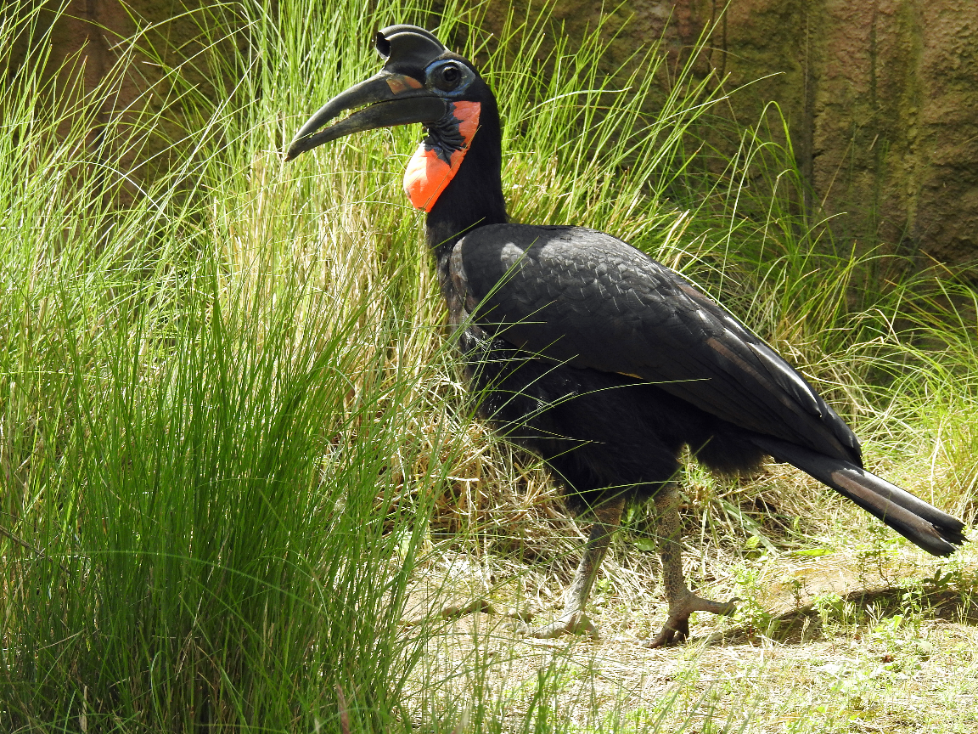
Figure 011. This Abyssinian Ground Hornbill male lives at the San Diego Zoo’s Safari Park, where it is well fed and well protected; its wild counterparts live much more precariously.
Abyssinian Ground Hornbill, Bucorvus abyssinicus
Sometimes called the Northern Ground Hornbill, this species was first identified and described to the ornithological community in 1780, by world-renowned naturalist and polymath Georges-Louis Leclerc, Comte de Buffon, in his Histoire Naturelle (see https://en.wikipedia.org/wiki/Georges-Louis_Leclerc,_Comte_de_Buffon for more information about this remarkable man). Three years later, this hornbill was given the binomial scientific name, Buceros abyssinicus, alluding to its initial identification in Ethiopia. Its genus name was changed to Bucorvus in 1830, pointing to corvus, Latin for “raven,” perhaps because of its black plumage and large, sharp bill.
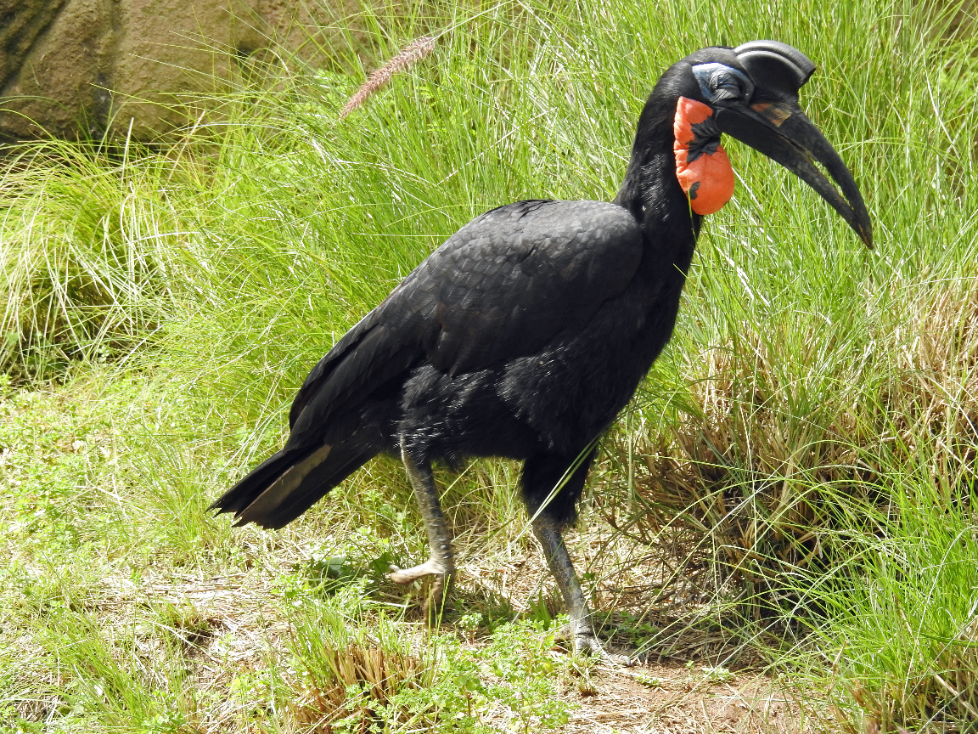
Figure 01. This male Abyssinian Ground Hornbill does have black plumage and a big pointed bill reminiscent of ravens (“corvus”).
The Abyssinian Ground Hornbill (Bucorvus abyssinicus) and the Southern Ground Hornbill (Bucorvus leadbeateri) are each other’s closest living relatives. On average, the Southern is bigger than the Abyssinian, and the casque of the Abyssinian is much more prominent than that of the Southern. Slight differences in coloration of the bare skin around their brown eyes and throat provide further distinction between the two species. Both species have mostly black plumage, with white primary (outer) feathers, typically revealed only when they fly.
Description
Abyssinian Ground Hornbill males weigh about 8.8 pounds (4000 g); females weigh about 7 pounds, 11.4 ounces (3500 g). On average, Southern Ground Hornbills weigh more. The total length of an Abyssinian Ground Hornbill is about 35–43″ (2’11″–3’7″, 90 to 110 cm), bill to tail. Of that, about 11.1″–15.3″ (28–38.8 cm) is its tail, with male tails averaging slightly longer than females (by about 1.2″, 3 cm). Wing length averages about 18.5–23.6″ (47–60 cm), with male wings slightly longer than females (by about 2″, 5 cm). Their black tarsi (ankle to toes) are about 4.9–6.2″ long, with males having tarsi averaging a fraction of an inch longer than females. (Compare with the Green Woodhoopoe’s tarsus length of 0.8–1″, 2–2.6 cm.)
Though the Abyssinian Ground Hornbill’s huge black body size is impressive, one of its two most memorable features is its huge bill — about 7.7–11.4″ (19.5–29 cm), with male bills about 1 ½ inches longer than female bills, on average. Bill depth (top to bottom) is about 1.9–2.4″ (4.94–6.12 cm), and bill width (side to side) is about 1.2–1.3″ (3.0–3.3 cm). Its other most outstanding feature is its large cylindrical casque, curving forward over its bill and open at the front. The open-ended casque looks like a musical instrument, which can resonate when the hornbill vocalizes.
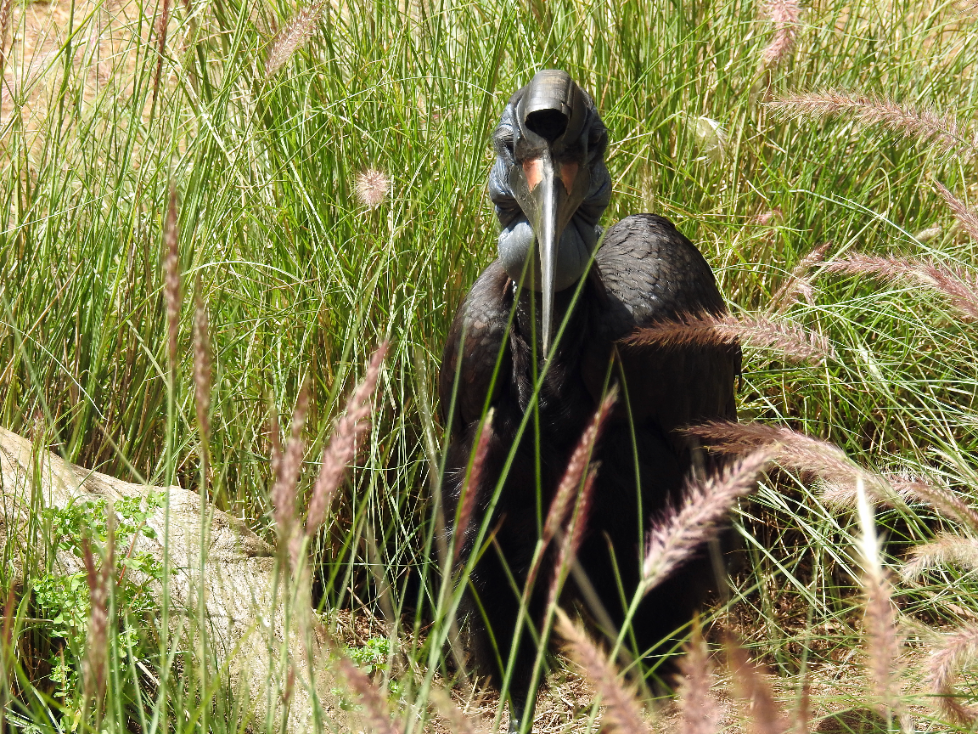
Figure 02. This female Abyssinian Ground Hornbill’s casque is visibly open at the front.
The female’s smaller size may not be immediately obvious to casual observers, but the coloration of the bare parts on each sex attracts attention. The female has luminous blue bare skin around her eyes, down her neck (front and back), and on her inflatable throat sac. A red patch adorns each side of her top mandible (upper bill). The male also has blue bare skin around his eyes, and his upper mandible has a red patch on each side, too. However, the back of his neck is covered in black feathers, not colorful bare skin, and his throat sac is mostly brilliant red, with a blue patch just beneath his bill.
The plumage of juveniles is more brown than black and it’s less glossy, with dark flecks mottling its otherwise-white primary feathers. Juveniles’ bare facial skin isn’t yet brightly colored and appears pale grayish blue; by one year, however, it’s possible to distinguish males from females. Juveniles have smaller bills and are slow to develop a casque, visible by age 3 years.
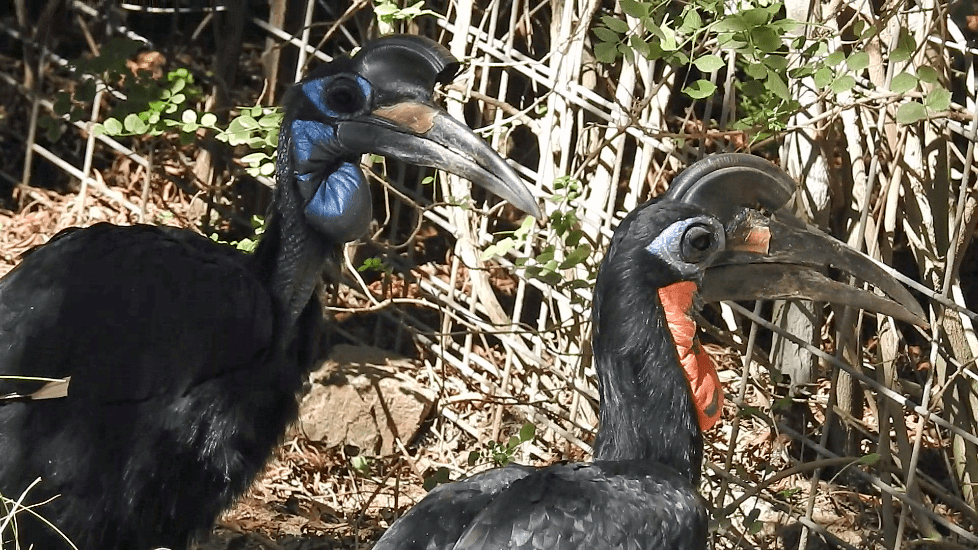
Figure 03. The sex differences between this female (left) and male (right) Abyssinian Ground Hornbill can easily be seen.
Vocalizations
Many ornithologists recognize both male and female Abyssinian Ground Hornbills by their complex vocalizations, especially their deep booming calls, which can be heard miles away at dawn and for a while afterward. (See https://xeno-canto.org/species/Bucorvus-abyssinicus for an example of their vocalizations.) Though similar to its genus-mate, the Southern Ground Hornbill, its calls are slightly higher-pitched, faster, and often last longer. During courtship, males have been heard making softer vocalizations as they approach females, and they may clap their bills on the ground, too. Males and females also duet with each other.
Distribution, Habitat, and Migration
The Abyssinian Ground Hornbill straddles a patchwork of tropical territories across the middle of Africa, south of the Sahara (< 16.6 degrees latitude) and north of the equator, between sea level and 7,800 feet (2.4 km), though seldom found above 6,500 feet (2 km); limited reports have indicated 10,700 feet (3.2 km). (See its eBird range map, https://ebird.org/map/noghor1? .) Its namesake territory, Abyssinia (now Ethiopia), provides widely distributed suitable habitats.
Its entire range has little overlap with the more southerly range of the Southern Ground Hornbill. Whereas the Abyssinian Ground Hornbill prefers relatively dry savannas, grasslands, and open woodlands, its southern cousin typically inhabits moister habitats. Abyssinians rest, roost, and nest in large trees, but they forage mostly in grasses and scrublands; they can also be found in rocky areas with short vegetation. Like other hornbills, they don’t migrate.
Family groups maintain large territories (2–100 square miles, 5.2–259.0 km2), year-round. They may roam to find enough food, as needed — on foot, as family groups, though they’ll take flight to get past obstacles such as dense vegetation or to avoid danger.
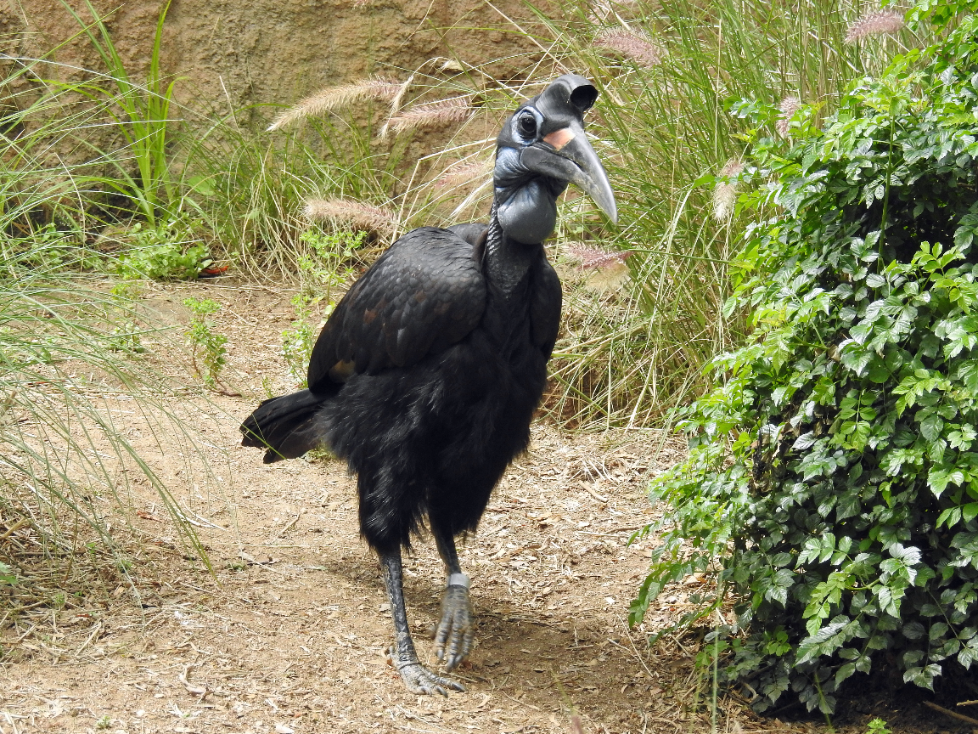
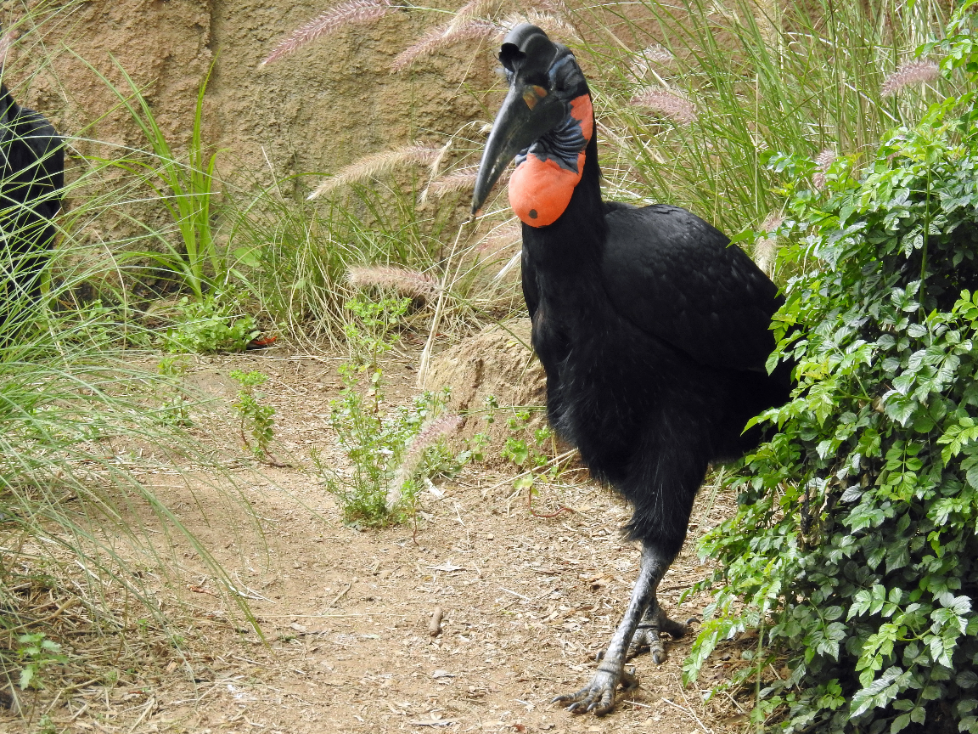
Figure 04. Though these Abyssinian Ground Hornbills (female, left; male, right) can fly, they spend most of their time walking and looking for prey.
Locomotion
As noted previously, both species of ground hornbills forage on the ground, using their long legs to walk long distances at a steady pace, on the ends of their toes, in pursuit of food. Able fliers, they prefer to walk or to run, except when flying to their roosts in trees, when getting past dense vegetation, or when escaping danger. When this ground hornbill flies, it reveals its otherwise-concealed white primary feathers.
Food and Foraging
As mentioned previously, ground hornbills are mostly carnivorous, eating both vertebrates (amphibians, reptiles, mammals, birds) and invertebrates, as well as carrion. They’ll occasionally also eat fruits, seeds, and ground nuts. According to Avibase, about 40% of their diet is small land vertebrates (not fish), 30% is invertebrate prey, 10% is carrion or other scavenged food, 10% is fruit, and 10% is seeds.
Typically, these hornbills forage in pairs, perhaps also with one or two offspring from previous breeding seasons. On rare occasion, when food is highly abundant, as many as 20 hornbills will be seen together, foraging. With their keen binocular vision, they forage while walking slowly across the ground, searching visually for prey on the ground and in vegetation. When it spots prey, it uses its bill to snatch it, running after the prey, as needed.
These hornbills sometimes also use their bills to dig up soil, searching for arthropods, and they’ve even been known to attack a beehive for its honeycomb. One source (https://birdsoftheworld.org/bow/species/noghor1/cur/foodhabits ) suggested that because the Abyssinian Ground Hornbill has a longer neck and longer bill than the Southern Ground Hornbill, it may be better at reaching agile prey, but less likely to dig with its bill. Another advantage to a long bill may be in handling venomous snakes such as puff adders. With a long bill, it’s easier to keep the snake’s mouth from reaching the face of the hornbill.
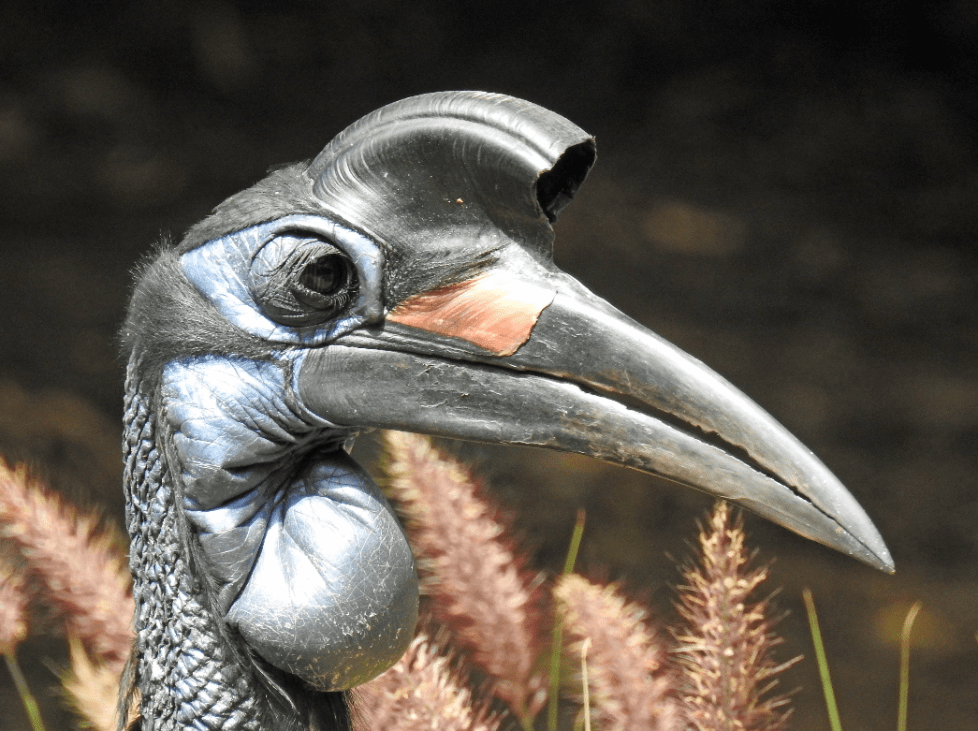
Figure 05. The bill of this female Abyssinian Ground Hornbill is quite formidable for grabbing and killing snakes and other vertebrate prey, yet she can also use it to uproot tiny arthropods she finds in the soil.
Despite the hornbill’s slow gait, a given bird can walk up to 6.8 miles (11 km) per day, continually snacking on whatever prey it finds. For larger prey, the hornbill grasps it, pulls on it, then dismembers and shreds the prey before eating it. For invertebrates and other small prey, it does less handling before swallowing and eating the prey.
Opportunistic feeders, these hornbills will watch for forest fires, to prey on small vertebrates fleeing the flames, or they’ll follow herds of hoofed animals, who stir up invertebrates for the hornbills to snatch. In captivity, they’ve been observed caching extra food items, but it’s not known whether they do so in the wild. Also, this hornbill has been observed drinking in captivity, but not in the wild.
Behavior and Lifestyle
This predator appears not to have known predators, other than humans, but it has not been well studied in this regard. These hornbills forage and roost as pairs or as small family groups, who defend their large territories. Their physical presence can intimidate most intruders, but their booming vocalizations also alert potential intruders to stay away.
These hornbills have a well-developed preen gland, which is covered by a dense tuft of feathers. They have often been seen using their preen oil for self-preening to maintain their plumage. They may also use preen oil to color the bill. Individual birds will sunbathe, and groups of birds will do so together.
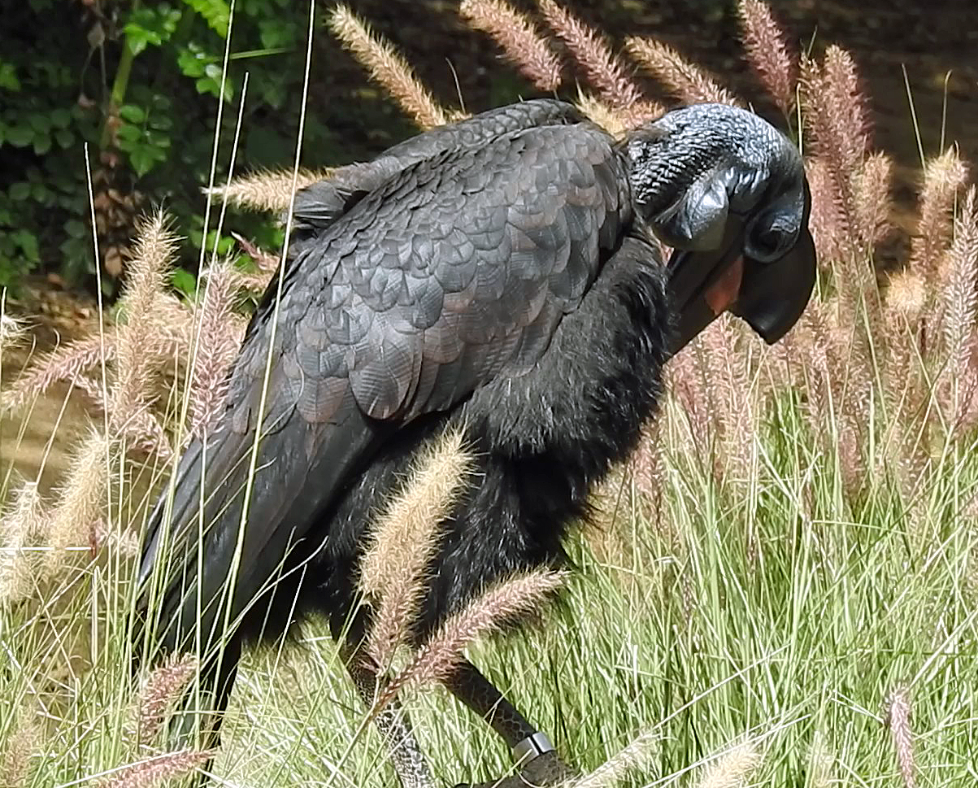
Figure 06. This female Abyssinian Ground Hornbill is taking time to preen her feathers.
When ready to sleep for the night, they roost in trees, which may help to safeguard them from wannabe nocturnal predators. All ground hornbills forage on the ground by day and roost in trees by night.
Breeding
Abyssinian Ground Hornbills are neither brood parasites nor brood-parasitized by other birds. (Imagine finding a monstrous ground hornbill egg in your tiny woodhoopoe nest, or a tiny woodhoopoe egg in your ground hornbill nest. No one’s tricking anyone!) Unlike the Southern Ground Hornbill, they don’t appear to engage in cooperative breeding. Abyssinian Ground Hornbills are monogamous, with both male and female engaging in courtship behaviors. For these hornbills, selection and inspection of a nest site is followed by courtship feeding (male feeds female) and displays (e.g., male slaps his bill on the ground), followed by mating.
Across its range, the timing of breeding varies widely, depending on local seasonality and weather — that is, whenever food is most abundant in a particular pair’s territory. Captive Abyssinian Ground Hornbill pairs at the San Diego Zoo’s Safari Park, in California, pay no heed to seasons, breeding at various times throughout the year. In fact, when a living chick was removed from the pair, the female laid another egg within 2 weeks. The Abyssinian Ground Hornbill has a slow reproductive rate, typically allowing three years to pass between breeding attempts, so opportunistic timing is advantageous.
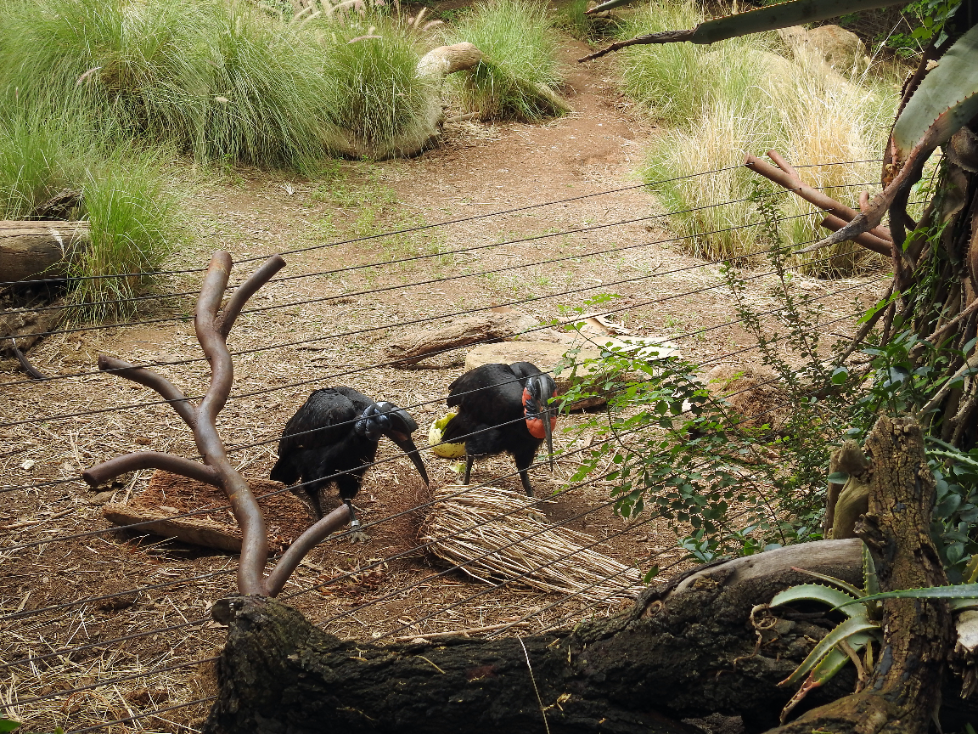
Figure 07. Abyssinian Ground Hornbill pairs carefully choose and inspect potential nest sites, only starting courtship behaviors and mating once the right nest site has been chosen.
The location of a pair’s nest is believed to be consistent across breeding seasons, but when choosing a new location, they spend many days or even weeks inspecting and choosing just the right spot. In captivity, a breeding Abyssinian Ground Hornbill pair maintained its established territory across breeding seasons, reworking and relining nest sites from previous breeding seasons. It’s believed that in the wild, monogamous pairs do likewise. These hornbills prefer to nest in cavities of large trees or tree stumps, about 10–15 feet (3–4.5 m) off the ground, though they’ll also use rocky crevices, ditches, or even artificial nest cavities such as baskets or carved-out logs. Typically, the male lines the cavity with dried leaves and grass.
At the San Diego Zoo’s Safari Park, a pair built two nests, both of which were refurbished and reused two more times. For each nest, both partners constructed the nest cavity using their bills to excavate a hole along an earthen bank, then they scraped out the soil, using their feet. The male then brought dry leaves and other debris to the female, who arranged these items in the nest, up to about 2.75–3″ (7–8 cm). The entrance to the nest — 10″ (24–25 cm) wide by 18″ (46–48 cm) high — was positioned to prevent direct sunlight from penetrating into the nest. A 48–52″ (122–132 cm) ramp made of soil and rhinoceros dung led from the entrance into the nest. The nest cavity was about 30″ (76 cm) high, by 18″ (46 cm) wide, by 42–48″ (76– 106–122 cm) deep (to the back of the nest).
Once the nest is prepared, the female Abyssinian Ground Hornbill enters the cavity and lays one or two chalky-white or cream eggs, with the second egg (if any) following the first after 4–5 days. The mom starts incubating the first egg even before she lays the second (if she does). This gives the first egg a head start of a few days. She incubates each egg for 37–41 days. During that time, the male feeds the female, who doesn’t leave the nest. Neither parent makes an effort to keep the nest cavity clean. (Unlike with the arboreal hornbills, the ground hornbill female doesn’t molt all her feathers during incubation.)
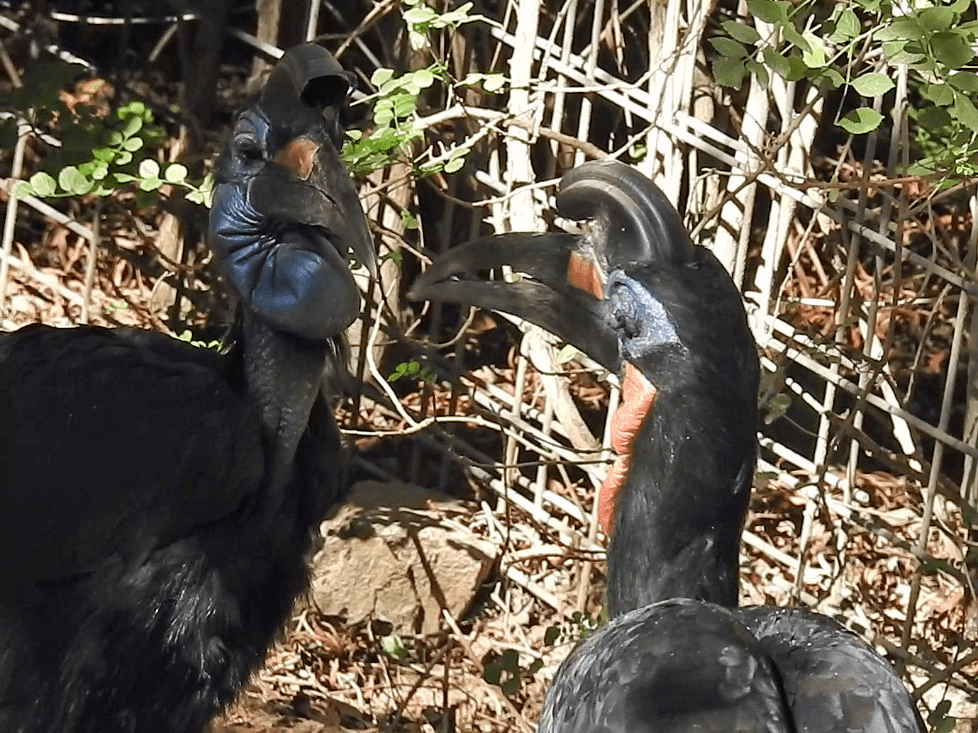
Figure 08. This Abyssinian Ground Hornbill pair lives at the San Diego Zoo’s Safari Park, where this species has been able to breed successfully.
After it pips the eggshell (making the first crack), the first Abyssinian Ground Hornbill chick may take up to two days to emerge. This first blind, pink-skinned, featherless chick is fed well and grows rapidly before the second chick hatches. In the wild, the first chick will eat almost all of the food provided by the parents, and the second chick typically dies of starvation. (In captivity, carers often remove the second chick and hand-rear this precious addition.)
Once the surviving Abyssinian Ground Hornbill chick is about 21–33 days old, its eyes are fully opened, and it is fully feathered. At this point, mom leaves the nest cavity and helps dad provide food for the growing chick. (Both parents have big bills, so they can deliver multiple food items at one time!) By this time, the chick has black skin and a dark gray bill with a cream-colored tip. By day 50, the chick doesn’t have to be mouth fed and can pick up and eat food from the floor of the nest. By about 80–90 days of age, the chick has an adult weight, can fly, and leaves the nest. The sexual dimorphism of its bare skin isn’t evident until the youngster is about a year old.
The Abyssinian Ground Hornbill chick stays with its parents for three years or so. These parents invest a lot to raise each chick to adulthood, averaging about 3 years between breeding attempts and raising only one chick to adulthood every 9 years or so. Nonetheless, in the wild, observers have seen family groups that include multiple fledged juveniles, as well as adults from previous seasons. In captivity, breeding rates and reproductive success have been much higher. The age at first breeding has been estimated at 3–6 years, and average generation length has been given as 13–19 years or more (up to 29.8 years).
Conservation Status
The IUCN Red List conservation status of Abyssinian Ground Hornbills is VU, Vulnerable. Though it inhabits many reserves and at least eight national parks, and has a widespread distribution, its population is sparsely distributed across its territory of 38–100 square miles (100–260 km2). Population decline over three generations is estimated at 21–38%; specific population trends also vary by region. Each breeding pair may occupy 74 acres (30 hectares), so a major threat is habitat loss and degradation, such as by affecting the availability of nest cavities. Habitat threat is often caused by increasing agricultural development, livestock grazing, urbanization, and resource extraction (e.g., logging).

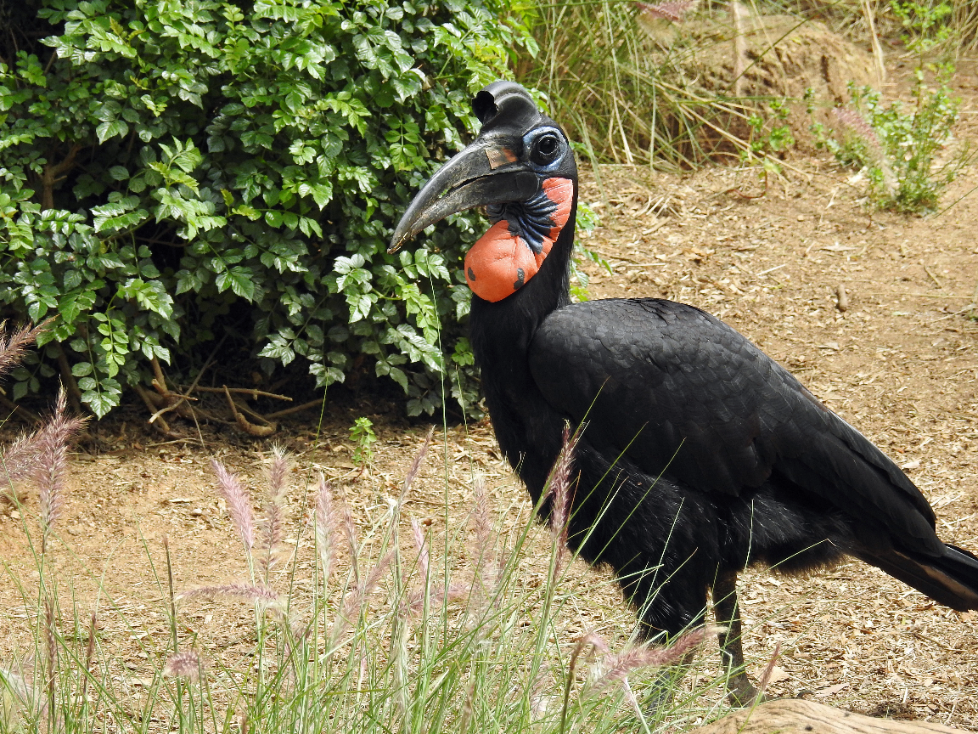
Figure 09. The San Diego Zoo and numerous other conservation organizations are working hard to conserve these vulnerable Abyssinian Ground Hornbills (female, left; male, right) and other species, in hopes of preventing their extinction in the wild.
In addition, humans directly threaten these hornbills by hunting them not only for their meat, but also for uses in traditional medicines or cultural rituals. In addition, these hornbills are killed by pathogens (e.g., West Nile Virus among captive birds in North America, bacteria in the wild) and parasites (e.g., lice, nematodes, tapeworms). Large predators, such as leopards, also kill some youngsters, and perhaps some adults, though human predators are more deadly by far.
This hornbill’s very slow breeding rate increases its vulnerability to severe population declines. (Small clutches combine with long periods of incubation and of parental care to worsen their low breeding rate.) These hornbills also delay sexual maturity for 3–6 years, further exacerbating the problem. On the plus side, adult survival is estimated to be about 90–98%/year, and in captivity, these hornbills have lived up to 40 years (Avibase estimates a maximum life span of 47–70 years).
Conservation efforts have primarily involved providing some protected areas across their range. Current conservation proposals involve research to gain better understanding of what these hornbills need (their biology and ecology), increased protected areas (and stepped-up protection within these areas), and education about the harmful impacts of hunting. Some researchers also urged study of the impact of the climate crisis on these tropics-dwelling birds.
Observations
The Cornell Lab of Ornithology gathers information from observers around the world through their eBird app and website. You can find 4,998 eBird observations at https://ebird.org/species/noghor1 , including 983 observations with photos, and 3 with audio recordings. A range map based on these observations may be found at https://ebird.org/map/noghor1 . The lab’s Macaulay Library website
(https://search.macaulaylibrary.org/catalog?taxonCode=noghor1 ) includes 2,120 photos, 3 audio recordings, and 39 videos. Video of male and female, walking, https://macaulaylibrary.org/asset/637432416 ; video featuring female foraging & snacking, https://macaulaylibrary.org/asset/201086851 .
In addition, the iNaturalist app and website (https://www.inaturalist.org/observations?taxon_id=5437 ) offer have 718 observations of the Abyssinian Ground Hornbill, including these:
male and female facing each other, https://www.inaturalist.org/observations/341076930 ; female and male in tree, https://www.inaturalist.org/observations/329178749 ; two males, one preening (see preen gland), https://www.inaturalist.org/observations/312675574 .
Southern Ground Hornbill, Bucorvus leadbeateri
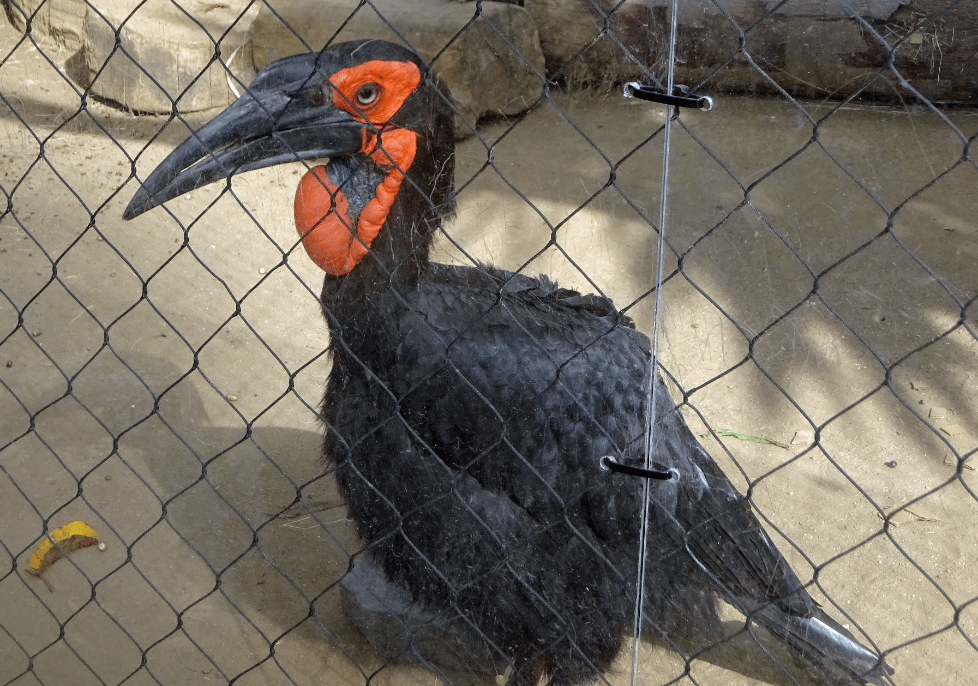
Figure 10. The San Diego Zoo has been home to this enchanting female Southern Ground Hornbill.
The Southern Ground Hornbill (Bucorvus leadbeateri; Spanish, Cálao Terrestre Sureño or Cálao Terrícola) is the only other species of ground hornbill, and it shares many characteristics with its genus-mate, including its conservation status as VU, Vulnerable. This species was identified and described to the Linnean Society of London in 1825, with its name leadbeateri recognizing “Mr. Leadbeater,” who possessed the specimen.
Description
As mentioned previously, the Southern Ground Hornbill is the heaviest hornbill species, averaging about 8.3 pounds (3.77 kg). Males weigh about 7.7–13.7 pounds (3.5–6.2 kg), females weigh about 4.9–10 pounds (2.2–4.6 kg). Their wing span (47–71″, 120–180 cm) is longer than their length from bill to tail (35–51″, 90–129 cm). Their tail accounts for 11–14″ (29–36 cm) of that length. Each wing is about 19–22.6″ long (48.7–57.3. cm).
Their long legs include a tarsus (ankle to toe) length of 5.1–6.1 inches (13–15.5 cm). To illustrate the enormity of their bills, compare their tarsus length to their bill length: 6.6–8.7 inches (16.8–22.1 cm). Their bills are about 1.9–2.1″ deep (top to bottom, 4.8–5.5 cm) and about 1–1.4″ wide (side to side, 2.7–3.5 cm). Imagine your own measurements being comparable! These hornbills have modest casques atop their bills.
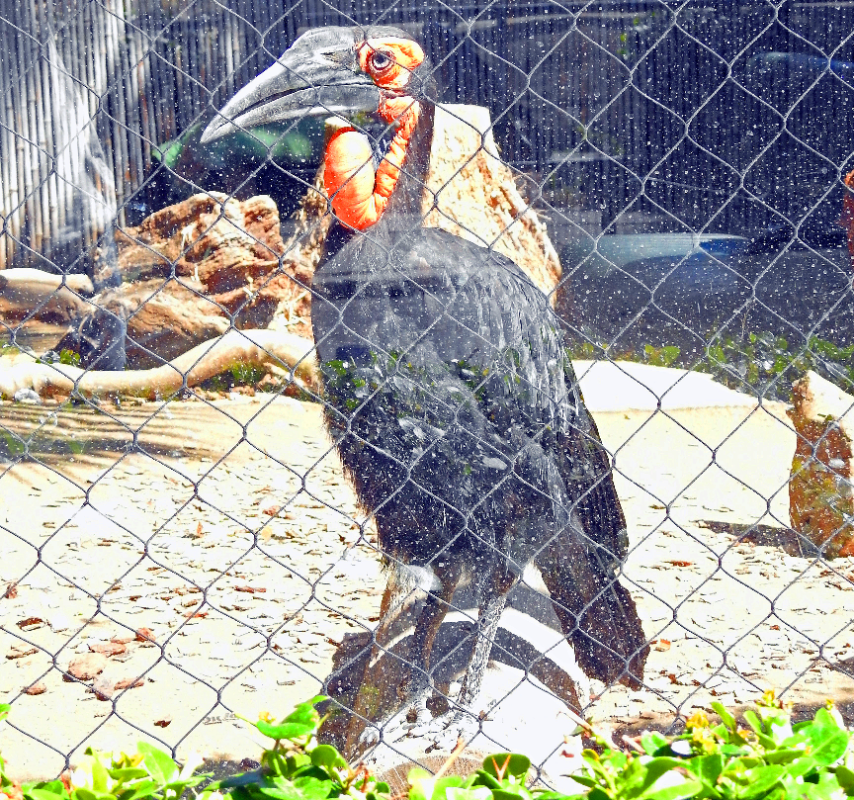
Figure 11. Despite the modest size of this Southern Ground Hornbill’s casque, it’s still quite an impressive bird, with its long bill, long legs, and bright red inflatable throat sac and facial features.
Like the Abyssinians, the Southerns have almost all black plumage, except for white primary (outer) feathers, visible during flight. The bare parts of males are all red, including facial skin and inflatable throat sac; females have mostly red bare skin, but with a blue patch at the top of their throats. Like the Abyssinian juveniles, the Southern juveniles are browner than the adults, and they have black flecks in their white primary feathers. Juveniles’ bare facial skin is also paler and grayer than that of adults, reaching full adult coloration by about 4–6 years of age. Like the Abyssinians, Southern Ground Hornbills have dark brown eyes, shaded by dense “eyelashes” (barbless feathers).
Vocalizations
Like the Abyssinians, Southern Ground Hornbills are very vocal, made even louder in choral groups, which can be heard from miles away, sometimes for protracted periods of time. Pairs of hornbills will duet together, with slightly different pitches. They also make softer contact hoots and deeper alarm calls. The website https://xeno-canto.org/species/Bucorvus-leadbeateri includes more than a full page of vocalizations by these hornbills.
Distribution, Habitat, and Migration
As this eBird range map (https://ebird.org/map/soghor1 ) shows, whereas the Abyssinian Ground Hornbill inhabits Africa north of the equator (and south of the Sahara), Southern Ground Hornbills are widely distributed south of the equator (to −33.61 degrees latitude), mostly in the eastern half of Africa, as well as in Angola. Nations inhabited by this hornbill include Angola, Botswana, Burundi, Democratic Republic of the Congo, Eswatini, Kenya, Lesotho, Malawi, Mozambique, Namibia, Rwanda, South Africa, Tanzania, Uganda, Zambia, and Zimbabwe. Whereas the Abyssinians prefer drier tropical grasslands, savannas, and woodlands, the Southerns prefer similar but moister tropical and subtropical woodland, shrubland, savanna, and grassland habitats, from sea level up to 1.8 miles above sea level (3 km).
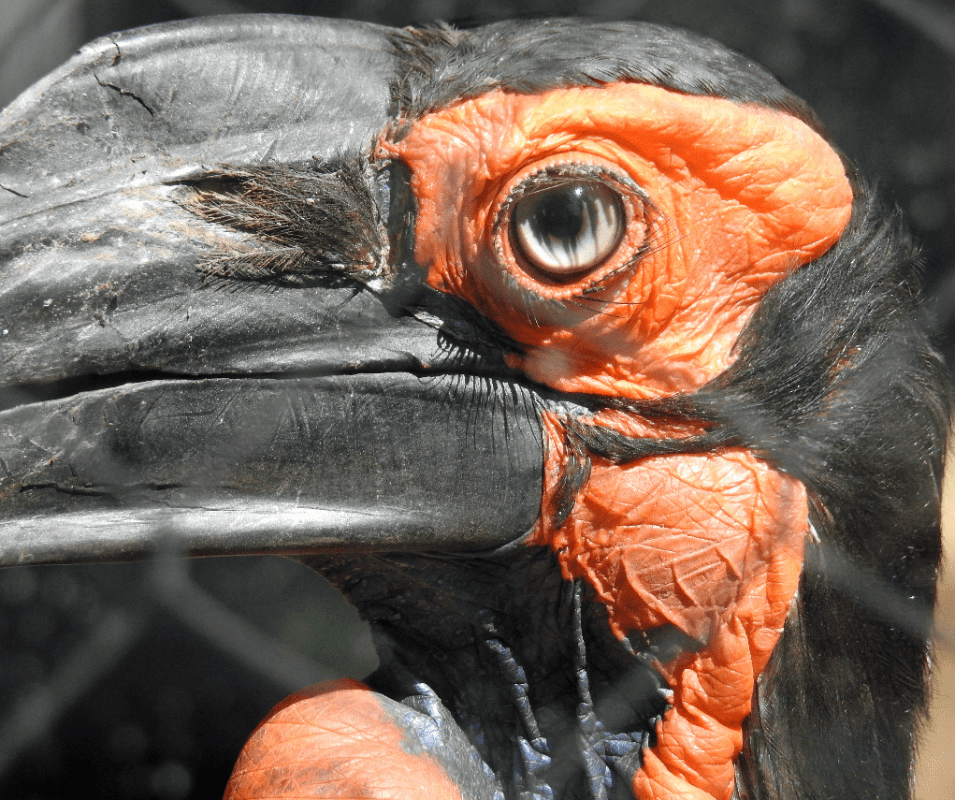
Figure 12. Southern Ground Hornbills are scattered sparsely throughout a wide range of southeastern Africa. Humans increasingly encroach on the habitats they need to survive.
Like their genus-mates, Southern Ground Hornbills don’t migrate. Family groups will inhabit year-round home ranges of 19–39 square miles (50–100km2), chosen based on whether they can find suitable nest sites (e.g., large trees with nest cavities), as well as enough food available during the dry season. Stated differently, they need big trees for nesting and short dense grass for foraging. Rainfall and soil type probably contribute to suitability, but human-caused threats such as agricultural development also play a role. Like the Abyssinians, they profit from the availability of areas protected from human threats.
Food and Foraging
Southern Ground Hornbills, like Abyssinians, eat invertebrates, vertebrates, and carrion, but they do so in different proportions, and they very rarely eat fruits or seeds. According to Avibase, about 60% of their diet is invertebrates, 30% is land vertebrates (no fish), 10% is scavenged carrion, and only traces of fruits and seeds are detected in their diet. Most of the invertebrates they eat are arthropods (e.g., insects, scorpions), but in the dry season, they also eat insect larvae and snails. The land vertebrates they eat are mostly reptiles (lizards, tortoises), amphibians (frogs, toads), and mammals (rats, hares). When eating carrion, they also scarf up any insects on the carrion. They are apex predators within their ecological niches. They have rarely been seen drinking.
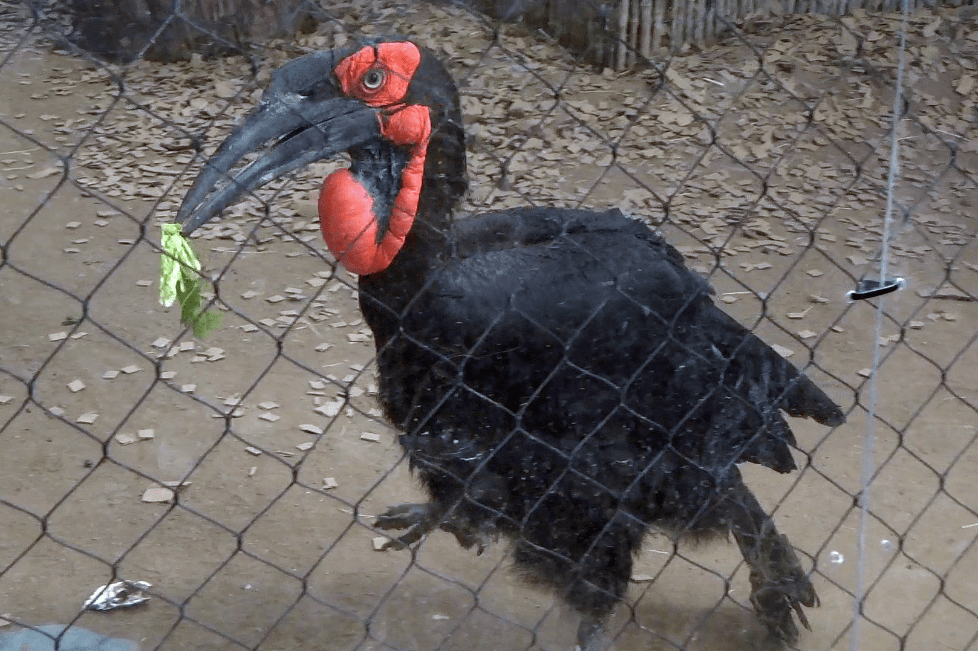
Figure 11. This charming Southern Ground Hornbill female may look mild-mannered in handling a wilted leaf, but her bill can be deadly when she catches prey.
Southern Ground Hornbills hunt (and roost) with 2–8 others (up to 11 at most) in their group. When the group encounters large prey, the whole group pursues and dismembers it, to share. Most of the time, however, each ground hornbill catches and eats its own prey. When going after small vertebrates, the hornbill smites the prey with its heavy pick-axe-like bill, killing then eating the prey. These hornbills also hunt for invertebrates, digging into dung, soil, or rotten wood.
Social Behavior and Breeding
Southern Ground Hornbills live in family groups of 2–9, 5–10, or up to 12 individuals, including juveniles, as well as adults (different observers give differing reports). They’re neither the perpetrator nor the victim of brood parasitism. Most ornithologists have presumed that these hornbills are monogamous, but some genetic tests reveal that extra-pair copulations have occurred.
Southern Ground Hornbills are obligate cooperative breeders; a dominant pair will always be aided by at least two helpers, usually males — adult or immature hornbills. Some research indicates that these hornbills need at least six years of experience as helpers in order to breed successfully later. The researchers inferred that (a) unaided pairs cannot raise their offspring successfully, and (b) the experience birds gain as a helper is vital for being able to raise their own offspring as adults. The helpers assist the parents in defending their territory, as well as in feeding the incubating parent and then the nestlings.
Southern Ground Hornbills opportunistically nest in tree cavities, in earthen banks, in rock or cliff faces, or in other locations where they can make or find a cavity for the nest. The male brings lining materials (e.g., dry leaves) to the nest, which presumably the female arranges. The female lays two (or sometimes one or three) all-white eggs and starts incubating as soon as the first egg is laid, laying additional eggs every 3–5 days. She incubates the eggs (or egg) for 37–43 days while her mate and the helpers feed her.
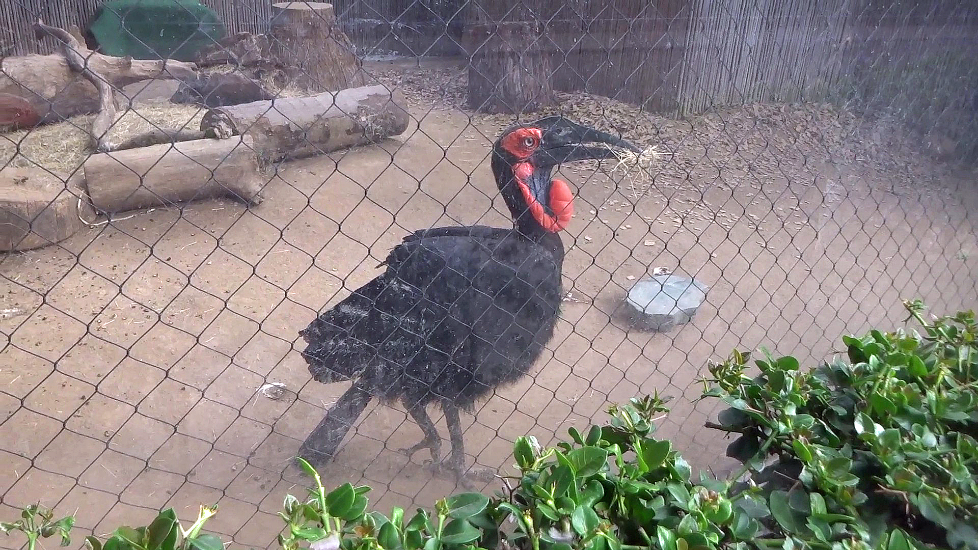
Figure 14. Southern Ground Hornbills line their nest cavities with dried vegetation.
The pink-skinned hatchling is fed 4–9 times/day by the dad and the helpers, each of whom carries multiple food items in its bill tip. The second chick to hatch isn’t fed (or isn’t fed much) and usually starves within a week, sometimes longer. Mom leaves the nest when the surviving chick is about 40–45 days old. The surviving chick fledges at about 86 days of age, but it continues to depend on its parents and their helpers for about one or two years — an unusually long period of time.
Southern Ground Hornbills don’t reach sexual maturity until about 3–6 years old, but even then, they don’t start breeding for additional years. Because juvenile ground hornbills remain dependent on their parents for so long, the parents usually don’t breed successfully more often than every 3 years. One South African study found that a family group successfully reproduced one fledgling only every 9 years. (Other studies have shown slightly more frequent success.) Various sources indicate the average generation length as 13.5–19.9 years, and even up to 26.4 years.
On the other hand, though juveniles show a high mortality rate, adults have a 90% annual survival rate. In captivity, they have been recorded living up to 70 years, and in the wild, it’s thought that they can be expected to live 30 years or more, perhaps up to 50–60 years.
Conservation Status
The IUCN Red List conservation status of Southern Ground Hornbills is VU, Vulnerable. Globally, their population has been declining by 10% over three generations, but data predict much greater declines in the future, perhaps 30–49%. In addition, many African nations have listed this species as Endangered. These hornbills have widespread distribution and are common in their local areas, but their distribution is sparse. They fare best in several reserves and national parks where they are protected, but outside of those protected areas, their population is declining rapidly.

Figure 15. Earth is richer, lovelier, and healthier with living Southern Ground Hornbills sharing it.
In addition to habitat destruction, their main threats are hunting and other human activity (e.g., use of poison baits and lead bullets). These hornbills are particularly vulnerable to eating carrion poisoned by lead bullets. Because these large birds need such a large territory in which to thrive, habitat destruction hits them particularly hard, especially the loss of trees. They’re increasingly vulnerable to human encroachment on their territory, such as agricultural development, livestock grazing, logging, and urbanization. The effects of the climate crisis, extreme temperatures, and extreme droughts seem foreboding but have not yet been fully analyzed. For a more extensive list of the numerous threats to these ground hornbills, please see https://www.iucnredlist.org/species/22682638/266675349 .
In addition to strengthening and increasing the number of protected areas, conservationists have been providing artificial nest cavities where natural tree cavities are lacking. Conservationists have been working to minimize human–wildlife conflicts and other harms, such as those caused by birds encountering human hunters, electrical wires, and other artifacts of human presence.
Conservationists are also trying to boost their populations through captive-breeding and re-introduction programs. These programs require tremendous effort and investment and still yield less than optimal results. Research (e.g., satellite tracking) is needed to understand the life histories of these birds and to determine the most effective strategies for helping to conserve them. Education and outreach are other avenues for conserving these birds.
Observations
The Cornell Lab of Ornithology gathers information about these birds from observers around the world through their eBird app and website, https://ebird.org/species/soghor1 . You can find 17,934 eBird observations there, 3158 with photos, and 43 with audio recordings. A range map based on these observations may be found at https://ebird.org/map/soghor1 . The lab’s Macaulay Library website (https://search.macaulaylibrary.org/catalog?taxonCode=soghor1 ) includes 6,019 photos, 51 audio recordings, and 71 videos of the Southern Ground Hornbill. Following are some of the videos I found entertaining:
- two preening atop bare tree branch, https://macaulaylibrary.org/asset/652173652
- fitting into a tree cavity, https://macaulaylibrary.org/asset/201854321
- video closeup of a female, https://macaulaylibrary.org/asset/200790461
- male using his bill to forage, https://macaulaylibrary.org/asset/723857
- view of wings at tree cavity, then flying off, https://macaulaylibrary.org/asset/201854301
- adult leads two juveniles to forage, https://macaulaylibrary.org/asset/201886421
In addition, the iNaturalist website (https://www.inaturalist.org/observations?taxon_id=144281 ) includes 3,846 observations with images (mostly photos, but some video or audio recordings). Here are some images I enjoyed:
- flying while carrying a live snake, https://www.inaturalist.org/observations/344741408
- four hornbills in trees, https://www.inaturalist.org/observations/343479656 ,
- closeup probably juvenile (brown feathers) https://www.inaturalist.org/observations/342920877 .
References
Bucerotidae
- Winkler, D. W., S. M. Billerman, and I. J. Lovette (2025). Hornbills (Bucerotidae), version 1.1. In Birds of the World (S. M. Billerman, B. K. Keeney, P. G. Rodewald, and T. S. Schulenberg, Editors). Ithaca, NY: Cornell Lab of Ornithology. https://doi.org/10.2173/bow.bucero1.01.1
Abyssinian Ground Hornbill (Bucorvus abyssinicus)
- Kumdet, P. S. and A. A. Chaskda (2025). Abyssinian Ground Hornbill (Bucorvus abyssinicus), version 2.1. In Birds of the World (M. G. Smith and S. M. Billerman, Editors). Ithaca, NY: Cornell Lab of Ornithology. https://doi.org/10.2173/bow.noghor1.02.1 https://birdsoftheworld.org/bow/species/noghor1/cur/references https://birdsoftheworld.org/bow/species/noghor1/cur/introduction
- https://avibase.bsc-eoc.org/species.jsp?avibaseid=948ED65C
- https://avibase.bsc-eoc.org/species.jsp?lang=EN&avibaseid=948ED65CEC66A149&sec=lifehistory
- https://en.wikipedia.org/wiki/Abyssinian_ground_hornbill
- https://www.iucnredlist.org/species/22682632/132204438
Southern Ground Hornbill (Bucorvus leadbeateri)
- Kemp, A. C., P. F. D. Boesman, and G. M. Kirwan (2025). Southern Ground Hornbill (Bucorvus leadbeateri), version 1.1. In Birds of the World (J. del Hoyo, A. Elliott, J. Sargatal, D. A. Christie, and E. de Juana, Editors). Ithaca, NY: Cornell Lab of Ornithology. https://doi.org/10.2173/bow.soghor1.01.1 https://birdsoftheworld.org/bow/species/soghor1/cur/introduction
- https://avibase.bsc-eoc.org/species.jsp?avibaseid=4192DE77
- https://avibase.bsc-eoc.org/species.jsp?lang=EN&avibaseid=4192DE77F2F73998&sec=lifehistory
- https://en.wikipedia.org/wiki/Southern_ground_hornbill
- https://www.iucnredlist.org/species/22682638/266675349
Etymology
- Lederer, Roger, and Carol Burr. (2014). Latin for Bird Lovers: Over 3,000 Bird Names Explored and Explained (224 pages). Portland, OR: Timber Press.
- Gotch, A. F. [Arthur Frederick]. Birds—Their Latin Names Explained (348 pp.). Poole, Dorset, U.K.: Blandford Press.
- Gruson, Edward S. (1972). Words for Birds: A Lexicon of North American Birds with Biographical Notes (305 pp., including Bibliography, 279–282; Index of Common Names, 283–291; Index of Generic Names, 292–295; Index of Scientific Species Names, 296–303; Index of People for Whom Birds Are Named, 304–305). New York: Quadrangle Books.
Taxonomy
- del Hoyo, J., Collar, N.J., Christie, D.A., Elliott, A. and Fishpool, L.D.C. 2014. HBW and BirdLife International Illustrated Checklist of the Birds of the World. Volume 1: Non-passerines. Barcelona, Spain and Cambridge, UK: Lynx Edicions BirdLife International.
Text and images by Shari Dorantes Hatch. Copyright © 2026. All rights reserved.
All images were taken at the San Diego Zoo or its Safari Park.


Leave a Reply