
Introduction to Storks (Ciconiidae)
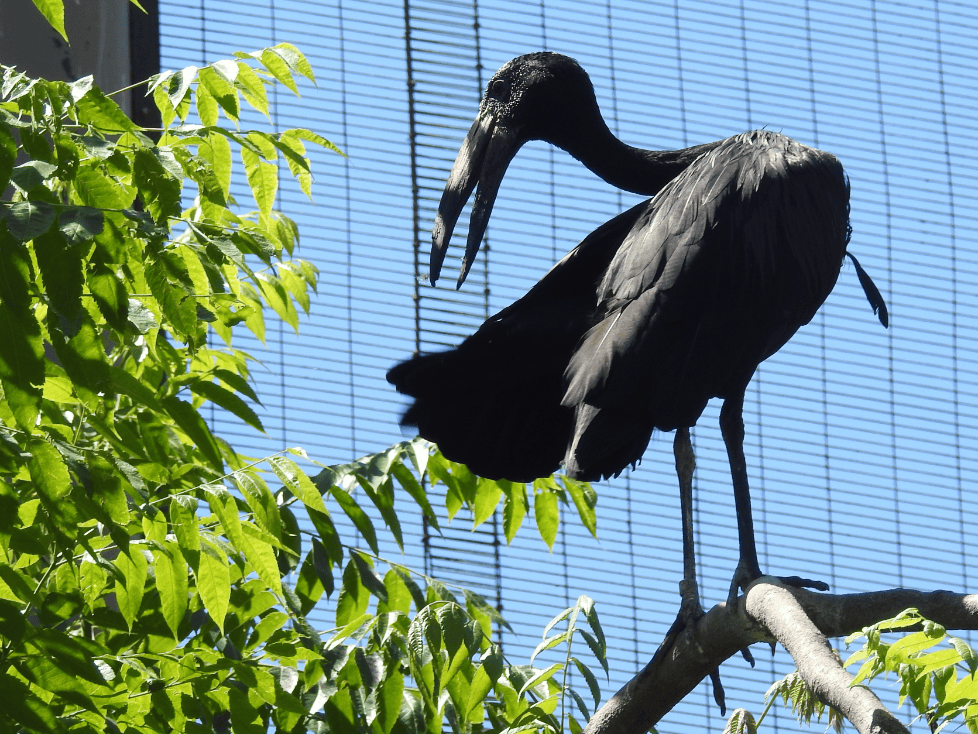
Figure 01. With their long bills and their heavier bodies, storks stand out, even among long-legged, long-billed wading birds. This African Openbill (stork) was photographed at the “Wings of the World” exhibit at the San Diego Zoo’s Safari Park.
This blog is the first of four about the Ciconiiformes order of birds known as storks, including the following sections:
- Etymology
- Taxonomy
- Appearance and Morphology
- Vocalizations and Other Sounds
- Distribution, Habitat, Migration
- Food and Foraging
- Behavior (such as Breeding)
- Conservation Status
- In Human Culture
In addition, this blog briefly highlights two illustrative stork species:
Etymology
The order name Ciconiiformes, the family name Ciconiidae, and the genus name Ciconia all come from Latin ciconia, meaning “stork.” By the 1100s (the age of “Middle English,” 1066–1400s), “stork” was already in use, having come from the “Old English” word storc, kin to other European words (Dutch, Danish, Swedish stork; German storch; Old Norse storkr), meaning “stiff,” pointing to its erect posture and strong straight legs (per Wikipedia, it originates in Proto-Indo-European *sr̥ǵos). In addition, 5 species of storks have common names that don’t include “stork.”
Taxonomy
Before ornithologists could use DNA evidence to discern family connections among birds, they typically classified birds on the basis of their appearance (e.g., long legs), geography (e.g., tropical Americas), habitat (e.g., shallow lakes), and behavior (e.g., eating fish). Using these observations, it was thought that most tall, long-legged wading birds belonged within a single order of birds. Now that genetic evidence can more truly reveal their relationships, ornithologists have separated long-legged waders into three separate orders (10 families):
- Ciconiiformes
- Ciconiidae — Storks — 6 genera (1 genus, more than 1 genera), including 20 species
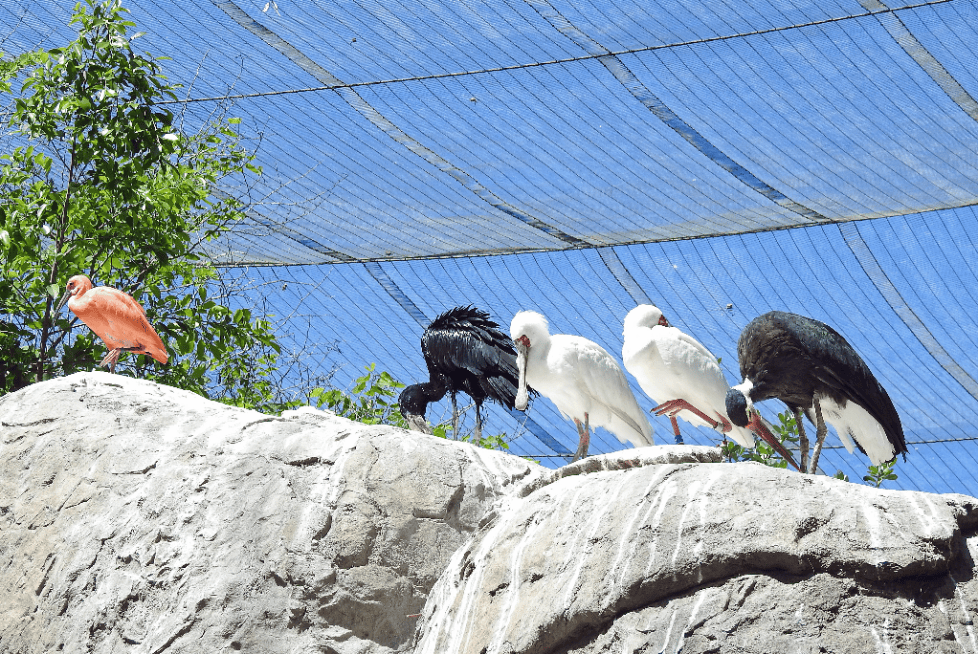
Figure 02. It’s easy to see how ornithologists lumped storks together with other long-legged, long-billed wading birds before they had DNA evidence to determine how closely particular birds were related to one another. Left to right, these are a Scarlet Ibis, an African Openbill (stork), two African Spoonbills, and a Storm’s Stork, all photographed at the “Wings of the World” exhibit at the San Diego Zoo’s Safari Park.
- Pelecaniformes
- Threskiornithidae — Ibises and Spoonbills — 13 genera, 36 species
- Ardeidae — Herons, Egrets, and Bitterns — 18 genera, 74 species
- Scopidae — Hamerkop — 1 genus, 1 species
- Balaenicipitidae — Shoebill — 1 genus, 1 species
- Pelecanidae — Pelicans — 1 genus, 8 species
- Suliformes
- Fregatidae — Frigatebirds — 1 genus, 5 species
- Sulidae — Boobies and Gannets — 3 genera, 11 species
- Anhingidae — Anhingas — 1 genus, 4 species
- Phalacrocoracidae — Cormorants and Shags — 7 genera, 34 species
The other main order of long-legged waders is Gruiformes, which includes 5 families:
- Gruidae (cranes, 4 genera)
- Aramidae (limpkin, 1 genus)
- Psophiidae (trumpeters, 1 genus)
- Sarothruridae (flufftails, 3 genera)
- Heliornithidae (finfoots and sungrebe, 3 genera)
- Rallidae (crakes, moorhens, gallinules, and rails, 38 genera)
Hence, the current taxonomy of the Ciconiidae family of storks is as follows: kingdom Animalia, phylum Chordata, class Aves (all living birds, including about 45 orders), Superorder Pelecanimorphae, order Ciconiiformes, with its solitary family, Ciconiidae.
The Ciconiidae family was named by zoologist John Edward Gray in 1840; Gray’s wife, Maria, helped him in his work, particularly with her illustrative drawings. According to Wikipedia, “Gray was one of the most prolific taxonomists in the history of zoology,” and a list of the taxa he named totals 1,578 — bearing in mind that the list includes both common and scientific names for many animals, creating numerous duplications. This list also includes not only genera and species names, but also family names (e.g., Ciconiidae) and other taxa (singular, taxon, referring to any level of taxonomic classification, even orders and families, as well as species and genera).
In 1854, 14 years after Gray had named the Ciconiidae family, naturalist and ornithologist Charles Lucien Jules Laurent Bonaparte (nephew of Napoleon) named the Ciconiiformes order, within which is the Ciconiidae family. Bonaparte, too, was a prolific taxonomist, with 621 taxa listed as having been categorized by him. In addition, the common names of four birds are named for him, two of them having scientific names ending with bonapartei and one ending with lucianii.
Within the Ciconiidae family are 6 genera, including 20 species. One system of classifying storks is to sort them into three tribes: Mycteriini, containing Mycteria and Anastomus; Ciconiini, containing Ciconia; and Leptoptilini, containing Leptoptilos, Ephippiorhynchus, and Jabiru. However, serious ornithologists disagree about whether two tribes or four tribes might organize these storks more accurately. Hence, this blog doesn’t use tribal classifications. Following are the 20 species, sorted into their 6 genera (indicating their conservation status, abbreviated):
- Anastomus, 2 species
- African Openbill (Anastomus lamelligerus), LC
- Asian Openbill (Anastomus oscitans), LC
- Ciconia, 8 species
- Abdim’s Stork (Ciconia abdimii), LC
- African Woolly-necked Stork (Ciconia microscelis), LC
- Asian Woolly-necked Stork (Ciconia episcopus), NT
- Black Stork (Ciconia nigra), LC
- Maguari Stork (Ciconia maguari), LC
- Oriental Stork (Ciconia boyciana), EN
- Storm’s Stork (Ciconia stormi), EN
- White Stork (Ciconia ciconia), LC
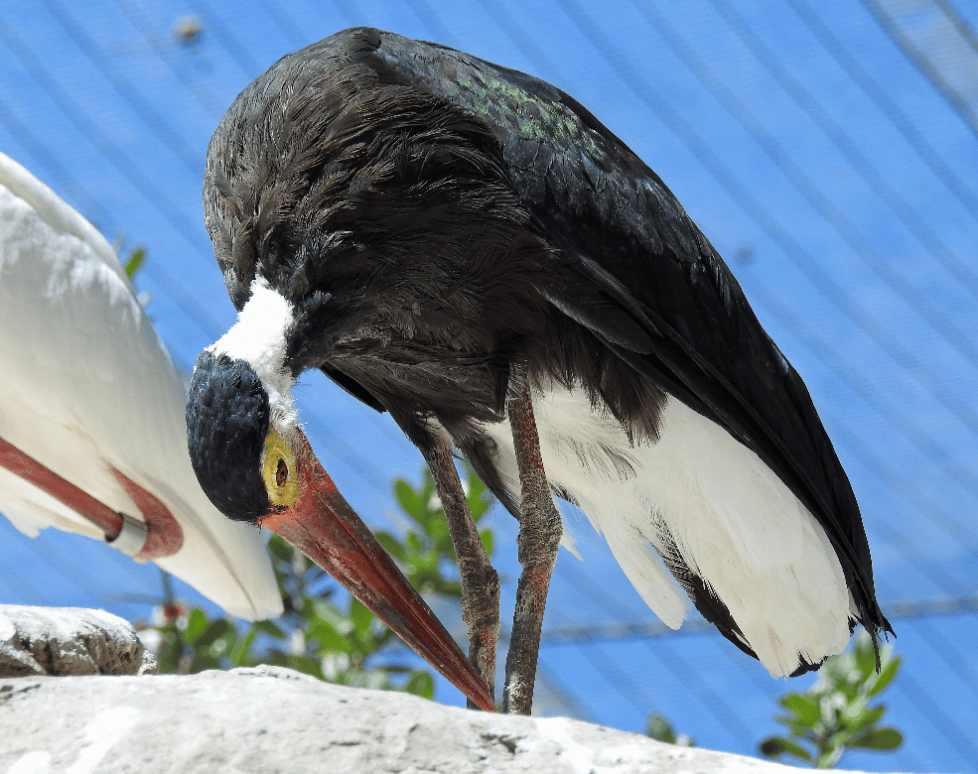
Figure 03. This Storm’s Stork, revealing the beauty of simple black-and-white plumage, was photographed at the “Wings of the World” exhibit at the San Diego Zoo’s Safari Park.
- Ephippiorhynchus, 2 species
- Black-necked Stork (Ephippiorhynchus asiaticus), LC
- Saddle-billed Stork (Ephippiorhynchus senegalensis), NT
- Jabiru, 1 species
- Jabiru (Jabiru mycteria), LC
- Leptoptilos, 3 species (adjutant is a military rank, called to mind by the stiff gait of these storks)
- Greater Adjutant (Leptoptilos dubius), NT
- Lesser Adjutant (Leptoptilos javanicus), NT
- Marabou Stork (Leptoptilos crumenifer), LC
- Mycteria, 4 species
- Milky Stork (Mycteria cinerea), EN
- Painted Stork (Mycteria leucocephala), LC
- Wood Stork (Mycteria americana), LC
- Yellow-billed Stork (Mycteria ibis), LC
In addition, fossil stork species have been found in Africa, Europe, Australia, and the Americas, some dating as long ago as the Early Oligocene, 30 million years ago — indicating that this family of birds has been distinct and widespread for millions of years, perhaps even 40–50 million years ago, by some estimates. Storks are highly adaptable; no species or subspecies of stork are known to have become extinct since the beginnings of recorded history.
Appearance and Morphology
Storks look somewhat similar to the other families of long-legged, long-billed wading birds, but they tend to have heavier bodies (e.g., 20-pound Marabou Stork, 9 kg), shorter tails, and sturdier, stouter (often longer) bills. They maintain an upright posture, accentuated by long necks, long legs, and an elongated ovoid body (held at a slight upward tilt), so they’re tall birds. Their wings are rounded (at the tips), broad (leading edge to trailing edge), and long (wingspan).
In fact, the Marabou Stork’s wingspan rivals the Andean Condor’s as the longest wingspan of any living land bird (though some seabirds — albatrosses and pelicans — are documented to have longer wingspans).
The Andean Condor’s wingspan is typically 9 feet, 3 inches (283 cm); maximum verified wingspan is 10 feet, 10 inches (330 cm). A subsequent section offers more details about the Marabou Stork, but some observers report a wingspan of 12 feet (3.7 m), with a verified span of 10 feet, 6 inches (3.2 m).
The Marabou Stork is probably also about the tallest (60 inches, 152 cm) and the heaviest (19.5–20 pounds, 8.9 kg) stork. Most storks are smaller — for instance, the Abdim’s Stork is only 30 inches (75 cm) tall and weighs just 2.75 pounds (1.3 kg). In addition, in most stork species, males are larger than females (up to 15% bigger in Saddle-billed Storks, and Jabiru males are about 25% heavier than females).
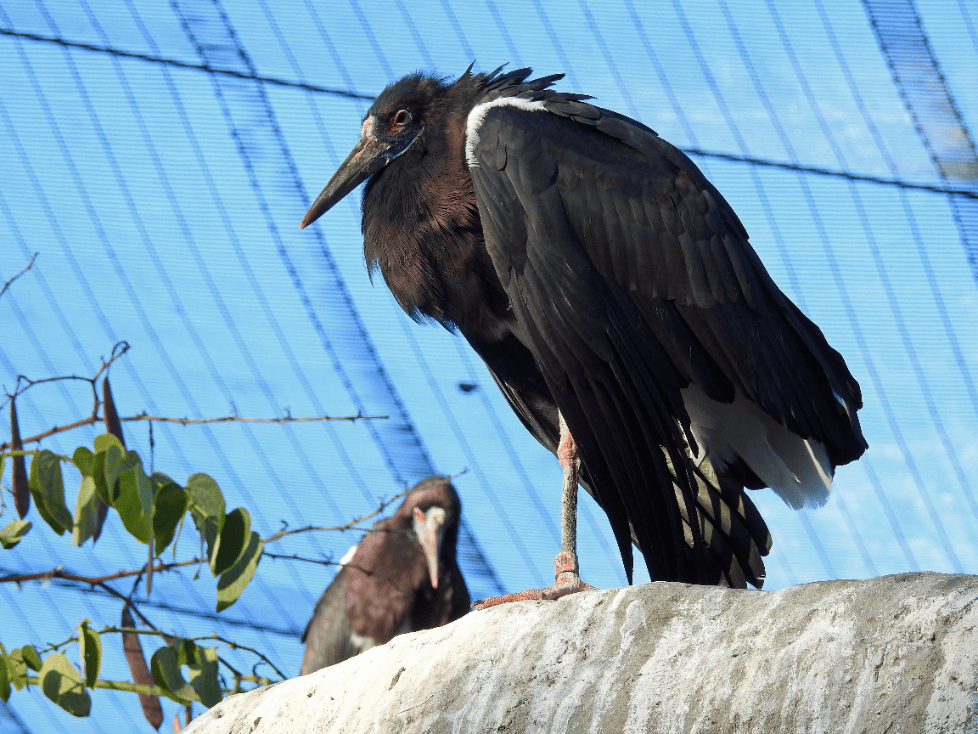
Figure 04. The Abdim’s Stork isn’t as big as most other storks, but at 30 inches (75 cm) tall, it’s still a pretty impressive bird. This Abdim’s Stork was photographed at the “Wings of the World” exhibit at the San Diego Zoo’s Safari Park.
Their plumage is almost invariably black, white, or black and white, and both sexes look similar. Unlike many other wading birds, storks do not have powder down, feathers that readily pulverize into a powder that makes it easier to clean fish slime from their feathers. Many stork species have colorful legs and long toes (which may be partially webbed at the base). Though most species have dark irises, at least four species have light-colored irises.
Storks also have colorful bills. The bills on some species have been called “massive” (e.g., Marabou Storks). Most species have thick straight bills, but some species’ bills curve slightly upward (e.g., Saddle-billed Storks, Jabirus). Some species’ bills curve downward (e.g., Wood Storks and Milky Storks).
In addition, the two “openbill” storks have a distinctive gap between the downward-curving mandible (upper bill) and the upward-curving maxilla (lower bill). Their open bills make it easier for them to capture their favorite prey — aquatic snails. Most stork species have colorful bare skin on the face, and some have a brightly colored featherless throat or neck.
Vocalizations and Other Sounds
Though stork species possess a syrinx, the organ for producing vocalizations, their syrinx isn’t adequate for making more than a few sounds (e.g., https://xeno-canto.org/60513 from a Jabiru; https://xeno-canto.org/1093586 from a Marabou Stork). In fact, they rarely produce any vocalizations at all. Nonetheless, the Xeno-canto website (https://xeno-canto.org/explore?query=ciconiidae ) has 374 sounds produced by 15 species of storks. Not all of these sounds are vocalizations, however. For instance, https://xeno-canto.org/807286 is a recording of a White Stork (Ciconia ciconia) engaging in bill-clattering, a key mode of stork communication, especially at the nest.
Distribution, Habitat, Migration
Stork distribution is nearly worldwide, though you won’t find any in the North or South Poles, in much of Australia, or even in most of North America. Wood Storks (Mycteria americana) may be found in most of South and Central America (except the west coast), in the Caribbean, and in southern Florida year-round; outside of breeding season, they may be found in coastal Mexico, southern California, and the Caribbean coast of North America. Farther south, the Jabiru and the Maguari Stork both inhabit inland waterways of South America year-round; the Jabiru (tallest flying bird in the Americas) also resides in some places on the east coast of Central America. A world away, the Black-necked Stork is found year-round in northern Australia, as well as in parts of Asia (northern India, Pakistan, Nepal, Sri Lanka, southeast Asia and nearby islands).
The many other stork species — the greatest diversity of storks — are found in Africa and Asia, as well as in Europe, where they’re often associated with human communities, making ginormous nests on homes and other buildings. Of these, 8 stork species breed in tropical Asia, and 6 breed in sub-Saharan Africa. Another 2 species breed in Europe and Asia then migrate to sub-Saharan Africa or southern Asia. The Oriental Stork breeds in Siberia and parts of northeastern China, then migrates to and from southern China and Asian islands (e.g., Japan, Korea, Taiwan).
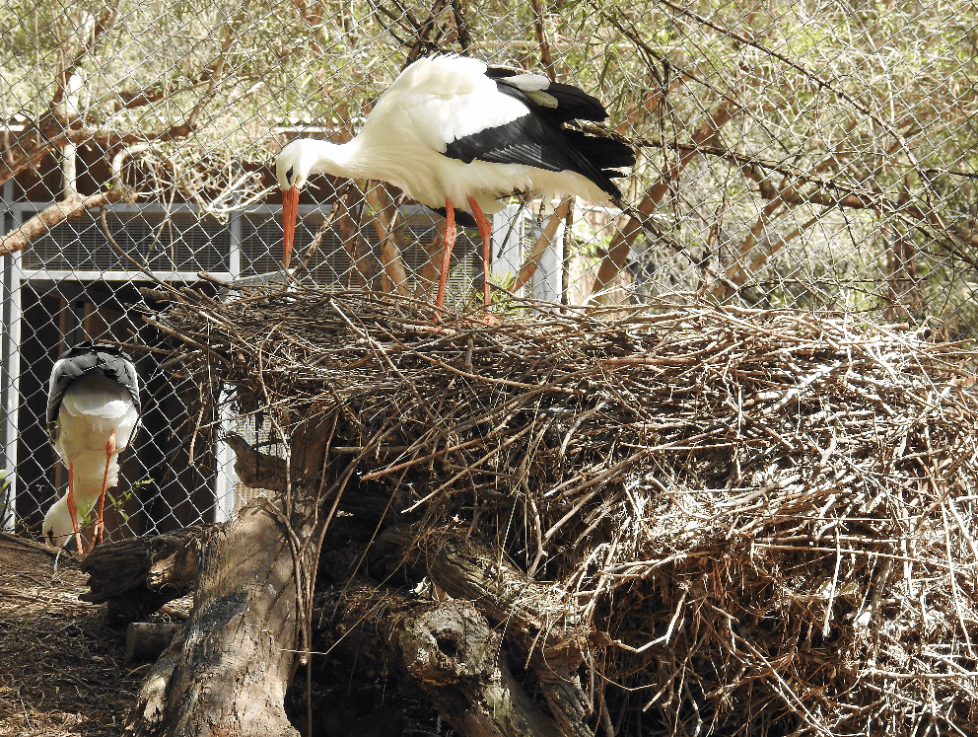
Figure 05. In Europe and elsewhere, the ginormous nests of storks have been associated with fertility, childbirth, and devoted parenting. These (European) White Storks were photographed at the San Diego Zoo’s Safari Park.
Most storks prefer tropical and subtropical habitats, especially marshes, other wetlands, and inland waterways (e.g., rivers, lakes). On the other hand, they’re more tolerant of drier habitats, such as forests and savannahs (e.g., in sub-Saharan Africa), than are many other waders (e.g., herons, spoonbills, ibises). In a given habitat, many stork species will seek out shallow pools whenever possible, given that local weather may dry out some locations, and monsoonal rains may flood others. Whatever the season, storks will find suitable habitats, including flooded grasslands, paddy fields, wet meadows, ponds, and so on.
Within the stork family, various species have their own preferences. For instance, Marabou and Abdim’s Storks often forage in open grasslands or savannahs, but European Black Storks seek out dense temperate forests, and Storm’s Storks prefer southeast Asian rainforests. Though many storks happily dine on aquatic prey, among other foods, Asian and African Openbills depend on eating freshwater aquatic prey; Wood Storks seek prey in fresh water or in marine habitats; and Lesser Adjutants and Milky Storks prefer marine habitats as sources of prey.
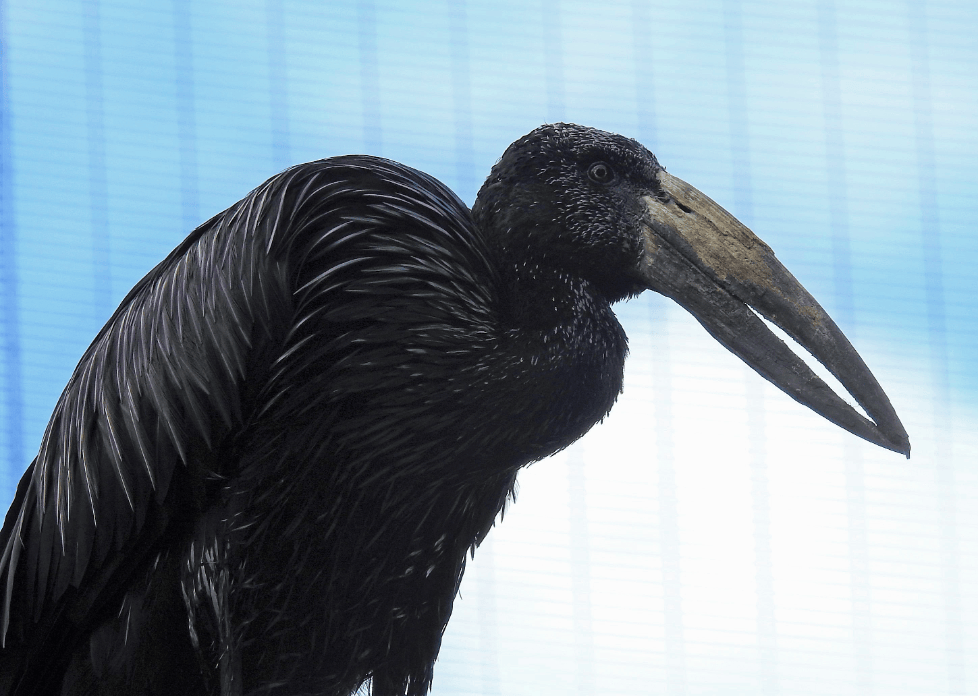
Figure 06. This African Openbill’s bill is perfectly suited to capturing aquatic snails and other freshwater prey; it was photographed at the “Wings of the World” exhibit at the San Diego Zoo’s Safari Park.
In addition, Woolly-necked Storks, Black-necked Storks, Asian Openbills, and Lesser Adjutant Storks have adapted to human settlements, including agricultural crops, artificial feedings, and some species have been seen nesting in trees located in gardens with swimming pools. Similarly, Greater Adjutants, Marabou Storks, and White Storks have been observed feeding at human landfill sites, as well as breeding in locations near humans (unless they’re persecuted for doing so).
Stork species living in tropical or subtropical locales aren’t likely to migrate. Stork species who live in temperate climates (e.g., White Storks, Black Storks, Oriental Storks) are more likely to migrate long distances to avoid the coldest months of winter, compared with storks living in tropical or subtropical habitats. A more unusual migrant is the Abdim’s Stork, which migrates from its breeding grounds in northern Africa (during the wet season) then migrates to (and from) southern Africa in the off season.
Migrating storks tend to take routes that minimize their travel over large bodies of water, even if it means they must travel longer distances to do so. Studies show that these routes are at least partially learned, not entirely innate (youngsters prevented from traveling with experienced birds don’t know the routes). Even within a given species (e.g., Black Storks), some storks may make stopovers and others may migrate nonstop.
Even non-migrants will still make small movements. Some may move around widely within a larger range, whereas others may commute from their nesting sites to their foraging grounds (e.g., Wood Storks sometimes commute 80 miles, 130 km, between feeding and breeding sites). Still others may move from a location with diminishing resources to one with abundant resources.
Food and Foraging
If generalizing about all storks, most are carnivorous predators who hunt for various animals: invertebrates (insects, mollusks, crustaceans, earthworms), amphibians (e.g., frogs), reptiles (lizards, caimans, turtles), fish, and even small birds and mammals (e.g., rodents). If they consume any plant material, it’s usually incidental to eating animal prey.
Typically, a stork feeds by standing or slowly walking in shallow water, often using tactilocation to hunt for prey. Storks who use tactilocation have bills with sensitive tips, making it easier to sense their prey, using touch — helpful in muddy or cloudy water. When hunting, the stork holds open its highly sensitive bill beneath the water, then when prey contacts the bill, it reflexively snaps shut within 25 milliseconds — among the fastest vertebrate reaction times known. Even more remarkably, the bill can distinguish between prey and inanimate objects (branches, etc.), though scientists don’t know how storks can do this so quickly.
Some storks have specialized diets. For instance, the two openbill Anastomus species eat mostly snails and some other mollusks. These storks use the typical stork method for hunting prey, but then they use the tip of the bill to pry open the shell and extract the snail. These storks’ saliva contains a narcotic substance that relaxes the snail, making extraction easier.
One source said that African Openbills have been seen riding on the backs of hippopotamuses when foraging. If they catch a snail while on hippo-back, they’ll take it to the shallows to eat it.
The three Leptoptilos species (Lesser Adjutant, Leptoptilos javanicus; Marabou Stork, Leptoptilos crumenifer; Greater Adjutant, Leptoptilos dubius) eat lots of carrion, so they scavenge more than they hunt.
The two Ephippiorhynchus species (Black-necked Stork, Ephippiorhynchus asiaticus; Saddle-billed Stork, Ephippiorhynchus senegalensis) are usually carnivorous, but some have adapted to human-modified environments (e.g., croplands) by eating a more varied diet.
The four Mycteria species (Milky Stork, Mycteria cinerea; Painted Stork, Mycteria leucocephala; Wood Stork, Mycteria americana; Yellow-billed Stork, Mycteria ibis) specialize in eating aquatic vertebrates (mainly fish), capturing them using tactilocation. A Milky Stork will even probe the burrows of mudskipper fish, plunging its whole head into the mud to grasp the fish.
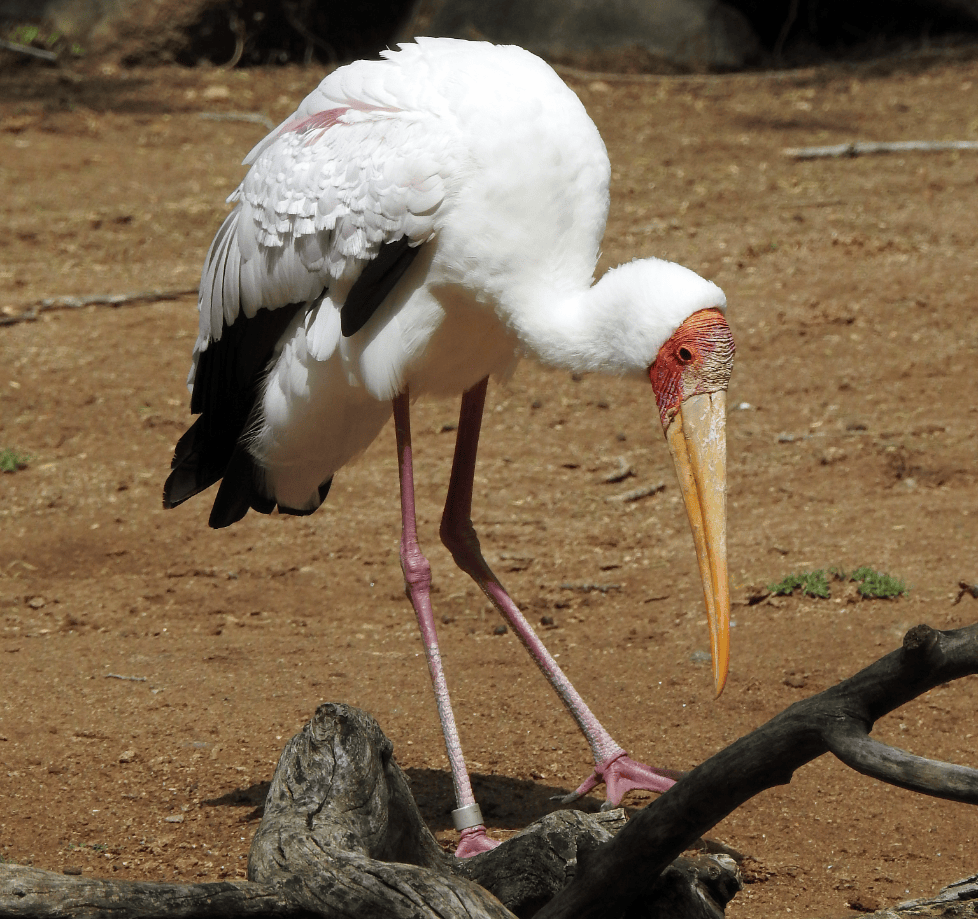
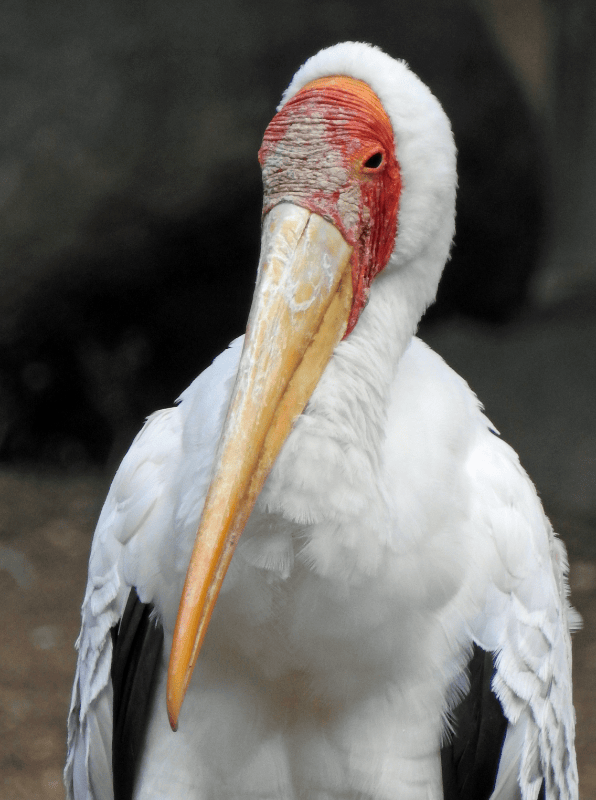
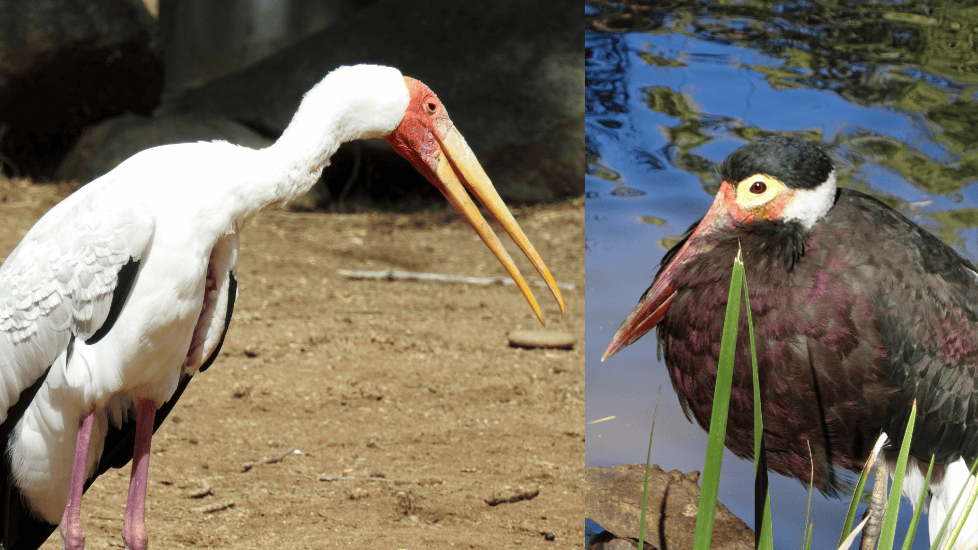
Figure 07a,b. Yellow-billed Storks specialize in capturing fish and other aquatic vertebrates, using their sensitive bills to tactilocate their prey. This Yellow-billed Stork was photographed at the San Diego Zoo’s Safari Park.
Two of the stork species that dwell in the grasslands and savannahs of sub-Saharan Africa (Marabou Stork, Leptoptilos crumenifer; Abdim’s Stork, Ciconia abdimii) must use a different strategy for hunting prey. For instance, flocks of these storks may seek out locust swarms and swoop through them, or they may take advantage of swarming escapees fleeing grassland fires. They’ll also vie for the leftovers of big-game kills on the savannah.
Behavior (such as Breeding)
Like other big, long-winged birds, storks typically soar or glide, rather than using powered flapping flight; soaring and gliding require less energy expenditure but also rely on thermal air currents and other updrafts. While in flight, most storks extend their necks forward, while their legs point backward (e.g., see two Wood Storks in flight, https://macaulaylibrary.org/asset/667918845 ). (Many other long-legged, long-necked waders retract their necks instead of extending them.)
When groups of storks are seen flying together, observers have come up with more imaginative names than just “flocks”: A “flight” of thousands of storks may be seen soaring thousands of miles during migration; a “phalanx” describes a well-coordinated formation of storks, inspired by Greek military terminology for a tightly organized group; more imaginatively, they may be called a “swoop” of storks. When storks gather, preparing to take flight together, they may be called a “muster” or a “mustering” of storks. When gathered on the ground, for breeding or feeding, they may be called a “congregation” of storks, or perhaps a “clan,” a “convocation,” or a “kettle” of storks. Perhaps the most delightful of all, when storks are foraging together, they may be called a “feast” of storks.
The sociability of storks during breeding season varies widely. Many species are solitary breeders, with a lone pair parenting their offspring in their own nest; quite a few form loose colonies of varying sizes; and several are fully colonial, large colonies of thousands of pairs. Among the exclusively solitary pairs of parents are the Jabiru, the two Ephippiorhynchus storks, and several species of Ciconia (Black Stork, Storm’s Stork, and probably both Woolly-necked Stork species). At the other extreme, the 4 Mycteria stork species, the 3 Leptoptilos storks, and the two Anastomus species breed entirely in colonies, which may be just a couple of pairs, or as many as thousands of stork pairs. Sometimes, these species even form colonies with other long-legged waders, such as herons, egrets, and ibises. Several species fall somewhere in the middle. Maguari Storks nest in loose colonies of 5–15 nests. White Storks, Oriental Storks, and Abdim’s Storks are often loosely colonial, living in scattered colonies that don’t interact much, but they may also be seen nesting as solitary pairs.
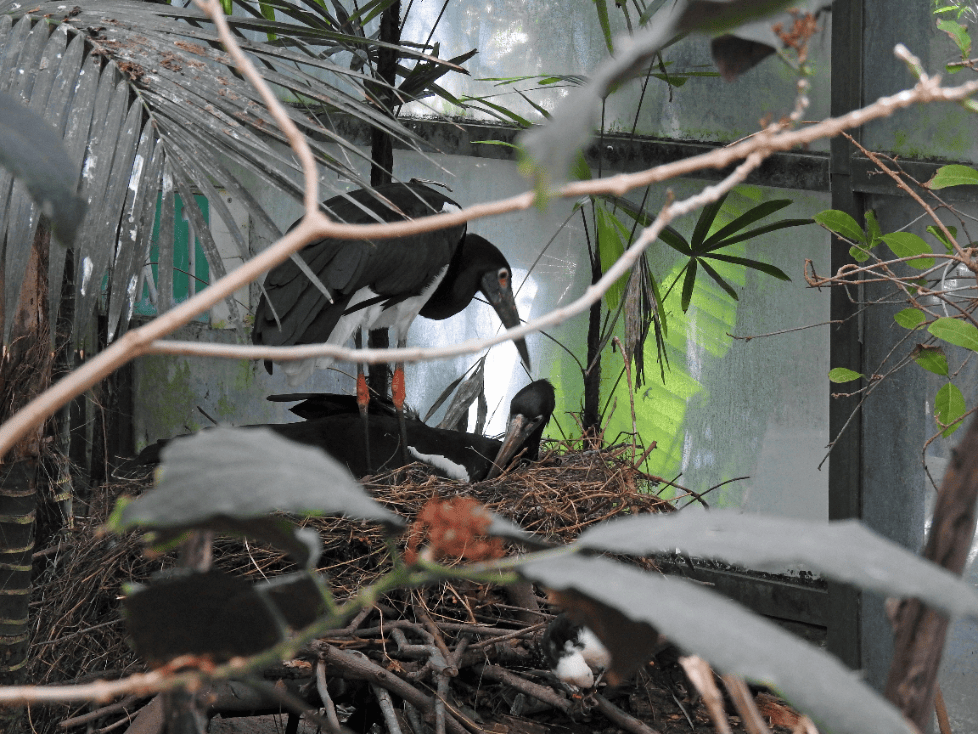
Figure 08. This pair of Abdim’s Stork’s would probably prefer to be nesting in a colony among other storks, but it’s making do at the “Hidden Jungle” exhibit at the San Diego Zoo’s Safari Park.
Regardless of their sociability, storks are socially monogamous (though some engage in extra-pair matings), and both parents are involved in all aspects of parenting: nest construction, incubation of eggs, and brooding and feeding their chicks. In truth, both parents are needed to build big bulky nests in trees, using mostly sticks (perhaps with a little mud, too). The huge nests may be used year after year, and with repeated use, they may reach sizes greater than 6 feet (2 m) in diameter and almost 10 feet (3 m) deep. Within human settlements, storks may also use rooftops or other human structures as the base for their nests. These nests have led numerous human cultures to associate storks with human childbirth for millennia.
In the nest, the female lays 2–5 eggs, which both parents incubate for about a month. Though they hatch nearly naked, the chicks soon grow a downy coat. Helpless upon hatching, they can’t stand upright until about 2 weeks of age, and they stay in the nest for a couple of months after hatching, tenderly cared for by both parents. Even after fledging, they occasionally return to the nest to be fed by their parents. On hot days, some parents regurgitate water to hydrate their chicks.
Conservation Status
Despite their near-global distribution, storks are imperiled. Of the 20 stork species, 65% (13 species) have an IUCN Red List status of LC, Least Concern, but the other 7 species are in danger, mostly due to habitat destruction, which may affect other species, too, in the future. Of these, 20% (4 species) are NT, Near Threatened, and 15% (3 species) are EN, Endangered. Other hazards include the use of pesticides and other poisons in agriculture, as well as reduced access to food refuse near human habitation. At medieval banquets, storks were often featured at feasts, and they continue to be consumed by humans, though not to a great extent.
In Human Culture
For many centuries, storks have been featured in myths, legends, and in several of the fables by Aesop (first published in English in 1484; e.g., see https://en.wikipedia.org/wiki/The_Farmer_and_the_Stork and https://en.wikipedia.org/wiki/The_Fox_and_the_Stork ; see also https://en.wikipedia.org/wiki/The_Frogs_Who_Desired_a_King ). Ancient Egyptians revered Saddle-billed Storks as among the most powerful of animals. Greek and Roman mythology exalts storks as the epitome of parental devotion, as well as of filial devotion in return. Perhaps most notable is the long-standing association between storks and human fertility and childbirth. Given its ancient origins, this lore was popularized in 1839, with Hans Christian Andersen’s story, “The Storks.” Considering the widespread distribution of storks, it’s not surprising that stork lore is also widespread, extending to the Philippines and South America.
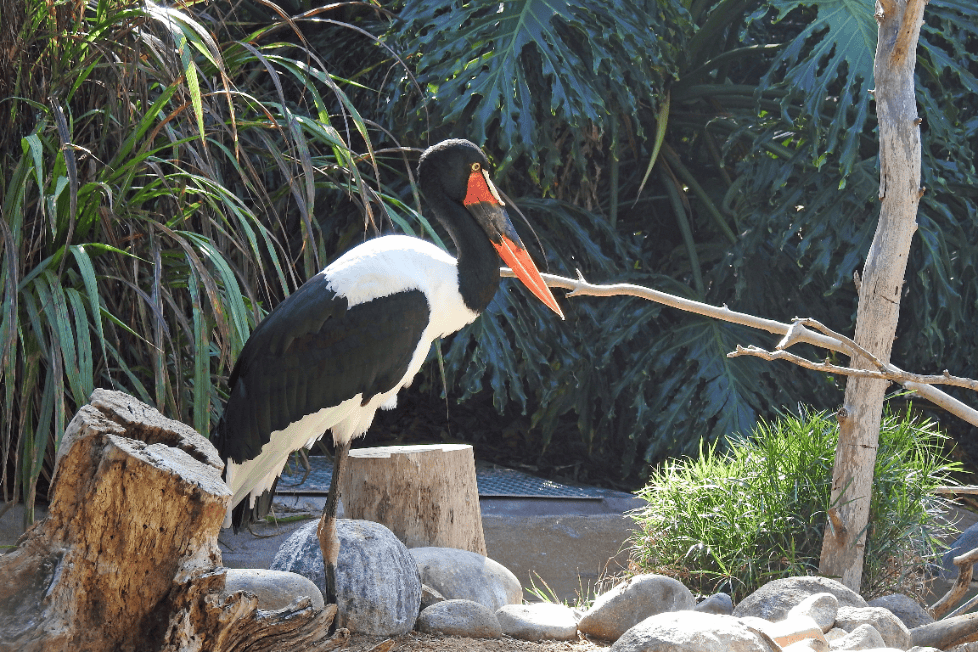
Figure 09. Storks have been mythological and fabled birds since time immemorial. For instance, Saddle-billed Storks were revered in ancient Egypt. This Saddle-billed Stork was photographed at the San Diego Zoo’s Safari Park.
Leptoptilos
The Leptoptilos genus includes three species, two of which have an NT, Near Threatened conservation status:
- Greater Adjutant, Leptoptilos dubius (NT, southern and southeast Asia);
- Lesser Adjutant, Leptoptilos javanicus (NT, southern and southeast Asia);
- and Marabou Stork, Leptoptilos crumenifer (LC, sub-Saharan Africa).
In 1831, naturalist René Lesson introduced the genus, naming it Lepto-, Greek for “slender” (or “delicate”) and -ptilon, Greek for “feather.” In addition to these three living species, extensive fossil evidence shows this genus dates as far back as 5.33–2.58 million years ago, to the Pliocene epoch, found in Asia and Africa, as well as in Argentina, Indonesia, and other locations.
All 3 species in this genus are huge — standing 43–59 inches (3 feet 7 inches to 4 feet 11 inches; 110–150 cm) tall, with wingspans of 83–98 inches (6 feet 11 inches to 8 feet 2 inches 210–250 cm) or larger (see Marabou Stork, next). All three have mostly black plumage above (wings and back) and white plumage below (breast, belly, undertail). Their heads are bare, and their bills are huge — even thicker than most other storks — which is saying a lot. Their bare heads are suited to their scavenging lifestyle; when they plunge their heads into a large corpse, blood and other glop doesn’t get stuck on head feathers. They also opportunistically feed on live prey, such as small amphibians, reptiles, birds, and mammals, as well as some insects (and sometimes feces). When feeding nestlings, they focus more on live prey and less on carrion. Most of the time, however, they feast on carrion, sometimes following vultures, whose sharp bills can more readily tear open a carcass. Like vultures, they serve a crucial ecological role, getting rid of rotting flesh. (For more on vultures, please see New World Vultures, Part 1 – Bird Brain .)
To see almost 24,000 photos and 200+ videos of Leptoptilos storks, please visit https://search.macaulaylibrary.org/catalog?taxonCode=t-12007205&includeChildTaxa=true
When in flight, the three Leptoptilos species look different from other stork species because instead of stretching their heads and necks forward, they pull in their necks, looking more like herons than storks.
All three Leptoptilos species are colonial breeders, forming large gregarious colonies with huge stick nests in neighboring trees.
Marabou Stork, Leptoptilos crumenifer
The same year that naturalist René Lesson introduced the genus Leptoptilos (1831), he also introduced the Marabou Stork, but — plot twist — he placed it in the already existing genus Ciconia, giving it the binomial scientific name Ciconia crumenifera. The name crumenifera references the pink purse-like appendage suspended from its neck, “carrying a purse around the neck” (see https://macaulaylibrary.org/asset/162614461 to see whether you agree with Lesson); the throat pouch is actually a gular air sac (gular pouch), which this stork can inflate. The common name, Marabou Stork, is said to derive from murābit, Arabic for “hermit” or perhaps “holy man.” When the species was moved from Ciconia to Leptoptilos, its species name was changed twice and is now simply crumenifer.
As mentioned previously, the Marabou Stork has one of the two longest wingspans of living land birds (along with the Andean Condor), averaging 8.5 feet (2.6 m; typical range 7–9 feet, 2.3–2.9 m), with records showing wingspans of 10 feet (3.2 m), as well as an unverified wingspan up to 13.3 feet (4 m).
- https://en.wikipedia.org/wiki/File:Marabou_stork_(Leptoptilos_crumenifer)_in_flight_2.jpg
- https://en.wikipedia.org/wiki/Marabou_stork#/media/File:Marabou_stork_(Leptoptilos_crumenifer)_head.jpg
- https://en.wikipedia.org/wiki/Marabou_stork#/media/File:Marabou_stork_(Leptoptilos_crumenifer)_spreading_wings_2.jpg
Among storks, it’s also the tallest (60 inches, 152 cm) and the heaviest (18–20 pounds, 8–8.9 kg, but as light as 9 pounds/ 4 kg has been observed). Length (bill to tail) is usually 47–51 inches (120–130 cm), with females shorter than males. Unlike the adjutants (which have pale irises), the irises of the Marabou Stork are dark. Like other Leptoptilos species, its bill is thick, and bill length ranges 10.5–14 inches (26.4–35 cm).
In addition to its throat “purse,” the base of its neck has a white “ruff,” much like an Elizabethan collar. The plumage coloration of males and females is similar to its genus mates. Unlike its genus mates, they have white legs and toes. Immature storks have browner plumage and smaller bills. Like most other storks, it rarely vocalizes outside of breeding season, but when it vocalizes, its gular sac may alter the sounds produced. In addition, it sometimes clatters its bill (e.g., https://xeno-canto.org/1093586 ; https://xeno-canto.org/294898 ; https://xeno-canto.org/1093586 ).
Like its genus-mates, it feeds opportunistically on a widely varied diet. They have learned that human-created garbage dumps and slaughterhouses have abundant refuse on which to feast. When hunting for prey, they use both tactilocation and visual searches. They have even been seen following large herbivorous mammals, who stir up insects for the storks to snatch.
Like its genus-mates, it breeds in gregarious colonies (typically, 20–60 pairs, but up to several thousand pairs), building a large stick nest (3 feet/100 cm wide, 1 foot/30 cm deep) in a tree 33–100 feet (10–30 m) above the ground. Because food is more plentiful in the dry season than in the wet season, that’s when it starts breeding. Clutches are typically 2–3 eggs, incubation lasts 29–31 days, and fledging occurs 95–115 days after hatching.
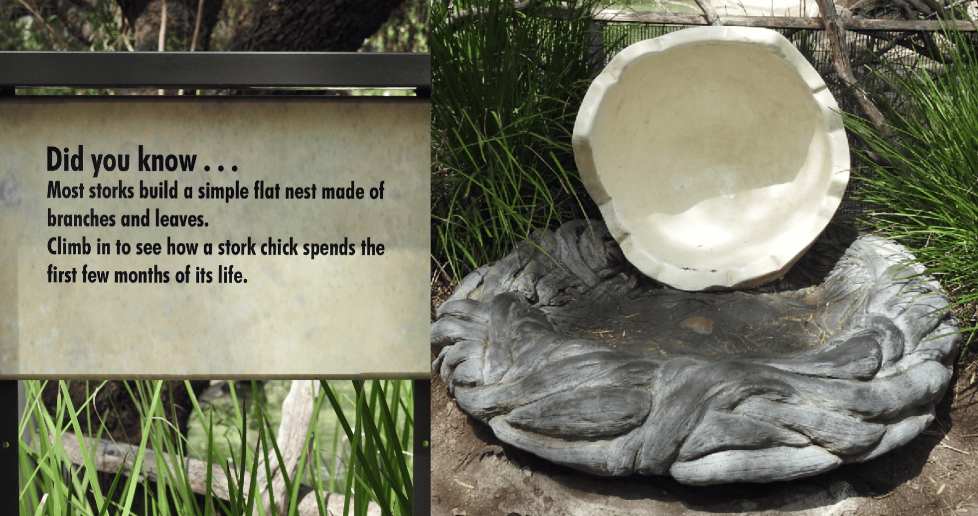
Figure 10. The San Diego Zoo’s Safari Park has this model and this sign, inviting youngsters to see for themselves the size of a stork’s nest. (Wisely, this model isn’t located dozens of feet in the air!)
First breeding usually doesn’t happen until at least age 4 years, and not all Marabou Storks breed in any given year. Adults may live to age 25 years old in the wild, up to 43 years in captivity.
Unlike its genus mates, the Marabou Stork has an IUCN Red List status of LC, Least Concern. They are common or even abundant across most of their range, and their global population was estimated at 200,000–500,000 birds in 2006. They have a high annual survival rate, and they’re threatened by few natural enemies.
Increasingly, however, they are becoming dependent on human-provided garbage. Given their predilection to be willing to eat absolutely anything they can swallow, they’re vulnerable to the consequences of eating unsuitable items such as shoes and metal objects. These storks have also been specifically targeted by humans wishing to use their feathers to adorn their clothing, hats, and fishing lines. Perhaps unfairly, the Marabou Stork has been named as one of the “Ugly Five” by African Safari participants; the other four are the hyena, vulture, warthog, wildebeest — perhaps also considered beautiful by their moms. That perception may have been advantageous for them, as hunters don’t seek them as trophies. When these storks are kept in captivity, they breed only occasionally.
The Cornell Lab of Ornithology gathers information from observers around the world through the eBird app and website (https://ebird.org/species/marsto1 ), which has 61,384 observations of the Marabou Stork, including 6,546 with photos and 32 with audio recordings.
To see any of 11,000+ photos and 100+ videos (as well as 35 audio recordings) of Marabou Storks, please visit https://search.macaulaylibrary.org/catalog?taxonCode=marsto1 , which also holds 35 audio recordings.
Jabiru, Jabiru mycteria
Of the 6 genera of storks, the Jabiru has its own genus, Jabiru, in which it is the only species. The genus name and the common name Jabiru come from the Tupi-Guarani indigenous language of Brazil, meaning “that which is swollen,” pointing to its thick neck with an inflatable gular sac. To see its neck and gular pouch inflated, please see https://macaulaylibrary.org/asset/43897281 , as contrasted with its deflated appearance, such as when in flight, https://macaulaylibrary.org/asset/287156311 (called a graceful flier by some observers). The second part of its binomial scientific name, mycteria, comes from the Greek word mukter, meaning “nose” or “snout,” referring to its other pronounced physical feature; at about 9.8–13.8 inches (25–35 cm) long, it’s broad, black, and slightly curved upward, ending in a sharp tip. Brazilians may call this species Tuiuiu, Tuim-de-papo-vermelho, or Cauauá. Also, some other species (e.g., the Wood Stork) have been called Jabiru at times.
This species was first described in 1819, by naturalist and physician Martin Hinrich Carl Lichtenstein, who extensively explored animal and plant species in sub-Saharan Africa. It’s unsurprising that Lichtenstein was the first to describe the Abdim’s Stork indigenous to that region; it’s more surprising that he was the first to describe the Jabiru, indigenous to the Americas, from Mexico to northern Argentina, east of the Andes (and especially in Brazil; see https://ebird.org/map/jabiru ). Fossil evidence indicates that Jabirus were living in South America by the early Pliocene (5.3–2.6 million years ago), and in Brazil by the late Pleistocene (120,000–11,700 years ago). Throughout their range, Jabirus seek out swamps, marshes, lagoons, rivers, lakes, flooded cultivated fields and paddies, and other waterways. Jabirus don’t truly migrate, but they do move around in relation to rainfall and wet versus dry seasons.
In the Americas, the Jabiru is the tallest flying bird, about as tall as the flightless Greater Rhea (Rhea americana) of southeastern South America. Specifically, the adult Jabiru stands about 5.0 feet (1.53 m) tall (toes to top of head), is about 48–55 inches (122–140 cm) long (bill to tail), and has a wingspan of about 90.5–110 inches (7.5–9.2 feet, 230–280 cm). By comparison, the Greater Rhea stands about 55–67 inches (4 feet 7 inches to 5 ft 7 inches, 1.4–1.7 m) tall and about 50–55 inches (127–140 cm) long. On the other hand, flightless Greater Rheas weigh about 44–60 pounds (20–27 kg), whereas flighted Jabirus weigh 9.5–19.8 pounds (4.3–9 kg). Jabirus show extreme sexual dimorphism in size, with males greatly outweighing females (males, 13–18 pounds, 5.9–8.1 kg; females, 9.5–14 pounds, 4.3–6.4 kg). In the Americas, only the Andean Condor has a longer wingspan, though the Marabou Stork of Africa has a longer wingspan among storks worldwide. The Jabiru’s tarsi (feet from ankles to toes, 11.2–15.4 inches, 28.5–39 cm long) are longer than its tail (7.9–9.8 inches, 20–25 cm).
To see images of Jabirus, please visit https://commons.wikimedia.org/wiki/File:002_Jabiru_feeding_its_babies_in_their_nest_in_Encontro_das_%C3%81guas_State_Park_Photo_by_Giles_Laurent.jpg or https://commons.wikimedia.org/wiki/File:Jabiru_mycteria_con_cr%C3%ADas.jpg or Jabiru (Jabiru mycteria) 2 – Jabiru – Wikipedia . See also the Cornell Lab of Ornithology’s Macaulay Library website, https://search.macaulaylibrary.org/catalog?taxonCode=jabiru , which holds 15,759 photos, 25 audio recordings, 186 videos of Jabirus.
Though the two sexes differ drastically in size, their coloration and plumage are the same — eye-catching — long black legs, long black bill, featherless black head leading downward to a long black neck that ends in an inflatable crimson red ring at its base; between these featherless extremes is vividly white plumage. When not breeding or caring for young in the nest, Jabirus are pretty quiet.
During the dry season, Jabirus are social eaters, wading in flocks of 11–50 birds, herding fish into shallow water where they can be more easily caught; during this time, fish make up 80% of their diet. In the wet season, however, Jabirus tend to hunt alone, eating a variety of vertebrates (frogs, fish, snakes, caimans, small crocodiles, turtles, etc.) and invertebrates (e.g., crabs, snails, insects). In the wet season, eels (measuring up to 31 inches, 80 cm) make up the bulk of the weight of their diet, but amphibians and invertebrates are more numerous in their diets. For a video of a Jabiru fishing (using visual searching), please see https://macaulaylibrary.org/asset/201277931 . Jabirus also eat fresh carrion or dead fish (e.g., during the dry season), so they join vultures in being ecological heroes in their habitat. They’re also opportunistic; in one instance, a population explosion of house mice invaded agricultural fields, and hundreds of Jabirus descended to devour their way through the overabundance. They’ve also been seen stealing the prey of two smaller stork species, Wood Storks and Maguari Storks.
Though they will hunt for prey visually (37%), they also use tactilocation (35%), like most other storks, or both senses (28%). With visual hunting, Jabirus will flush prey by splashing their bill around with each step. With tactilocation, the Jabiru holds its bill open, submerged into the water at a 45-degree angle; when prey contacts its bill, the Jabiru snaps the bill shut, extracts the prey from the water, and tosses its head back to swallow it. In addition to tactilocation and visual searching, Jabirus listen for baby caimans to make distress calls, making it easier to locate them. After catching a caiman, the Jabiru will thwack it against a log to make sure it’s dead before eating it. With fish, the Jabiru may take the fish to the shore to eat it, lessening the chances that the fish can wiggle away. Jabirus will eat fish weighing up to 1.1 pounds (500g), but for a huge fish, they’ll dismember it before eating it.
Jabiru parents appear to have lifelong monogamous pair bonds, hanging out together even outside of the breeding season. Both parents build a massive nest of sticks (and mud) in the crown of a large tree, using the same nest year after year, adding to it over time. The nest may gradually reach more than 6.5 feet (2m) in diameter and nearly 6 feet (1.8 m) deep. Jabirus are usually solitary nesters, but their nests may be near the nests of a few other Jabirus and perhaps herons and other wading birds.
The mom lays 3–4 (range 2–5) white eggs in the nest, and both parents take turns incubating them. Both parents also vigorously defend their territory during this time — warranted defense given that Wood Storks and other Jabirus are known nest predators. No one is known to prey upon a healthy adult Jabiru, however. After the down-covered chicks hatch, it takes them about 80–110 days to fledge, but their parents continue to care for them for an additional 2 or 3 months or so. Because chick-rearing is so time consuming, most Jabirus breed only every other year. One study suggested that 0.9–1.5 chicks fledge per each nest.
The average lifespan of Jabirus is 36 years, and the oldest captive Jabiru lived more than 36 years. Their IUCN Red List status is LC, Least Concern. Though Jabirus aren’t especially abundant in any given area, they are widespread, with a large range. Decades ago, they were deemed NT, Near Threatened, but steps have been taken to protect them, and their numbers have slowly risen as a result. Current estimates are about 10,000–25,000 adult Jabirus in Central America and northern South America, and more than 25,000 adult Jabirus in southern South America. As is so often the case, habitat loss and degradation continue to threaten Jabirus. Pesticide use and intentional hunting of them by humans also threaten this species.
The Cornell Lab of Ornithology’s eBird app and website (https://ebird.org/species/jabiru) has received 42,926 observations, 7455 with photos and 22 with audio recordings.
Following this introduction to storks (Ciconiidae) will be three forthcoming blogs, which will discuss members of four other genera of Ciconiidae.
References
Ciconiiformes, Ciconiidae
- Elphick, Jonathan. (2014). The World of Birds. Buffalo, NY: Firefly Books.
- Lovette, Irby, & John Fitzpatrick (Eds.), (2016). The Cornell Lab of Ornithology Handbook of Bird Biology (3rd ed.). Hoboken, NJ: Wiley.
- Winkler, David W., Shawn M. Billerman, and Irby J. Lovette. (2015). Bird Families of the World: An Invitation to the Spectacular Diversity of Birds. Barcelona: Lynx, Cornell Lab of Ornithology.
- Stork, [Ciconiiformes, Ciconiidae], https://en.wikipedia.org/wiki/Stork
- Winkler, D. W., S. M. Billerman, and I. J. Lovette (2020). Storks (Ciconiidae), version 1.0. In Birds of the World (S. M. Billerman, B. K. Keeney, P. G. Rodewald, and T. S. Schulenberg, Editors). Ithaca, NY: Cornell Lab of Ornithology. https://doi.org/10.2173/bow.ciconi2.01 ; https://birdsoftheworld.org/bow/species/ciconi2/cur/introduction
- Ciconiidae, zoologist John Edward Gray, https://en.wikipedia.org/wiki/John_Edward_Gray
- https://en.wikipedia.org/wiki/Category:Taxa_named_by_John_Edward_Gray ; approximately 1,578 taxa total
- Ciconiiformes, naturalist and ornithologist Charles Lucien Jules Laurent Bonaparte (nephew of Napoleon), https://en.wikipedia.org/wiki/Charles_Lucien_Bonaparte
- Collective noun for storks
- https://nounmaster.com/collective-noun-for-storks/
- https://www.online-field-guide.com/what-is-a-group-of-storks-called/
- https://petreader.net/what-is-a-group-of-storks-called/
- https://allcollectivenouns.com/collective-noun-for-storks/
- https://www.earthofbirds.com/what-is-a-group-of-wood-storks-called/
Genera and Species of Ciconiidae
- List of storks, https://en.wikipedia.org/wiki/List_of_storks
- Leptoptilos, https://en.wikipedia.org/wiki/Leptoptilos
- Leptoptilos genus, René Lesson, https://en.wikipedia.org/wiki/Ren%C3%A9_Lesson
- Marabou Stork
- Marabou Stork. Elliott, A., E. Garcia, and P. F. D. Boesman (2021). Marabou Stork (Leptoptilos crumenifer), version 1.1. In Birds of the World (Eds. not available). Ithaca, NY: Cornell Lab of Ornithology. https://doi.org/10.2173/bow.marsto1.01.1 ; https://birdsoftheworld.org/bow/species/marsto1/cur/introduction
- https://en.wikipedia.org/wiki/Marabou_stork
- “Ugly Five”
- “The Ugly Five Animals of Africa,” https://www.lionworldtravel.com/news/ugly-five-animals-africa , July 19, 2019
- “The not so well known ‘Ugly Five,’” https://www.sabisabi.com › discover › topics › the-not-so-well-known-ugly-five ; Sep 5, 2023
- “Africa’s ‘Ugly Five’ and Why They Matter,” https://www.shumbalala.co.za › blog › post › africas-ugly-five-and-why-they-matter › ; Dec 5, 2024 … Meet the “Ugly Five”: the warthog, hyena, vulture, wildebeest, and marabou stork.
- “What is the Ugly Five? | Kariega Game Reserve,” https://www.kariega.co.za › blog › what-is-the-ugly-five ; May 19, 2024 … 1. The Hyena · 2. The Warthog · 3. The Wildebeest · 4. The Marabou Stork · 5. The Vulture
- Jabiru, Jabiru mycteria
- Elliott, A., E. Garcia, G. M. Kirwan, and P. F. D. Boesman (2020). Jabiru (Jabiru mycteria), version 1.0. In Birds of the World (J. del Hoyo, A. Elliott, J. Sargatal, D. A. Christie, and E. de Juana, Editors). Ithaca, NY: Cornell Lab of Ornithology. https://doi.org/10.2173/bow.jabiru.01 ; https://birdsoftheworld.org/bow/species/jabiru/cur/introduction
- Jabiru, Jabiru mycteria, https://en.wikipedia.org/wiki/Jabiru
- Martin Hinrich Carl Lichtenstein, physician, explorer, botanist, zoologist, https://en.wikipedia.org/wiki/Hinrich_Lichtenstein
- Jabiru and Abdim’s Stork — as well as Golden-crowned Kinglet, Greater Crested Tern, Levaillant’s Cisticola, Spotted Thick-knee, Tufted Antshrike, White-tailed Lapwing — among the 59 taxa named by Lichtenstein, https://en.wikipedia.org/wiki/Category:Taxa_named_by_Hinrich_Lichtenstein
- cf. Greater Rhea (Rhea americana), https://en.wikipedia.org/wiki/Greater_rhea
Etymology
- Gotch, A. F. [Arthur Frederick]. Birds—Their Latin Names Explained (348 pp.). Poole, Dorset, U.K.: Blandford Press.
- Gruson, Edward S. (1972). Words for Birds: A Lexicon of North American Birds with Biographical Notes (305 pp., including Bibliography, 279–282; Index of Common Names, 283–291; Index of Generic Names, 292–295; Index of Scientific Species Names, 296–303; Index of People for Whom Birds Are Named, 304–305). New York: Quadrangle Books.
- Lederer, Roger, and Carol Burr. (2014). Latin for Bird Lovers: Over 3,000 Bird Names Explored and Explained (224 pages). Portland, OR: Timber Press.
Text and images by Shari Dorantes Hatch. Copyright © 2026. All rights reserved.
Images were recorded in at the San Diego Zoo and its Safari Park.


Leave a Reply