
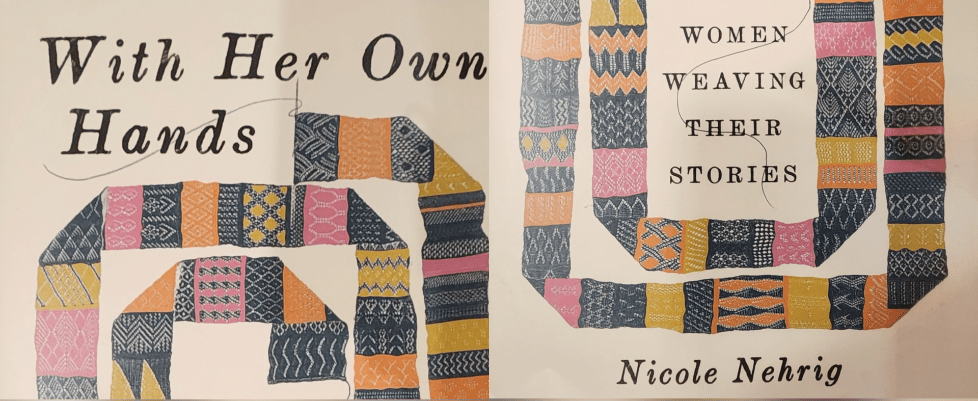
This is the second of two blogs about Nicole Nehrig’s With Her Own Hands: Women Weaving Their Stories (2025). The first blog (https://bird-brain.org/2026/05/13/nehrig-women-and-textiles-part-1/ ) discussed the introduction and Chapters 1–4; this second blog discusses Chapters 5–7 and the back matter of the book.
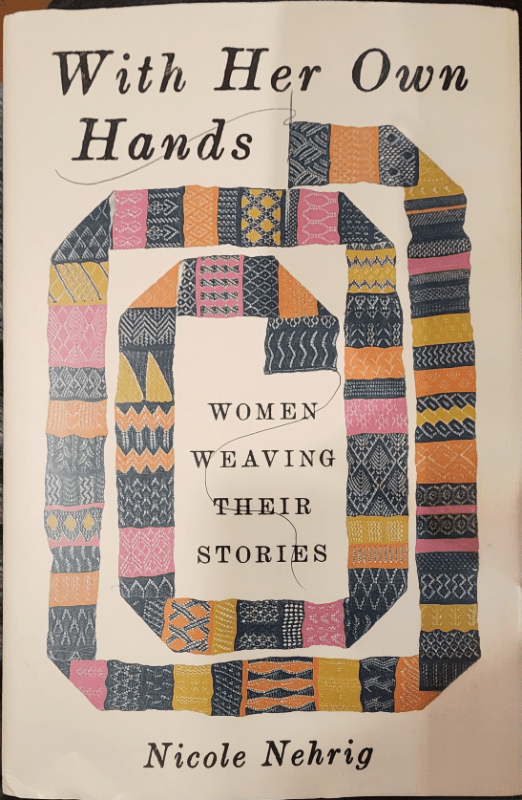
Nicole Nehrig. (2025). With Her Own Hands: Women Weaving Their Stories. New York: W. W. Norton & Company.
Chapter 5 The Social Fabric, 133–163
Nehrig opens the chapter with a Native American Crow legend about female solidarity among animals. Though much of textile handicrafts are done by solitary women, women also do textile handiwork communally. Archeologist and textile scholar Elizabeth Wayland Barber has found that women gathered communally to work on craft projects – spinning, weaving, and so on — by at least 4,000 years ago, in the Neolithic and early Bronze ages. Especially during the winter months, these women gathered to engage in handicrafts while their children played together. Barber found that “Neolithic textiles are remarkably ornate — multiple colors are used to weave patterns, and beads and embroidery are used to adorn the cloth” (p. 135). Doubtless, these women enjoyed each other’s company, learned from one another, inspired one another, and shared materials and tools.
For illustrations and information about Neolithic textiles, see
In the 1700s, in chilly northern European winters, women gathered in “spinning bees,” sharing the light and warmth of a fire while they and their children entertained one another while they spun. Quilting bees made quilt-making a social activity. Each quilter might make individual blocks on her own, but then as a group, they collaboratively stitched together the blocks and had fun together doing the rather tedious work of stitching together the quilt layers. A quilt made with many hands (and the resources and skills of many quilters) can be superior to one created by a solitary quilter. (Though the term “quilting bee” didn’t emerge until the 1800s, in the late 1700s, women were gathering to work on quilts. For more on quilting bees, see https://en.wikipedia.org/wiki/Quilting_bee .)
Fair Isle knitter Hazel Tindall recalls that at any Shetland (Scotland) social event, women would bring their knitting, so they could knit while socializing. “A study of [more than 3,000] knitters found that knitting in a group significantly impacted their perceived happiness and improved social contact and communication with others” (p. 136). Social handiwork allows both the shy or nonverbal handicrafter and the overly chatty handicrafter to participate in social events. Handicrafters usually bring simpler (perhaps tedious) projects that require less cognitive energy than projects they might do at home, in solitude. These social handicraft experiences can also foster social skills, useful in other settings.
In Gee’s Bend, Alabama, generations of women have been making distinctive quilts celebrating their African-American heritage. In recent years, they have held annual festivals displaying and honoring these quilts and their makers. Gee’s Bend quilter Marlene Bennett Jones said of the festival, “It’s people from all over the world talking, laughing — well, these quilts brought people together. . . . you’re connecting with them [like] the quilt pieces are connecting and talking to each other” (p. 139). “Notably, Black and white women sometimes quilted together in the South in the early part of the twentieth century, even when everything else was segregated” (p. 140).
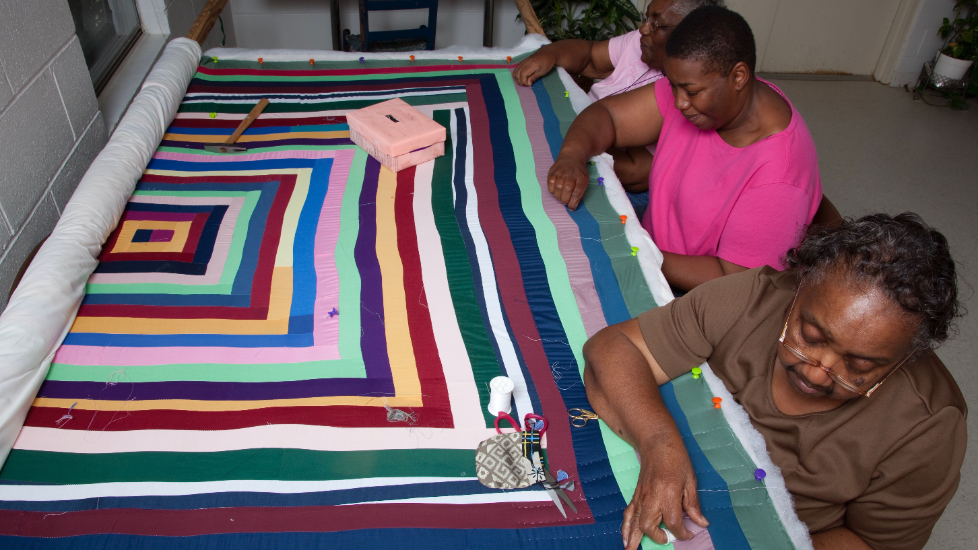
Figure 05-01. Once the top of the quilt has been pieced and sewn together, the actual quilting — stitching the backing, the padding, and the top together — must be done, and the quilting can be done much more quickly and easily when you have company, such as these quilters in Gee’s Bend, Alabama.
(The photographer who captured this gathering of quilters has dedicated the work to the public domain by waiving all of their rights to the work worldwide under copyright law, including all related and neighboring rights, to the extent allowed by law. You can copy, modify, distribute and perform the work, even for commercial purposes, all without asking permission.)
Weaver and scholar Lilly Marsh cofounded the Hudson Valley Textile Project (https://www.hvtextileproject.org/ ), “to support environmentally responsible and economically sustainable farm-to-fabric supply chains in the region, creating a network of people involved in all aspects of textile production.” Marsh “helps local farmers birth lambs and shear wool and then coordinates with a local fiber mill to spin it into yarn, which she dyes and weaves into items such as blankets, table runners, and scarves for farms to sell” (p. 140).
When handicrafters get together, they can appreciate the technical skill and artistry of one another’s work in ways that others wouldn’t notice. In addition, they can learn from one another, both by observing the result and by watching the process or producing the handicraft item. Knitters have formed various formal and informal social groups. In 1999, Debbie Stoller’s Stitch ’n Bitch group started in New York City’s East Village; there are now thousands of such groups across the globe. In the 1940s, women had formed “Stitch and Bitch” knitting groups, to produce knitted items for the war effort and to offer support to one another while their mates were overseas (see https://en.wikipedia.org/wiki/Stitch_%27n_Bitch for more information). (The TV show 911 even featured a “Stitch and Bitch” group in Season 9, Episode 11.)
As communities have migrated to an online presence, the online social platform Ravelry hosts almost 9 million members who can look through Ravelry’s online crochet and knitting pattern database (some patterns are free). Through Ravelry, they can communicate with fellow knitters, look for local groups of fellow knitters, and engage in various other social handicraft activities.
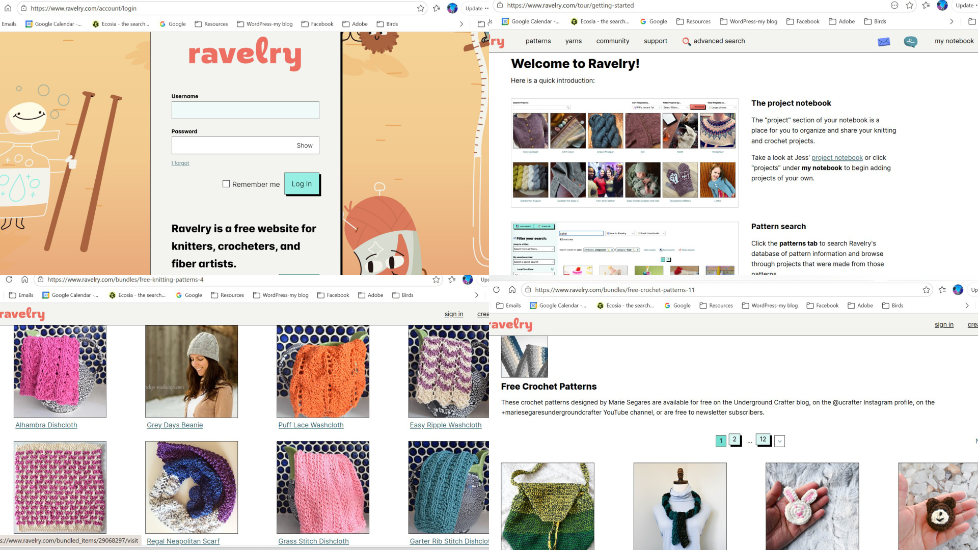
Figure 05-02. These are screenshots from the Ravelry website. Top left is the log-in for newbies to the site (it took me 15 minutes to create an account); top right is the welcome page after signing up. Bottom are a sampling of patterns for knitting (left) and crochet (right). For more information on Ravelry, see https://en.wikipedia.org/wiki/Ravelry ; to sign up, visit https://www.ravelry.com/account/login .
During the COVID pandemic, knitwear designer Lindsay Degen started Knit.Club for knitters ages 18–35, especially providing a “safe space for queer and BIPOC knitters” (p. 143). Knit.Club facilitates both online and in-person communication, meetups, and knit-a-longs, as well as knitting tutorials. “Cloth is a connective tissue” (p. 144).
Often, handicrafts can be a way for generations of women to form and affirm their connections with one another. As young girls master handicrafting skills, they gain approval and recognition from their elders, often for good, but sometimes as a means of constraining the girls’ roles in their society. The teaching of handicrafts can be a way for older and younger women to form or affirm their bonds, for each to show appreciation of the other.
When a parent or grandparent dies, continuing to use the skills learned from the loved one can be healing and comforting. Even when we’re alone, we can feel tied to those with whom we shared our handicrafting. We can even feel their physical presence through handicrafts, such as when Gee’s Bend quilter Marlene Bennett Jones cut apart the clothing of her deceased mother and father to create quilts for her siblings.
Knitters Masey Kaplan and Jen Simonic formed Loose Ends, a nonprofit organization that will accept the partially completed projects started by a deceased loved one. Then Kaplan and Simonic will find volunteers to complete those projects and return them to the donors. Often, volunteers and donor families form a relationship. “Within a year of starting Loose Ends, [26,000] people from [more than 60] countries have volunteered to be finishers, and [2,500] projects are in progress or have been completed” (pp. 149–150).
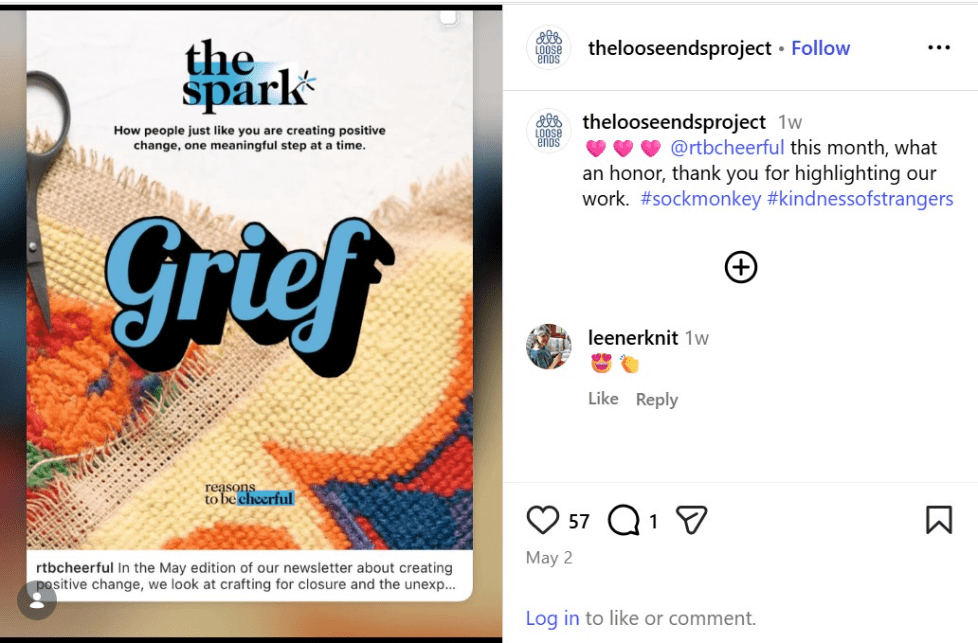
Figure 05-03. The Loose Ends Project welcomes volunteers to complete projects left unfinished by deceased crafters, families who wish to offer unfinished projects, and people who are better able to donate their time to the project in other ways or to donate financially to the project. (See https://looseends.org/ .)
Archeologist Elizabeth Wayland Barber has observed that what people wear typically reflects their cultural and personal identity. When Spaniards conquered the Incan Empire, the Incans willingly offered them gold and silver but either hid or destroyed their textiles to keep them from the conquerors. When whites were invading the Great Plains, forcing Native Americans onto reservations, the indigenous women used increasingly extravagant beadwork on their garments and their moccasins, imbuing their handiwork with cultural meaning.
In the 1860s, the U.S. military not only forced Navajos onto reservations but also destroyed their vast herds of Churro sheep. The Navajo were supplied with more than 72,000 pounds of mill-spun, aniline-dyed yarn, which the weavers used to create their own distinctive blankets, which they then sold to tourists as an important source of income until they were able to acquire new breeds of sheep.
Art historian Janet Catherine Berlo has used the term bricolage to describe many modern textiles from Latin America and other parts of the world. In particular, women often “transform odds and ends into useful garments, household items, and works of art” (p. 153).
“bricolage (noun) 1. The process or technique of creating a new artwork, concept, etc., by appropriating a diverse miscellany of existing materials or sources. — 1960. 2. An object or concept created or constructed by appropriating a diverse miscellany of existing materials or sources, particularly (in Art) of found objects. Also in weakened sense: a miscellaneous collection of accumulated objects or detritus. — 1971.” Oxford University Press. (n.d.). bricolage, n., 1. 2. In Oxford English Dictionary. Retrieved May 9, 2026, from https://doi.org/10.1093/OED/9241875732
Indigenous Panamanian Guna women have been making molas for centuries, stitching crafted panels together to make traditional mola blouses. “Molas are made using a reverse appliqué technique where multiple layers of fabric are sewn together and then cut away in shapes to reveal the colors in the layers of fabric beneath. Embroidered details are added as well” (p. 153). (Please see https://en.wikipedia.org/wiki/Mola_(art_form) for examples of this exquisitely artful handicraft.) Nehrig gives an example of bricolage in which a Panamanian Guna woman created a mola blouse depicting the label of a box of Parrot Safety Matches, including an embroidered “Made in Sweden.” This artisan combined an appealing image with her own resources and skills to create an entirely new artistic piece.
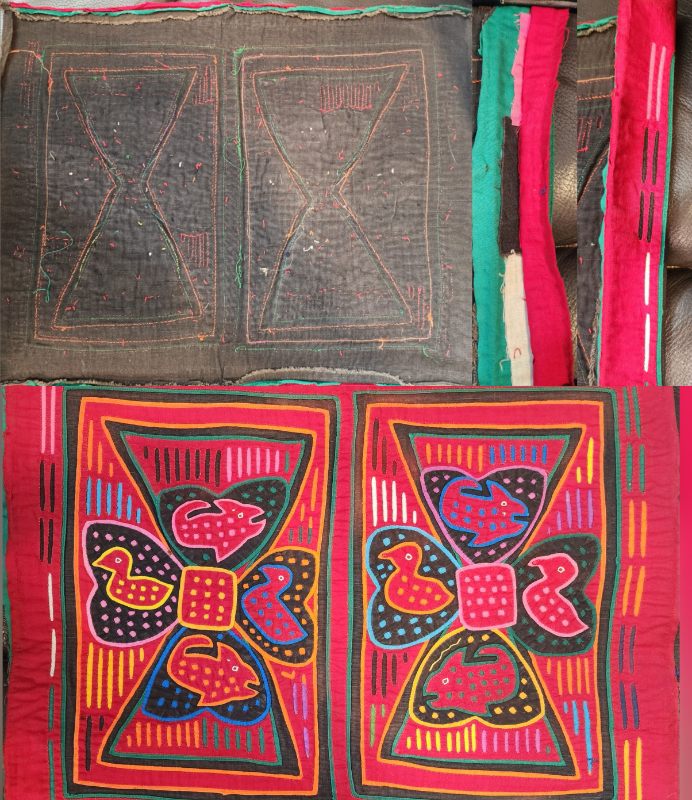
Figure 05-04. Through the centuries, Panamanian Guna women have been making reverse-appliqué molas, depicting the world around them as they see it. The top row shows the back of the appliqué (left), a peek behind the top of the fabric, showing the different layers of fabric for the reverse-appliqué (middle), and the result of having different fabric layers for the reverse-appliqué effect (right). The bottom row shows how the mola looks from the front.
English literature professor Kathryn Sullivan Kruger suggests broadening the definition of “written texts” to include textiles, noting that much of women’s storytelling was produced through textiles. By including textiles in historical “written texts,” we find many female “authors.” “Cloth tells stories, records histories, and shapes culture” (p. 154).
In the 11th century, the Bayeaux Tapestry recorded the 1066 Norman Conquest of England through embroidery, using colored wool thread on linen fabric. “No one knows who stitched it. . . . [though] most scholars believe that a group of Anglo-Saxon embroiderers stitched it near Canterbury, England” (p. 154). The embroiderers were almost certainly all women, as was the custom of the time, and women doubtless also spun the thread and wove the cloth. The tapestry is 230 feet long (70m) by 20″ (50 cm) high (https://en.wikipedia.org/wiki/Bayeux_Tapestry ), including 58 scenes. Though it’s called a “tapestry,” the scenes are embroidered, not woven, and the background is flax-colored linen, allowing the embroidery to stand out.
At a time when thread was hand-spun, and embroiderers valued hand-spun thread as a precious commodity, they used stitch techniques that conserved thread as much as possible. For instance, at the back of the work, tiny couching stitches can be seen bonding the thread to the fabric, and most of the stitches on the front are long, minimizing the use of thread that wouldn’t be seen. While the scenes were probably sketched out by others (probably men) before the embroidery began, the choice of border stitching was probably invented by the embroiderers, though not all scholars agree on this point. The borders included both real and fanciful animals, often alluding to fables (e.g., “The Fox and the Crow”) and myths. It’s clear that different women embroidered different parts of the tapestry, probably unaware of what others were stitching. According to Bayeaux Tapestry Museum curator Antoine Verney, the tapestry “was the first known graphic representation of a current event in northern Europe,” capturing elements of a historical event that otherwise might not be as well known. Ironically, the women who captured and kept this history are unknown to history.
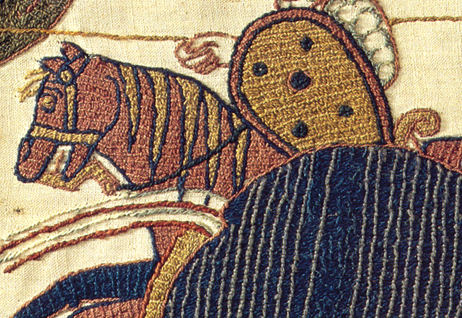
Figure 05-05. This closeup of a scene from the Bayeaux Tapestry can give you a sense of the skill and creative expression used by the embroiderers to create this magnificent work. Though someone may have sketched an outline of each scene, the embroiderer decided what expression to give the horse’s face, whether to outline the horse’s main, what texture to give to the horse’s coat in contrast to the reins, and so on.
Description Detail of image: Odo_bayeux_tapestry.png. Source Wikimedia Commons. Author This file is lacking author information. Public domain. This work is in the public domain in its country of origin and other countries and areas where the copyright term is the author’s life plus 70 years or fewer. You must also include a United States public domain tag to indicate why this work is in the public domain in the United States. Note that a few countries have copyright terms longer than 70 years: Mexico has 100 years, Jamaica has 95 years, Colombia has 80 years, and Guatemala and Samoa have 75 years. This image may not be in the public domain in these countries, which moreover do not implement the rule of the shorter term. Honduras has a general copyright term of 75 years, but it does implement the rule of the shorter term. Copyright may extend on works created by French who died for France in World War II (more information), Russians who served in the Eastern Front of World War II (known as the Great Patriotic War in Russia) and posthumously rehabilitated victims of Soviet repressions (more information). This file has been identified as being free of known restrictions under copyright law, including all related and neighboring rights.
In 1885, Elizabeth Wardle organized 37–39 women to re-create their own Bayeaux Tapestry. These women spent just one year creating their replica, and — unlike their forebears — signed their own names to the sections that they had embroidered. Their signatures also reveal something of their process. While some women appeared to work alone for long stretches, a group of four women produced a 4-foot section, perhaps chatting and laughing as they stitched.
Another difference between the medieval tapestry and the Victorian tapestry: In the medieval original, naked men and horses were depicted with anatomical accuracy, but the Victorian version omitted some of these details. It turns out that they did so because men working in the museum archives bowdlerized the photos of the original, to keep the embroiderers from seeing — and reproducing — the correct anatomy.
In 2012, 416 stitchers, ages 4–100, stitched a final panel for the tapestry, in a library in Alderney, Great Britain; then Prince Charles of Wales (now King Charles III) participated, too. The work was completed a year later. Since then, Swedish-born English seamstress Mia Hansson has undertaken the solitary task of single-handedly recreating the Bayeaux Tapestry; she expects to finish in 2027. “Hanson plans to finish her Bayeaux Tapestry replica just in time for a major restoration of the original tapestry, . . . scheduled to begin in 2028” (p. 161). As Hansson has been closely noticing the original tapestry while creating her reproduction, she noticed, “Their varying skill levels are clear from the stitching” (p. 162). There are also gaps between where two women worked, or overlaps where neither woman wanted to stop her own stitching. Hansson opines that these embroiderers were probably Anglo-Saxon women, many of whom lost loved ones during the bloody battles they were depicting.
Chapter 6 Homespun Opportunities, 165–195
(spinning, weaving)
Icelandic wadmal (“vaðmal”) is a “coarse, dense, usually undyed wool fabric woven in Iceland, Norway, Sweden, Denmark, Greenland, and the Orkney, Faroe and Shetland Islands from the Middle Ages into the 18th century. Wadmal was woven on the warp-weighted loom used throughout these areas of Norwegian influence, and was usually a 2/2 twill weave . . . . Wadmal was a medium of exchange throughout Scandinavia . . . accepted as currency . . . . . the main export of Iceland, where length, width, thread count, and weight for different grades were fixed by law. . . . a dominant legal currency in Iceland” (https://en.wikipedia.org/wiki/Wadmal ). In a 2/2 twill pattern, the weaver crosses 2 warp threads then under 2 warp threads, then under, and so on.
So, in Iceland, by at least the 12th century, women were not only producing the main income, but also literally making the money used there. Wadmal fabric has a distinctive makeup: The warp threads are made from sheep’s coarse outer guard hairs, making them sturdy and strong, as well as waterproof. The weft threads are made using the sheep’s soft inner fuzzy coat, which felted together, making the fabric warm and fluffy. “Together, they made a warm, waterproof garment” (p. 166). Icelandic women also adapted their cloth in response to climate change — specifically, during the “Little Ice Age,” they more densely packed the weft threads to provide even better warmth and insulation.
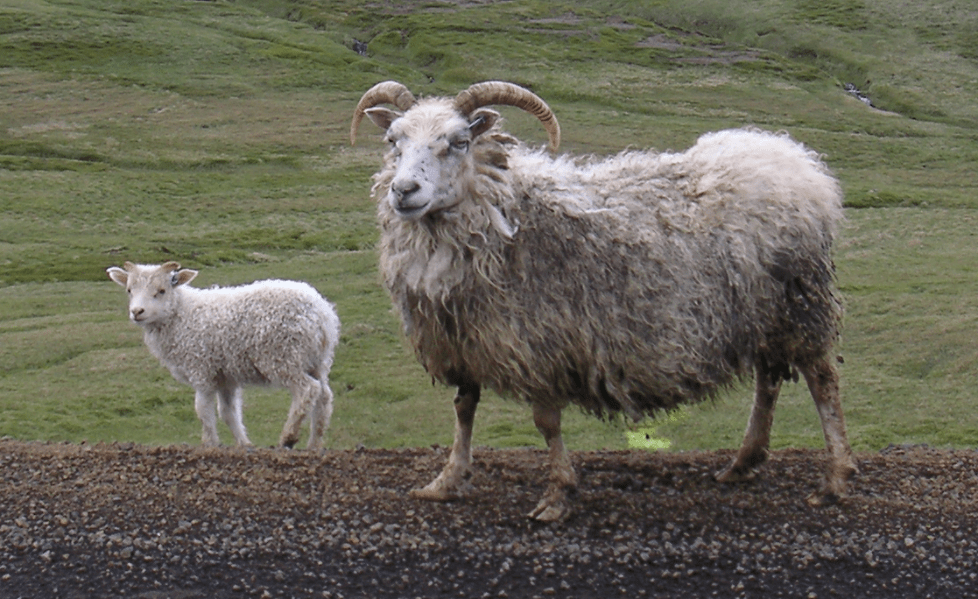
Figure 06-01. As this ewe and lamb show, Icelandic sheep have dense, fluffy wool. Icelandic sheep display wider color variations than most other breeds of sheep, making it deeply appealing to crafters who use only natural, undyed wool. This photo was taken by Kyle MacLea, Iceland, June 2005, and she is magnanimously sharing it with Wikipedia, through Creative Commons Attribution ShareAlike License v. 2.5. CC BY-SA 2.5. The image is available at https://en.wikipedia.org/wiki/Icelandic_sheep#/media/File:Icelandic_sheep.jpg . Through her licensing of this image, you are free: to share – to copy, distribute and transmit the work; to remix – to adapt the work. Under the following conditions: attribution – You must give appropriate credit, provide a link to the license, and indicate if changes were made. You may do so in any reasonable manner, but not in any way that suggests the licensor endorses you or your use.
If you are the least bit interested in how wadmal (vaðmal) is made, I highly recommend that you visit this website, where the author fully explains all the steps for doing so, from raw fleece (uncombed, but possibly cleaned) to spinning the fiber to weaving the cloth: https://wroot.blog/2020/10/10/reconstructing-fabric-from-norse-greenland-tiny-wadmal/
Before the Industrial Revolution, “the home was the center of economic activity for much of human history. Families profited from their labor, their land, and the various skills of household members. All work contributed to the family’s sustenance, so there was greater interdependence between men and women” (p. 167).
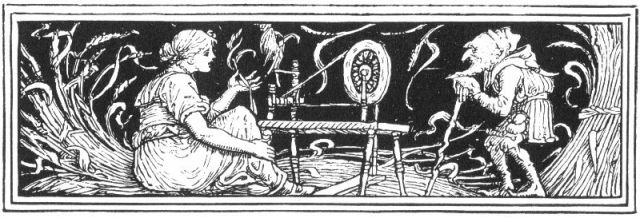
Figure 06-02. “The Rumpelstiltskin tale of spinning flax into gold has both alchemical and economical significance. Through textile production, women [can] literally [transform natural materials] into a product of monetary value” (p. 167). This illustration of the Rumpelstiltskin tale is by Walter Crane from Household Stories by the Brothers Grimm (1886). The image was obtained by Project Gutenberg and is in the public domain. I found it from https://en.wikipedia.org/wiki/Rumpelstiltskin#/media/File:Rumpelstiltskin-Crane1886.jpg , in https://en.wikipedia.org/wiki/Rumpelstiltskin .
“Icelandic historian Helgi Þorláksson calculated the annual needs of small preindustrial farm houselands in Iceland to be [70–100] kilograms of wool. It provided for clothing, bedclothes, sails, taxes, and land rent. Of course, all of this wool had to be spun and woven to be useful. Based on records on the style of dress at the time, to spin the [3] kilograms of wool needed to produce one adult outfit took around [400] hours, or [50] days, if we assume an average of [8] hours of spinning a day. Þorláksson estimated [12] kilograms of wool were needed to produce the vaðmal required for yearly taxes and tithes, which would have taken [1,600] hours in spinning time alone” (p. 168) (1,600 ÷ 8 = 200 days, just for spinning, not even considering time needed for weaving.)
***
During the 1600s, in rural Britain, women were given raw materials with which they produced textiles at home, under the “management” of their husbands, earning low wages for doing so. In addition, of course, these women needed to make garments for their family members, other textiles for the household needs, as well as tend the children, cook the food, launder the clothes, and carry out uncounted additional household chores.
For an enchanting monologue about the lives of ordinary women in the 1600s, please see this brief (2:27 minutes) clip, https://youtu.be/oPEMzh_Y75Q?si=tW3VAxrX7xLYbF65
Meanwhile, male embroiderers organized guilds that excluded women and even gained passage of a 1609 bylaw making it illegal for women to gain an income from embroidery or even to be apprentices to male embroiderers. A few women managed to support themselves through their handiwork, but most “toiled in utter poverty, struggling to make enough to survive” (p. 169).
In contrast, on Shetland, women knitters could fully support themselves through their knitting. Their knitting contributed importantly to the Shetland economy. Nowadays, an estimated 300 million women make money producing handicrafts from home, “the leading source of employment for women worldwide” (p. 170). “The nonprofit organization Nest . . . focuses on supporting and promoting the work of artisans around the world, [and] worked with the United Nations to create standards for ethical handcraft that are now followed by [many] major retailers” (p. 171).
To see the breakneck speed of traditional Shetland knitters, visit
https://www.knitting-naturally.com/shetland-knitting.html ,
and check out the video there.
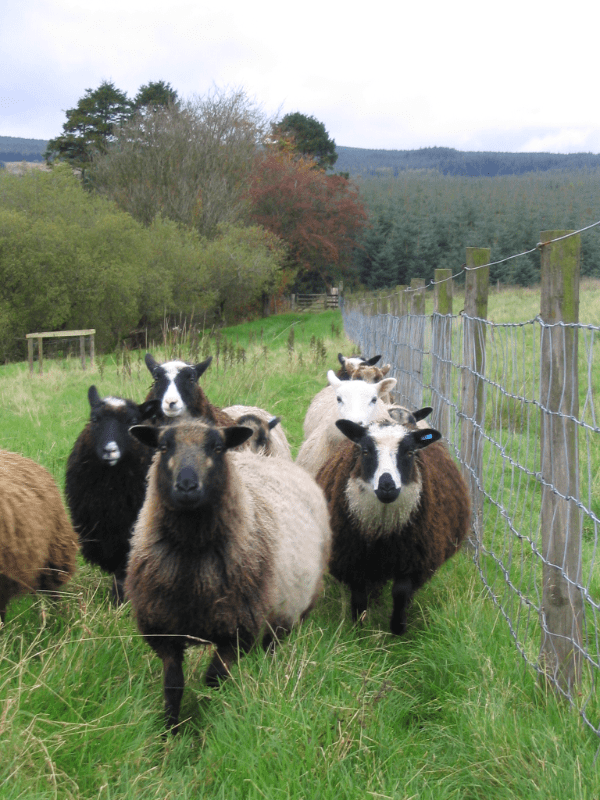
Figure 06-03. This photo of Shetland sheep, Scotland, United Kingdom, was taken by Andrew, who has generously offered to share his work through the Creative Commons (Wikipedia), provided that attribution is given and its use doesn’t imply endorsement of the user of the image.
Nest founder Rebecca van Bergen was motivated to found Nest after her research revealed the appallingly meager earnings of women who spent hours each day producing handicrafts. By 2023, Nest had affected the economics of 52,713 handworkers living in more than 25 countries (5 continents). Part of the process is to conduct time-motion studies to determine a fair piece-rate pay for a given craft item, then to use that pay as a base for determining the price. In addition, the intermediaries must demonstrate that no child labor is involved in the supply chain. Nest also investigates and resolves any allegations of abuse. Consumers can seek out the “Nest Seal of Ethical Handcraft” when purchasing handcrafted items (see https://www.buildanest.org/ethical-handcraft for more information).
***
Of course, handicraft that is produced within the constraints of the marketplace differs from handicraft a woman produces freely expressing her own vision of her craft. On the other hand, producing handicrafts from home frees an artisan to care for children and perform other household chores without having to leave her home. When compared with factory work, home handicrafts may work better for the children in a family. “In Bangladesh, homeworkers breastfed their children an average of 19.3 months, whereas factory workers breastfed for an average of 9.9 months. In China, only 10.5 percent of homeworkers said their children are left unattended regularly, compared with 23.9 percent of factory workers” (p. 17). In addition, women living in rural areas may simply lack easy access to factory work. Further, many women simply prefer being at home instead of in a crowded factory that may not only have unsafe or at least unpleasant working conditions but also exposure to illnesses, such as during a pandemic.
Factories have certainly gotten a bad reputation for unsafe working conditions (e.g., the Triangle Shirtwaist Factory fire of 1911; see https://en.wikipedia.org/wiki/Triangle_Shirtwaist_Factory_fire ) or for exploitation (e.g., of child labor and migrant labor in garment factories). Factory work can, however, offer women independence, opportunities to work away from home, and the possibility of delaying an unwanted marriage. Factory work can also be made more hospitable, not only by providing safe working conditions and adequate pay, but also by designing the factory environment and schedule to accommodate the workers. For instance, a clothing factory in Normandy, France, trains each worker in a variety of jobs in the factory then rotates the workers among the jobs, to minimize the likelihood of repetitive-motion injuries, as well as boredom. Textile leftovers are also made available to the workers to use for their own sewing, and some women stay after work to use the machines and sew their own projects.
***
In the 1500s and 1600s, Venetian nuns made lace to support the finances of the convent. Some nuns also accepted private commissions for their needlework, to earn a little extra for themselves. Most of the profits, however, went to merchants who sold the nuns’ lace. One such merchant was Arcangela Tarabotti, a nun who acted as a lace broker in the early 1600s. Tarabotti, born with a clubfoot, had been sent to a convent at age 13 and wrote extensively about the miseries of living in a convent, using her texts to call for the equal treatment of women and men. She and the lacemaking nuns with whom she worked made a good living, though she profited from the transactions more than did the other nuns.
From the 1800s until the mid-1900s, Italian women of modest means were taught to embroider from an early age. From about age 7 until they married, they would embroider their own dowry of beautiful linens. On marrying, the sheets, towels, underclothes, and other linens could be used to beautify the home while being useful. In times of financial difficulty, they could sell their linens to help the family, to cushion the loss of a husband, or to pay for the family to emigrate.
In the 1800s in the United States, some unmarried women could earn an independent income through their handicrafts. Mercy Jane Bancroft (Blair) was a traveling dressmaker. That is, she would spend anywhere from a few hours to a few weeks in a household, measuring each family member. (When she stayed more than a few hours, room and board was also provided by the family.) Once she had accurate measurements, Blair would carefully fit and cut the clothing pieces to suit each family member. She also hand-sewed the garments, but her key skill was in the careful tailoring and fitting. Though many (if not most) women knew how to sew, few had the skills needed to fit a garment to each person. She earned about $75/year, or about $35,000/year in today’s dollars; women working 6 days/week in cloth factories at the time earned about $65/year.
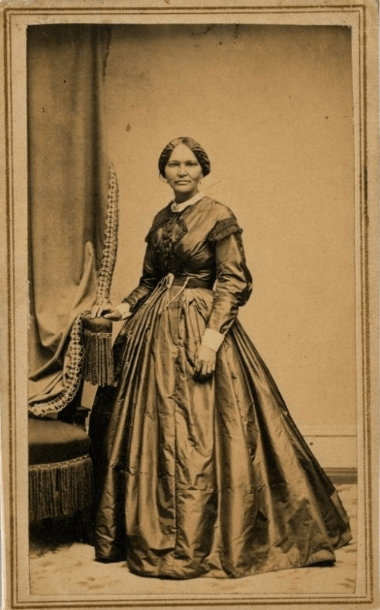
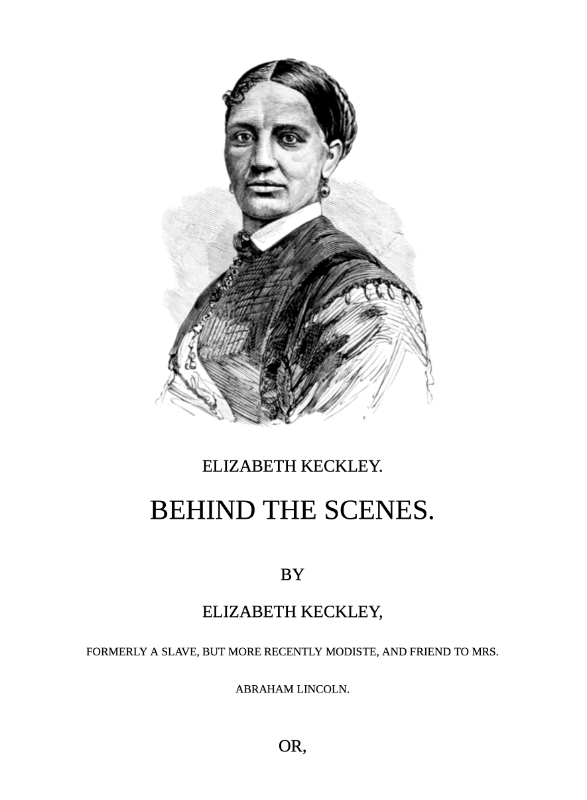
Figure 06-04. Elizabeth Hobbs Keckley was born into slavery, suffered abuse as a child, and was brutalized, but she nonetheless developed skills as a seamster (seamstress, sewist). Those who held her in bondage realized they could make money from her skills if they hired her out. She was allowed to keep some of the money for her work, and in 1855, she bought her own freedom and the freedom of her son. In 1860, she moved to Washington, DC, establishing a business making dresses for elite politicians’ wives. Like Mercy Jane Bancroft, Keckley did all of the careful measuring and fitting, but she hired 20 sewists to do the sewing to make garments. March 4, 1861, inauguration day, Keckley met Mary Todd Lincoln, and Lincoln quickly hired Keckley to be her dresser, soon becoming much more, and often visiting the Lincoln living quarters. Keckley’s 1868 memoir revealed more about the Lincolns than Mary or her son Robert wanted to have revealed, and she suffered as a result. For more about Keckley, see https://en.wikipedia.org/wiki/Elizabeth_Keckley . These images are available in the public domain. (Note. Nehrig didn’t mention Keckley, but she seems like an appropriate complement to Blair, whom Nehrig did discuss.)
In the Sumban district of Kodi, Indonesia, Marta Mete was the youngest of five wives of the local raja. In the 1980s, the raja’s health was failing and he died, and Mete collaborated with the raja’s fourth wife and six other local women to form a local textile cooperative, producing textiles with ikat indigo designs. The women bought thread and backstrap looms and hired younger women to work with them for cash (not a share of the cooperative’s profits). Preparing the ikat design for a textile takes about a week or so, but requires great expertise; dyeing the thread takes just a few days after the indigo dye is prepared, but also requires skill; weaving the cloth can take 2–4 weeks to complete but requires less skill than the other two processes. After the raja’s death, three of the older wives took charge of the raja’s wealth, effectively cutting Mete’s access to funds. Mete nonetheless managed not only to support her children, but also to provide for her daughter’s education as “the first Kodi girl to finish college” (p. 184).
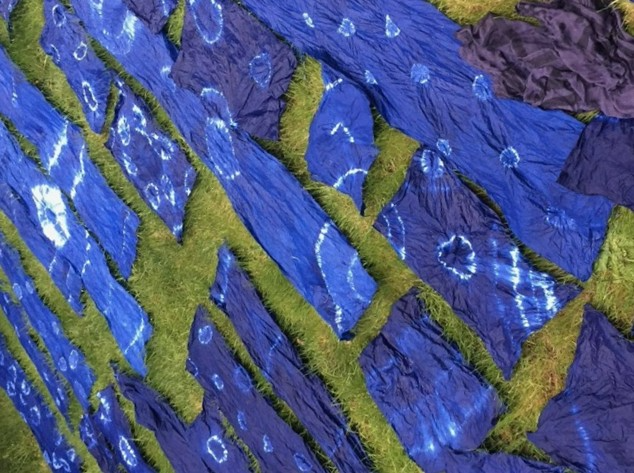
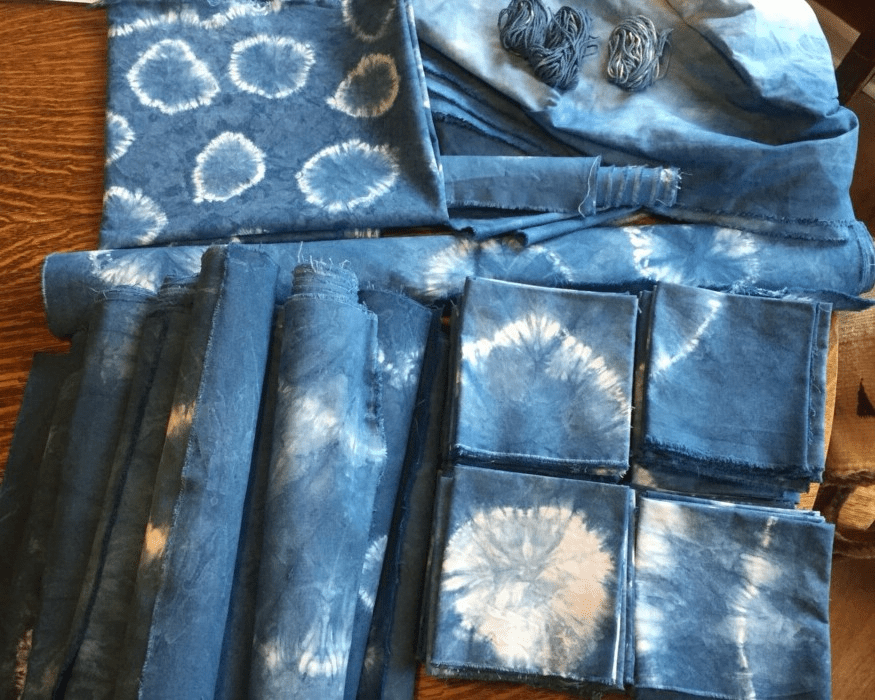
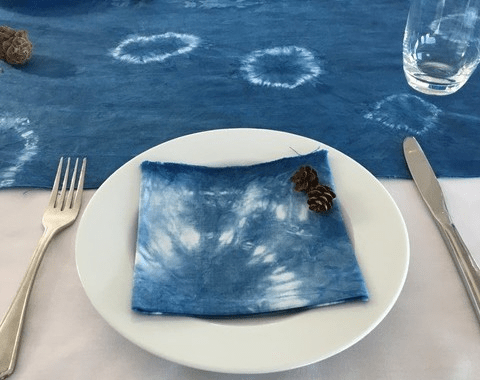
Figure 06-05. These photos of indigo-dyed textiles are by ceramic artist Petra Juarez, who also explores other artistic media and shares her skills as a registered nurse. Her designs differ from the ikat designs used by Mete, but both artisans show skill and artistic expression.
***
Even after the Civil War, for many generations, Alabaman Gee’s Bend quilters didn’t earn any income from their quilts. Nonetheless, their quilts kept their families warm during chilly winters in drafty ramshackle houses. These quilters couldn’t afford to purchase fabric, so they repurposed the cloth from old clothes, flour and sugar sacks, and any other sources of fabric. They carefully designed their quilts to maximize the amount of fabric they used, so they didn’t cut circles or curved pieces, which would waste fabric. Instead, they used strips, rectangles, and other blocks of fabric ensuring that every square inch of fabric would be put to good use. When the quilts wore out, they salvaged any fabric they could, and they used the remainder to make rugs or saddle blankets or to provide insulation.
Gee’s Bend quilters weren’t quilting full time. Instead, they’d toil all day in the fields, then quilt long after dark. These quilters were also advocates for voting rights, and many were among the people beaten, alongside John Lewis and Martin Luther King Jr., on the Edmund Pettus Bridge in 1965. Later that year, Francis Xavier Walter, a white Episcopal priest, drove to Gee’s Bend, and he used a $700 grant from the Episcopal Society for Cultural and Racial Unity to buy quilts from the local women for $10 each. At that time, the annual family income was a bit more than $1000/year, so $10 made a big difference.
The following year, Walter auctioned off the quilts, netting $2,065, which paid for “washing machines, telephones, and indoor bathrooms for the [quilters’] homes, as well as college tuition for the great-granddaughter of an enslaved person” (p. 187). The New York Times wrote about the auction, and soon Bloomingdale’s, Saks Fifth Avenue, and other vendors were buying the quilts to sell.
Later that year, 60 women got together to establish the Freedom Quilting Bee, a quilt collaborative. The quilters would work at home or meet together at the home of Estelle Witherspoon (who had protested on the Edmund Pettus Bridge). They fulfilled individual orders from advertisements in mail-order catalogs. Then they got an order from Bloomingdales — for $20,000 worth of quilts! Sears and Roebuck followed with a long-term contract for making pillowcase covers. The women bought sewing machines and standardized their means of quilt production.
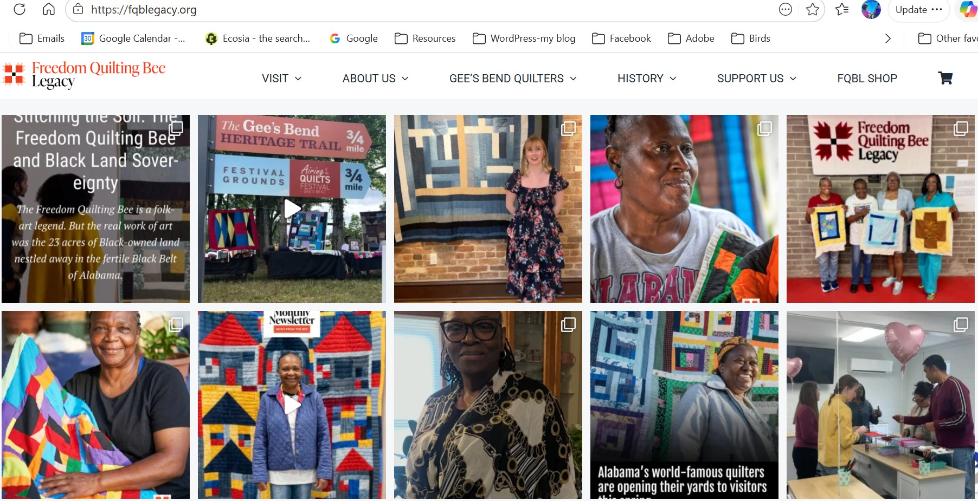
Figure 06-06. The Freedom Quilting Bee has its own website; on the left are logos from their Airing of the Quilts event (https://www.airingofthequilts.org/ ), and on the right is a screenshot taken from the opening page of their website, https://fqblegacy.org/ . (See also https://stories.artbma.org/timeline-the-freedom-quilting-bee/ and https://www.alabamaheritage.com/blog/2025/03/26/the-founding-of-the-freedom-quilting-bee/ .)
By combining their income with grants and loans, in 1969, the Bee built the Martin Luther King Jr. Memorial Sewing Center, a community workplace, where the women could work together. The center included a child-care program, too, so generations of children have grown up there, while their mothers quilted. According to Claudia Pettway Charley, “When we had the Freedom Quilting Bee, that was the first time that women actually owned their own income because the men back then, they weren’t sharing” (p. 190).
By the mid-1990s, many of the founders of the Bee had retired, died, moved, or found other paid work, so the Bee was losing momentum. In 1990, folk art collector William Arnett saw a photo of a Gee’s Bend quilter with one of her quilts and decided to investigate. While in Gee’s Bend, Arnett helped remind the women of the value of their quilts, and in 2002, he organized the Quilts of Gee’s Bend exhibit, including more than 60 quilts, which traveled through six cities, including New York City, San Francisco, and Washington, DC. Many of the quilters accompanied the exhibit. Even after the exhibit, however, the women earned little for their quilts.
In 2019, Nest (Rebecca Van Bergen’s organization) became aware of the Gee’s Bend quilters and researched how best to help them earn a living from their quilts. Through Nest, the quilters “received guidance on pricing and product photography to create Etsy shops. . . . Prior to creating [19 Etsy] shops, the average three-month income of Gee’s Bend residents was $4,210. Within three months on Etsy, the average three-month income rose to $17,625. Gee’s Bend quilts now sell for thousands of dollars apiece” (p. 194). Quilter Claudia said that she and fellow quilters now say, “I deserve this. I am good enough. I am somebody” (p. 194). Some quilters also sell their quilts to fashion designers, earning even more money. Claudia was able to pay for her daughter’s college education with the sale of her quilts. Claudia’s daughter, Francesca, studies anthropology and forensic science but also makes quilts and pot holders, along with her mother and grandmother, saying, “we have no rules, we just do stuff and whatever comes out of it, comes out of it. It’s always so much fun to have such a good free rein for what I want to do” (p. 195).
Meanwhile, William Arnett’s nonprofit organization, Souls Grown Deep, is continuing to invest in the Gee’s Bend quilters, securing their intellectual property rights, and having their quilts placed in the permanent collections of major national and international art museums. (See, e.g.,
https://en.wikipedia.org/wiki/Souls_Grown_Deep_Foundation and https://www.soulsgrowndeep.org/ .) Nest continues to support the quilters’ financial independence, too, such as by helping them form partnerships with brands.
Chapter 7 Hands to Power, 197–225
(e.g., embroidery, quilting)
Nehrig introduces this chapter by pointing to a suffragist banner created in 1910 and signed — in thread — by 80 “women who were imprisoned for protesting for women’s right to vote” (p. 197). The banner was held aloft later that year in a suffrage march of 10,000 women, stretching for 2 miles. More than 150 similar protest banners were embroidered between 1908 and 1913. By using embroidery, these women were both asserting their femininity and proclaiming that their femininity shouldn’t be a reason to deny them civil and human rights.
Decades earlier, in the 1880s in the United States, crazy quilts also expressed women’s desire to freely express themselves and their embrace of their own womanliness. In 1970, multimedia artist, quilter, and storyteller Faith Ringgold, along with other women artists, protested at New York City’s Whitney Museum, decrying the appalling lack of female artists on exhibit. It took another four decades of raising a ruckus to have women represent 55% of the artists exhibiting at the Whitney’s Biennial in 2010.
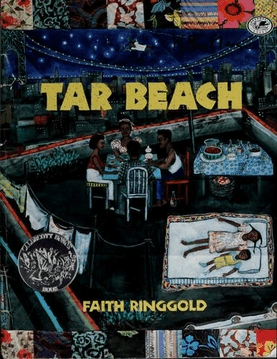
Figure 07-01. In addition to making story-quilts, Faith Ringgold wrote numerous children’s books, including Tar Beach (1991), her award-winning first book, which takes readers to the roof of her Harlem apartment building, through photographs of her story-quilts depicting her fond childhood memories. This cover is under copyright, but it’s my belief that this use qualifies as “fair use” of this low-resolution image. (Among Faith Ringgold’s many children’s books illustrated with story quilts are these: https://www.powells.com/book/aunt-harriets-underground-railroad-in-the-sky-9780517885437?condition=Used%20-%20Good , https://www.powells.com/book/tar-beach-9780517885444?condition=Used%20-%20Good , https://www.powells.com/book/harlem-renaissance-party-9780060579111?condition=New , as well as many more, if you click on the author button for any of the books.)
Nehrig gives many other examples of women using their crafts to artistically advocate for societal change. For instance, in the Postal Art Event (ca. 1975), more than 300 art pieces were exchanged among dozens of (mostly white, middle-class) women in rural and urban England. These were consciousness-raising events, a global expression of feminism at that time, and in 1976 and 1977, the event led to public exhibitions. In the late 1970s, several women formed the FENIX collective, working in a gallery space that was open to the public. The collective also offered child care, so women artists and artisans could ensure their children were cared for while they worked.
More recently, women artisans have asserted their creative power in highly public ways, such as by knitting together in public or by yarn-bombing (aka guerrilla knitting or knitted graffiti) in public locations. (For examples of yarn-bombing, please see https://en.wikipedia.org/wiki/Yarn_bombing ; “According to Manuela Farinosi and Leopoldina Fortunati, yarn bombing has become synonymous with the current feminist movement due in part to the reclamation of the traditionally feminine arts of knitting and crocheting to partake in the traditionally masculine and male-dominated graffiti scene.”) “Writer and maker Betsy Greer . . . coined the term craftivism . . . making your own creativity a force to be reckoned with” (p. 207).
“Graphic embroiderer” Ana Martins (aka Ahenah) uses what she calls “urban cross stitch” to create public artistic expression that uses “cross-stitches” in representational pieces similar to how pixels work on digital representation. Specifically, she mounts a wooden board with closely spaced screws, around which she wraps wool, creating a cross-stitched pixelated effect.
Nehrig gives several examples of how women have used embroidery to create public expressions, such as protests against misogyny, racism, and homophobia, or recovery from trauma. Another such use of textile arts is the Common Threads Project described in Chapter 4. A similar project aided transgender women to create “dresses symbolizing their resistance to oppressive gender-identity norms and violence against the LGBTQ+ community” (p. 215). The use of arpilleras (story cloths, also described in Chapter 4) have also been valuable.
Starting in 1905, Indians rebelled against oppressive British rule by spinning their own thread and weaving their own cloth, boycotting imported foreign cloth. Mahatma Gandhi was instrumental in popularizing this move toward self-reliance and self-sustenance as a way to push for Indian independence. (See also https://en.wikipedia.org/wiki/Swadeshi_movement for more about this movement.)
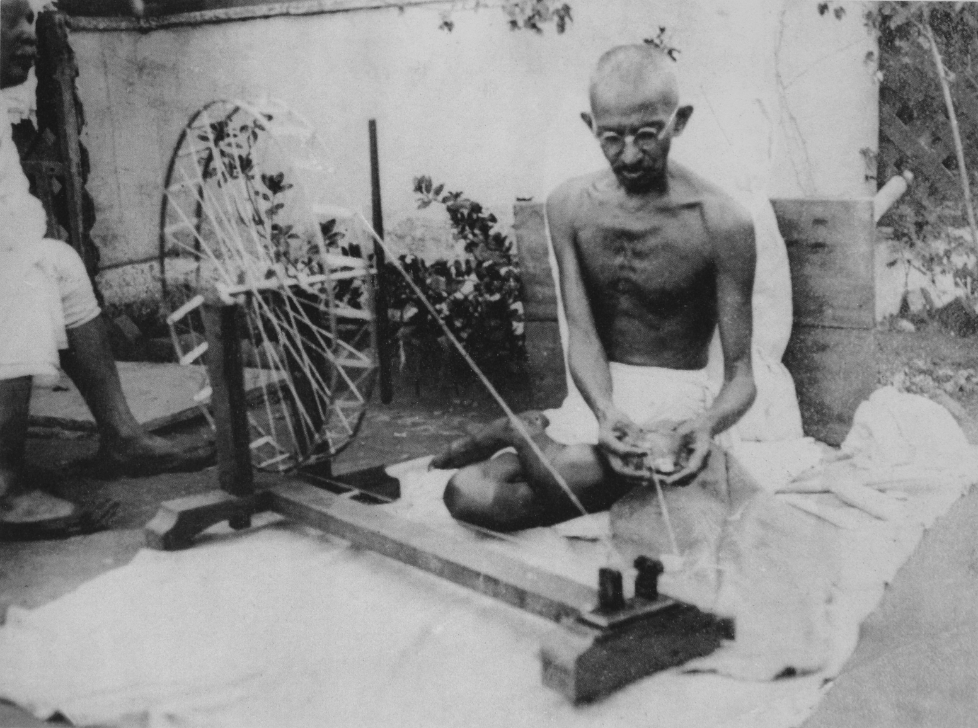
Figure 07-02. During the early 20th century, Mahatma Gandhi popularized the Swadeshi movement for Indians to reject British colonialism by refusing to buy imported cloth, instead spinning their own thread and weaving their own cloth (called khadi). A side benefit was that it gave women, as the primary spinners and weavers, greater status. (This image is in the public domain, https://en.wikipedia.org/wiki/Spinning_wheel#/media/File:Gandhi_spinning.jpg ; see also https://en.wikipedia.org/wiki/Spinning_wheel#Charkha.)
For more than 3,000 years, Palestinian women have used the embroidery technique of tatreez to affirm and convey their cultural identity. Similar in appearance to the cross-stitch, it is actually sewn differently, using waste canvas instead of an embroidery hoop, and going in and out of the fabric using one motion. Even in a refugee camp, a grandmother, mother, and daughter can be affirming their heritage through tatreez embroidery.
Though there are regional differences in color and design choices, the method and the overall look are the same. For many Palestinian women, especially refugees, tatreez has been a means of supporting themselves and their family, both through their embroidered goods and through offering tatreez workshops.
Tatreez not only preserves cultural identity but also defies political oppression. When the Israeli army has confiscated flags and other symbols of Palestinian identity, women have embroidered their thobes (dresses, robes) with tatreez maps of Palestinian, depictions of Palestinian life, and even Arabic phrases such as “We will return” (p. 220).
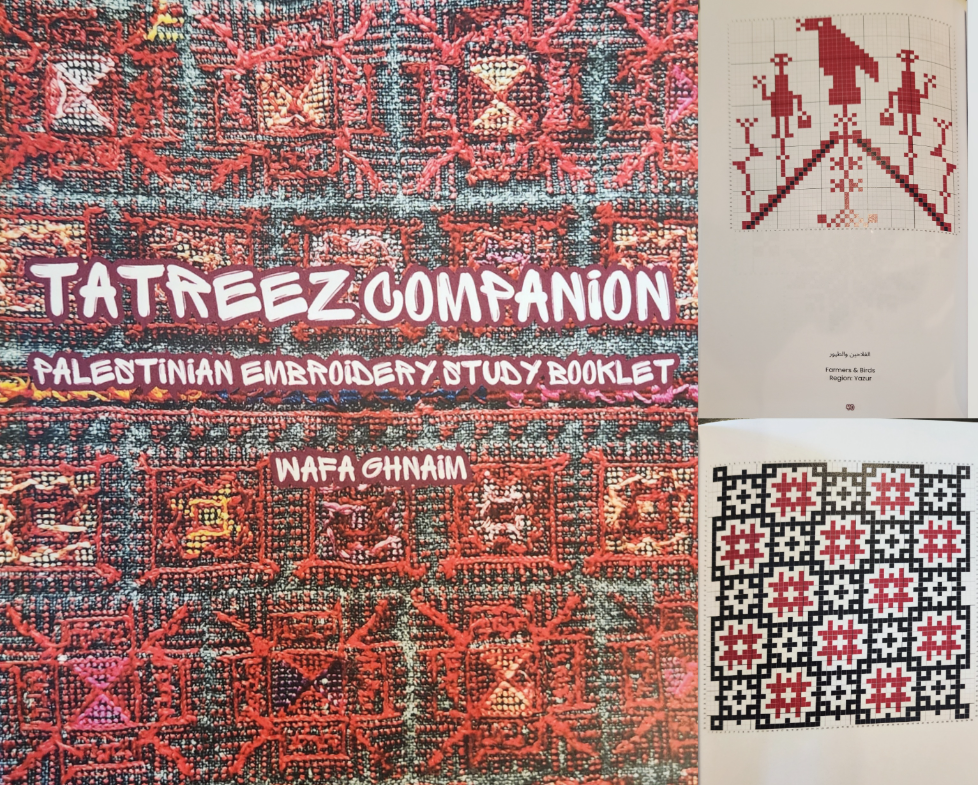
Figure 07-03. Wafa Ghnaim, Palestinian-American dress historian, activist, and educator, learned tatreez from her mother, starting at just 2 years old. As part of the Palestinian diaspora, Ghnaim works to preserve her cultural heritage and to spread the knowledge of tatreez, such as with her Tatreez Companion: Palestinian Embroidery Study Booklet.
Textile artist Sonya Clark has explored racial justice through unraveling Confederate flags, such as by doing so in a gallery space, creating piles of blue, red, and white threads through the tedious unraveling process. In one of her installations / exhibitions, she recruited 50 volunteers to help her unpick threads of a flag, together managing to unpick only an inch in 90 minutes. While deconstructing each flag, she reveals the complexity involved in weaving this symbol of racism. Once a flag is unraveled, the threads offer limitless possibilities for how to be rewoven into something worthwhile and meaningful. One of the possibilities Clark wove was a large-scale Flag of Truce, symbolically creating peace, equity, and harmony.
Rilla Marshall is using her weaving to visibly depict the erosion taking place on Prince Edward Island in Canada, as a result of the climate crisis. She documented the erosion, using drone aerial footage, then she created her weaving to reflect the changes over time, making the invisible processes visible. “Marshall wants people to notice the changes in their landscape that they may not otherwise observe” (p. 223) “Marshall paints her warp prior to weaving. . . . [Her weaving] is technical and precise and allows her to depict where the shoreline once was compared with where it is now through the use of different patterns” (p. 224).
“So much about textile work, whether weaving, crocheting, knitting, or quilting, is about paying attention: to the materials, to the skills, to the traditions, to the stories. We learn from others and then pass on their knowledge. In this way, textiles are often the common thread that connects us to our heritage. . . . Making something by hand reminds us of the slow pace of transformation — that change requires sustained, cooperative effort — one stitch at a time” (p. 225).
Epilogue: Crafting a Purpose 227–233
Nigerian Olutosin Oladosu Adebowale, a victim of domestic violence, “seeks to empower women through sewing in her community” (p. 227). She had no money, so she started gathering discarded textiles and began sewing them together to make purses and phone cases. When she found scraps too small to be sewn into even a phone case, she began making fabric “paintings” with these scraps. “Her fabric paintings have a purpose both in transforming trash into artwork and transforming a woman’s life into something equally beautiful and powerful” (pp. 230–231).
As she was better able to support herself and her daughters, she wanted to help other women, too, and in 2011, she founded Star of Hope Transformation Centre (see https://transformcenter.wordpress.com/ ; if you have access to Facebook, you can also see https://www.facebook.com/societywomen.transformation/ ). There, she teaches women and girls how to sew, knit, farm, and do carpentry as a means of fighting sexual abuse and domestic violence. She also teaches other women to collect fabric scraps, which they can transform into beautiful slippers, hair accessories, laptop bags, and even quilts. When they find discarded Styrofoam, they use it to make insulated bags for storing food.
The women also make wonderbags (https://en.wikipedia.org/wiki/Wonderbag ), for cooking food. Wonderbags minimize the need to use fuel to cook food. The food is brought to a high heat in a lidded cooking pot, then the pot is removed from the heat source and placed into the well-insulated wonderbag, where it can continue to cook, saving about 30% of the total fuel needed for cooking.
(back matter)
- Acknowledgments, 235–238
- Notes, 239–258 — “Introduction,” 7; Chapter 1, 56; Chapter 2, 51; Chapter 3, 57; Chapter 4, 50; Chapter 5, 67; Chapter 6, 57; Chapter 7, 58; “Epilogue,” 7.
- Image Credits, 259 (See insert, Chapter 4)
- Index, 261–278 — Abbasi-Ghnam, Feryl – Zimmerman, Elizabeth, including concepts, people, events, locations, techniques — very thorough
Text by Shari Dorantes Hatch, Copyright © 2026. All rights reserved.
Image Credits
- Figure 06-05, three images of dyed fabrics, by ceramic and textile artist Petra Juarez, Copyright 2025, all rights reserved;
- Images from Wikimedia: 05-01, Gee’s_Bend quilters, public domain; 05-05, Bayeux Tapestry, public domain; 06-01, Icelandic sheep, Creative Commons; 06-02. Rumpelstiltskin, public domain; 06-03, Shetland sheep, Creative Commons; 06-04, Elizabeth Keckley portrait and book cover, public domain; 07-02, Mahatma Gandhi spinning on a charkha, public domain;
- Screenshots from websites: Ravelry website (05-02); Loose Ends website (05-03); Powell’s Books, Tar Beach book cover (07-01);
- All other images were taken by Shari Dorantes Hatch, Copyright © 2026. All rights reserved.


Leave a comment