
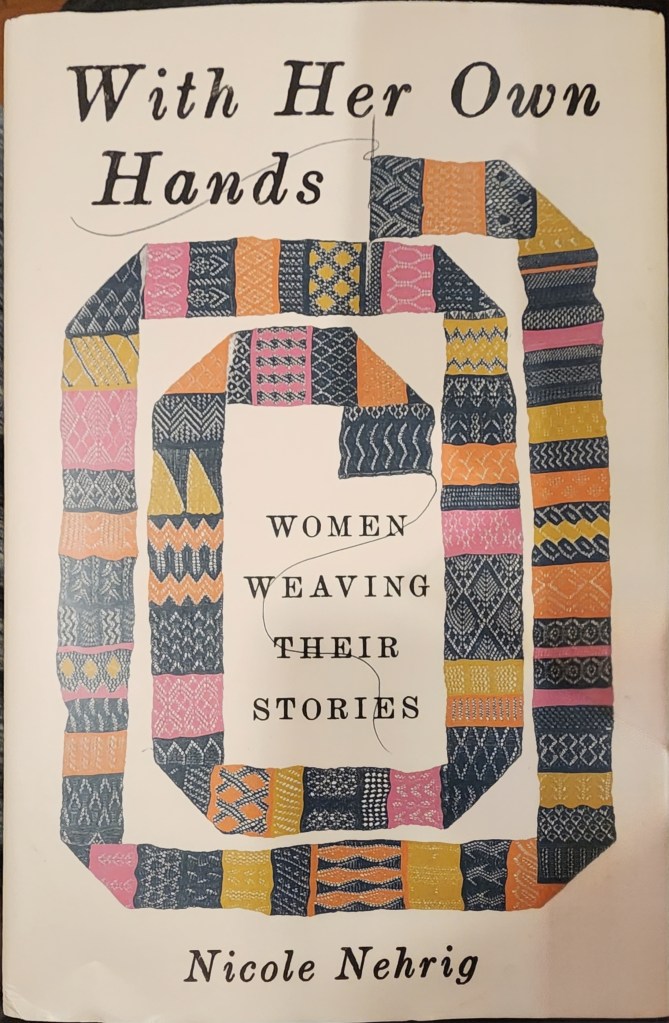
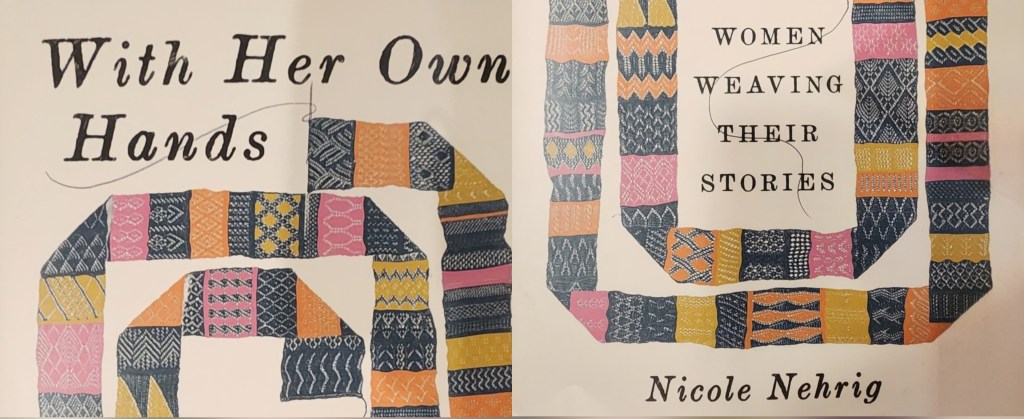
Nicole Nehrig. (2025). With Her Own Hands: Women Weaving Their Stories. New York: W. W. Norton & Company.
Introduction, 1–10
Nehrig describes her own introduction to knitting, as an adult, and how knitting has become increasingly important in her life. Knitting can be a portable way to form a community of fellow knitters, to find a calming influence during chaotic or stressful times, to cope with crises (e.g., a pandemic).
Nehrig then explores how women’s work with textiles has had historical importance, not only as a means of providing needed cloth, but also as a way for women to earn an income, celebrate or mourn life events, communicate cultural traditions, and find creative expression.
The distaff, a tool used by hand-spinners to hold raw fiber to be spun onto a spindle, has often been used as a symbol not only for women’s work, but even for women ourselves — such as referring to the “distaff side” of a family to point to the maternal relatives.
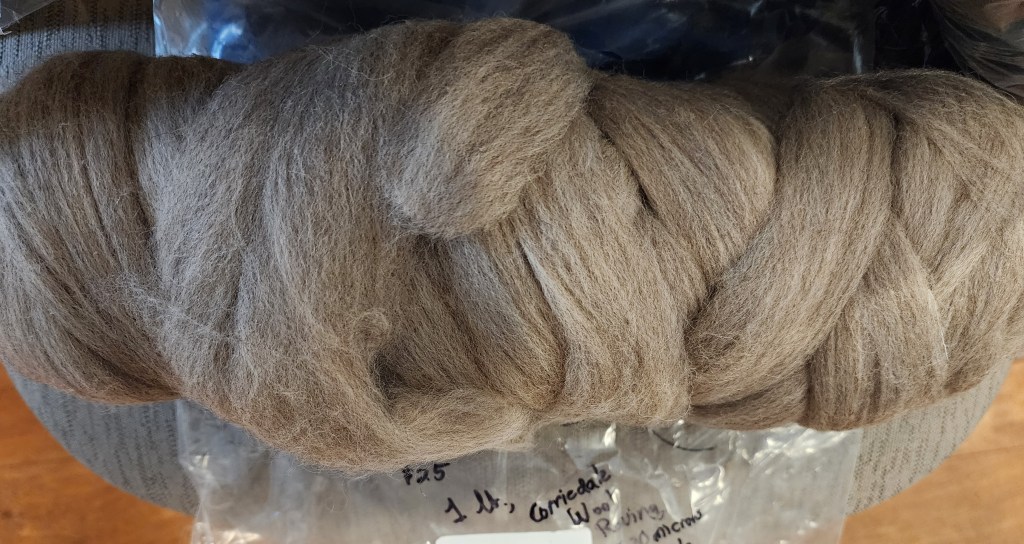
Figure 00-2. When spinning, spinsters would use a distaff to hold the raw fiber; seen here is some wool roving (combed and carded so it’s ready for spinning) from Corriedale sheep (a New Zealand breed).
“A National Endowment for the Arts survey found that in the United States, fiber arts were the most common form of craft for women of nearly all ages and ethnic groups” (p. 5; Nehrig’s note indicates a 2017 article.) Nehrig opines that women create textiles not only to produce something useful, but also to do something meaningful. She points to the belief of Auschwitz survivor and psychologist Viktor Frankl that when we approach life’s activities creatively, we imbue these activities with meaning.
Nehrig also opines that “In any given place, on any given day, women had more control over their individual lives than over cultural norms and institutional restrictions” (p. 6). Though women probably had little control over whether they spun, wove, and sewed textiles for their families, they doubtless had a lot of control over where, when, and how they did so. They were probably also able to make many creative choices while carrying out these activities.
We have little documentation of the lives of women throughout his-story. Even among those women who could and did write, their writings were rarely read by many others, let alone published for wider audiences. Even the lives of wealthy women were rarely recorded. The daily activities of most women led to ephemeral results: cooked food was eaten, cleaned homes got dirty, hand-spun yarn was woven into cloth, which was worn and then worn out.
Even their names were often omitted from census data — listed only as someone’s wife or daughter or mother. Sometimes, however, some ancient textiles remain as indications of their having been alive. And sometimes, images of their activities are preserved, such as the image of Mayan women weaving on backstrap looms, on pottery from about 1100–1200 years ago, or an image in the Aztec Florentine Codex (written 1545–1590; for more about this fascinating set of books, see https://en.wikipedia.org/wiki/Florentine_Codex ). (See https://en.wikipedia.org/wiki/Loom#Backstrap_loom for images of women using backstrap looms around the world.)
Though textile production has been primarily women’s work, men have been the main weavers in some places. For instance, in Ghana, the men have been weaving kente cloth, and in Zaire, men weave the cloth, and women embroider it.
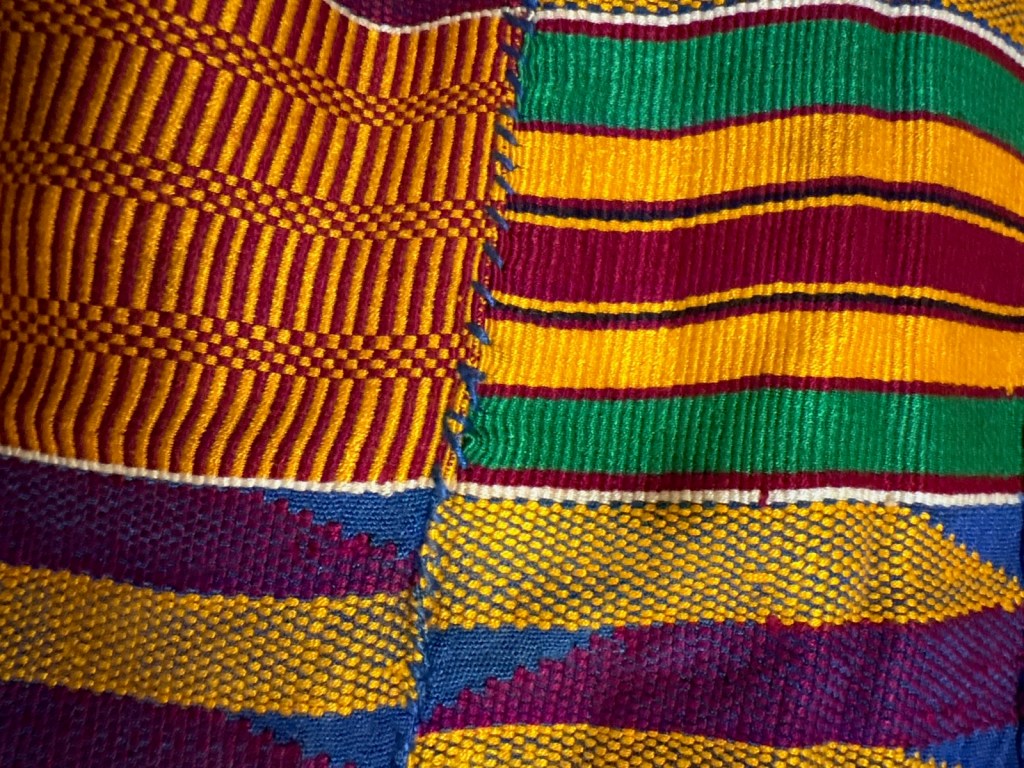
Figure 00-3. My lifelong friend, textile artist Kikanza Nuri, generously shared this photo of kente cloth, which she has on hand; the cloth is woven in narrow strips and then strips are sewn together.
Nehrig intends her book to be “a synthesis of archaeological, anthropological, historical, literary, and personal accounts of the meaning women have made through their textile work” (p. 10).
Chapter 1 To Live and Dye, 11–36
(dyeing, weaving, rug hooking)
In Nehrig’s introduction to this chapter, she focuses on the spiritual meaning of dyeing for some weavers and dyers in Peru. She then explores Norse mythology in relation to the production of textiles. Next, she explores how the Kodi of Indonesia see spiritual symbolism in textile production. She does likewise for Hindus, whose goddess Māyā “encapsulates this complex relationship between creation, magical powers, and danger. The term māyā is associated . . . with art and procreation” (p. 19).
In Iceland, Viking women wove in dyngjas, which were separate from the main house and which were associated with witchcraft. “For the Vikings, powerful female deities Freya and Frigg oversaw textile work” (p. 23). In many places in medieval Europe, the distaff was considered a source of power for women, who were otherwise powerless in many ways. Many households that included unmarried women may have relied on these women to provide income by producing textiles. On the other hand, even today, in many places (e.g., Ghana, Nepal, India, Papua), women are branded as witches if they are either too independent — such as owning their own property — or too dependent — such as being financially dependent on family members.
When marriage rates were low, and unmarried women were more numerous, women often gathered after dark, to share a light source and to socialize while spinning. When marriage rates rose (e.g., Victorian England), fewer women were likely to engage in textile production to earn an income, so they turned their craftiness to embroidery.
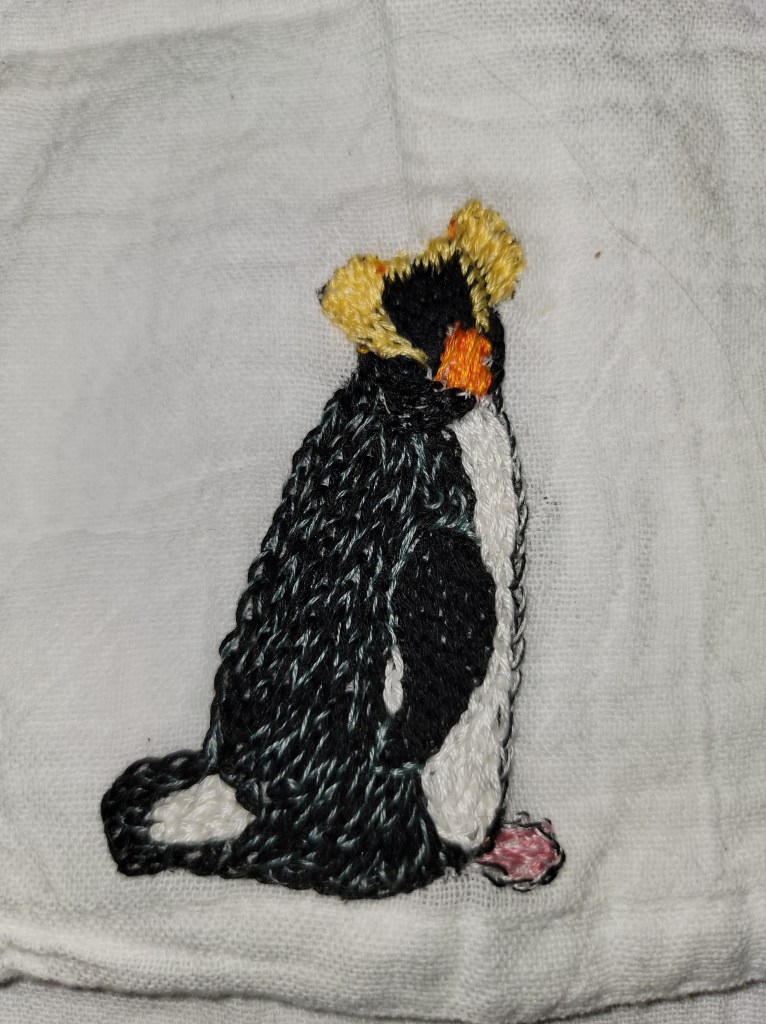
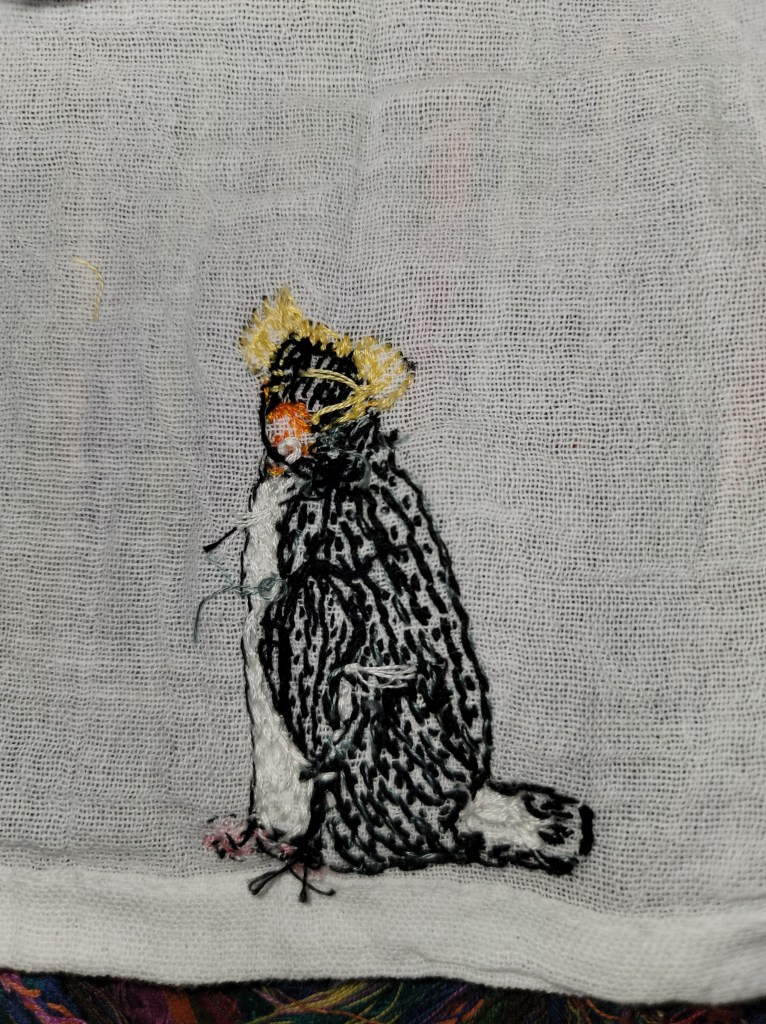
Figure 01-01. In 2021, when Caitlin, a talented artist and San Diego Zoo keeper (and granddaughter of a family friend) married, I embroidered four towels, each with an endangered bird. The original bird images were drawn by Caitlin; I merely traced and colored in her drawings. Here are the front and back of one embroidered bird, an endangered Erect-crested Penguin, Eudyptes sclateri.
Among the Iban of Borneo, women were weavers, and men were warrior/head-hunters, and both the cloth and the trophy enemy heads were valued. Even after head-hunting was outlawed (1920), women have continued the tradition of weaving various textiles with spiritual and cultural significance. (For images of the cloth woven by the Iban weavers of Indonesia, please see https://en.wikipedia.org/wiki/Pua_Kumbu .)
In the ancient world, many dyes were literally deadly, containing arsenic and other toxic compounds. At that time, women performed the crucial social function of weaving burial shrouds, such as the one that Penelope, Odysseus’s wife, was weaving (and secretly unraveling) for her deceased father-in-law, Laertes. The Kodi and other cultures similarly enshroud their dead in cloth made by women. For the Kodi, the women also dye the fabric with indigo, “to fix their spirits in their graves . . . to keep [them] from wandering” (p. 33). The decaying pungent indigo of the dyebath also smells like the decay of death. In the Andes, funerary khipus (usually spelled quipu; ropes made of twisted thread) “help liberate the dead from this world and transition them to the next” (p. 34). (To see images of quipus, as well as information about how they were used for record keeping, please see https://en.wikipedia.org/wiki/Quipu .)
A Scandinavian mother made a hooked rug using “all the pieces of her children’s outgrown clothing . . . . Cloth also contains the cells of the maker—our sweat, skin, and blood as it moves through our hands” (p. 36)
Chapter 2 Webs of Knowledge, 37–68
(weaving, knitting, bobbin lace, dye, crochet)
Nehrig introduces this chapter with the Navajo creation story, revering Spider Woman, who “had the ability to weave a map of the universe,” which she did (p. 37). “Today, young Navajo weavers are instructed to place the palm of their right hand on a spiderweb without damaging it to allow Spider Woman’s gift of weaving to enter the young weaver’s spirit, where it will live forever” (p. 38). (Anne Hillerman wrote a novel, Spider Woman’s Daughter, which explores this legend, described in https://en.wikipedia.org/wiki/Spider_Woman%27s_Daughter . For a different take on this myth, among various indigenous cultures of the American southwest, see https://en.wikipedia.org/wiki/Spider_Grandmother . For images of and information about Navajo weaving, please see https://en.wikipedia.org/wiki/Navajo_weaving#Gallery .)
In Peru, weavers practice their craft as part of their cultural heritage, from their Incan ancestors. Nehrig introduces a weaver who first learned to weave at age 8 and “was really happy to learn to weave” (p. 39). Not all Andean families weave, but in Andean weaving families, girls typically learn to spin at age 3–5 years, then at about 5 years of age, they learn to weave narrow straps, then by age 8, they learn to weave wider belts.
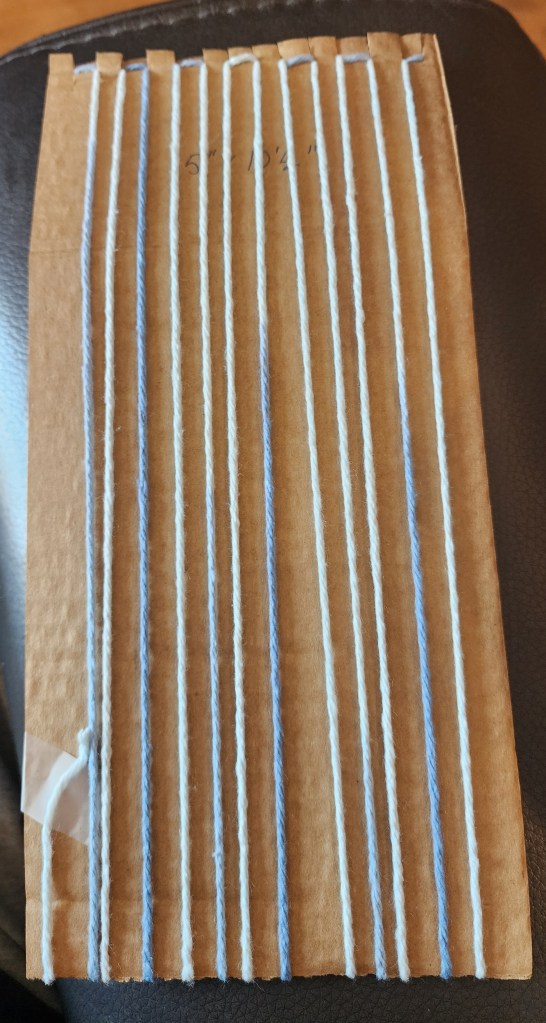
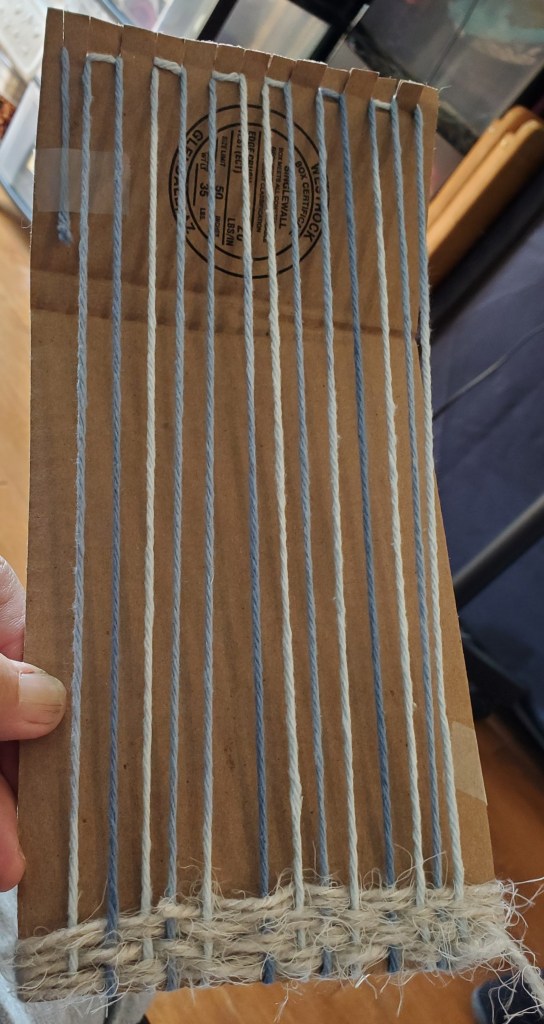
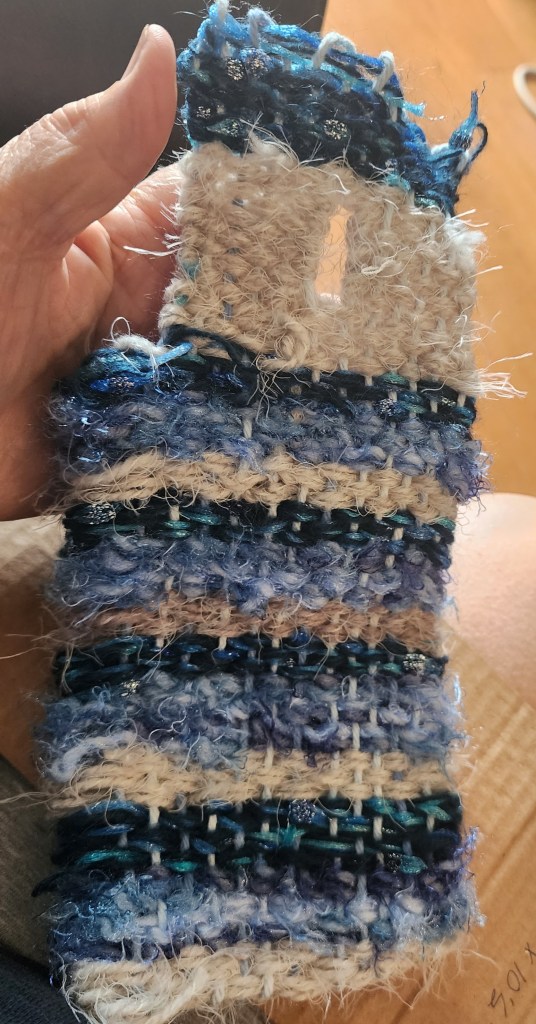
Figure 02-01. Many Andean girls learn to spin at age 3–5 and start learning to weave at age 5 or so. About a decade after I retired, I decided to learn how to weave (though I had fooled around with it decades earlier). One of my first projects was an eyeglass case, made with a corrugated-cardboard “loom,” cotton yarn as the warp, and novelty yarn as the weft. I think a 6-year-old Andean girl might be too polite to laugh at it outright, but she might snicker a bit.
Among Peruvian weavers, in early adolescence, a girl’s right of passage is to learn to weave a lillija, a mantle large enough to carry a baby. These teens also begin to learn more complex patterns for their cloth. By this time, these young women have spent years watching the women around them set up a loom and its warp (the threads from the front to the back of the loom that form the basis of a weaving), and observing women weave a weft (the crosswise threads that intersect with the warp) back and forth, moving their hands to create intricate patterns in the cloth. What outside observers might see as a complex intellectual task has become second nature to these weavers, partly muscle memory.
An ocean away, in the Shetland Islands of Scotland, girls have similar experiences with Fair Isle colorwork knitting. They learn to knit at such an early age that they can’t remember not knowing how to knit. Shetland knitter Hazel Tindall can knit 255 stitches in 3 minutes, the fastest knitter in the world. Hazel almost literally embodies knitting (see her brief autobiography at https://www.hazeltindall.com/about ). As with the Incan weavers, Fair Isle knitters must use their intellect to design and implement their intricate colorful patterns. “Knitters employ mathematical skills to determine the number of stitches and pattern repeats to make a sweater based on sizing and knitting gauge and have the challenge of choosing multiple coordinating colors — often upward of ten — to knit with” (p. 42).
To see just how challenging it can be to knit using the Fair Isle technique, you may be interested in watching a 46-minute YouTube video, “How to knit Fair Isle for beginners [+tips and tricks for neat results], YouTube, NimbleNeedles,” https://youtu.be/-8t8s5Fwups?si=-wVKn_0xit7VS1IH
Like experienced Andean weavers, experienced Fair Isle knitters don’t write down the colorwork patterns, instead “simply” holding them in memory. Both weavers and knitters are also practicing their craft while tending to children, watching the pot, and minding other household chores. Unlike weavers, the knitters are also shaping the garment to fit the person who will wear the sweater, increasing and decreasing the length of the rows. In considering the embodied knowledge of experienced artisans, knitting icon Elizabeth Zimmerman said, “One tends to give one’s fingers too little credit for their own good sense” (p. 42).
***
Since at least the time of the Italian Renaissance, a line has divided art from craft, with art being exalted and craft being devalued. At one time, even sculpture was prized less highly than paintings because of the manual labor involved to sculpt. Art was more strongly associated with the life of the mind, and craft was “merely” action of the hands. This bias still persists to a large extent.
Recent neurological research has questioned the veracity of this bias. For starters, one third of the motor cortex is dedicated to the use of our hands. That’s a lot of brain space! In addition, “a neuropsychiatrist at the Mayo Clinic found that women who engaged in knitting or quilt making in middle age or later life had a decreased risk of mild cognitive impairment and memory loss” — quite probably because of their handiwork. Correlational studies of >3,000 knitters showed a positive correlation between their knitting frequency and their cognitive abilities, such as memory, concentration, and spatial awareness.
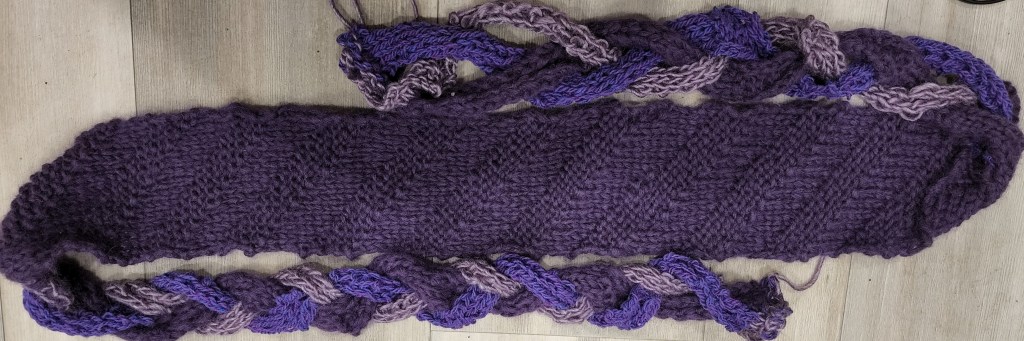
Figure 02-02. I’m reassured to know that my cognitive abilities are enhanced when I knit. It’s certainly entertaining and keeps me out of trouble — such as by occupying my hands so I’m less tempted to snack on less-than-healthy foods.
Psychoanalyst Anna Freud (daughter of Sigmund) believed that mental activity was enhanced by handicraft; she practiced what she preached, weaving textiles as part of her thought process. “What she did with her hands facilitated what she did with her mind, and vice versa” (p. 45). For many handicrafters, “the motion of the hands working is a form of thinking” (p. 45). In all likelihood, women have been thinking through their hands for millennia.
Nehrig interviewed Elena Kanagy-Loux, a textile scholar who makes bobbin lace. Though there are pattern books for bobbin lace, they’re too rudimentary to reveal the intricate complexities of how to physically move the bobbins to create this intricately patterned lace. The only way to learn how to make bobbin lace is to make it, make mistakes, learn from your mistakes, and make more.
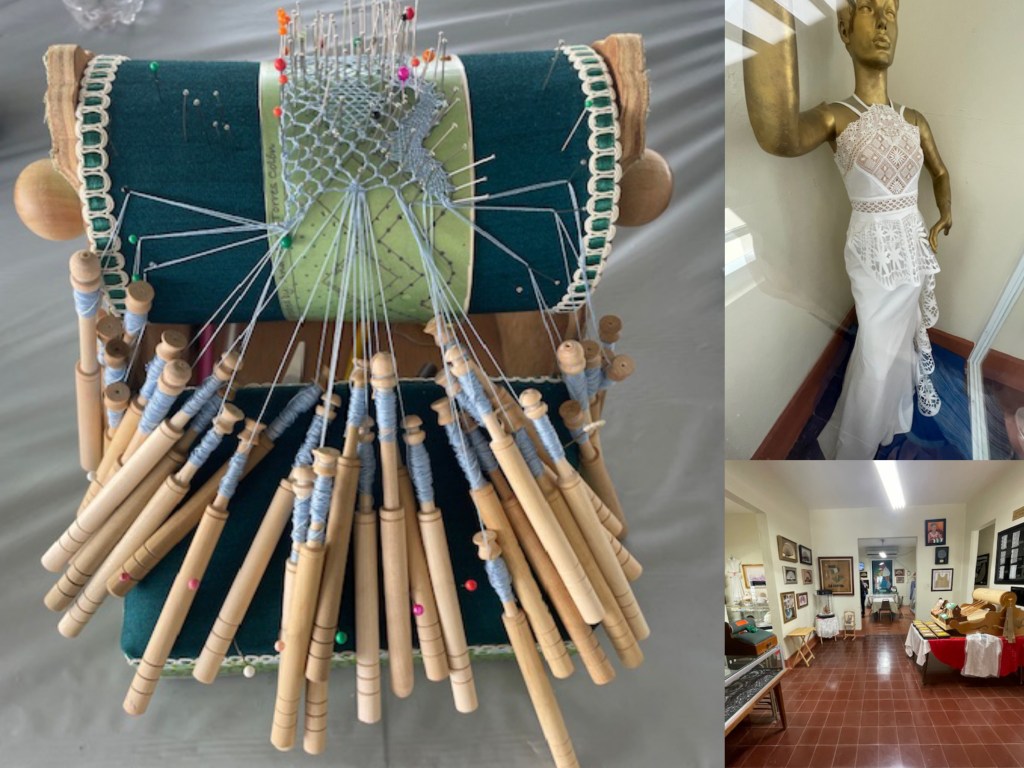
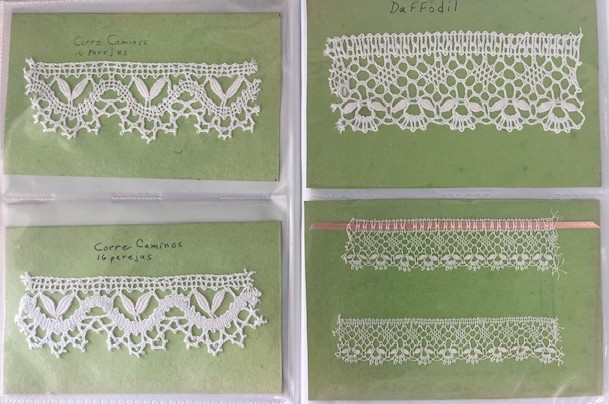
Figure 02-03. Collage, at left: When Kat Stesney visited the Museo del Mundillo (Museum of Bobbin Lace, bottom right) in Moca, Puerto Rico, she was captivated by the process of making this bobbin lace (far left) and by the magnificent results of this process (bobbin-lace gown, top right). Photo, right: Samples of bobbin lace (left, 2 samples of “Corre Caminos,” road runners; right, 3 samples of “Daffodil”). Kat graciously agreed to let me post her fascinating photos here. (For more illustrations and information about this marvelous Puerto Rican treasure, please see https://www.puertoricodaytrips.com/moca-bobbin-lace/ and https://latinogenealogyandbeyond.com/blog/category/museo-del-mundillo-puertorriqueno/ ; for more examples of the complexity of bobbin lace, please see https://en.wikipedia.org/wiki/Bobbin_lace .)
***
In Chinchero, Peru, Nilda Calañuapa Alvarez founded the Centro de Textiles Tradicionales del Cusco (CTTC; https://www.textilescusco.org/ ; see also their online store, https://store.textilescusco.org/store/ ), in the late 1990s. Through CTTC, she planned to singlehandedly revive the traditional Quechua methods of dyeing and weaving textiles. She did so because she had become alarmed at the way in which easy access to synthetic dyes and yarns were jeopardizing traditional methods and techniques. She feared that if she didn’t act, these traditions could be lost within generations. Alvarez not only interviewed traditional dyers and weavers, but also followed them into the jungle to gather plants and insects to prepare dyebaths. With their help, she researched with traditional methods (e.g., ikat; see https://en.wikipedia.org/wiki/Ikat ).
She continued to experiment with traditional methods herself until she could implement them well enough to produce satisfyingly colorful textiles. To encourage other artisans to try using traditional methods, CTTC funds their initial efforts to implement traditional methods. Initial experiments with traditional methods rarely produce sellable textiles, but with the CTTC funding, an artisan can gain mastery well enough to produce textiles that can be sold.
As an example, traditional red dyes were produced using cochineal insects, parasites on prickly pear cacti. But getting from dead bug to colorfast dyed textiles (or yarn) can be tricky. Numerous other additives are needed (e.g., sometimes using urine that has been fermented for 2–4 weeks), especially mordants, which help the yarn absorb the dye and increase the vibrancy, as well as making it colorfast. Altering the acidity or the alkalinity of the dye (using various additives) also influences the color and other properties. Even the age of the person affects the urine’s quality (e.g., children’s urine differs greatly from the urine of women over age 60).
With so many factors to consider comes the need for repeated experimentation. Even a given dye “recipe” may need to be adjusted. “Consistency, smell, taste, and color are all indicators to gauge that the recipe or process is correct” (p. 53). To determine the timing of a process, a dyer who lacks a timepiece may need to gauge time by chanting something that lasts a particular length of time. “Dyeing with plants is one of the best examples of the efficiency of the empirical acquisition of expertise” (p. 54).
Alvarez has now built up a community of dyers, weavers, and other artisans with whom she has shared this traditional knowledge of the dye process. They are also practicing traditional weaving techniques (e.g., discontinuous warp, see https://andeantextilearts.org/ticlla-a-discontinuous-weaving-technique/ ). Hundreds of artisans now challenge themselves to use ancient traditions in their craft.
***
Another superlative example of the mind–handicraft link is Maria Mitchell, the first noted U.S. female astronomer, who started learning to do needlework from an early age. In recalling the influence of her early handiwork, she observed, “The training of a girl fits her for delicate work. The touch of her fingers upon the delicate screws of an astronomical instrument might become wonderfully accurate in results . . . . The eye that directs a needle in the delicate meshes of embroidery will equally well bisect a star with the spider web of the micrometer” (pp. 56–57).
In A.D. 300 China, Su Hui embroidered with silk thread on woven brocade fabric to create her intricate poem, “Star Gauge,” a square grid of 29 × 29 characters, which could be “read horizontally, vertically, and diagonally, resulting in 2,848 possible poems” (p. 58). “Art historian Janet Catherine Berlow says, ‘The work of our hands is our thought made manifest’” (p. 60).
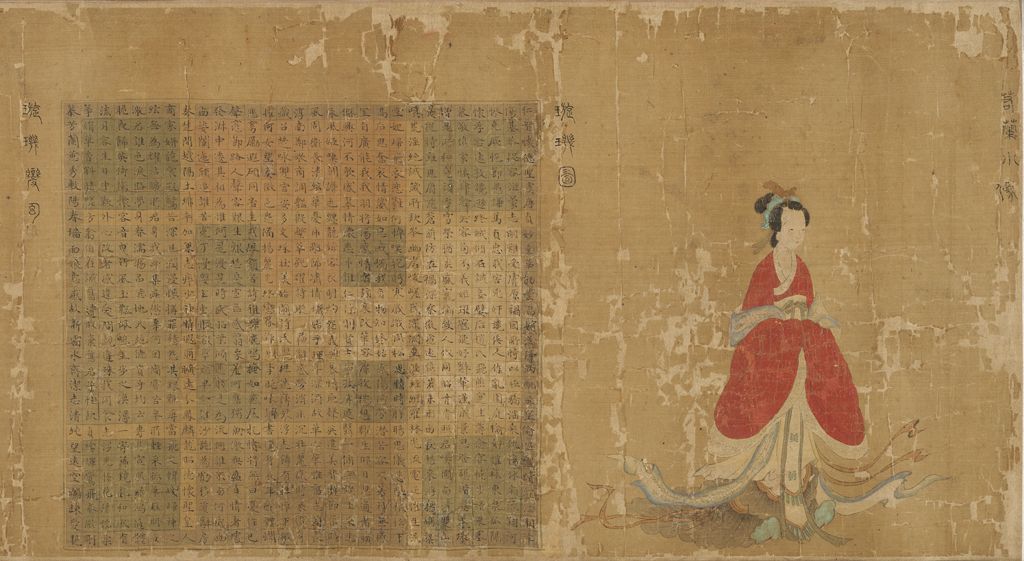
Figure 02-04. For more information about Su Hui and her embroidered palindromic poem (horizontally, vertically, and diagonally), “Star Gauge,” see https://en.wikipedia.org/wiki/Su_Hui_(poet) . This reproduction of Su Hui’s poem is in the public domain and doesn’t require a license to be used.
Another artisan uses cross-stitch to translate various images and ideas into a grid structure, similar to the way a computer uses a grid of pixels to create visual images and ideas. “Math is embedded in the making of fabric” (p. 61). Mathematician and handweaver Ellen Harlizius-Klück is the principal investigator of the PENELOPE project, with the mission “to explore the historical contributions of weaving to science and technology” (p. 61). She even points to weaving as having been the basis for ancient Greek science and mathematics, including Euclid’s Elements (ca. 300 B.C.).
“The warp-weighted loom that was used in ancient Greece is an upright frame with warp threads that hang down and are attached to weights at the bottom to provide tension for weaving in the weft threads. The weaving process begins with a prewoven band [probably] produced by tablet weaving, another ancient form of weaving in which small cards or tablets separate the warp threads and which produces only narrow bands. The band was then turned on its side so that the longer weft threads became the warp threads on the warp-weighted loom” (p. 62, emphasis added). This process demands that the correct number of warp threads must be known from the start, to ensure that there will be the correct number of repeats for the pattern. To see sketches and photos of warp-weighted looms, please see https://en.wikipedia.org/wiki/Warp-weighted_loom .
To create complex patterns, “Understanding odd, even, and prime numbers and being able to find factors and multiples are all critical for determining which patterns will fit evenly across the cloth and had to be decided when the initial band was created” (p. 62). For instance, a warp that has a prime number of threads, by definition, cannot allow for evenly repeated patterns.
The mathematics of weaving becomes apparent when moving to Jacquard punch-card looms, which use binary code to automate a complex pattern of supplemental weaving, such as brocade. Ada Lovelace and Charles Babbage credit the binary punch-card loom as an inspiration for development of the Analytical Engine, progenitor to the modern computer. Nehrig would move the origins one step backward, to hand weaving as the mathematical origin of the binary code on which computing depends. Interestingly, Lovelace also proposed improvements to weaving technology, as well.
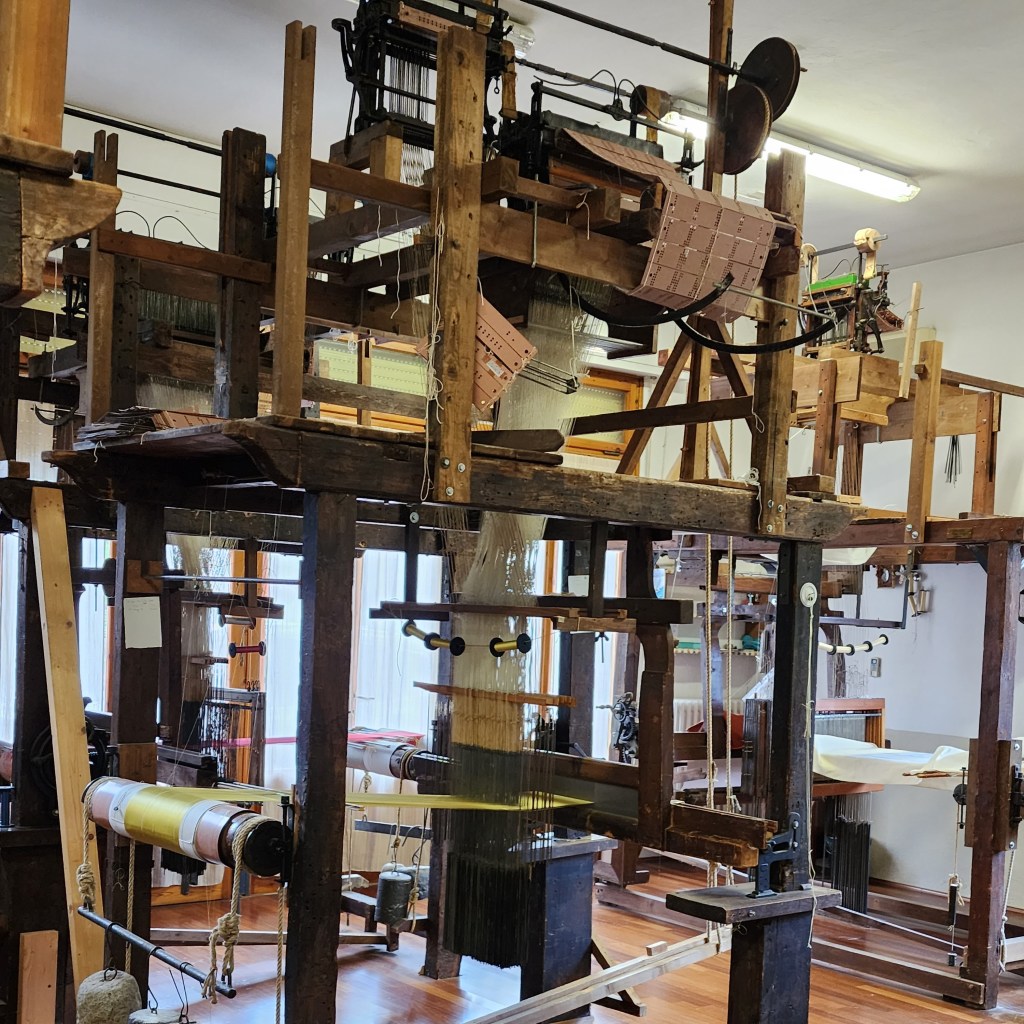
Figure 02-05. This Jacquard Loom is in the Fondazione Arte della Seta Lisio in Florence, Italy, where I photographed it in November 2022. Two other women and I participated in a weaving workshop, during which each of us had a turn using this magnificent machine, one of several working looms at the Fondazione. To find out how the Jacquard loom works, please see https://en.wikipedia.org/wiki/Jacquard_machine#Principles_of_operation .
To take this one step further, “in 1997, mathematician Daina Taimiņa learned how to use textiles to express a mathematical idea that hadn’t been realized in three dimensions” (p. 64). She crocheted a model to represent this idea (her basic idea: for every 12 crochet stitches, increase one stitch on the subsequent row; others have adapted her technique, decreasing the number of base stitches per increase stitch, for a frillier result).
Taimiņa’s work inspired Australian sisters Margaret Wertheim, a science writer, and art educator Christine Wertheim, to create the Crochet Coral Reef project (https://crochetcoralreef.org/ ), starting in 2005. “Through crochet, they were able to illustrate the beauty and variety of life in coral reefs and show by comparison the bleaching and atrophy of a dying reef” (p. 66; for Margaret’s TED talk about the project, see https://crochetcoralreef.org/about/ted-talk/ ; for more by Margaret, see https://www.margaretwertheim.com/new-blog ). As Taimiņa so aptly asserted, “Mathematics is not scary when you can touch it” (p. 68).
To learn how to crochet hyperbolic crochets yourself, please see
https://ncartmuseum.org/wp-content/uploads/2021/10/Reef-How-To-FINAL2020-copy-1.pdf .
See also https://www.youtube.com/watch?v=Rkprzo60GVk .
Chapter 3 Stitching a Self, 69–103
(knitting, weaving, quilting, appliqué, embroidery)
Nehrig opens this chapter with “In the 1960s, knitwear designer Elizabeth Zimmerman began to revolutionize the knitting industry . . . by giving women the tools and encouragements to think for themselves in knitting,” rather than slavishly following patterns provided by “experts” (p. 69). She “provided instruction on the technical skills needed to achieve whatever effects knitters desired by altering patterns or devising their own” (p. 69). “She offered multiple methods for working various steps in the knitting process and encouraged knitters to experiment to determine what worked best for them” (p. 70). (For more about Zimmerman, see https://en.wikipedia.org/wiki/Elizabeth_Zimmermann .)
During the millennia that women’s lives have been dominated by domestic duties and largely controlled by men, the freedom to be creative was circumscribed. Nonetheless, as weaver and scholar Lilly Marsh observed, Zimmerman taught us that “a creative life can be lived in an ordinary way or lived in the midst of family and domesticity” (p. 71). Women can express their creativity through how they cook, care for children, . . . and make textiles. Though wealthy women had much more free time and resources for self-expression, any woman could choose to look for small ways in which to create while spinning, weaving, knitting, sewing, cooking, entertaining children.
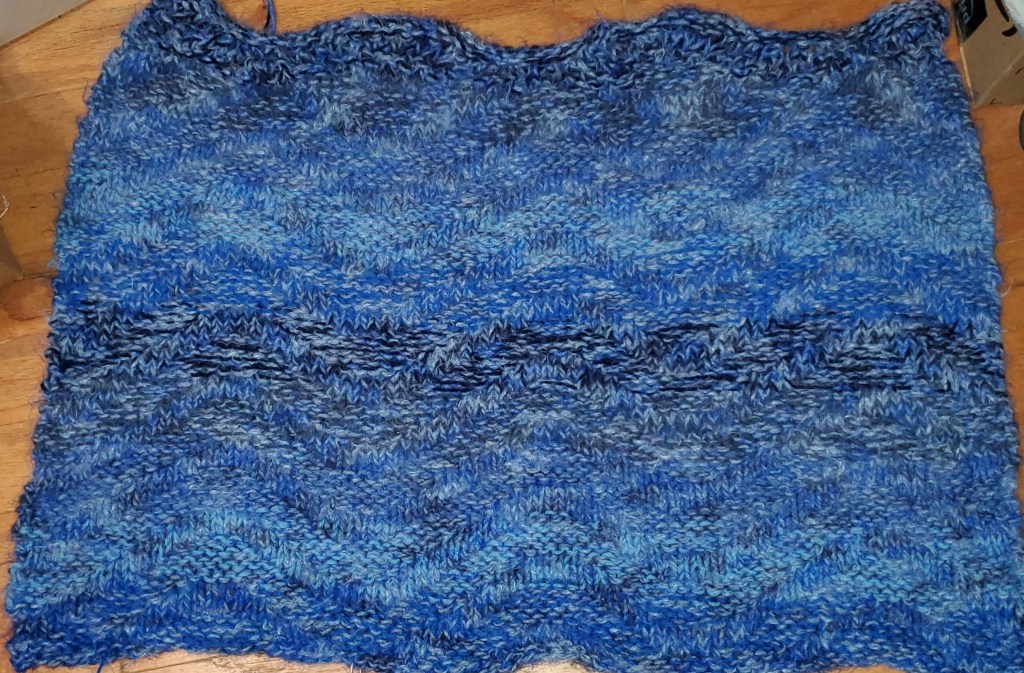
Figure 03-01. Sometimes, something as simple as knitting a blanket can be an opportunity for creative expression.
During the medieval period, both women and men could become professional embroiderers, who had relative freedom in choosing their subjects and designing their handicrafts. Ironically, the Italian Renaissance may have heralded some freedom of thought, but it introduced more gender restrictions, barring women from many craft guilds. Women could continue to embroider at home, but they were encouraged to develop technical skill in following the patterns of others, rather than creatively designing their own works. They were encouraged to copy paintings or pattern books designed by men. Nonetheless, even while carrying out tedious chores, women could think their own thoughts — which made many patriarchs uneasy.
Woven textiles offer a superlative example of the infinite possibilities within a constrained setting. Warp (the threads running from the front to the back of the loom) and weft (the crosswise threads that weave over and under the warp) form a binary system: Either the warp is on top and the weft goes under the warp, or the weft is on top, going over the warp. Using a simple backstrap loom — basically, two sticks, a belt, and a cord — an Andean weaver can create a seemingly infinite variety of complex textile designs. For a few examples, please see https://en.wikipedia.org/wiki/Andean_textiles#/media/File:Wari_cap.jpg , https://en.wikipedia.org/wiki/Andean_textiles#/media/File:Paracas_mantle,_BM.jpg , and https://en.wikipedia.org/wiki/Andean_textiles#/media/File:Tupa-inca-tunic.png ; for more, see https://en.wikipedia.org/wiki/Andean_textiles .
In Old English, the term woolgathering referred to the practice of gathering tufts of wool caught on branches, shrubs, fences as sheep passed by. Over time, this term came to mean “daydreaming,” more evidence that ordinary activities may occupy a woman’s hands but not her thoughts.
Flora Collingwood-Norris uses “visible creative mending” in her knitwear designs. She turns what may seem to be drudgery — mending a damaged, stained, or worn-out garment — into an opportunity for creativity. We who have attempted to mend knitted garments with invisible repairs realize the near-impossibility of doing so. Flora turned that frustration into an avenue for creation, to turn a worn, stained, damaged garment into an entirely new, beautiful one. She might duplicate-stitch in vibrant colors over a threadbare elbow or maybe embroider floral vines climbing a stained sweater. (To see how to duplicate-stitch over your knitted fabric, see https://knittingconfessions.com/blog/how-to-sew-a-duplicate-stitch .) Handicrafts show us that “mistakes and imperfections are not permanent and can be transformed into something beautiful” (p. 82).
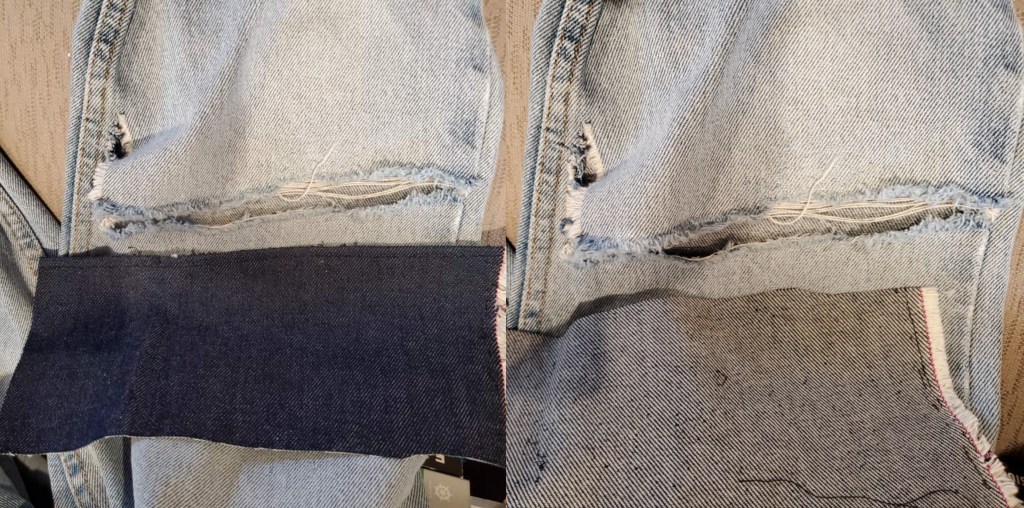
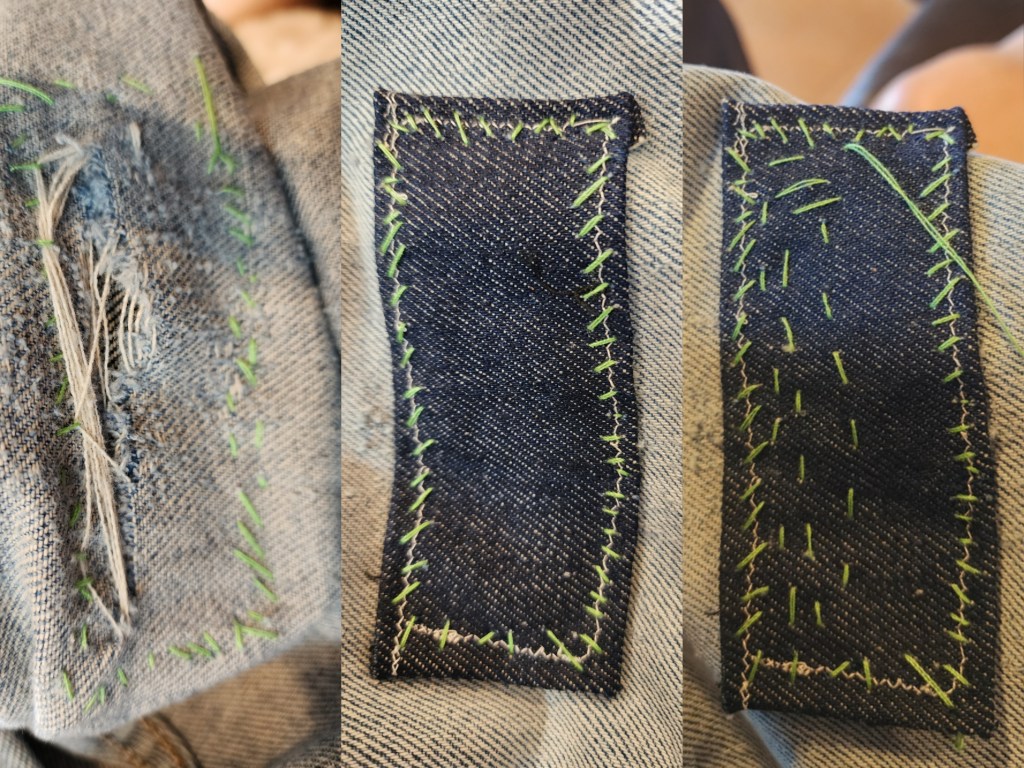
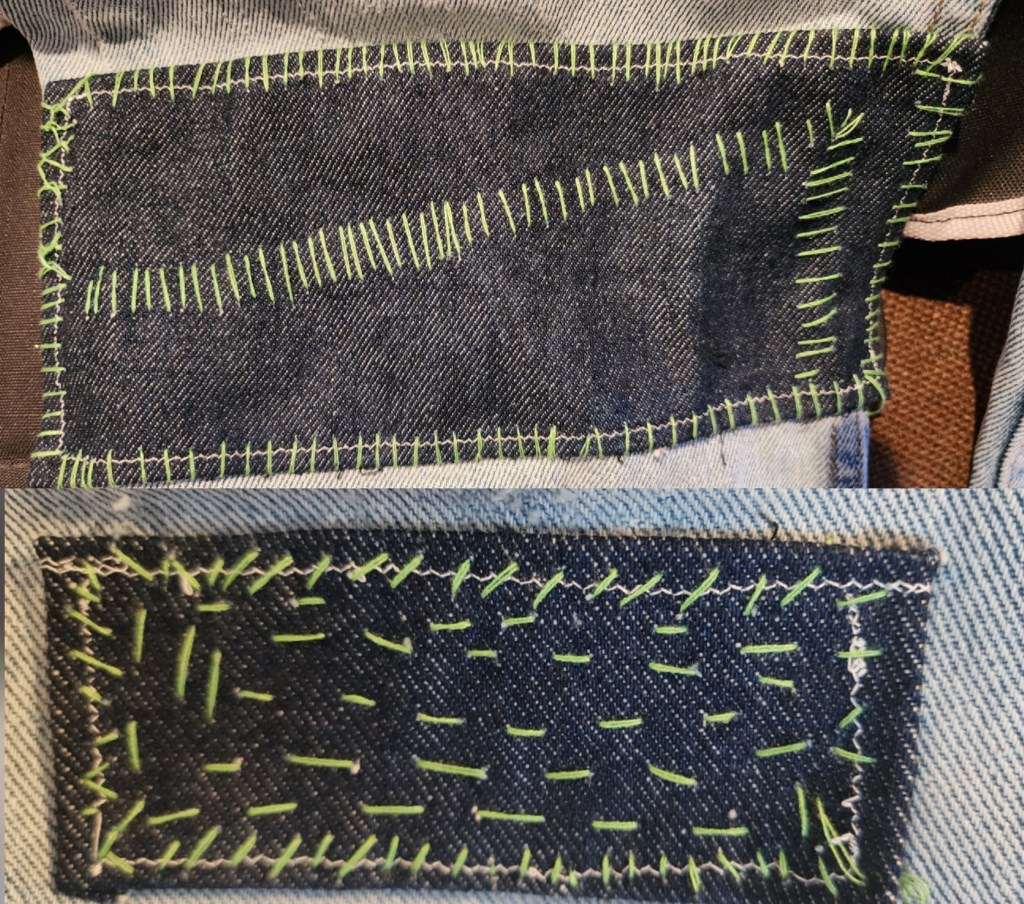
Figure 03-02. Ripped, well-worn jeans requiring major repairs don’t lend themselves to invisible repairs. Instead, how about bold mending, imitative of the Japanese “sashiko” stitches? (See https://en.wikipedia.org/wiki/Sashiko for more beautiful examples and a better description of the technique and its history.)
Before readymade cloth was available, or whenever new whole cloth has been too expensive, every scrap of fabric has been precious and put to good use. Patchwork quilts, bags, and garments can be beautiful products made from finding new uses for old scraps. (Songwriter and singer Dolly Parton wrote about her childhood experience of wearing a patchwork coat hand-made by her mother; see https://en.wikipedia.org/wiki/Coat_of_Many_Colors .) Appliqué, too, often uses scraps of fabric left over from other projects or from worn-out garments. These patchwork and appliqué items required ingenuity and creativity to design to be not only useful but also beautiful. Likewise, each quilter uses her own creativity to create her own unique quilt.
In the Bloomsbury Group of the early 1900s, Virginia Woolf, John Maynard Keynes, Lytton Strachey, Molly and E. M. Forster, Vanessa and Clive Bell, and others discussed profound intellectual ideas — and knitted and embroidered — both men and women using their hands, as well as their minds. Virginia Woolf “once noted in a letter to her husband that ‘knitting is the saving of life,’ adding that her younger brother had taken it up, too” (p. 87).
In Panama, the Guna women extensively appliqué and embroider molas, which may include geometric designs, human figures, wildlife and other nature-inspired depictions, and scenes from their daily lives. Many of the images in the molas have cultural, symbolic, and even spiritual significance, conveying a narrative about their experiences.

Figure 03-03. While sitting in the comfort of your home, you can buy one or more molas from Etsy or various other online retailers. Some Etsy shops and other online retailers are operated by women’s collectives, who ensure that the artisans are paid a fair price for their work. I’m very pleased that I ordered this one (though I’m not sure which way is up!).
In southern China, the Miao people — who lack their own written language — also elaborately embroider story cloths. Through these story cloths, women “use weaving and embroidery to tell stories, pass down histories, celebrate their religion, and express their longings” (p. 89). When Miao women reach age 16 years or so, they start to embroider their own woven wedding dress, continuing to convey their cultural heritage. (For more about the Miao people, please see Miao people – Wikipedia ; e.g., see https://commons.wikimedia.org/wiki/File:Miao_woman_in_Yangshuo_(China).jpg)
In the Americas, when a Mayan weaver begins to make a huipil blouse, she carefully chooses the colors for her warp threads, but she doesn’t yet know what design she will weave. She fills her thread basket with colors that will coordinate with and complement her warp threads, then she spontaneously designs her fabric while she is weaving. Her extensive experience with traditional Mayan designs and patterns offers her a vast repertoire of possibilities, but she makes her own spontaneous decisions as she weaves her weft at each row. (See also https://en.wikipedia.org/wiki/Huipil .)
In the early 1880s in the United States, women became entranced with making crazy quilts. These quilts were made from a variety of fabrics (satins and velvets, as well as cottons), cut into haphazard (or at least haphazard-looking) shapes, then pieced together. The craziness didn’t end there. Rather than having invisible seams, these quilts included top-stitching in contrasting colors, as well as embroidery. Women often further embellished these quilts with ribbon and lace, sometimes even adding buttons and beads. Many women relished their seemingly unrestrained craziness in making these quilts. Other women and men disparaged the time and resources invested in these quilts as being truly “crazy.”
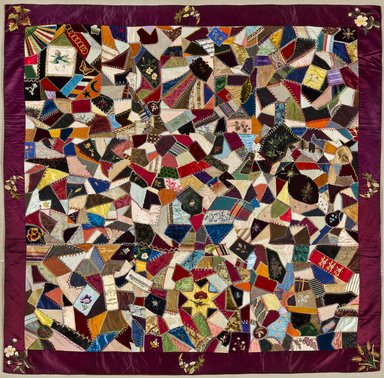
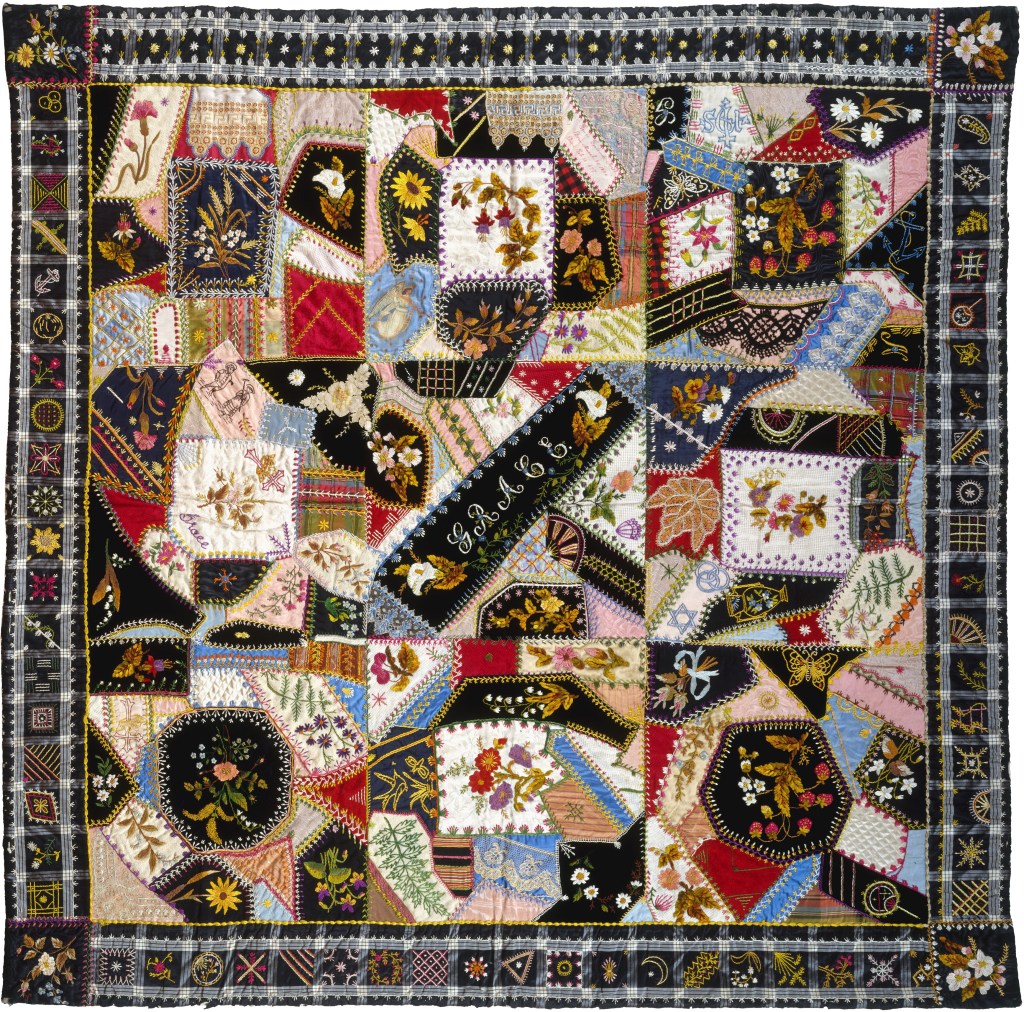
Figure 03-04. (a) This crazy quilt was made by Rebecca Palmer, completed in 1884, and now residing in the Brooklyn Museum, which considers the photo to have no copyright restrictions and which Wikimedia considers to be in the public domain. (b) This crazy quilt was made by Tamar Horton Harris North, completed in 1877, and now residing at The Metropolitan Museum of Art, also in the public domain. For more images of and information about crazy quilts, please see https://en.wikipedia.org/wiki/Crazy_quilting .
The Egyptian-American women in Ghada Amer’s household sewed, and while doing so, they enjoyed the company of women, away from the attention of men. Though not interested in sewing garments, Amer enjoyed the freedom of doing needlework with other women. She uses strands of thread to paint pictures and has begun to use the Egyptian appliqué technique khayamiya. (“Khayamiya . . . is a decorative Egyptian art appliqué textile, that dates back to as far as Ancient Egypt” — https://en.wikipedia.org/wiki/Khayamiya . Part of tent construction, each piece is traditionally made similar to a quilt, with a backing that faces the outside of the tent, a top layer, and elaborate appliqué stitched to the top, which faces the interior of the tent. In the images shown on Wikipedia, the tentmakers were men.) Amer has also commissioned men to stitch feminist statements through needlework.
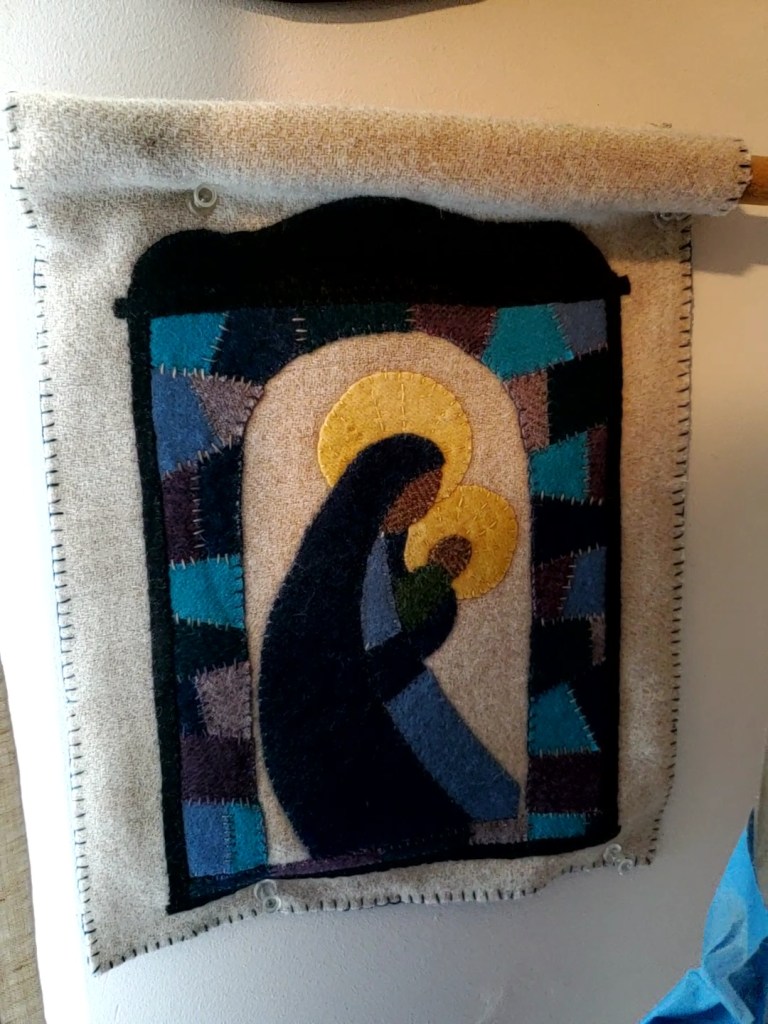
Figure 03-05. This lovely appliqué was handmade by my favorite sister, whom I cherish, and which I treasure.
Michelle Kingdom also grew up among needleworkers, and she uses embroidery to express her artistic viewpoint. She “avoids using traditional stitches and getting tied up in the technical aspects of embroidery” (p. 101), and she pays no attention to how the back of her stitchery looks. Instead, “she is interested in embroidery as a vehicle for symbolism” (p. 102). To Kingdom, “part of the joy of stitching is intentionally breaking some . . . rules” (p. 103).
Chapter 4 Unraveling Emotions, 105–132
(quilting, handiwork, and healing)
For many women, creative handicraft, such as quilting, is a soothing balm for troubled times, whether the troubles are internal (e.g., depression) or external. Also, textiles themselves can be comforting. Harry Harlow’s 1960s experiments with rhesus monkey infants showed that tactile / textile comfort can be key to normal development. We swaddle infants in cloth to comfort them, and many children have beloved cloth objects that they cuddle for solace.
Working with textiles involves producing a product, but for many textile handicrafters, the process of making textiles is at least as important as the product. The process of making textiles can distract us from unpleasantries, soothe us, provide a sense of satisfaction at accomplishing something (however small), stimulate our creativity or provide familiar somewhat meditative repetitions, occupy our hands while allowing our minds to wander, and much more.
Research supports the belief that doing skilled work with our hands can alleviate stress, anxiety, and depression. These activities go beyond mitigating negative experiences to actually providing a sense of happiness and calm, as evidenced by a survey of 3,545 female knitters. “Those who knitted daily experienced the most benefit” (p. 109).
One way in which handicrafts provide these benefits may be neurological, through the release of the neurotransmitter serotonin. Another possibility is that handicrafts help to mitigate a sense of learned helplessness, a process by which we experience a sense of powerlessness so often that we come to expect that we will never be able to have an impact on our situation, so we need never attempt to do so. Through handicrafts, we can see that we are having an impact, making a difference.
Art therapist Ann Futterman Collier describes women who use textile-making techniques (knitting, crocheting, weaving, spinning, quilting, needlework, etc.) as textile-copers. According to Collier, “Textile-copers reported significantly greater success in transforming their negative moods compared with non-textile-copers using their preferred coping method. . . . [textile-copers] became more absorbed in their crafting activity and reported feeling more rejuvenated afterward” (p. 111).
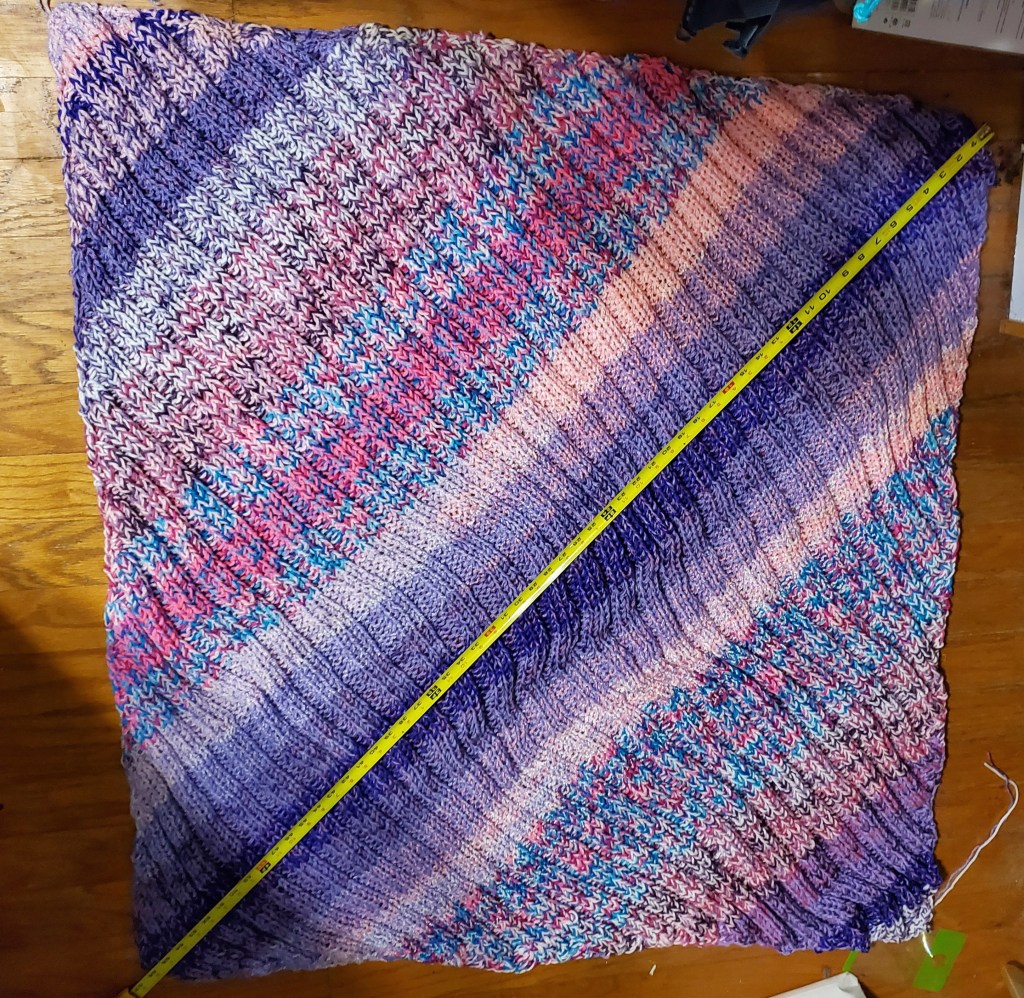
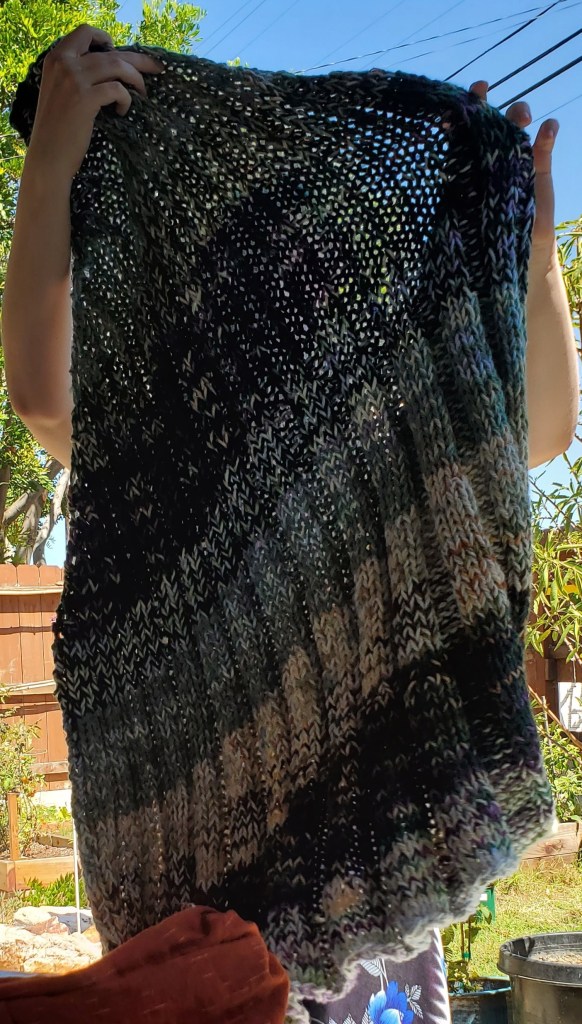
Figure 04-01. The process of knitting offers immeasurable benefits for the knitter, but it can also lead to something to share with others, such as a blanket for a newborn or a shawl to honor a high-school graduate for whom a ceremony wasn’t possible during the COVID pandemic.
Perhaps one reason textile work is so satisfying and rewarding is that whenever we make a mistake in making textiles, we can undo it, fix the mistake, and continue. “Textile work is forgiving. We can unravel or unpick stitches, mend holes and tears, reuse materials, and rework pieces” (p. 112). A woman grieving the loss of her child said, “when I find myself trying to change the ending, I pick up my needles and yarn instead” (p. 112). When we are knitting (or engaged in other textile handicrafts), we can make mistakes and fix them, we can see our own progress, and we can obtain tangible results.
Textiles can also play a direct role in grieving. When someone dies, we may rend their garments or other textiles, literally and symbolically tearing the fabric of the person’s life. Christy Thompson, art therapist and textile artist, unraveled the knitted clothing of her deceased brother to make him a burial shroud. “The process of weaving the shroud became a metaphor for maintaining her connection to her brother” (p. 114). “Textiles are an archive showing the traces of daily life. They store memory in the form of stains, holes, patches, stretching, pilling, and other signs of wear” (p. 115).
Textile handicrafts have been used as therapy for grieving, eating disorders, and recovering from trauma (e.g., rape). Chilean women coped with the tragedy wrought by the Pinochet government by appliquéing and embroidering arpilleras, story cloths depicting the torture, imprisonment, and even murder of their loved ones (for more on arpilleras and arpilleristas, see https://en.wikipedia.org/wiki/Arpilleras ). “Studies show that performing a repetitive visual-spatial task during or shortly after a traumatic event significantly reduces the incidence of flashbacks. . . . Sewing and other repetitive handwork while processing these memories may help integrate them into the larger brain network so they . . . do not intrude into the present with such intensity” (p. 120).
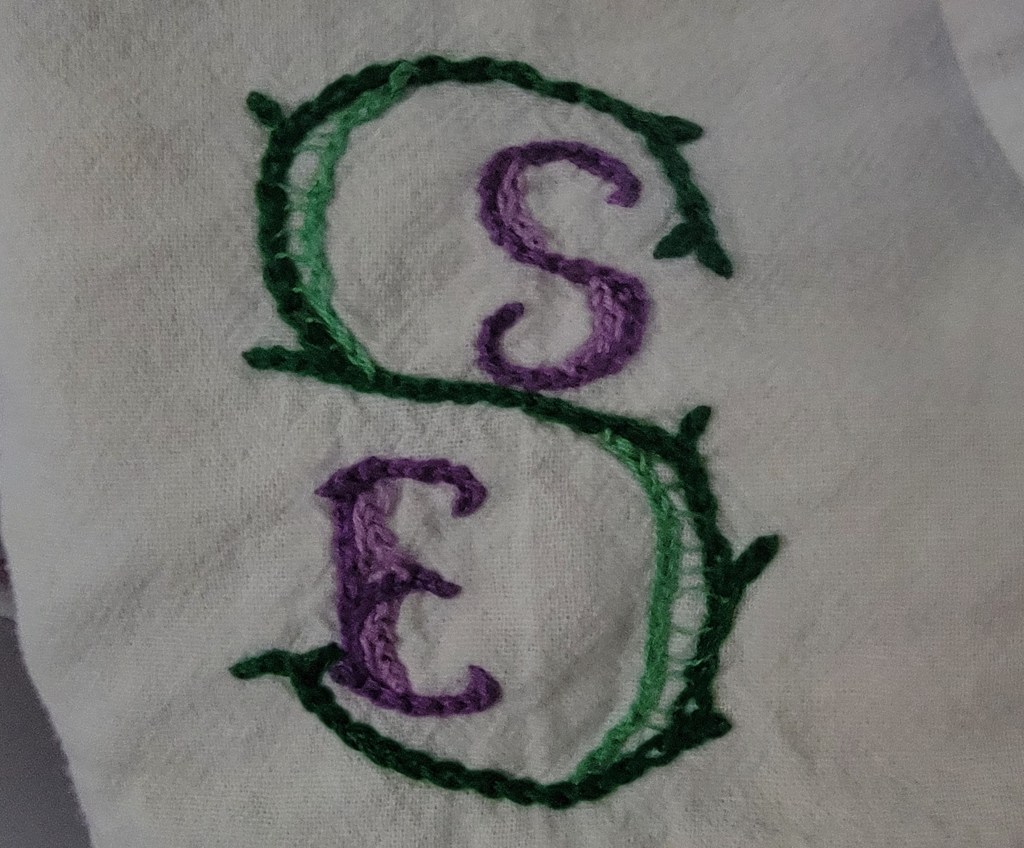
Figure 04-02. This towel was embroidered to celebrate the lives of the two daughters of my daughter, but when their beloved cat died, it became their cat’s burial shroud.
***
Color plates, 8-page insert, between pages 120 and 121
(1st page), (a) Andean weaver Marcela Salas Calcina, with her backstrap loom near Cusco, Peru; (b) Navajo wedding basket. (2nd page), (a) Re-creation of Su Hui’s embroidered “Star Gauge” poem, readable horizontally, vertically, diagonally; (b) photo from Christine and Margaret Wertheim’s Crochet Coral Reef project. (3rd page), (a) Flora Collingwood-Norris’s creative visible floral mending of a blue sweater; (b) Ghada Amer’s thread paintings intended to transform pornographic views of women into “independent female sexuality.” (4th page), (a) Michelle Kingdom’s hand embroidery depicting war, corruption, and capitalism; (b) Ecuador’s Common Threads Project, using applique and embroidery for trauma recovery. (5th page), (a) Esther Nisenthal Krinitz’s embroidered memories of her childhood traumatized by the Holocaust; (b) Deborah Valoma’s Armenian needle lace reinforcing her cultural tradition. (6th page), (a) Woven Navajo blanket (ca. 1900), on exhibit; (b) Mia Hansson’s single-handed re-creation of the Bayeaux Tapestry (still in process), originally hand-embroidered by numerous 11th-century women and re-created by 39 women in 1885. (7th page), (a) Three generations of Gee’s Bend Quilters (in Alabama) and some of their quilts; (b) banner created by women’s suffragists, honoring alumna of Cambridge and opposing war. (c) Su Richardson’s fabric sculpture depicting the many roles of a mother. (8th page), (a) An embroidery mural in Portugal, which “blends digital and analog elements by using cross stitch to mimic pixels” (caption beneath photo); (b) Olutosin Oladosu Adebowale’s fabric self-portrait, made from scraps of fabric, thereby transforming trash into beautiful art.
***
The Common Threads Project is a community-based therapy program for trauma recovery being implemented in conflict-torn locations across the globe (e.g., Bosnia, Nigeria, Ecuador, Nepal) and in places where refugees may be found, including in the United States of America. A key component of these therapy programs is the sewing circle, where participants learn and practice using various simple embroidery stitches. At first, participants stitch the border of a story cloth, then slowly, slowly, with time, they begin to embroider their stories of trauma, all the while being supported by facilitators, as well as their fellow participants. When they have words, they can speak, but when they lack words, they can sew and feel their own presence encircled by support.
Multimedia artist Louise Bourgeois, “When I was growing up, all the women in my house were using needles. I’ve always had a fascination with . . . the magic power of the needle. . . . used to repair the damage. It’s a claim to forgiveness” (p. 126). The power of the needle can be seen through the AIDS quilt textile memorial, started in 1987 in San Francisco, and which spread nationwide, now including more than 50,000 panels.
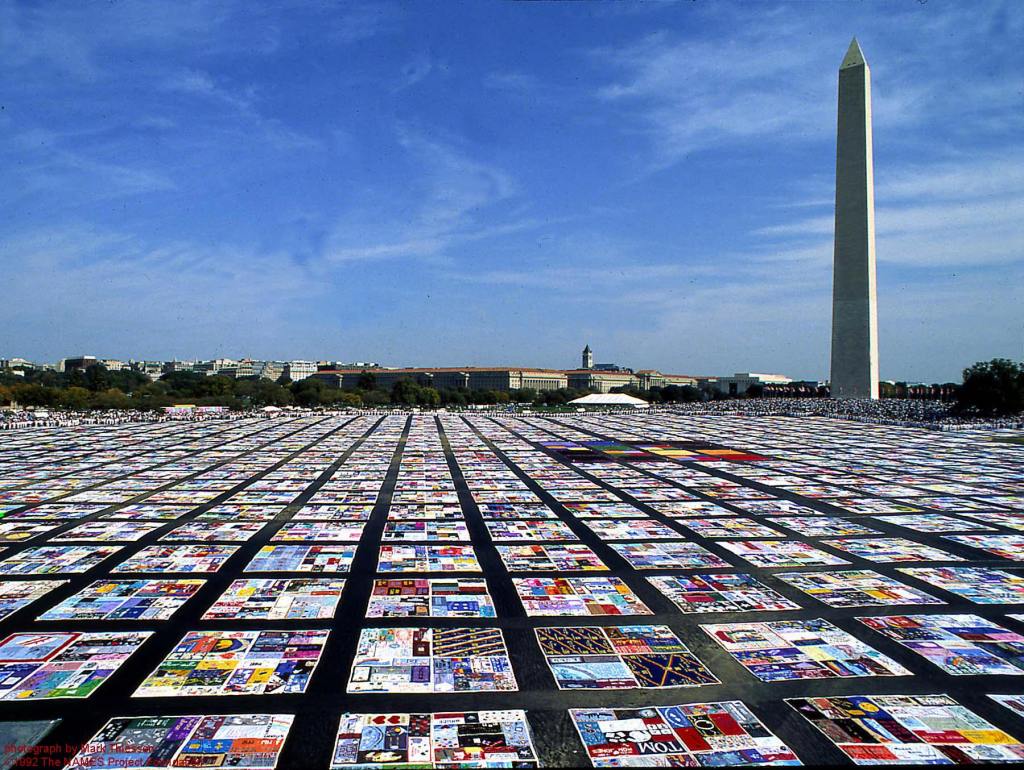
Figure 04-03. This photo of the AIDS Memorial Quilt (see NAMES Project AIDS Memorial Quilt – Wikipedia ), in front of the Washington Monument in Washington, D.C., was taken by an employee of the National Institutes of Health, in the employee’s official capacity (and is therefore in the public domain). Every single quilt represents countless hours of handiwork to honor someone (or someones) killed by AIDS.
Carla Hemlock quilted a memorial to honor the lives of thousands of Kahnawake Mohawk children who were killed in a Canadian residential boarding school, run by a church and operating from 1831 until 1997.
Esther Nisenthal Krinitz used embroidery to memorialize her childhood experiences of the Holocaust (for more information about Esther and an illustration of her work, see https://en.wikipedia.org/wiki/Esther_Nisenthal_Krinitz ).
Deborah Valoma did extensive research on Turkey’s genocide of Armenians and decided to memorialize this historical event through a traditional Armenian lace stitch. With the help of two elderly Armenian women, she “is simply doing the stitch over and over again. There is no stopping point or finished object in mind, just the repetitive motion of the stitch” (p. 131).
For additional information about the centuries-old tradition of Armenian needlelace, with photos, please see https://en.wikipedia.org/wiki/Armenian_needlelace . “Lacemaking was part of many or most women’s lives” throughout Armenia. For the technique for making it, using just a needle, thread, and scissors, freestyle, please see https://en.wikipedia.org/wiki/Armenian_needlelace#Technique . After the Armenian genocide, Armenian needlelace spread through the Armenian diaspora to Greece, France, the United States, Crimea, Asia, and Africa.)
Textile handicrafts can be “both a means and a metaphor” for coping with and recovering from trauma (p. 132).
Forthcoming is the second of two blogs about Nicole Nehrig’s With Her Own Hands: Women Weaving Their Stories (2025); the second blog discusses Chapters 5–7 and the back matter of Nehrig’s book.
Text by Shari Dorantes Hatch, Copyright © 2026. All rights reserved.
Image of kente cloth (Figure 00-3) was taken by textile artist Kikanza Nuri. Images of bobbin lace (Figure 02-03) were taken by globe-trotting art connoisseur Kat Stesney. NO permission is granted to reproduce these images in any form, without express permission of Kikanza Nuri or Kat Stesney. Four images are from Wikimedia: Su Hui’s embroidered poem (Figure 02-04), two crazy quilts (by Rebecca Palmer and by Tamar Horton Harris North) (Figure 03-04), and the AIDS Memorial Quilt (Figure 04-02); all four are in the public domain. All other images were taken by Shari Dorantes Hatch, Copyright © 2026. All rights reserved.


.jpg)
Leave a comment