
June 25, I underwent surgery on both eyes, to remove cataracts. The hope was also to relieve the progression of glaucoma in both eyes, as well as to improve my visual acuity for distance vision. My eyes are still a work in progress at Day 12 following the surgery. My vision varies from pretty good to pretty bad, and both eyes still occasionally hurt, though not excruciatingly so. (For me, they seem to hurt more at bedtime, and if they’re still hurting after 2 hours, I take ibuprofen, which does the trick.)
Here are my retrospective tips for anyone who will be undergoing cataract-removal surgery or a similar eye surgery. These tips are incomplete, as it’s expected that my eyesight and my eye comfort will continue to improve for a few weeks after the surgery. I have scheduled an appointment with an optometrist at 4 weeks postsurgery, to create a new prescription for eyeglasses, as my old prescription no longer works.
Planning ahead for the first two days after surgery
Plan ahead for not being able to use your eyes much at all the first couple of days. I was given diffusely translucent eyepieces to wear the first 24 hours, and even after I removed them, it seemed as though my eyes were coated with a thick layer of Vaseline for about 48 hours.
Driving
- Plan for someone to drive you to and from your surgery.
- Plan for someone to drive you to and from your first follow-up appointment with the ophthalmologist.
Food
- Buy enough groceries for at least a week, and put them in convenient, highly visible locations in your fridge or on your counter.
- Don’t expect to be able to read any labels or recipes.
- Stock your fridge (or freezer) with food that you can eat with little to no food prep and very poor vision — premade salads, microwaveable meals, snacks you can eat with little effort, etc. Perhaps even pre-cut some slices of cheese, to use on toast, or slice veggies, to dip into hummus, etc. Put these prepared items into baggies, and put the baggies somewhere highly visible.
Bathing
- If you have a hand-held shower nozzle, you can easily keep water from getting into your eyes for washing your body from below the shoulders downward. You shouldn’t splash your face, but you can get your hands wet and wipe your face carefully to clean it.
- If you don’t have a hand-held shower nozzle, buy yourself a pair of cataracts-friendly goggles and a waterproof visor. (See pics of the ones I bought.)


Figure 01. Equipment for keeping water from splashing or dripping into your eyes following surgery.
- Hair
- If you have long hair, consider cutting it short. I cut 10″ off my hair, so that washing it will be faster and easier.
- I plan to wash my hair at Day 14. Luckily, I don’t have anyone judging me by my hair hygiene at present. (I’ll update these notes after I wash it, to let you know how it went. I may end up paying someone to wash my hair in a salon — the third time I will have visited a salon as an adult. Please see the following update.)
- I will use a pair of cataracts-friendly goggles and a waterproof visor while washing my hair. Here’s a pic of how ridiculous I look while wearing them.
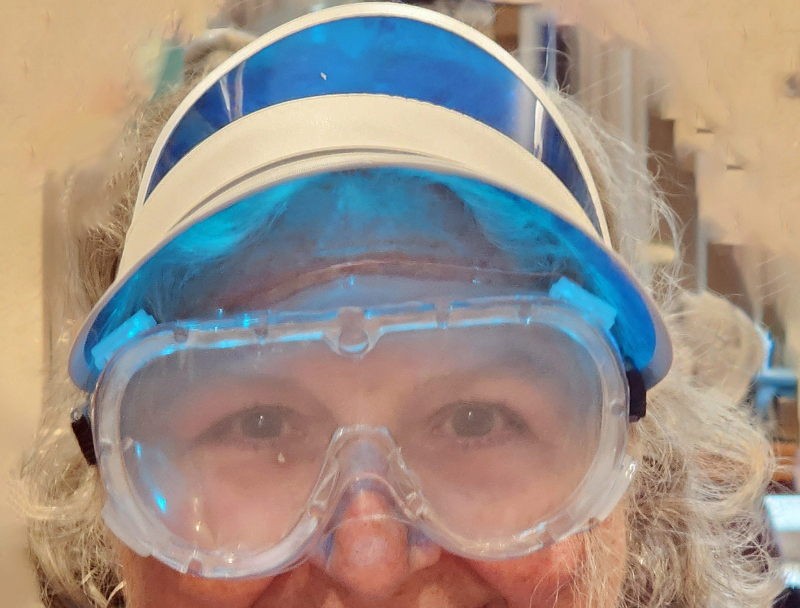
Figure 02. My pal Kat took this picture of me wearing a snazzy waterproof visor and eye-friendly goggles to keep water from splashing or dripping into my eyes while washing my hair. I’ll let you know how it goes once I do this.
Update, July 14, 2025: I wimped out and decided to have a professional wash my hair.
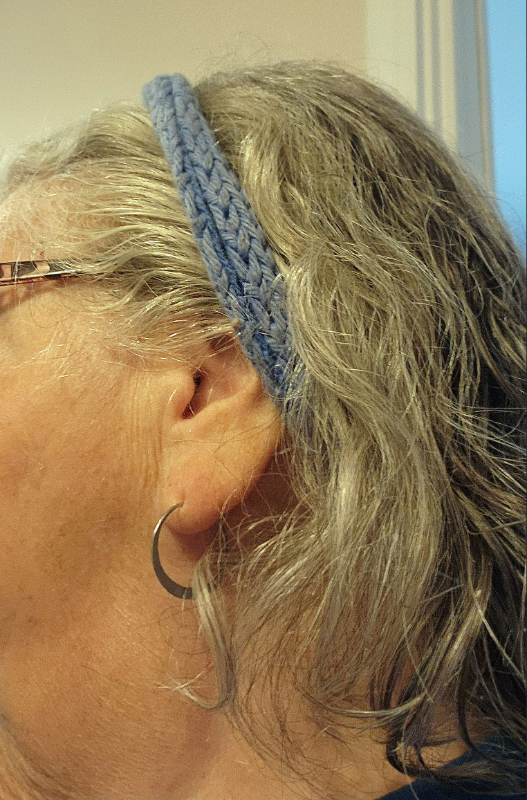
I went to Supercuts, where Lucely did a marvelous job washing my hair (while massaging my scalp!)! I enjoyed the process, and I’m delighted with the results. I was her first client of the day, so no funky smells. She agreed to use just a simple shampoo and no conditioner, no blow dry. I couldn’t be happier. ($7 shampoo, $13 tip, $20 TOTAL!)
Entertainment — PREPARE ahead
- You won’t be able to read at all the first couple of days, and your reading for the first week or more will have to be brief, sometimes unfocused, and sometimes painful.
- Audiobooks: Set yourself up to read audiobooks. There’s a free cellphone app called “Libby,” which gives you access to a free library of audiobooks, using your library card. As it happens, my local library card didn’t work with the Libby app, BUT our county library does. I had let my county library card expire, but Libby let me sign up anew. Their nonfiction selections are fewer than their fiction titles, but I found many, many books that appealed to me. I have already “read”/listened to three and am on my fourth book now. It’s not like reading, but it is entertaining, informative, and enjoyable. I found the books interesting enough that I actually ordered four of the books to read in real life once my eyes heal fully. My daughter, my sister, and my dear friend (of 60+ years) regularly listen to audiobooks and thoroughly enjoy them. My daughter says I just have to get used to the idea that I’m not going to grasp all the information the way I would if I read it.
- Earphones: I wanted to be able to listen sometimes without others having to hear my book. I have never been able to use normal earphones that fit inside your ear canals, so I bought myself a set of bone-conduction earphones, which work great. If you don’t want to disturb others while you listen, you might want to try these.
Planning ahead for the duration of healing and recovery
Even after the first couple of days, you won’t be able to use your eyes reliably for the first week or more. If you have errands or chores to do within the first week, arrange for someone else to do so or to drive you and to do any of the exertion associated with those errands or chores. Just think: You have a great excuse not to do any of the yucky chores you hate doing! YAY!
Reading and other visual tasks
In advance, I looked at my eyeglass prescription and saw that my bifocals added +1.50 diopters for reading, in addition to what was needed for distance vision. I bought three pairs of very cheap readers, which I wear at night (even with my CPAP machine), to ensure that I won’t accidentally touch my eyelids. The outpatient clinic suggested wearing the eyepieces at night for the first week, but I find that these readers do just as well and are more comfortable than the eyepieces.
I also bought an inexpensive pair of polychromic bifocals: The bottom of the bifocals adds 1.50 diopters, for reading, and the top of each lens is polychromic, darkening in bright sunlight and lightening to clear when indoors. They don’t get as dark as my old prescription eyeglasses did, but they do get dark enough to wear for driving.
For being outdoors, such as for walking laps around the pool, I wear the very dark sunglasses given to me by the eye surgeon plus a pair of polychromic goggles. These suffice even in bright afternoon (after 3 p.m.) light. I can’t read a thing while wearing them, but I don’t do a lot of reading while in the pool.
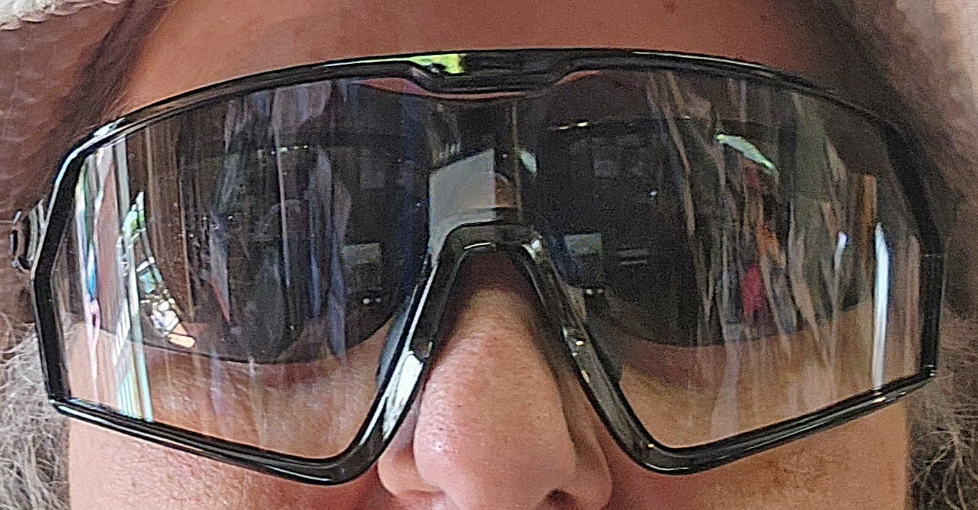
Figure 03. If you look closely, you can see the dark eyeglasses I received at the outpatient clinic, beneath the polychromic goggles.
Driving
I never drive after dark (even before the eyes surgery), and I didn’t drive for the first week after surgery. On the eighth day, I felt comfortable that I could see well enough to be safe for driving around to do errands. Your vision and your comfort level may differ.
Exertion
Plan ahead for not exerting yourself, not bending over (squatting, as needed), and not lifting more than 10 pounds for 4 weeks.
Dogs
- If you own any dogs, plan for someone else to walk your dog. If someone in your household can take over, great, but if not, find someone else to do so. I paid my granddaughter to walk my dog for 8 days.
- If you feed your dog something other than a cupful of kibble, plan for this to be a challenge; pre-portion whatever you’ll need for at least a few days.
Food
- Groceries: At the store, you can have a clerk carry your groceries and put them into your car. Unfortunately, they won’t be willing to drive home with you, so you’ll need to arrange with someone (a neighbor?) to carry your groceries from your car to your kitchen. If you bought anything heavy (e.g., liquids), have your neighbor put those items away for you.
- Meals and snacks — Still keep things simple. Don’t plan to use your iron skillets, to make big pots of soup or sauce, or otherwise prepare food that will require you to do any heavy lifting — literally and figuratively.
Exercise
- Don’t exert yourself at all for the first week.
- After returning to exercise, don’t put yourself in a situation where you’ll have to walk farther or do more than you’re ready to do. If you have a walking route, do one fourth in one direction, then return to your starting point, and assess your exertion level. If you still have plenty of oomph, do one fourth in the other direction. If not, call it a day.
- Adapt the activity to minimize exertion. For instance, I had been “swimming” daily — actually clumsily doggie-paddling forward and back-stroking backward. After the surgery, I didn’t do anything in the pool for the first week. After a week, I started slowly walking around the periphery of our 4-foot-deep pool. I started with just a few laps, then gradually increased the number of laps, but never to the point of feeling tired. When I get out of the pool, I have about the same level of energy as when I entered it.
Please feel free to ask questions or to make comments about this information. My sole expertise is my own experience. Your experience, or that of your loved ones, may differ. I would welcome hearing from you how your experiences were similar or different.
Update, July 13, 2025: I still don’t see reliably well, my eyes tire easily when I’m reading, and my eyes are still irritated and mildly painful more often than I’d like. My vision is improving, but I’m growing impatient with my progress. In three days, it will be three weeks since the surgeries. I had hoped for more progress by now. I’m hoping for substantial improvement within the next 10 days.
Further update, July 19, 2025: This past Wednesday, it had been three weeks since my eyes surgeries, and I had been feeling pretty discouraged about my progress until today. Today, I have been able to read without tiring easily, and my eyes don’t hurt, even after prolonged reading and writing. This coming Thursday, I see an optometrist about getting a new eyeglass prescription, and I feel that my vision will be sufficiently stabilized by then. Whew! I’m looking forward to getting eyeglasses to suit my new eye lenses.
Even further update, July 27, 2025: On July 24, I visited an optometrist for a new eyeglass prescription. Mostly good news — my distance vision acuity is good, but my astigmatism in my right eye still needs correction. He also noticed improvement in my glaucoma (eye pressures) — YAY! Great news: Because I’m old enough to be on Medicare, Kaiser paid for my $79 frames and my $130 trifocal lenses (reading, computer, distance vision), but I did have to pay a whole $90 for the transitions feature that adapts to sunshine or normal room light, so I won’t need sunglasses. I LOVE being old enough for Medicare!
Though my vision is much better, my eyes aren’t 100% recovered, as I feel teensy twinges of pain when I shut my eyes tightly (e.g., when shaking out my swim gear). I’m also annoyingly slow to build back up to my normal swim routine after my 4 weeks of just walking around the pool. (I use the term “swim” loosely, as what I do involves using a floatie belt and flailing my arms and legs to create some forward motion.) Even if I’m not wearing eyeglasses, I can see to navigate, chop veggies, and do other normal things. For now, my cheapo bifocal readers will do until I can pick up my new eyeglasses.
Summary: My surgery was great, and I’m pleased with my recovery.
Copyright © 2025, Shari Dorantes Hatch. All rights reserved.


Leave a comment