
This is the third of three blog articles on the sensational shorebirds of San Diego. (See also https://bird-brain.org/2025/05/14/touching-shorebirds-of-san-diego/ which discussed shorebirds’ sense of touch, and https://bird-brain.org/2025/05/16/sight-of-san-diego-shorebirds/ which discussed shorebirds’ sight.)

Figure 00. San Diego, California, regularly hosts more than 30 species of shorebirds, including this Willet, and at least some of these shorebirds live here year-round.
- Hearing
- Taste and Smell
- Magnetic Sense
- Resources
Hearing
Bird ears differ somewhat from human ears in their anatomy and physiology, but most birds — including shorebirds — can hear sounds within the same ranges of frequency (pitch) and volume (loudness) as humans. (For more information on the anatomy and physiology of birds’ ears and their hearing, please see “Hearing,” https://bird-brain.org/2025/05/01/bird-sense-by-tim-birkhead/#2 )
Figure 01. Black Turnstones have distinctive calls, which are in the same frequency and volume range as sounds humans can hear.
Despite these similarities, bird hearing excels in some ways. Like us, they can locate sounds horizontally (side to side). In addition, the asymmetrical positioning of their ear openings (covered by feathers in most birds) allows them to localize sounds vertically, too. This 3-D location ability helps them detect prey, as well as sneaky predators.
Birds can also make finer auditory discriminations than humans can. Birds speedily process multiple sounds at once. They can detect fine differences among complex vocalizations, recognizing individuals within a dawn chorus of multiple species.

Figure 02. While few humans can differentiate all the shorebird vocalizations at a common foraging or rest area, individual shorebirds can probably distinguish not only their own species, but other species, and perhaps even individuals within their flock.
Birds also have finer control of their inner-ear bone and can restrict the transmission of obnoxiously loud sounds. Birds can tolerate noise volumes louder than humans can, such as when airplanes fly low over Ocean Beach and Point Loma in San Diego.
Remarkably, birds can continually replace damaged or worn-out auditory sensory receptors. Humans can’t do so, which is why we often lose at least some of our hearing as we age. Some shorebirds who forage at night may be able to hear better than many shorebirds who forage only during the daytime. Also, the hearing abilities of shorebirds doesn’t vary seasonally, as it does in many songbirds, who hear better during breeding season than at other times.
Figure 03. Like other birds, this Willet won’t suffer hearing loss with aging; it continually replaces damaged or worn-out sensory receptors in its ears.
Structures in the inner ears of birds help them sense balance and equilibrium by using gravity to detect which way the head is oriented. These senses help birds orient themselves in three-dimensional space. Though we and other mammals have this structure, too, birds’ ears have more of these sensory detectors, so they have a keener sense of gravitational pull and of acceleration through 3-D space.
Taste and Smell
Most birds can probably use hearing to identify mates, parents, offspring, flockmates, their own species, and perhaps some other species. In addition, most birds can use smell to recognize family members and perhaps flockmates, to choose mates, and perhaps to identify other bird species. Smell also plays a key role in finding prey or other foods, in navigation, and in other uses. For more information on birds’ sense of smell, please see https://bird-brain.org/2025/03/03/birds-smell/
Both taste and smell allow birds to sense chemicals that contact sensory receptors, located in the nose, bill, mouth, throat, tongue, or more than one location. Researchers have been slow to recognize that most birds can sense smells and tastes. Why? (1) Birds have fewer taste buds than humans and other mammals, (2) they don’t salivate as much as mammals, (3) they don’t typically chew their food, and (4) they swallow food soon after it enters the mouth. Despite these apparent challenges to tasting food, most birds can and do taste it.
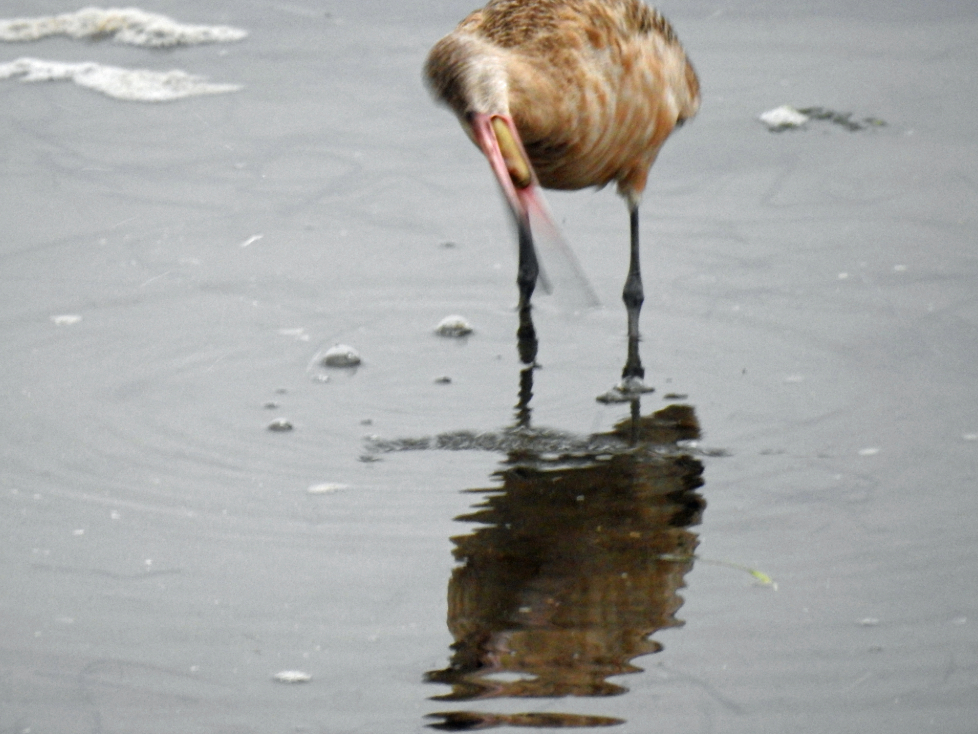
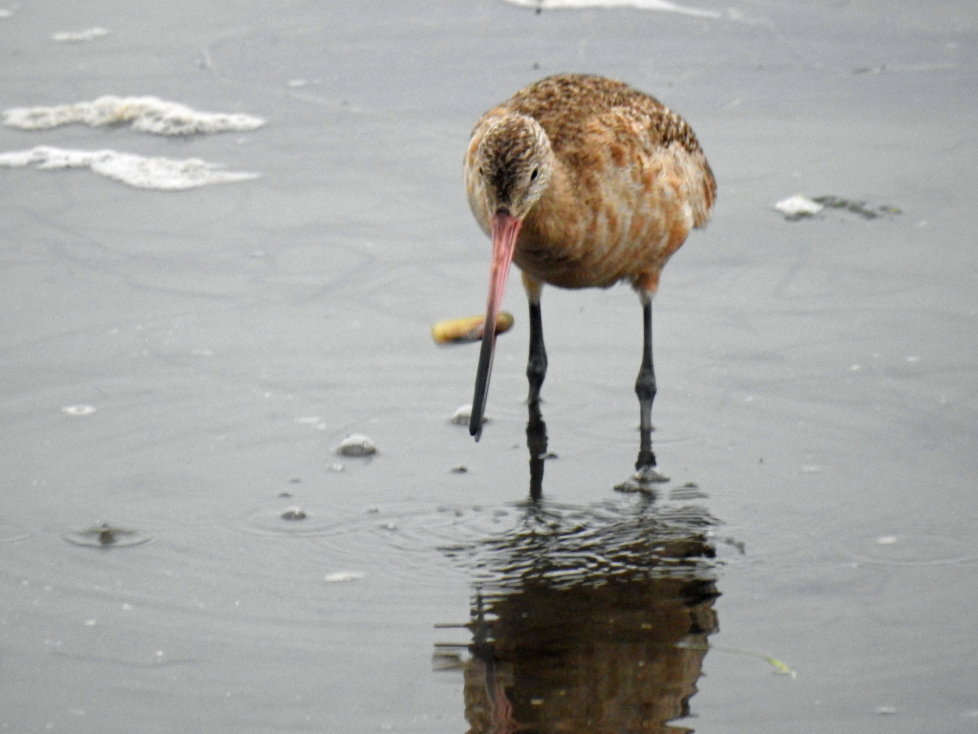

Figure 04. In this series of photos (from May 11, 2021), this Marbled Godwit is deciding not to swallow something that was in its mouth. Something about the item’s taste or texture deterred the godwit from swallowing it.
Birds’ taste receptors are strategically located at the base of the tongue (not on the tip), on the palate, and at the throat, often near the salivary glands, which moisten food for optimal taste perception. Most birds have about 300 (30–400) taste buds, each of which holds many chemical receptors for detecting particular tastes: salty, sour, bitter, sweet, and umami (i.e., amino acids).
The receptors can then signal whether or not to swallow the food.
Taste receptors help birds ensure that each food item is not harmful and provides enough nutrients. For instance, insect eaters show strong aversions to some distasteful caterpillars or other insects, hummingbirds and other nectar eaters prefer sweeter nectar, and fruit eaters who crush the fruit before swallowing it (e.g., parrots, waxwings, tanagers) prefer riper, sweeter fruits.
Sanderlings can not only taste food they’re about to swallow, but also detect whether prey are present when they probe their bills into sand or mud. For Sanderlings, though touch receptors are more important for detecting prey, taste plays a key role, too. Some other shorebirds appear to be able to detect the presence of prey in wet sand, as well. At least some species of duck have taste receptors in the tip of the bill, where the duck first contacts a food item. Perhaps some shorebirds have taste receptors there, too.

Figure 05. Though Sanderlings sense prey mostly through touch, they also use their sense of taste to detect where to find prey in wet sand.
Magnetic Sense
Most shorebirds migrate thousands of miles to and from breeding grounds and wintering grounds, but how do they achieve this feat? Many sensory cues help to guide migratory birds to and from their breeding and wintering grounds: visual landmarks and guidelines (e.g., coasts, mountain ranges), rotations of the sun or the stars, wafting smells, wavering sounds (especially low-frequency sounds), and more.
“Nearly two-thirds of the [shorebird] species that breed in North America journey from their arctic nesting grounds to winter in Central and South America, and then return to the Arctic the following spring. Many species traverse more than 15,000 miles in this annual circuit. Some fly at altitudes exceeding 10,000 feet and achieve cruising speeds approaching 50 mph. . . . . at least some birds on nonstop flights cover nearly 2,000 miles in less than two days” (Ehrlich, Dobkin, & Wheye, 1988).
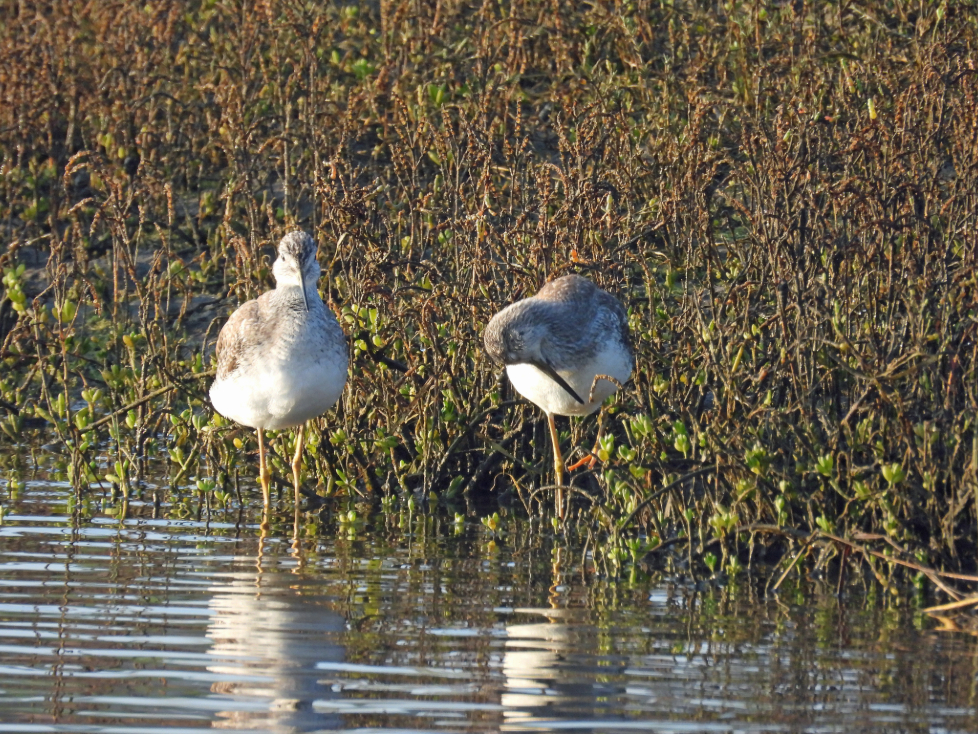
Figure 06 a–c. Six San Diego shorebirds are known long-distance migrants: Black-bellied Plovers, Greater Yellowlegs, Least Sandpipers, Red-necked Phalaropes, Sanderlings (see Figure 05), and Western Sandpipers. (a) Black-bellied Plovers typically migrate at night in small flocks (from a few plovers to more than 100). (b) Greater Yellowlegs migrate from subarctic breeding grounds to and from the southern United States or even southern Chile, probably in a series of short hops of a few-hundred miles. (c) Least Sandpipers migrate between subarctic breeding grounds and wintering grounds as far away as northern South America, with females migrating farther south than males.

Figure 06 d–f. Three more of San Diego’s long-distance migrant shorebirds: (d) Red-necked Phalaropes migrate over land more than other phalaropes do, but most spend the winter at sea most of the time. (e) Sanderlings (see Figure 05) spend the winter in either temperate or tropical climes, so their migration distances (1,800–6,200 miles, 3,000–10,000 km) and durations vary widely. (f) Western Sandpipers migrate from western Alaska to wintering grounds as far south as coastal Peru.
In addition to these sensory cues, one other sense plays a key role: the magnetic sense of many birds, in tune with Earth’s magnetic field. Earth’s magnetic field varies with Earth’s latitude and longitude, more intense in some locations than in others, and having a directional component.

Figure 07. Whimbrels and Spotted Sandpipers migrate between intermediate and long distances, with some shorebirds migrating much farther than others. (g) During migration, most Whimbrels stick to the ocean or the coast, with some flying nonstop 2,500 miles (4,000 km), but others relying on staging areas where up to 1,000 birds will stop over. (h) Spotted Sandpipers migrate singly or in small groups; female adults typically migrate first, followed by male adults and then juveniles.
Many birds — perhaps most — have particles of magnetite (iron oxide) in their heads, within the bill, the skin, or inside the bird’s nasal cavities. These infinitesimal particles can detect Earth’s magnetic field, acting both to orient the bird (where am I?) and to guide the bird in navigation (where am I going?). Additionally, at least some birds may have magnetoreceptor cells in the retina of one or both eyes, which interact with the photoreceptors there. These receptors enable the bird to “see” Earth’s magnetic field and to use that sensory information to navigate.
Figure 08. Willets and Marbled Godwits may migrate short, intermediate, or long distances. (i) Willets (see Figure 03) typically fly at night, in small flocks, stopping to winter along the Pacific coast anywhere from California to central Chile; (j) Marbled Godwits typically winter in southern California or Mexico, and some individuals may linger on the wintering grounds all year long.
Figure 09. (k) Semipalmated Plovers may travel either intermediate or long distances, between Arctic/subarctic breeding grounds and wintering grounds anywhere from southern North America to southern South America, mostly at coastal locations.


Figure 10. Killdeers and American Avocets migrate intermediate distances. (l) Killdeers migrate both during daytime and at night, in flocks of 6–30 plovers. (m) Migration patterns of American Avocets aren’t yet well known, but they have been observed at stopover locations for extended stays during migration.
Probably the most impressive migrant shorebird is the Bar-tailed Godwit, who takes just 8 days to travel 6,800 miles (11,000 km) — nonstop! — from Alaska to New Zealand. Even diminutive Sanderlings (see Figure 05) migrate from their arctic breeding grounds across the top of North America, south along the Atlantic coast, to winter in South America, then they fly north along the Pacific coast, by way of San Diego, California, to return to their breeding grounds.


Figure 11. Three other shorebirds migrate short to intermediate distances: (n) Black Turnstones (see Figure 01) migrate along the Pacific coast south as short a distance as southern Alaska or as far away as Mexico. (o) Black-necked Stilts migrate to California, Mexico, or Central America, stopping along the way for extended stays en route. (p) Long-billed Curlews may migrate a little more than 1,500 miles (2,400 km), but many don’t migrate far; they have been heard vocalizing in flight during the early evening; they disperse pretty widely during migration, with more than 10 different stopover sites noted.
During these and many other astonishing migrations, birds must be able to stay on their migration route despite changes in the position of the sun or the stars, strong winds and other hazardous weather, exhaustion, and hunger. Perhaps more astonishing, birds must memorize all of the necessary sensory clues to their migration after just one trip, and then remember them in the reverse order for the return trip. Not surprisingly, the more often a bird migrates, the more ably the bird can travel the route, even when displaced by storms or other unexpected events. About 70% of songbirds never complete their first migration (Hore & Mouritsen, 2022). More experienced migrating birds succeed much more often.
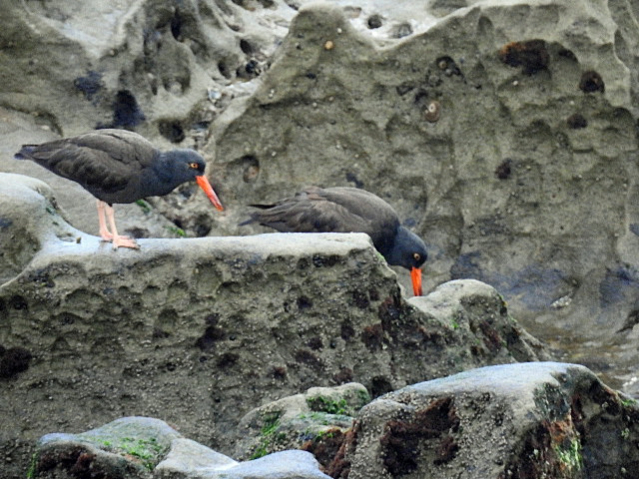
Figure 12. Another San Diego shorebird migrates only short distances, if at all: the Black Oystercatcher. Migratory flocks have been observed flying less than 3 feet (1m) above the water, seldom flying over land.
Text and images by Shari Dorantes Hatch. Copyright © 2025. All rights reserved.
Resources
Books
- Elphick, Chris, John B. Dunning, Jr, & David Allen Sibley. (2001). The Sibley Guide to Bird Life & Behavior. New York: Alfred A. Knopf. (Illustrated by David Allen Sibley).
- Elphick, Jonathan. (2016). Birds: A Complete Guide to Their Biology and Behavior. Buffalo, NY: Firefly Books.
- Kricher, John. (2020). Peterson Reference Guide to Bird Behavior. New York: Houghton Mifflin Harcourt.
- Lovette, Irby, & John Fitzpatrick (eds.), (2016). The Cornell Lab of Ornithology Handbook of Bird Biology (3rd ed.). Hoboken, NJ: Wiley.
- Morrison, Michael L., Amanda D. Rodewald, Gary Voelker, Melanie R. Colón, Jonathan F. Prather (Eds.). (2018). Ornithology: Foundation, Analysis, and Application. Baltimore: Johns Hopkins University Press.
- Stokes, Donald W., and Lillian. (1983). A Guide to Bird Behavior, Volume II: In the Wild and at Your Feeder. Boston: Little, Brown and Company. Vol. 2. Stokes Illustrated by John Sill, Deborah Prince, and Donald Stokes.
- Killdeer, pp. 23–35
- Spotted Sandpiper, pp. 37–47
Birds of the World (Cornell Lab of Ornithology, online subscription)
- Oystercatchers (Haematopodidae) — Winkler, D. W., S. M. Billerman, and I. J. Lovette (2020). Oystercatchers (Haematopodidae), version 1.0. In Birds of the World (S. M. Billerman, B. K. Keeney, P. G. Rodewald, and T. S. Schulenberg, Editors). Cornell Lab of Ornithology, Ithaca, NY, USA. https://doi.org/10.2173/bow.haemat1.01. 1 Genera, 12 Species
- Black Oystercatcher, Haematopus bachmani — Brad A. Andres and Gary A. Falxa, Version: 1.0 — Published March 4, 2020, Text last updated January 1, 1995
- Plovers and Lapwings (Charadriidae) — Winkler, D. W., S. M. Billerman, and I. J. Lovette (2020). Plovers and Lapwings (Charadriidae), version 1.0. In Birds of the World (S. M. Billerman, B. K. Keeney, P. G. Rodewald, and T. S. Schulenberg, Editors). Cornell Lab of Ornithology, Ithaca, NY, USA. https://doi.org/10.2173/bow.charad1.01. 12 Genera, 69 Species
- Killdeer, Charadrius vociferus — Bette J. Jackson and Jerome A. Jackson, Version: 1.0 — Published March 4, 2020, Text last updated January 1, 2000
- Semipalmated Plover, Charadrius semipalmatus — Erica Nol and Michele S. Blanken, Version: 1.0 — Published March 4, 2020, Text last updated September 9, 2014
- Black-bellied Plover, Pluvialis squatarola — Alan F. Poole, Peter Pyle, Michael A. Patten, and Dennis R. Paulson, Version: 1.0 — Published March 4, 2020
- Sandpipers and Allies (Scolopacidae) — Winkler, D. W., S. M. Billerman, and I. J. Lovette (2020). Sandpipers and Allies (Scolopacidae), version 1.0. In Birds of the World (S. M. Billerman, B. K. Keeney, P. G. Rodewald, and T. S. Schulenberg, Editors). Cornell Lab of Ornithology, Ithaca, NY, USA. https://doi.org/10.2173/bow.scolop2.01 15 Genera, 97 Species
- Willet, Tringa semipalmata — Lowther, P. E., H. D. Douglas III, and C. L. Gratto-Trevor (2020). Willet (Tringa semipalmata), version 1.0. In Birds of the World (A. F. Poole and F. B. Gill, Editors). Cornell Lab of Ornithology, Ithaca, NY, USA. https://doi.org/10.2173/bow.willet1.01
- Greater Yellowlegs, Tringa melanoleuca — Elphick, C. S. and T. L. Tibbitts (2020). Greater Yellowlegs (Tringa melanoleuca), version 1.0. In Birds of the World (A. F. Poole and F. B. Gill, Editors). Cornell Lab of Ornithology, Ithaca, NY, USA. https://doi.org/10.2173/bow.greyel.01
- Marbled Godwit, Limosa fedoa — Gratto-Trevor, C. L. (2020). Marbled Godwit (Limosa fedoa), version 1.0. In Birds of the World (A. F. Poole and F. B. Gill, Editors). Cornell Lab of Ornithology, Ithaca, NY, USA. https://doi.org/10.2173/bow.margod.01
- Long-billed Curlew, Numenius americanus — Dugger, B. D. and K. M. Dugger (2020). Long-billed Curlew (Numenius americanus), version 1.0. In Birds of the World (A. F. Poole and F. B. Gill, Editors). Cornell Lab of Ornithology, Ithaca, NY, USA. https://doi.org/10.2173/bow.lobcur.01
- Whimbrel, Numenius phaeopus — Skeel, M. A. and E. P. Mallory (2020). Whimbrel (Numenius phaeopus), version 1.0. In Birds of the World (S. M. Billerman, Editor). Cornell Lab of Ornithology, Ithaca, NY, USA. https://doi.org/10.2173/bow.whimbr.01
- Spotted Sandpiper, Actitis macularius — J. Michael Reed, Lewis W. Oring, and Elizabeth M. Gray, Version: 1.0 — Published March 4, 2020, Text last updated January 30, 2013
- Western Sandpiper, Calidris mauri — Samantha E. Franks, David B. Lank, and W. Herbert Wilson Jr., Version: 1.0 — Published March 4, 2020, Text last updated January 31, 2014
- Least Sandpiper, Calidris minutilla — Silke Nebel and John M. Cooper, Version: 1.0 — Published March 4, 2020, Text last updated September 9, 2008
- Sanderling, Calidris alba — R. Bruce Macwhirter, Peter Austin-Smith Jr., and Donald E. Kroodsma, Version: 1.0 — Published March 4, 2020, Text last updated January 1, 2002
- Black Turnstone, Arenaria melanocephala — Colleen M. Handel and Robert E. Gill, Version: 1.0 — Published March 4, 2020, Text last updated January 1, 2001
- Red-necked Phalarope, Phalaropus lobatus — Margaret A. Rubega, Douglas Schamel, and Diane M. Tracy, Version: 1.0 — Published March 4, 2020
- Stilts and Avocets (Recurvirostridae) — Winkler, D. W., S. M. Billerman, and I. J. Lovette (2020). Stilts and Avocets (Recurvirostridae), version 1.0. In Birds of the World (S. M. Billerman, B. K. Keeney, P. G. Rodewald, and T. S. Schulenberg, Editors). Cornell Lab of Ornithology, Ithaca, NY, USA. https://doi.org/10.2173/bow.recurv1.01 — 3 Genera, 9 Species
- Black-necked Stilt, Himantopus mexicanus — Julie A. Robinson, J. Michael Reed, Joseph P. Skorupa, and Lewis W. Oring, Version: 1.0 — Published March 4, 2020, Text last updated January 1, 1999
- American Avocet, Recurvirostra americana — Joshua T. Ackerman, C. Alex Hartman, Mark P. Herzog, John Y. Takekawa, Julie A. Robinson, Lewis W. Oring, Joseph P. Skorupa, and Ruth Boettcher, Version: 1.0 — Published March 4, 2020, Text last updated January 3, 2013
Other Resources
- Ehrlich, Paul R., David S. Dobkin, & Darryl Wheye (1988). “Shorebird Migration.” https://web.stanford.edu/group/stanfordbirds/text/essays/Shorebird_Migration.html . Retrieved May 18, 2025
- Hore, Peter J., & Henrik Mouritsen (April 1, 2022), “How Migrating Birds Use Quantum Effects to Navigate,” Scientific American, https://www.scientificamerican.com/article/how-migrating-birds-use-quantum-effects-to-navigate/

 Bird Brain
Leave a comment