
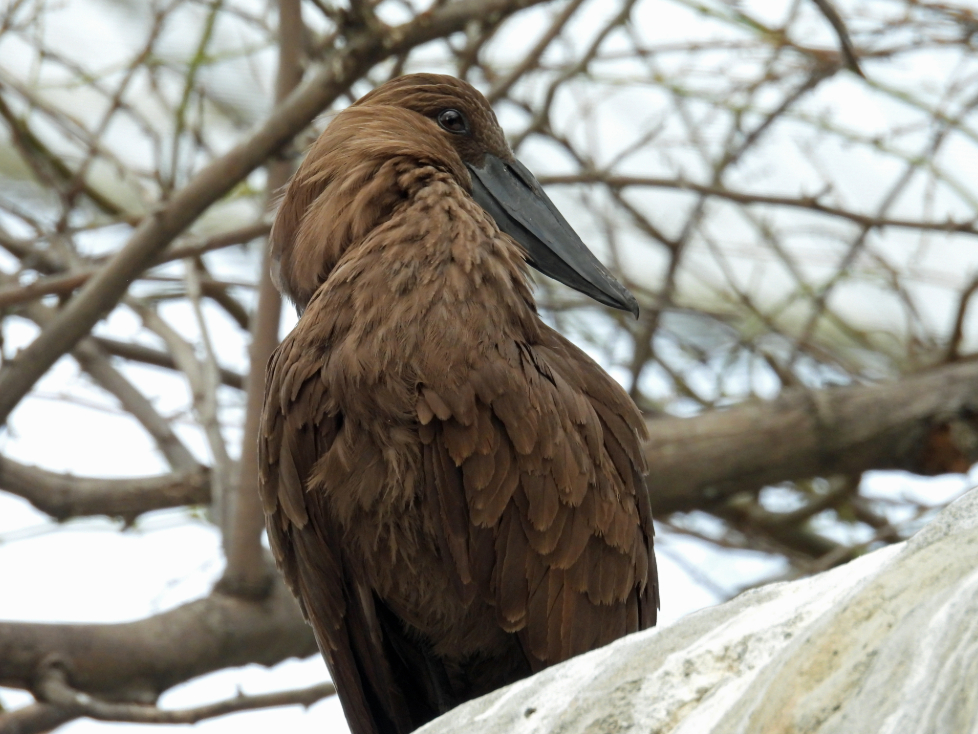
Is this Hamerkop enjoying a whiff of something delightful? We are just now learning how smells are affecting birds in all aspects of their lives.
- How Do Birds Detect Smells?
- Sniffing for Food
- Stinky Birds
- Finding the Best-smelling Mate
- The Scent of Eggs and Hatchlings (e.g., Eurasian Hoopoe)
- Sensational Studies
- Resources
- Books
- Online Resources
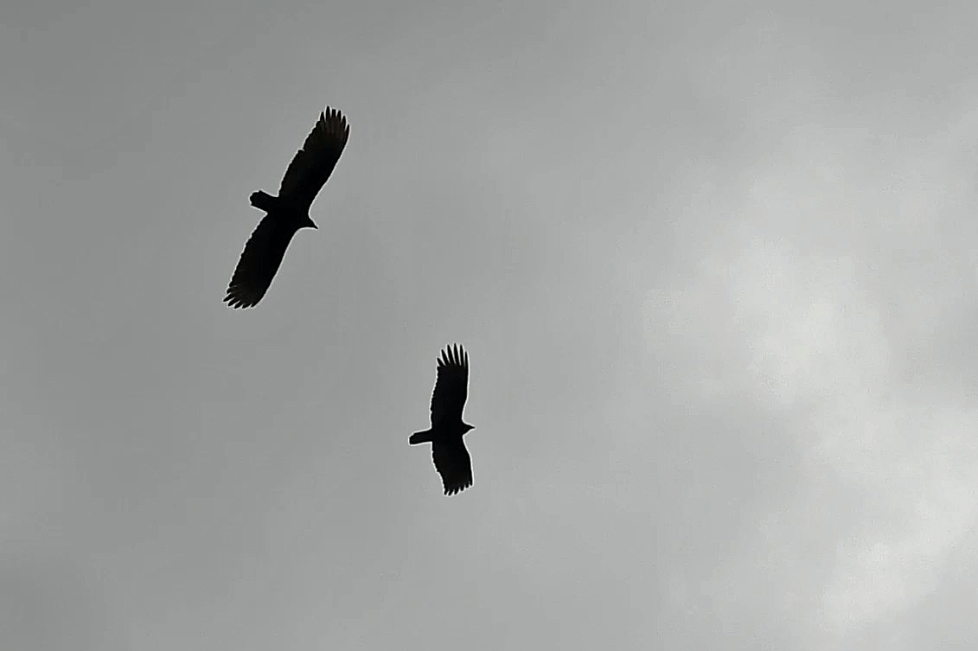
Turkey Vultures prompted many ornithologists to reconsider how well birds smell and how much scent affects how they live.
How Do Birds Detect Smells?
With rare exceptions, a bird inhales air through a pair of nares (nostrils) at the top of the base of its bill. This inhaled air contains chemical molecules with odor information about the surrounding environment. After passing through the nares, this air goes through the choanae, also called “internal nostrils,” opening at the back of the nasal cavity at the roof of the mouth. The choanae lead into the elaborate chambers of mucus-lined nasal conchae (slender bony or cartilaginous scrolls) that not only detect odors, but also filter, warm, and moisten the air. (Chemical odorant molecules must be moist to be detected as smells.) The more convoluted the conchae, the more surface area there is for receptor cells. Because the conchae also receive air from the oral cavity, food in the mouth can be smelled, as well.
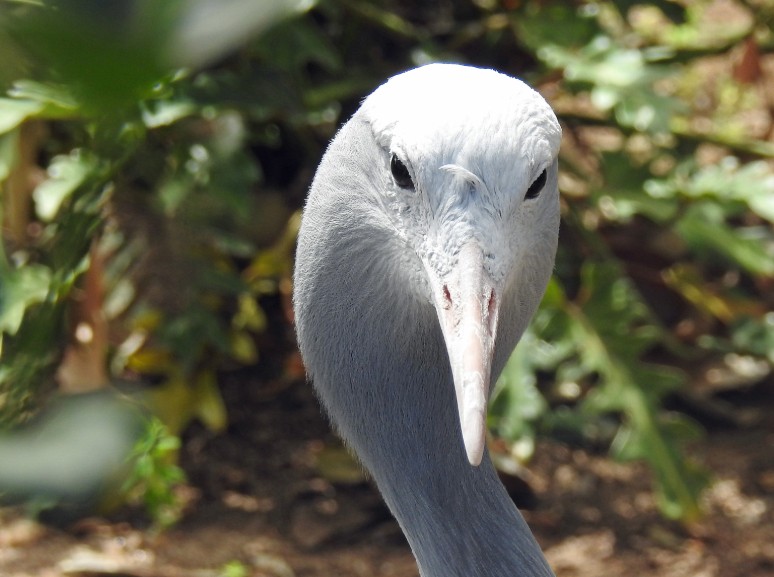
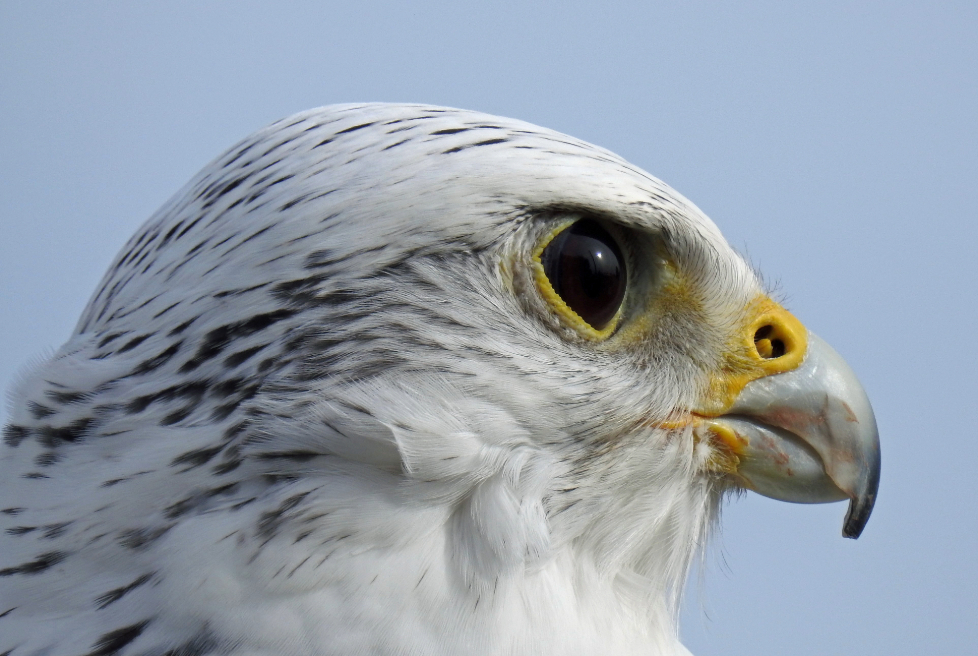
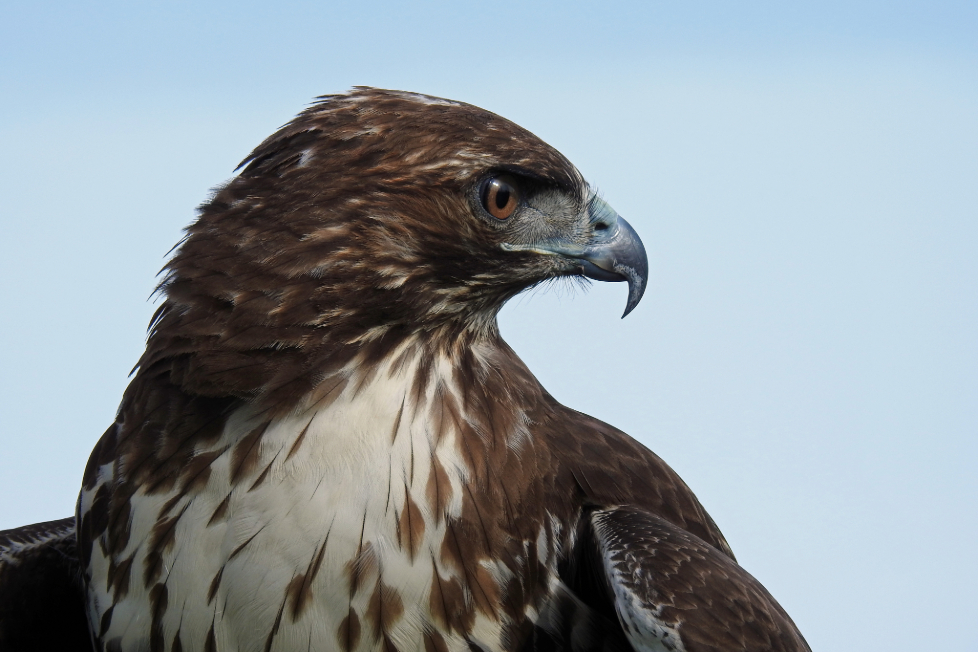
Figure 01. Nares (nostrils). (a) The nares on top of the base of this Blue Crane’s bill are easy to see. They’re harder to spot on some other birds. (I tried to find them on photos of toucans and couldn’t!) (b) Falcons, which speed through the air while diving onto prey, have tiny cones inside their nares, which lessen the force of the air entering their nostrils. (c) Hawks don’t speed-dive, so their nares lack these cone structures. Some ground-feeding birds (e.g., pigeons, chickens) have little flaps of skin covering their nares while they’re snuffling along the ground, as do some water-diving birds. The nares of some divers (e.g., cormorants) are completely enclosed to keep out water when they’re diving. In short, just as bills vary widely, so do the sizes and shapes of the nares.
The mucousy conchae are lined with myriad sensory receptors, each of which is attuned to particular odorants. Distinctive odorants in the inhaled air activate these receptors by binding to them. When activated, the receptors transmit information to neurons in the bird’s olfactory bulb, located at the front of the brain, near the nostrils.
Figuring out a link. The size of the olfactory bulb doesn’t directly equate to olfaction (sensation of smell), though size often roughly indicates olfactory ability. A better indicator is the number of genes devoted to olfaction, but this link, too, isn’t definitive. The number and variety of olfactory receptors does indicate olfactory ability, but it’s challenging to determine both the number and the variety of olfactory receptors in a given species. Studying nature can be challenging!
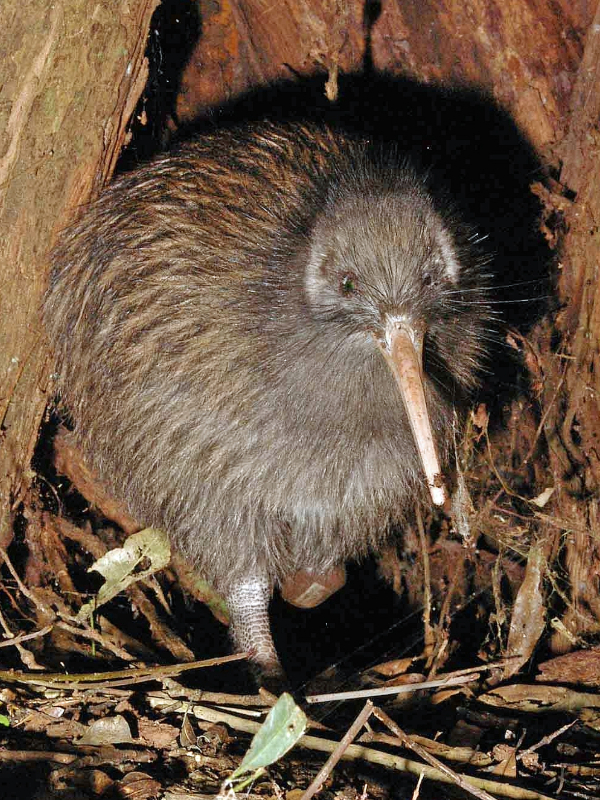
Figure 02. Nocturnal New Zealand Kiwis are the only birds with nostrils at the tips of their beaks. Their bill tips also have touch receptors, so when they’re snuffling through leaf litter, they can follow the scent to their prey — worms and insects — then instantly detect prey they touch. Observers say they can easily hear kiwis sniffing out their prey, perhaps also clearing their nostrils, as well as gathering scents. Source: https://en.wikipedia.org/wiki/Kiwi_(bird)#/media/File:TeTuatahianui.jpg. This work has been released into the public domain by its author, Maungatautari Ecological Island Trust. This applies worldwide. If shared, attribution must be included.
The olfactory bulb processes the incoming information and sends it on to particular areas of the brain for further processing. The brain sorts this information into identifiable odors, either linking the odors to previous experiences or flagging the odors as novel, linked to this particular experiential context.
Quick learners: For quite a few birds, by the time an embryo has pipped an opening in the shell, it has learned to identify the distinctive odors of its nest and its parents. In addition, many hatchlings learn the distinctive aroma of their hatch-place, ably returning to it months or even years later.
Sniffing for Food
Some birds can detect smells better than others. Quite a few nocturnal birds use smell expertly. For instance, Oilbirds live in communal lightless caves by day. At night, they leave home to fly slowly over the tree canopy, sniffing for ripe, aromatic, high-fat fruits. At night’s end, they return to their dark crowded caves, flying slowly, mostly using sound (echolocation clicks) to guide them, while avoiding collisions with other oilbirds.
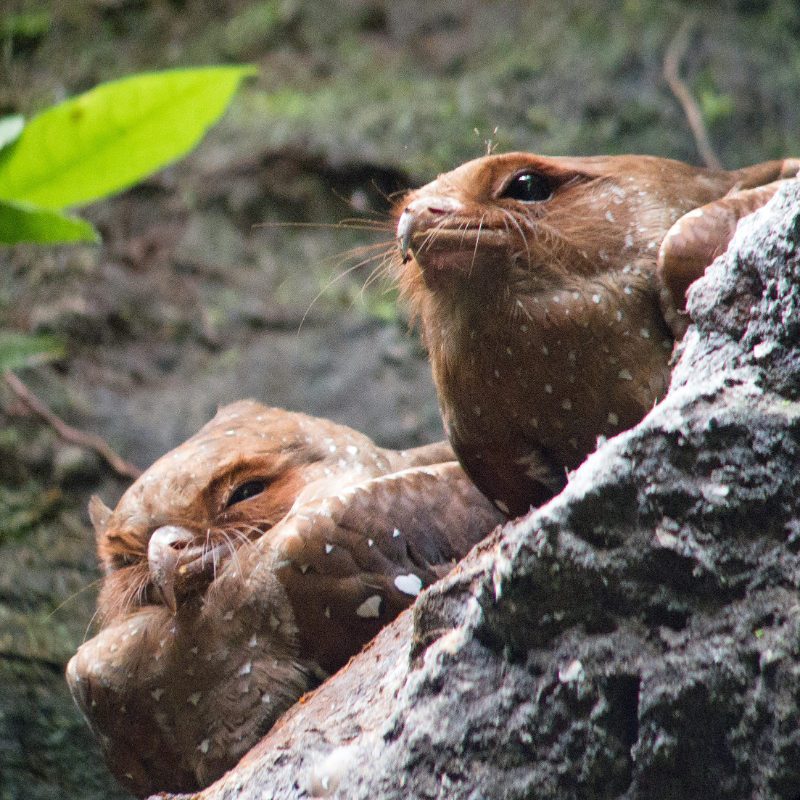
Figure 03. Oilbirds swallow whole fruits while hovering above the trees, then they digest the pulp and regurgitate the seeds; they play a key role in dispersing fruit seeds in neotropical forests. Oilbirds don’t walk on the ground, but they do shuffle along narrow cave ledges, with all four of their toes spread out and pointing forward (called pamprodactyly). Oilbird parents preen each other during courtship, and both monogamous parents incubate, brood, and care for their young. Source: By Eric Gropp from USA – Roosting Oilbirds in Ecuador, CC BY 2.0, https://commons.wikimedia.org/w/index.php?curid=56704012. This file is licensed under the Creative Commons Attribution 2.0 Generic license. Available to share if attribution is given.
Whereas nocturnal kiwis use their sharp sense of smell to find prey beneath the soil, some diurnal (daytime) birds use smell to detect prey from high in the skies. While soaring on thermal air currents, North American vultures, such as California Condors and Turkey Vultures, keenly detect scents arising from fresh carrion (no more than a few days old; they don’t like rotting, putrid flesh). On the ground, woodcocks and many other shorebirds rely on smell to detect earthworms and other invertebrates beneath the mud, sand, or soil. Smells can even help some shorebirds and others to locate places to forage where food is more abundant. A study of Great Tits (a woodland passerine; passerines include songbirds) suggests that they can sniff out areas or even particular trees where they’re likely to find lots of the caterpillars they like to eat.
Over the ocean, “tube-nosed” seabirds (albatrosses, petrels, storm-petrels, and shearwaters) sniff for aromas wafting from phytoplankton (tiny aquatic plants) being eaten. These seabirds don’t eat phytoplankton, but they do eat the krill (zooplankton, tiny aquatic animals), squids, and fishes that feed on phytoplankton. Snowy Albatrosses (aka Wandering Albatrosses) rely on smell to detect prey almost half the time.
Fun facts: The Snowy Albatross’s wingspan (254–351 cm, 100–138″) is the largest of any bird. They form monogamous pairs who share in incubating their eggs and rearing their chicks; they live about 50 years, but possibly up to 80 years. In a smaller albatross species, a Laysan Albatross, a female of named “Wisdom” is the oldest wild bird whose age has been documented. In 2021, when at least 70 years old, another of Wisdom’s chicks successfully hatched. Laysan Albatross parents have also been known heard to “talk” to their eggs.
Tube-nosed seabirds have extended tubes alongside their bills, which completely enclose their nares. Having one tube on each side of the bill may make it easier to detect the direction from which a scent is approaching them. To have the best chance of catching a whiff of potential prey, tube-noses glide over the sea in a zigzag pattern, rather than in a straight line. This way of gliding also enables them to take advantage of how air moves across the sea.
Tube-nosed seabirds also follow their nostrils to find their remote-island breeding colonies from thousands of miles away. When birds have had their sense of smell blocked, they either took excessively long times to get home, or they never made it home at all. Tube-noses can also readily find their own mate and nest in a densely packed colony of nests.
Other birds use odorous trail markers, too. At least some species of starlings, swifts, catbirds, and pigeons/doves can follow scent trails. Homing pigeons use scent and other senses to find their way home. For birds that migrate at night (as many do!), scent trails may be important to getting where they want to go. It’s thought that perhaps an individual bird’s scent trail may lead a bird home or may even lead its partner to where it is.
On the other hand, some birds can’t smell well at all. In fact, whole families of birds — Sulidae, Phalacrocoracidae, and Anhigidae — have no external nostrils. Without external nostrils, they can dive deeply into water, but to breathe, their mouths must be open. It seems unlikely that they — or other divers, such as Brown Pelicans — can smell well, if at all.
Stinky Birds
Birds not only detect smells, but they also exude smells. We mammals exude smells in our sweat, farts, urine, and feces, but birds don’t sweat, fart, or urinate. Instead, birds excrete pungent semisolid uric acid and digestive waste in odiferous feces. These excrement odors can reveal quite a bit about the excreter.
Birds reveal far more, however, through the diverse aromas arising from their rumps, through uropygial glands, which secrete preen oil. Among other things, preen oil contains antimicrobial bacteria and other substances that protect birds’ feathers from degrading. The oil may also release odors that identify the bird: by species, sex, health status, hormone status, and individual identity. It’s thought that at least some birds produce their own distinctive odor profile (or “odor signature”) unique to that bird (tube-noses, of course, but also at least some passerines). Odors also vary by season and other contextual factors. For instance, in some places, during mosquito season, the preen oil of some birds seems to contain a mosquito-repellent scent.
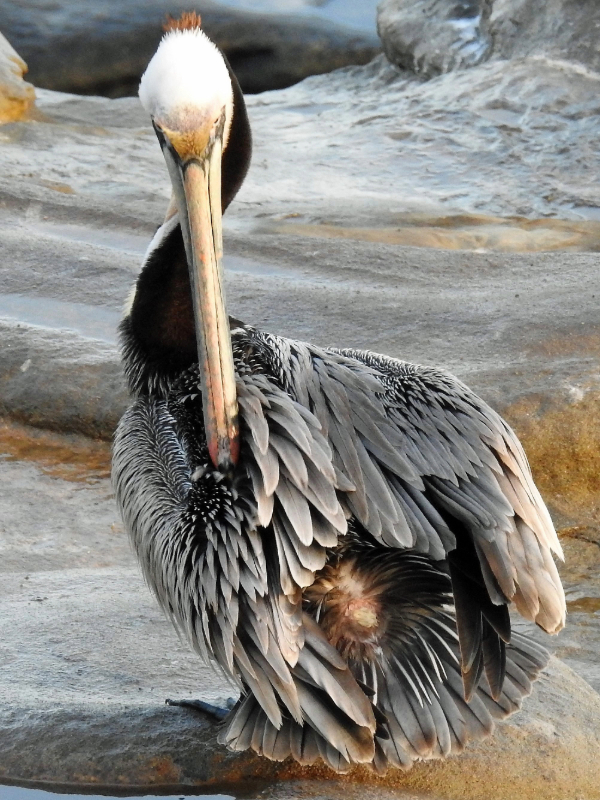
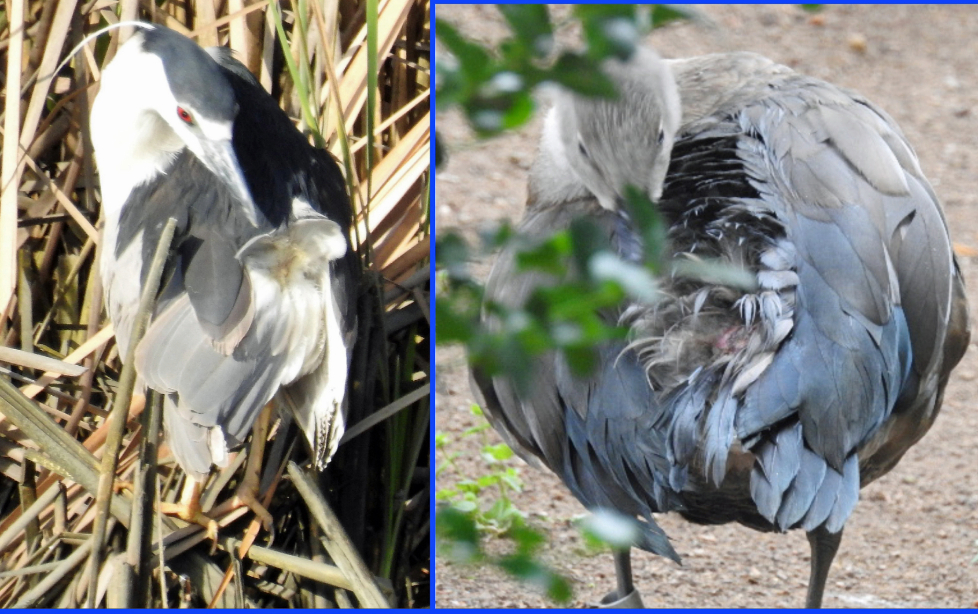
Figure 04. Feather maintenance is vital to flight, and every flighted bird spends many hours a day preening, coating its feathers with oil from the uropygial gland in its rump. Here you can see the uropygial glands of (a) a Brown Pelican and (b) a Black-crowned Night Heron and (c) a Blue Goose.
“All living things produce chemical substances that other living things detect with the . . . chemical senses, smell and taste” (p. 20, Danielle J. Whittaker, The Secret Perfume of Birds: Uncovering the Science of Avian Scent).
Figure 05. In her The Secret Perfume of Birds, Danielle Whittaker wondered about whether birds use their bills to send scent signals or to mark their scents. When birds preen their feathers, they use their bills to gather preen oil from their uropygial glands in their rump. Presumably, some of the preen oil remains on their bills, even after preening their feathers. When birds feak their bills by rubbing them against a branch, are they marking the branch with their scent? Is this Black-spotted Barbet sending a scent signal? Whittaker noticed that male juncos (passerine songbirds) did much more feaking when they were courting a female.
Finding the Best-smelling Mate
To procreate, birds must find and be found by other birds. Smell offers one way to do so, especially during courtship. Male and female birds exude distinct pheromones, chemicals that stimulate a recipient’s response. When a bird is physiologically ready to mate, sexual pheromones signal this readiness to prospective mates. These chemical signals help birds avoid wasting valuable energy trying to copulate fruitlessly.
Figure 06. Is this pair of Hadada Ibises sending scent signals to each other while they work on their nest?
Odors may also help to choose among potential mates. Strongly male-smelling males appeal more to females, and female-smelling females attract more males. Both sexes prefer the scents of healthy mates whose high-quality genes differ greatly from their own genes (no inbreeding, please). Smell can also enhance pair bonding. During breeding season, Crested Auklet pairs strengthen their bond by nuzzling each other’s tangerine-scented napes (on the back of the neck, where a bird can’t easily reach on her- or himself). These scents are somehow exuded directly onto the nape feathers, not placed there from uropygial-gland secretions.
The Scent of Eggs and Hatchlings
In Red Knots, some other shorebirds, and some ducks, the potent, highly volatile odors of courtship subside, as both parents start to incubate their eggs. Their subtler, less volatile scent helps to hide the nest from potential predators who might otherwise sniff out the brood. Many birds also use smell to choose antimicrobial materials for their nests, to keep down ectoparasites, which feed on chicks’ skin and feathers, harming the chicks.
Figure 07. As this pair of Superb Starlings gathers nest materials, are they sniffing for materials that will repel microbes and parasites that might harm their chicks? (Both Superb Starling parents help build the nest, but only the mom incubates the eggs. Once the eggs hatch, both parents care for the young, as do other adults in their colony.)
Nest parasites aren’t the only threat to chicks. Brood parasites, such as cuckoos, lay their eggs in other birds’ nests, often to the detriment of the eggs or chicks of the caregiving parents. Juncos can use scent to detect when another bird has been in their nest, at least if the parent arrives soon after the offending bird has left. If the juncos detect a foreign scent, they quickly get rid of the offending egg, protecting their own chicks. Zebra Finch moms also recognize — and prefer — the scent of their own eggs over that of other moms’ eggs. (Many chicks can recognize their own mom’s scent, too.) Another passerine species, House Finches (and perhaps other birds), may be able to use scent to detect another threat to chicks: predators (e.g., domestic cats).
Instead of trying to hide their chicks from danger, some moms go on the offensive, exuding fetid odors while incubating eggs and rearing chicks. For instance, in the preen oil of cavity-nesting Eurasian Hoopoe moms, Enterococcus bacteria multiply astronomically, making it thick, dark, and putrid. These smelly bacteria ravenously devour harmful microbes, so when the hoopoe mom smears this oil over her eggs, she protects her embryos from infection. An unrelated bird, the junco mom, also uses her own preen oil for her young, smearing it onto her hatchlings, to protect them from ectoparasites.
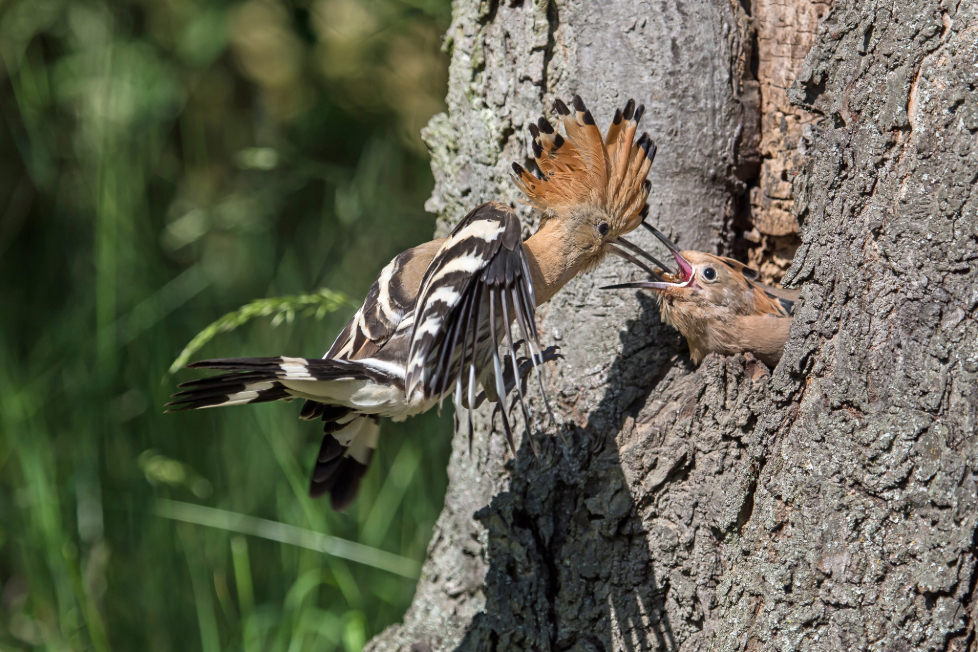
Figure 08. Before her chicks hatched, this Eurasian Hoopoe mom smeared her eggs with stinky antimicrobial oil from her uropygial gland. Source: https://en.wikipedia.org/wiki/Hoopoe#/media/File:Wiedehopf_beim_F%C3%BCtterungsanflug_im_Naturschutzgebiet_Glockenbuckel_von_Viernheim.jpg (By Hwbund – Own work, CC BY-SA 4.0, https://commons.wikimedia.org/w/index.php?curid=91713109. “Eurasian Hoopoe (Upupa epops) at their tree-hole in the nature reserve Glockenbuckel von Viernheim.” This file is licensed under the Creative Commons Attribution-Share Alike 4.0 International license. Available to share, with attribution.
Sensational Studies
We’ve known a lot about seeing and hearing for centuries. We humans have been fascinated to study the two key senses we use to understand our surroundings. It’s relatively easy to study these two senses. Seeing is sensing waves of light, measurable in wavelengths (colors) and intensity (brightness); hearing is sensing sound waves, which can be measured in frequency (high/low pitch) and intensity (loudness). Both light and sound move in straight lines extending outward from the source of the light or sound. Scientists can measure light and sound and study how these affect physiological processes and behavior.
Studying smell is much more challenging. Sensations of smell rely on being able to detect molecules of chemical odorants in air or water. Chemical odorant molecules move around unpredictably in myriad directions, depending on air movement, humidity, obstacles, and countless other environmental conditions, so smell is tricky to measure. It’s hard to study how organisms, including birds, can detect odors. Nonetheless, since the 1950s, quite a few bold scientists (e.g., Betsy Bang, Bernice Wenzel) have forged ahead.

Figure 09. Smells can invite us to enjoy many of life’s pleasures, especially food. Good-looking food is nice, but good-smelling food (muffins, berries, lemons, pizza, roasted beets, coffee) is great!
“Many living things can sense light. Some can respond to sound. A select few can detect electric and magnetic fields. But every thing, perhaps without exception, can detect chemicals. Even a bacterium, . . . can find food and avoid danger by picking up on molecular clues from the outside world.” (p. 26, Ed Yong, An Immense World: How Animal Senses Reveal, the Hidden Realms around Us)
Resources
Initially, this blog was just going to be highlights from Danielle Whittaker’s delightful book, The Secret Perfume of Birds: Uncovering the Science of Avian Scent, but the more I wrote, the more I wanted to know, and I ended up looking through many other books (some of which I had previously read), as well as many articles about bird families and species from the Cornell Lab of Ornithology’s Birds of the World. To find usable images of birds, I also looked up birds in Wikipedia, where I found even more fascinating information.
Books
- Birkhead, Tim (2012). Bird Sense: What It’s Like to Be a Bird. New York: Bloomsbury.
- Lovette, Irby, & John Fitzpatrick (eds.), (2016). The Cornell Lab of Ornithology Handbook of Bird Biology (3rd ed.). Hoboken, NJ: Wiley.
- McGee, Harold. (2020). Nose Dive: A Field Guide to the World’s Smells. New York: Penguin Press.
- Morrison, Michael L., Amanda D. Rodewald, Gary Voelker, Melanie R. Colón, Jonathan F. Prather (Eds.). (2018). Ornithology: Foundation, Analysis, and Application. Baltimore: Johns Hopkins University Press.
- Whittaker, Danielle J. (2022). The Secret Perfume of Birds: Uncovering the Science of Avian Scent. Baltimore: Johns Hopkins University Press.
- Yong, Ed (2022). An Immense World: How Animal Senses Reveal, the Hidden Realms around Us. New York: Random House.
Online Resources
- Birds of the World, a paid online subscription from the Cornell Lab of Ornithology, about bird families, genera, and species
- Diomedeidae (Albatrosses) — Winkler, D. W., S. M. Billerman, & I. J. Lovette (2020). Albatrosses (Diomedeidae), version 1.0. In Birds of the World (S. M. Billerman, B. K. Keeney, P. G. Rodewald, & T. S. Schulenberg, Editors). Cornell Lab of Ornithology, Ithaca, NY, USA. https://doi.org/10.2173/bow.diomed1.01
- Laysan Albatross (Phoebastria immutabilis) — Awkerman, J. A., D. J. Anderson, & G. C. Whittow (2020). Laysan Albatross (Phoebastria immutabilis), version 1.0. In Birds of the World (A. F. Poole, Editor). Cornell Lab of Ornithology, Ithaca, NY, USA. https://doi.org/10.2173/bow.layalb.01
- Snowy Albatross (Diomedea exulans) — del Hoyo, J., C. Carboneras, F. Jutglar, N. Collar, G. M. Kirwan, & E. Garcia (2023). Snowy Albatross (Diomedea exulans), version 1.0. In Birds of the World (F. Medrano & B. K. Keeney, Editors). Cornell Lab of Ornithology, Ithaca, NY, USA. https://doi.org/10.2173/bow.wanalb1.01
- Eurasian Hoopoe (Upupa epops) — Mlodinow, S. G. & P. Pyle (2024). Eurasian Hoopoe (Upupa epops), version 2.1. In Birds of the World (S. M. Billerman & G. M. Kirwan, Editors). Cornell Lab of Ornithology, Ithaca, NY, USA. https://doi.org/10.2173/bow.hoopoe.02.1
- Kiwis (Apterygidae) — Winkler, D. W., S. M. Billerman, & I. J. Lovette (2020). Kiwis (Apterygidae), version 1.0. In Birds of the World (S. M. Billerman, B. K. Keeney, P. G. Rodewald, & T. S. Schulenberg, Editors). Cornell Lab of Ornithology, Ithaca, NY, USA. https://doi.org/10.2173/bow.aptery1.01
- Oilbird
- Winkler, D. W., S. M. Billerman, & I. J. Lovette (2024). Oilbird (Steatornithidae), version 2.0. In Birds of the World (S. M. Billerman, B. K. Keeney, P. G. Rodewald, & T. S. Schulenberg, Editors). Cornell Lab of Ornithology, Ithaca, NY, USA. https://doi.org/10.2173/bow.steato1.02
- Bosque, C., A. A. del Risco, & A. Echeverri (2024). Oilbird (Steatornis caripensis), version 2.0. In Birds of the World (F. Medrano, B. K. Keeney, T. S. Schulenberg, & S. M. Billerman, Editors). Cornell Lab of Ornithology, Ithaca, NY, USA. https://doi.org/10.2173/bow.oilbir1.02
- Procellariidae — Winkler, D. W., S. M. Billerman, & I. J. Lovette (2020). Shearwaters & Petrels (Procellariidae), version 1.0. In Birds of the World (S. M. Billerman, B. K. Keeney, P. G. Rodewald, & T. S. Schulenberg, Editors). Cornell Lab of Ornithology, Ithaca, NY, USA. https://doi.org/10.2173/bow.procel3.01
- Diomedeidae (Albatrosses) — Winkler, D. W., S. M. Billerman, & I. J. Lovette (2020). Albatrosses (Diomedeidae), version 1.0. In Birds of the World (S. M. Billerman, B. K. Keeney, P. G. Rodewald, & T. S. Schulenberg, Editors). Cornell Lab of Ornithology, Ithaca, NY, USA. https://doi.org/10.2173/bow.diomed1.01
- Wikipedia, regarding particular species:


#/media/File:TeTuatahianui.jpg)

Leave a comment