
Sunday, March 2, 2025, I took a one-hour stroll through the San Diego Zoo Safari Park’s “Wings of the World” aviary. Previously, I posted images and information about 10 of the 20 species I captured there. Today, I’m posting about the remaining 10 of the 20. Please let me know what you think, and I’ll either do more of these or fewer.
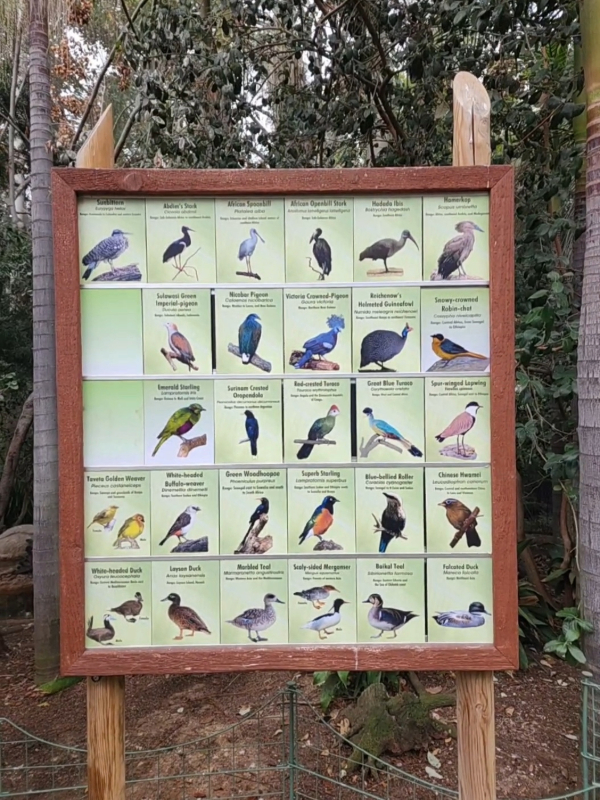
According to the signage, there are actually 28 species of birds in the San Diego Zoo Safari Park’s “Wings of the World” aviary. In my one-hour stroll through the aviary, I captured images of only 20, 10 of which appeared in a previous blog and 10 appear in this blog. More to find on my next visit!
- Pelecaniformes
- Columbiformes
- Ciconiiformes
- Charadriiformes
- Bucerotiformes
- Phoeniculidae
- Resources
Pelecaniformes
In general, Pelecaniformes are biggish, medium- to large-sized waterbirds, who make their homes throughout the world. Most Pelecaniformes have bare skin on their gular (throat) area, and they breathe through their mouths, as their nares (nostrils) are typically dysfunctional slits. For most, their longest toe has a pectinate nail, shaped like a comb, to make it easy to comb through their feathers when preening. Pelecaniformes eat mostly marine vertebrates (e.g., fish) and invertebrates (e.g., squid). Though most nest colonially, they do so in monogamous pairs. Their hatchlings are altricial,* completely depending on their parents not only for food but also for thermoregulation (maintaining the right body temperature).
Threskiornithidae
The two main types of birds in the Threskiornithidae family look different because they obtain food differently: Ibises have long, decurved (i.e., curved downward) bills, which help them pull prey out of mud. Spoonbills have long spatulate (i.e., flat with a spoon-shaped tip) bills, which they can sweep side-to-side across the water, to glean prey.
Despite their differences, these two share many similarities. Both mostly prefer to live in open wetlands and like to eat both invertebrates (e.g., mollusks, crustaceans, worms, insects, larvae) and small vertebrates (fish, amphibians, lizards, rodents). Both also exploit tactile senses on their bills to find prey: ibises while probing mud and water, spoonbills while sweeping across water. Both ibises and spoonbills fly buoyantly, with straight necks, appearing quite graceful.
Most threskiornids nest in colonies near water. Threskiornid parents are monogamous and share in caring for their young, from nest construction to incubation to feeding their hatchlings, which are altricial*. The hatchlings of threskiornids look more similar to each other soon after hatching, before their bills become more clearly differentiated.
Hadada Ibis (Bostrychia hagedash)
Hadada Ibises can make a home in many habitats, from marshes to beaches to town parks, but they especially like wooded streams. Their raucous calls can be heard at dawn and dusk year-round (visit https://xeno-canto.org/species/Bostrychia-hagedash to hear some samples). They’re loudly chatty soon after waking and when leaving their nests to find food. Like my family members at a feast, as soon as they start feeding, they quiet down and focus on food. Then when they return to roost, they call loudly to one another again.
Hadada Ibises use their sensitive bill-tips to find prey, mostly invertebrates (insects, as well as crustaceans, spiders, earthworms, snails), but they’ll also snack on small reptiles or frogs. They’re able flyers, quickly taking flight and easily maneuvering through dense forests. These monogamous parents may breed year-round or only during the wet season, sometimes up to four broods/year, whenever enough food is available in the area. Both monogamous parents incubate their eggs, and both feed their young food that they have regurgitated (YUM!). More experienced parents have greater success in rearing young who survive.
Figure 01. Each pair of parents builds its own solitary crude twig-platform nest (which doesn’t prevent all chicks from falling off). Both parents also share in caring for their young. (This video doesn’t show off the iridescent green of their plumage, visible in bright sunlight.)
African Spoonbill (Platalea alba)
African Spoonbills are more often seen at lakes, marshes, and other shallow inland waterways than at coastal lagoons. They don’t truly migrate, but they do roam around within their range, depending on the rainfall.
The African Spoonbill eats mostly fish and aquatic invertebrates, but it loves adding frogs to its diet when available. Its main way of feeding is to wade in shallow water and partly or wholly submerge its bill into the water, sweeping it side to side until it senses prey. Occasionally, it will also chase a fish or probe in the mud.
Hundreds of pairs of African Spoonbills will nest together colonially, often with other species, too (e.g., cormorants or darters). They prefer to build their stick-platform nests on partly submerged trees or in reeds. The parents incubate the eggs for less than a month then care for the hatchlings another month or so.
Figure 02. As if the African Spoonbill’s bill alone weren’t distinctive enough, its bright white plumage and its bare red face and pinkish-red legs, feet, and partly webbed toes certainly stand out. It’s usually quiet when not on its nest, but it does vocalize distinctively on occasion (visit https://xeno-canto.org/species/Platalea-alba for samples).
Scopidae
This entire family has one genus, one species (a second species became extinct during the Pliocene).
Hamerkop (Scopus umbretta)
Its common name, Hamerkop, comes from Afrikaans, for “hammerhead.” Its scientific genus name, Scopus (Latin, “broom of twigs”) probably refers to its ginormous twiggy nest, but it may also point to its tufts of feathers projecting from the back of its head. (Its species name is umbretta — umbra-, Latin, “shade,” -etto, diminutive suffix.)


Figure 03. The Hamerkop seems to be an assemblage of exaggerated features: long crest, long tail, longish legs, long bill — narrow as viewed from the front (side to side) but wedge-shaped when viewed from the side (top to bottom). It walks and swallows like a heron, but with a much shorter neck. When alone, it’s mostly silent, but it vocalizes — sometimes excitedly — when near others. (Please visit https://xeno-canto.org/species/Scopus-umbretta for sample vocalizations.)
Hamerkops prefer aquatic prey and roost in trees, so they inhabit various wetlands with nearby trees. The Hamerkop can spot prey visually (e.g., in clear water) or by touch (e.g., in muddy water), adeptly catching frogs, tadpoles, and small fish. It also eats some invertebrates (shrimps, worms, insects) and some other small vertebrates (rodents, birds). It can also flush prey with its feet or its wings, as needed. Occasionally, it has been seen flying slowly over water, spotting small prey, hovering briefly, scooping up its prey, and swallowing it on the wing. Hamerkops are crepuscular, preferring to hunt and eat at dawn and dusk, resting midday and midnight.
Hamerkops aren’t truly colonial breeders, but if food is abundant, many pairs will sometimes nest in a given area. According to the Cornell Lab’s Birds of the World, “Hamerkops build the largest nest of any bird, a massive structure built mostly of sticks held together with mud, usually placed in a tree and often adorned with objects such as bones and scraps of fabric” (emphasis added). The dome-roofed nest even has an interior chamber where the eggs are laid. Both parents participate in building the nest, which they continue to work on year-round, so it’s used for roosting as well as for rearing their young. Both parents incubate the eggs, and both parents feed their hatchlings, who stay in the nest until they fledge, about 6 weeks after hatching.
A distinctive social behavior of Hamerkops is to mount one another, as if to copulate, but not actually copulating; same-sex mounting and female-on-male mounting happen, too, so it’s probably part of their social relationships. Hamerkops also engage in social allopreening, preening each other as a way to affirm social bonds.
Columbiformes
The order of Columbiformes has one family: Columbidae.
Columbidae
No matter where you live, if you go outside at all — or even look out a window — you’re likely to see columbids — pigeons or doves — even if you don’t see many other birds at all. Pigeons/doves may also have been among the first birds you identified by sight or by sound. With their smallish heads, short bills, shortish necks, stout bellies, and head-bobbing way of walking, they’re easy to spot. (They appear to bob their heads because they thrust their eyes forward, ahead of their bodies, to keep their visual focus constant while walking.) Most have large wings, which makes them strong flyers who can take off quickly and maneuver easily.
By the way, what’s the difference between pigeons (originally French) and doves (originally German)? NO DIFFERENCE at all. People tend to call the smaller birds in this family “doves” and the larger ones “pigeons,” but there’s absolutely no genetic or physiological difference between pigeons and doves. There are 353 species of columbids, classified into 51 genera (1 genus, 2 genera). The smallest columbids are two ground doves, about the size of house sparrows; the largest is the Victoria Crowned Pigeon (see below), though before it went extinct, the Dodo was even larger. (The Dodo’s closest living relative is thought to be the Nicobar Pigeon, included here.)
Columbids tend to be either frugivores, eating mostly fruits (found mostly on trees), or granivores, eating mostly seeds (found mostly on the ground), though a few species eat mostly insects, and some also eat flowers and snails, as well as other foods.
Most columbids build relatively flimsy, flat stick-nests on a tree branch or fork. Some columbids nest in colonies or at least in aggregated groups, but most pairs nest solo, usually with just one egg, though some species lay two eggs, or rarely more. Both (monogamous) parents incubate the eggs, and both parents not only brood their chicks but also feed them “crop milk” (please see my blog, https://bird-brain.org/2025/01/06/got-bird-milk/) until they’re able to eat seeds or fruits.
Nicobar Pigeon, aka Nicobar Dove (Caloenas nicobarica)
The Nicobar Pigeon prefers wooded areas, as well as mangroves, scrub, and forests in lowlands or foothills. Though it doesn’t truly migrate, it nomadically moves among Pacific islands in Micronesia and Melanesia. Trees provide their roosts at night. Crepuscular feeders, at dawn and dusk they descend to the ground, to eat fallen fruits and seeds, as well as some small invertebrates, and perhaps some nuts.
Nicobar Pigeons breed colonially on slip-shod twig-platform nests. Each pair has one egg, which both parents incubate; both parents care for the altricial* hatchling, feeding it “crop milk” (see https://bird-brain.org/2025/01/06/got-bird-milk/). It takes about a month for their chick to fledge.
Figure 04. The Nicobar Pigeon’s “hackles” around the nape of its neck distinguish this bird, along with its iridescent plumage, shimmering different colors as the light changes.
Victoria Crowned Pigeon (Goura victoria)
The Victoria Crowned Pigeon resides in the lowland or swamp forests of New Guinea and doesn’t migrate. It forages fallen fruits, as well as some seeds and even invertebrates, on the forest floor. If disturbed, these pigeons retreat up into the tree canopy.
As parents, the expectant dad brings palm and other leaves to the mom, which she uses to build a nest high up in a tree, to make a solid, compact mass. She lays one egg, which both parents incubate, and both parents feed it “crop milk” until it’s able to eat and digest fruits and seeds. (See https://bird-brain.org/2025/01/06/got-bird-milk/ .) Youngsters usually receive parental care for about 3 months.
The biggest threat to this “Near Threatened” species is habitat loss, but humans also hunt them for their feathers and their meat.
Figure 05. It’s not clear whether these birds are named for Britain’s Queen Victoria due to their elegant crest feathers or their magnificent size (the largest existing pigeon species on Earth!) — or both!
Laughing Dove (Spilopelia senegalensis)
Widely distributed throughout Africa, this dove inhabits dry savannas, woodlands, and even urban gardens located within several miles of water. In Freetown, Sierra Leone, it takes the role of the Rock Pigeon elsewhere. In some locations, it shows some seasonal movement and partial migration. They don’t vocalize loudly, but they do make a variety of calls — coos, hisses, snaps, squeaks, hoots, bleats — especially during breeding season. You can hear their calls by visiting https://xeno-canto.org/species/Spilopelia-senegalensis . In addition, their wingbeats make a distinctive sound when they take flight.
Unlike most other columbids, Laughing Doves often lay two eggs and occasionally lay one or three eggs. During courtship, the female may beg for food, which the male may provide, and both partners may preen each other. To build the nest, the male brings materials to the female. After eggs are laid, the male incubates them more during the day, but both parents are involved. If a predator approaches, either parent might feign an injury to draw the predator away from the nest. Both parents feed their hatchlings “crop milk.”

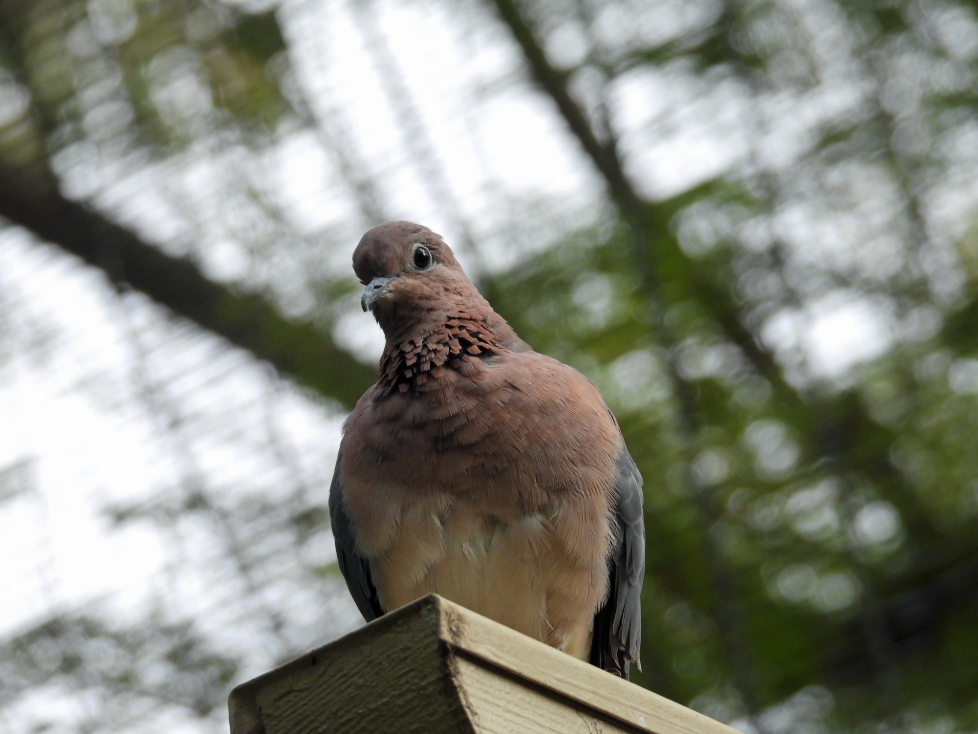
Figure 06. Laughing Doves eat mostly seeds less than 2mm long (smaller than a grain of rice), but they’ll occasionally eat larger seeds (sunflowers, maize), as well as fruits, aloe nectar, and insects (ants, larvae, pupae). They forage on the ground close to shrubs, but they rarely pluck fruits or seeds directly from plants. (True confession: The dove on the left is from the San Diego Zoo’s Scripps Aviary; the dove on the right is from the Safari Park’s “Wings of the World” aviary, but I wanted you to see the seed size.)
Ciconiiformes
Yet another one-family order: All Ciconiiformes are members of the Ciconiidae (stork) family.
Ciconiidae
The Ciconiidae family includes 20 species (sorted into 6 genera) of storks — long-legged, long-necked, long-billed waders who make their homes in various wetland and marshy habitats, mostly in the Old World. Many storks migrate between Africa, where they feed, and Europe, where they breed. Though relatively heavy birds, their wide wingspans enable storks to soar and glide on thermal air currents (much like many vultures and raptors), so they expend less energy while flying long distances.
Their predilection to build huge, bulky stick-nests on European rooftops led to their popular association with human babies. Both (socially) monogamous stork parents build their nests, incubate their eggs (typically two to five), and care for their altricial* hatchlings, which may stay in the nest a couple of months or more.
Naturally, these waders prefer wetlands, where they forage using tactile senses to capture small vertebrates (fish, frogs, reptiles, rodents), as well as some invertebrates (insects, mollusks, crustaceans). Stork bills vary in size and shape, to suit their favorite prey. For instance, the bills of openbill storks are specially adapted for grabbing aquatic snails.
About 30% of storks are endangered, mostly due to habitat destruction.
Abdim’s Stork (Ciconia abdimii)
Abdim’s Storks tolerate drier locations, even semi-desert locales, though they must be near water, such as marshes or pools. They cross northern Africa to breed north of the equator during the rainy season, then they cross back southward for the rest of the year.
They gorge themselves on large insects almost exclusively, especially when they can find locust swarms, but they also eat caterpillars and occasionally snack on small mammals and aquatic animals (e.g., toads). Abdim’s Storks are mostly quiet, but they occasionally point their bills upward and clatter them.
Figure 07. The smallest stork species (30″ tall, half the height of the 60″ Marabou Stork), Abdim’s Storks have been known to live to more than 21 years old, in managed care.
African Openbill (Anastomus lamelligerus)
The African Openbill inhabits swamps, lakes, floodplains, and similar habitats. Some openbills cross the equator to breed in the south as the wet season is ending and the dry season is starting. Though these storks can soar on thermals (head forward, wings extended) like other storks, their smaller size enables them also to maneuver more agilely, perhaps acrobatically, than many other storks.
The openbill specializes in eating aquatic snails, not only snatching them from murky waters, but also scooping snails out of the mud. It extracts snails from their intact shells then swallows the shell-less snails. The openbill also dines on other vertebrates (frogs, fish) and invertebrates (mussels, crabs, worms, insects), using its specialized mandible (lower bill/jaw).
To eat mussels (bivalves who hold their shells tightly closed), these ingenious storks gather them, pile them on the shore in the sun, and wait for the mussels to die; then the storks easily open the shells and eat their prey.
The openbill’s bill is poorly suited to the bill-clattering done by other storks, but these storks do sometimes rattle their top and bottom bills sideways during copulation.
African Openbills prefer to nest in trees, making a stick platform. They breed when snails are most abundant, usually late in the rainy season. Both parents not only incubate the eggs but also regurgitate water over the eggs, presumably to cool them down. After the eggs hatch, both parents feed the hatchlings.
One more thing about this clever species: Like vultures, when they’re overheated, they excrete on their legs, to evaporatively cool them. (Please see my blog https://bird-brain.org/2025/01/17/feeling-the-heat/#pee-poop-cocktail) Even nestlings will use this technique. Stinky nest, right?
Figure 08. African Openbills often look black, but sometimes, they glisten iridescently in green, purple, or brown; these iridescent colors arise from the feathers’ structure, not pigments. (Notice that this stork can swallow sipped water without having to tip its head upward, the way that ducks do.)
Charadriiformes
Charadriiformes contains 19 families and 391 species of water-loving birds who eat mostly invertebrates or small vertebrates. Most species of this worldwide order live near water, but a few are pelagic (ocean-dwelling), a few spend time in deserts, and a few can be found in dense forests. The Charadriiformes order can be classified into three suborders, one of which is Charadriis, which includes Charadriidae (plovers and lapwings) and seven other shorebird families.
Charadriidae
San Diego, California, often hosts a few species of plovers: Semipalmated Plovers, Black-bellied Plovers, Killdeer, and occasionally Snowy Plovers. In addition, San Diegans can see some lapwing species at the San Diego Zoo or its companion Safari Park.
Figure 09a-9b. (a, left) Semipalmated Plovers, like other plovers, have a run-stop-hunt-run style of foraging. (b, right) Black-bellied Plovers enjoy a plover-ish diet of invertebrates.

Figure 09 (c) Killdeer parents approach parenting like other plovers: Protect their young, but expect them to find food on their own.
These shorebirds make homes wherever there are open muddy or sandy shores from which they can pluck prey. The trademark plover move is to run several steps, stop abruptly, poke the mud or sand for prey, look around, then run off again. San Diego plovers are also observed to tap, tap, tap the mud or sand when they stop, perhaps stirring up prey or trying to sense the presence of prey through vibrations.
When breeding, most plovers are monogamous, with “nests” little more than a shallow scrape in the sand, occasionally lined with a few grasses or leaves. Each plover clutch includes two to four eggs, and both parents incubate the eggs for 3–4 weeks. The hatchlings have cryptic plumage, which camouflages them in their habitat, and they’re extremely precocial**. Nonetheless, both parents typically provide some protective care for their hatchlings.
Spur-winged Lapwing, aka Spur-winged Plover (Vanellus spinosus)
Spur-winged Lapwings don’t need big bodies of water; they’re often content with pools, marshes, lagoons, mudflats, or even flooded fields in Africa, the Middle East, and the Mediterranean. They eat mostly insects and their larvae, but they also eat some other invertebrates (crustaceans, mollusks) and some small vertebrates (e.g., frogs, small lizards). Like other plovers, they take a few quick steps, then stop and stab for prey. They may also tremble one foot atop the damp ground, perhaps to flush prey to the surface.
Like other plovers, their “nest” is just a shallow scrape, which might be lined with grass or other materials. The mom typically lays two to four eggs; both parents incubate them, then care for the hatchlings together. If the mom lays a second clutch, she incubates the eggs of the second clutch while the dad tends to the chicks in the first clutch. A lapwing mom has been seen carrying her chicks under her wings before they had fledged.
Figure 10. This Spur-winged Lapwing is calling, running, and taking flight, perhaps in response to the scary human with the camera. (To hear more of its vocalizations, please see https://xeno-canto.org/species/Vanellus-spinosus) The spurs on the leading edge of its wings are usually visible when in flight, but they’re not visible in this video or when the wings are resting at its side.
Bucerotiformes
The Bucerotiformes order includes some remarkable bird families:
- Bucorvidae — ground hornbills — 2 species, each standing about 3′ tall, with humongous bills, among the longest-lived birds in the world
- Bucerotidae — hornbills — 62 species (15 genera), much smaller than ground hornbills, but with similarly outstanding bills
- Upupidae — hoopoes — 3 species (1 genus) (see my blog https://bird-brain.org/2025/03/03/birds-smell/#Hoopoe)
- Phoeniculidae – woodhoopoes — 8 species (2 genera)
Phoeniculidae
Woodhoopoes can be found in places with large trees in savannas, woodlands, and forests in sub-Saharan Africa. Their body form and lifestyle may seem similar to those of woodpeckers: Their short legs and stiff tails enable them easily to move up the sides of trees to probe for arthropods (especially insects) within the bark, using long, slender bills.
Phoeniculids are monogamous, and both parents care for their young. The parents don’t excavate their own nest cavities; they rely on finding natural cavities or those created by other animals. The mom lays the eggs and incubates them, but the dad keeps her well fed while she does so, as do helpers in their cooperative-breeding families. After the eggs hatch, the mom feeds the chicks, but the food is provided to her by the dad and other helpers. Over time, mom lets dad feed the chicks directly while she forages away from the nest.
Green Woodhoopoe (Phoeniculus purpureus)
Green Woodhoopoes eat mostly arthropods (especially insects) but also some other invertebrates, some small vertebrates (e.g., lizards), and some small fruits, which they find in various woodsy habitats of sub-Saharan Africa. To find prey, Green Woodhoopoes will sometimes hang beneath or on the sides of branches, peek or probe into holes or crevices, pry or hammer bark to loosen it. If they find larger prey, they may pound it or rub it against a branch before swallowing it. Males tend to forage lower on the trees, while females and juveniles tend to forage higher up, and they may also peck their prey rather than probing the bark.
Figure 11. This eye-catching species, with its long body, short legs, and slightly decurved bill, glistens iridescently in sunlight. They live in cooperative groups and make various vocalizations together, often while rocking, bobbing tails up and down, and partly opening their wings (you might enjoy listening to a few of the choices at https://xeno-canto.org/species/Phoeniculus-purpureus).
This species breeds cooperatively, with 1–10 bird helpers for each breeding pair. The parents move into an unoccupied tree cavity at least 27 feet above the ground, often much higher; a pair might use the same cavity again and again. Like other woodhoopoes, the mom is the primary caregiver, but with strong support from the dad and other helpers. Even after the chicks fledge, they may still be fed by their parents or other helpers, and many remain with their cooperative family group for years afterward, becoming helpers themselves.
I am eager to hear from you regarding whether you enjoy this type of blog, or whether you find it less interesting than other topics. I would welcome your comments, tips, suggestions, or any other feedback you’d like to offer. Thank you.
Resources
- Pelecaniformes
- – https://en.wikipedia.org/wiki/Pelecaniformes?wprov=sfla1
- Threskiornithidae
- ■ Winkler, D. W., S. M. Billerman, & I. J. Lovette (2020). Ibises and Spoonbills (Threskiornithidae), version 1.0. In Birds of the World (S. M. Billerman, B. K. Keeney, P. G. Rodewald, & T. S. Schulenberg, Editors). Cornell Lab of Ornithology, Ithaca, NY, USA. https://doi.org/10.2173/bow.thresk1.01
- ■ https://en.wikipedia.org/wiki/Threskiornithidae?wprov=sfla1
- Hadada Ibis (Bostrychia hagedash)
- Matheu, E., J. del Hoyo, E. Garcia, A. Bonan, & P. F. D. Boesman (2020). Hadada Ibis (Bostrychia hagedash), version 1.1. In Birds of the World (S. M. Billerman, Editor). Cornell Lab of Ornithology, Ithaca, NY, USA. https://doi.org/10.2173/bow.hadibi1.01.1
- https://en.wikipedia.org/wiki/Hadada_ibis?wprov=sfla1
- African Spoonbill (Platalea alba)
- Matheu, E., J. del Hoyo, E. Garcia, & P. F. D. Boesman (2020). African Spoonbill (Platalea alba), version 1.0. In Birds of the World (J. del Hoyo, A. Elliott, J. Sargatal, D. A. Christie, & E. de Juana, Editors). Cornell Lab of Ornithology, Ithaca, NY, USA. https://doi.org/10.2173/bow.afrspo1.01
- https://en.wikipedia.org/wiki/African_spoonbill?wprov=sfla1
- Scopidae
- ■ Winkler, D. W., S. M. Billerman, & I. J. Lovette (2020). Hamerkop (Scopidae), version 1.0. In Birds of the World (S. M. Billerman, B. K. Keeney, P. G. Rodewald, & T. S. Schulenberg, Editors). Cornell Lab of Ornithology, Ithaca, NY,USA. https://birdsoftheworld.org/bow/species/scopid1/cur/species
- ■ https://en.wikipedia.org/wiki/Scopus_%28bird%29?wprov=sfla1
- Hamerkop (Scopidae)
- Elliott, A., E. Garcia, & P. F. D. Boesman (2020). Hamerkop (Scopus umbretta), version 1.0. In Birds of the World (J. del Hoyo, A. Elliott, J. Sargatal, D. A. Christie, & E. de Juana, Editors). Cornell Lab of Ornithology, Ithaca, NY, USA. https://doi.org/10.2173/bow.hamerk1.01
- https://en.wikipedia.org/wiki/Hamerkop?wprov=sfla1
- Columbiformes, Columbidae
- ■ Winkler, D. W., S. M. Billerman, & I. J. Lovette (2020). Pigeons and Doves (Columbidae), version 1.0. In Birds of the World (S. M. Billerman, B. K. Keeney, P. G. Rodewald, & T. S. Schulenberg, Editors). Cornell Lab of Ornithology, Ithaca, NY, USA. https://doi.org/10.2173/bow.columb2.01. https://birdsoftheworld.org/bow/species/columb2/cur/introduction
- ■ https://en.wikipedia.org/wiki/Columbidae?wprov=sfla1
- Nicobar Pigeon, aka Nicobar Dove (Caloenas nicobarica)
- Baptista, L. F., P. W. Trail, H. M. Horblit, & G. M. Kirwan (2020). Nicobar Pigeon (Caloenas nicobarica), version 1.0. In Birds of the World (J. del Hoyo, A. Elliott, J. Sargatal, D. A. Christie, & E. de Juana, Editors). Cornell Lab of Ornithology, Ithaca, NY, USA. https://doi.org/10.2173/bow.nicpig1.01, https://birdsoftheworld.org/bow/species/nicpig1/cur/introduction —
- https://en.wikipedia.org/wiki/Nicobar_pigeon?wprov=sfla1
- Victoria Crowned Pigeon (Goura victoria)
- Baptista, L. F., P. W. Trail, H. M. Horblit, & E. Garcia (2020). Victoria Crowned-Pigeon (Goura victoria), version 1.0. In Birds of the World (J. del Hoyo, A. Elliott, J. Sargatal, D. A. Christie, & E. de Juana, Editors). Cornell Lab of Ornithology, Ithaca, NY, USA. https://doi.org/10.2173/bow.vicpig1.01
- https://en.wikipedia.org/wiki/Victoria_crowned_pigeon?wprov=sfla1
- Laughing Dove (Spilopelia senegalensis)
- Baptista, L. F., P. W. Trail, H. M. Horblit, P. F. D. Boesman, & E. Garcia (2022). Laughing Dove (Spilopelia senegalensis), version 1.1. In Birds of the World (N. D. Sly, Editor). Cornell Lab of Ornithology, Ithaca, NY, USA. https://doi.org/10.2173/bow.laudov1.01.1
- https://en.wikipedia.org/wiki/Laughing_dove?wprov=sfla1
- Ciconiiformes, Ciconiidae
- ■ Winkler, D. W., S. M. Billerman, & I. J. Lovette (2020). Storks (Ciconiidae), version 1.0. In Birds of the World (S. M. Billerman, B. K. Keeney, P. G. Rodewald, & T. S. Schulenberg, Editors). Cornell Lab of Ornithology, Ithaca, NY, USA. https://doi.org/10.2173/bow.ciconi2.01
- ■ https://en.wikipedia.org/wiki/Stork?wprov=sfla1
- Abdim’s Stork (Ciconia abdimii)
- Elliott, A., D. A. Christie, E. Garcia, & P. F. D. Boesman (2020). Abdim’s Stork (Ciconia abdimii), version 1.0. In Birds of the World (J. del Hoyo, A. Elliott, J. Sargatal, D. A. Christie, & E. de Juana, Editors). Cornell Lab of Ornithology, Ithaca, NY, USA. https://doi.org/10.2173/bow.abdsto1.01
- https://en.wikipedia.org/wiki/Abdim%27s_stork?wprov=sfla1
- African Openbill (Anastomus lamelligerus)
- Elliott, A., E. Garcia, & P. F. D. Boesman (2020). African Openbill (Anastomus lamelligerus), version 1.0. In Birds of the World (J. del Hoyo, A. Elliott, J. Sargatal, D. A. Christie, & E. de Juana, Editors). Cornell Lab of Ornithology, Ithaca, NY, USA. https://doi.org/10.2173/bow.afrope1.01
- https://en.wikipedia.org/wiki/African_openbill?wprov=sfla1
- Charadriiformes
- ■ https://en.wikipedia.org/wiki/Charadriiformes?wprov=sfla1
- Charadriidae
- ■ Winkler, D. W., S. M. Billerman, & I. J. Lovette (2020). Plovers and Lapwings (Charadriidae), version 1.0. In Birds of the World (S. M. Billerman, B. K. Keeney, P. G. Rodewald, & T. S. Schulenberg, Editors). Cornell Lab of Ornithology, Ithaca, NY, USA. https://doi.org/10.2173/bow.charad1.01
- ■ https://en.wikipedia.org/wiki/Charadriidae?wprov=sfla1
- Vanellus (genus)
- Spur-winged Lapwing or Spur-winged Plover (Vanellus spinosus)
- Wiersma, P. & G. M. Kirwan (2020). Spur-winged Lapwing (Vanellus spinosus), version 1.0. In Birds of the World (J. del Hoyo, A. Elliott, J. Sargatal, D. A. Christie, & E. de Juana, Editors). Cornell Lab of Ornithology, Ithaca, NY, USA. https://doi.org/10.2173/bow.spwlap1.01
- https://en.wikipedia.org/wiki/Spur-winged_lapwing?wprov=sfla1
- Bucerotiformes
- ■ https://en.wikipedia.org/wiki/Bucerotiformes?wprov=sfla1
- Phoeniculidae
- ■ Winkler, D. W., S. M. Billerman, & I. J. Lovette (2020). Woodhoopoes and Scimitarbills (Phoeniculidae), version 1.0. In Birds of the World (S. M. Billerman, B. K. Keeney, P. G. Rodewald, & T. S. Schulenberg, Editors). Cornell Lab of Ornithology, Ithaca, NY, USA. https://doi.org/10.2173/bow.phoeni2.01
- Green Wood Hoopoe (Phoeniculus purpureus)
- Ligon, J. D. & G. M. Kirwan (2020). Green Woodhoopoe (Phoeniculus purpureus), version 1.0. In Birds of the World (J. del Hoyo, A. Elliott, J. Sargatal, D. A. Christie, & E. de Juana, Editors). Cornell Lab of Ornithology, Ithaca, NY, USA. https://doi.org/10.2173/bow.grewoo2.01
- https://en.wikipedia.org/wiki/Green_wood_hoopoe?wprov=sfla1
- Bucorvidae
- Billerman, S. M. (2020). Ground-Hornbills (Bucorvidae), version 1.0. In Birds of the World (S. M. Billerman, B. K. Keeney, P. G. Rodewald, & T. S. Schulenberg, Editors). Cornell Lab of Ornithology, Ithaca, NY, USA. https://doi.org/10.2173/bow.bucorv1.01
- Bucerotidae
- Winkler, D. W., S. M. Billerman, & I. J. Lovette (2020). Hornbills (Bucerotidae), version 1.0. In Birds of the World (S. M. Billerman, B. K. Keeney, P. G. Rodewald, & T. S. Schulenberg, Editors). Cornell Lab of Ornithology, Ithaca, NY, USA. https://doi.org/10.2173/bow.bucero1.01
- Upupidae
*Newly hatched altricial chicks can’t feed themselves or even regulate their own body temperature without help from one or both parents.
** Precocial chicks can feed themselves soon after hatching, and most can also regulate their own body temperature without help from one or both parents. Their parents may still offer them some protection from predators, or some supplementary feedings, depending on the species.
Copyright © 2025, Text and Photos, Shari Dorantes Hatch. All rights reserved.

 Bird Brain
Leave a comment