
The Most Perfect Thing:
Inside (and Outside) a Bird’s Egg
by Tim Birkhead
Esteemed ornithologist Tim Birkhead (Royal Society fellow and university professor) explores the insides and outsides of bird eggs in his 2016 book, The Most Perfect Thing: Inside (and Outside) a Bird’s Egg, published by Bloomsbury. This blog isn’t a critique of his book as much as a celebration of what I learned from his book. In addition, he piqued my interest enough to do a bit of further research on some of the birds he mentions. I include a separate “Additional Resources” section listing where I found these additions.
- Preface ix–xvi
- Climmers and Collectors 1–26
- Making Shells 27–48
- The Shape of Eggs 49–76
- Colouring Eggs — How? 77–94
- Colouring Eggs — Why? 95–120
- Much Ado About Albumen: The Microbe War 121–146
[8 pp. of plates between pp. 144 & 145] - Yolk, Ovaries and Fertilisation 147–177
- Stupendious Love: Laying, Incubation and Hatching 178–204
- Epilogue: Lupton’s Legacy 205–220
Notes 221–244
Bibliography 245–265
Glossary 266– 269
Bird Species Mentioned in the Text 270–274
Acknowledgements 275–277
A Note on the Plate Section 278
Index 279–288

Figure 00. Flamingo moms and dads are very attentive parents, caring for their solitary egg (and later their hatchling). For more about flamingo parents, see my blog Got (Bird) Milk? – Bird Brain.
Preface ix–xvi
Birkhead’s preface asserts that in regard to eggs (and everything else), “there’s still a great deal we don’t know. . . . [and] knowing what we don’t know is extremely important — it is what makes research exciting” (p. xv). Exciting way to invite readers into his book and into future research. Also, we mistakenly believe we know about eggs because we’re so familiar with chicken eggs, blinding “us to the extraordinary diversity of egg size, shape and structure across the ten thousand other species of birds that currently exist in the world.” “We see only a fraction of the biological miracle that eggs are” (p. xvi).
Birkhead took his title from abolitionist and women’s rights activist Thomas Wentworth Higginson, who wrote (in 1862), “I think that, if required on pain of death to name instantly the most perfect thing in the universe I should risk my fate on a bird’s egg.” Bird eggs are highly adaptable: “Birds lay and incubate in such an incredible diversity of habitats and situations, from the poles to the tropics; in wet, dry, clean and microbe-infested conditions; in nests and without nests; warmed by body heat and without body heat. The shape, colour and sizes as well as the composition of their yolk and albumen all constitute the most extraordinary set of adaptations” (p. xvi).
Figure 01. Among the 10,000+ bird species and their eggs, Southern Screamer parents stand out. Both parents incubate their 2 (or more) eggs for about 45 days, then both care for their chicks for 8–10 weeks more.
Chapter 1. Climmers and Collectors,
pp. 1–20
Birkhead reveals how early (1600s and beyond) collectors of eggs often recklessly appropriated hundreds, maybe thousands, of bird eggs, for their beauty. Eventually, this passion led to a more scientific appreciation of bird eggs. For instance, in the 1670s, Frances Willughby and John Ray gathered observations, which Ray wrote up and “published the first ‘scientific’ book on birds . . . entitled The Ornithology of Frances Willughby” (p. 10).
Modern scientific technologies and advancements offer insights not possible during the 1600s. For instance, through DNA analysis, we can see examples of convergent evolution: “Hummingbirds in the New World and sunbirds in the Old World both feed on nectar which they extract from flowers using their long tongue and bill and they both have iridescent plumage. Despite their physical similarity, hummingbirds and sunbirds do not have an immediate common ancestor — they have evolved completely independently” (p. 14).
Figure 02. (above) Like all hummingbirds, this nest-building mama Emerald Hummingbird is native to the Americas (North and South). (below) On an entirely different continent (Africa) and not closely related, Sunbirds are tiny long-billed nectar eaters, too.
Chapter 2. Making Shells, pp. 21–48
The egg’s shell is the embryo’s interface with the world outside the shell, offering both protection from pests and access to oxygen and other necessities. The shell has to be strong enough to support the weight of an incubating parent, yet weak enough to allow the developed chick to break free from it. Birkhead calls the egg “a self-contained life-support system” (p. 21).
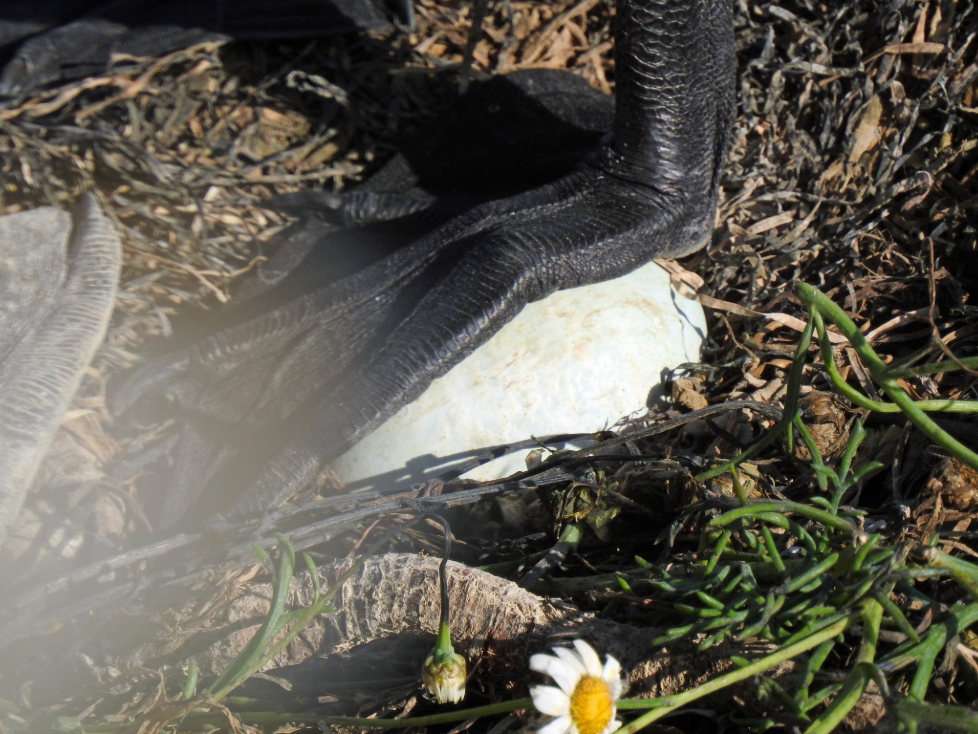
Figure 03. Brandt Cormorant eggs must be able to withstand the full weight of a parent’s body while incubating.
Egg production varies widely across species, but it typically takes several hours to get from the mom’s ovary, through the oviduct, to her uterus. As the ovum approaches the uterus, the ovum’s yolk is “surrounded by a thin layer of very viscous albumen contained and supported within an egg-shaped bag — the shell membrane” (p. 25). It’s egg-shaped but still very squooshy.
The egg’s paper-thin shell membrane looks like a solid layer, but it’s a double-layered fibrous ultrafine mesh, made of protein and collagen. Inside the oviduct (just before the egg enters the uterus), thousands of tiny glands extrude myriad fibers, creating the mesh membrane. This membrane determines the shape of the egg (not the outer eggshell). The membrane is loosely woven, to allow the albumen within it to engorge with water later in its formation.
Shell creation begins in the uterus. According to Birkhead, the process of shell production is like having hundreds of sprayers releasing dollops of chalky calcium-carbonate foam onto the shell membrane. After a few hours, the surface of the shell membrane is covered with these hardening dollops of chalky foam, with tiny spaces between the dollops. The egg passes into another area of the uterus, where water is sprayed between the foamy lumps, reaching the albumen, plumping it up to almost completely fill the shell membrane. Once it’s plump enough, more dollops of concentrated calcium-carbonate foam are sprayed onto the exterior of the shell.
These dollops still have tiny gaps, which will become “the pore canals — the airways that connect the shell membrane with the outside world — so that gases and water vapour can pass in and out through the shell, allowing the embryo to breathe” (p. 27). These tiny airways connect the embryo’s blood supply with the oxygen in the outer environment. The airways also allow excess carbon dioxide and water vapor to escape. (Astonishingly, birds living at higher altitudes adjust the size and density of the pores to allow for the differences in air pressure.) One more amazing thing: It’s thought that birds may be able to detect their parent’s odor through these airways, so they can recognize their parents’ scent after hatching.
Almost done! But not quite. For a colorful egg, additional “sprayers” start applying colored dyes onto the egg, using pigments combined with calcium carbonate. That creates a fairly uniform background color for the eggs. If the egg will have additional markings, “spots and streaks — called maculation,” those are applied at this time. Last of all, the uterus applies a sticky protein cuticle to the exterior of the egg (or inorganic calcium salts in some species). This sticky substance may also be mixed with a pigment, covering the entire shell surface; this exterior coat dries “almost immediately [as] the egg emerges into the outside world” (p. 27).
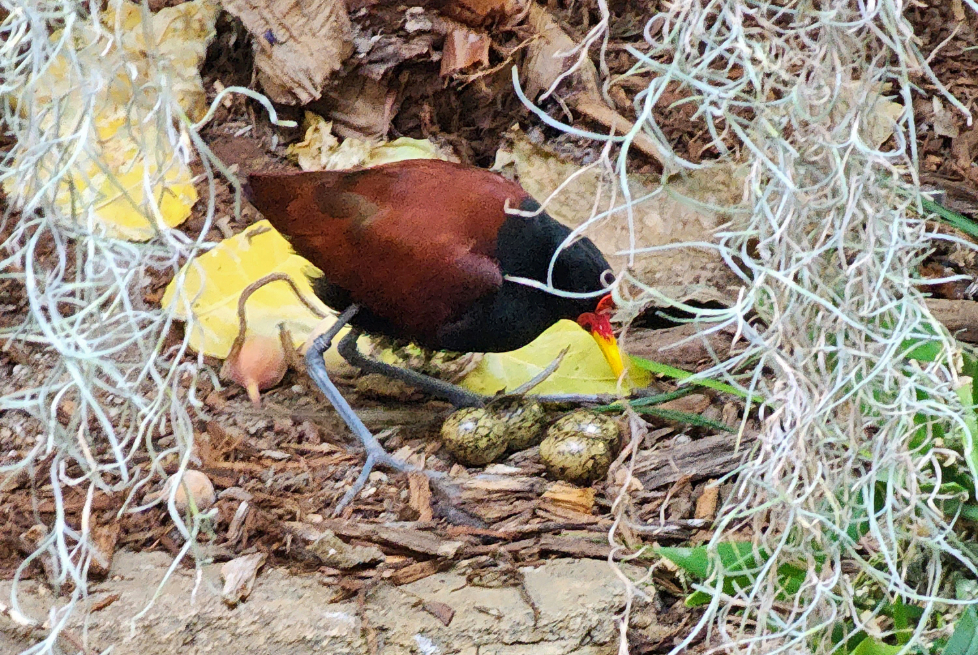
Figure 04. The Wattled Jacana mom typically lays a series of four exquisitely beautiful golden eggs with distinctive markings, which the dad incubates for about 4 weeks.
Bird moms need a whole lot of calcium to produce eggs. Bird skeletons contain very little calcium, so a mom can’t afford to draw on her own calcium to produce eggs (with some rare exceptions). If she’s a raptor, heron, or other predator, she can probably get enough calcium from the skeleton of her prey. For other birds, however, she must somehow forage enough calcium from what she eats. The thicker and bigger the shell, the more calcium she needs. For a chicken mom, if her diet isn’t supplemented, she may need to forage as much as 36 hours to get enough calcium to produce one egg. During a mom’s egg-laying season, she will preferentially add calcium-rich foods (e.g., snails, oyster shells) to her diet, which she otherwise wouldn’t seek.
Chapter 3. The Shape of Eggs, pp. 49–76
The thin mesh shell membrane, not the hard exterior shell, determines the shape and contours of a bird’s egg. Also, the size and shape of a bird mom’s pelvis doesn’t limit the size and shape of her eggs. (Unlike the pelvis of human moms, a bird mom’s pelvis doesn’t form a complete circle of bone.)
Bird egg sizes, colors, and shapes show an abundant variety. These shapes are varied and tough to categorize precisely, but scientists have differentiated five basic egg shapes:
- pyriform — blunted at one end, pointed at the other end, asymmetrical
- biconical — pointed at each end, symmetrical
- spherical — globe-shaped
- oval — symmetrical, a sphere that’s squished inward in the middle, not elongated
- elliptical — symmetrical, elongated, less spherical than an oval
Some bird species and families have typical egg shapes. For instance, owls lay spherical eggs; shorebirds, King Penguins, and Emperor Penguins lay pyriform eggs (blunt end–pointed end); grebes lay long narrow biconical eggs (two pointed ends); and hummingbirds lay oblong ovular or elliptical eggs.

Figure 05. Brandt Cormorants have up to four ovular eggs in a clutch, with each oval showing slightly pointed tips.
We don’t yet know the reasons for particular kinds of bird eggs having particular shapes. More spherical eggs have the smallest possible surface-area-to-volume ratio, so they can keep warmer in cooler environments when not in contact with the incubating parent. More elongated eggs have a greater surface-area-to-volume ratio, so they have more contact with the incubating parent, who can keep them warm, but they cool down more quickly when the parent isn’t in physical contact.
Most shorebirds have four elongated pyriform-shaped eggs, which can be arranged to fit neatly into a nest. This arrangement allows an incubating parent to have maximum surface-area contact with the eggs, so they can incubate relatively larger eggs. Larger eggs create larger chicks, which can better tolerate being precocial — more independent after hatching, typical of shorebirds.
Figure 06. This Wattled Jacana dad (a shorebird) is watching over his pyriform-shaped eggs; mom has little interest in the eggs after she lays them.
One more key factor in shell shape affects the developing embryo: A spherical egg is typically stronger, to support the weight of the incubating parent; a more elongated egg is weaker, but it may be easier for the emerging chick to break free of the shell. An elongated egg may also give the chick more room to stretch out its legs for leverage in breaking out.
Chapter 4. Colouring Eggs — How,
pp. 77–94
As with plumage, the differences in the egg colors we perceive depend on how a particular object or substance reflects or absorbs differing wavelengths of light. Scientists have been better able to analyze egg (or plumage) colors by using technology that can analyze the entire spectrum of color reflected by an object or substance. In addition, microscopic coloration can be detected, using spectroscopy, which can detect the spectrum of color reflected at a microscopic level.
Bird moms create the colors of their eggs by using substances from their blood and their bile. So far, scientists have identified seven different pigments used for egg coloration. These seven can be categorized into two classes: protoporphyrin (aka porphyrin) and biliverdin. Both of them are involved in making and breaking down heme, the red substance that colors hemoglobin (red blood cells) and myoglobin (red protein in muscles). In general, porphyrin produces reddish-brown coloration, and biliverdin yields blue-green coloration on eggs.
When these substances are combined in various ways, the resulting array of colors are seemingly infinite. Birkhead notes the extraordinary beauty of tinamou eggs. Tinamous lay their eggs “on the ground on damp leaf litter and when not covered by the incubating bird (in tinamous, it is usually the male) they glow brilliantly in the forest half-light” (p. 79).

Figure 07. Tim Birkhead, an expert observer of bird eggs, says, “Tinamous lay the most extraordinary and beautiful eggs — like glazed porcelain — and those of different species are blue, green, pink or purple.” Here are just two clutches of Tinamou eggs. Both images are by Marcos Massarioli: (larger) eggs from Tinamus guttatus; (inset) eggs from Nothura maculosa. For both, permission is granted to copy, distribute and/or modify this document under the terms of the GNU Free Documentation License, Version 1.2. (b, right). Attribution must accompany the images.
Pigment can be applied in any of the shell’s layers, including sometimes the cuticle and even the shell membrane. Some species apply little to no coloring, whereas others freely apply multiple colors in multiple layers of the shell and shell membrane. When coloration is added to different layers of the shell, it occurs at different times during egg production.
Within a single clutch, there may also be variations in coloration. If there are exterior stripes, spots, patterns, or markings (called “maculation”), those differ across eggs within a clutch. Guillemots, some species of bowerbirds, jacanas, and other species seem to add ink-drawn squiggles on their eggs.
Figure 08. Periodically, this Wattled Jacana dad readjusts his eggs and his position over them. It benefits the developing embryos to be turned, and it may make him more comfortable, too. Note the distinctive markings on each of the four eggs.
In addition, even the background color of the eggs may differ within a single clutch. In general, if there are variations, the last egg to be hatched may be darker or bluer than the earlier eggs. It’s thought that darker or bluer eggs may absorb more blue wavelengths of light, which have been shown to accelerate embryo growth. Darker or bluer eggs may speed up their growth, to hatch more quickly.
Chapter 5. Colouring Eggs — Why?,
pp. 95–120
We have much to learn about how birds color their eggs. We have even more to learn about why they do so. Several ideas have emerged:
- Beneficial Pigments
- Biliverdin pigments have antioxidant properties, which can protect the egg from unwanted by-products of metabolism, and porphyrin offers protection from microbial invasion.
- Cryptic Coloration
- Cryptic coloration can camouflage the eggs, which may help protect the eggs from predators. Many ground-nesting birds (e.g., shorebirds) have eggs with cryptic coloration, which easily blend into their environment. In addition, “birds such as kingfishers, bee-eaters, woodpeckers, trogons and owls that lay their eggs in concealed places produce white eggs” (p. 98). That is, when the nests and eggs are concealed, there’s no evolutionary advantage to cryptic coloration of eggs.
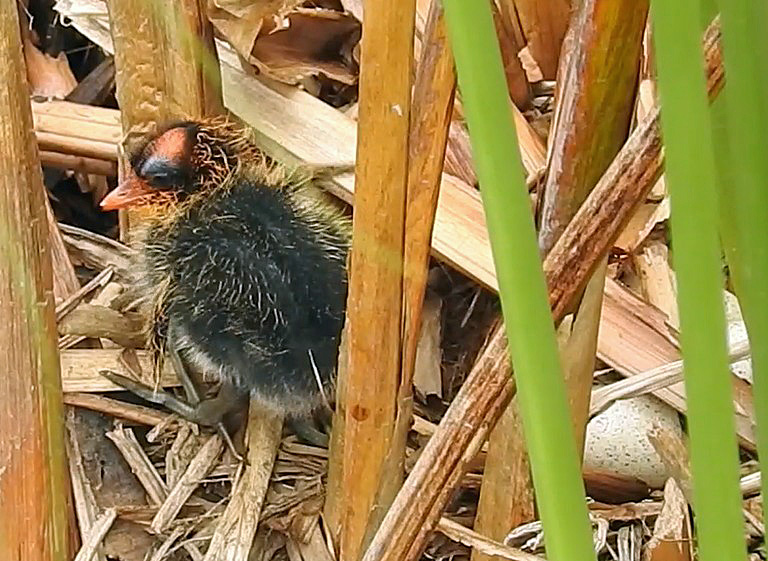
Figure 09. The subtle colors of eggs of American Coots match beautifully with their reedy environment. The chick’s colors, however — not very subtle.
- Light Absorption
- For eggs that aren’t concealed and aren’t being covered by an incubating parent, dark-colored eggs absorb more light and heat. In a sunny environment, darker eggs are more vulnerable to heat stress than light-colored eggs. In a chilly environment, heat absorption can be a plus.
- Mom’s Health
- Egg color may also indicate the health of the mom. Sick or stressed moms produce less pigment for their eggs. Eggs with lighter pigment may get less parental care after hatching, as the parents are less sure they’ll survive.
- Recognizing Eggs within a Large, Dense Breeding Colony
- One possible reason that guillemot eggs are so varied in color, size, and shape is that they breed in large densely clustered colonies, making it crucial for each parent to recognize its own egg. Other birds, who breed in colonies with plenty of separation between nests, have less distinctive variations, and their coloration seems more for camouflage than for identification.
- Avoiding Brood Parasites
- Distinctive egg coloration may help the incubating parents to be able to identify their own eggs, so they’ll recognize the eggs of a brood parasite who lays its eggs in a host bird’s nest. By recognizing their own eggs, the host parents can incubate just their own eggs and rear their own chicks, not those of a brood parasite. American Coot moms are notorious brood parasites of other American Coot parents. Coot eggs show great variation, making it easier for host parents to identify parasite eggs and bury or push aside the undeveloped eggs in their nest materials. Of course, as hosts get more discriminating, brood parasites get more deceptive, creating a never-ending evolutionary contest.
Figure 10. The varied coloring of this American Coot mom’s eggs may help her detect when a brood-parasitic coot mom tries to dump an egg in this mom’s nest.
Ostriches have a distinctive way of incubating their eggs: First, a senior mom lays her eggs in a large nest, then several less-senior moms lay their eggs in the nest, too, for a solitary dad to incubate, with help from the senior mom. The extra moms lay their eggs and move on, presumably to find another site for dumping their eggs. The senior mom can recognize her own eggs “by recognising the pattern of pore openings on the creamy white, unmarked egg surface” (p. 120). Imagine! In a huge nest filled with eggs, she can identify her own eggs by their pore patterns. Often, the senior mom pushes the other eggs to the periphery of the nest — or even out of the nest entirely.
Chapter 6. Much Ado About Albumen:
The Microbe War, pp. 121–146
Cuticle, Calcium Salts, or ???
Scanning electron microscopes have examined the outermost layer of the shell and confirmed its key role in keeping microbes away from the embryo. Among tinamous, kiwis, jacanas, and many other birds, the outermost layer is a cuticle, made of organic materials, such as proteins. Among pelicans, cormorants, gannets, flamingos, grebes, and other birds, the outermost layer is made of inorganic calcium salts. The composition of the outermost layer doesn’t seem to affect its thickness. An inorganic-composition layer may be more suitable for birds who incubate their eggs in aquatic, wet, or muddy locations. The inorganic composition may provide some degree of waterproofing, as well as antimicrobial protection.
Figure 11. American Flamingo moms and dads share in incubating their water-resistant egg in its muddy nest, as well as in feeding and caring for the chick after it hatches. For more about flamingo parents, see my blog Got (Bird) Milk? – Bird Brain.
Pro tip: Don’t wash eggs if you’re trying to prevent them from rotting. If you wash off the outer cuticle, you’re washing away the egg’s best antimicrobial defenses. Worse still, if you wash them with cool water, the microbes will be pulled into the surface pores while the egg dries. Also, in commercial poultry farms, in cases of deadly salmonella contamination, the bacteria are transmitted to the egg from inside the hen’s body, not from external contamination or even from the passage through the cloaca.
Many bird nests breed microbes: Megapodes (e.g., Malleefowl and brushturkeys) build mounds of rotting vegetation, into which they bury their eggs; guillemots incubate their solitary eggs in guano-rich colonies; tropical birds live in humid areas abounding with microbes; and so on. Like aquatic birds, megapodes have a calcium-phosphate outer shell covering, which isn’t easily decomposed by microbes.
A notable exception to the antimicrobial outermost layer is the hoopoe family of birds, which have absolutely no organic cuticle and no inorganic calcium-salts layer. Yet the embryos have extra protection from microbes. The hoopoe mom has disgustingly smelly preen-gland secretions, which contain beneficial bacteria with antimicrobial properties. As the mom lays her eggs (4–12), she smears her preen-gland secretions over the entire surface of each egg. It’s possible that some other birds may be able to use preen-gland secretions, too. Some ducks defecate on their eggs when they’re trying to protect them from potential predators.
Some other birds also lack a cuticle on the outside of their eggshell: Woodpigeons, ostriches, and some small passerines (e.g., warblers and flycatchers) incubate their eggs in dry, “super-clean environments” (p. 144). Perhaps because microbial infection is so unlikely, these birds don’t make an antimicrobial outer layer for their eggs.
Figure 12. The nests and eggs of some birds (such as this Emerald Spotted Wood-Dove, also called a “woodpigeon”) are relatively clean, so they don’t need as many antimicrobial protections as birds in environments with dense populations of unwanted microbes. [For information about how doves and pigeons raise their chicks, see my blog Got (Bird) Milk? – Bird Brain.]
Shell Membrane
The rare microbes that manage to penetrate the outermost layer of the shell confront the shell membrane. This ultrafine fiber mesh seems to trap many bacteria. It’s not completely impenetrable, though, because some kinds of bacteria can eat holes in the fiber, gaining access to the next line of embryo defense: albumen.
Albumen
According to Birkhead, “albumen is absolutely remarkable, mysterious stuff. Its role in the developing egg is vital, providing water and proteins for the growing embryo and at the same time cushioning the embryo from physical damage as the egg is turned or rolled around the inside of the nest” (pp. 121–122).
The albumen (albus, “white”) of cooked chicken eggs is opaque white, but in the developing egg, the albumen is colorless. It doesn’t seem to have much structure, but it actually comprises four distinct concentric layers. Its innermost layer holds two fine filaments (chalazae), which attach the ovum to each of the opposite sides of the shell membrane. These filaments thereby suspend the ovum within the shell. When the egg is rolled, the filaments rotate, ensuring that the ovum always stays atop the yolk, within the albumen. This self-righting property ensures that the embryo is always closest to the incubating parent and to the shell’s oxygenation pores.
Figure 13. Brandt Cormorant moms and dads frequently turn and adjust their eggs while incubating them.
Experiments in which the albumen or the yolk were removed from the developing embryo found that the effects of removing albumen were much more drastic, stunting the growth of the chicks. Also, in looking at the comparative sizes of bird eggs, as size increases, the amount of albumen increases more than the amount of yolk. For the growing embryo, the albumen has to provide all the water the embryo will need until it hatches.
Perhaps even more important is albumen’s role in shielding the embryo from microbes that would gluttonously devour the embryo. “The microbes that can infect eggs include bacteria, viruses, yeasts and fungi” (p. 125). Albumen contains more than 100 antimicrobial proteins, including lysozyme, which destroy bacteria. Many of these proteins are particularly activated when warm — at the temperature of an incubating bird. In addition, albumen contains no nutrients that microbes can eat. It’s also slightly alkaline, which microbes don’t like.
Fun fact: The lysozome in human tears, saliva, and some other bodily fluids, has antiseptic properties, too.
In temperate zones, many bird species lay multiple eggs in a given clutch, but at most, they can lay one egg each day. Frequently, ducks and other birds wait to incubate their entire clutch until they have finished laying all their eggs. This leaves a lot of time for un-incubated eggs to be attacked by microbes. Once incubation begins, the albumen’s antimicrobial enzymes kick into high gear.
Chapter 7. Yolk, Ovaries
and Fertilisation, pp. 147–177
Unlike human moms, bird moms can produce new ova during all or most of their lifetimes.
See https://en.wikipedia.org/wiki/Wisdom_(albatross) — “Wisdom (albatross),” a Laysan Albatross mom. At age 73, Wisdom laid an egg in 2024, probably 1 of 30–40 eggs she has laid.
A bird mom can store sperm for awhile (sometimes for many days), choosing when to have it inseminate any of her ova. Presumably, the mom chooses the highest-quality ovum to develop into an embryo. Within minutes of fertilization, the ovum starts its journey down the oviduct toward the uterus. Each ovum is nestled into its own yolk.
The egg’s yolk is “full of nutrients, mainly fat and protein, which come from the bird’s diet” (p. 155). Producing the nutrient-rich yolk takes time and resources, and the bigger the egg, the more time and resources are needed. Yolk sizes also differ in terms of whether the chicks are precocial (e.g., kiwis, ducks, chickens), born with feathers and ready to start feeding themselves almost as soon as they hatch, or they’re altricial (e.g., robins, blackbirds), born mostly or entirely bare-skinned, completely dependent on their parents to feed them during their nestling period. As you might expect, precocial chicks typically have larger yolks than altricial chicks. Different birds produce the yolk at differing rates of speed, with a Red Phalarope doing so in 4–5 days and a Southern Royal Albatross needing 30 days to do so.
Figure 14. A Wattled Jacana mom draws on her body’s resources and her diet to create the ovum, yolk, albumen, and shell for her eggs. After that, it’s up to dad to incubate the eggs and care for the hatchlings.
In addition to the yolk’s rich resources, the embryo needs water and some protein from the albumen, as well as calcium from the egg’s shell, to build its skeleton. Mom also adds some specific substances directly to the cells surrounding the ovum, which she can increase or decrease. She selectively adds some of her own hormones (e.g., testosterone), which her body produces, as well as carotenoid pigments and Vitamins A and E, which she must gain from her diet. Carotenoids and these vitamins have antioxidants, which can minimize oxidative stress. Oxidative stress can cause cell damage, and it can be caused by environmental pollutants and contaminants, as well as by-products of metabolism.
Chapter 8. Stupendious Love:
Laying, Incubation and Hatching
pp. 178–204
Egg Laying
In their 1678 Ornithology, Willughby and Ray observed, “birds should with such diligence and patience sit upon their nests night and day for a long time . . . With what courage and magnanimity do even the most cowardly birds defend their eggs . . . Stupendious in truth is the love of birds to a dull and lifeless egg” (p. 190, The Perfect Thing).
When eggs are pyriform (blunt at one end, pointed at the other), how do the eggs go through the mom’s body and out into the world. For most birds with pyriform eggs, the pointed end travels down through the oviduct and through the uterus, but at the last minute (possibly up to an hour), before being laid, the egg rotates and is laid blunt end first. Astonishingly, the mom’s uterus slips down into her vagina, so that she lays the egg without ever having it contact her vagina or cloaca. The whole process of “labor,” expelling the egg from her body, can take anywhere from a few seconds (e.g., in brood parasites such as cuckoos) to a few hours.
Sometimes, a bird mom does things a bit differently. Domestic ducks and geese, petrels and albatrosses, and guillemots lay their eggs with the pointed end first. For instance, a guillemot mom stands upright, pulls her neck down into her shoulders, extends her wings slightly outward, and expels the egg (up to 10 minutes later), pointed tip downward. As soon as the pointed tip of the egg is on the ground, she stands even taller, on her tippy-toes, so that the rest of the egg can emerge. As soon as it does, she “flops forward, catching the egg with her bill and drooping her wings to provide additional protection against the egg rolling away. After looking at the egg for a few moments — presumably to fix its appearance in her brain, or if she’s bred before to remind herself what it looks like — she then positions the egg beneath her with the pointed end between her legs, and begins the lengthy process of incubation” (pp. 183–184). By the way, guillemots typically lay their eggs on a bare cliff edge, but they have been seen incubating an egg on ice.

Figure 15. Many geese and ducks have pyriform eggs, which they lay with the pointed end exiting first. Pictured here, from topmost to bottommost: Hawaiian Goose (aka Nene), Red-breasted Goose, Swan Goose, Mallard duck.
Most passerines and other small birds lay their eggs soon after the sun rises, but the Common Cuckoo, a brood parasite, lays her egg (in another bird’s nest!) in the middle of the afternoon. Presumably, she waits until the host mom or dad heads out to grab a snack, then swoops in for a quick lay. Ducks, raptors, and many seabirds might lay their eggs any time during the day. Petrels and shearwaters lay their eggs at night.
Figure 16. Like some other seabirds, Brandt Cormorants usually lay their eggs overnight, or maybe early in the morning.
Incubation
It can be tricky to get the incubation temperature and humidity right, as well as to turn the eggs properly for embryo development. For starters, birds create a nurturing place for incubation by building a suitable nest; the nest can be well insulated, poorly insulated, or nearly nonexistent, depending on what best suits that species in that environment.
Odd fact: One human is known to have hatched bird eggs using his own body warmth — Robert Stroud, “Bird Man of Alcatraz,” hatched eggs of House Sparrows and canaries under his armpit, “inside a protective cup made from Europlast during his incarceration.” The human body temperature (±98.6̊ F.) is actually just right for incubating most bird eggs.
In addition, when preparing to incubate their eggs, parents (females, males, or both) typically develop brood patches, bare areas of skin for contacting their eggs directly. The incubating parent loses belly feathers and develops sensitive temperature receptors in these patches of skin. According to Birkhead’s Bird Sense (2012, pp. 93–94), the brood patch’s keen temperature receptors are linked to blood vessels that can increase or decrease blood flow. (Physical contact between the brood patch and the eggs triggers the bird’s pituitary gland to release prolactin, a hormone that prompts birds to continue incubating their eggs.)
Luckily, embryo development doesn’t require a constant temperature; this allows a parent to briefly leave the nest to eat and so on. Nonetheless, embryo development demands that the temperature be kept within a range of temperatures (usually 86–100̊ F; 30–38̊ C). Slightly too warm is more dangerous than slightly too cool, even briefly.
To adjust the temperature of the eggs, the incubating parent has a few options besides just sitting on the eggs or leaving them alone. For one thing, the parent can increase or decrease contact with the eggs, through posture, perhaps even just standing over the eggs at times. Importantly, she or he can increase or decrease blood flow to the brood patch, maximizing or minimizing heat transfer to the eggs. Surprisingly, at times, the incubating parent may sense that the eggs are getting too hot and will reduce blood flow to the brood patch while sitting on the eggs. As the brood patch cools, it draws heat away from the eggs.
Brood patches vary across species: Most have one patch, which can be quite large or quite small; others have two patches (e.g., a Razorbill, which lays just one egg); and some have three (e.g., Herring Gulls lay three eggs and have three patches). After breeding season, these feathers grow out again.
Fun fact: The kiwi dad develops a brood patch for incubating his one or two huge eggs after the mom lays them. In addition, some dads get help from up to five other adult males, who not only help him with incubation, but also develop their own brood patches, despite not being the biological father to the eggs. (From Birds of the World — BotW)
An interesting variation is the female Goldcrest (about 3″ long, up to 1/4 ounce), who lays two separate clutches of 6–13 biggish eggs, each of which takes 14–17 days to hatch. This hard-working mama uses her legs, as well as her brood patch, to incubate her eggs. “The incubating female pumps more blood through her legs to generate additional incubation heat among the eggs piled up beneath her. The legs and feet were effectively employed like an immersion heater . . . keeping the eggs at a constant 39̊C. Even more remarkably, as she incubates the female goldcrest gently paddles her legs to distribute the heat among the eggs, turning them at the same time” (p. 190).
Quite a few birds often leave their eggs unattended for many days. The Red Jungle Fowl (ancestor of our domestic chickens) parent delays incubating her eggs 8–10 days, until she has finished laying all of her large clutch of eggs, one day at a time. For the Fork-tailed Storm Petrel, its egg can be unattended for many days while the mom seeks nourishment during incubation that can last 37–68 days.
In environments hotter than the bird’s body temperature, parents must figure out how to keep the eggs cool. They might simply stand over their eggs to shade them from the sun, or if the air temperature is dangerously hot, they might sit down on their eggs to cool the eggs to their body temperature. The Egyptian Plover has a distinctive strategy for incubation: The parents bury the eggs in sand that’s within walking distance to a river, keeping the eggs out of the sun. When the sand temperature gets dangerously hot, the parents walk to the river, plop their bellies in it to soak up the water, and head back to the “nest,” to drip water over the sand where their eggs lie.
Figure 17. Egyptian Plover parents (not plovers, not Egyptian) wholly or partially bury their eggs in sand, to keep them cool. When the sand temperature gets too hot, the parents have figured out how to use evaporation to cool their eggs.
Humidity is another consideration, but it’s most readily regulated by choosing a habitat, a nest site, or a nest style that’s best able to provide suitable humidity. Even so, the mom can offer some adaptation for the embryo by designing a shell that best adapts to the desired humidity. In addition, some birds can also ventilate their nests. For instance, some woodpeckers and bee-eaters are known to move back and forth in their nesting tunnels, repeatedly, to move air in and out.
Another concern is turning the eggs. During the first few days of incubation, the eggs must be turned, to ensure the full development of the embryo’s network of external blood vessels, which channel nutrients and water to the developing embryo. In addition, by turning the eggs, the embryo rotates (remember the two chalazae filaments?) around in the egg, keeping a constant position atop the yolk, within the albumen.
Figure 18. Brandt Cormorant parents share incubating duties, including the need to turn and move their eggs, so the embryos develop properly.
A few birds can’t turn their eggs. Species of palm swift use saliva to glue a feathered nest to the underside of a palm leaf and then to glue two eggs into the nest. Luckily, the palm leaf and its precious cargo sway and flap in the breeze, so the embryo has plenty of opportunity for moving about inside its shell. Palm swifts are altricial; it turns out that it’s more important for embryos of altricial chicks to be turned often than for embryos of precocial chicks.
Megapodes (e.g., Malleefowl, maleos, brushturkeys) bury their eggs in a mound of soil or vegetation. In some species, the parents simply walk off, doing nothing more for their eggs. In other species, the parents continue to care for the eggs. For instance, Australian brush turkey males continue to keep watch over their eggs inside the mound for months. It appears that they may open their bills inside the mound, using their tongues or palates to detect its temperature near their eggs. However they do so, when they detect that the mound is too cool, they add more material to the mound; if the mound seems too hot, they open it up somewhat, to release excess heat.
Kiwi eggs weigh as much as 25% of the mom’s weight, so she needs a long rest after laying it. The kiwi dad incubates the egg, but he can’t turn it because the nesting burrow doesn’t have enough room for him to do so. Both megapodes and kiwis are precocial, and they have proportionately more yolk and less albumen than the embryos of other species. (Albumen makes up about 80% of the eggs of small altricial songbirds, about 60% of precocial ducks, 50% of “super-precocial malleefowl,” and 30% for “the extraordinarily precocial kiwi.”) For precocial chicks, the extra yolk offers them an extra nutritional boost for their early days as chicks.
At each end of the spectrum of embryo development are the extremely helpless altricial chicks of most songbirds (passerines) and the “completely independent ‘super-precocial’ chicks of the megapodes which hatch fully feathered, their eyes open and capable of flight” (p. 203). In between are various degrees of being altricial or precocial. For instance, baby chickens are hatched fully covered in down, with their eyes open, and able to feed themselves, but still reliant on parental care and protection. Guillemot chicks, likewise, hatch down-covered, with eyes open, but they rely on their parents for temperature regulation and for ensuring that they don’t fall off the cliff on which they’re nesting.
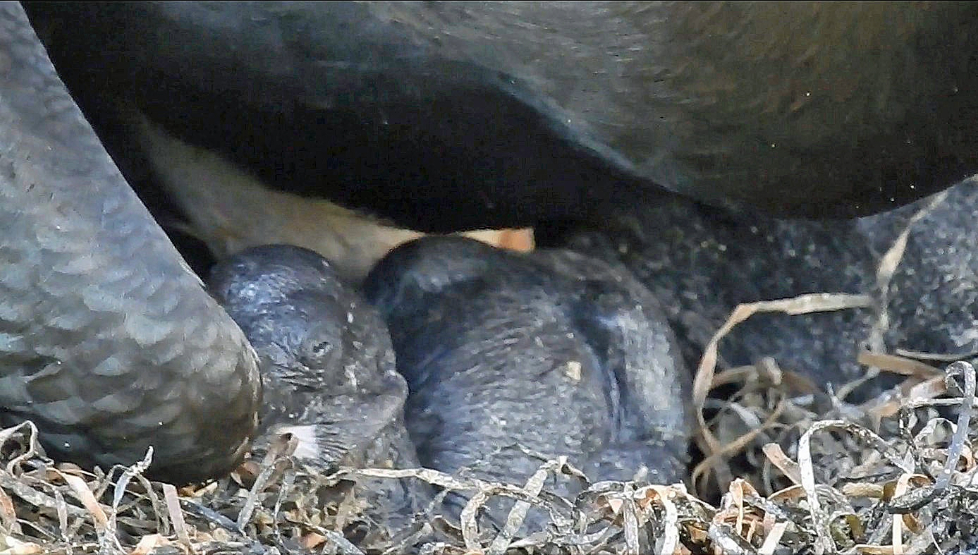
Figure 19. Brandt Cormorant hatchlings are born without the feathers they need for flight, and they depend on both parents to feed them.
Similarly, the time needed for incubation varies widely. The eggs of some small songbirds hatch within 10 days of being laid. Procellariformes (shearwaters, petrels, albatrosses) typically have relatively long incubation periods, as the parents have to travel a long way to find food. The Royal Albatross egg can take about 80 days to hatch after being laid. Kiwis can take about 80 days to hatch, too. In general, the larger the egg, the longer it takes to hatch, though, of course, there are wide variations. For instance, the Eurasian Griffon (a vulture) weighs about 14–23 pounds (6.5–10.5kg), and its altricial chicks hatch in about 50 days (up to 65 days, per Birds of the World — BotW). The female Common Ostrich weighs about 200–260 pounds (90–120kg), but her egg (weighing >3 pounds, 1.5kg) hatches into a precocial chick in less than 40 days.
Also, birds who are relatively safe from predators, such as those that breed in cavities (e.g., chickadees) tend to have long incubation periods because they can afford this extended period of vulnerability.
Figure 20. This Bananaquit eats mostly nectar, along with a few insects and maybe small fruits, so it’s not truly a predator for this Screaming Piha egg, but it certainly imperils the egg, showing just how precarious the life of an egg can be.
Hatching
When the fully developed embryo is ready to hatch, it’s pretty tightly scrunched inside the egg, “with its ankles at the pointed end and its head towards the blunt end; its neck is so bent that the head lies adjacent to the breast with the beak poking out from under the right wing up against the egg membrane. This pre-hatching posture seems to be typical of all birds, except for megapodes.”
In preparation to hatch, the embryo has to switch from getting all its oxygen through the shell’s pores, via its network of blood vessels, to getting oxygen by using its own lungs. It uses its “egg tooth,” at the tip of its bill, to puncture a hole into the top of the egg’s shell. The instant it breaks this hole, it starts breathing its own air. Second, the chick must switch off its blood supply from the network lining the shell’s inner surface, pulling its blood into its own body. It does so before it starts cutting more of the shell, to break free. Third, the chick must extract any remaining nutrients from the yolk and pull them into its own abdomen, literally sucking them up through a tiny stalk connected to the chick’s guts. For a precocial chick, this yolk provides a needed storehouse of nutrients until it can ably find food.
Having completed its physiological independence, it’s ready to cut through the shell completely, thrusting its egg tooth against the interior wall of the shell. (Later, the hardened-calcium egg tooth either is reabsorbed or loosens and falls off.) While hammering with its egg tooth, it’s also thrusting its shoulders upward, pushing its legs downward inside the shell, for leverage. Luckily, the embryo used some of the eggshell’s calcium to build its own skeleton, so the eggshell has become thinner than it was when it was laid.
Sometimes, once an emerging chick pips the shell (i.e., makes that first break), its parents help it along by breaking off some of the shell near the broken hole. Some parents even tip their chicks out of the shell as soon as enough shell has been removed. (According to BotW, Eurasian Griffon vulture parents have been seen nibbling around the shell opening, enlarging it.)
There are also variations in how the emerging chicks break the shell. Some cut through just barely enough of the egg’s circumference to shatter it and break free. Others cut a neat circular cap in the top of the shell. The Bobwhite Quail even cuts around the cap more than once before emerging. Some eggshells and shell membranes are harder to break than others. More brittle eggs (e.g., those of ducks or chickens) are easier to break than tougher and less brittle eggs (e.g., those of pigeons and quails), which need more poked perforations than brittle eggs.
Among some species, such as those that breed in dense colonies, the emerging chick starts calling to its parent as soon as it has pipped the shell, and the parents respond in turn. This may help them to identify one another more easily after the chicks hatch. In addition, embryos in a clutch may call to each other while in the eggshell. Embryos of Japanese Quails and Bobwhite Quails have been observed making clicks and other sounds to one another. These communications may help chicks to synchronize their development and their readiness to hatch, so that they can hatch at about the same time, despite being laid one or more days apart.
For many species, it’s advantageous to hatch in synchrony, within hours of one another, despite being laid on differing days. Mallard parents can sigh with relief once all their precocial chicks have hatched, so that the parents can take them to safety, away from potential predators.
Rheas are large flightless distant relatives of ostriches and emus, with a distinctive breeding style. A male will build a simple “nest,” then he’ll mate with 2–12 females, each of whom will lay her eggs in his nest. These eggs may be laid up to 14 days apart (taking 27–41 days to incubate). Yet, all of the 10–60 eggs will hatch within 36 hours of each other. According to BotW (Birds of the World), Greater Rhea eggs hatch within 6 to 8 hours of each other, despite being laid about 12 days apart. The developing embryos make loud calls, audible to their clutch-mates, which may stimulate this close timing. I’m guessing the dad is quite relieved once all his eggs hatch. (See also https://en.wikipedia.org/wiki/Rhea_(bird).)
Fun fact: As Greater Rhea eggs hatch, they exude a pungent odor, which attracts flies — and within a few hours, the hatchlings are gluttonously eating the flies, who had been hoping for a free meal. (BotW)
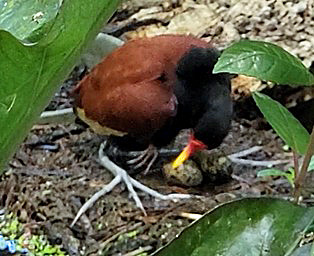
Figure 21. For many birds, it’s not important to have all the eggs in the clutch hatch synchronously. For instance, this Wattled Jacana dad is incubating unhatched eggs while also carrying his newly hatched chicks (note the dangling toes).
As in many things about egg production, megapode eggs hatch differently. Because the eggs don’t have to support the weight of an incubating parent, megapode egg shells can be relatively thin. The thinness of the shell makes gas exchange (oxygen and carbon dioxide) easier, and it makes it much easier for the emerging chick to break free. In fact, these chicks don’t even have any egg teeth. They use their feet to kick their way out of their shells. It’s easier for them to get out of their shell, but they must also dig their way out of their mound of soil or rotting vegetation, so it actually takes them a couple of days to emerge from the mound.
What’s left? Empty eggshells. Empty eggshells are dangerous, both because of their sharp edges and because they may attract predators. Quite a few bird parents eat the calcium-rich shell; others remove the shell from the nest. For tree-nesting birds (e.g., herons), they can simply flick the shell out of the nest. Ground-nesting birds have to cart it away. Grebes and other aquatic birds shove the shell bits beneath the water surface. Ducks simply leave the shells and the nest, escorting their ducklings to a safer spot.
Chapter 9. Epilogue: Lupton’s Legacy,
pp. 205–220
Despite the tremendous physiological investment of the mom, only about 90% of laid eggs result in a healthy hatched chick. And that’s the average. Sadly, the rate of success is even lower among endangered species, probably largely because their population is so low that they have to breed with close relatives. Inbreeding increases the likelihood of undesirable genetic traits appearing in the offspring, further decreasing the population, creating a vicious spiral.
Among New Zealand Kākāpō, only about one third of laid eggs become healthy hatchlings. Kākāpōs lay eggs only in years when the fruit harvest abounds, so about every 3–4 years. Even with fruit abundance, each night, the Kākāpō mom must leave her hatchlings to find food, leaving them vulnerable to attack from predators, as well as to being chilled. Even after hatching, the chicks are vulnerable to predators while mom searches for food. Once they survive their chick-hood, they can live about 60 years, and they can start breeding as young as 5 or so years, though 9 is more common.

Figure 22. Rare and precious Kākāpō eggs and the even rarer hatchlings require conservation management in the wild to help them survive. (a) “Hatching kakapo egg, ‘kakapo “Lisa’s” egg hatching, hand held’” (Josie Beruldsen, 2008). (b) “Hatchlings” (Mike Bodie, 2005). (c) “A full length parrot portrait, Sirocco the kakapo poses for the camera” (Mike Bodie). (d) “Individual nicknamed Trevor feeding on poroporo fruits, Maud Island” (Don Merton, 2001). All photos are courtesy of the Department of Conservation, New Zealand. For each image, this file is licensed under the Creative Commons Attribution 2.0 Generic license. If shared, it must include full attribution.
Scientists really don’t know when dinosaur birds, in their evolutionary past, began to incubate their eggs through contact with their body heat. Surely, they had evolved to be ectotherms (warm-blooded) prior to having incubation be beneficial to their young. How long was it that birds started incubating their eggs after becoming ectotherms? No one knows. Yet. They do know, however, that whenever contact incubation evolved, embryos also had to evolve much larger proportions of albumen in their eggs, to supply enough water to the developing embryo, as they could no longer draw it from a watery environment.
The evolution of contact incubation made bird reproduction more efficient, more successful, and more flexible than reptile reproduction. The warmth provided by contact incubation speeds up embryo development, so the young are vulnerable for a shorter time. Parents could keep their eggs warm in many more habitats and environments than they could without incubating them. Bird parents could make their homes in places where reptiles couldn’t thrive. The global expansion of bird populations was partly made possible by parental incubation of their young. Emperor Penguins can breed during Antarctic winter, Grey Gulls can incubate in Chile’s Atacama Desert (with nearly no annual rainfall), and cormorants and grebes can raise their young in floating nests.
Figure 23. Flamingo eggs and their parents are beautifully adapted to their environment, illustrating the amazing realization of millennia of small but significant adaptations. For more about flamingo parents, see my blog Got (Bird) Milk? – Bird Brain.
“Birds’ eggs are perfect only in the sense that they are the optimal compromise between different selection pressures” (p. 215). Nonetheless, “No adaptation is perfect, and . . . what evolves is invariably a compromise between different selection pressures” (p. 209).
Back Matter
- Notes, pp. 221–244
Preface, 3 notes; Ch. 1, 24; Ch. 2, 36; Ch. 3, 45; Ch. 4, 29, Ch. 5, 41; Ch. 6, 52; Ch. 7, 47; Ch. 8, 43; Epilogue, 19 notes. - Bibliography, pp. 245–265
from Abati to Zuckerman - Glossary, pp. 266– 269
from Altricial chicks to Yolk sac. - Bird Species Mentioned in the Text, pp. 270–274
alphabetical listing of common names, with scientific names, from “African thrush, Turdus pelios,” to “Zebra finch, Taeniopygia guttata” - Acknowledgements, pp. 275–277
- A Note on the Plate Section, p. 278
Details on the final photo in the plate section - Index, pp. 279–288
from Abati (Baldus Angelus Abbaticus) to Zuckerman, Solly
Additional Resources
Birds of the World — Families
- Apterygidae, Kiwis — Winkler, D. W., S. M. Billerman, & I. J. Lovette (2020). “Kiwis (Apterygidae),” version 1.0. In Birds of the World (S. M. Billerman, B. K. Keeney, P. G. Rodewald, & T. S. Schulenberg, Editors). Cornell Lab of Ornithology, Ithaca, NY, USA. https://doi.org/10.2173/bow.aptery1.01
- Diomedeidae, Albatrosses — Winkler, D. W., S. M. Billerman, & I. J. Lovette (2020). “Albatrosses (Diomedeidae),” version 1.0. In Birds of the World (S. M. Billerman, B. K. Keeney, P. G. Rodewald, & T. S. Schulenberg, Editors). Cornell Lab of Ornithology, Ithaca, NY, USA. https://doi.org/10.2173/bow.diomed1.01
- Jacanidae, Jacanas — Winkler, D. W., S. M. Billerman, & I. J. Lovette (2020). “Jacanas (Jacanidae),” version 1.0. In Birds of the World (S. M. Billerman, B. K. Keeney, P. G. Rodewald, & T. S. Schulenberg, Editors). Cornell Lab of Ornithology, Ithaca, NY, USA. https://doi.org/10.2173/bow.jacani1.01
- Megapodiidae, Megapodes — Winkler, D. W., S. M. Billerman, & I. J. Lovette (2020). “Megapodes (Megapodiidae),” version 1.0. In Birds of the World (S. M. Billerman, B. K. Keeney, P. G. Rodewald, & T. S. Schulenberg, Editors). Cornell Lab of Ornithology, Ithaca, NY, USA. https://doi.org/10.2173/bow.megapo1.01
- Rheidae, Rheas — Winkler, D. W., S. M. Billerman, & I. J. Lovette (2020). Rheas (Rheidae), version 1.0. In Birds of the World (S. M. Billerman, B. K. Keeney, P. G. Rodewald, & T. S. Schulenberg, Editors). Cornell Lab of Ornithology, Ithaca, NY, USA. https://doi.org/10.2173/bow.rheida1.01
- Greater Rhea (Rhea americana) — Kirwan, G. M., A. Korthals, & C. E. Hodes (2021). Greater Rhea (Rhea americana), version 2.0. In Birds of the World (B. K. Keeney, Editor). Cornell Lab of Ornithology, Ithaca, NY, USA. https://doi.org/10.2173/bow.grerhe1.02
- Struthionidae, Ostriches — Winkler, D. W., S. M. Billerman, & I. J. Lovette (2020). “Ostriches (Struthionidae),” version 1.0. In Birds of the World (S. M. Billerman, B. K. Keeney, P. G. Rodewald, & T. S. Schulenberg, Editors). Cornell Lab of Ornithology, Ithaca, NY, USA. https://doi.org/10.2173/bow.struth1.01
- Common Ostrich — video
- Tinamidae, Tinamous — Winkler, D. W., S. M. Billerman, & I. J. Lovette (2020). “Tinamous (Tinamidae),” version 1.0. In Birds of the World (S. M. Billerman, B. K. Keeney, P. G. Rodewald, & T. S. Schulenberg, Editors). Cornell Lab of Ornithology, Ithaca, NY, USA. https://doi.org/10.2173/bow.tinami1.01
Birds of the World — Species
- American Flamingo — del Hoyo, J., P. F. D. Boesman, & E. Garcia (2024). “American Flamingo (Phoenicopterus ruber),” version 1.1. In Birds of the World (J. del Hoyo, A. Elliott, J. Sargatal, D. A. Christie, E. de Juana, & M. G. Smith, Editors). Cornell Lab of Ornithology, Ithaca, NY, USA. https://doi.org/10.2173/bow.grefla2.01.1
- Brandt’s Cormorant — Wallace, E. A. & G. E. Wallace (2021). “Brandt’s Cormorant (Urile penicillatus),” version 1.1. In Birds of the World (A. F. Poole & F. B. Gill, Editors). Cornell Lab of Ornithology, Ithaca, NY, USA. https://doi.org/10.2173/bow.bracor.01.1
- Egyptian Plover — Maclean, G.L., & G. M. Kirwan (2020). “Egyptian Plover (Pluvianus aegyptius), version 1.0. In Birds of the World (J. del Hoyo, A. Elliott, J. Sargatal, D. A. Christie, & E. de Juana, Editors). Cornell Lab of Ornithology, Ithaca, NY, USA. https://doi.org/10.2173/bow.egyplo1.01
- Emerald-spotted Wood-Dove — Baptista, L. F., P. W. Trail, H. M. Horblit, P. F. D. Boesman, & G. M. Kirwan (2020). “Emerald-spotted Wood-Dove (Turtur chalcospilos), version 2.0. In Birds of the World (T. S. Schulenberg & B. K. Keeney, Editors). Cornell Lab of Ornithology, Ithaca, NY, USA. https://doi.org/10.2173/bow.eswdov1.02
- Eurasian Griffon — Salvador, A. (2024). “Eurasian Griffon (Gyps fulvus),” version 7.0. In Birds of the World (S. M. Billerman, M. A. Bridwell, & B. K. Keeney, Editors). Cornell Lab of Ornithology, Ithaca, NY, USA. https://doi.org/10.2173/bow.eurgri1.07
- Gray Gull — Medrano, F., I. Escobar Gutiérrez, & R. Silva (2024). “Gray Gull (Leucophaeus modestus), version 2.1. In Birds of the World (S. M. Billerman, Editor). Cornell Lab of Ornithology, Ithaca, NY, USA. https://doi.org/10.2173/bow.grygul.02.1
- Kākāpō — Collar, N., C. J. Sharpe, & P. F. D. Boesman (2024). Kākāpō (Kakapo) (Strigops habroptilus), version 1.1. In Birds of the World (J. del Hoyo, A. Elliott, J. Sargatal, D. A. Christie, & E. de Juana, Editors). Cornell Lab of Ornithology, Ithaca, NY, USA. https://doi.org/10.2173/bow.kakapo2.01.1
- See also https://en.wikipedia.org/wiki/K%C4%81k%C4%81p%C5%8D, a resource for photos of Kākāpō, as well as information.
- Palm Swifts
- Asian Palm Swift — Chantler, P. & P. F. D. Boesman (2020). “Asian Palm Swift (Cypsiurus balasiensis),” version 1.0. In Birds of the World (J. del Hoyo, A. Elliott, J. Sargatal, D. A. Christie, & E. de Juana, Editors). Cornell Lab of Ornithology, Ithaca, NY, USA. https://doi.org/10.2173/bow.aspswi1.01
- African Palm Swift — Kirwan, G. M., P. Chantler, & P. F. D. Boesman (2021). “African Palm Swift (Cypsiurus parvus),” version 1.2. In Birds of the World (G. M. Kirwan, Editor). Cornell Lab of Ornithology, Ithaca, NY, USA. https://doi.org/10.2173/bow.afpswi1.01.2
- Southern Screamer — Brady, S. (2020). “Southern Screamer (Chauna torquata),” version 1.0. In Birds of the World (T. S. Schulenberg, Editor). Cornell Lab of Ornithology, Ithaca, NY, USA. https://doi.org/10.2173/bow.souscr1.01
Copyright, 2025, Shari Dorantes Hatch, images and text, except where specific attributions are noted. All rights reserved.


 Bird Brain
Leave a reply to valiantlyblaze5d0d5f2b66 Cancel reply