
You know what I’d appreciate?
Cough it up, Dad! Regurgitate!
— Judy Sierra, from “Regurgitate,” [p. 8],
Antarctic Antics: A Book of Penguin Poems
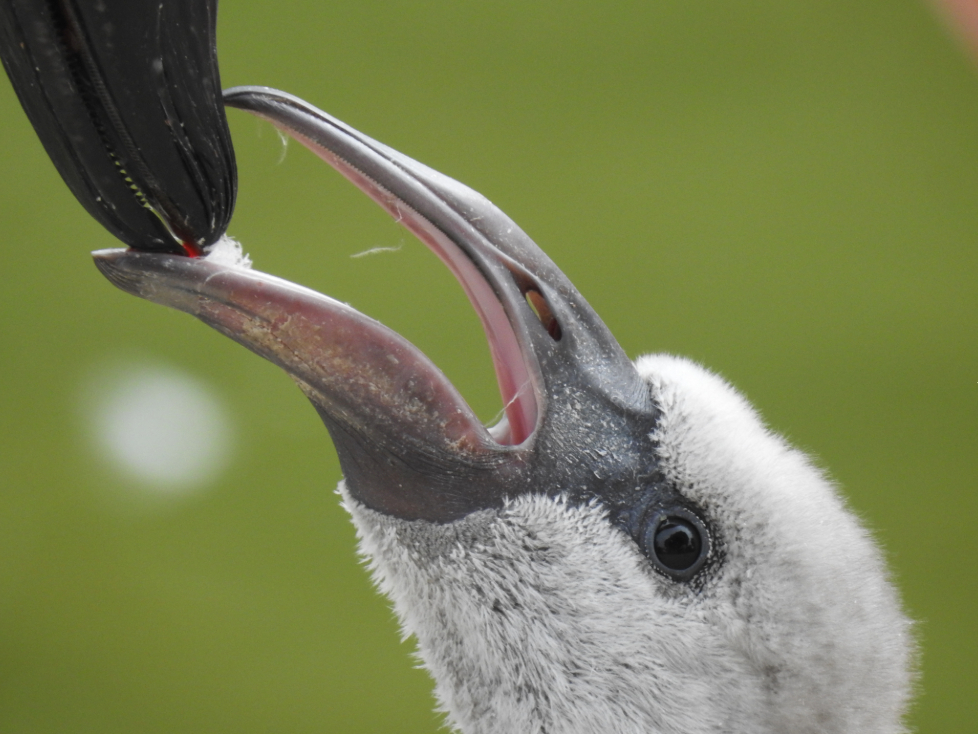
A key trait of mammals is that we (mammal moms) can produce milk to feed our babies. No other kinds of animals can do that, right?
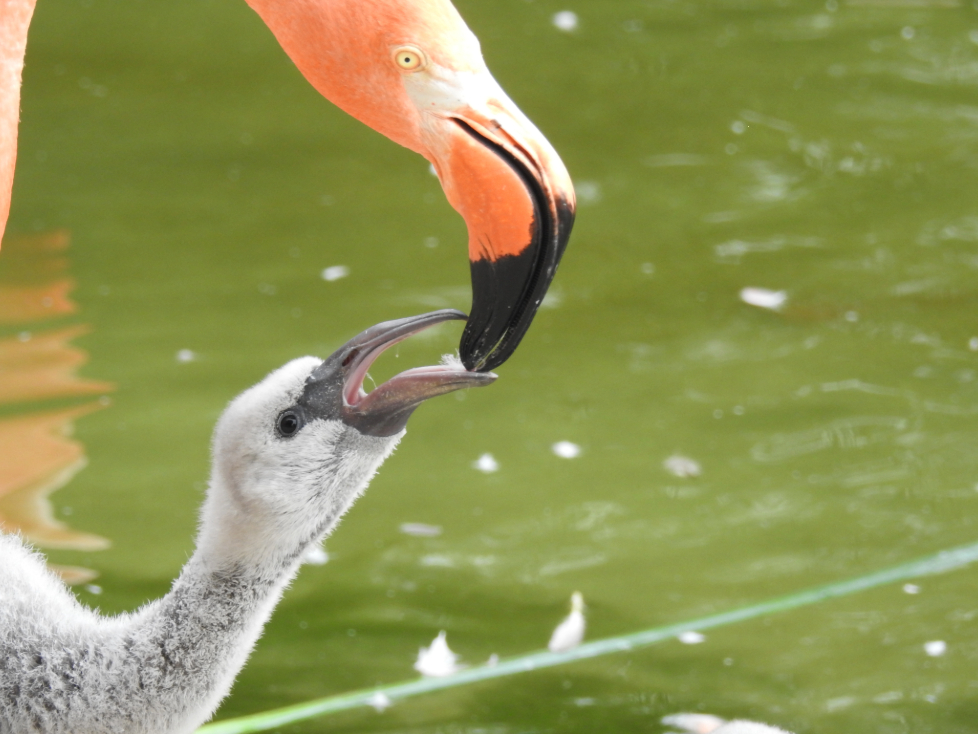
Yes and no. Birds don’t have mammary glands, so they can’t produce milk the way we mammals do. However, some birds can produce “crop milk” to nourish their offspring. You’ve doubtless seen one of the families of birds who produce “crop milk” for their hatchlings: Columbidae (pigeon and dove dads and moms). Also, the San Diego Zoo and many other zoos enable us to enjoy seeing Phoenicopteridae (flamingo moms and dads). In addition to these two families of birds, one other bird species can make crop milk, too: Emperor Penguin dads (not moms!).
These bird moms and dads share parenting duties, so producing crop milk is just one of the ways they take care of their young. The parents create nourishing crop milk then regurgitate it into their own bills to feed their chick.
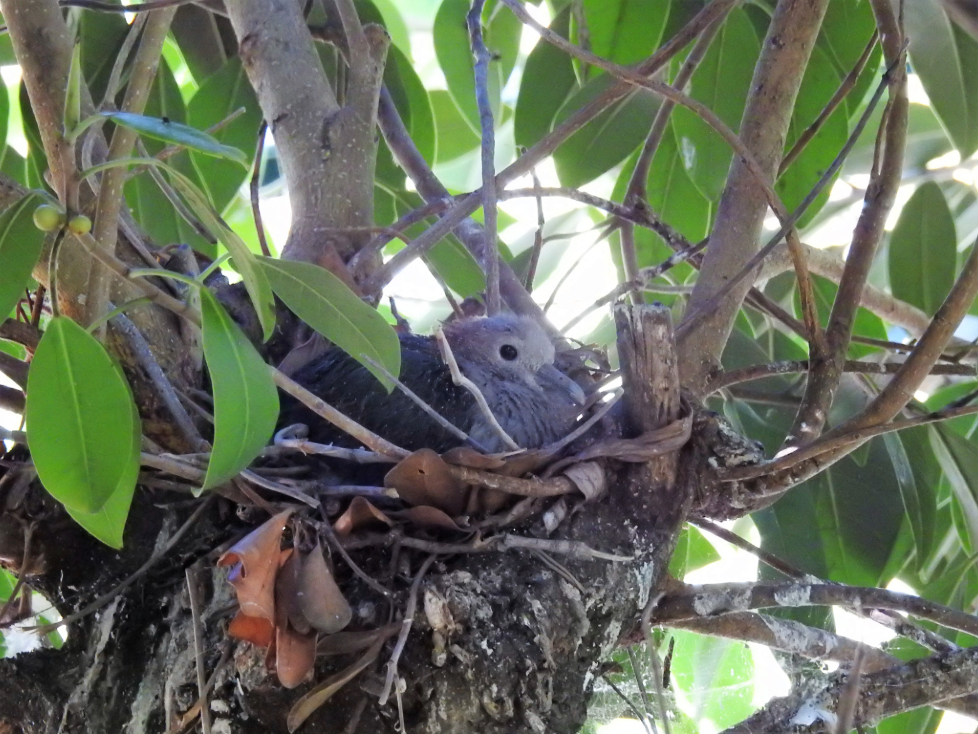
What’s the difference between a pigeon (such as this Sulawesi Green Imperial-Pigeon, above) and a dove (such as this Emerald Spotted Dove, below)? No difference. In general, people tend to name bigger birds pigeons and smaller ones doves, but there’s no biological or behavioral difference between the two.

Pigeons, doves, and several other families of birds have crops. This pouch-like bulge of the esophagus can store food until the bird is ready to digest it. For pigeon and dove moms and dads, a short time before their egg hatches, a hormone stimulates them to produce and accumulate a milky substance lining the crop. After the egg hatches, the crop milk can be sloughed off and moved into the bill, ready for mom and dad to feed it to their hatchling. Because flamingos and Emperor Penguins don’t have crops, they use the whole esophagus to produce “crop milk.”
Though the exact substance differs somewhat across families and species, all crop milk is nutrient-rich. Unlike mammal milk, crop milk doesn’t contain carbohydrates (sugars or starches), so it has even more proteins and fats for the hatchlings. Like mammal milk, crop milk also contains vitamins, immune-system boosters, antioxidants, and microbes that aid digestion. A perfect concoction for a growing bird!

Pigeon and dove chicks poke their bills directly into their parents’ open bill to feed on crop milk.
You may be wondering why these particular bird families go to all this trouble for their young, especially when these families differ so greatly from one another. (Pigeons are strong fliers who live almost anywhere except Antarctica; Emperor Penguins are nonfliers who live only in Antarctica.)
For pigeons and doves, their usual carbohydrate-based diet (seeds or fruits) is hard to digest and doesn’t offer enough protein and fat for hatchlings to develop and mature. Unlike many other bird species, pigeons and doves don’t supplement their high-carb diet with high-protein, high-fat insects and other invertebrates. Luckily, crop milk offers the fats and proteins the growing chicks need.
Over time, the parents mix some softened carbohydrate-loaded foods into the crop milk, and eventually the chicks can feed themselves. Crop milk may be one reason why pigeons and doves have adapted to various regions and habitats and enjoy a long breeding season. They don’t depend on invertebrate availability to feed their young.
A flamingo hatchling needs several weeks to develop a bill and the skill to filter-feed effectively, moving its bill upside-down underwater, along the ground. Flamingos need a complex bill structure to expertly strain edible algae and invertebrates from inedible mud, sand, and silt. Lamellae (hard ridges) line the flamingo’s upper and lower jaws, and the bird uses its big strong coarse tongue to force murky liquid through the lamellae. Until the chick can filter-feed with its specialized bill, the chick needs some other source of nutrition. Crop milk to the rescue! Flamingos have evolved this clever way of ensuring that young flamingos survive and thrive until they’re able to feed independently.
For Emperor Penguins, the father incubates the egg while the mother is away at sea, accumulating fish in her stomach, to feed her young when she returns. Typically, the egg hatches before the mother returns, and the father must feed the hatchling despite not having eaten anything for two months. At great cost to himself, he produces crop milk for his hatchling until the mother returns and can feed regurgitated fish to the chick.
Crop milk helps these hatchlings to thrive, grow, and develop under diverse circumstances, for differing reasons, but in each case, crop milk is truly a life-saving ambrosia for these chicks.
Text and photos by Shari Dorantes Hatch. Copyright © 2025. All rights reserved.
Resources
Books and Textbooks
- Bird Families of the World: An Invitation to the Spectacular Diversity of Birds. Winkler, David W., Shawn M. Billerman, & Irby J. Lovette (2015). Lynx, Cornell Lab of Ornithology.
- pp. 68–71, “Columbiformes”
- pp. 66–67, “Phoenicopteriformes”
- pp. 161–162, “Sphenisciformes”
- Handbook of Bird Biology. Lovette, Irby, & John Fitzpatrick (eds.) (2016). Cornell Lab of Ornithology.
- p. 193 (crop milk); also, mentions on 44, 445
- Ornithology: Foundation, Analysis, and Application. Morrison, Michael, Amanda Rodewald, Gary Voelker, Melanie Colón, & Jonathan Prather (eds.) (2018). Baltimore: Johns Hopkins Press.
- p. 129, “From Fertilization to Independence,” Matthias Starck
- p. 153, “Anatomy,” Chapter 5, Margaret A. Voss & Marco Pavia
- The World of Birds, Elphick, Jonathan (2014). Firefly Books.
- p. 149 (crop)
Articles
- “Bird Milk,” Ehrlich, Paul R., David S. Dobkin, & Darryl Wheye (1988). https://web.stanford.edu/group/stanfordbirds/text/essays/Bird_Milk.html
- Birds of the World, Cornell Laboratory of Ornithology, online (subscription) resource
- “Columbidae: Pigeons and Doves,” Winkler, David W., Shawn M. Billerman, & Irby J. Lovette; Version: 1.0. Published March 4, 2020
- “Victoria Crowned-Pigeon, Goura victoria,” Baptista, Luis F., Pepper W. Trail, H. M. Horblit, & Ernest Garcia; Version: 1.0. Published March 4, 2020; Text last updated January 28, 2019
- “Phoenicopteridae: Flamingos,” Winkler, David W., Shawn M. Billerman, & Irby J. Lovette; Version: 1.0. Published March 4, 2020
- “Spheniscidae: Penguins,” Winkler, David W., Shawn M. Billerman, & Irby J. Lovette; Version: 1.0. Published March 4, 2020
- “Columbidae: Pigeons and Doves,” Winkler, David W., Shawn M. Billerman, & Irby J. Lovette; Version: 1.0. Published March 4, 2020
- “Common Crowned Pigeon,” Smithsonian National Zoo,
https://web.archive.org/web/20051226083932/http://nationalzoo.si.edu/Animals/Birds/Facts/FactSheets/fact-crownpigeon.cfm (April 14, 2024) - “Crop Milk and Clutch Size in Mourning Doves,” Blockstein, David E. (1989), Wilson Bulletin, 101(l), pp. 11–25.
- Wikipedia (April 11–18, 2024)
- “Crop (anatomy),” https://en.wikipedia.org/wiki/Crop_(anatomy)
- “Crop milk” https://en.wikipedia.org/wiki/Crop_milk?wprov=sfla1
- “Emperor Penguins,” https://en.wikipedia.org/wiki/Emperor_penguin
- “Epithelium,” https://en.wikipedia.org/wiki/Epithelium?wprov=sfla1
- “Flamingo,” https://en.wikipedia.org/wiki/Flamingo
Poem
- “Regurgitate,” Antarctic Antics: A Book of Penguin Poems [p. 8]. Sierra, Judy (Jose Aruego & Ariane Dewey, illustrators) (1998). New York: HarperCollins.
Video
- “Pigeon Crop Milk | Racing Homer Pigeon” on YouTube, https://youtu.be/QMWzRqyfJLw?feature=shared
animals Avibase biparental care birding birds books Charles Darwin conservation status Cornell Lab of Ornithology diurnal doves eBird eggs (of birds) feathers fledging (of birds) foraging fungi habitat destruction habitats iNaturalist incubation IUCN Red List knitting LC (Least Concern) Macaulay Library migration (of birds) monogamous nature nesting nestlings nests nonfiction pigeons plumage predator prey San Diego Zoo San Diego Zoo’s Safari Park sexual maturity (of birds) taxonomy threats (to birds) trees vocalizations (birds) wildlife yarn


 Bird Brain
Leave a reply to Kikanza Nuri-Robins Cancel reply