
Eurypygiformes, Rhynochetidae, Rhynochetos jubatus
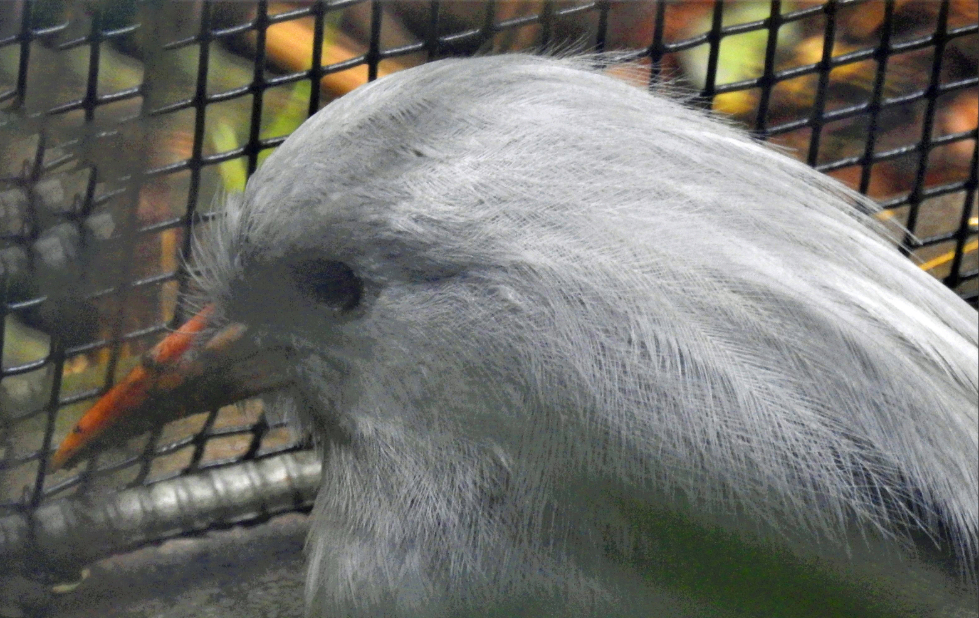
The Passeriformes order of birds includes about 6,500 bird species in more than 140 families. The Eurypygiformes order includes 2 families of birds, each containing 1 genus with 1 species. The Eurypygidae family contains the Eurypyga genus, with just 1 species, Eurypyga helias, the Sunbittern, native of Latin America. (A previous blog already featured Sunbitterns, https://bird-brain.org/2025/02/06/exotic-birds-sunbittern/ .) The Rhynochetidae family has only the Rhynochetos genus, with the sole species Rhynochetos jubatus, the Kagu, endemic to New Caledonia, a group of islands southeast of Australia.
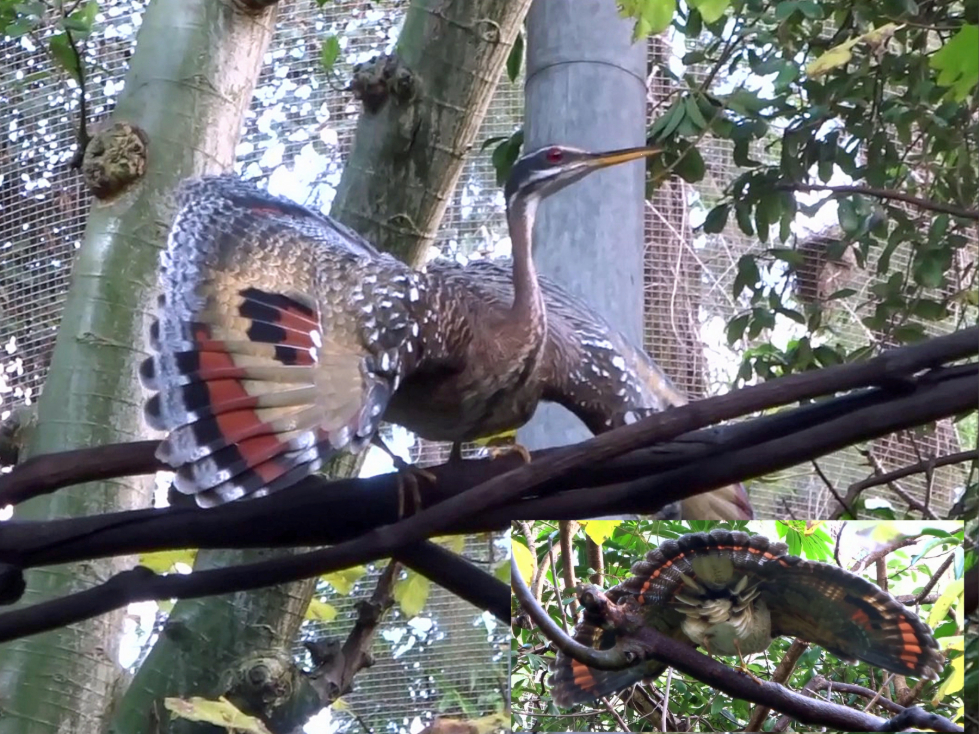
Figure 01. The Sunbittern’s spread wings are stunning to see from the top, as well as from the bottom. Their only closest living relative, the Kagu, is also distinguished by its spread-wing display (see https://macaulaylibrary.org/asset/629702851 ).
The relationships between these two bird families and their relationships with other orders of birds has prompted lots of speculation. For instance, at one time they were thought to be linked to Ardeidae (herons, 74 species) because Kagus and herons have similarities in plumage, egg and chick colors, and internal anatomy. Those similarities turn out to have evolved independently (convergent evolution), however, not due to shared genetic traits. Speculation has also tied these birds to Gruiformes (cranes) or even to Caprimulgiformes (e.g., nightjars) or Phaethontiformes (tropicbirds). They have also been said to resemble Rallidae (156 species of rails), Phasianidae (187 species of pheasants), and even Pittidae (46 species of pittas) — none of which are related birds.
Recent genetic evidence does show that these two families should be together, within their own order, separate from all others. How could these two geographically separated families be related? At one time, Earth’s continents were configured to form one united land mass, the supercontinent Gondwana (named by geologist Eduard Suess, 1861). At that time, no Pacific Ocean existed to separate these two bird families. Hence, weird as it seems, the Sunbittern is the closest living relative to the Kagu. Evidence suggests that their families diverged about 17–45 million years ago. There’s also some fossil evidence that the genus Rhynochetos may have included another species, which dwelled in the lowlands, not overlapping with the highland-loving Kagu.
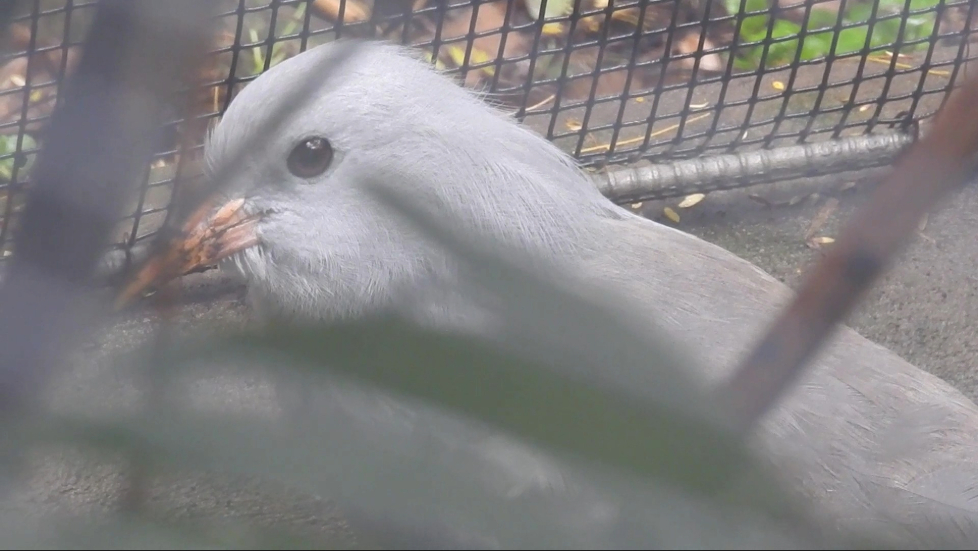
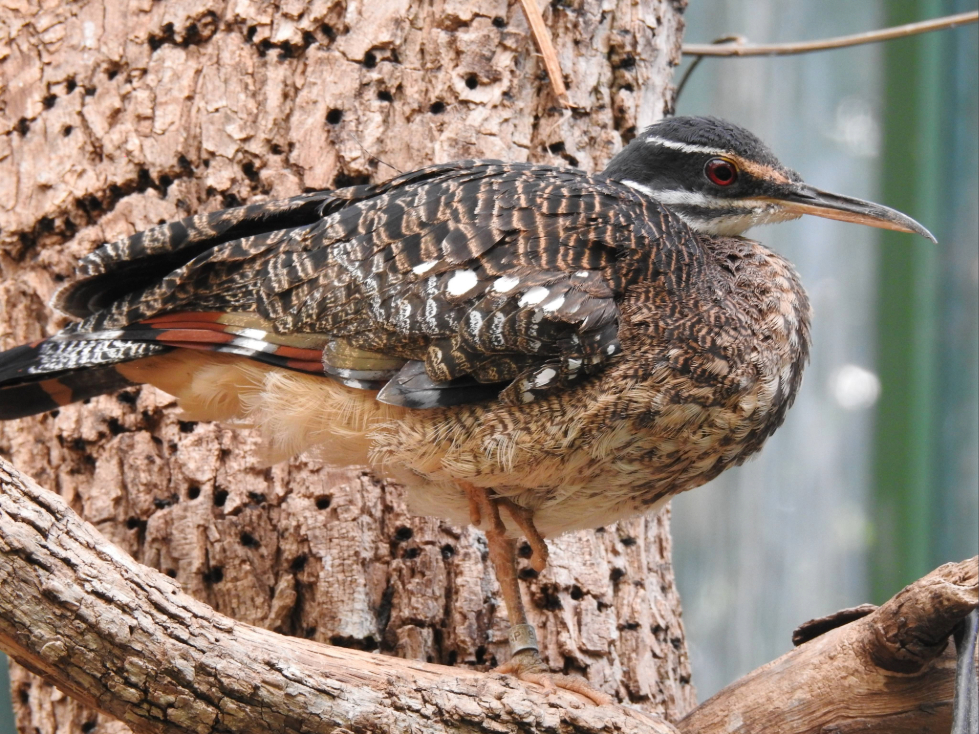
Figure 02, a,b. The Sunbittern and the Kagu differ in many ways, but they’re each other’s closest living relatives.
In addition to living an ocean apart, the Kagu and the Sunbittern don’t look very similar, except that both have highly distinctive patterns on their wings. In addition, the Sunbittern uses its wings to fly and glide, whereas the Kagu is typically considered flightless; with no terrestrial predators on its island habitat, the Kagu has no need to fly. (Some sources say it’s “almost flightless.”)
The two birds also differ sharply in population size and conservation status. The Sunbittern’s IUCN Red List status is LC, Least Concern, with its population estimated at 500,000–4,999,999. The Kagu’s IUCN Red List status is EN, Endangered, with its population estimated at 250–2000 individual birds (https://www.iucnredlist.org/species/22692211/156666402 ).
In full, the Kagu’s taxonomy is kingdom Animalia, phylum Chordata, class Aves, clade Eurypygimorphae, order Eurypygiformes, family Rhynochetidae, genus Rhynochetos, species Rhynochetos jubatus. Whew!
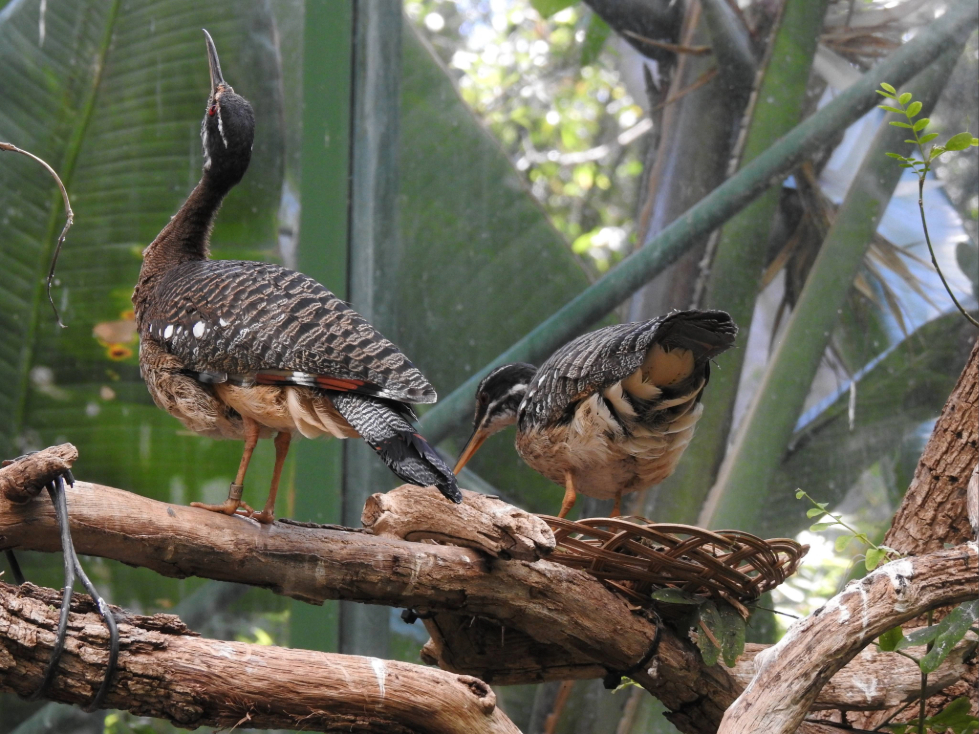
Figure 03, a,b. Whereas the Kagu pretty much sticks to ground-level transportation on foot, the Sunbittern ably flies among treetops and courts its mate with elaborate flight displays. Both species, however, raise their young as monogamous pairs, sharing the care for their offspring.
Kagus
The family name Rhynochetidae and the genus name Rhynochetos both have Greek origins: rhis, for “bill” or “nose,” and khaitē, for “long flowing hair,” indicating the long stiff hairlike feathers over its nostrils. (The suffix -idae indicates it’s a family name.) Its species name, jubatus comes from Latin, iubatus, for having a crest — which it can raise or lower, at will. The common name Kagu (or “kavu” or “kagou”) comes from the Kanak name for these birds; the Kanaks are the indigenous Melanesian people of New Caledonia.
Description
Kagus are medium-sized birds, about 21.7″ long (55 cm), with tails about 6.8–7.9″ long (17.23–20.13 cm). Their weight varies quite a bit seasonally, anywhere from 17.6 to 39 ounces (500–1100 g), depending on food availability. Their body shape is ovoid, with an upright stance, on quite long legs. The tarsus alone (ankle to base of toes) is about 3.9″ (10 cm); for comparison, a 36-ounce Great Blue Turaco has a tarsus of about 1.4–2.5″ (3.5–6.4 cm). With its sturdy, strong legs, the Kagu moves almost entirely on foot, traveling long distances, and it can run quickly (to see its bright orange-red feet and toes, check https://macaulaylibrary.org/asset/610148416 ).
Figure 04. Kagus have full-sized wings, but they stay on the ground, where they live, forage, and raise their young. With their long legs, they have a mostly upright stance, can run quickly, and can travel long distances on foot.
Though the Kagu can’t fly (at least, not much), it has full-sized wings, with a wingspan of about 30.5–33.9″ (77.5–86 cm); each wing is about 10.4″ long (26.4 cm). Its broad wings lack the musculature for flight, but it can glide when it needs to. Perhaps more important than flight, the Kagu uses its wings for display (e.g., see https://macaulaylibrary.org/asset/146496321 ). When the Kagu spreads its wings, it reveals a striking pattern of black and white horizontal stripes (with some chestnut highlights) crossing both wings; the pattern may be bolder and more extensive on females than on males.
The Kagu may spread its wings for social interactions or when alarmed. Also, like the Sunbittern, it will use its wings to distract potential predators from threatening its eggs or chicks. Each of these birds will fake having an injured wing in a “broken-wing” display, to attract the attention of the predator, then draw the predator away from the nest. Unlike the Sunbittern, however, the Kagu will run away, rather than flying off once the predator is far from the nest.
Other than its banded wings, the Kagu’s plumage colors are basically a grayish white to pale gray, with lighter coloring on its underparts than on its upperparts; its coloring can appear pale bluish-gray at times (e.g., https://macaulaylibrary.org/asset/222006161 ). The coloration of its plumes aren’t the only thing special about its feathers. It also has abundant powder-down feathers. Like all feathers, powder-down feathers are made of keratin, but these feathers grow continuously (rather than molting), and parts of the feather can turn to dust (“powder”). The Kagu spreads this dust to neighboring feathers, helping to keep the feathers dry and to insulate the bird in the humid tropical climate of New Caledonia. (To see a rather bedraggled-looking Kagu, see https://macaulaylibrary.org/asset/617984555 ).
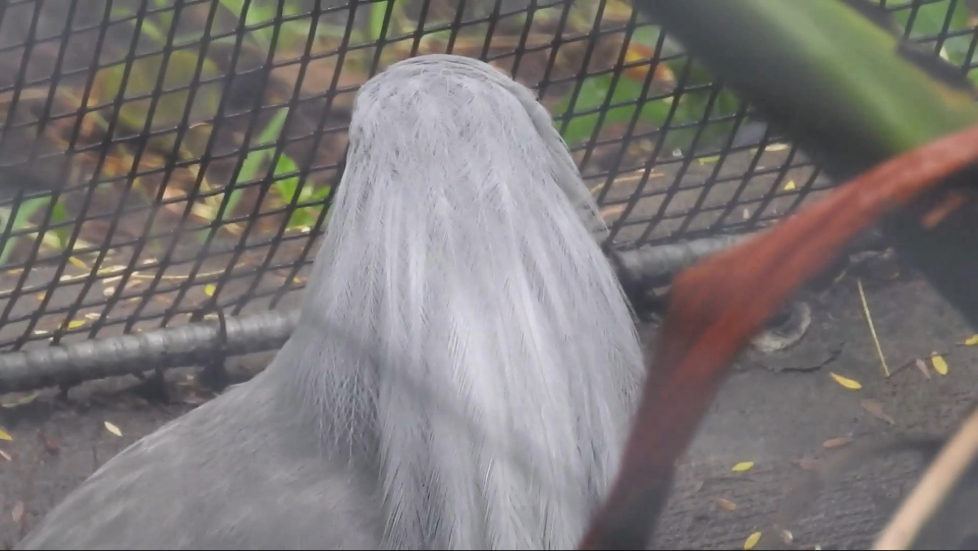
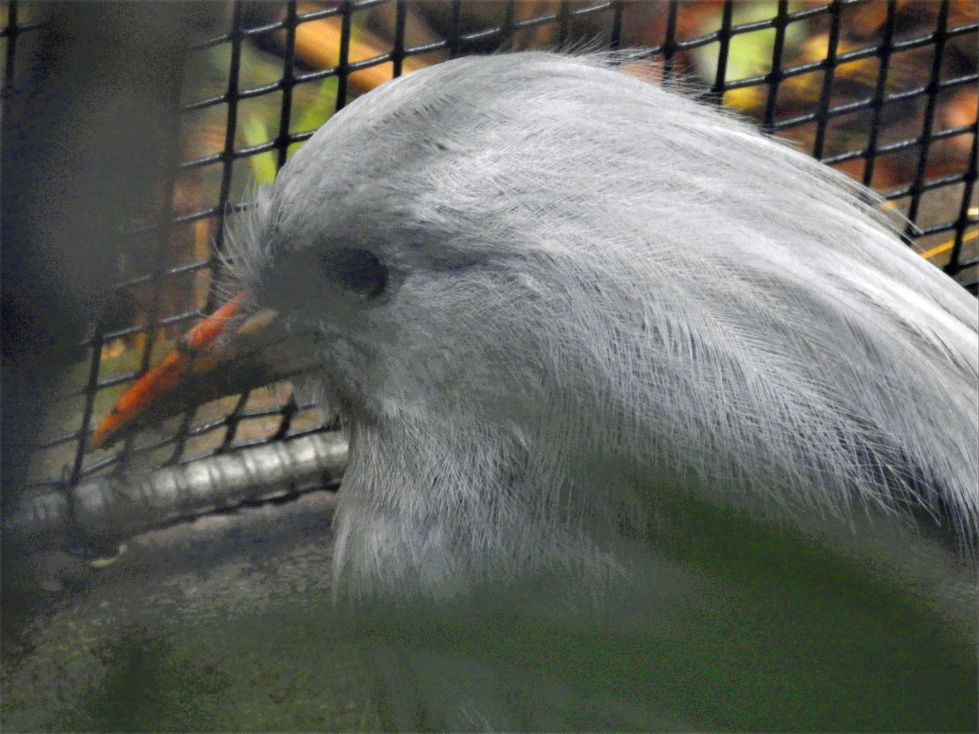
Figure 05, a-b. The Kagu’s feathers include powder-down feathers, which can break down to turn to a powder the Kagu can spread onto its other feathers when preening, a help in the humidity of their native New Caledonia. (See https://macaulaylibrary.org/asset/617984595 for an example of how the humidity can affect the Kagu’s feathers.)
The Kagu’s crest feathers are even more impressive, though most of the time, the Kagu keeps those feathers draped down the back of its head and neck. At any time, however, the Kagu can raise its long shaggy feathers and fan them to create an impressive crest. When interacting with family members, or when otherwise excited, it raises its crest, expressively. (For examples, please see https://macaulaylibrary.org/asset/610283240 or https://macaulaylibrary.org/asset/618385516 .)
Figure 06. The Kagu’s distinctive crest feathers often softly drape over the back of its head. The crest feathers can be seen erected here, https://macaulaylibrary.org/asset/629702846 .
The Kagu’s bright red-orange longish, straight-ish bill is 2.6″ long (6.7 cm), 0.4″ wide (0.95 cm), 0.65″ deep (1.65 cm), and it slopes ever-so-slightly downward. At the top of its bill are a pair of “nasal corns,” oblong bulges covering its nostrils — unique to the Kagu, according to more than one source. Feathers also spring from the bill near the nostrils (see https://macaulaylibrary.org/asset/205514481 or https://macaulaylibrary.org/asset/561692791 ). It’s thought that the corns and the feathers help keep soil from getting into its nostrils while it’s probing into the ground for food. (See https://macaulaylibrary.org/asset/644570281 , https://macaulaylibrary.org/asset/618703798 , and https://macaulaylibrary.org/asset/640019519 for how dirty its bill can get.)
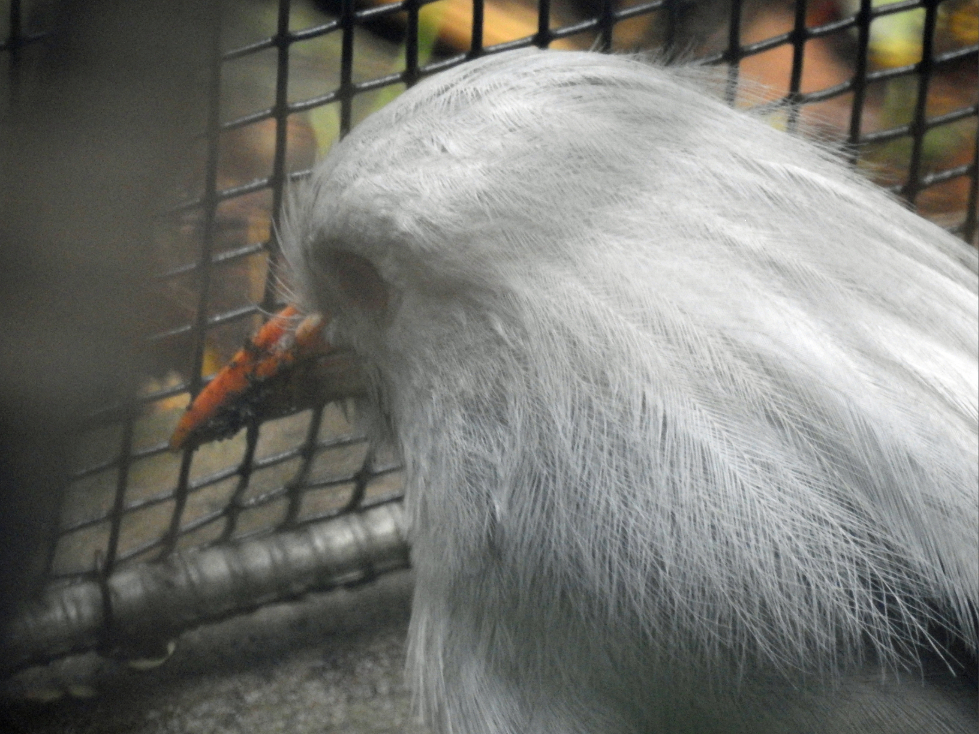
Figure 07. The Kagu’s bright-orange bill has distinctive “nasal corns” bulging above its nostrils, as well as hairlike feathers, which may protect it from inhaling dirt while digging through soil to find prey.
Its crimson red eyes, on either side of its head, are positioned to offer some binocular overlap of its visual field, so that it can perceive depth while looking for prey in leaf litter or while scampering through the dense forest. (See https://macaulaylibrary.org/asset/628728957 .) Also, this image shows that a nictitating membrane protects each eye while the Kagu probes the leaf litter with its bill and its distinctive tongue: https://macaulaylibrary.org/asset/610158593 .
Juvenile Kagus look much like adults, but during their first year, their plumage is browner and more finely banded, and their legs and bills are browner, too. During their second year, their plumage gets grayer, and their bills and legs get more orange. By 2–3 years of age, they look almost identical to adults, except that their crests are a bit shorter, reaching adult length at about age 4 years.
Vocalizations
Kagus are known to be quite noisy, with vocalizations that can be heard up to 0.6 miles (1 km) away. These diurnal birds often vocalize in a series of long nasal hoots and cackles, especially before dawn, sometimes lasting about 15 minutes. They vocalize not only solos, but also duets. For instance, a male might produce a series of soft deep notes, building to a crescendo of pitch and tempo, then the female may join him with even faster notes. As the song continues, the baritone male and the soprano female may sing in unison, continuing to sing together for 3–5 minutes then abruptly halting. Groups of Kagus may sing together as a chorus. For examples, see https://xeno-canto.org/species/Rhynochetos-jubatus (18 vocalizations listed; these sound mostly like whoops to me).
Distribution and Habitat
The Kagu is endemic to the tropical islands of New Caledonia, mostly restricted to the main island of Grande Terre. (See https://ebird.org/species/kagu1 for a range map of the Kagu.) On Grand Terre, the Kagu mostly inhabits a patchwork of moist, dense mountain forests, though it can be found from sea level up to 4,600 feet (1,400 m) or beyond. Hunting and predation by introduced species of animals have restricted the Kagu’s territorial range (now estimated between 518 and 2,741 square miles (1342 –7100 km2).
Though the Kagu prefers rainforests, if it can find enough prey in shrubland or drier lowland forests, it can be found there, too. It may travel through grasslands or other types of habitats, but only on its way to more desirable forest lands — walking up to 1.25 miles (2 km) at a time. Even on mountainous terrain, they’ve been seen to move quickly, ascending more than 2,400 feet (740 m) over two days.
Figure 08. Kagus can cover a lot of ground on their long legs, even climbing more than 2,400 feet up a mountain in a two-day period.
Once a pair of Kagus has established their exclusive territory, they don’t migrate. Nonetheless, they do seem to move around at the ground level within their territory, following food supplies that vary seasonally. Their preferred prey is most abundant in the summer rains and the least available in the dry season. Females who lose their partners may abandon their current territory and roam widely before finding a new one. Juvenile Kagus will make numerous exploratory short trips outside their parents’ territory before leaving it altogether, which may not be until they’re 3 or more years old.
Diet and Foraging
Kagus have a purely carnivorous diet; according to Avibase, about 80% of their diet is invertebrates (e.g., larval and adult insects, spiders, centipedes, millipedes, snails, earthworms) and 20% is land vertebrates (e.g., lizards). In captivity, it will also eat small fishes, mice, and saltwater shrimps.
When foraging, a Kagu will suddenly stop, lift one foot, and stand completely still, looking and listening for prey. While motionless, it uses its binocular vision and acute hearing to detect prey, often looking and listening for movements. Once it sees or hears prey, it pokes its bill into the leaf litter and the soil to unearth its prey. It may also flush prey by jostling the litter with one foot, or it may prompt earthworms to surface above the soil in this manner. It uses its bill, not its feet, to capture the prey, deftly extracting worms or other animals. In addition to scouring the leaf litter or soil, the Kagu will look for prey among plants, decomposing logs, and even rocks. Once it has captured the prey, the Kagu kills it before eating it. (For photos of Kagus with invertebrates, see https://macaulaylibrary.org/asset/628728931 and https://macaulaylibrary.org/asset/197857921 .)
Figure 09. Kagus have binocular vision and exceptional hearing for detecting prey movements beneath the forest’s leaf litter.
Social Behavior and Breeding
A Kagu pair will share a territory year-round (25–69 acres, 10–28 hectares), but the two will live separately outside of breeding season and will forage separately, though there may be some overlap. Neighboring Kagu families may have overlapping territories, and if one Kagu steps into the territory of one another, the two will display toward each other, raising and lowering their crests and spreading their wings. If neither backs off, they may resolve the dispute by using bills and wings to fight, but serious injury rarely results.
Breeding can occur 10 months/year (not January or February), typically peaking in July, depending on tropical weather patterns and availability of food. When ready to breed, the monogamous pair comes together, sometimes with additional male helpers, typically offspring from previous seasons. (A Kagu pair is at https://macaulaylibrary.org/asset/610283241 .) The helpers help to defend the territory, and their presence increases reproductive success, but they do not share in incubation, feeding, or other parenting duties.
The Kagu pair scrapes out an area in the leaf litter on the floor of the forest, near a tree trunk, a log, or low vegetation, close to where prey is readily available. They don’t try to conceal the nest, built of sticks or layered leaves. Some pairs don’t even bother making any nest at all.
Under most circumstances, the pair attempts just one clutch of one egg per year, but if the offspring doesn’t survive, they may try again another 2–4 months later. The female lays a single dusky grayish-pinkish egg with brown specks and blotches (photo of a single Kagu egg in its “nest,” https://www.inaturalist.org/observations/145215040 ), and both parents take turns incubating their egg. Each parent will incubate the eggs for 24 hours, switching off at about midday. Early each morning, the incubating parent will call to its mate for a brief respite to forage quickly and then resume incubation duties until noonish. Those duties continue for about 33–37 days.
The hatchling’s coloring is pale, fawn, and dark brown, with an area of bare skin on its upper back. Both parents take care of their semiprecocial chick, brooding it nightly (more often by the dad) and feeding it for up to 14 weeks after it hatches. By the time it’s 3 weeks old, it weighs about 10.5 ounces (300 g), and by 2 months of age, it weighs about 21 ounces (600 g) and has a 4″ (10-cm) crest. Even after the parents no longer feed their youngster, it may stay on its parents’ territory for up to 6 years, often aiding in territorial defense for subsequent clutches; up to five older juveniles have been observed staying with one pair. Kagu parents have also been seen providing care for an unrelated chick. Unfortunately, even these attentive parents all too often lose their young to predators, especially attacks by dogs. If one of the parents is killed, the surviving mate may find a new breeding partner.
Figure 10. Kagu moms and dads both attentively care for their young until they’re able to care for themselves, and the Kagu youngsters often continue to stay on their parents’ territory for years afterward. The youngsters’ continued presence also helps the parents to defend their territory when the parents breed again in subsequent years.
Males reach sexual maturity at about 2 years of age, but the age for females is not known. The age at first breeding for both sexes is about 2–2.25 years. The average generation length is about 6.7–8.2 years, with one report of 15 years.
Conservation Status
The IUCN Red List conservation status of Kagus is EN, Endangered, and it’s listed as endangered, CITES I, due to its drastic population decline since the arrival of Europeans on New Caledonia. Some estimate its territorial range as just 518 square miles (1341.75 km²), and even within its range, its habitat is dangerously fragmented. Most of its suitable intact habitat is now restricted to relatively remote areas at higher altitudes. The contemporary population of wild Kagus has been estimated at 250–1000 birds.
For decades, conservation efforts have been focused on the Kagu, and it enjoys full protection in New Caledonia. Luckily, Kagus respond well to captive-breeding programs. A captive-breeding program at the Nouméa Zoo (in New Caledonia’s capital) has successfully led to releases of captive-bred birds into Rivière Bleue Territorial Park, where wild and captive-bred Kagus are protected, including a pest-management program. Though numbers are difficult to ascertain, it’s thought that there may now be 850 or more Kagus, from a low of 300 birds in 1998.
The IUCN reports that the conservation of Kagus is being aided by protective conservation sites, action plans for recovery of this species, programs to control or prevent invasive species, successful programs for reintroducing birds to protected areas, in-situ conservation of Kagus, education and awareness programs, and both national and international legislation for management of these populations.
Even before Europeans arrived at New Caledonia, Kagus had been important to the indigenous Kanak people of New Caledonia. They engaged in subsistence hunting, incorporated its calls into their ceremonies, and used its feathers in head-dresses. After Europeans arrived and discovered the Kagu (in the mid-1800s), they hunted it for its meat, considered a delicacy. They also extensively trapped the bird for the European pet trade, as a fashion trend, as well as for museums, zoos, and menageries, severely threatening the Kagu population. With Kagus on the verge of extinction, a 1977–1982 campaign was waged to eliminate the pet trade in Kagus. The perils to these birds didn’t end, however, as they continue to be threatened by habitat destruction and by the invasive introduction of predatory mammals, such as dogs, cats, and pigs.
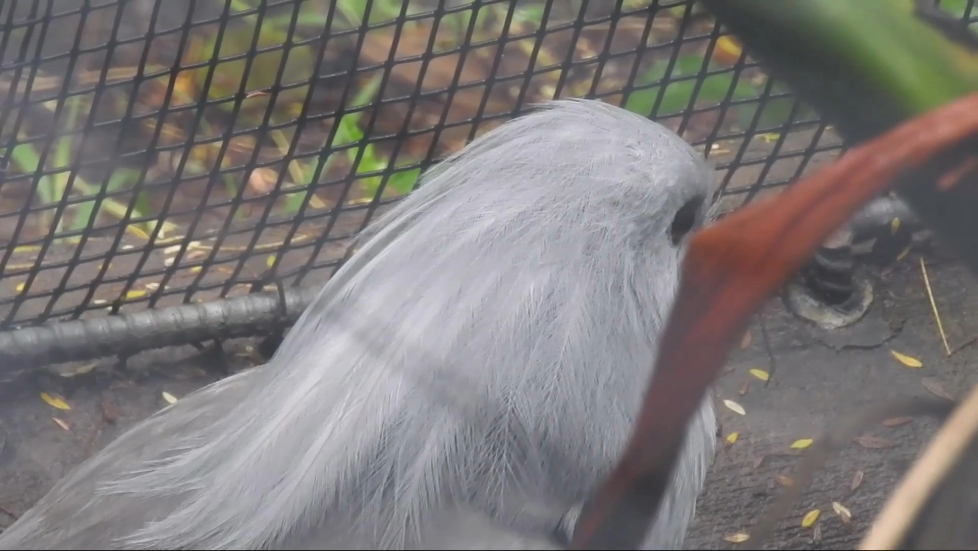
Figure 11. The Kagu’s feathers have been prized not only by fellow Kagus, but also by the indigenous Kanak people of New Caledonia — occasionally to the detriment of the Kagus.
Dogs pose a particular hazard. One 1993 report, using birds with radio transmitters, found that dogs killed 17 of the 21 birds; a 2017 report found that dogs killed half of the radio-tagged Kagus. A single dog killed another 20% of the existing birds within 6 weeks in 2018. Luckily, there aren’t wild feral populations of dogs, so predation by dogs occurs only near to where humans have settled. A less concerning threat is predation by cats, rats (who eat nestlings), and feral pigs (who occasionally eat Kagu eggs). Less directly, feral pigs and introduced deer are damaging forest habitats, but the impacts are not yet known.
As technology has improved, the range of tracking technology has improved, which greatly aids in research and in devising appropriate conservation and breeding strategies for Kagus.
The Kagus’ forest habitats are also being threatened by human-caused logging, mining, and fires. These encroachments into the forest also facilitate forest access by dogs. Diseases and naturally occurring heavy metals (in the soil) also threaten the Kagu. In areas with higher levels of heavy metals in the soil, Kagus lay fewer eggs and have fewer fledglings; even the adult Kagus are smaller (less body mass) and must cover larger territories when foraging. It’s possible that Kagus can tolerate higher concentrations of heavy metal than other birds, but there’s a limit to their tolerance.
The annual adult survival rate of Kagus is 86%, and in captivity, the oldest recorded Kagu lived at least 31 years, with the oldest breeding female living at least 29 years. Radio-tracking data indicates that Kagus can live to be at least 22 years old in the wild, possibly up to 25 years.
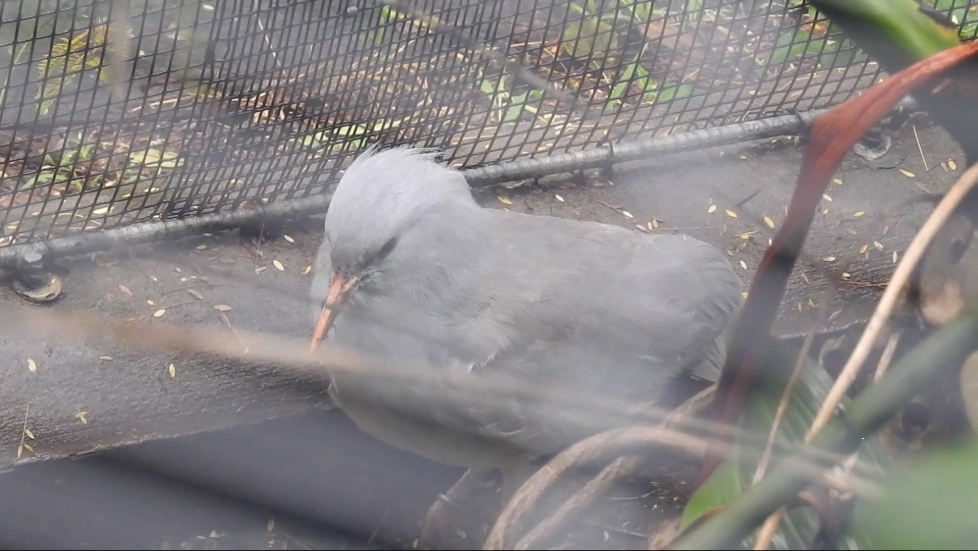
Figure 12. In captivity, endangered Kagus can live more than three decades. Also, captive breeding programs have led to releases into protected habitats, helping to reduce further population decline.
The Cornell Lab of Ornithology’s eBird website (https://ebird.org/species/kagu1 ) and app have recorded 691 observations, 205 with photos, 19 with audio recordings. For instance, one checklist includes several videos of Kagus: https://ebird.org/checklist/S64820403 ; my favorite is https://macaulaylibrary.org/asset/201361331 , in which four Kagus vocalize together. The Cornell Lab’s Macaulay Library website (https://search.macaulaylibrary.org/catalog?taxonCode=rhynoc1&includeChildTaxa=true ) includes 612 photos, 24 audio recordings, and 54 videos of Kagus.
Unrelated to the Cornell Lab is the iNaturalist website (https://www.inaturalist.org/observations?taxon_id=570 , Kagus, Family Rhynochetidae and Genus Rhynochetos) and app, where you may find 176 observations, including this photo of a Kagu with its wings spread, https://www.inaturalist.org/observations/132342408 ; a photo of three Kagus with raised crests and wings held out, https://www.inaturalist.org/observations/70485846 ; and a video of a Kagu walking, https://www.inaturalist.org/observations/329914428 .
And if anyone doubts whether it’s worth all the trouble to try to keep Kagus from becoming extinct, please watch this video again: https://macaulaylibrary.org/asset/201361331 . Earth needs these charmers.
References
Books
- Elphick, Jonathan. (2014). “Kagu, Rhynochetidae” (p. 342). The World of Birds. Buffalo, NY: Firefly Books.
- Lovette, Irby, & John Fitzpatrick (eds.), (2016). Eurypygiformes, Rhynochetidae. The Cornell Lab of Ornithology Handbook of Bird Biology (3rd ed.). Hoboken, NJ: Wiley.
- Winkler, David W., Shawn M. Billerman, and Irby J. Lovette. (2015). “ “Europygiformes,” “Rhynochetidae” (pp. 156–157). Bird Families of the World: An Invitation to the Spectacular Diversity of Birds. Barcelona: Lynx, Cornell Lab of Ornithology.
Web Resources
- Hunt, G.R., G. M. Kirwan, and C. J. Sharpe (2020). Kagu (Rhynochetos jubatus), version 1.0. In Birds of the World (J. del Hoyo, A. Elliott, J. Sargatal, D. A. Christie, and E. de Juana, Editors). Ithaca, NY: Cornell Lab of Ornithology. https://doi.org/10.2173/bow.kagu1.01
- Winkler, D. W., S. M. Billerman, and I. J. Lovette (2020). Kagu (Rhynochetidae), version 1.0. In Birds of the World (S. M. Billerman, B. K. Keeney, P. G. Rodewald, and T. S. Schulenberg, Editors). Ithaca, NY: Cornell Lab of Ornithology. https://doi.org/10.2173/bow.rhynoc1.01 https://birdsoftheworld.org/bow/species/kagu1/cur/introduction
- https://avibase.bsc-eoc.org/species.jsp?lang=EN&avibaseid=227D77FBFA6E408A&sec=lifehistory
- https://en.wikipedia.org/wiki/Eurypygiformes
- https://en.wikipedia.org/wiki/Kagu
- https://www.biodiversitylibrary.org/item/19433#page/444/mode/1up — French or Latin text of when this species was first sited.
- https://www.iucnredlist.org/species/22692211/156666402#habitat-ecology
Text and images by Shari Dorantes Hatch. Copyright © 2026. All rights reserved.
All images were taken at the San Diego Zoo or its Safari Park.
 Bird Brain
Leave a comment