
Musophagiformes, Musophagidae
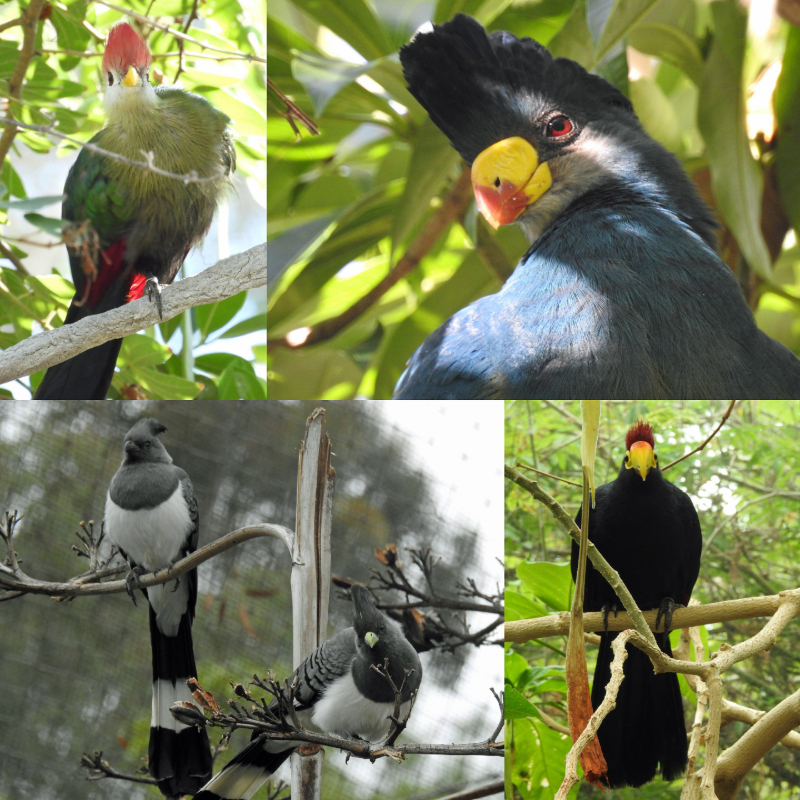
Turacos — the Musophagidae family, Musophagiformes order — differ markedly in appearance but share many characteristics, including their parenting, in which both partners care for their young.
The Musophagiformes order includes just one family: Musophagidae, which includes 23 species, across 5 genera: Corythaeola, 1 species; Gallirex, 2 species; Menelikornis, 2 species; Crinifer, 5 species; and Tauraco, 13 species. Based on body shape, Musophagidae used to be associated with the Hoatzin or with Cuculiformes (see https://bird-brain.org/2026/03/08/cuckoos/ ). Now that we can use DNA to make genetic analysis, however, these relationships have been all over the map, but no relationships with other bird families have been well supported as recent or strong. Apparently, even geneticists believe that turacos are unlike any other birds.
This blog, Part 1 of 2, discusses three species in the Tauraco genus:
- Red-crested Turaco, Tauraco erythrolophus
- Ross’s Turaco, Tauraco rossae
- White-crested Turaco, Tauraco leucolophus
A future blog will discuss two other turacos in two other genera.
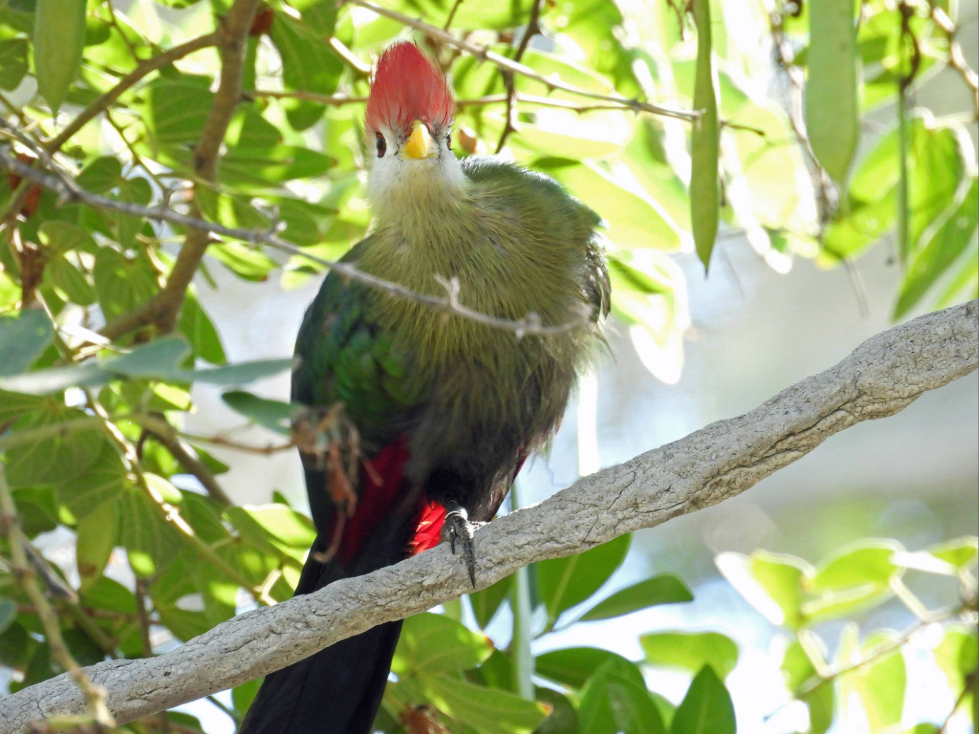
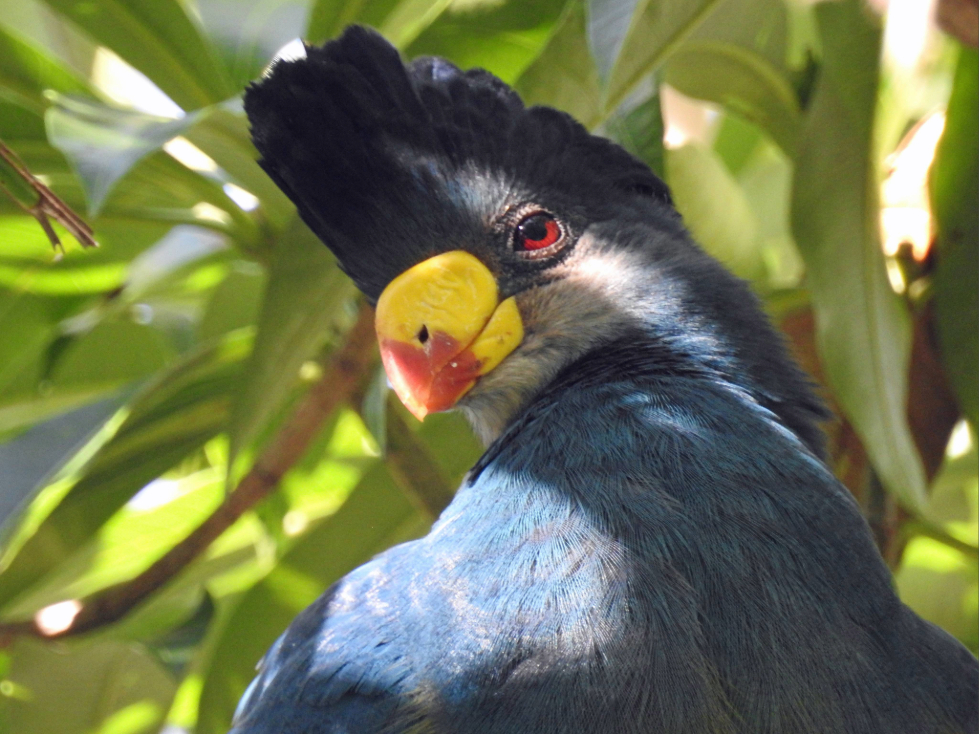
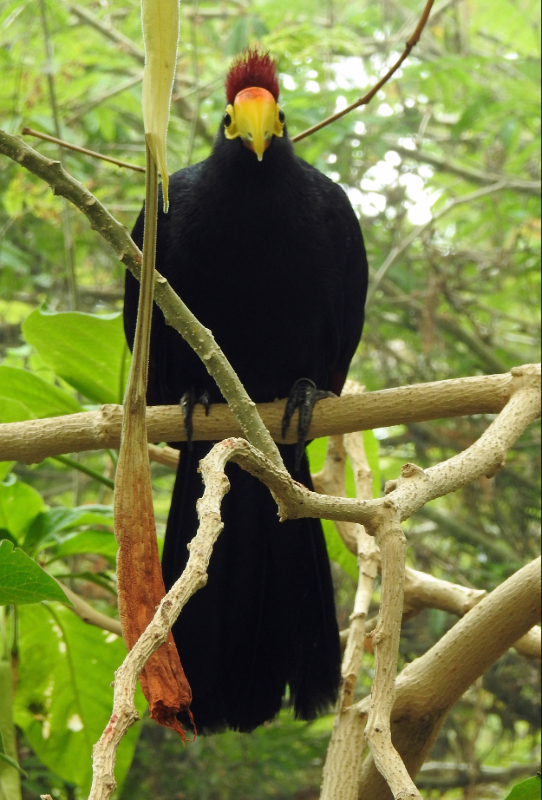
Figure M-01, a,b,c. Though their plumage varies widely, the basic body shape of turacos is similar, and all turacos have charisma.
The name Musophagidae comes from musa– (new Latin; derived from Arabic môza), which means “banana” or “plantain” (a starchier fruit similar to bananas), and phagus, Greek for “eater of.” Musa plants (plantains or bananas) are native to tropical Indomalaya and Australia, not to Africa, so it’s unlikely that this fruit-eating, fruit-loving bird actually eats many of either fruit in its native habitat. The common name, turaco, and a genus comprising 13 of its 23 species, Tauraco, come from an African name for these birds, thought to be imitative of the bird’s call. A South African name for them is “louries” or “loeries.”
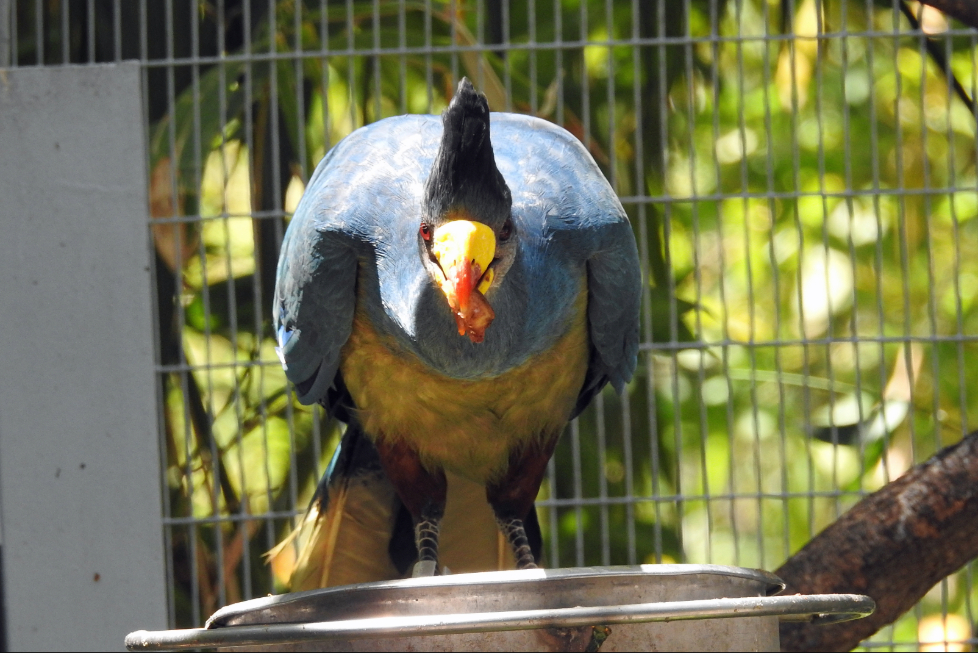
Figure M-02. This Great Blue Turaco clearly relishes eating fruits.
Appearance
Of the 23 species of turacos, 18 species show brilliantly colorful plumage. In fact, two plumage colors originate from pigments unique to turacos. These 18 turaco species can produce one or both of these distinctive pigments: turacin (red) and turacoverdin (green). No other animal in the world is known to produce either of these pigments. The red pigment turacin is unique to turacos, though other birds can produce different red pigments, using carotenoids. Both pigments contain copper, and according to Sea World, “if you stirred a glass of water with a red turaco feather, the water would turn pink! In museum specimens, the pigments deepen with age because the copper begins to oxidize.”
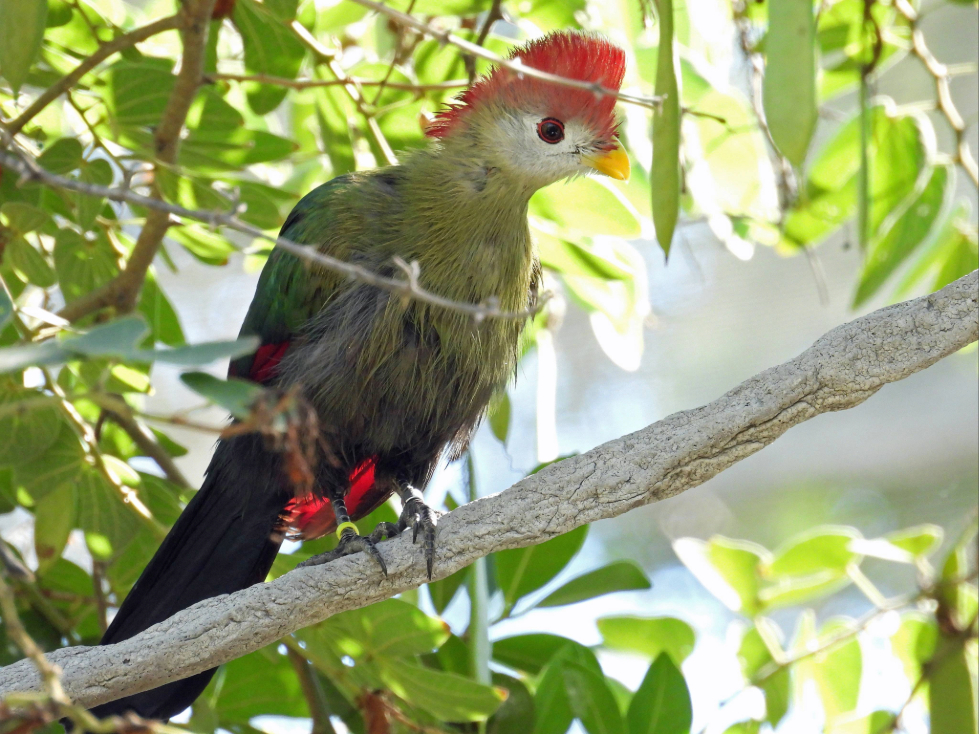
Figure M-03. The coloration of this Red-crested Turaco’s plumage includes two pigments unique to turacos: red turacin and green turacoverdin. No other animals in the world can produce either pigment.
Aside from turacoverdin, no other true green pigment is known to exist in birds. When other birds appear to have green coloring, it arises from a combination of yellow pigment (e.g., a carotenoid) and an appearance of blue, based on how the physical structure of their feathers scatters light to make them look bluish; the yellow pigment and the bluish structure combine to make the green coloration.
The 5 species in the Crinifer genus (go-away-birds and plantain-eaters) display neutral shades of grays, whites, and browns. These 5 species, who lack the pigments of other turacos, live on savannas or among acacias, not in the forests where the other 18 species live. Some scientists wonder whether habitat plays a role in the ability to produce turacoverdin.
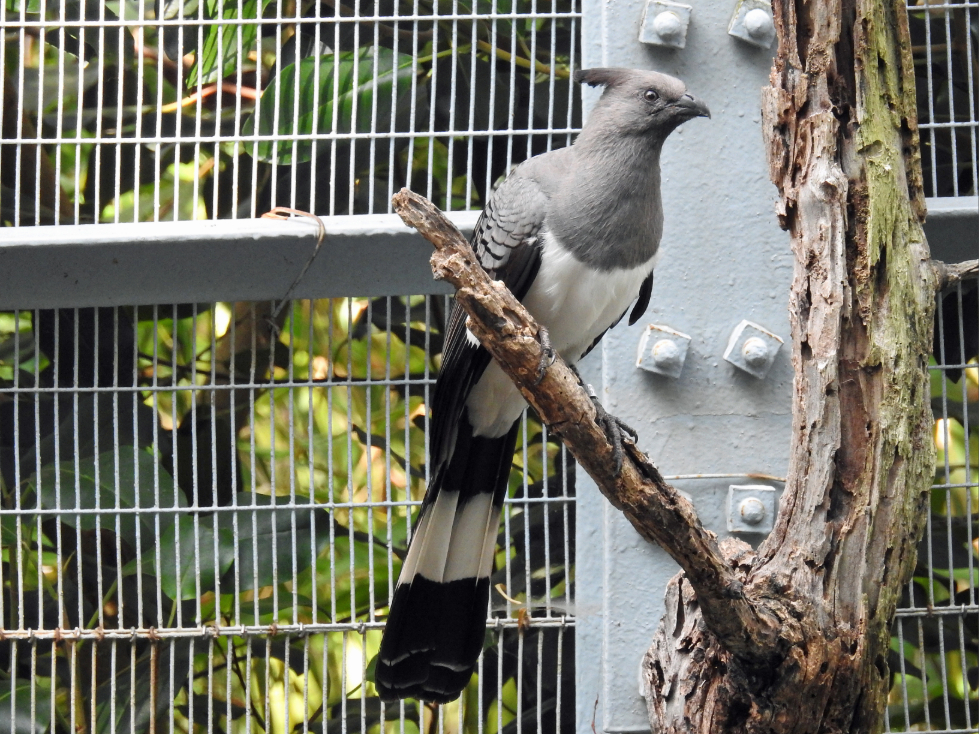
Figure M-04. This White-bellied Go-away Bird is one of five species of turaco who doesn’t have ostentatious plumage colors, but few would say that this bird’s looks aren’t impressive.
According to two sources (Zoo Atlanta and Elphick, 2014, pp. 74–75), the feathers on a turaco’s head and breast have few or no barbules (the hooks that connect feather barbs to one another). This affects both the texture and the color of the feathers. Prominent crests adorn the heads of 21 of the 23 species of turacos. (The two plantain-eaters of the Crinifer species lack crests; poor plantain-eaters — no crests, no special pigments.) Most turacos can raise or lower the crest (at least slightly). The crests aren’t included in measures of their length (bill to tail), but these are still midsized to large-ish birds. Most are 15–21″ (38– 54 cm) long and weigh 6–19 ounces (170–548 g). The big exception to this rule is the Great Blue Turaco, Corythaeola cristata, which earns its name at 27.5–29.5″ (70–75 cm), weighing 28.9–43.4 oz (1.8-2.7 lb., 820–1230 g); about 50% longer and about 200% as heavy, perhaps even heavier.
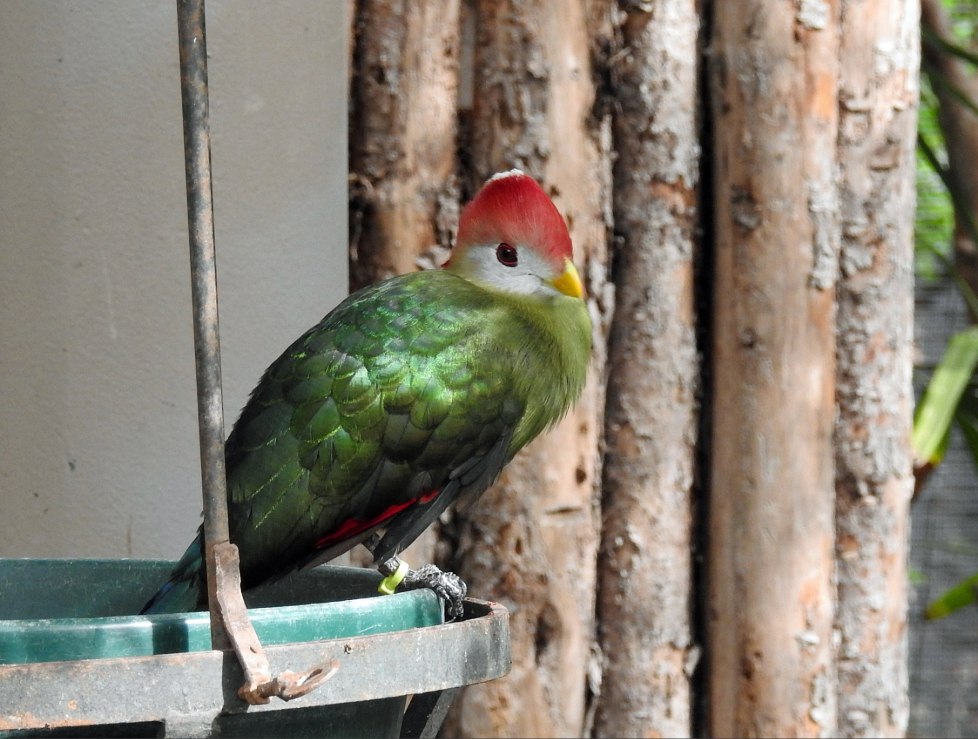
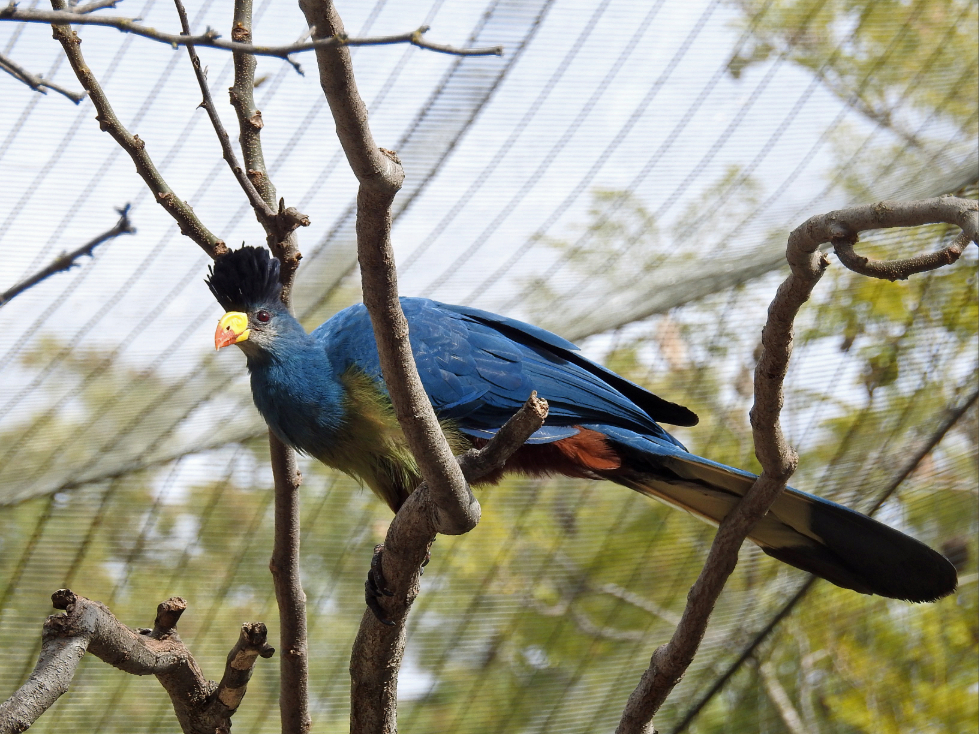
Figure M-05, a,b. This Red-crested Turaco (a, left) is among the smallest turacos (9.4 oz.); this Great Blue Turaco (b, right) is the biggest (43.4 oz) — weighing more than four times as much.
Turacos have a sturdy, elongated, ovoid body shape. They have short, rounded wings and a long, broad tail. Both sexes are similar in plumage, size, and shape. Atop a thick, solid neck is its head (described as pheasant-like). The short, strong bill is deep and broad, with a serrated bill and a downward-curving upper mandible (top part of the bill).
Their thick legs end in zygodactyl toes, but their fourth toe is often held perpendicular to the main axis of the foot. That toe can be rotated to point either backward (zygodactyl), almost touching the first toe behind the foot, or directly forward, alongside the second and third toes. In some species of turacos, the second and third (forward-pointing) toes are somewhat conjoined.
Figure M-06. These White-bellied Go-away Birds readily use their long zygodactyl toes to flit about on trees.
Vocalization
The three species of go-away birds are reputedly named for their elongated, nasal calls that sound like “g’waay” or “gorrwAAay”— alarm calls to which many other birds and even mammals seem to react. Though these three species are the most conspicuous for their vocalizations, many other species of turaco are noisy or at least chatty. The website https://xeno-canto.org/explore?query=turaco has 23 full pages of turaco vocalizations, which have been described as “loud, gruff, barking sounds,” “higher-pitched hoots,” two-toned song duets, “cackling or laughing calls ending in a gradually fading chatter,” and more.
Figure M-07. This White-bellied Go-away Bird’s vocalizations don’t seem terribly impressive, but perhaps it wasn’t in the mood to give its namesake call.
Distribution and Habitat
As mentioned, the Crinifer genus lives mostly on savannas or among acacias, but most other turacos inhabit various forests and other woodlands in sub-Saharan Africa. Rainforests, plantations, and even wooded suburbs offer homes to some species of turacos. Though turacos don’t migrate, they do make local movements, often in family groups of up to 10, searching for fruit trees. They’re among the few bird families who are endemic to continental Africa.
Locomotion
Their shortish rounded wings make them ill suited to long flights, but their distinctively versatile toes and long tails (for balance) let them run and climb easily, leaping from branch to branch, and quickly and agilely moving through trees, shrubs, and other dense vegetation. They go to the ground to drink or to bathe, but otherwise, they prefer an arboreal lifestyle. Like Hoatzins, turaco nestlings have wing claws, which help them to climb — along with their flexible toes.
Figure M-08. Turacos, such as these White-bellied Go-away Birds, far prefer hopping and scampering through the trees, rather than flying for any distance.
Food and Foraging
All turacos eat fruits, but only some species are strictly frugivores. Other species add to their fruity diet various other parts of plants (leaves, flowers, shoots, buds), and some also add prey to their diet: insect adults and larvae (e.g., caterpillars), snails, and other invertebrates — especially during the breeding season.
Figure M-09. All turacos eat at least some fruits; many eat only fruits, but some turacos supplement their fruity diet with other parts of plants, and even with invertebrates. Great Blue Turacos eat mostly fruits, but they also eat other parts of plants — and they’ve even been seen eating algae.
Breeding and Social Behavior
Turacos are monogamous, and both parents are involved in care for their offspring, often vigorously defending their territory. In addition, some species (e.g., go-away birds) breed cooperatively, with helpers who also defend their territory and feed their young.
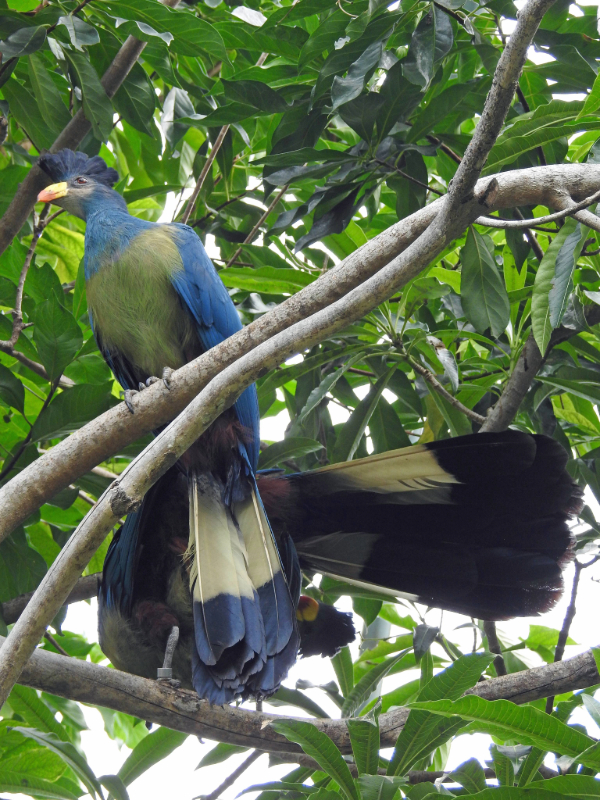
Figure M-10. Turaco parents form a monogamous pair who build a nest, defend their territory, incubate and protect their eggs, and feed their nestlings.
Most turacos place their nests in a tree or a bush, hidden by dense foliage. Because species in the Crinifer genus live in savannas or in acacia “woodlands,” they can’t conceal their nests as easily as forest-dwelling turacos. Nests are flat and often rather flimsy, built from twigs and sticks. Females lay two (or sometimes three) white, cream, or pale-colored eggs, and both parents incubate their eggs, which can take 16–31 days until hatching. The altricial youngsters hatch wearing thick down, and with their eyes either open or almost open. Both parents feed the nestlings, starting by regurgitating food directly into their mouths. Feedings continue for about 2–3 weeks, until the young can climb out of the nest. Even afterward, the parents continue to give food to the young until they fledge (fly for the first time) at about 4–5 weeks old (25–38 days).
Figure M-11. Among turacos, go-away birds breed cooperatively. Within their flock, flockmates help the parents to defend their territory and feed their young.
Conservation Status
According to the IUCN Red List, 78.3% of turaco species are LC, Least Concern, but 17.4% are NT, Near Threatened. Luckily, no turacos are listed as VU, Vulnerable; EN, Endangered; CR, Critically Endangered; EW, Extinct in the Wild, or EX, Extinct. Just 4.3% of species have an unknown status at present. Following is a list of the 23 species, their population trends (decreasing or stable), and their IUCN status:
- Tauraco, 13 species
- Ross’s Turaco, Tauraco rossae, decreasing, LC
- White-crested Turaco, Tauraco leucolophus, decreasing, LC
- Red-crested Turaco, Tauraco erythrolophus, decreasing, LC
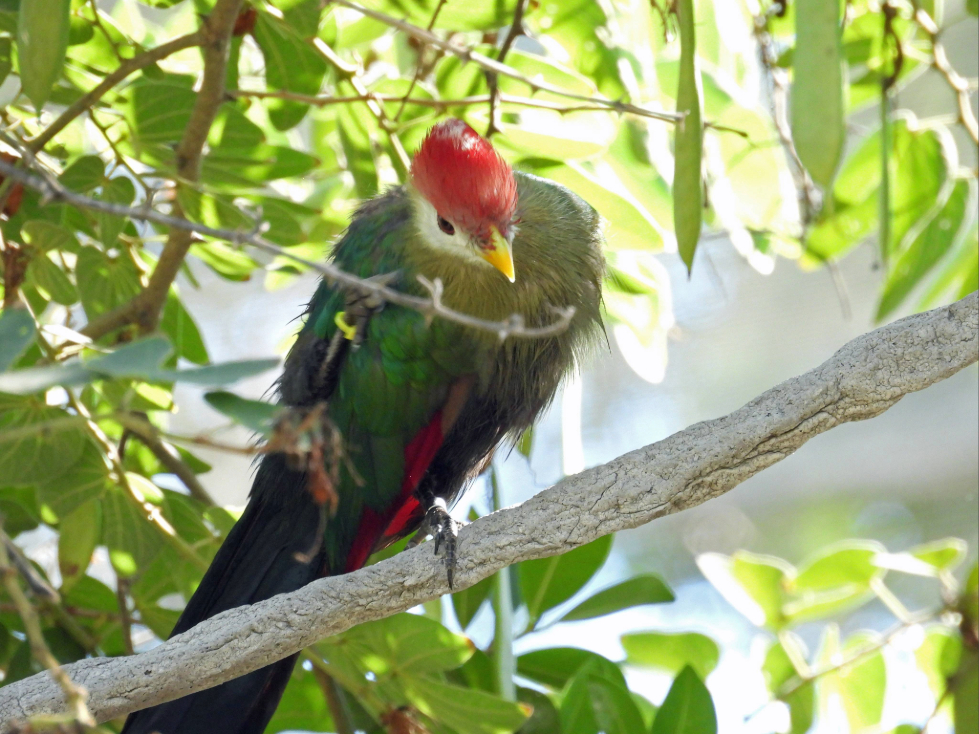
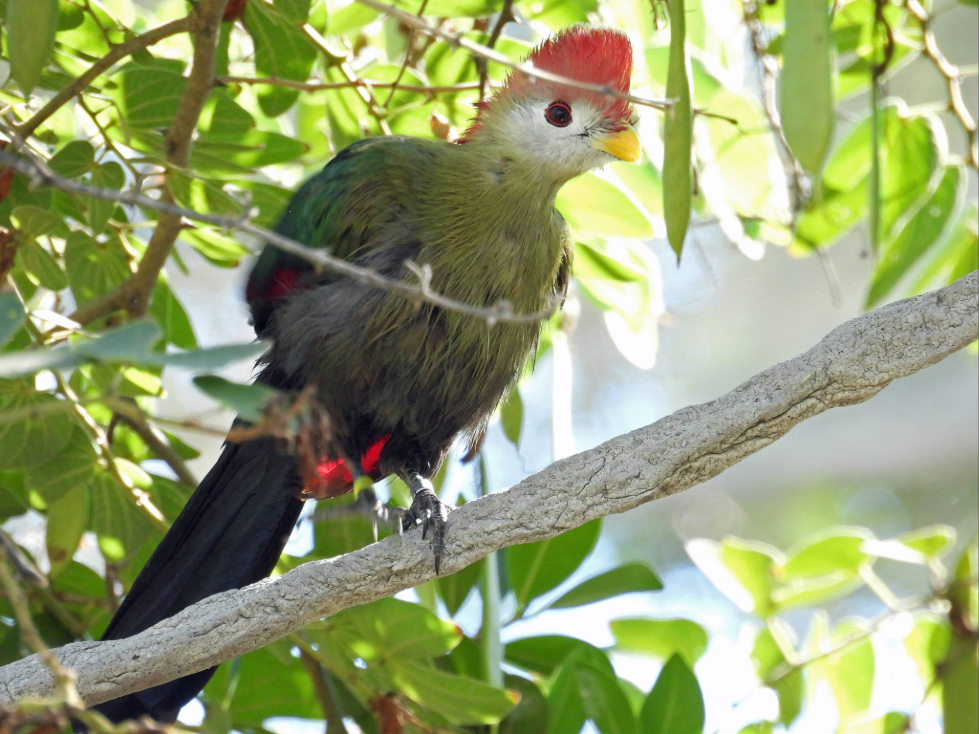
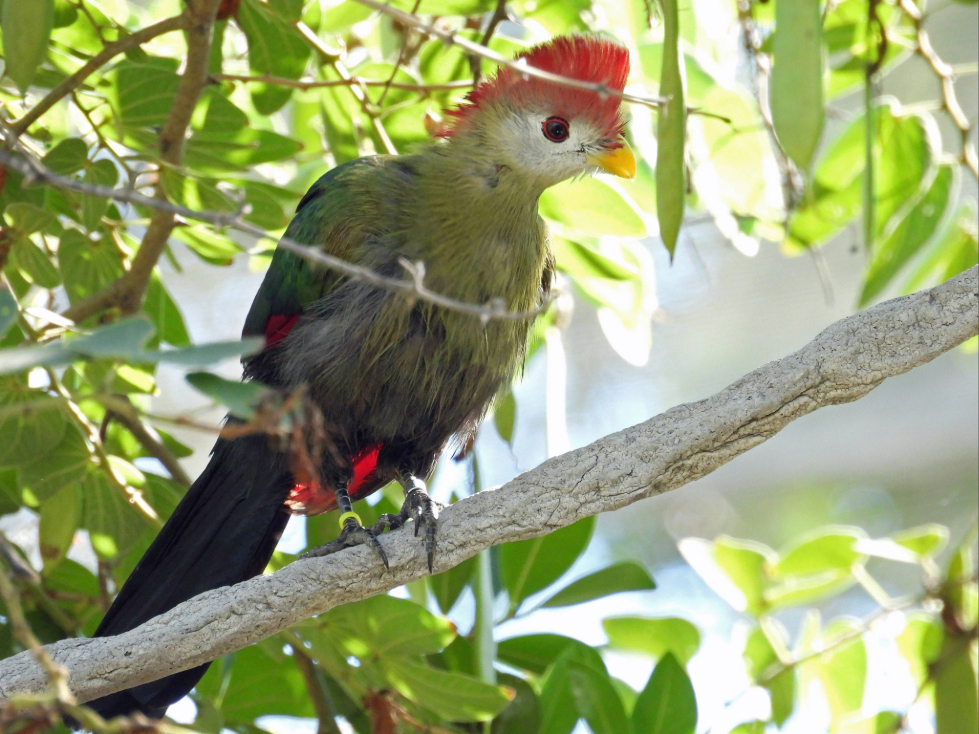
Figure M-12, a–c. Though their population is declining, the IUCN has assessed the Red-crested Turaco species to be LC, Least Concern.
- [Tauraco]
- Violet Turaco, Tauraco violaceus, decreasing, NT
- Yellow-billed Turaco, Tauraco macrorhynchus, decreasing, LC
- Bannerman’s Turaco, Tauraco bannermani, decreasing, NT
- Black-billed Turaco, Tauraco schuettii, decreasing, LC
- Schalow’s Turaco, Tauraco schalowi, decreasing, LC
- Guinea Turaco, Tauraco persa, aka Green Turaco, decreasing, LC
- Hartlaub’s Turaco, Tauraco hartlaubi, decreasing, LC
- Fischer’s Turaco, Tauraco fischeri, decreasing, NT
- Livingstone’s Turaco, Tauraco livingstonii, decreasing, LC
- Knysna Turaco, Tauraco corythaix, decreasing, LC
- Corythaeola, 1 species
- Great Blue Turaco, Corythaeola cristata, decreasing, LC
Figure M-13. Fortunately, though its population is decreasing, the Great Blue Turaco is deemed to be LC, Least Concern, by the IUCN.
- Crinifer, 5 species
- White-bellied Go-away-bird, Crinifer leucogaster, stable, LC
Figure M-14. The White-bellied Go-away-bird has a stable population, and this species isn’t imperiled.
- [Crinifer]
- Gray Go-away-bird, Crinifer concolor, stable, LC
- Bare-faced Go-away-bird, Crinifer personatus, aka Brown-faced Go-away Bird, stable, LC
- Western Plantain-eater, Crinifer piscator, stable, LC
- Eastern Plantain-eater, Crinifer zonurus, stable, LC
- Gallirex, 2 species
- Rwenzori Turaco, Gallirex johnstoni, decreasing, LC
- Purple-crested Turaco, Gallirex porphyreolophus, decreasing, LC
- Menelikornis, 2 species
- White-cheeked Turaco, Menelikornis leucotis, decreasing, LC
- Prince Ruspoli’s Turaco, Menelikornis ruspolii, aka Ruspoli’s Turaco, Tauraco ruspolii, decreasing, NT
The most imperiled turacos are suffering from ongoing destruction and fragmentation of their habitat, mostly due to human causes, such as our eagerness to convert forests either to agriculture or to timber logging. Sadly, some species are also hunted directly by humans, sometimes for their meat, to sustain a subsistence living, but also known to have been eaten by one disreputable ornithologist. They have also been hunted for their feathers (especially crimson) or to exploit them through the exotic pet trade.
In captivity, turacos can be quite long-lived, often to 30 years of age, and at least one to nearly 37 years.
Figure M-15. Most turacos, such as this White-bellied Go-away Bird, are not under grave threat.
Tauraco Turacos
The genus Tauraco includes 13 of the 23 species of turacos. This blog explores three of these species: Red-crested Turaco, Tauraco erythrolophus, Ross’s Turaco, Tauraco rossae, and White-crested Turaco, Tauraco leucolophus. All three of these species have been on exhibit at the San Diego Zoo or its Safari Park.
Red-crested Turaco, Tauraco erythrolophus
As mentioned, the genus name Tauraco comes from an African name for these birds, perhaps alluding to the bird’s vocalizations. The species name, erythrolophus, comes from erythros, Greek for “red,” and lophus, Latin for “crest” (named by Louis Pierre Vieillot, 1819, who ranks with taxonomist Carl Linnaeus and fellow ornithologist John Gould). Its Spanish name is Turaco Crestirrojo.
The Red-crested Turaco is at the smaller end of the turaco size range, 15.75–16.9″ (40–43 cm), 9.4 ounces (range 7.4–11.5 ounces; 267.5 g, 210–325 g). Like many other turacos, their tails (6.9–9.4″, 17.63–23.9 cm) are longer than their wings (6.5–6.9″, 16.6 – 17.6 cm). They also have relatively short legs, with a tarsus length (ankle to toes) of 1.5–1.6″ (3.87–4.13 cm). Both sexes are similar in size and appearance.
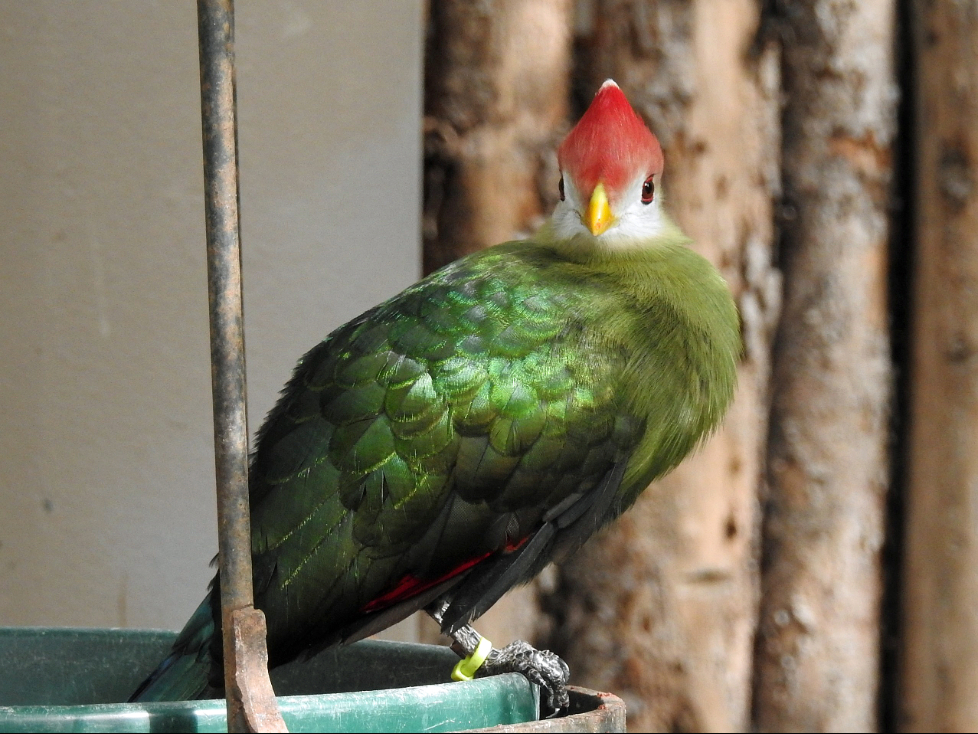
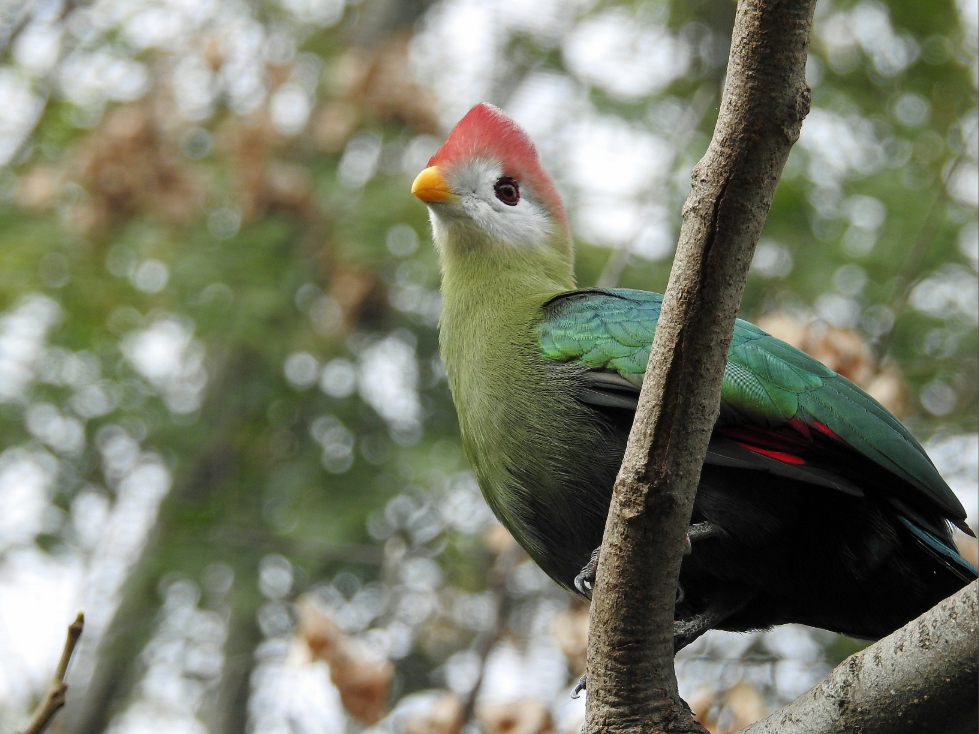
Figure RC-01 a,b. The Red-crested Turaco shows off both pigment colors unique to turacos: red and green. Its brilliant crimson crest runs down the back of its neck, and its iridescent green plumage shimmers on its back and wings, with a mostly hidden glimpse of red under its wings (when not flying). Its fluffy breast, neck, and head feathers have few or new barbules to hook the feather barbs together. This turaco’s white facial feathers extend forward to cover the nostrils on its small bill — 1″ (2.45–2.68 cm) long, 0.5″ (1.3 cm) deep, and 0.3″ (0.76 – 0.9 cm) wide. Its dark eyes are rimmed by a narrow crimson orbital ring.
There is only one example of this turaco’s vocalizations on https://xeno-canto.org/species/Tauraco-erythrolophus , but it will delight you to hear two calling and singing to one another. It has been described as “a deep barking call [with] the female’s call . . . slightly higher-pitched than the male’s. They are highly vocal, particularly at dawn” (Wikipedia).
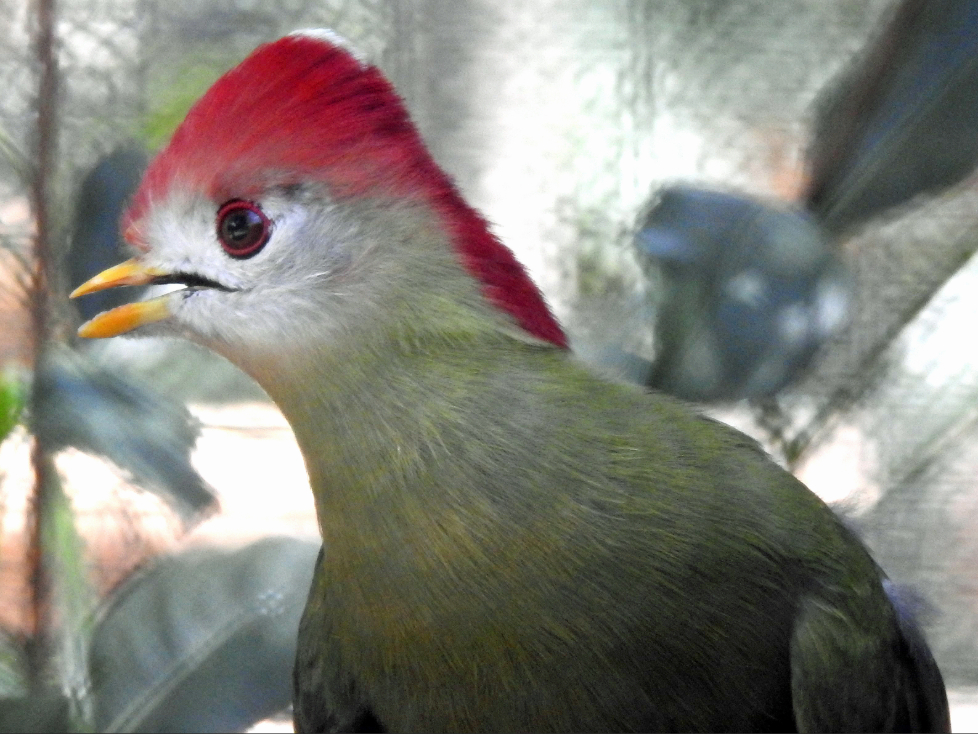
Figure RC-02. Red-crested Turacos enjoy chatting with one another, especially early in the morning.
The Red-crested Turaco is endemic to west-central Angola, where it’s the national bird and enjoys scattered concentrations between sea level and 6,500 feet (2,000 m). These turacos prefer old-growth forests (“primary”) and secondary-growth forests (regenerated after human-caused disturbances), either evergreen (e.g., conifers, acacias) or riverine gallery forests (woodsy corridors alongside rivers or other wetlands). It doesn’t migrate, but it does occasionally move in pursuit of available fruits.
Figure RC-03. Red-crested Turacos prefer hanging out in trees, rarely seen on the ground.
According to Avibase, it eats almost entirely fruits, including berries that would be poisonous to humans. Some observers have suggested it may also sometimes eat nuts, leaves, flowers, and seeds, as well as insects. Though it can fly, it rarely does so, and it mostly stays in the trees, rarely descending to the ground (e.g., to drink). This turaco is sociable, often seen in pairs or even in flocks of up to 30 birds.
Figure RC-04. Red-crested Turacos rarely fly, and when they do, it’s not for long distances.
Much of what we know about Red-crested Turaco breeding behavior is inferred from what is known about other turaco species, bolstered by anecdotes. They’re believed to be monogamous, with both parents building a flimsy nest in the trees, about 16–66 feet (5–20m) from the ground. The female lays two eggs in the nest, then both parents incubate the eggs (length of incubation not known). Both parents protect and feed their nestlings, who leave the nest at 4–5 weeks of age. The age at which these turacos start breeding is a little shy of 2 years.
Figure RC-05. Red-crested Turacos keep to a 1:1 parent-offspring ratio, with two parents to care for their two youngsters each season.
These turacos have an IUCN Red List conservation status of LC, Least Concern, with an estimated annual population decline of 10% (1–19%). The annual adult survival rate is a little more than 75%, and their average generation length is about 4.8–5 years. The maximum recorded age for this species is about 13 years. One of the threats imperiling this species is the pet trade, but this species is subject to some international management and trade controls. In addition, Angola offers conservation sites and protected areas within its range.
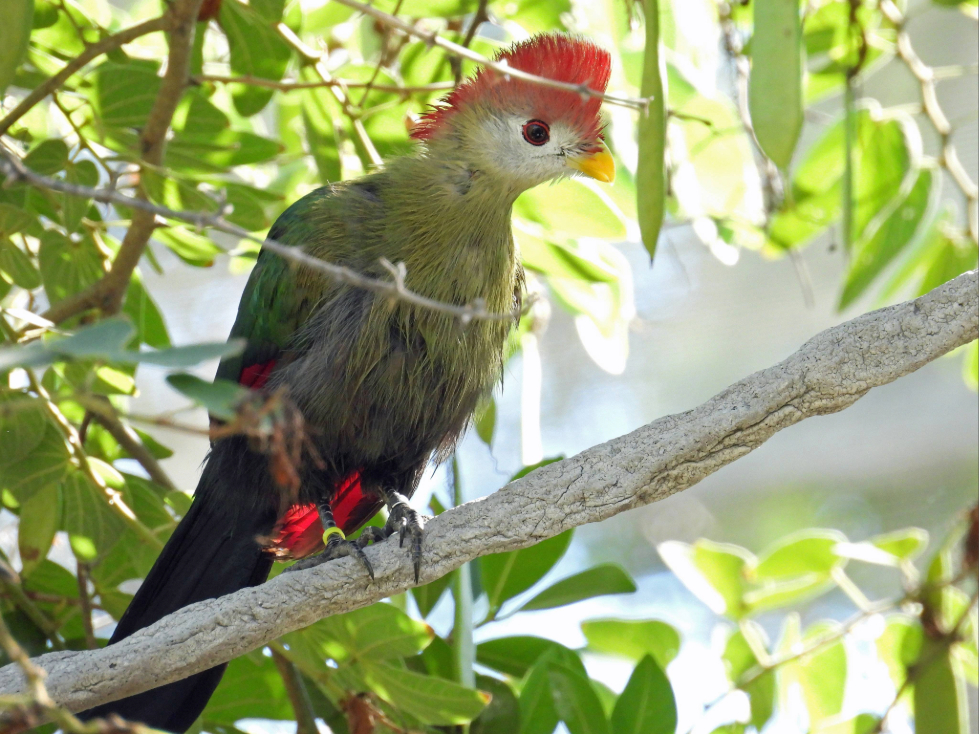
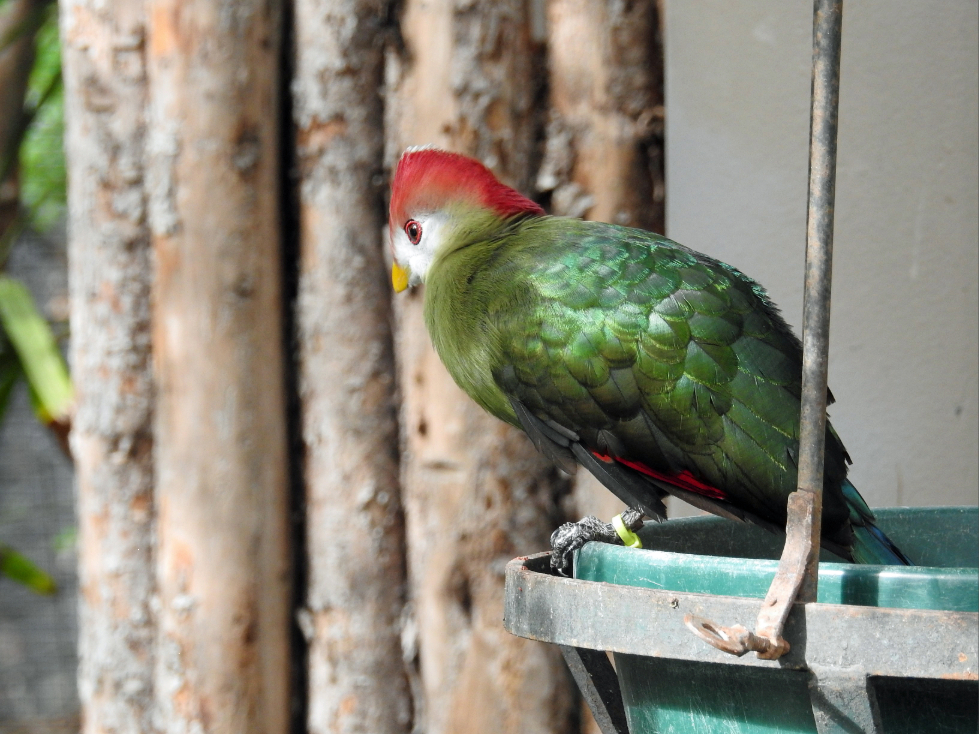
Figure RC-06-a,b. This lovely turaco is rarely seen but much admired.
The Cornell Lab of Ornithology’s eBird app and website (https://ebird.org/species/rectur1 ) has 249 observations, 41 with photos, 3 with audio recordings. The lab’s Macaulay Library (https://search.macaulaylibrary.org/catalog?taxonCode=rectur1 ) holds 90 photos, 3 audio recordings, and 2 videos of this species.
Ross’s Turaco, Tauraco rossae
Ornithologist John Gould identified this species in 1852. The common name, Ross’s Turaco, the scientific name, Tauraco rossae, and even the Spanish name, Turaco de Ross, honor someone with the surname Ross.
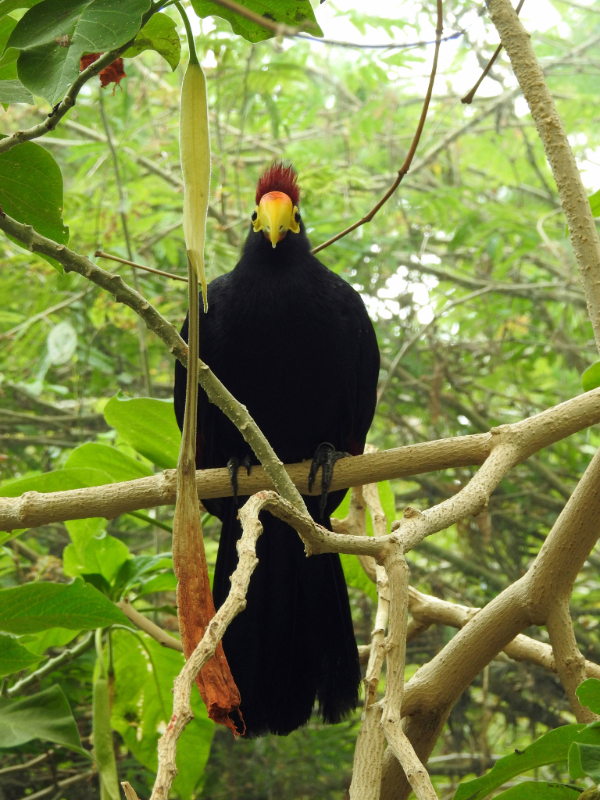
Figure Ro–01-a,b. Now known simply as “Ross’s Turaco,” this species was once named “Lady Ross’s Turaco,” honoring the woman who first brought this species to the attention of the scientific world.
Where it all went wrong! At first, I wondered whether the honored “Ross” was Alexander Milton Ross (1832–1897), a Canadian ornithologist, physician, naturalist, and abolitionist who had identified hundreds of bird species — or perhaps Ross’s wife (he had children, so presumably, he had a wife). He was alive at that time (just 22 years old), so it wasn’t impossible.
Then, luckily, I found this resource: https://www.biodiversitylibrary.org/item/96443#page/123/mode/1up , p. 93. I include my typing of the entire facsimile in the references
“Mr. Gould exhibited to the meeting a drawing . . . of a new and beautiful species of Musophaga, of which a living example had been for the last ten years in the possession of Lady Ross at St. Helena. Mr. Gould also exhibited some feathers shed from the wings and tail of the bird, an examination of which, and of the drawing, satisfied him that the bird was quite distinct from all previously described members of the genus.
Lady Ross, who is at present in England, had informed Mr. Gould that the bird was about the size of a hen-pheasant, and that it had been brought to St. Helena from the western coast of Africa, but the precise locality in which it had been procured was unknown to her.
For this interesting addition to the Musophagae Mr. Gould proposed the specific appellation of Rossae, in honour of its amiable owner.”
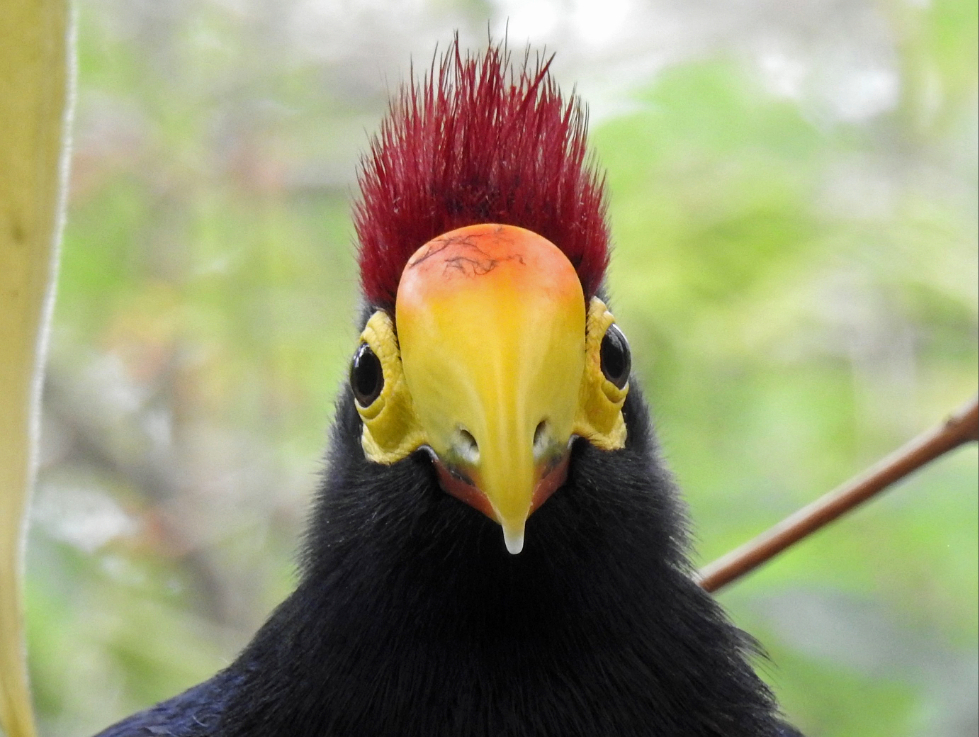
Figure Ro-02-a,b. In the 1850s, Lady Ross enjoyed the companionship of a stunning African turaco; she introduced the species to ornithologist John Gould, who named it in her honor.
The Ross’s Turaco is the second largest turaco (after the Great Blue Turaco), weighing 13.8–15.7 ounces (390–444 g), just under a pound. It’s about 20–21.3″ inches (51–54 cm) long, bill to tail, with its tail about 8.6–9.7″ (21.8 – 24.7 cm) long — about 40% of its total length. Its rounded wings are shorter than its tail, about 8.2–9.3″ (20.8–23.6 cm) long — better suited for short bursts of flapping flight than for gliding or for flying long distances.
Figure Ro-03. The tail of a Ross’s Turaco is about 40% of its total length, bill to tail; such a long tail makes it easy to balance as it hops and flits from place to place among the trees.
Like other turacos in this genus, the Ross’s Turaco’s plumage delights your eyes. Its upper body, wings, and tail shimmer with glossy bluish-purple plumage, intensified by a high proportion of melanin (black pigment). To quote the description by the London Zoological Society (1852), “body, wings and tail rich deep blue ; primaries and secondaries arterial blood-red, narrowly margined and more broadly tipped with purplish-brown, as in the other species of the genus; crown surmounted with a high rounded crest of hair-like blood-red feathers; bill and denuded orbits yellow ; irides brown.”
Like other Tauraco species, the Ross’s Turaco’s head, neck, and breast feathers have few or new barbules, so they appear fluffier than the smooth glossy feathers of the rest of its plumage. These feathers and the feathers on the belly and thighs appear black. According to Sea World, the crest “stands about 5 cm (2 in.) when they are excited.” For a bird a little over 20″ long, a 2″ crest is out-standing.
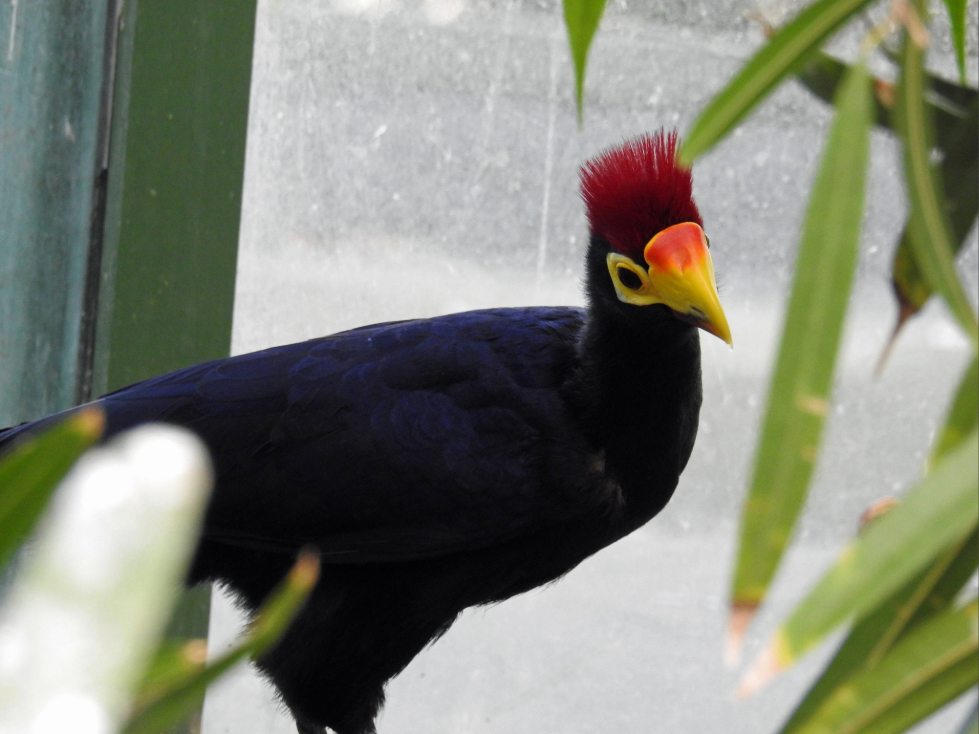
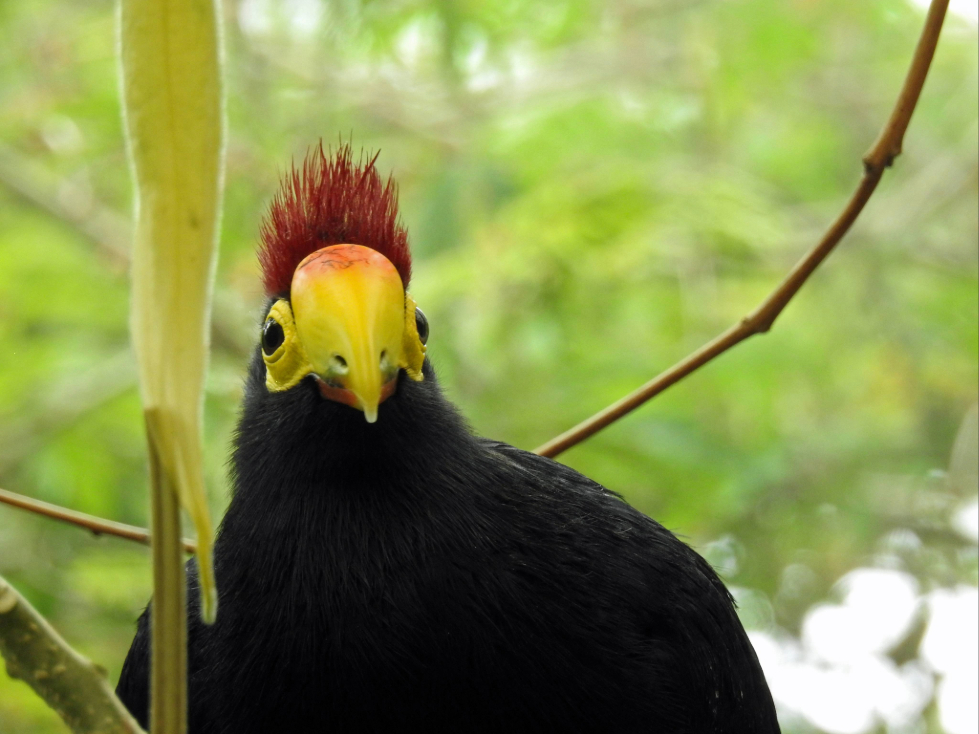
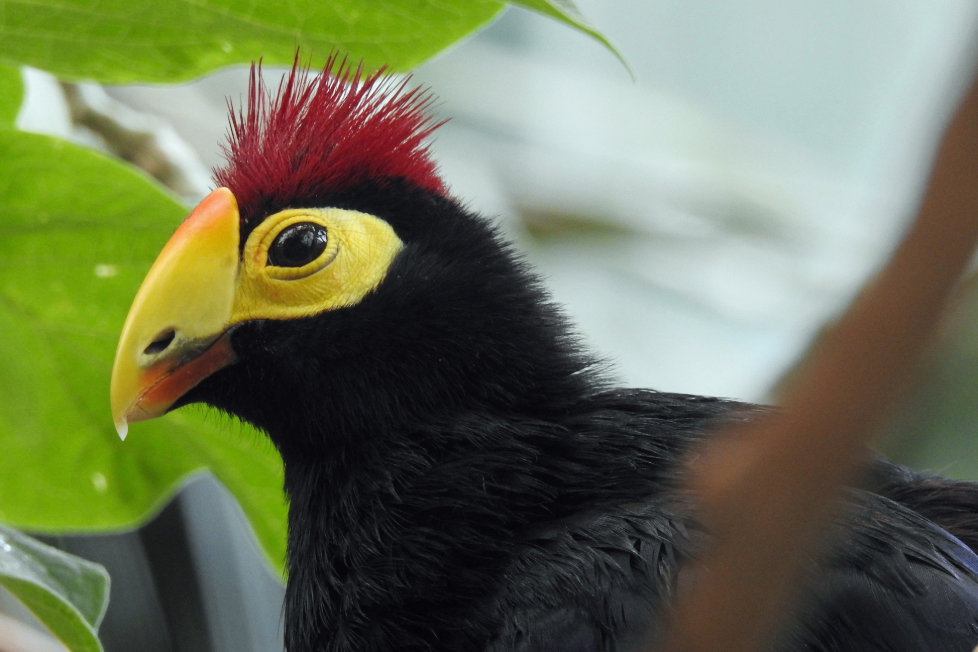
Figure Ro-04a–c. Though the crest may be the Ross’s Turaco’s most notable feature, other noteworthy features include its bill, with its convex shield, and the bare yellow skin surrounding dark eyes.
The “arterial blood-red” tips of the primary and secondary flight feathers of this species are fully visible when the bird is in flight, both from above and from below. Here’s a link to the Cornell Lab of Ornithology’s Macaulay Library: https://search.macaulaylibrary.org/catalog?taxonCode=rostur1 . There, you can see numerous views of this bird in flight, including the following:
https://macaulaylibrary.org/asset/627988233 , https://macaulaylibrary.org/asset/121444441 , https://macaulaylibrary.org/asset/84872061 , https://macaulaylibrary.org/asset/121444681 . Breathtaking, right? Males and females are of similar size and plumage coloration, including their crimson crests; both sexes can slightly raise or lower their crests.
Their black legs end in their distinctive four toes, with the fourth toe being flexible in facing forward or backward — enabling them easily to zip around in the tree canopy. Between their flexibly gripping toes and their long tails for balance, they’re well equipped for flitting agilely among the trees.
Figure Ro-05. Even with relatively short black legs (tarsus length, ankle to toes, 1.6–2″, 4.08–4.97 cm), Ross’s Turacos can nimbly hop around among the trees, using their long, flexible black toes. The stunning Ross’s Turaco is more comfortable scrambling or hopping on trees than flying long distances.
Both males and females have a yellow, longish, downwardly curved, pointed-tip upper mandible, 1–1.7″ long (2.76 – 4.3 cm), 0.25–0.3″ wide (0.65–0.78 cm), and 0.43–.55″ deep (1.1 – 1.4 cm). Males’ upper mandibles tend to be brighter, and females’ have a slightly yellow-green hue. The lower mandible is red on both sexes. The upper bill curves upward into a convex shield, the top arch of which is a delicately patterned orange; the arch’s tip reaches to just above the front corner of each eye. The dark brown eyes are surrounded by bright yellow bare skin, forming an ovoid extending from the bill toward the back of the head.
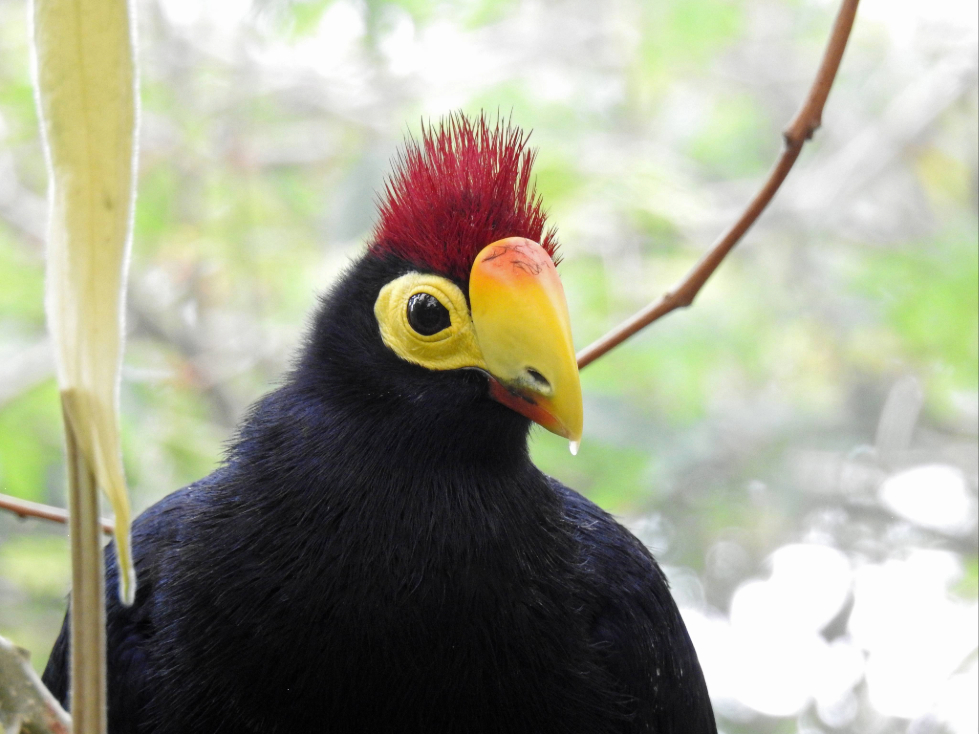
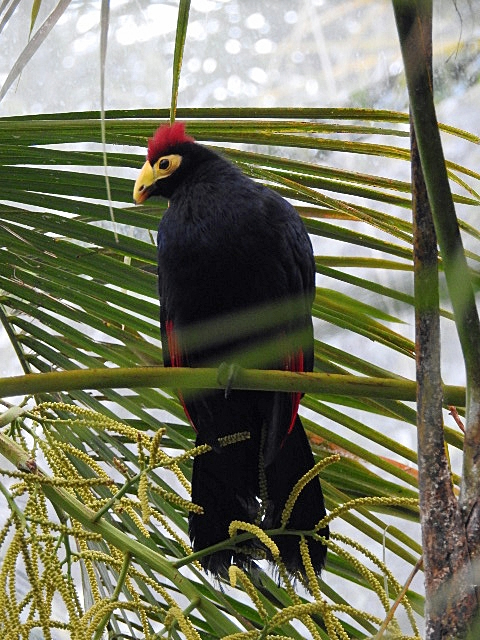
Figure Ro-06, a,b. The highly distinctive appearance of Ross’s Turacos fascinates viewers from near or far.
The vocalizations listed in https://xeno-canto.org/species/Tauraco-rossae extend to two pages (e.g., https://xeno-canto.org/854461 ). While vocalizing, a Ross’s Turaco will point its neck forward horizontally and erect its throat feathers. Though they usually vocalize from a well-concealed perch, they occasionally do so more visibly. They vocalize year round, particularly in early morning and late afternoon. Ross’s Turacos sing in choruses of two or more birds, usually initiated by one bird, to which other birds respond. These choral vocalizations can be heard far away, and they often prompt a distant chorus to respond, as well. These choral calls and responses can prompt further responses from additional groups. It’s thought that these vocalizations proclaim territories. In addition to raucous calls and rasps, these turacos will sometimes growl or give loud alarm or distress calls. Much is yet to be learned about their vocalizations, including the function of their calls and whether there are any sex differences in the vocalizations.
Figure Ro-07. Ross’s Turacos are much more readily heard than seen in their forest habitat.
Ross’s Turaco is widely dispersed across riparian forests and woodlands, as well as evergreen or gallery forests, swamp forests, thickets, shrublands, and savannas in central Africa, as can be seen from a map of the observations reported to eBird: https://ebird.org/species/rostur1 , showing populations in Cameroon, northern Central African Republic, Uganda, western Kenya, Rwanda, Burundi, western Tanzania, northern and eastern Angola, Zambia, scattered locations in the Democratic Republic of the Congo, southern South Sudan, and parts of Gabon.
It doesn’t migrate, but it can be nomadic, wandering to wherever it can find fruiting trees. It can be erratic and irruptive in pursuit of available food sources — for instance, showing up as vagrants in Botswana or Namibia, or in suburban gardens with tall trees. They’re flexible as to elevation, found from sea level to 5,900 feet above it (1,800 m), occasionally up to 8,200 feet (2,500 m).
Figure Ro-08. Ross’s Turacos feel most at home in forests and other woodlands, where they can blend into the trees.
Ross’s Turacos eat mostly fruits (80% of their diet, according to Avibase) — especially figs, and they also eat berries deemed highly toxic to humans. In addition, they eat the seeds, flowers, and shoots of both wild and cultivated plants (e.g., guavas, loquats). They’re superlative spreaders of seeds throughout their territories, so the ecosystem benefits from their presence. Agricultural crops don’t benefit, however, as these turacos will readily eat from cultivated crops and gardens. These turacos also eat invertebrates, such as insects, slugs, and snails, especially during breeding season, and they often feed invertebrates to their young. They’re also social eaters, congregating to forage among fruit trees in groups of 6–12 birds. Sociable by day, when foraging, they roost solo at night, to sleep.
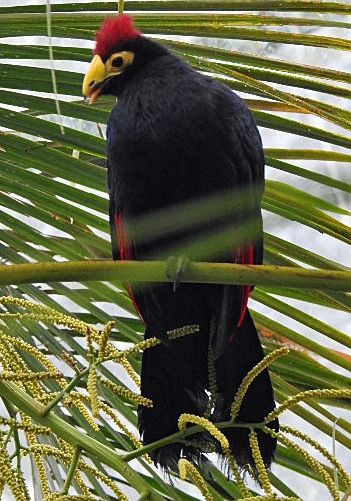
Figure Ro-09. The Ross’s Turaco’s love of fruits makes it highly beneficial to its native ecosystem — but not quite so beneficial to any nearby cultivated fruit orchards.
Outside of breeding season, males and females don’t share resources on their territory, but during breeding season, Ross’s Turacos form monogamous breeding pairs who share responsibility for rearing their young. When courting, males have been seen feeding their mates, and some report mating displays, too, but these haven’t been well described. During breeding season, both sexes defend their territory, even against much larger species such as the Great Blue Turaco. Both partners build a nest of sticks over several days (5–16), about 6.6–52.5 feet (2–16 m) above the ground in dense foliage or vines. They build the outer nest platform (about 8″, 20–21 cm, across) with big sticks and then line the interior with smaller sticks.
The female then lays one or two cream-colored cylindrical eggs. Next, both parents begin to incubate, switching off about 3–4 times/day for 21–26 days. After the chicks hatch, the parents spend another 4–7 weeks protecting and feeding them until they fledge. They also keep a tidy nest, eating the eggshells and then the hatchlings’ feces. While both parents brood them, the newly hatched chicks are covered in dark wooly down.
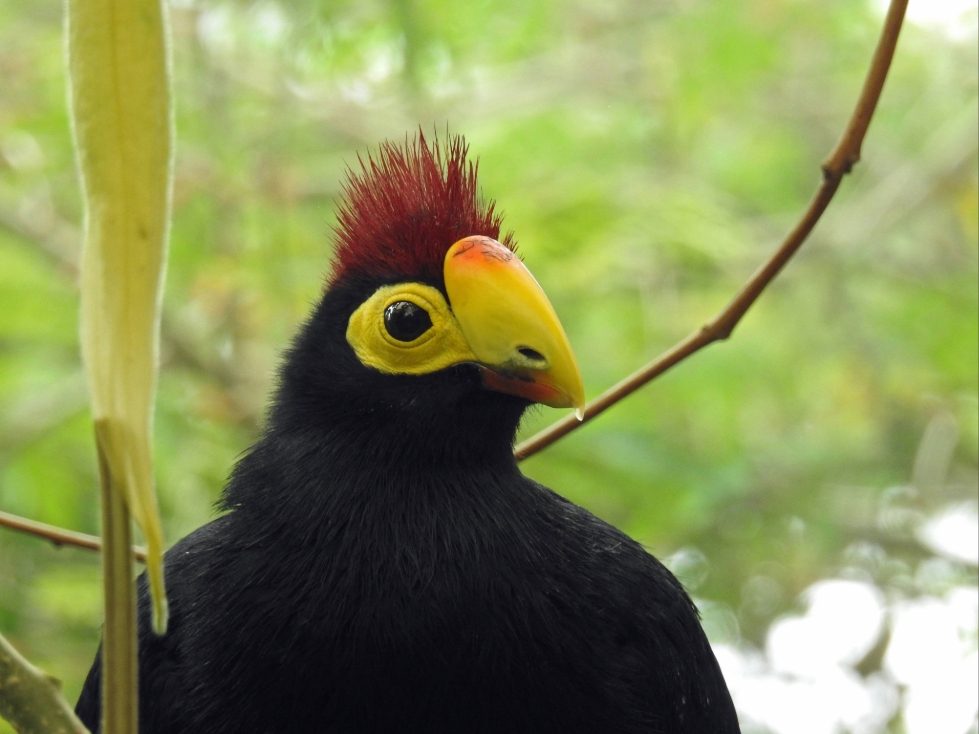
Figure Ro-10. Ross’s Turacos don’t develop their bill’s shield for about a year after hatching.
To see a month-old Ross’s Turaco being fed at the Cincinnati Zoo, see https://www.youtube.com/watch?v=kO_jILo8b0s&t=4s .
It takes about 8 days for their first quill feathers to start emerging, but their body is fully feathered after about 3 weeks. The head is still downy for another 2–8 days, while the crest develops (by day 30). The bare skin surrounding their eyes is dark, and their bill is yellow, but with no frontal shield. The crown of the head is black, but with a crimson red patch in the middle. It takes about a year for them to transform into adult coloration and plumage. Chicks are said to make a “soft croaky trill.”
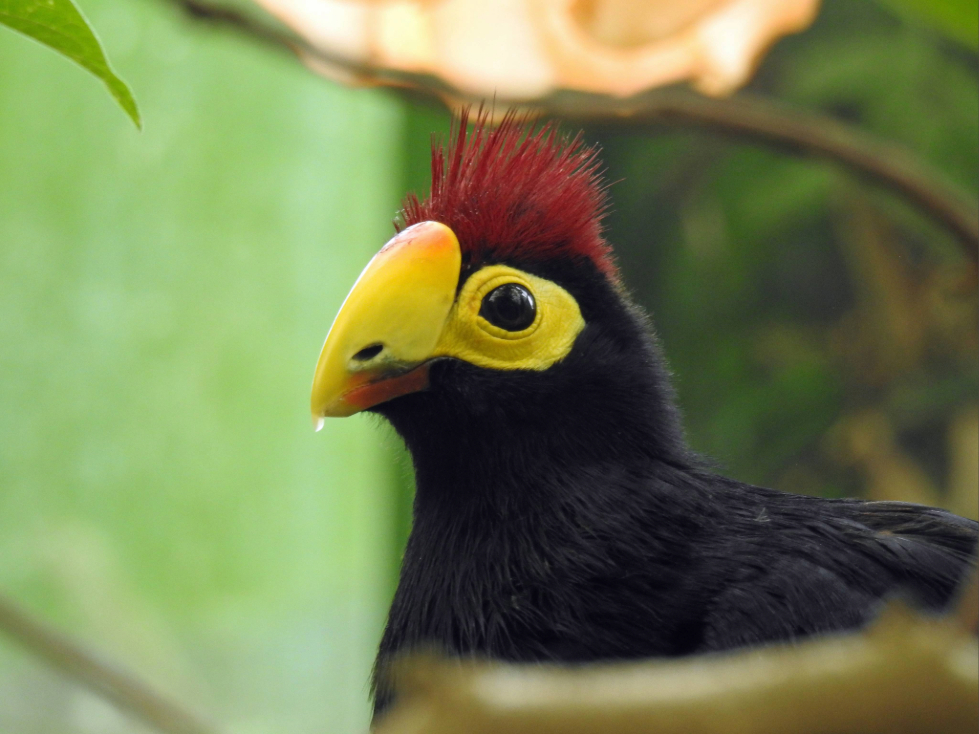
Figure Ro-11. Adult Ross’s Turacos sport a stunning crest, but youngsters have a red patch that hints of the crest to come.
Because their lifestyle involves climbing on trees more than on flying, the nestlings gain most of their independence even before they can fly (after about 4 weeks). Their parents continue to attend to them until they leave the nest permanently, when they’re about 26–31 days old. Often, flock members will also take food to the nest, especially if the female is a first-time mother. Parents initially regurgitate food directly into the mouths of their chicks; it wasn’t specified whether flock-mates do likewise or they deliver uneaten foodstuffs.
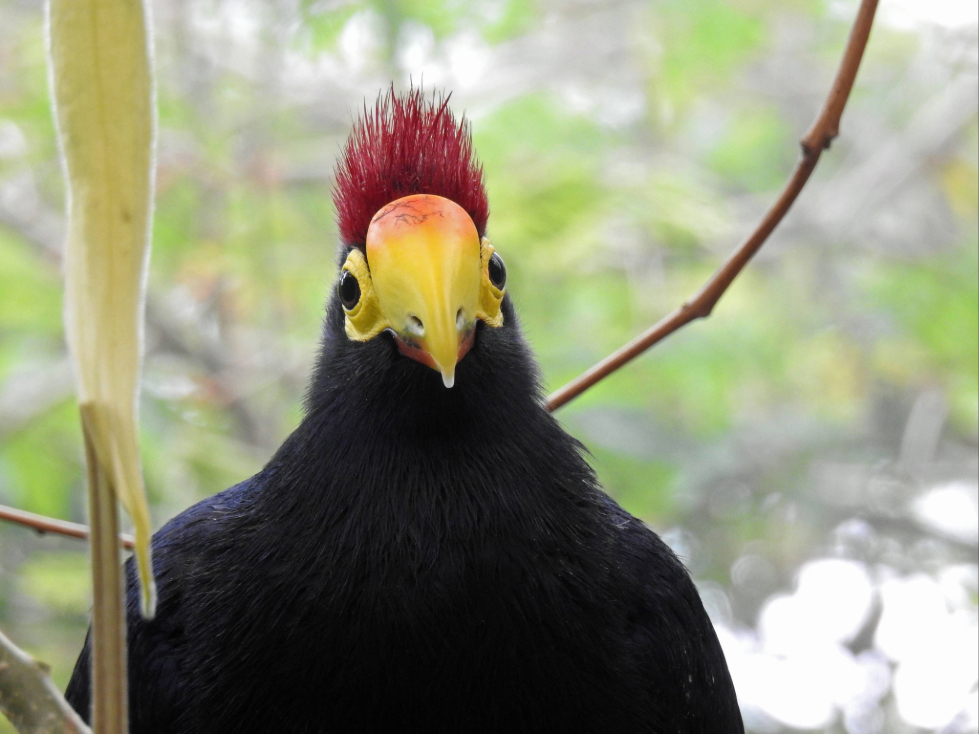
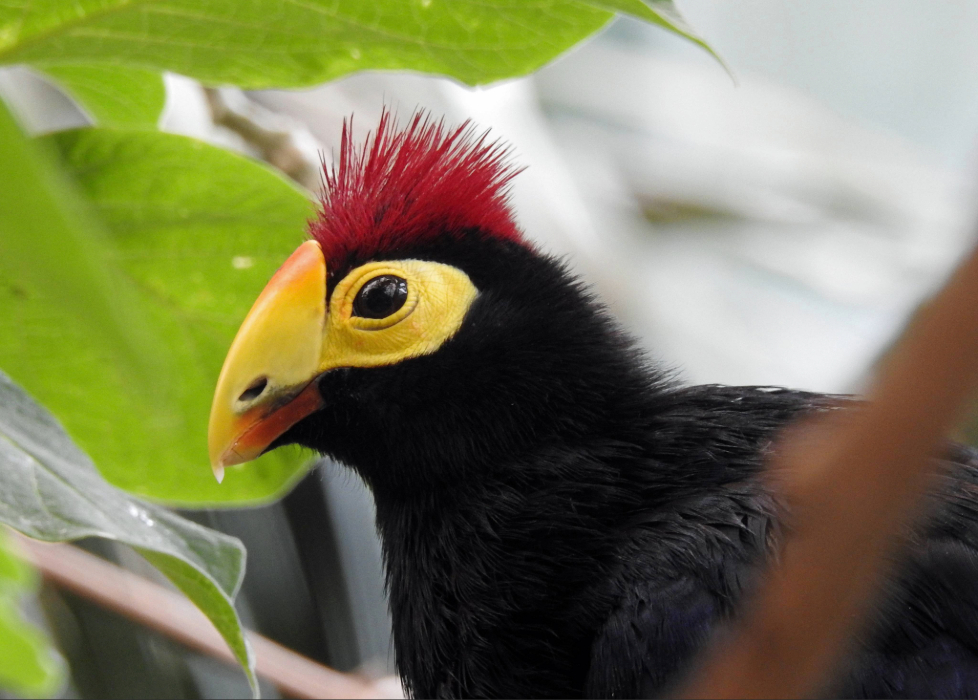
Figure Ro-12-a,b. Ross’s Turacos mostly hop about in the trees, rather than flying, so their chicks are ready to leave the nest even before they can fly.
Ross’s Turacos reach sexual maturity after 1 year of age, but age at first breeding is about 2.3 years. Even after fledging, youngsters stay near their parents in extended family flocks (up to 30 birds). Average generation length is 5–6.5 years.
To see a pair of Ross’s Turaco chicks hatched at the Phoenix Zoo, see https://www.youtube.com/watch?v=Naiq1KShWqI . Several months later after this video was taken, these chicks’ parents, old-timers Otto (age 21) and Leela (age 22) had a third chick, whom they were raising chick with help from these two now-6-month-old males. Apparently, Ross’s Turacos realize “it takes a village,” or at least an entire family.
Yearly productivity per pair is about 0.58 youngsters, and the rate of breeding success (nests leading to fledged young) is 31%. A Kenyan study of breeding success revealed that only 6 of 12 nesting attempts led to hatched eggs, and of the 12 eggs that hatched, only 7 chicks fledged; the others were subject to predation by raptors, snakes, and monkeys. Life in the wild is tough.
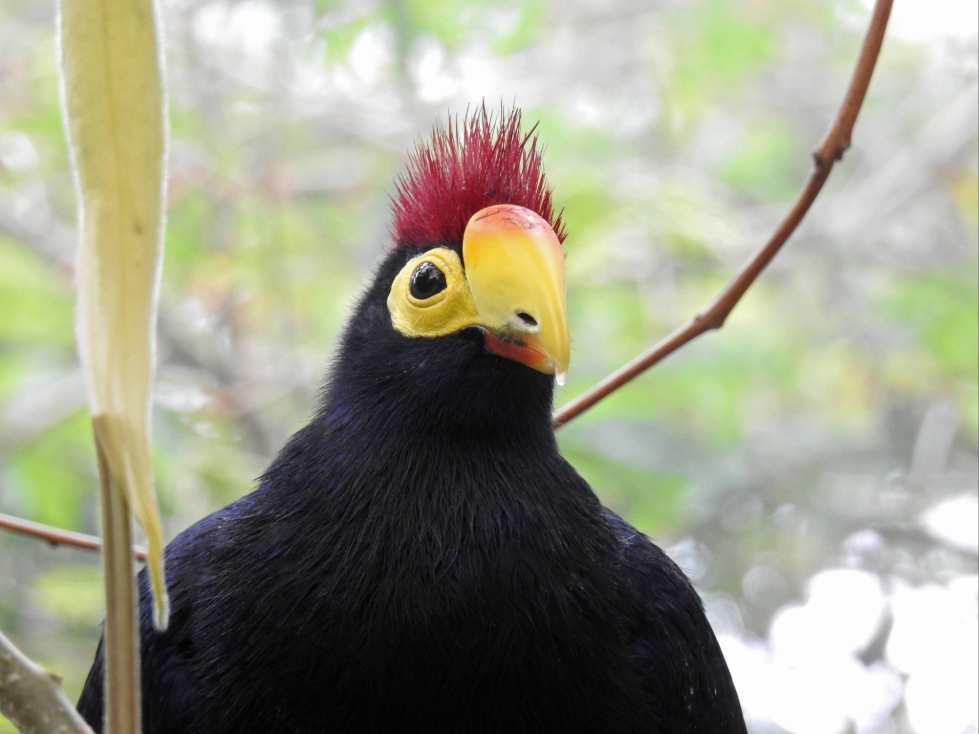
Figure Ro-13. In the wild, only 31% of Ross’s Turaco eggs reach the fledgling stage of life, largely due to predation. After reaching adulthood, however, they have an 80% annual survival rate. In captivity, they have even longer life spans.
The IUCN Red List conservation status of Ross’s Turacos is LC, Least Concern. It’s not deemed to be globally threatened, and it’s reported as being “frequent” to “common” in much of its range. In some locations, it appears to be adapting to forest degradation and fragmentation, as well as habitat destruction due to agriculture expansion. Unfortunately, their favorite habitats — gallery forests and riverine forests — are being converted to subsistence agriculture more rapidly than other ecosystems.
Their willingness to eat food crops makes them a pest to any nearby agriculture, but in the forest, their dispersal of seeds makes them highly beneficial to the ecosystem.
Their exquisite plumage exposes them to threats due to the pet trade, but luckily, their trade has been declining. Desired as pets, they may be obtained from questionable suppliers, and wild-caught birds may have parasites or other illnesses. In addition, they probably won’t respond well to human interactions. Captive-raised birds, however, are accustomed to the presence of human caregivers, and they’re usually hardy, calm, and friendly. Ross’s Turacos do well in captivity and are common inhabitants of zoos and menageries, where they are fed assorted fruits and “softbill diet pellets.” Their preference for climbing rather than flying makes them easier to keep in smaller aviary spaces.
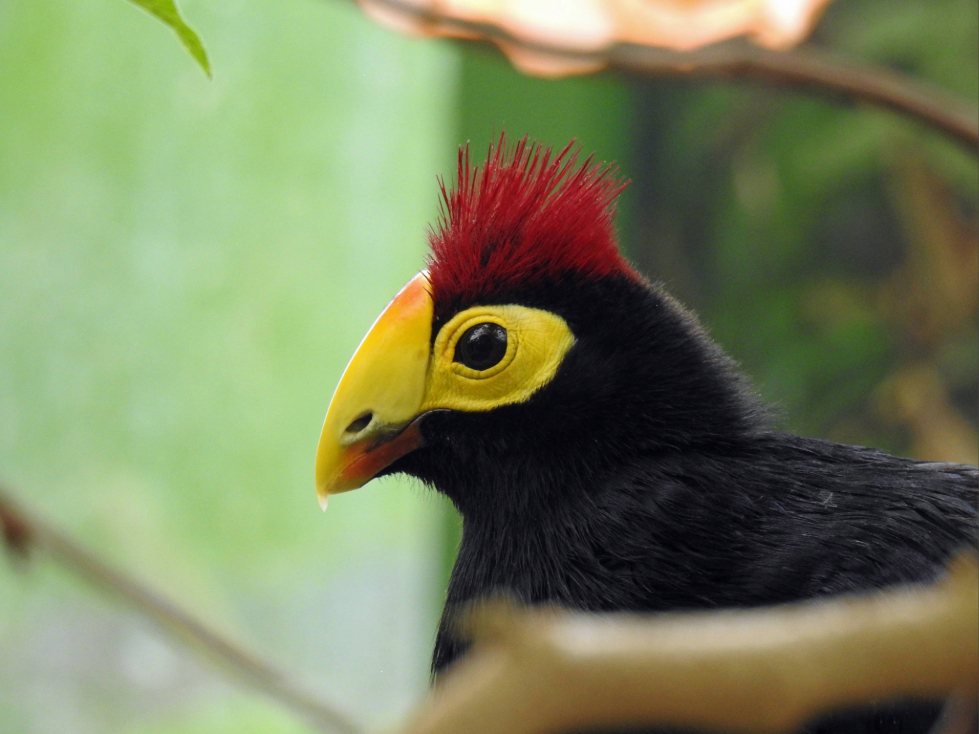
Figure Ro-14. The stunning appearance of Ross’s Turacos may be appealing to prospective mates, but it also makes them vulnerable to capture for the pet trade.
The only conservation actions known at present are provision of at least one protected area for their species in their entire range. The annual adult survival rate is 80%. Life span in the wild appears to be 8–20 years, with a maximum recorded age of 17.3 years. Captive birds usually live much longer. According to the Phoenix Zoo, “the oldest [male of a known age] to reproduce was 21.06 years” and their 22-year-old Leela “ is the second oldest [female of a known age] to produce a chick.” According to the San Francisco Zoo, Ross’s Turacos can live up to 30 years in captivity.
The Cornell Lab of Ornithology’s eBird app and website (https://ebird.org/species/rostur1 ) have 9608 observations, 672 with photos, and 61 with audio recordings. Its Macaulay Library (https://search.macaulaylibrary.org/catalog?taxonCode=rostur1 ) holds 1,219 photos, 65 audio recordings, and 30 videos of this species.
White-crested Turaco, Tauraco leucolophus
As mentioned, the genus name Tauraco comes from an African name for these birds, perhaps alluding to the bird’s vocalizations. Its species name, leucolophus, comes from Greek, leuko, “white,” and lophus, “crest,” “tuft.”
The White-crested Turaco is even smaller than the Red-crested Turaco, weighing just 7–8 oz. (198–226 g). Its tail is 6.3–7″ (16–18 cm) long, verging on half its full length of 15.75″ (40 cm). Its wings are about 6–7″ long (14.9–17.7 cm). Though its dark brownish-black legs are short (tarsus length, 1.3–1.5″m 3.33–3.72 cm), it has long zygodactyl, flexible turaco toes.
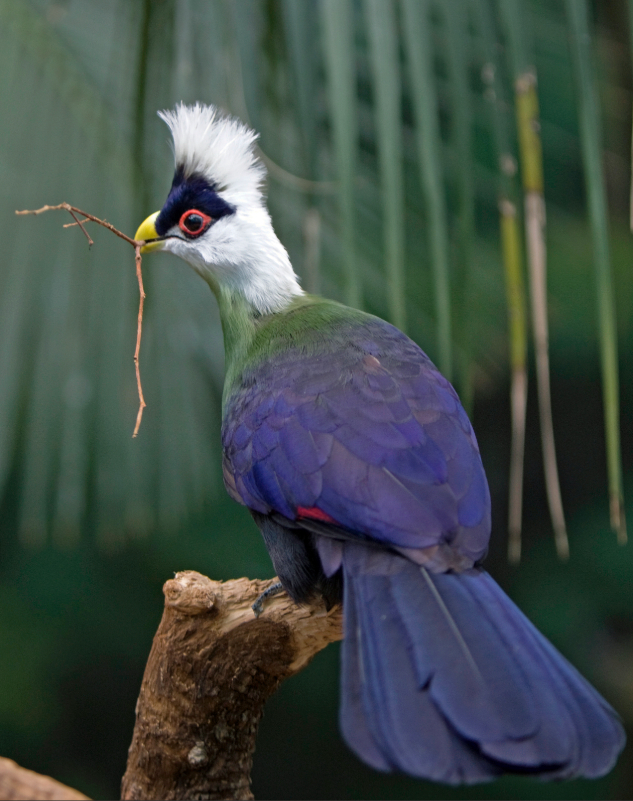
Figure WT-01. This White-crested Turaco was photographed by Brian Jelonek at Chicago’s Brookfield Zoo, March 1, 2010.
Brian Jelonek generously agreed to licensing his photo with a Creative Commons Attribution 2.0 Generic license, which entitles others to share this image, if the image gives appropriate credit, provides a link to the license, indicates whether changes were made, and makes it clear that the use doesn’t suggest an endorsement by the licensor. The license may be found at https://commons.wikimedia.org/w/index.php?curid=9627036; the image file is https://en.wikipedia.org/wiki/White-crested_turaco#/media/File:Tauraco_leucolophus_-Brookfield_Zoo,_Chicago,_USA-8a.jpg
Among the stunningly beautiful turacos, the White-crested Turaco still stands out. The verdant green of its mantle (around its shoulders) and breast plumes morph into its glossy bluish violet back, inner wings, and tail. Its belly and undertail look blackish. Like the Ross’s Turaco, when it extends its apparently violet-black wings to take flight, it reveals crimson primary and secondary flight feathers, to which this turaco adds narrow black tips, accentuating the crimson.
This turaco’s chin, cheeks, throat, neck, and the back of its head are gleaming white, rising up and atop its head to form its crest. This gleaming white offsets deeply purple feathers extending from its bill up its forehead and down toward the back of its head, with a narrow underline beneath its eyes. Each dark-brown eye is surrounded by a scarlet ovular orbital ring that tapers at the front and back of each eye. Its bright-yellow curved bill is about 1″ long (2.4–2.7 cm), 0.5″ deep (1.3–1.5 cm), 0.4″ wide (0.9–1 cm).
Its calls have been called “raucous cawing” or “wailing” — as you can hear by playing https://xeno-canto.org/740023 . Four other sound recordings may be found at https://xeno-canto.org/species/Tauraco-leucolophus . If you’re having a tough day, you might want to keep this link handy; I’m pretty sure they’ll perk you up.
Figure WT-02. Even this appallingly poor-quality video can reveal a glimpse of these magnificent turacos.
As can be seen in the range map gathered from more than 1,800 eBird observations (https://ebird.org/species/whctur2 ), the white-crested turaco is native to a wide tropical swath of countries across central Africa, including extreme southeastern Nigeria, northern Cameroon, east across southern Chad and northern Central African Republic, through southern South Sudan, northeastern Democratic Republic of Congo, Uganda, western Kenya, and eastern Rwanda. It doesn’t migrate, but it can be nomadic, sometimes wandering in pursuit of available fruits. A congregatory species, its movements can be irruptive at times.
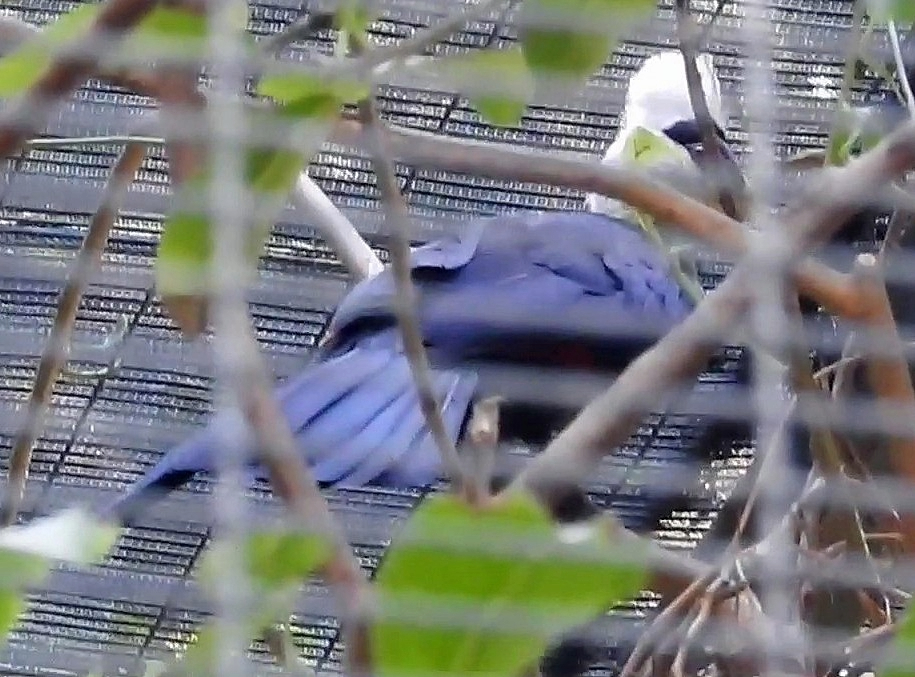
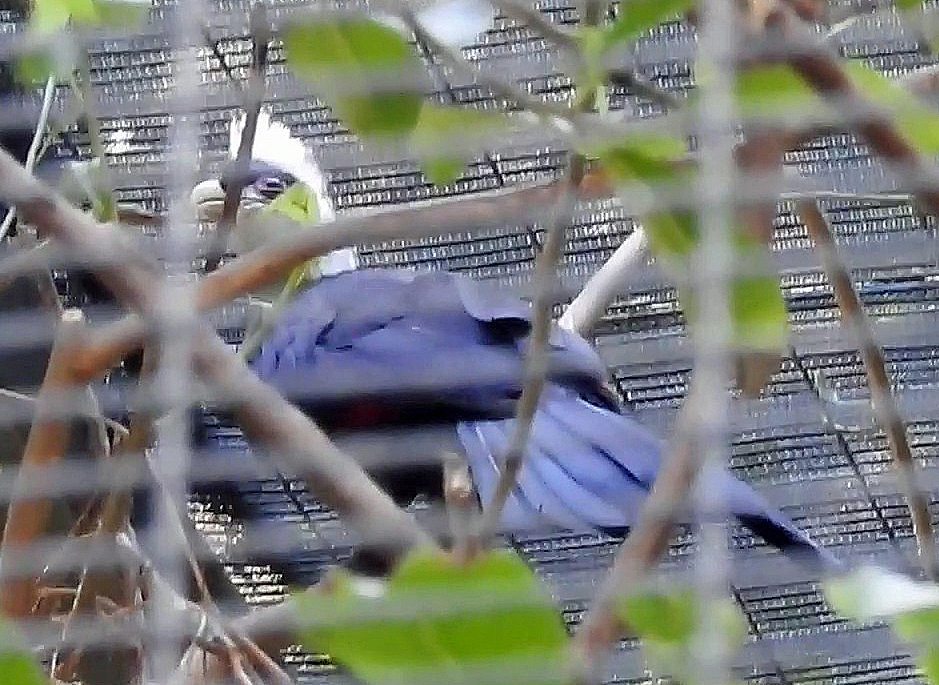
Figure WT-03-a,b. White-crested Turacos are at home in almost any woodlands, but they prefer having freshwater nearby.
This species of turaco particularly likes woodlands adjacent to freshwater, such as riverine forests (alongside rivers), as well as wooded savannas containing tangles of creeping plants. It seems to prefer lowland (e.g., 328 feet, 100m) woodsy areas, but it’s also found in elevations up to 7,200 feet (2,200 m). Occasionally, fruiting trees may entice these turacos to stray into shrublands and wetlands.
According to Avibase, fruits compose about 70% of its diet, flowerheads and other plant matter make up about 20%, and invertebrates (e.g., snails) make up the last 10%. If it’s like other turacos, the proportion of invertebrates rises during breeding season.
The breeding season varies widely across its range (e.g., April or August). During this season, monogamous pairs share resources in their territory. Together, they build a flimsy twiggy platform, described as “saucer shaped,” about 10–23 feet (3–7 m) above the ground, often without much concealment, in an acacia or similar tree with sparse foliage. The female lays two white eggs (not glossy) in their nest, and both parents incubate the eggs for 22–23 days. Research is needed to find more information about the care of their hatchlings, though presumably both parents participate in that care. Their young start breeding at about 2 years of age. The average generation length is about 4.8 (4.1–5.4) years.
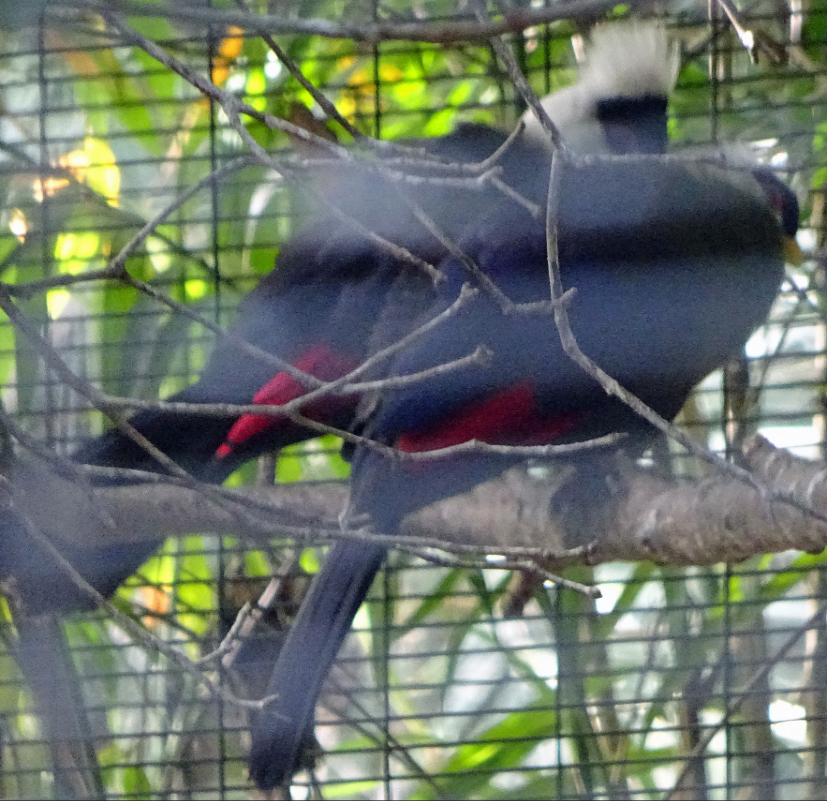
Figure WT-04-a,b. Both White-crested Turaco parents share in building a nest (albeit a flimsy one) and caring for their young.
The IUCN Red List conservation status of White-crested Turacos is LC, Least Concern; they’re not globally threatened, and they’re locally common in numerous areas of their wide range. In fact, their population appears to be relatively stable, though the number of mature birds is not known. The annual survival rate for adults is 0.77%. The maximum recorded age is 12.8 years. According to the IUCN, there is some international management or trade control for this species, and there is at least one protected area in its range.
The Cornell Lab of Ornithology’s eBird app and website (https://ebird.org/species/whctur2 ) has received 1812 observations, 176 with photos, and 17 with audio recordings. Its Macaulay Library (https://search.macaulaylibrary.org/catalog?taxonCode=whctur2 ) includes 395 photos, 23 audio recordings, 3 videos.
References
Musophagiformes, Musophagidae
- Elphick, Jonathan. (2014). “Turacos, Musophagidae” (pp. 385–386). The World of Birds. Buffalo, NY: Firefly Books.
- Lovette, Irby, & John Fitzpatrick (eds.), (2016). “Musophagiformes.” The Cornell Lab of Ornithology Handbook of Bird Biology (3rd ed.). Hoboken, NJ: Wiley.
- Winkler, David W., Shawn M. Billerman, and Irby J. Lovette. (2015). “Musophagiformes” (pp. 101–102). Bird Families of the World: An Invitation to the Spectacular Diversity of Birds. Barcelona: Lynx, Cornell Lab of Ornithology.
- Winkler, D. W., S. M. Billerman, and I. J. Lovette (2020). Turacos (Musophagidae), version 1.0. In Birds of the World (S. M. Billerman, B. K. Keeney, P. G. Rodewald, and T. S. Schulenberg, Editors). Cornell Lab of Ornithology, Ithaca, NY, USA. https://doi.org/10.2173/bow.musoph1.01
- https://en.wikipedia.org/wiki/Turaco
- https://www.iucnredlist.org/search?query=Turacos&searchType=species
- Turacos and hoatzins, “Convergent forms include hoatzin and touracos as large crested zygodactyl arboreal herbivores and also in the use of wing claws for climbing by nestlings.” Fain, Matthew G., & Houde, Peter (2004). “Parallel radiations in the primary clades of birds” (PDF). Evolution. 58 (11): 2558–2573. doi:10.1554/04-235. PMID 15612298. S2CID 1296408. Archived from the original (PDF) on 2017-07-09. Retrieved 2016-07-08. https://web.archive.org/web/20170709030601/http://biology-web.nmsu.edu/~houde/Parallel_radiations.pdf
- Zoo Atlanta, “Talking about turacos,” “Keeper Stories,” by Sam G., Keeper I, Birds, March 14, 2023 https://zooatlanta.org/talking-about-turacos/
Red-crested Turaco (Tauraco erythrolophus)
- Turner, D. A., and G. M. Kirwan (2020). Red-crested Turaco (Tauraco erythrolophus), version 1.0. In Birds of the World (J. del Hoyo, A. Elliott, J. Sargatal, D. A. Christie, and E. de Juana, Editors). Cornell Lab of Ornithology, Ithaca, NY, USA. https://doi.org/10.2173/bow.rectur1.01
- https://avibase.bsc-eoc.org/species.jsp?avibaseid=91187A52
- https://avibase.bsc-eoc.org/species.jsp?lang=EN&avibaseid=91187A5248462828&sec=lifehistory
- https://ebird.org/species/rectur1
- https://en.wikipedia.org/wiki/Gallery_forest
- https://en.wikipedia.org/wiki/Old-growth_forest
- https://en.wikipedia.org/wiki/Red-crested_turaco
- https://en.wikipedia.org/wiki/Secondary_forest
- https://www.iucnredlist.org/search?query=Red-crested%20turaco&searchType=species
Ross’s Turaco (Tauraco rossae)
- Turner, D. A., G. M. Kirwan, and P. F. D. Boesman (2024). Ross’s Turaco (Tauraco rossae), version 1.2. In Birds of the World (J. del Hoyo, A. Elliott, J. Sargatal, D. A. Christie, and E. de Juana, Editors). Cornell Lab of Ornithology, Ithaca, NY, USA. https://doi.org/10.2173/bow.rostur1.01.2
- https://avibase.bsc-eoc.org/species.jsp?avibaseid=2C7BA3A6
- https://avibase.bsc-eoc.org/species.jsp?lang=EN&avibaseid=2C7BA3A6C773C461&sec=lifehistory
- https://ebird.org/species/rostur1
- https://en.wikipedia.org/wiki/Ross%27s_turaco
- https://seaworld.org/animals/facts/birds/lady-ross-turaco/
- https://www.iucnredlist.org/search?query=ross%27s%20turaco&searchType=species
- chicks, helpers, longevity, https://www.phoenixzoo.org/blog/animal-updates/meet-otto-the-lady-rosss-turaco/
- https://www.sfzoo.org/lady-rosss-turaco/
- Lady Ross’s Turaco, facsimile of original first citation of this species, https://www.biodiversitylibrary.org/item/96443#page/123/mode/1up .
- Zoological Society of London (founded, 1826). Proceedings of the Zoological Society of London. Vol. 1851. London: Academic Press. https://www.biodiversitylibrary.org/page/30680332. (Contributed by Natural History Museum Library, London. Contributed by BioStor. Adams, Arthur, 1820–1878; Date of Publication, 1852. Original Publication, Proceedings of the Zoological Society of London. Volume, 1851. Pages 82–92.
- Here is the complete text, which I typed from the facsimile available online: p. 93, “Mr. Gould exhibited to the meeting a drawing by Lieut. J. R. Stack, of a new and beautiful species of Musophaga, of which a living example had been for the last ten years in the possession of Lady Ross at St. Helena. Mr. Gould also exhibited some feathers shed from the wings and tail of the bird, an examination of which, and of the drawing, satisfied him that the bird was quite distinct from all previously described members of the genus. ¶ Lady Ross, who is at present in England, had informed Mr. Gould that the bird was about the size of a hen-pheasant, and that it had been brought to St. Helena from the western coast of Africa, but the precise locality in which it had been procured was unknown to her. ¶ For this interesting addition to the Musophagae Mr. Gould proposed the specific appellation of Rossae, in honour of its amiable owner, who has promised that in the event of her not returning to St. Helena, she will have the bird brought to England, where its arrival will be hailed with pleasure by every lover of science. ¶ Body, wings and tail rich deep blue ; primaries and secondaries arterial blood-red, narrowly margined and more broadly tipped with purplish-brown, as in the other species of the genus; crown surmounted with a high rounded crest of hair-like blood-red feathers; bill and denuded orbits yellow ; irides brown.”
- https://en.wikipedia.org/wiki/Zoological_Society_of_London
- ornithologist Alexander Milton Ross, https://en.wikipedia.org/wiki/Alexander_Milton_Ross
White-crested Turaco (Tauraco leucolophus)
- Turner, D. A., and P. F. D. Boesman (2020). White-crested Turaco (Tauraco leucolophus), version 1.0. In Birds of the World (J. del Hoyo, A. Elliott, J. Sargatal, D. A. Christie, and E. de Juana, Editors). Cornell Lab of Ornithology, Ithaca, NY, USA. https://doi.org/10.2173/bow.whctur2.01
- https://avibase.bsc-eoc.org/species.jsp?avibaseid=FF2AF138
- https://avibase.bsc-eoc.org/species.jsp?lang=EN&avibaseid=FF2AF138EF023C2D&sec=lifehistory
- https://ebird.org/species/whctur2
- https://en.wikipedia.org/wiki/White-crested_turaco
- https://www.iucnredlist.org/species/22688369/264153910
Etymology
- Lederer, Roger, and Carol Burr. (2014). Latin for Bird Lovers: Over 3,000 Bird Names Explored and Explained (224 pages). Portland, OR: Timber Press.
- Gotch, A. F. [Arthur Frederick]. Birds—Their Latin Names Explained (348 pp.). Poole, Dorset, U.K.: Blandford Press.
- Gruson, Edward S. (1972). Words for Birds: A Lexicon of North American Birds with Biographical Notes (305 pp., including Bibliography, 279–282; Index of Common Names, 283–291; Index of Generic Names, 292–295; Index of Scientific Species Names, 296–303; Index of People for Whom Birds Are Named, 304–305). New York: Quadrangle Books.
Text by Shari Dorantes Hatch.
Image of White-crested Turaco by Brian Jelonek; other images by Shari Dorantes Hatch.
Copyright © 2026. All rights reserved.
 Bird Brain

Leave a comment