
Cuculiformes, Cuculidae
Special request: Would you please comment on the length of these blogs? I suspect that they’re much too long, but I’d value your opinion. I’m thinking of breaking up long posts into smaller chunks. Your thoughts? Thank you.
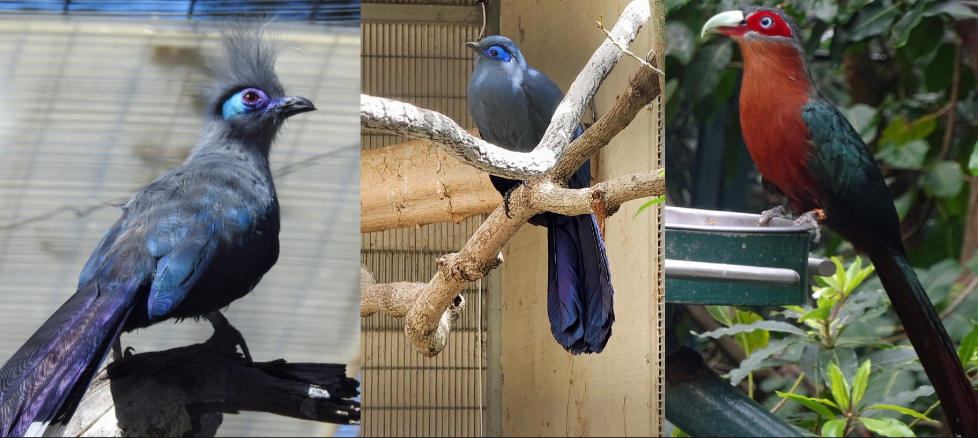
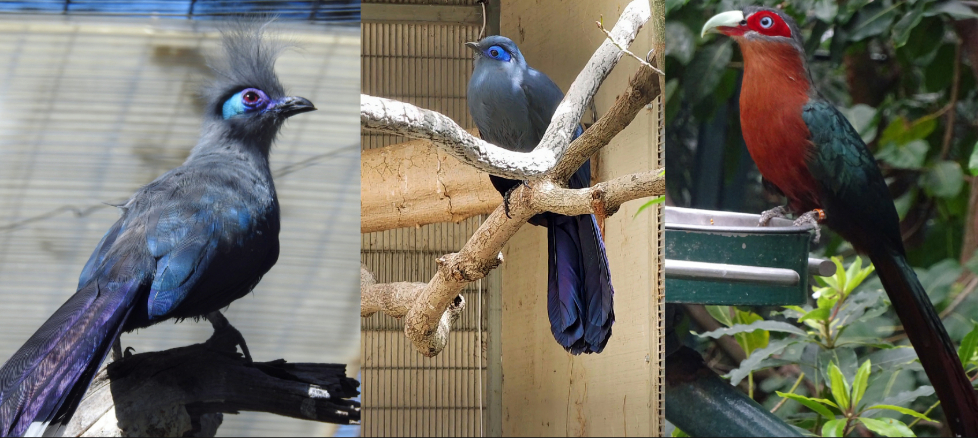
These three beauties belong to the Cuculidae family (Cuculiformes order of birds); photographed at the San Diego Zoo within the past decade. When these three species (Crested Coua, Blue Coua, Chestnut-breasted Malkoha) breed, both parents carefully tend to their eggs and then their hatchlings. Some cuckoo moms, however — “brood parasites” — notoriously leave their eggs in the nests of other birds and make no effort to incubate their eggs or to protect or feed their hatchlings.
The only family in the Cuculiformes order is Cuculidae. Both names come from Latin cuculus, for “cuckoo.” The English “cuckoo” (and other names for these birds) is considered imitative of the sound uttered by some birds in this family. Not all cuckoos are called “cuckoo”: Some family members are called roadrunners, koels, malkohas, couas, coucals, and anis. Preliminary genetic analysis suggests relationships among Cuculiformes (cuckoos), Musophagiformes (turacos), and Otidiformes (bustards), but these relationships aren’t yet understood.
Though named for their “cuckoo” call, the members of this family actually have a wide repertoire of vocalizations — whistles, flutes, hiccups, alarm calls, courtship calls, begging peeps, and more. Most typically, calls are used to proclaim territory and to attract a mate. It’s thought that a given species’ calls are innate, not learned.
Figure 01. Like most cuculids, these male and female Chestnut-breasted Malkohas are comparable in size and plumage; there are subtle distinctions that a malkoha and a keen ornithologist might detect, but most humans would not.
It would be hard to state a common theme for plumage colors, as some family members sport brilliant, even iridescent plumage, whereas many show neutral browns, grays, and whites in cryptic patterns. Most species are sexually monomorphic (males and females look alike), but species in two big genera are dichromatic — male and female plumage differs. Cuckoo size ranges from small to medium; in some species, one sex may be bigger than the other, but most male and female cuckoos are similar in size within a given species.
Most cuckoos have longish oval-shaped bodies, with short, pointed wings and very long tails, which may be tapered or rounded. It helps to have a long tail when navigating through dense forests. Most have short legs, and all have zygodactyl toes (inner two toes forward, outer two toes backward). Most cuckoos have relatively small heads and short necks. Their bills may be straight or curved, thick or thin, medium (most) to long. The bare skin around their eyes may be colorful, and some species have crests or other facial plumes.
Fun fact: Tail feathers, responsible for navigating birds in flight, are called rectrices (1 rectrix, 2 rectrices). Originally, a rectrix was a female rector, that is, “one who directs.” Apt, huh?
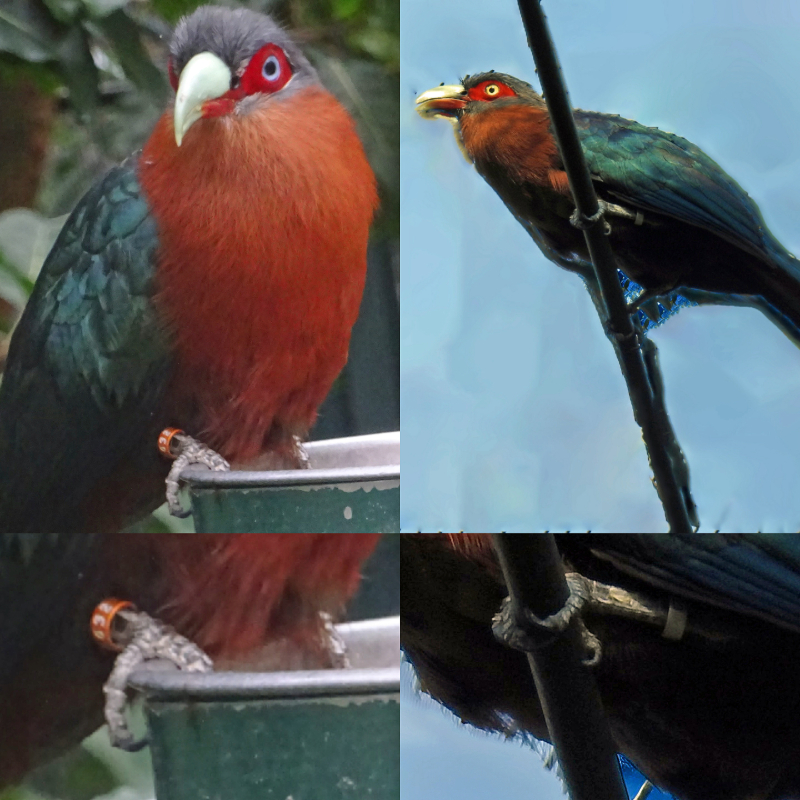
Figure 02. Cuculid species, including this Chestnut-breasted Malkoha, have zygodactyl toes, with the inner two toes pointing forward and the outer two pointing backward. Some species (e.g., couas) have a reversible third toe, which can be switched to the back, as needed.
The largest cuckoo in the world, the Channel-billed Cuckoo, weighs 1 pound, 6 ounces (630 g) and is about 25″ (63 cm) long (bill to tail). Its tail is 9.9–11.8″ (25.3–29.9 cm) long, and its bill is about 2.4–3.8″ (6.8–9.7 cm) long, 1″ (2.6 cm) wide (side to side), and 1.25″ (3 cm) deep (top to bottom). Its tail is about 44% of its body length, and its bill is about 13% of its body length, totaling 57%. (To see a photo of this bird in flight, check out https://en.wikipedia.org/wiki/Channel-billed_cuckoo#/media/File:Channel-billed_Cuckoo_0A2A9439.jpg .)
Cuculidae, embracing 36 genera, across 156 species, can be found on six continents (not Antarctica), though absent in some regions of some continents. They make their homes in a variety of habitats. Though most inhabit woodlands, many prefer scrublands, savannas, or even deserts (e.g., Greater Roadrunners — beep, beep). Most cuculids feed mostly on insects, especially larvae such as caterpillars, but some (e.g., koels) eat mostly fruits, and some (e.g., couas) eat fruits whenever insects aren’t available. Some even eat noxious, hairy caterpillars avoided by other birds, but they first rub the prey against hard surfaces, then crush it in their mouths before swallowing it. Some larger species feast on small vertebrates, sometimes bludgeoning the prey with their big bills.
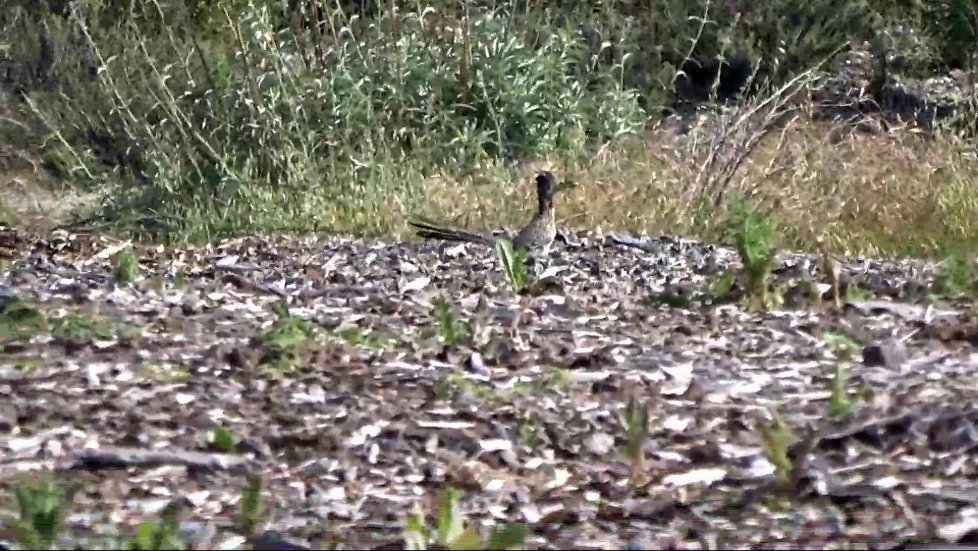
Figure 03. Greater Roadrunners prefer arid scrublands, savannas, and deserts, rather than the woodlands preferred by most other cuculids. Though roadrunners aren’t known for outsmarting coyotes, they do readily hunt, kill, and eat rattlesnakes and other fearsome reptiles. (This image is a still from a smartphone video taken in 2016. FAR BETTER images can be found at https://search.macaulaylibrary.org/catalog?taxonCode=greroa and https://www.inaturalist.org/observations?taxon_id=1986 .)
The most notorious of cuckoos use brood parasitism to raise their young. These scoundrels lay their eggs in the nests of other birds, usually birds of a different species, then they leave their eggs to be incubated by other parents, who will also be left to feed their hatchlings. Many of these cuckoos have evolved highly sophisticated mimicry of the coloration of the eggs of other species — even species with complex patterning of their eggs. Among some species, the hatchlings also resemble the foster parent’s offspring, though typically much larger. In many instances, the parasitic offspring not only accept the care of the fostering parent but even eject their foster siblings (eggs or hatchlings) from the nest, or otherwise commit step-siblicide. The unfortunate foster parent loses its own young and is left to care for the parasite hatchling alone.
Most cuckoos, however, care for their own eggs and hatchlings. Many cuckoos form monogamous pairs who incubate their eggs and care for their hatchlings together.
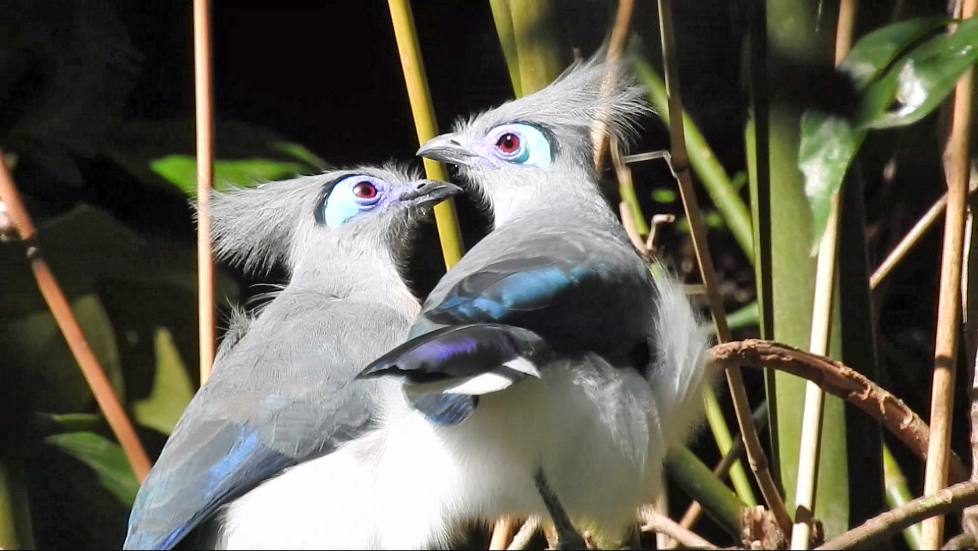
Figure 04. Like most cuckoos, Crested Coua parents form monogamous pairs, who incubate their own eggs and attentively care for their hatchlings together, sometimes still feeding them after they fledge.
Some cuckoos are cooperative breeders; up to five mated pairs will share a territory and a joint nest, as well as parenting responsibilities, both males and females participating. Anis, in the genus Crotophaga, live and breed cooperatively, sharing a territory among two or more pairs, up to 17 otherwise unrelated individuals.
“Ani” is the Tupi name for these birds; Tupi was the indigenous language of Brazil, the native land of two of the three ani species.
Among cooperative breeders, the clutch size of a shared nest can reach 20 eggs; among monogamous pairs, 1–5 eggs are typical. In addition, some cuckoo species are polyandrous, with the moms having multiple partners and leaving the incubation and parenting duties to the dad. The nests built by cuckoos can be a simple shallow bowl of sticks or an elaborate dome-shaped grass nest with a side entrance. All cuckoo offspring are altricial (dependent on parental care after hatching), but they grow quickly from hatchling to fledgling.
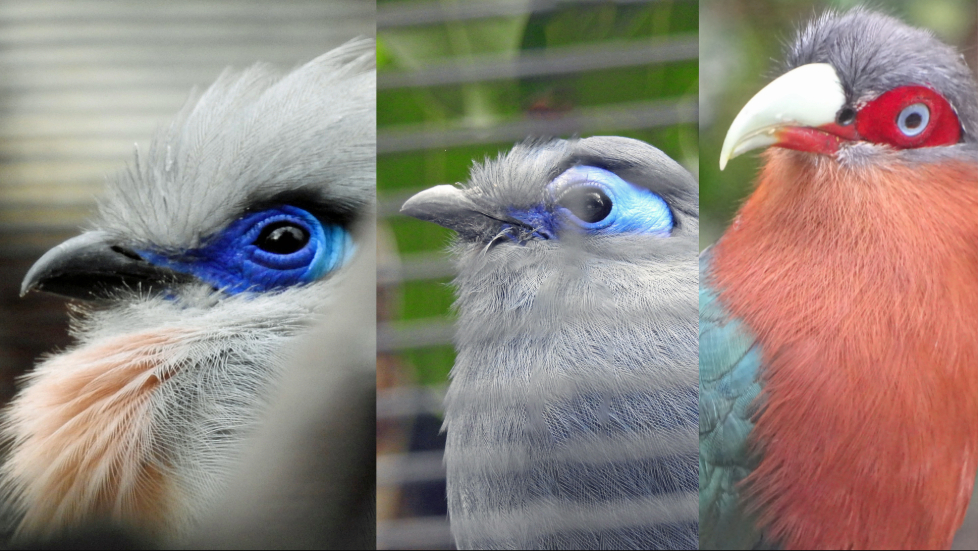
Figure 05. Fortunately, most cuculids — including this Crested Coua, this Blue Coua, and this Chestnut-breasted Malkoha — are assessed as “LC,” Least Concern, by the IUCN Red List. However, 20 of the 156 species are imperiled, 2 of them CR, Critically Endangered.
Like many other bird families, cuculid species are imperiled by habitat destruction and degradation. According to the IUCN Red List, 13% of cuckoo species are deemed to be at grave risk (10 NT, Near Threatened; 6 VU, Vulnerable; 2 EN, Endangered; and 2 CR, Critically Endangered); the conservation status of 11.5% isn’t known. In addition to habitat threats, some cuckoos are endangered by human hunting for their meat, predation by introduced mammal predators, and introduced competitors for their habitat and food.
Let’s meet a few of the Cuculidae family members. For several years, the San Diego Zoo and its Safari Park, exhibited three gorgeous cuculids:
- Crested Coua, aka Northern Crested Coua, Coua cristata
- Blue Coua, Coua caerulea
- Chestnut-breasted Malkoha, Phaenicophaeus curvirostris
(All photos of these species were taken at the San Diego Zoo, since 2016.)
In addition, San Diegans can occasionally catch glimpses of this intriguing cuculid:
- Greater Roadrunner, Geococcyx californianus
Luckily, all four of these species have IUCN Red List status of LC, Least Concern.
Coua Genus
The genus name Coua is from koa, a Malagasy name for this genus, thought to reflect the sound of these birds’ calls. Malagasy is one of the two official languages of Madagascar, the native home of couas. The genus Coua includes 11 species, 2 of which have been on exhibit at the San Diego Zoo: Crested Coua, Coua cristata, and Blue Coua, Coua caerulea. Their Latinate species names refer to their appearance — cristata, meaning “crested,” and caerulea meaning “cerulean,” “sky blue.”
Couas effortlessly walk along tree branches, with their long zygodactyl toes (their third toe is reversible). Not long-distance flyers, they easily hop from branch to branch or glide from tree to tree in the canopy, foraging from one to another. Couas call and respond to one another in a short repetitive series of notes. They build their own nests, incubate their own white eggs, and care for their own young.
Figure 06. Couas, such as this Blue Coua, seem to enjoy exploring as they hop about.
Crested Coua, Coua cristata
This species is the most widespread coua, with a range of 217,000 square miles (562,000 km2). The Crested Coua is distinguished by — you guessed it — its tall, wispy, feathered crest. Its plumage is mostly gray — with hints of blue — on top (head, back, wings, tail); its long tail can shimmer purplish-blue, with a white tip. (Its undertail is violet-black.) Beneath its gray chin is its rufous chest, extending down to its white belly, flanks, and thighs. Legs, feet, zygodactyl toes (with a reversible third toe), and claws are black.
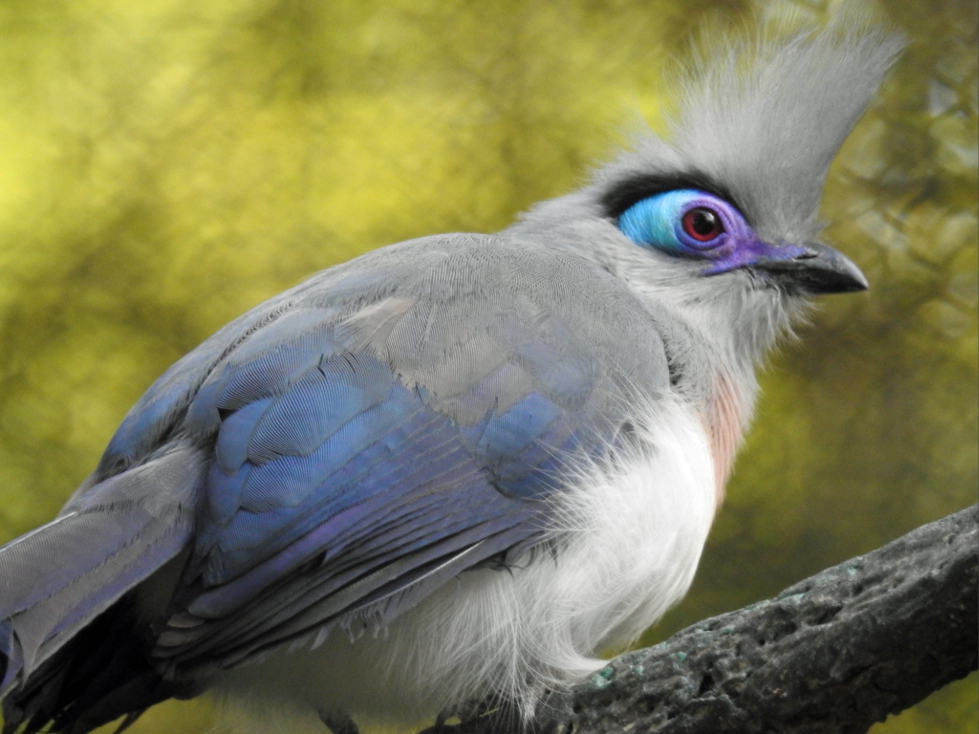
Figure 07. The Crested Coua’s coloring spans from light salmon on its breast to gray and white body feathers and crest, then down its back to subtle turquoise and purplish iridescent plumes on its wings and tail, and forward to the striking turquoise and purple bare skin surrounding its intense eyes.
Its face is even more captivating. Its curved black bill leads back to bare African-violet skin extending to the middle of its scarlet eye (which can be reddish-brown or even purplish in some birds). The bare purple skin blends into turquoise bare skin extending far back on its head; atop the exquisitely colorful bare skin is a thin feathered black brow, topped off with whimsical wisps forming a gray crest, from the bill to the back of the head.
Both male and female Crested Couas weigh about 5 ounces (144.2 g; 3.7–5.9 oz., 103–168 grams). By comparison, American Robins weigh about 2.7 ounces (77 g) and are about 9–11″ long (23–28 cm). The Crested Coua is typically 15–17″ long (40–44 cm, bill to tail), with its tail accounting for 7–8.7″ of that length. The Crested Coua’s rounded wings are about 5.2–6.7″ (13.1–17 cm) and each tarsus (ankle to toes) is just 1.4–1.9″ (3.5–4.7 cm) long. Its bill is 0.7–0.9″ (1.7–2.4 cm) long.
Figure 08. This Crested Coua is showing off its astonishing plumage, with its white-tipped black undertail.
All couas live in Madagascar, though different species and subspecies inhabit different regions. Like other couas, the Crested Coua chooses forests, and in particular, it prefers primary and secondary forests, rather than wetter forests or brushlands. It generally stays below 3,773 feet (1,150 m) in elevation, and it’s not known to migrate.
Crested Couas are known for vocalizing often, with a variety of calls, and frequently raising their crests while they call. The variety of calls can be heard at https://xeno-canto.org/species/Coua-cristata . Just a sampling of the offerings there:
- A distinctive whooping-chirping call: https://xeno-canto.org/26702
- A chorus of calls: https://xeno-canto.org/26705
- A delightful variety of vocalizations: https://xeno-canto.org/162245
- 1 or 2 individuals calling: https://xeno-canto.org/573774
- a whistle and a harsh call: https://xeno-canto.org/624029
They call to raise alarm (intensely or less so), to court prospective or current mates, to beg for food (youngsters), to simply check in with fellow couas, or to engage with couas in adjacent territories — perhaps up to 15 individual birds answering each other. At sunset, they tend to vocalize more, often in concert with other bird species. These vocalizations may reflect the gregarious nature of this species. Outside of breeding season, they often hang out in groups of 3–5 conspecifics (birds of the same species) and sometimes even join mixed-species flocks.
Figure 09. Every once in awhile, this Crested Coua likes to take time to enjoy a little sunbathing.
Crested Couas eat mostly invertebrates — especially large insects and larvae (e.g., caterpillars) — as well as some fruits, seeds, and flower buds, and some small vertebrates — such as lizards (geckos, chameleons). They’re not known to scavenge or to eat fish, nectar, or most parts of plants; some observations suggest they sometimes eat the eggs of other birds. Typically, they forage by starting at the base of a tree and working their way up to the top of the tree canopy, gleaning food from branches and trunks as they go, then returning to the base. They even take resin (“gum”) from acacias and other trees; some resins offer not only calories but also various nutritious minerals. In captivity, they have been sustained on live insects (e.g., crickets) and dry dog food, supplemented with some cooked beef and some fruits.
Crested Couas are monogamous, but it’s not clear whether they’re seasonally monogamous or mate for life. Both parents choose a nest location about 30 feet (9m, 6.5–49 feet, 2–15 m) off the ground, hidden by trees, vines, or shrubs. They cooperate to build a bulky, shallow nest of twigs and rootlets, measuring 5.5–7″ (14–18 cm) across by 1.1–2″ deep (28–50 mm). The female lays 2 (usually) dull white eggs, and both parents incubate them (for an unobserved length of time). Despite parental vigilance, their eggs are often preyed upon.
Figure 10. Like most other cuculids, Crested Couas form monogamous pairs who collaborate to build a nest for their eggs, incubate their eggs together, and cooperate to protect and feed their hatchlings.
Each altricial (dependent, typically unfeathered) nestling hatches with a bright red bill, bright pinkish-red palate, and white pattern making it easy for parents to see where to put the food into its mouth. For a closeup photo of the chick’s mouth pattern, visit https://news.mongabay.com/2012/10/picture-of-the-day-a-bizarre-baby-bird-with-oral-fingerprints/ .
Astonishingly, the chicks feather out within about a week; both parents provide care for about two weeks, at which time the chicks leave the nest. Four-week-olds look similar to adults, though they’re slightly paler, with a shorter crest, and lacking the stunningly colorful bare skin of adults. The brief caregiving period allows some pairs to rear more than one clutch during breeding season.
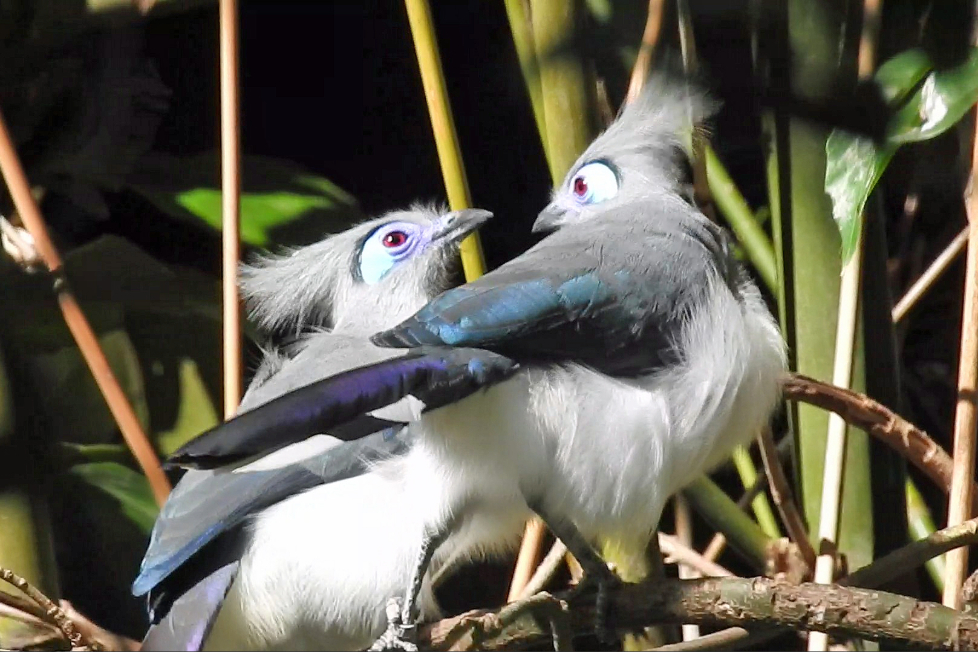
Figure 11. Crested Coua couples cooperate to provide for their offspring, sometimes raising more than one clutch in a given breeding season.
The Crested Coua has an IUCN Red List conservation status of LC, Least Concern, and they enjoy a long life span (up to 15 years in captivity). The population is considered stable, but indications suggest that it is declining, largely due to habitat loss and degradation, as well as to hunting, both by humans and by fossas, hawks, and eagles.
The Cornell Lab of Ornithology’s eBird website (https://ebird.org/species/crecou1 ) and app have received postings of 3124 observations, including 500 with photos and 35 with audio recordings. The lab’s Macaulay Library (https://search.macaulaylibrary.org/catalog?taxonCode=crecou1 ) has received 864 photos, 35 audio recordings, and 4 videos of this species. The iNaturalist website (https://www.inaturalist.org/observations?taxon_id=1865 ) and app have received 296 observations of this species.
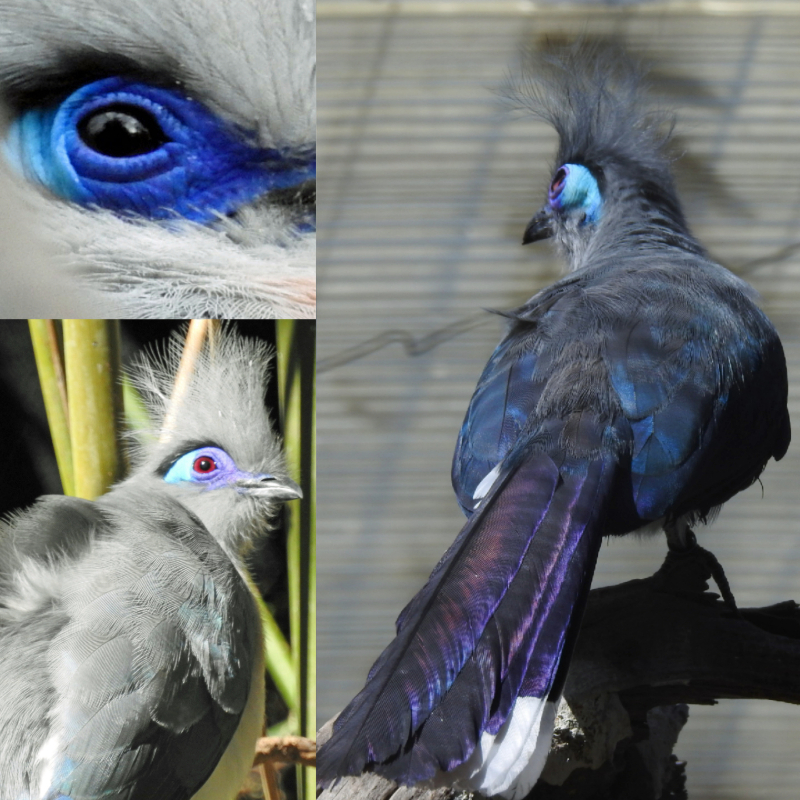
Figure 12. Beautiful from any angle—close up or from a distance—the Crested Coua is among the loveliest of birds.
Blue Coua, Coua caerulea
Blue Couas are bigger than Crested Couas, about 18.9–19.7″ (48–50 cm) long, bill to tail, compared with Crested Couas’ 15–17″ (40–44 cm). They weigh more, too, with females weighing 8.5–9.5 ounces (240–268 g), slightly more than males 7.9–9 ounces (225–257 g); for comparison, both sexes of Crested Couas weigh about 5 ounces. It lacks the crest of the Crested Coua, but it’s no less stunning a bird, with its intense blue plumage, its long blue tail that glimmers with purple iridescence, and the bare blue skin surrounding its dark eyes (brown or reddish brown). Both species of couas have black bills, legs, feet (large), and toes (including a reversible third toe), and both have short, broad wings.
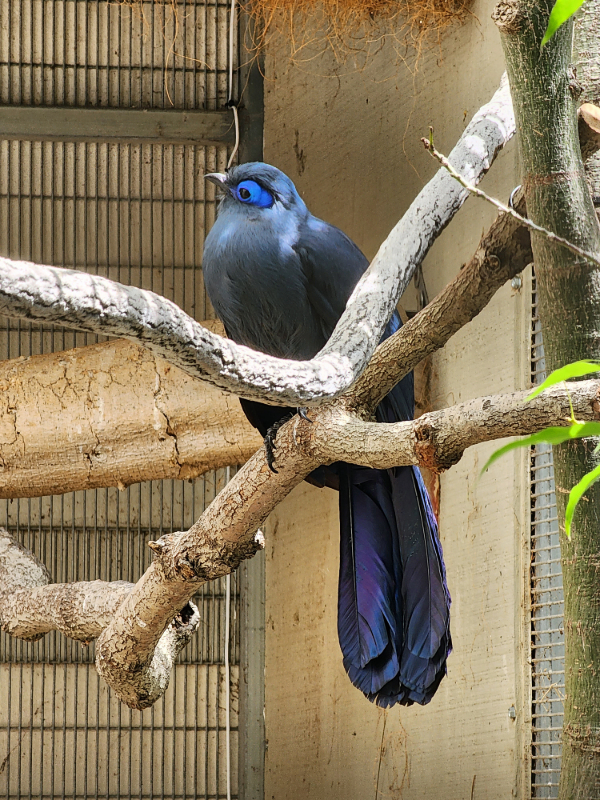
Figure 13. Aptly named, the Blue Coua has both blue plumage, with hints of purple on its tail (no white tips), and brilliant bare blue skin surrounding its eyes.
Like other couas, Blue Couas show a variety of vocalizations, as can be seen by visiting https://xeno-canto.org/species/Coua-caerulea . Just a few I enjoyed were
https://xeno-canto.org/162443 , https://xeno-canto.org/86591 , https://xeno-canto.org/162877 , and https://xeno-canto.org/622817 .
The territorial range of Blue Couas overlaps with that of Crested Couas, though it may reach into some higher elevations (up to 6,500 feet / 2000 m). Neither species of coua migrates. The Blue Coua dines mostly on insects (adults and larvae) and other invertebrates (e.g., spiders, centipedes), but it also eats small vertebrates, such as lizards (chameleons), frogs, and crabs, and it eats fruits, flowers, and the gum resins of some trees. One analysis suggests its diet is 60% invertebrates, 20% vertebrates, and 20% fruits, more or less (Avibase).
Figure 14a,b,c. Blue Couas, like most other birds, spend time tending to their plumes, preening each feather to be flight-ready.
Though it occasionally will run on the ground, it mostly forages among the treetops, perhaps down to the undergrowth. Blue Couas are found alone, in pairs, or in small family groups (up to 5 individuals). Rarely, they have been seen in mixed-species flocks.
Breeding season peaks in October–December (austral spring), though it can start as early as July (austral winter). This species builds bowl-shaped or flat nests made of sticks or other dense plant matter, about 6″ (15 cm) in diameter, on a tree branch about 14.75–26.2 feet (4.5–8 m) above the ground. The female lays one white egg in the nest, and both sexes incubate it for about 13 days. After the egg hatches, both parents care for it for about two weeks, when the chick fledges. At first fledging, the youngster has a sooty-black back, rump, and lower belly, with dull blue wings. Its tail doesn’t yet glimmer.
Figure 15. Blue Couas share parenting duties during breeding season, and they enjoy having a mate outside of breeding season, too.
Like the Crested Coua, the Blue Coua has an IUCN Red List conservation status of LC, Least Concern. Fortunately, its range includes several protected areas, where their density is much higher than in unprotected or even degraded forests. In some areas, however, both habitat destruction and hunting (by humans, for its meat) are threatening this species. A goshawk species also preys on these couas. Annual adult survival rate in the wild is 83%, maximum recorded age is 14.9 years, and average generation length is 5.8–6 years.
The Cornell Lab of Ornithology’s eBird website (https://ebird.org/species/blucou1 ) and app have received 3,548 observations of this species, 351 with photos, and 55 with audio recordings. The lab’s Macaulay Library (https://search.macaulaylibrary.org/catalog?taxonCode=blucou1 ) has received 576 photos, 59 audio recordings, and 3 videos of this species. The iNaturalist website (https://www.inaturalist.org/observations?taxon_id=1871 ) and app have received 220 observations of this species.
Chestnut-breasted Malkoha, Phaenicophaeus curvirostris
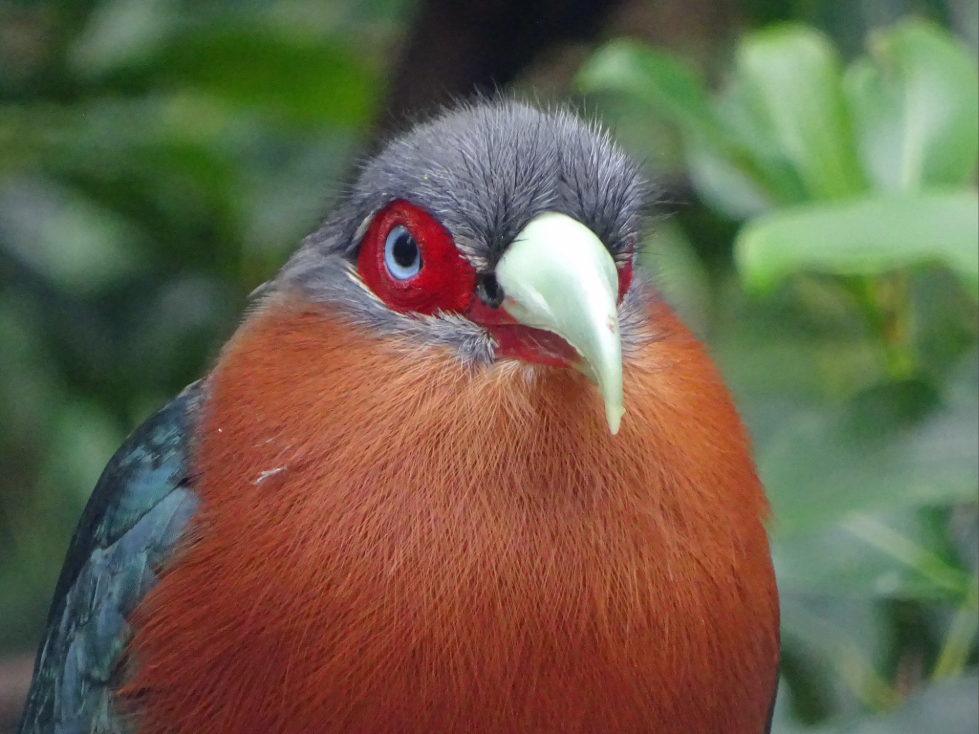
Figure 17. This Chestnut-breasted Malkoha, Phaenicophaeus curvirostris, is showing its namesake plumage and curved bill (curvirostris).
When a pair of Chestnut-breasted Malkohas lived in the San Diego Zoo’s Owens Aviary, you would have been able to identify them among all the birds there, based on the name alone. The crimson of the bare skin extends out to the lower mandible of the bill, contrasting with the pale yellow of the curved upper mandible. Surrounding the crimson skin are dark gray feathers, which cover the top of its head and extend down the back of its neck.
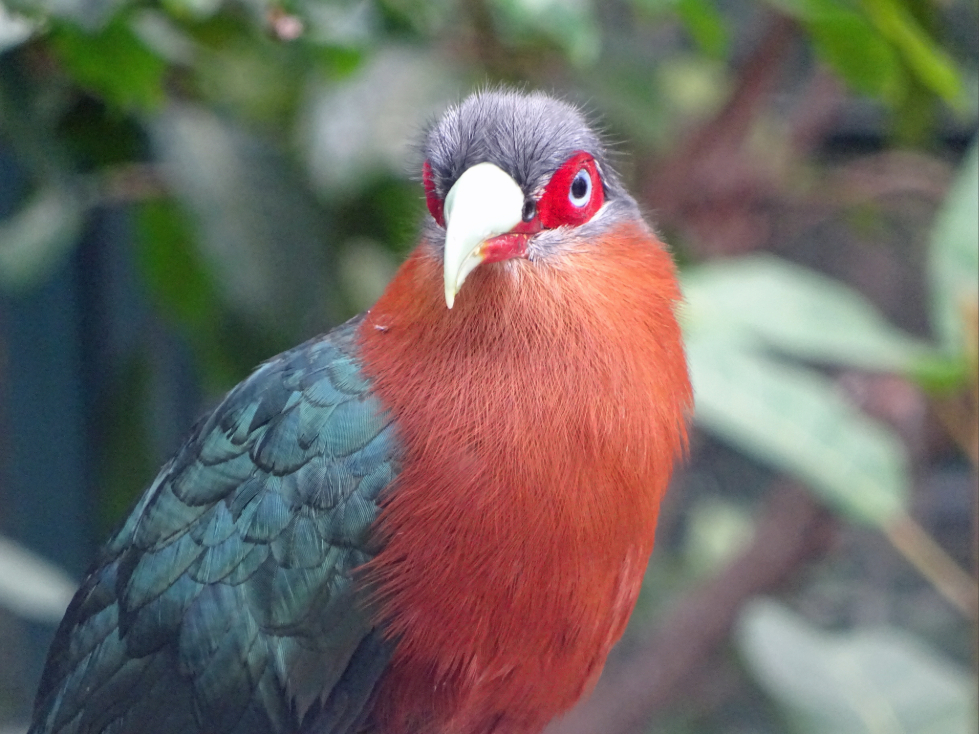
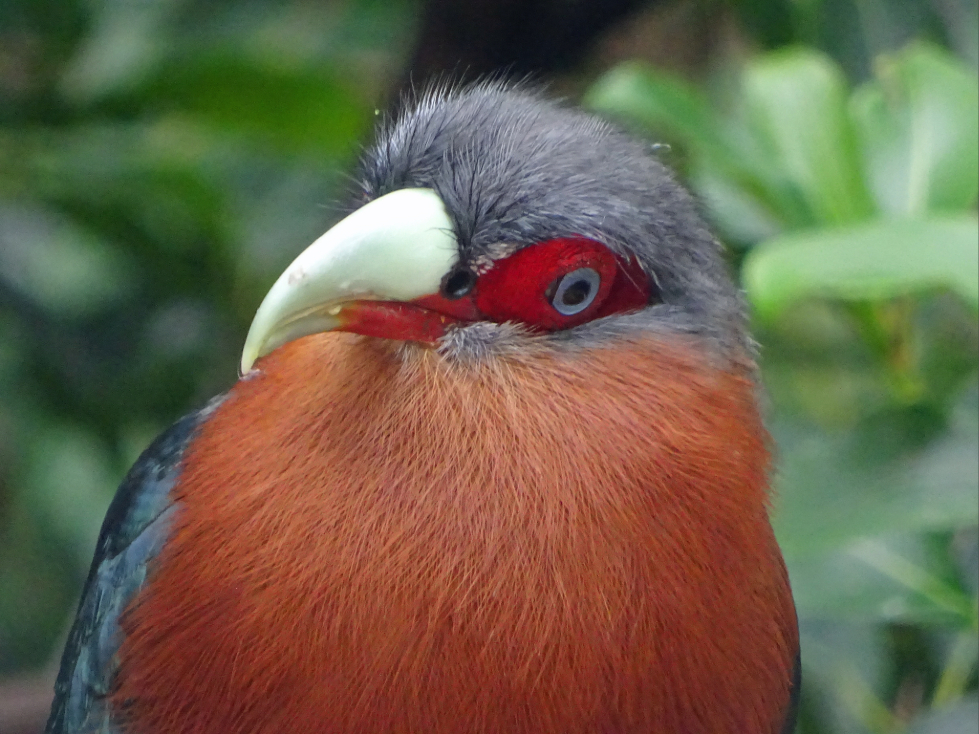
Figure 18a,b. This photogenic Chestnut-breasted Malkoha is posing to show the distinctive coloring of its bare skin and its exquisite plumes, including the thin dark-gray stripe of feathers beneath its eyes, complementing its crown.
Below its curved bill (“curvirostris”) begin its namesake chestnut feathers of its breast and much of the belly. The top of the back and wings glisten with forest-green iridescence, as does the beginning portion of the tail. Both the ends of the tail feathers and the underwings continue the chestnut coloration. Black feathers are at the bottom of the belly, extending backward through the undertail coverts. Legs, feet, and toes are dark gray. Few data are available regarding molting.
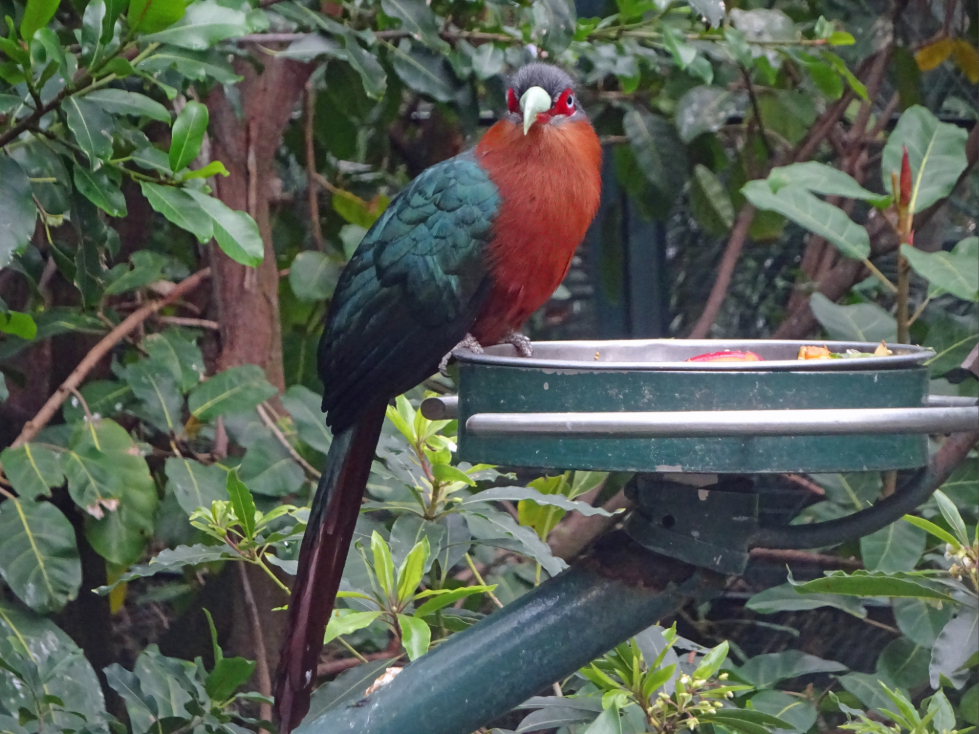
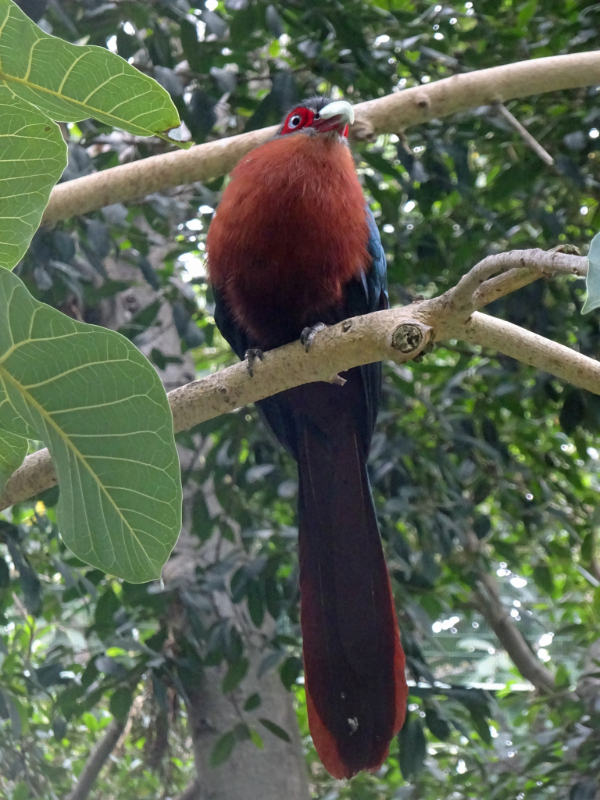
Figure 19a,b. Different angles reveal different aspects of this Chestnut-breasted Malkoha’s plumage, with the iridescent green glistening only from some points of view.
Keen observers may note a subtle difference between males and females, in that on females, the gray stripe is slightly wider and also extends under her chin. The irides (1 iris, 2 irides) of both sexes may be pale blue, white, or gray; in females, the iris is surrounded by a yellow, cream, or red outer ring; in males, the ring may be paler than the iris.
Among the various subspecies of this species, in some subspecies, females are slightly heavier than males, and in others, they’re slightly lighter than males. The weight range across the various subspecies is from 4.7 ounces (134g, lightest bird of lightest subspecies) to 6.7 ounces (190g, heaviest bird of heaviest subspecies). For comparison, Blue Couas weigh about 7.9–9.5 ounces, and Crested Couas weigh about 5 ounces. With a bill-to-tail length of 16.5–19.7″ (42–50 cm), they’re comparable to Blue Couas (18.9–19.7″) and longer than Crested Couas’ 15–17″. Like other Cuculidae, their tails (9.4–11.4″ long) are quite a bit longer than their wings (6.2–7.2″ long). Their bill length (1.5–1.6″, 3.7–4.2 cm) is comparable to the length of their tarsus (1.4–1.75″, 3.6–4.5 cm, ankle to toes).
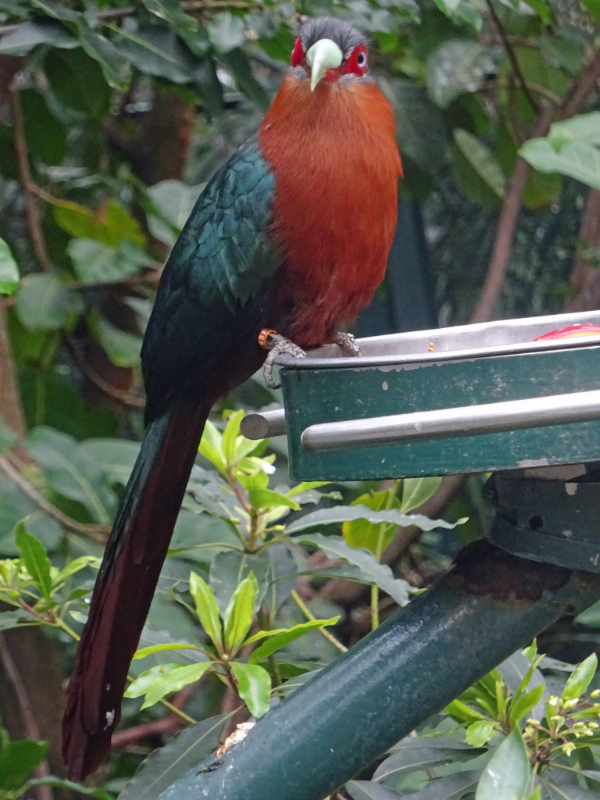
Figure 20a,b. The Chestnut-breasted Malkoha is biggish for a bird but midsize for a cuckoo. The Little Bronze Cuckoo, the smallest, weighing 0.6 ounces (17 g), is 6″ long (15 cm, bill to tail); the Channel-billed Cuckoo, the largest, weighing 22 ounces (630 g), is 25″ long (63 cm). Like most cuckoos, a big part of the malkoha’s length is its tail, which it uses not only for navigation, but also for balance.
The various subspecies of this species also differ in plumage coloration, facial coloration, tail pattern, and nostril shape. Most observers might not notice these subtle differences, except that different subspecies tend to be distributed in different geographic areas across southeast Asia (e.g., Myanmar, Thai-Malay Peninsula) and several Pacific Islands (e.g., Java, Bali, Borneo, Sumatra, Palawan Philippines). To see a map of the range of this species, visit https://xeno-canto.org/species/Phaenicophaeus-curvirostris , where you can also listen to a variety of calls made by this species. (You may notice that there are fewer recordings listed here, and this species has a reputation for being less chatty than many other species of Cuculidae.) Two of my favorites are https://xeno-canto.org/822197, in which you hear a chick begging followed by an adult making a call that sounds sort of like a human popping its cheek, and https://xeno-canto.org/539803, with an adult singing to its mate.
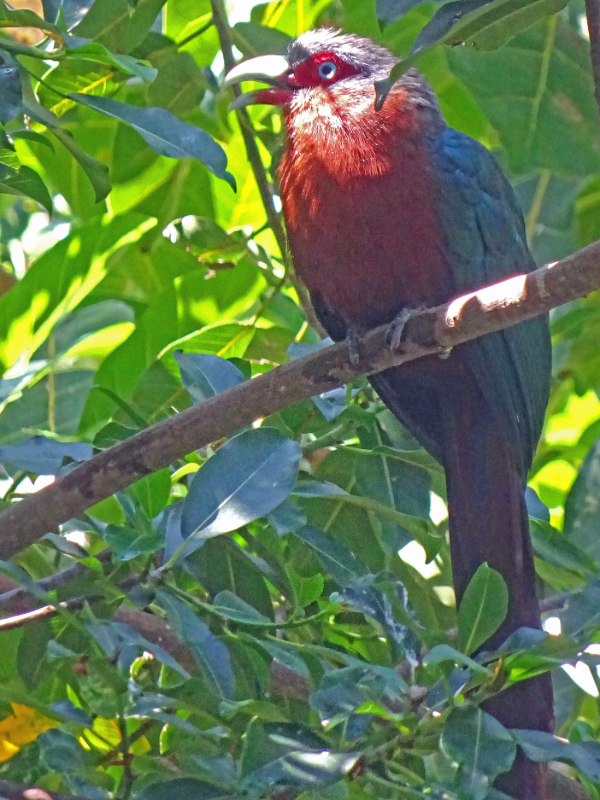
Figure 21. Though not as chatty as some other cuculids, Chestnut-breasted Malkohas can produce a variety of fascinating vocalizations.
Like most other Cuculidae, this species prefers woodlands (tropical or subtropical), but it’s eclectic in its choices, inhabiting lowland forests, scrublands, thickets, peatswamp forests, mangroves, and even plantations (e.g., citrus, cocoa, rubber), grasslands, and gardens if enough trees are available. Wherever they’re found, they prefer the dense foliage in the middle story, and they don’t migrate.
Though more data and observations are needed, it’s known that this malkoha also enjoys a varied diet of
- insect adults and larvae (especially caterpillars), spiders,
- small vertebrates (e.g., lizards, frogs, small snakes, crabs, and even baby birds),
- and fruits (especially figs).
Figure 22a,b. These Chestnut-breasted Malkohas are demonstrating the three key elements to their diet: (a) While one is chomping on a mouse, the other swoops in to grab a cricket; (b) and this malkoha is enjoying a fruit — yes, green beans are fruits (seeds + pulp + skin = fruit, though you might not want them in your fruit salad).
In Avibase, the proportions are given as 70% invertebrates, 20% land vertebrates, and 10% fruits. This malkoha scampers through trees, swinging its long tail. Sometimes, it pauses, perching motionless, looking for prey. While foraging, it often joins mixed-species flocks. When not eating or looking for food, they may be seen bathing or sunbathing.
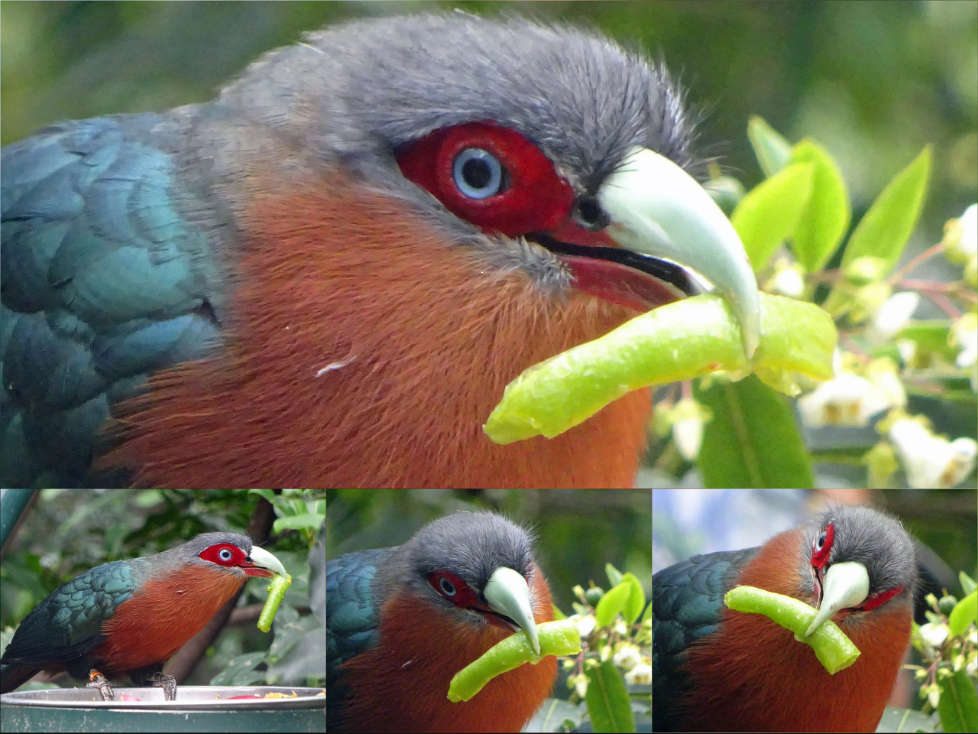
Figure 23. This Chestnut-breasted Malkoha can easily find food in an aviary at the San Diego Zoo; this tray alone offers a choice of insects, freshly thawed mice, and fruits — including this favorite — green beans.
Like most members of the Cuculidae family and like all other malkohas, this species builds its own nest, incubates its own eggs, and raises its own young. This species has not been widely studied, however, and much of what we know relies on observational anecdotal evidence. Apparently, both parents participate in building a thick platform nest in the fork of a tree or at least a tall bush. The nest, made of twigs and lined with leaves, is quite thick, with its outer dimensions 13.8″ (35 cm) across and 5.1″ (13 cm) deep, but its interior 4.3″ (11 cm) across and just 2″ (5 cm) deep. The male continues to contribute nest material even after the female lays the first plain white chalky-textured egg (of typically two or three).
Both parents incubate the eggs for at least 13 days, but the exact length of incubation hasn’t been well documented. Each hatchling has hair-like black down and a red gape. Both parents feed the nestlings and remove excrement and detritus from the nest. The length of time caring for the hatchlings isn’t known, but it may be about 11 days. Once parents start delivering larger prey to their young, they can make less frequent foraging forays. Juveniles have chestnut (rufous) throat and breast, tinged slightly purplish, with black abdomen and undertail-coverts. Their tail feathers are less colorful and narrower than those of adults. The juvenile’s black bill isn’t yet curved, and its irides are dark brown, lightening over time.
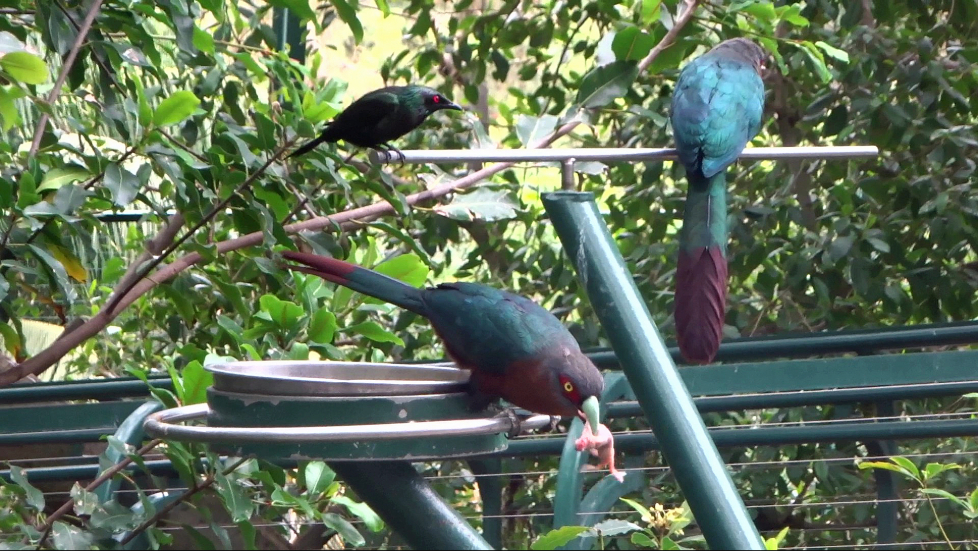
Figure 24. Like most other cuculids, these Chestnut-breasted Malkohas share in parenting duties, incubating the eggs and protecting and feeding their young. When the nestlings are able to handle bigger prey items, the parents can deliver those items less frequently than they did the smaller food items.
The Chestnut-breasted Malkoha has an IUCN Red List conservation status of LC, Least Concern. It’s not globally threatened and it’s common across many of the locations in its range. Some concerns have been raised regarding selective logging, however.
The age at first breeding is about 1.8 years, and the average generation length is 4.5 years. The annual survival rate for adults is 77%. The maximum recorded age is 11.8 years, but the typical lifespan seems to be much shorter; more research is needed.
The Cornell Lab of Ornithology’s eBird website (https://ebird.org/species/chbmal2 ) and app have received 12,660 observations of this species, 1327 with photos, and 16 with audio recordings. The lab’s Macaulay Library (https://search.macaulaylibrary.org/catalog?taxonCode=chbmal2 ) has received 2,079 photos, 18 audio recordings, and 19 videos of this species. The iNaturalist website (https://www.inaturalist.org/observations?taxon_id=73186 ) and app have received
964 observations of this species.
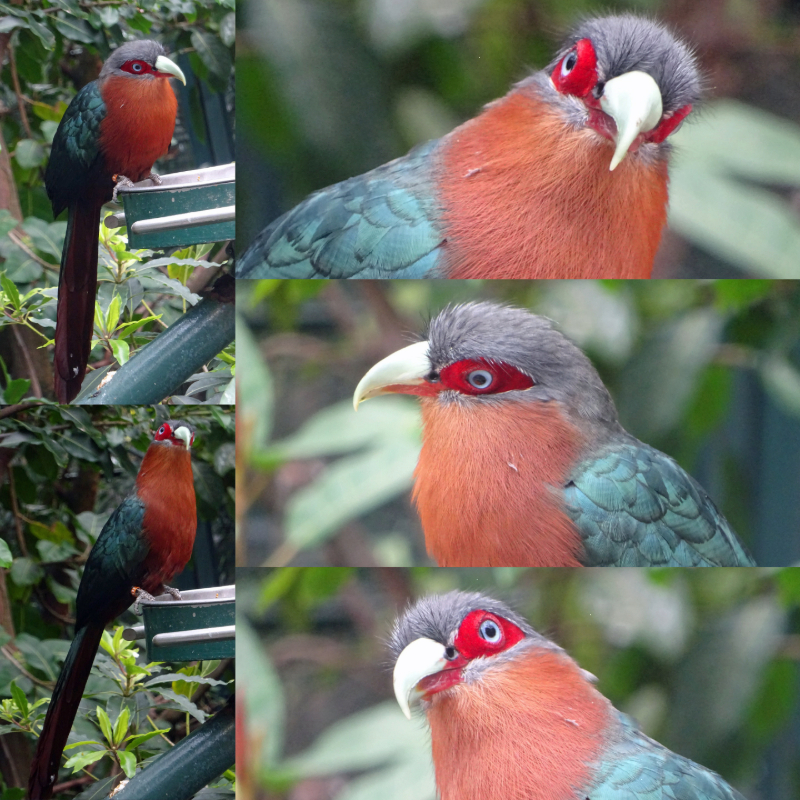
Figure 25. The Chestnut Malkoha is both more common and more widely observed than the Blue Coua and the Crested Coua, combined, as indicated by both their number of eBird observations and the number of photos in the Macaulay Library for these species. Though my photos don’t do it justice, you can see why this bird is so admired for its beauty.
Another Cuckoo: Greater Roadrunner, Geococcyx californianus
The Geococcyx genus has just two species: Lesser Roadrunner, Geococcyx velox, and Greater Roadrunner, Geococcyx californianus. The genus name, Geococcyx, comes from Greek, geo-, “ground” or “Earth,” and kokkyx (Latin coccyx), “cuckoo.” The common name is self-explanatory for this terrestrial genus. The species name for the Greater Roadrunner, californianus, refers to where the type specimen was found. Perhaps you’re already familiar with a cartoon version of this species, as the nemesis of Wile E. Coyote (since 1949). The road-running image isn’t far from this bird’s natural behavior.
I didn’t find any “beep, beep” vocalizations on https://xeno-canto.org/species/Geococcyx-californianus , but this roadrunner does produce a variety of sounds, such as bill snaps (https://xeno-canto.org/542593 ), chirp and bill clattering (https://xeno-canto.org/815026 ), a whooping call (https://xeno-canto.org/884929 ), a whining song (https://xeno-canto.org/324296 ), distinctive chirping with other vocalizing (https://xeno-canto.org/179226 ), and many more (5 full pages of vocalizations are available).
You may have seen social-media images of this roadrunner thrashing a rattlesnake senseless, and this opportunistic predator can do likewise with other snakes, lizards, rodents, bats, and even birds. It catches live prey then smacks the heck out of it on a hard surface to ensure it’s dead before eating it. It supplements its diet of vertebrates with invertebrates such as spiders, scorpions, and insects. NOT observed to mess with coyotes, however.
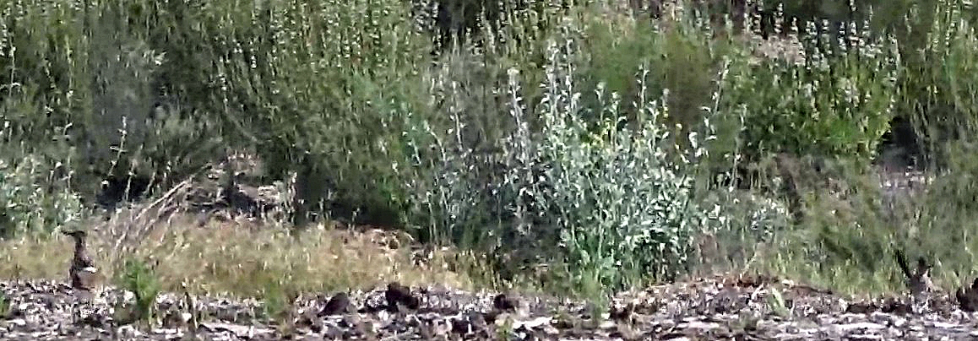
Figure 26. Greater Roadrunners have long legs — suited for running — long tails, and cryptic (camouflaged) plumage, so they blend into the scrubby habitats they prefer. (You have my apologies for my poor photography and videography, taken with my 2016 cellphone.)
Like most other Cuculidae family members, Greater Roadrunners are monogamous. These roadrunners even form and maintain long-term pair bonds, and the pair works together to defend a large territory. Each breeding season (spring and summer), they engage in elaborate courtship displays to renew their bond, including ceremonial offerings of nesting materials and food given to the female by the male.
The pair chooses a nest location with full shade, with dappled sunlight, or at least where shade covers the nest during the hottest part of the day, then they work together to build the nest. The male provides most of the materials (twigs plus soft lining materials) and the female does most of the actual construction work. Eventually, the nest is about 12″ (or perhaps larger) across and about 6–8″ deep from the outside, 2–4″ deep on the inside. Once nest construction is mostly completed, the female lays 3–6 light smooth chalky ovular eggs. Both parents develop a brood patch, and as soon as the first egg is laid, both parents start incubating the eggs. The incubating parent won’t get off the nest until the second parent arrives to take over. The male incubates at night, as well as some of the day, and the female incubates for longer stretches during the day. Parents position themselves to provide maximal shade during the daytime, and the egg temperature is constant 24/7 throughout the incubation period, which lasts about 19–20 days.
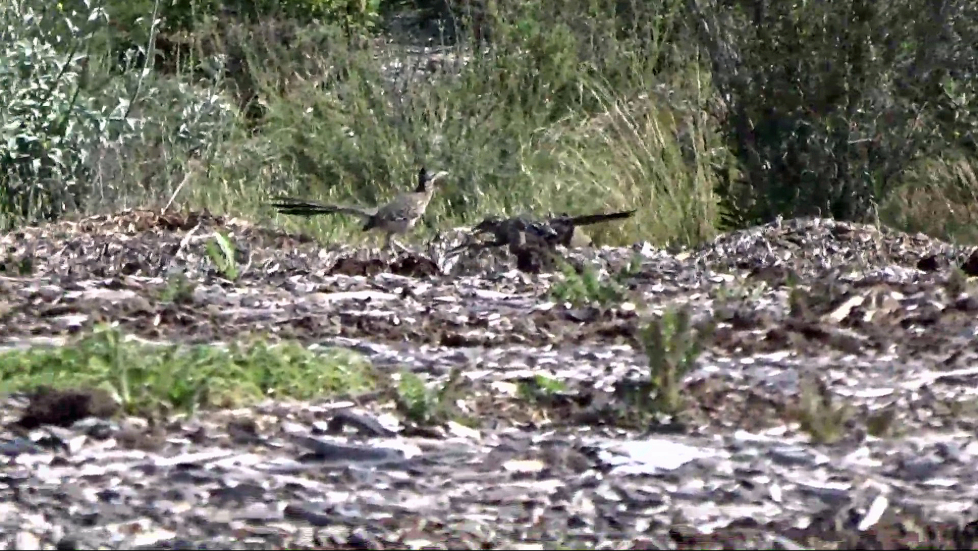
Figure 27. San Diego’s Mission Trails Grasslands offer plenty to eat for families of Greater Roadrunners.
Like other Cuculidae hatchlings, they’re altricial on hatching, but they’re strong, active, and eager to be fed. Their small size and their sparse feathers on black skin is eyecatching, but what’s most noteworthy about hatchlings is their bright red-and-white palate, tongue, and mouth — see https://sites.tufts.edu/babybirds/bird/greater-roadrunner/ . Parents start by feeding them insects, then as the chicks mature, the parents start feeding them small vertebrates, as well. During the first 14 days, the parents directly insert regurgitated or shredded food into the nestling’s mouth.
Within 14 days, most of the chicks’ feathers have emerged, except their flight feathers (primaries, secondaries, rectrices), and adult plumage patterns start appearing. By this time, they have been moving around on their disporportionately huge legs and toes. In another 2 days, they’re running with long strides, preening a bit, clacking their bills, bobbing their tails, and raising their head crests. They can even pick up and swallow some food items with their bills. During this time, both parents are attentive and regularly deliver food, but they may leave chicks alone more of the time. Because reptiles are more active between about 7 a.m. and 1 p.m., that’s when parents do most of their foraging and food delivery.
Figure 28. Please do NOT turn up the volume on this video, or you’ll be listening to the ramblings of a novice birder and her pal. We didn’t realize that the first roadrunner was feeding the second one, probably a youngster, at the time.
Life can be brutal as a roadrunner hatchling. From time to time, a “parent may inspect chicks by picking them up by the head. Overly lethargic nestlings that do not beg for food are tossed into air and swallowed whole by the parent, or fed to a stronger nestling” (Hughes, Birds of the World). These unsympathetic parents are quite sanitary, though, either eating the hatchlings’ fecal sacs or carrying them far from the nests (at least 100 feet / 30 m).
About 14–25 days after hatching, the youngsters fledge and leave the nest, sometimes prompted by parents who offer them food at increasingly distant locations. If a youngster falls from the nest prematurely, parents coax it to protective cover then continue to feed it as long as they feed the youngsters still in the nest. After fledging, the young continue to get some food from their parents, and as needed, they’re guided to safer locations, such as under cover. By about 21 days of age, the fledglings can catch some slow-moving prey, but they still get food from their parents until they’re about 30–40 days old and can feed themselves entirely. Parents also tutor their young on how to handle prey, beating it in front of the young and prompting them to copy that behavior.
Figure 29. Do you have suggestions regarding what this Greater Roadrunner is doing? Killing its prey, pulling apart prey, feaking its bill, or just probing a mysterious object? Please let me know your thoughs. I’m clueless. I realize that the appallingly poor videography doesn’t help at all.
Anecdotes suggest that some Greater Roadrunners have been brood parasites, at least in the nests of fellow Greater Roadrunners, and perhaps in the nests of other species. Adequate data are lacking.
Greater Roadrunners have an IUCN Red List conservation status of LC, Least Concern. In some localities, they’re threatened by hunters who falsely believe that roadrunners are killing quail that the hunters want to kill for themselves. Near agricultural areas, they’re threatened by pesticides and other contaminants; near roads, they’re threatened by vehicle collisions; and in many places, habitat destruction, fragmentation, and degradation imperils them.
The Cornell Lab of Ornithology’s eBird website (https://ebird.org/species/greroa ) and app have received 411,300 observations of this species, 30,725 with photos, and 582 with audio recordings. (The range map there shows how widely this species has spread across the southwestern United States west of the Mississippi River and into Mexico.) The lab’s Macaulay Library (https://search.macaulaylibrary.org/catalog?taxonCode=greroa ) has received 55,467 photos, 699 audio recordings, and 212 videos of this species. The iNaturalist website (https://www.inaturalist.org/observations?taxon_id=1986 ) and app have received
37,468 observations of this species.
References
Cuculiformes, Cuculidae
- Elphick, Jonathan. (2014). “Cuckoos, Cuculidae” (pp. 387–389). The World of Birds. Buffalo, NY: Firefly Books.
- Lovette, Irby, & John Fitzpatrick (eds.), (2016). “Cuculiformes” (p. 97). The Cornell Lab of Ornithology Handbook of Bird Biology (3rd ed.). Hoboken, NJ: Wiley.
- Winkler, David W., Shawn M. Billerman, and Irby J. Lovette. (2015). “Cuculiformes” (pp. 97–100). Bird Families of the World: An Invitation to the Spectacular Diversity of Birds. Barcelona: Lynx, Cornell Lab of Ornithology.
- Winkler, D. W., S. M. Billerman, and I. J. Lovette (2020). Cuckoos (Cuculidae), version 1.0. In Birds of the World (S. M. Billerman, B. K. Keeney, P. G. Rodewald, and T. S. Schulenberg, Editors). Ithaca, NY: Cornell Lab of Ornithology. https://doi.org/10.2173/bow.cuculi1.01
- https://en.wikipedia.org/wiki/Cuckoo
Couas
- https://en.wikipedia.org/wiki/Coua
- Crested Coua
- Kirwan, G. M., R. B. Payne, J. del Hoyo, and N. Collar (2020). Crested Coua (Coua cristata), version 1.1. In Birds of the World (S. M. Billerman, B. K. Keeney, and T. S. Schulenberg, Editors). Ithaca, NY: Cornell Lab of Ornithology. https://doi.org/10.2173/bow.crecou1.01.1
- https://avibase.bsc-eoc.org/species.jsp?avibaseid=FCAB4323
- https://avibase.bsc-eoc.org/species.jsp?lang=EN&avibaseid=FCAB43238B5B65A1&sec=lifehistory
- https://ebird.org/map/crecou1
- https://en.wikipedia.org/wiki/Crested_coua
- Blue Coua
- Payne, R. B., and G. M. Kirwan (2020). Blue Coua (Coua caerulea), version 1.0. In Birds of the World (J. del Hoyo, A. Elliott, J. Sargatal, D. A. Christie, and E. de Juana, Editors). Ithaca, NY: Cornell Lab of Ornithology. https://doi.org/10.2173/bow.blucou1.01
- https://avibase.bsc-eoc.org/species.jsp?avibaseid=B569EDF7
- https://avibase.bsc-eoc.org/species.jsp?lang=EN&avibaseid=B569EDF797B139CB&sec=lifehistory
- https://ebird.org/species/blucou1
- https://en.wikipedia.org/wiki/Blue_coua
Chestnut-breasted Malkoha (Phaenicophaeus curvirostris)
- Kirwan, G. M., R. B. Payne, J. del Hoyo, and N. Collar (2024). Chestnut-breasted Malkoha (Phaenicophaeus curvirostris), version 2.1. In Birds of the World (B. K. Keeney, Editor). Ithaca, NY: Cornell Lab of Ornithology. https://doi.org/10.2173/bow.chbmal2.02.1 . https://birdsoftheworld.org/bow/species/chbmal2/cur/introduction
- https://avibase.bsc-eoc.org/species.jsp?avibaseid=ABE1621C
- https://avibase.bsc-eoc.org/species.jsp?lang=EN&avibaseid=529F2C76AB39CE35&sec=lifehistory
- https://ebird.org/species/chbmal2
- https://en.wikipedia.org/wiki/Malkoha
- https://en.wikipedia.org/wiki/Chestnut-breasted_malkoha
Greater Roadrunner (Geococcyx californianus)
- Hughes, J. M. (2020). Greater Roadrunner (Geococcyx californianus), version 1.0. In Birds of the World (A. F. Poole, Editor). Ithaca, NY: Cornell Lab of Ornithology. https://doi.org/10.2173/bow.greroa.01 . https://birdsoftheworld.org/bow/species/greroa/cur/introduction
- https://ebird.org/species/greroa
- https://en.wikipedia.org/wiki/Greater_roadrunner
- https://en.wikipedia.org/wiki/Roadrunner
- https://sites.tufts.edu/babybirds/bird/greater-roadrunner/
Other Cuckoos
- Ani, genus Crotophaga — Crotophaga, 3 species, comprising Greater Ani, Crotophaga major; Smooth-billed Ani, Crotophaga ani; Groove-billed Ani, Crotophaga sulcirostris
- Bowen, B. S. (2020). Groove-billed Ani (Crotophaga sulcirostris), version 1.0. In Birds of the World (A. F. Poole and F. B. Gill, Editors). Ithaca, NY: Cornell Lab of Ornithology. https://doi.org/10.2173/bow.grbani.01
- Quinn, J. S. and J. M. Startek-Foote (2020). Smooth-billed Ani (Crotophaga ani), version 1.0. In Birds of the World (A. F. Poole and F. B. Gill, Editors). Ithaca, NY: Cornell Lab of Ornithology. https://doi.org/10.2173/bow.smbani.01
- Riehl, C. (2020). Greater Ani (Crotophaga major), version 1.0. In Birds of the World (T. S. Schulenberg, Editor). Ithaca, NY: Cornell Lab of Ornithology. https://doi.org/10.2173/bow.greani1.01
- Channel-billed Cuckoo (Scythrops novaehollandiae)
- Payne, R. B. (2020). Channel-billed Cuckoo (Scythrops novaehollandiae), version 1.0. In Birds of the World (J. del Hoyo, A. Elliott, J. Sargatal, D. A. Christie, and E. de Juana, Editors). Ithaca, NY: Cornell Lab of Ornithology. https://doi.org/10.2173/bow.chbcuc2.01 https://birdsoftheworld.org/bow/species/chbcuc2/cur/introduction .
- https://en.wikipedia.org/wiki/Channel-billed_cuckoo
Etymology
- Lederer, Roger, and Carol Burr. (2014). Latin for Bird Lovers: Over 3,000 Bird Names Explored and Explained (224 pages). Portland, OR: Timber Press.
- Gotch, A. F. [Arthur Frederick]. Birds—Their Latin Names Explained (348 pp.). Poole, Dorset, U.K.: Blandford Press.
- Gruson, Edward S. (1972). Words for Birds: A Lexicon of North American Birds with Biographical Notes (305 pp., including Bibliography, 279–282; Index of Common Names, 283–291; Index of Generic Names, 292–295; Index of Scientific Species Names, 296–303; Index of People for Whom Birds Are Named, 304–305). New York: Quadrangle Books.
- https://en.wikipedia.org/wiki/Malagasy_language
- https://en.wikipedia.org/wiki/Tupi_language
- rectrix, rectrices, https://www.merriam-webster.com/dictionary/rectrix
Text and images by Shari Dorantes Hatch. Copyright © 2026. All rights reserved.
 Bird Brain

Leave a comment