
Herons, Egrets, and Bitterns
The order Pelecaniformes includes the heron family, Ardeidae, as well as four other bird families: Pelecanidae, pelicans (DUH!); Threskiornithidae, ibises and spoonbills; the one-species family Scopidae, Hamerkop; and the one-species family Balaenicipitidae, Shoebill (“Stork”). Herons also have similarities with two other wading-bird families: Gruidae, cranes (6 genera, 15 species; order Gruiformes); and Ciconiidae, storks (6 genera, 20 species; order Ciconiiformes).
Figure 01. These three herons — Tricolored Heron, Little Blue Heron, and Snowy Egret — clearly resemble one another in appearance and in foraging style; they also belong to the same genus of herons, Egretta. In contrast, the Marbled Godwit (a sandpiper) and the Black-bellied Plover look and behave differently.
According to the Cornell Lab of Ornithology’s Birds of the World (subscription) website, Ardeidae — the family comprising herons, egrets, and bitterns — includes 72 species of birds, within 18 genera (plural; genus, singular). Of the four subfamilies of Ardeidae, the subfamily Ardeinae includes the herons with which we are most familiar. These widespread, typical herons include 16 species in the Ardea genus (e.g., Great Egret, Ardea alba; Great Blue Heron, A. herodias; Western Cattle-Egret, A. ibis; and Goliath Heron, A. goliath); the 12 species of Egretta egrets (e.g., Reddish Egret, Egretta rufescens; Little Blue Heron, E. caerulea; Tricolored Heron, E. tricolor; and Snowy Egret, E. thula); the two widespread Nycticorax night herons (e.g., Black-crowned Night Heron, Nycticorax nycticorax); and the solitary surviving species of Nyctanassa night herons (i.e., Yellow-crowned Night Heron, Nyctanassa violacea).
Other genera with which we may be familiar are 2 of the 14 bittern species of the genus Botaurus (e.g., Least Bittern, Botaurus exilis; American Bittern, B. lentiginosus); 1 of the 2 species of Butorides (e.g., Green Heron, Butorides virescens); or any of the 6 species of Ardeola pond herons (e.g., Malagasy Pond-Heron [aka Madagascar Pond-Heron], Ardeola idae; Javan Pond-Heron, A. speciosa).
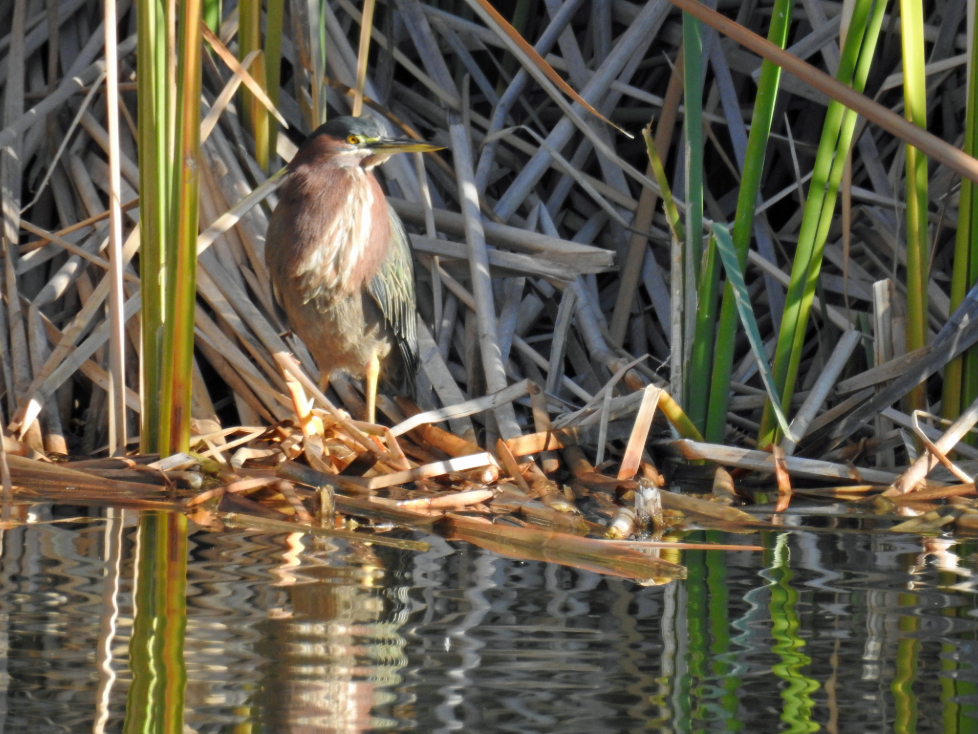
Figure 02. Despite their exquisite colors, Green Herons seem to blend into their reedy environments. Green Herons are also among the few species of birds who use tools, providing lures to attract fish to within reach.
Description
Though many herons literally stand out for us to see, a few are more skulky, with cryptic plumage that’s hard to spot. Heron sizes range widely, from the diminutive Least Bittern to the ginormous Goliath Heron. Their length (bill to tail) ranges from 27 to 150 cm (11–59 inches — a little less than 1–5 feet), wingspan from 40 to 150 cm (16–90 inches, 1.3–7.5 feet), and their weight ranges from 100 to 4,500 g (3.5 oz–158.4 oz. — about as much as a ripe plum to almost 10 pounds).

Figure 03. The San Diego Zoo’s Safari Park hosts the world’s largest heron species, the Goliath Heron, aptly named at almost 5 feet long, with a wing span of 7.5 feet, and weighing nearly 10 pounds— hefty for a bird!
All heron species have long, broad wings and very short tails. Nonetheless, heron shapes vary somewhat, with bitterns, night herons, and pond herons having relatively shorter and more compact bodies, with thicker necks, and shorter bills and legs, whereas most Egretta and Ardea herons have relatively long slender bodies, with long necks, legs, and bills. Among the long-necked herons, many typically hold their necks in an “S” shape much of the time.
Plumage colors vary widely, too. Some Egretta, Ardea, and Ardeola (pond) heron species are almost completely white; quite a few have striking combinations of greens, browns, rufous, reds, salmons, blues, and other colors; and many have mostly gray (from light to dark), grayish blue, or black plumage, perhaps with colorful accents. All herons (except four species of bittern) are sexually monomorphic, with female and male plumage looking alike. As breeding season approaches, some heron species display attention-grabbing plumes — such as the exquisite aigrette plumes (delicate sprays of feathers) on egrets or the lanceolate (tapering to a tip) plumes on the nape or head of night herons.
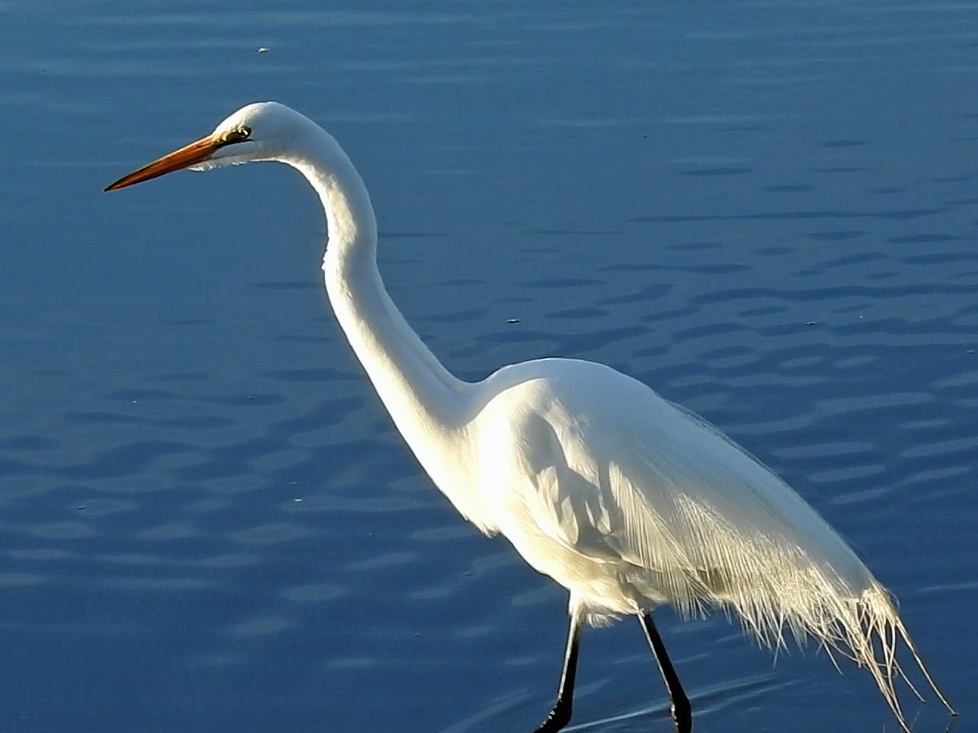
Figure 04. My photograph doesn’t fully capture the exquisite beauty of this Great Egret’s aigrette plumes during breeding season.
During courtship, many heron species’ unfeathered parts also brighten or even change colors, such as the iris (eyes), any bare facial skin, the bill, and the legs. Heron bills are long and pointed, occasionally two-toned, with a paler lower mandible and a darker upper one. Heron legs are long, too, with most species having quite long legs, for wading. Legs are bare from the knee down and mostly bare from the knee up. Legs may be dark or bright (e.g., yellow), or even dark with contrasting yellow toes. Toes are typically, long, anisodactyl (three pointing forward, one pointing backward), and readily support the birds on muddy, squishy, or vegetated ground. Their middle front toe has a pectinate (comblike) claw, for preening.
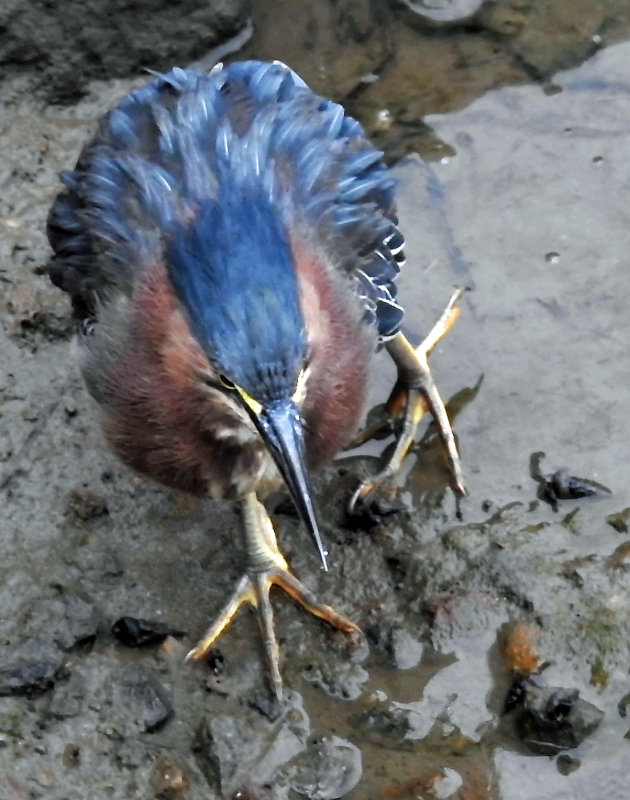
Figure 05. Like other herons, this Green Heron has long anisodactyl toes, with three pointing forward, one pointing backward, making it easier to walk on mud, vegetation, and other smooshy ground.
Heron vocalizations vary, and many are mostly quiet except at breeding sites. Some bittern species are distinguished by their ability to inflate the esophagus to produce loud booms. Herons also make sounds by clapping, snapping, or clattering their bills.
Habitat (and Migration)
A rare few heron species (e.g., Cattle Egrets) reside in dry habitats such as grasslands, but the vast majority prefer any type of wetlands: lakes, swamps, rivers, mangroves, seacoasts, and so on, on almost every continent (not Antarctica or the far Arctic north). Fresh water, salt water, brackish water, muddy water, any water will do. During most of the year, herons usually prefer open wetlands, but during the breeding season, most prefer trees or at least shrubs, for nesting — except bitterns, who prefer reedy marshes for hiding their nests. When herons roost or nest in trees, they can easily climb about or perch.
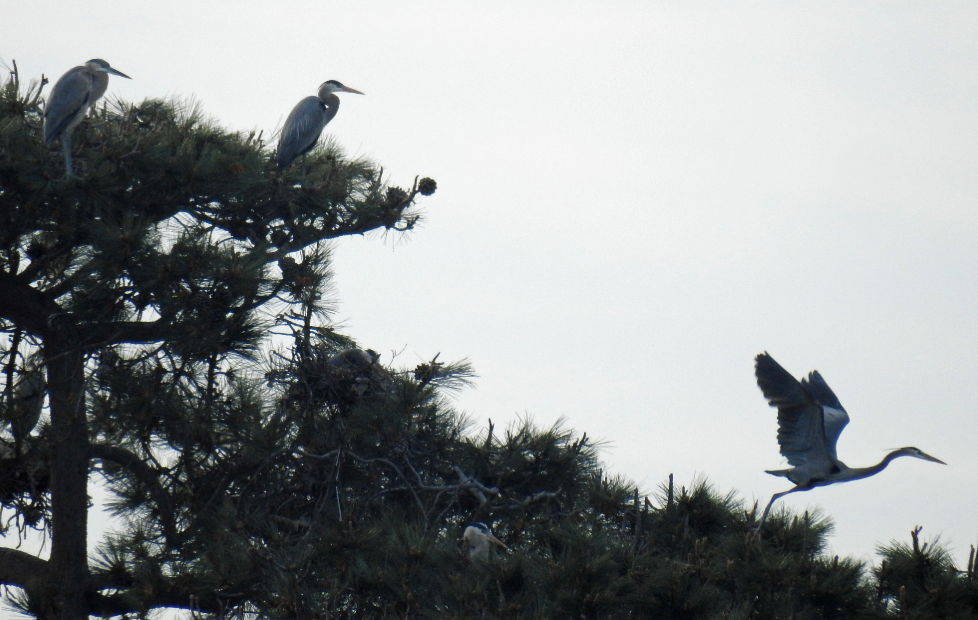
Figure 06. If you’re anywhere near a heron rookery, I highly recommend that you visit. You’ll be spellbound as you watch them fly in and out of roosts, climb along quivering branches, squeeze between foliage, or — best of all — raise their young in high-up nests.
As needed, some herons migrate to temperate locations with abundant food sources, but many species and populations stay put if the climate is mild and adequate food is available.
Flight
All but one species of heron flies with the neck retracted into an “S”-shaped coil near the body. Their legs, however, are extended backward, behind their short tails. Herons can maintain powered (flapping) flight for long distances, over long periods of time. Most of the larger species use slow wingbeats, whereas some of the smaller species (e.g., night herons and bitterns) have faster wingbeats.
Diet and Foraging
Food
Most herons eat aquatic vertebrates (fish, amphibians) and invertebrates (e.g., arthropods, molluscs). Some also eat other small terrestrial vertebrates (reptiles, mammals, birds — adults, eggs, young) and invertebrates (e.g., insects). Distinctively, Cattle Egrets specialize in insects, stirred up by livestock (e.g., cattle) or wild mammals.
Figure 07. This Great Egret doesn’t mind fishing alongside other herons, such as a Little Blue Heron and numerous Snowy Egrets.
Foraging
Heron bills can either spear their prey or grasp it. Most herons combine remarkable patience and stillness with lightning-quick speed and accuracy to capture prey. A few, however, dance about, chasing prey; others use their wings to shade their fishy prey; still others use their toes to stir and roust their prey. The Green Heron even uses lures to attract fish to within reach.
Though some heron species are usually solitary or in pairs, many often roost and feed together; food availability may affect whether a heron forages alone or with others.
Preening
For most areas of their bodies, herons can use their bills to preen their feathers, but for some spots — necks, heads, and so on — they need to use their toes. Luckily, the middle toe on each foot of each heron has a pectinate claw, which can facilitate preening. In addition, all herons produce “powder down” among their plumes, which they use for preening, helping to remove fish slime and other debris.
Figure 08. This immature Little Blue Heron is still almost all white until its adult, dark blue plumage comes in. Even so, it must preen its feathers, using mostly its bill, but also its toes.
Breeding
Most species of herons are monogamous, with both parents caring for their eggs and their young. Most also nest in colonies (as a collection of individual families), though some nest as solitary families. Typically, both parents work together to construct a nest of sticks (or other vegetation), in a tree or large shrub, located near water. Most herons have clutches of about 3 to 7 eggs (range: 1–10); eggs rarely have markings and are typically white or pale blue. Both parents incubate their eggs, typically about 14–30 days. Eggs are laid asynchronously (1 at a time over a period of days), and chicks hatch asynchronously, which can be problematic for the late-hatching chicks. Siblicide and parental neglect aren’t uncommon. Once the chicks hatch, both parents provide food to their young, who typically stay in the nest 25–90 days. Some parents continue to aid their young for a week or two after they fledge, as well.
Figure 09. In San Diego, the best place to see Cattle Egrets — especially Cattle Egret nestlings — is at the San Diego Zoo’s Safari Park (in Spring), where many nests are at eye level in one of the outdoor dining areas. These three nestlings seem to be amicably sharing a nest, but that isn’t always so for heron youngsters.
Conservation Status
Two thirds of heron species are noted as of Least Concern (LC), according to the IUCN (2024) Red List. Of the remaining third, 4.2% are considered Near Threatened (NT), 5.6% are Vulnerable (VU), 4.2% are Endangered (EN), and 1.4% are Critically Endangered (CR); others are now extinct or have unknown conservation status. Habitat destruction and fragmentation, as well as hunting by humans, continue to cause declines in population. (The San Diego Zoo was once home to the Endangered Malagasy Pond Heron and has continued to host many other endangered species.)
Resources
- Elphick, Jonathan. (2014). The World of Birds. Buffalo, NY: Firefly Books. (pp. 312–315)
- Winkler, D. W., S. M. Billerman, and I. J. Lovette (2020). Herons, Egrets, and Bitterns (Ardeidae), version 1.0. In Birds of the World (S. M. Billerman, B. K. Keeney, P. G. Rodewald, and T. S. Schulenberg, Editors). Cornell Lab of Ornithology, Ithaca, NY, USA. Published March 4, 2020. https://doi.org/10.2173/bow.ardeid1.01
- Threskiornithidae, Ibises and Spoonbills, https://birdsoftheworld.org/bow/species/thresk1/cur/introduction
- Scopidae, Hamerkop, https://birdsoftheworld.org/bow/species/scopid1/cur/introduction
- Balaenicipitidae, Shoebill, https://birdsoftheworld.org/bow/species/balaen1/cur/introduction
- Pelecanidae, Pelicans, https://birdsoftheworld.org/bow/species/peleca1/cur/introduction
- Order Gruiformes, Gruidae, Cranes, https://birdsoftheworld.org/bow/species/gruida1/cur/introduction
- Order Ciconiiformes, Ciconiidae, Storks, https://birdsoftheworld.org/bow/species/ciconi2/cur/introduction
Copyright 2025, text and photos, Shari Dorantes Hatch.
All rights reserved.

 Bird Brain
Leave a comment