
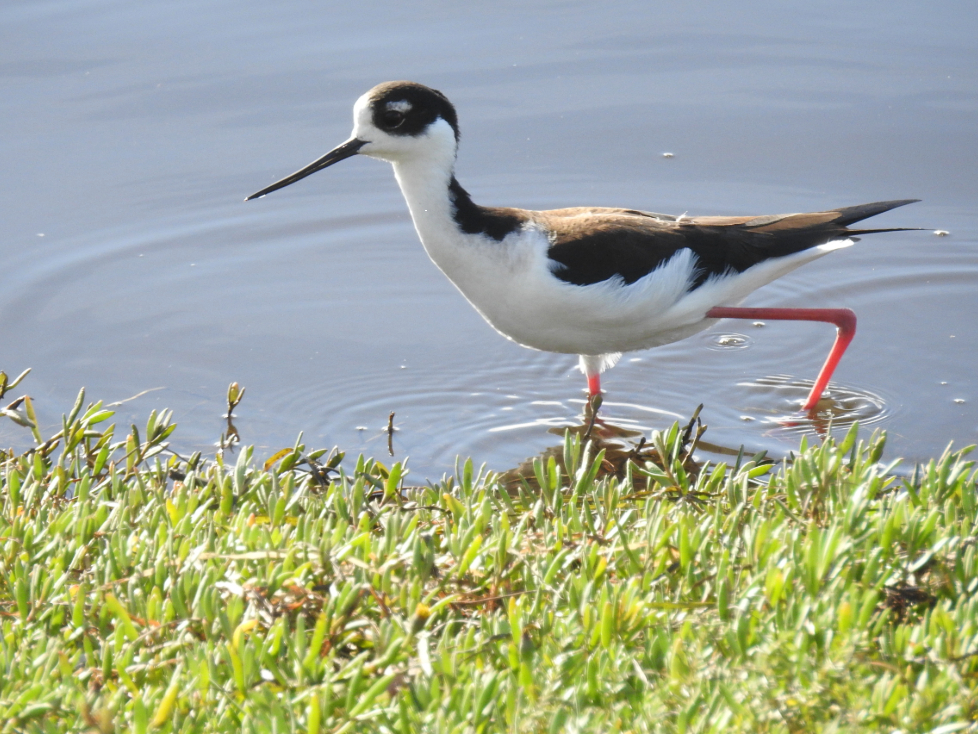
Black-necked Stilt, on the prowl, using various foraging strategies to find invertebrate prey, visually and tactilely.
To be able to fly swiftly without colliding into other birds or other objects, flying birds must see extraordinarily well. The following table indicates how speedily many shorebirds can fly; their exquisite vision saves lives. In addition, like other birds, shorebirds must be able to find prey and to avoid becoming prey, which superlative vision lets them do.

Table 01. San Diego’s shorebirds can reach some astonishing flight speeds for such tiny birds (6–23″ head to tail, 0.7–21 ounces).
In proportion to their body size, birds’ eyes are as big as possible. A bird’s heavy fluid-filled eyes, located at the front of the body, away from its center of gravity, would impair flight if they were any bigger. Even so, birds’ eyes fit so tightly in their skulls that birds can’t rotate their eyes in the sockets. (You can find a table listing length, wingspan, and weight measurements of common San Diego shorebirds at the end of this article, just before the list of resources used for this article.)

Figure 01. The eyes of Sanderlings and other birds are about as they can be for their size, so their eyes are fixed in their sockets, unable to rotate or swivel.
Luckily, however, birds’ highly flexible necks can swivel the head in almost any direction. Head movements can help birds assess their distance from an object. Birds can triangulate distances, and they can judge distance by how quickly objects seem to be moving in relation to their eyes; closer objects will seem to be moving faster than more distant ones. When foraging, birds often move their heads around to view potential food from different angles.

Figure 02. (a) A visual forager, this Spotted Sandpiper must turn its head to see well, but luckily, the necks of birds are highly flexible. In fact, (b) these American Avocets can comfortably turn their heads 180̊ to rest their heads and bills on their shoulders.
Birds’ eyes cram many more photoreceptor cells into their retinas than do human eyes, so birds have higher image resolution than we do. Their eye muscles also more swiftly adjust the curvature of the lens, contracting and dilating the iris, quickly accommodating changes in focal distance while moving. Each bird eye also has a pecten, a special structure to oxygenate and nourish the retina without having dense blood vessels that would obstruct vision.


Figure 03. (a) This Black Oystercatcher’s eyes have retinas jam-packed with photoreceptors enabling it to find prey through visual searching. (b) Its eyes are positioned on each side of its head, so it can easily spot prey on either side. Its pointed bill can stab into a bivalve, slice its muscle to keep it from closing, and grab the soft prey inside.
The location of a bird’s eyes shapes how it sees the world. Most shorebirds have one eye positioned on each side of the head; each eye faces the world sideways. This positioning offers shorebirds excellent panoramic sideways vision, to watch out for predators, among other things. This positioning also offers some forward vision, with limited depth perception, but no rearward vision. (The eyes of some ducks and other birds can see their own tails without moving their heads.) Each eye sends its own visual information to the brain, and some shorebirds sleep with one eye open, suggesting that half of the brain sleeps while the other half remains alert.
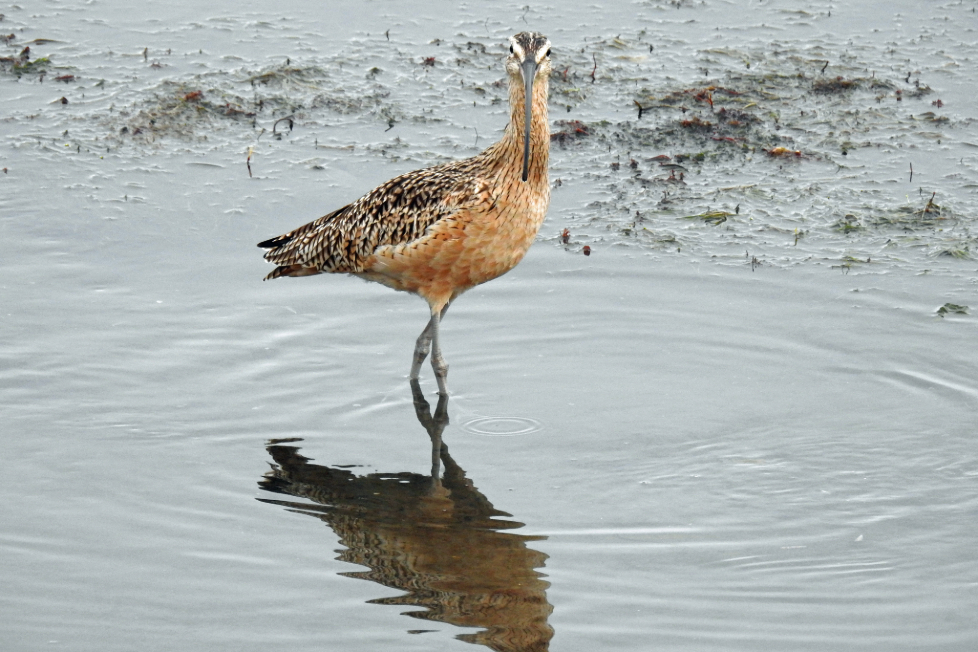

Figure 04. (a) This Long-billed Curlew, like other shorebirds, has its eyes positioned on each side of its head, offering it panoramic sideways vision but limited depth perception, so it must move its head to assess distances visually. (b) This Killdeer relies on vision to find prey; each of its eyes has a panoramic view of everything on each side, even without rotating either eye.
Photoreceptor cells come in two types: cones, which offer high visual acuity (sharp images) in bright light, and rods, which offer high visual sensitivity (detecting even dim images) in low light. The eyes of diurnal hunters are packed with many more cones than rods, so they can see extraordinarily well in bright light, but at dawn, dusk, and overnight, they can’t see much. The eyes of nocturnal hunters are packed with many more rods than cones, so they can see surprisingly well at dawn, dusk, and on moonlit nights, but they can’t see as well as diurnal hunters can in bright light. Most shorebirds forage during daytime, but some forage at dawn and dusk, some forage at night, and some forage any time of day or night. The types of photoreceptors they have allow for these differences.
Figure 05. Whimbrels rely on vision when hunting for prey. If they feed at night, they do so more slowly, in smaller areas, and finding prey at shorter distances than they do during the daytime. The Whimbrel usually inserts the tip of its bill into soft mud, only occasionally probing more deeply. (The Long-billed Curlew, seen toward the end of the clip, probes more deeply and uses touch, as well as vision, to find prey.)
The eyelids of most birds also look different from human eyelids. The top eyelid stays put, and the bottom lid closes upward. The outer eyelids close out light for sleeping, but to moisten, clean, and protect the eyes, birds have an extra pair of eyelids, translucent nictitating membranes, which move from the inner corner of the eye to the outer corner of the eye. Like human eyes, bird eyes also have lacrimal glands with tears that lubricate and nourish the cornea of the eyes.


Figure 06. (a) On most birds, such as this Great Blue Heron, the bottom eyelid closes upward, and the top eyelid doesn’t move. In addition, (b) most birds have a translucent nictating membrane, which moves from the inner corner of the eye to the outer corner of the eye.
Most shorebirds have cryptic plumage with rusty (rufous), brown, black, gray, or white feathers; cryptic plumage offers shorebirds great camouflage at any time of day. They don’t need the highly specialized color vision of birds who use brightly colored plumage to attract mates. (For information on color vision in birds, see https://bird-brain.org/2025/05/01/bird-sense-by-tim-birkhead/#1 )
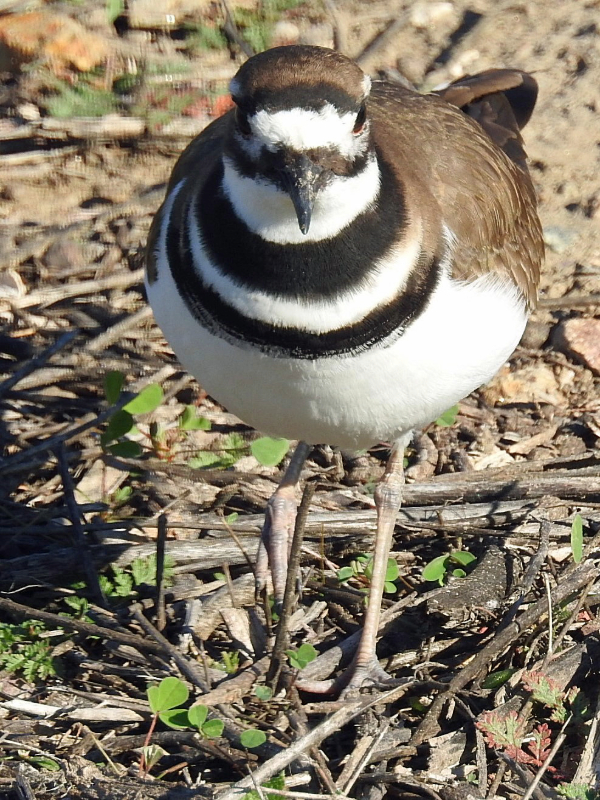

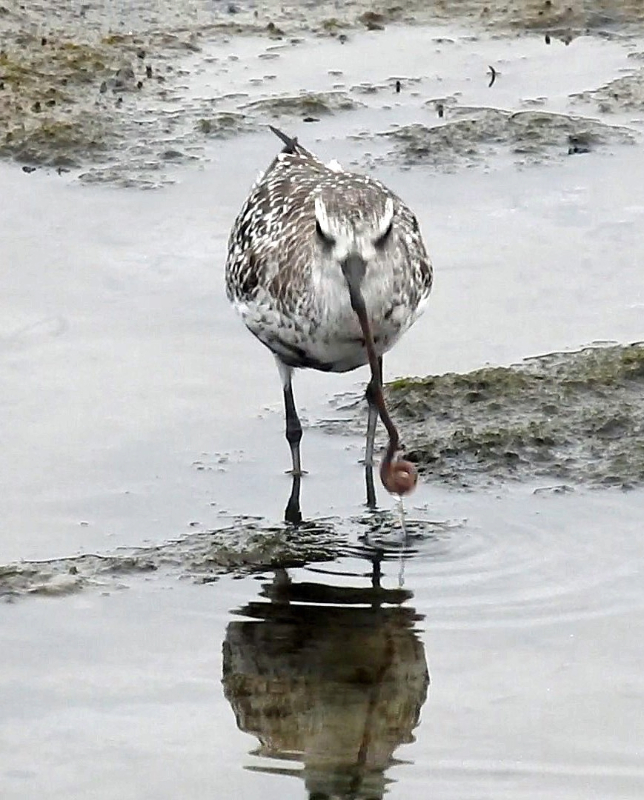
Figure 07. Here are a few of San Diego’s shorebirds who rely almost entirely on vision to find prey: three plovers — (a) Killdeer, (b) Semipalmated Plovers, and (c) Black-bellied Plover


plus (d) Black Turnstone and (e) Red-necked Phalaropes. Plovers, turnstones, and phalaropes all have distinctive ways of foraging, but each counts on being able to see its prey. All have cryptic plumage that enhances concealment from predators, rather than offering flashy courtship displays.
Shorebirds come in all sizes (and shapes), in addition to having many foraging styles.
Measurements of San Diego Shorebirds

Figure 08. Measurements of Common San Diego Shorebirds: length, wingspan, ounces. Based on information from the cellphone app, The Sibley eGuide to the Birds of North America.
Text and images by Shari Dorantes Hatch, Copyright © 2025. All rights reserved.
Resources
Books
- Elphick, Chris, John B. Dunning, Jr, & David Allen Sibley. (2001). The Sibley Guide to Bird Life & Behavior. New York: Alfred A. Knopf. (Illustrated by David Allen Sibley).
- Elphick, Jonathan. (2016). Birds: A Complete Guide to Their Biology and Behavior. Buffalo, NY: Firefly Books.
- Kricher, John. (2020). Peterson Reference Guide to Bird Behavior. New York: Houghton Mifflin Harcourt.
- Lovette, Irby, & John Fitzpatrick (eds.), (2016). The Cornell Lab of Ornithology Handbook of Bird Biology (3rd ed.). Hoboken, NJ: Wiley.
- Morrison, Michael L., Amanda D. Rodewald, Gary Voelker, Melanie R. Colón, Jonathan F. Prather (Eds.). (2018). Ornithology: Foundation, Analysis, and Application. Baltimore: Johns Hopkins University Press.
- Stokes, Donald W., and Lillian. (1983). A Guide to Bird Behavior, Volume II: In the Wild and at Your Feeder. Boston: Little, Brown and Company. Vol. 2. Stokes Illustrated by John Sill, Deborah Prince, and Donald Stokes.
- Killdeer, pp. 23–35
- Spotted Sandpiper, pp. 37–47
Birds of the World (Cornell Lab of Ornithology, online subscription)
- Oystercatchers (Haematopodidae) — Winkler, D. W., S. M. Billerman, and I. J. Lovette (2020). Oystercatchers (Haematopodidae), version 1.0. In Birds of the World (S. M. Billerman, B. K. Keeney, P. G. Rodewald, and T. S. Schulenberg, Editors). Cornell Lab of Ornithology, Ithaca, NY, USA. https://doi.org/10.2173/bow.haemat1.01. 1 Genera, 12 Species
- Black Oystercatcher, Haematopus bachmani — Brad A. Andres and Gary A. Falxa, Version: 1.0 — Published March 4, 2020, Text last updated January 1, 1995
- Plovers and Lapwings (Charadriidae) — Winkler, D. W., S. M. Billerman, and I. J. Lovette (2020). Plovers and Lapwings (Charadriidae), version 1.0. In Birds of the World (S. M. Billerman, B. K. Keeney, P. G. Rodewald, and T. S. Schulenberg, Editors). Cornell Lab of Ornithology, Ithaca, NY, USA. https://doi.org/10.2173/bow.charad1.01. 12 Genera, 69 Species
- Killdeer, Charadrius vociferus — Bette J. Jackson and Jerome A. Jackson, Version: 1.0 — Published March 4, 2020, Text last updated January 1, 2000
- Semipalmated Plover, Charadrius semipalmatus — Erica Nol and Michele S. Blanken, Version: 1.0 — Published March 4, 2020, Text last updated September 9, 2014
- Black-bellied Plover, Pluvialis squatarola — Alan F. Poole, Peter Pyle, Michael A. Patten, and Dennis R. Paulson, Version: 1.0 — Published March 4, 2020
- Sandpipers and Allies (Scolopacidae) — Winkler, D. W., S. M. Billerman, and I. J. Lovette (2020). Sandpipers and Allies (Scolopacidae), version 1.0. In Birds of the World (S. M. Billerman, B. K. Keeney, P. G. Rodewald, and T. S. Schulenberg, Editors). Cornell Lab of Ornithology, Ithaca, NY, USA. https://doi.org/10.2173/bow.scolop2.01 15 Genera, 97 Species
- Willet, Tringa semipalmata — Lowther, P. E., H. D. Douglas III, and C. L. Gratto-Trevor (2020). Willet (Tringa semipalmata), version 1.0. In Birds of the World (A. F. Poole and F. B. Gill, Editors). Cornell Lab of Ornithology, Ithaca, NY, USA. https://doi.org/10.2173/bow.willet1.01
- Greater Yellowlegs, Tringa melanoleuca — Elphick, C. S. and T. L. Tibbitts (2020). Greater Yellowlegs (Tringa melanoleuca), version 1.0. In Birds of the World (A. F. Poole and F. B. Gill, Editors). Cornell Lab of Ornithology, Ithaca, NY, USA. https://doi.org/10.2173/bow.greyel.01
- Marbled Godwit, Limosa fedoa — Gratto-Trevor, C. L. (2020). Marbled Godwit (Limosa fedoa), version 1.0. In Birds of the World (A. F. Poole and F. B. Gill, Editors). Cornell Lab of Ornithology, Ithaca, NY, USA. https://doi.org/10.2173/bow.margod.01
- Long-billed Curlew, Numenius americanus — Dugger, B. D. and K. M. Dugger (2020). Long-billed Curlew (Numenius americanus), version 1.0. In Birds of the World (A. F. Poole and F. B. Gill, Editors). Cornell Lab of Ornithology, Ithaca, NY, USA. https://doi.org/10.2173/bow.lobcur.01
- Whimbrel, Numenius phaeopus — Skeel, M. A. and E. P. Mallory (2020). Whimbrel (Numenius phaeopus), version 1.0. In Birds of the World (S. M. Billerman, Editor). Cornell Lab of Ornithology, Ithaca, NY, USA. https://doi.org/10.2173/bow.whimbr.01
- Spotted Sandpiper, Actitis macularius — J. Michael Reed, Lewis W. Oring, and Elizabeth M. Gray, Version: 1.0 — Published March 4, 2020, Text last updated January 30, 2013
- Western Sandpiper, Calidris mauri — Samantha E. Franks, David B. Lank, and W. Herbert Wilson Jr., Version: 1.0 — Published March 4, 2020, Text last updated January 31, 2014
- Least Sandpiper, Calidris minutilla — Silke Nebel and John M. Cooper, Version: 1.0 — Published March 4, 2020, Text last updated September 9, 2008
- Sanderling, Calidris alba — R. Bruce Macwhirter, Peter Austin-Smith Jr., and Donald E. Kroodsma, Version: 1.0 — Published March 4, 2020, Text last updated January 1, 2002
- Black Turnstone, Arenaria melanocephala — Colleen M. Handel and Robert E. Gill, Version: 1.0 — Published March 4, 2020, Text last updated January 1, 2001
- Red-necked Phalarope, Phalaropus lobatus — Margaret A. Rubega, Douglas Schamel, and Diane M. Tracy, Version: 1.0 — Published March 4, 2020
- Stilts and Avocets (Recurvirostridae) — Winkler, D. W., S. M. Billerman, and I. J. Lovette (2020). Stilts and Avocets (Recurvirostridae), version 1.0. In Birds of the World (S. M. Billerman, B. K. Keeney, P. G. Rodewald, and T. S. Schulenberg, Editors). Cornell Lab of Ornithology, Ithaca, NY, USA. https://doi.org/10.2173/bow.recurv1.01 — 3 Genera, 9 Species
- Black-necked Stilt, Himantopus mexicanus — Julie A. Robinson, J. Michael Reed, Joseph P. Skorupa, and Lewis W. Oring, Version: 1.0 — Published March 4, 2020, Text last updated January 1, 1999
- American Avocet, Recurvirostra americana — Joshua T. Ackerman, C. Alex Hartman, Mark P. Herzog, John Y. Takekawa, Julie A. Robinson, Lewis W. Oring, Joseph P. Skorupa, and Ruth Boettcher, Version: 1.0 — Published March 4, 2020, Text last updated January 3, 2013


 Bird Brain
Leave a comment