
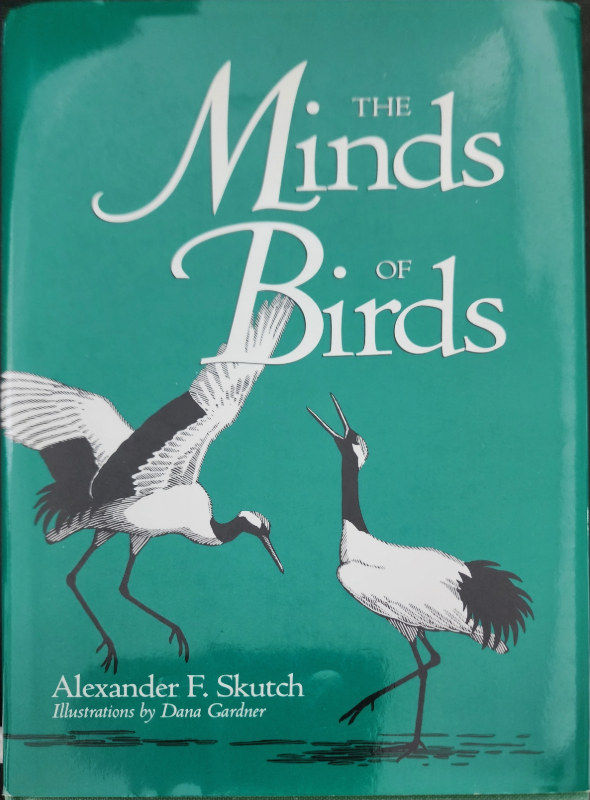
Skutch, Alexander F. (1996). The Minds of Birds. College Station, TX: Texas A&M University Press. (Illustrations by Dana Gardner; includes bibliographical references and index.)
- Preface
- Chapter 1. Recognition of Individuals
- Chapter 2. Memory and Anticipation
- Memory
- Anticipation
- Chapter 3. Social Life
- Chapter 4. Emotions
- Chapter 5. Play
- Chapter 6. Counting and Timing
- Counting
- Timing
- Chapter 7. Tool Using
- Chapter 8 Aesthetic Sense
- Chapter 9. Dissimulation
- Chapter 10. Mental Conflicts
- Chapter 11. Intelligent Birds
- Chapter 12. Apparently Stupid Behavior
- Chapter 13. Freedom and Altruism
- Freedom of Choice
- Altruism
- Chapter 14. The Brain and Senses
- Chapter 15. Homing and Migration
- Chapter 16. The Mind of a Parrot
- Chapter 17. Summary and Conclusions
- Resources
- Birds of the World
- Other resource
Preface
Alexander Skutch lived almost 90 years (May 1904–May 2004), more than two thirds of which he spent appreciating, observing, and studying birds. In 1996, his The Minds of Birds was published, detailing his lifetime conclusion that birds are intelligent, emotional, caring, and fascinating. He supports most of his conclusions with his own observations, bolstered by his study of the work of other ornithologists, both in the field and in the laboratory, as well as the observations of studious citizen scientists.
Figure 01. Ornithologists who have studied bird intelligence often highlight the intelligence of corvids such as this pair of Common Ravens.
A few of the details he cites have been superseded by information that has come to light since this book was published, but they don’t detract from his keen insights based on a lifetime of experience observing birds. As he says in his preface, “We should expect considerable diversity in mental qualities among the [thousands of] species of birds and even appreciable difference among individuals of the same species. . . . [In any case,] we have good evidence that birds are far from stupid” (p. xiii).
This book offers details about birds’
- superlative geospatial memory for locating thousands of food items hidden and cached months before
- navigational ability to fly to a destination thousands of miles away, which they have visited just once, a year earlier
- social skills in recognizing numerous individuals within large social groups
- social dexterity in forming highly complex social systems of cooperative breeding to care for their young
- aesthetic sensibilities in discerning the physical beauty of prospective mates’ plumage, songs, courtship rituals, or display stages
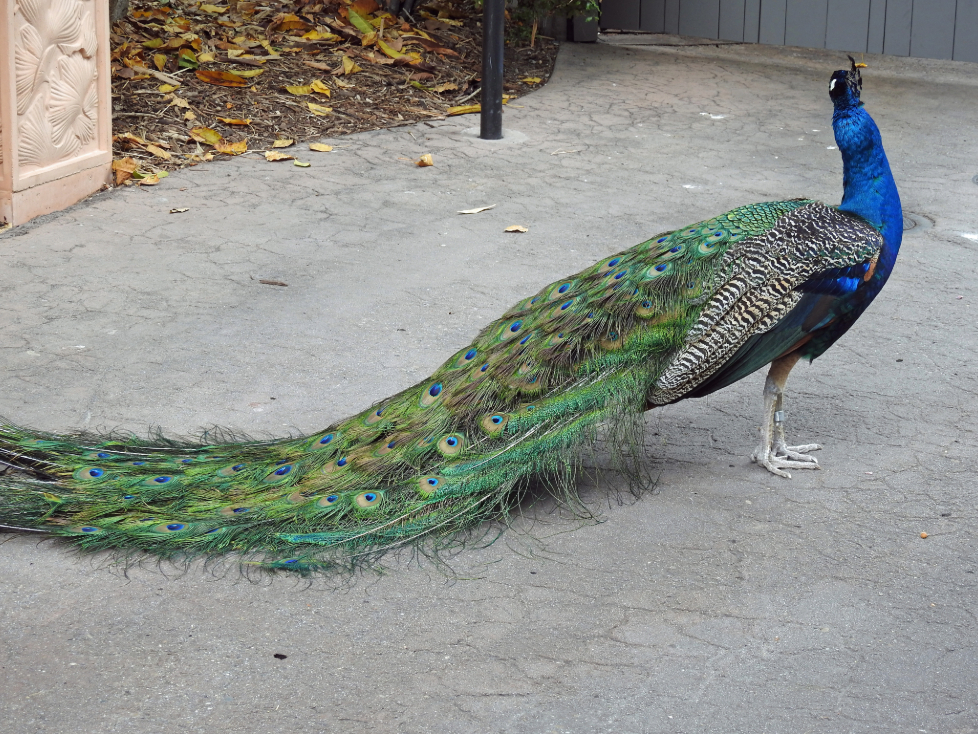
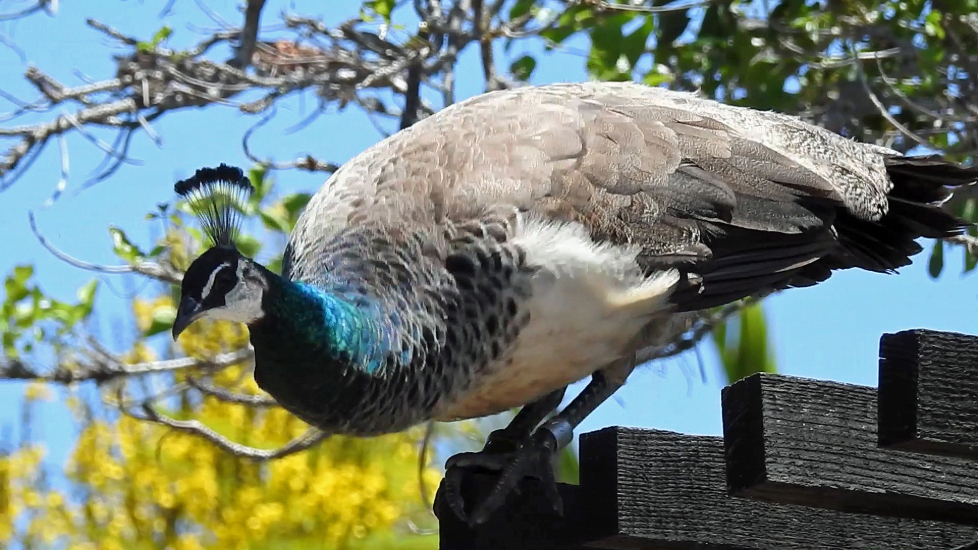
Figure 02a,b. Indian Peafowl hens aren’t nearly as glamorous as peafowl cocks, but the hens may actually have a more refined aesthetic sensibility, as each female carefully chooses a male whose beautiful plumage most attracts her.
- devotion to caring for their embryos and their nestlings, ensuring the well-being of their young, often at risk to their own safety and health
- emotional responsiveness, clearly demonstrating affection, fear, anger, and other basic emotions
Chapter 1. Recognition of Individuals
Many nestlings can recognize the voices and appearance of their parents within two days after hatching, and many parents can do likewise. Some embryos (e.g., Common Murres) can even identify the voices of their incubating parents before hatching. These identification skills generally develop quickly among birds with smaller clutches who nest in more densely packed breeding colonies. Among birds who breed in large colonies of 100s or even 1000s of birds, parents can still find and feed their own chicks in the colony’s crèche (and their chicks seek their own parents, to be fed).
These identification skills also apply to adult birds; monogamous pairs readily identify their own mates, even as they approach the nest from great distances. Many can do so both visually and auditorily, recognizing both the vocalizations and the appearance of their approaching mates. Monogamous pairing relies on mutual recognition.
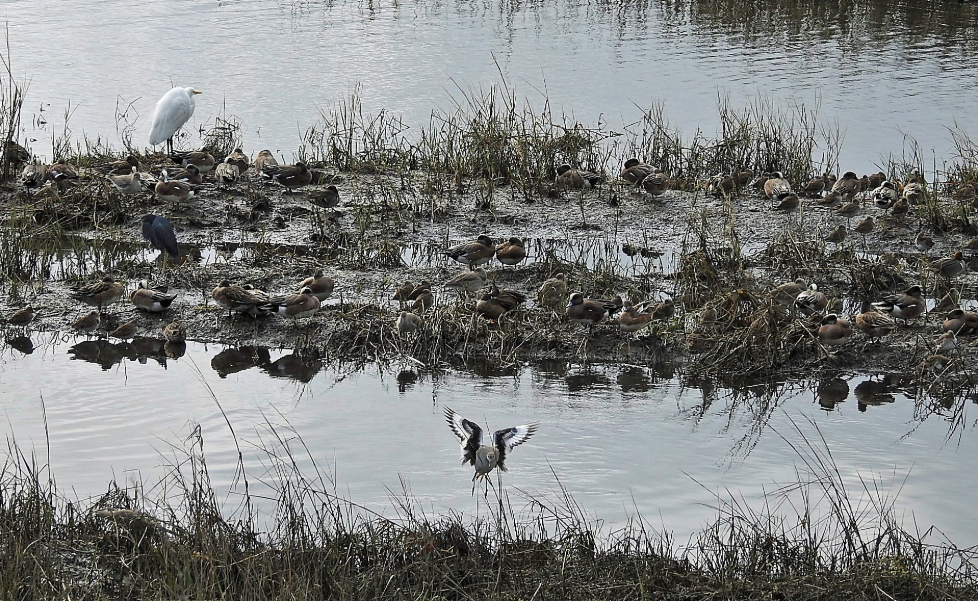
Figure 03. Many of these ducks, shorebirds, and herons may recognize one another and may remember each other when meeting again. This Great Egret and these American Wigeon ducks form pair bonds that continue through at least one breeding season; Willet pairs are monogamous even beyond one breeding season.
Many birds also easily recognize familiar neighbors, with whom they have amicable relations, as distinct from unwelcome neighboring intruders of the same species. Birds who live in complex social groups, with complex dominance hierarchies, must not only recognize all members of the group, but also the relative ranking of each member.
In all of these identifications, facial recognition is generally the most important, but overall appearance, vocalizations, posture, and movement style may also play a role.
Birds with extensive or intensive contact with humans may recognize individual humans, as well, chiefly by face, but also by their attire.
Chapter 2. Memory and Anticipation
Memory
Birds remember intensely emotional experiences (e.g., a predator killing or harming a mate or a nestling), as can be seen in how they behave, such as being alarmed when approaching the location where a predator had been, or continuing to bring food to a nest where their chicks were killed.
Quite a few bird species (e.g., many jays and nutcrackers) cache hundreds, thousands, or even tens of thousands of seeds, across large territories during months when seeds are abundant. Then months later, when little food is available, they return to find the cached seeds, with 50–99% accuracy. According to Skutch, “Birds rarely find food hidden by others” (p. 15). That is, in a broad expanse of land, observers have watched these seed-cachers uncover their own seeds with remarkable accuracy but almost never accidentally stumble onto seeds cached by other birds. It’s thought that these birds take note of the locations of distinct vertical landmarks (trees, stumps, etc.), which will be visible even when the ground is covered by snow.
Migrating birds likewise show phenomenal geospatial memory. Somehow, these birds use the sun’s position, various landmarks and other sensory cues, and other clues while flying in one direction, in order to exactly reverse their path in the opposite direction, many months later. Banding studies have shown that individual birds will return again and again to the same exact location year after year. It also appears that males are more territory-specific than females, who return to the same general breeding territory but may be guided more by choosing a mate than by choosing a specific location.
Figure 04. Caspian Terns and Elegant Terns both migrate seasonally, the Elegant migrating over longer distances. Black-bellied Plovers migrate long distances, as well.
Racing/homing pigeons show a related ability to find their particular coop, even if they have been absent from that location for years.
Bird songs require memory abilities, too. Many birds learn and remember their songs while youngsters, listening to the songs of older birds, either on territory or during migration. Then, after not hearing those songs for many months, as adults, they can recall and produce the songs. For instance, “an individual warbler can . . . imitate from 63 to 84 species, an average of 76.” Other birds recall hundreds of songs. “Marsh Warblers can sing uninterrupted for an hour without becoming monotonous” (pp. 18–19).
Birds not only recognize one another, but also remember mates, neighbors, and even humans despite not having seen one another for many months.
Anticipation
Numerous species of birds show anticipation of their eggs’ hatching by delivering food to the nest ahead of the start of hatching. Mostly dads do so, but some moms do so, too.
Perhaps even more remarkable is how many birds can anticipate where to locate a nest site for their future hatchlings. Often, on arriving at a breeding territory, the needed vegetation or insects haven’t yet emerged or arrived, so the bird must know the signs of where plant matter or arthropods will appear by the time the embryos hatch.
Chapter 3. Social Life
For starters, bird families show superlative devotion to caring for their embryos and their hatchlings. Migratory birds tend to have shorter breeding seasons than birds who can linger in their breeding territory. Some migratory birds, however, continue to provide food and protection to their young, even after leaving their breeding territory.
Some birds engage in cooperative breeding, in which one or more breeding pairs are aided by nonbreeding helper birds, who may help build nests, incubate eggs, or at least feed the hatchlings. Skutch describes three types of cooperative-breeding groups: (1) singular breeding, in which just one mating pair is aided by several helpers, often their own young from previous broods; (2) plural breeding, in which two or more pairs of birds of the same species breed in two or more nests, each pair having assistants, but all bird pairs being mutually supportive; (3) joint nesting, in which two or more females share one nest, all of the moms lay their eggs in that nest, all group members help to incubate all the eggs, and all members feed and protect all of the hatchlings after they hatch. In each of these cases, the birds must manage complex social relationships with one another, recalling previous interactions and adapting their behavior to optimize their relationships with one another.
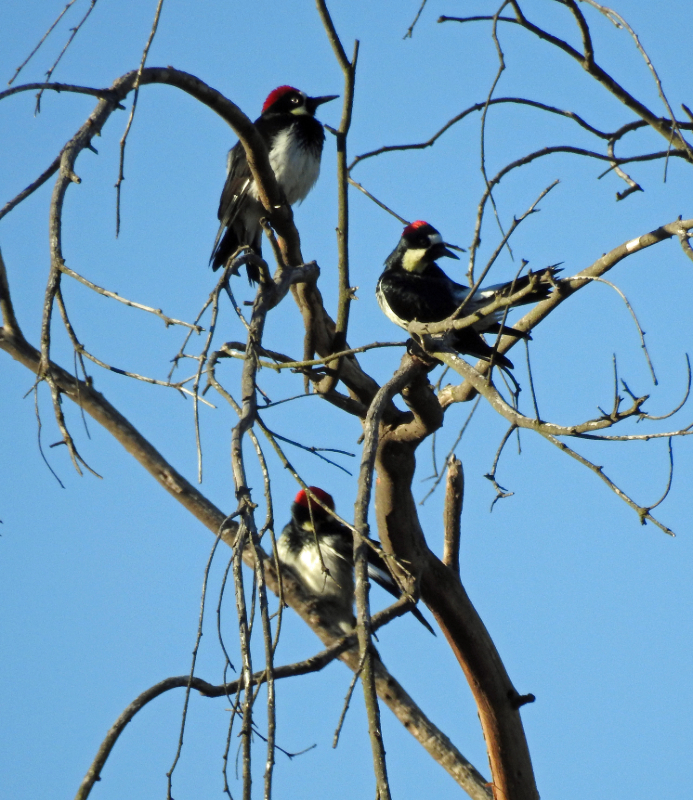
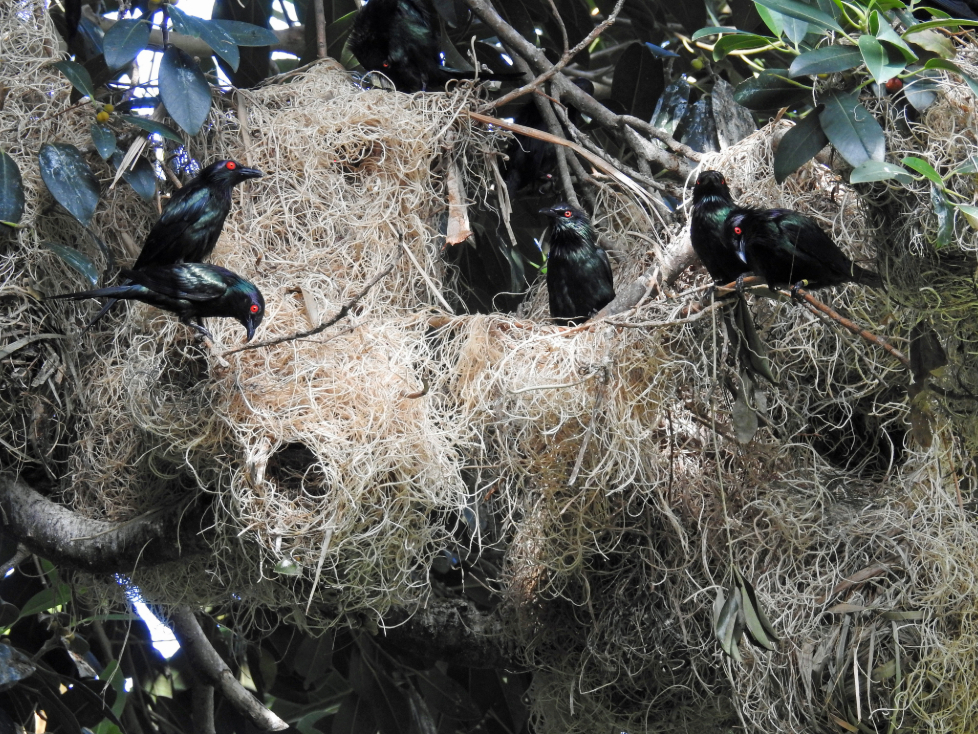
Figure 05. Acorn Woodpeckers and Metallic Starlings breed cooperatively. (a) Acorn Woodpeckers engage in joint nesting, with all the breeding females sharing one nest cavity for incubating all of their eggs; nonbreeding helpers share in raising the youngsters. (b) Metallic Starlings breed plurally in colonies of 4–400 separate nests in one tree; adjoining nests sometimes coalesce into a single nest, in which the females incubate the eggs but both males and females feed the nestlings.
Whether or not they breed cooperatively, many birds live within social groups according to dominance hierarchies, which also require birds to form complex relationships with each other member of the hierarchy. Once dominance hierarchies have been established, and each participant knows its role, internal conflicts are rare.
Birds strengthen their social bonds in several ways:
- share food, or feed other adult birds, as well as nestlings
- reciprocally preen one another (“allopreening”)
- keep in touch while resting or sleeping, either physically or vocally
- play together
- participate in group displays
- resolve territorial disputes through territorial displays or vocalizations, rather than physical conflicts
- see a need and fill it
Younger birds particularly benefit from social groups in which they can learn skills from older birds, such as how to
- forage efficiently
- recognize and avoid enemies or other threats
- sing their species’ songs
- build elaborate or at least structurally sound nests
- care for their own eggs and hatchlings after watching or perhaps even helping adult birds to do so
Chapter 4. Emotions
Even casual observers of the reunions of cranes, albatrosses, and grebes can see the joyful exuberance of mates who have been long apart. Many other birds also seek out their mates from whom they have been parted after a long migration. Some passerines (e.g., Black-striped Sparrows and Vermilion-crowned Flycatchers) even have greeting ceremonies after brief separations.
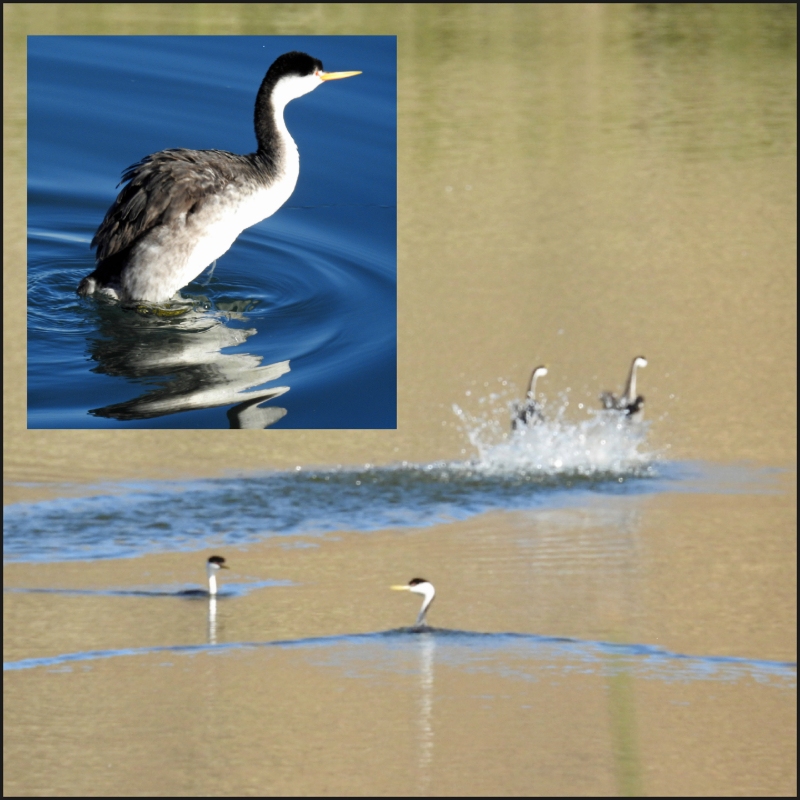
Figure 06. Both Clark’s Grebes (portrait) and Western Grebes have various greeting courtship rituals, the most stunning of which is rushing, in which both birds rise up from the water simultaneously and run across the surface of the water together, then fall back down to float together atop the water.
Certainly, for many bird species and individuals, the female chooses a male because of the territory he has claimed, but often, the female chooses a mate before he has established a territory. In any case, once the female has chosen her mate, most females will then avoid mating with other males.
Many migrant species stay together even during migration, presumably bonded through affection, not lust. The devotion of quite a few pair-bonded birds are legendary, such as Mute Swans, Australian Ravens, Pink Cockatoos (formerly called “Major Mitchell’s Cockatoos”), and Graylag Gooses.
Many birds find various ways to show and to strengthen their lifelong pair bonds, such as by
- singing back and forth antiphonally (call-and-response) when foraging in dense vegetation that limits visibility
- preening one another (allopreening)
- giving one another food
Figure 07. These two Fischer’s Lovebirds enjoy being together and find ways to strengthen their pair bond.
Nesting also seems to elicit emotional behavior, as expressed through song:
- Some flycatchers have a “nest song” they sing softly to one another when choosing a nest site; neighboring pairs may join in, as well.
- Some incubating parents (e.g., flycatchers, some grosbeaks, vireos, and orioles) sing softly to their eggs during incubation
- Some birds sing on returning to their nest (e.g., some grosbeaks)
- The moms of several bird species explode with song when a nestling hatches
- Some dads who haven’t been incubating their eggs will sing when they first see their newest hatchling
- Several species vocalize when a nestling first fledges
- Some parents even visit the empty nest and sing to their absent fledglings
Parents’ attachment to their nestlings is shown not only through their dedicated incubation of their eggs and feeding of their hatchlings, but also through their efforts to thwart predators by attacking them, vocalizing loudly, or trying to distract the predator.
Figure 08. Black Phoebes eat mostly insects, which they sally out to catch midair. Skillful fliers, a Black Phoebe would have no reason to dive-bomb this Killdeer. Watching this behavior, we have to wonder whether this plover might have gotten too close to the phoebe’s nest.
Chapter 5. Play
According to Skutch, “Play . . . is spontaneous, intrinsically rewarding activity, a pastime in which healthy animals who have satisfied all vital needs expend excess energy for enjoyment alone, with no ulterior motive” (p. 43). For some activities, the line between play and purposeful — or at least useful — behavior isn’t clear. Are those rough-and-tumble episodes playful, or are they practicing skills they’ll later use for aggression, defense, or courtship? The more closely it relates to finding food, finding a mate, or escaping danger, the less likely it is to be playful.
Some activities, however, are clearly playful, a freely chosen activity arising when the bird has already met other basic needs and has excess time to use as it pleases. Because of the requirement for excess time, altricial chicks, who can depend on their parents to feed them for awhile, show more playfulness than precocial chicks, who must quickly get out and about to find their own food and shelter. Skutch noticed that swallows, who stay in the nest a bit longer than most small birds, “have fun even in the cradle,” playfully interacting with nestlings in adjacent nests (p. 44).
Young birds tend to play more than older birds, playing social games of chase-and-tag (land or air versions), poke-jab-flee, or toss-and-catch. Displacement games such as “King of the Hill” are a hit for birds of all ages, including turacos and tits. Long-billed playmates will knock their bills against one another (a favorite of aracaris or other toucans), grab each other’s bills (e.g., adult and immature Ground Hornbills), or toss things to one another with their bills.
Figure 09. Bird with long bills, such as these Toco Toucans, particularly seem to enjoy play-fighting with their bills.
At many ages, birds play dropping games, either with one another or simply alone
- dropping stones to hear them plink on a hard surface or against other stones,
- tossing tidbits onto the ground,
- dropping feathers, leaves, seaweed, or twigs from on high and then catching them before they reach the ground,
- and so on.
Birds seen playing these games have included Common Ravens, Barn Swallows, Inca Terns, Frigatebirds, House Sparrows, bowerbirds, and many others.
Birds often seem simply to enjoy flying: letting strong winds take wings upward and downward, right and left; soaring; gliding; catching a draft and riding it upward then gliding down, then repeating the upward slope, or soaring up in the wind then precipitously diving before soaring again; flying aerobatically with forward rolls, sideward rolls, half-rolls.
Pairs or small or large groups of birds will rise as one, fly in synchrony, then land together or splash down. Perhaps the most breathtaking examples are of swallows, swifts, and starling murmurations. Typically, these occur on their route to their roosts, but they sometimes seem more like spontaneous expressions of joyful flight.
In addition to aerobatics, birds seem to enjoy acrobatics. Corvids particularly enjoy dangling from a branch by one foot or two, then grabbing the branch with the bill, dangling briefly, then dangling by the feet again. Acrobatics often entice onlookers, who may or may not join in the fun. Parrots enjoy similar acrobatic antics, dangling from one or two feet while screeching or spreading their wings.
Figure 10. Like other parrots, Fischer’s Lovebirds seem to enjoy acrobatic movements, using both their bill and their feet.
Sliding is another playtime pastime, whether it’s Galahs sliding down guy wires from towers, ravens sliding down river banks, or eiders sliding down river rapids. One observer noticed an Anna’s Hummingbird repeatedly slide down the stream of water from a garden hose, over and over. In a similar fashion, penguins were observed catching rides on slow-moving ice-floes, hopping off, swimming back, and then riding another.
Play can involve dance or song, such as when Arabian Babblers do their morning-greeting dance or their water dance. Many immature future songsters playfully try out their song repertoire long before song will play any part in the serious business of reproduction. Even meaningful song can seem to be superfluously elaborate or prolonged, more exuberant than practical.
Skutch concludes this chapter by saying, “It is pleasing to know that birds, who give so much pleasure to us, are themselves capable of enjoyment” (p. 56). Clearly Skutch enjoys being with and watching birds.
Chapter 6. Counting and Timing
Counting
Many species of captive birds have been trained to count. Common Ravens and African Gray Parrots have been trained to count up to six dots or objects, captive Jackdaws can be trained to count items in a box, a captive Great Tit was trained to tap out the correct number of taps after being told a number word. In the wild, many moms can count their eggs, continuing to lay eggs until they reach the desired number, even if some sneaky researcher steals one or more eggs from her nest.

Figure 11. Wattled Jacana moms can count to four, always laying four eggs for the dad to incubate while she heads out to rest and recuperate.
Timing
Though it’s harder to estimate timing than to count, our circadian rhythms govern many physiological processes, and many birds seem able to tune into these biological timings. For instance, homing pigeons seem to be partly guided by their circadian rhythms when finding their way home. More impressive, perhaps, successful egg laying and incubation rely on careful timing. The timing of mating, laying, and incubation must coordinate with the timing of plentiful food — fruits or other plant food, insects or other prey — as well as the reduced likelihood of chilly weather that could threaten developing embryos. Incubating parents must also time their foraging outings when their eggs are less at risk of danger from predators or chills.
Timing is crucial for incubating seabird parents. One parent must remain on the eggs while the other forages at sea, far from the nest; that parent must return to the nest in time to relieve the other parent before it’s too weak to fly. If the partner parent is gone too long, the incubating parent may be forced to leave the egg (or hatchling) or risk starving to death. Most seabirds manage to rise to these challenges.
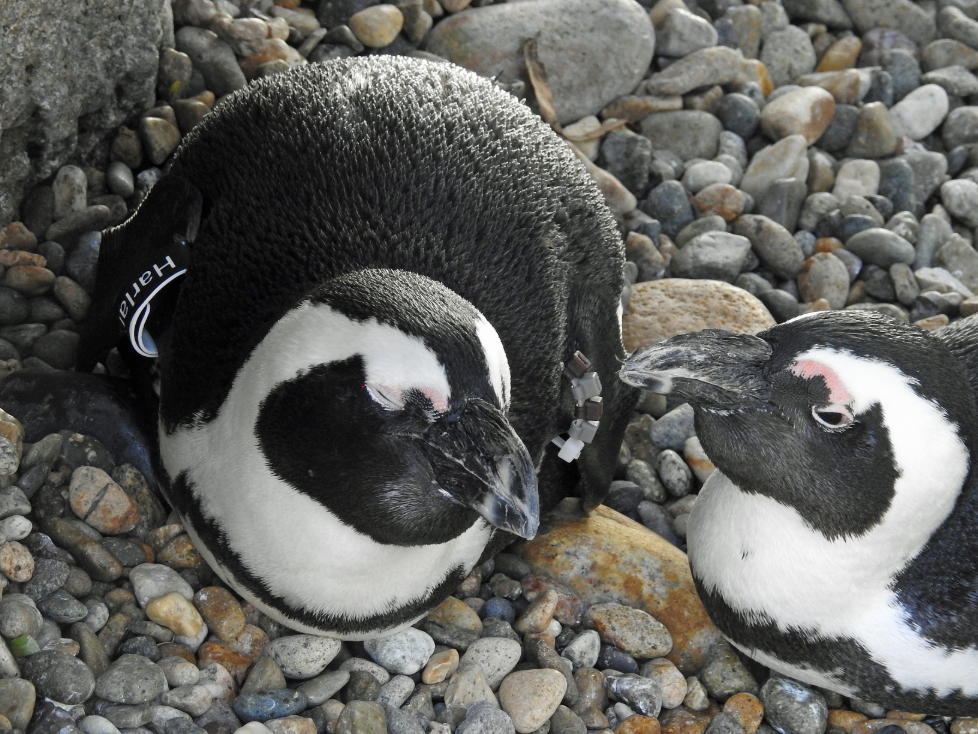
Figure 12. Unlike Adélie and Emperor Penguins, African Penguins live in the milder coastal environments of southern Africa, where they have been observed breeding every month of the year. These lucky penguin parents can often switch turns incubating their chicks and brooding their hatchlings, while still foraging for food regularly.
Adélie and Emperor penguin parents have a precarious situation, too; one of the parents leaves their egg (or eggs) with the other, feeds at sea for weeks, but must return in time for the now-ravenous co-parent to go to sea to feed. That parent, too, must time her or his return to arrive by the time the egg has hatched, eager to eat.
Incubation clearly requires both a physiological inner clock and an awareness of how to follow it.
Chapter 7. Tool Using
Though few wild birds have been observed to use tools, it may be that such behavior is highly situational, and few observers have been in the right place at the right time. Nonetheless, at least three species of finches have been observed to use tools, in particular finding a spine or twig to use as a probe with which to extract an insect. In some instances, the finch broke off a spine or twig specifically for this purpose. At least two species of corvid use this trick, as do three other species of passerines, and an Oystercatcher in a zoo.
Brown-headed Nuthatches detached a loose bark scale to pry off a tightly attached bark scale, exposing any prey lying beneath. An aracari (a kind of toucan) even made its own twig tool by holding a twig beneath its foot, then pulling the twig through its sharply serrated bill, removing any extraneous projections from the twig. That done, it probed successfully for its prey.
In the wild, a titmouse noticed a juicy caterpillar suspended by a silken thread and pulled up the thread to snatch the caterpillar. Much to the dismay of several ice fishers, Hooded Crows have discovered a similar trick. A crow grabs an unattended fishing line, pulls it up, then walks slowly backward as far as possible; as needed, it walks forward stepping on the line, gets to the fishing hole and grabs the line at a lower spot, repeating this process until the fish or bait is within reach. Some humans suspend birds’ food from strings or threads, for tits, jays, macaws, and other birds to pull up to within reach.
Figure 13. Green Herons are 1 of only 12 birds known to catch fish using lures. This heron has managed to catch a fish without a lure, using stealth and keen observation. According to the Cornell Lab’s Birds of the World, “One bird dug earthworms from mud and used them as bait, and twice birds broke pieces of stick to make bait, an example of tool-making.”
At least 12 species of birds use lures to catch fish. For instance, Green Herons will toss or drop an attractive item — bread, a leaf, a feather — onto the surface of the water, attracting fish to the surface. As soon as the fish nibbles the bait, the heron pounces. In some instances, the heron also made the lure, such as by snapping off short lengths of a twig. Experienced adults succeeded in luring, catching, and eating fish far more often than inexperienced youngsters, who used oversized lures or failed to make themselves inconspicuous while trying to lure the fish. Pied Kingfishers have been seen using this technique, as well.
Gulls may use height and a hard surface to break open bivalve shells, but whether that could be called a tool isn’t clear. On the other hand, many birds use tools to break open eggshells to devour their contents: Egyptian Vultures toss stones at Ostrich eggs (one was also seen to toss a stone at a monitor lizard, killing it), buzzards do likewise with emu eggs, and curlews open albatross eggs in the same way. Corvids have been seen to drop things near an incubating parent, to intimidate the parent into abandoning their eggs. Similarly, an incubating corvid was seen to toss stones toward potential threats.
The Palm Cockatoo has a less lethal but more complex use of tools. One of its favorite foods is the absurdly hard-shelled “kanara nut” (usually requiring a hammer to crack it). (Wikipedia names it the “kanari nut,” Canarium australasicum.) First, the cockatoo manipulates the nut in its mouth, sawing a notch into it. Then it tears off a piece of leaf, wrapping it around the nut so it can’t slip out as the cockatoo maneuvers, cuts, and tongues the nut to extract the scrumptious kernel.
Figure 14. The Palm Cockatoo’s formidable bill can crunch most nut husks, but the kanari nut’s husk is too tough. A Palm Cockatoo used a leaf to keep the nut from slipping away while cutting an opening and extracting the nut’s kernel.
Tools may also be used for preening. For instance, two captive parrots (a cockatoo and an African Gray) were seen to grasp objects in their feet in order to scratch unreachable areas of their backs. Wild birds have been seen to grasp an ant while wiping it across their feathers, exploiting the ant’s repellent chemicals.
A wild Double-crested Cormorant was seen to pick up one of its fallen feathers then use it to draw off preen oil and “paint” the oil onto its wing plumage. Nuthatches and a chickadee have been seen “painting” the juices of small beetles around their nests, presumably to deter intruders and pests. A bowerbird used a spongy wad to soak up a “paint” made from saliva and mashed-up berries then paint the interior walls of its bower. A species of bird of paradise uses a “cloth” (snakeskin, feathers, fur tufts) to polish the perch above its courtship display grounds.
Figure 15. At least one Double-crested Cormorant came up with a clever idea for “painting” preen oil onto its feathers.
While many hummingbirds use spiderwebs to make their tiny nests more flexible, some also use them as fasteners, as do some warblers and other birds. Other tools birds have used include dippers, to get water to drink or to pour water over dry food.
Chapter 8. Aesthetic Sense
Glamorously plumed and ornamented males are probably simply displaying their genetic endowments, but the females who judiciously select the more glamorous male with whom to mate clearly have an aesthetic sensibility. Males who sing to attract a mate may begin with a genetic gift, but they must learn to perfect it if they are to woo a mate. Highly complex songs, large repertoires of songs, or songs including extensive mimicry require countless hours of practice and learning, as well as an aesthetic sense to know when a song is more melodious, more beautiful.
Figure 16. Even a few seconds of listening to a Northern Mockingbird’s calls reveals a rich repertoire of sounds.
Males who perform and perfect elaborate courtship displays or exquisite courtship bowers, pavilions, or stages may start with a genetic endowment, but anyone who watches a male perfecting his display recognizes that he, too, has a strong aesthetic sensibility. Typically, younger males watch older males as the youngsters learn to perform, build bowers, or otherwise work on their courtship displays or actions. In time, the younger males also try their own courtship behavior or displays, but rarely are they as successful as the older, more experienced birds. In intrasexual selection, males compete against other males for the chance to mate with the local females.
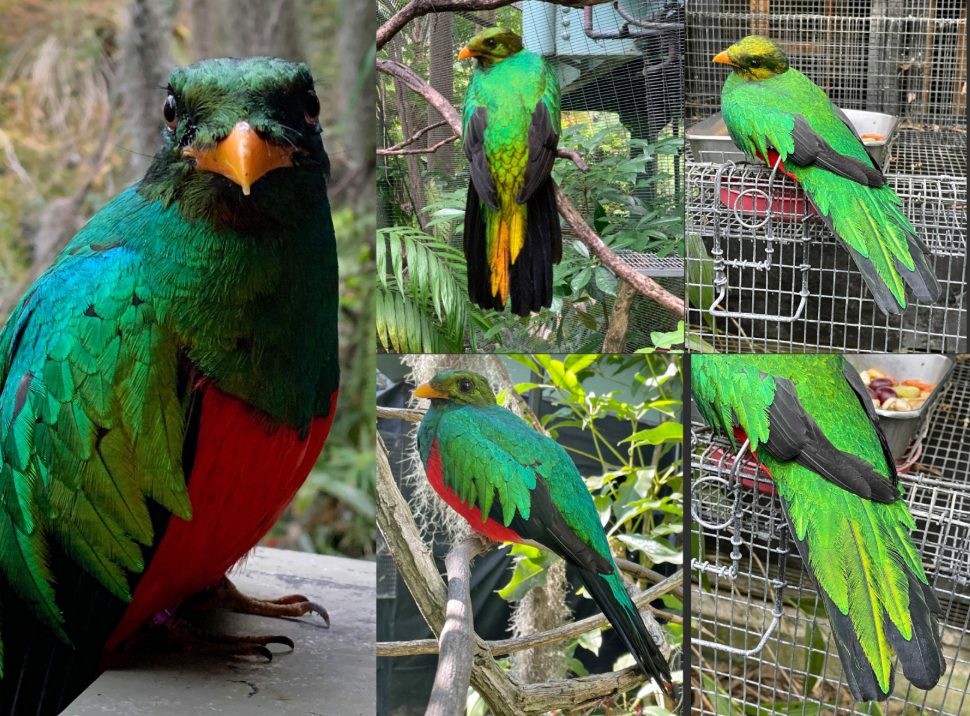
In intersexual selection, the selection may be unilateral (e.g., the female chooses her mate) or mutual (the female and the male choose each other), but in any case, mates are freely chosen by one or both partners. Some males offer territory with desirable resources, as well as assurance that they’ll help with incubation or brooding and they’ll protect their mate and their offspring. Others, however, offer nothing more than their superior genes. In these instances, the females choose a mate based solely on his aesthetic appeal, whether it’s his plumage, his bower, his dances, his songs, or his other aesthetic attributes or actions. It should be noted that some highly attractive males, such as the Resplendent Quetzal, are also hard-working dads, who participate in incubating their eggs and caring for their hatchlings.
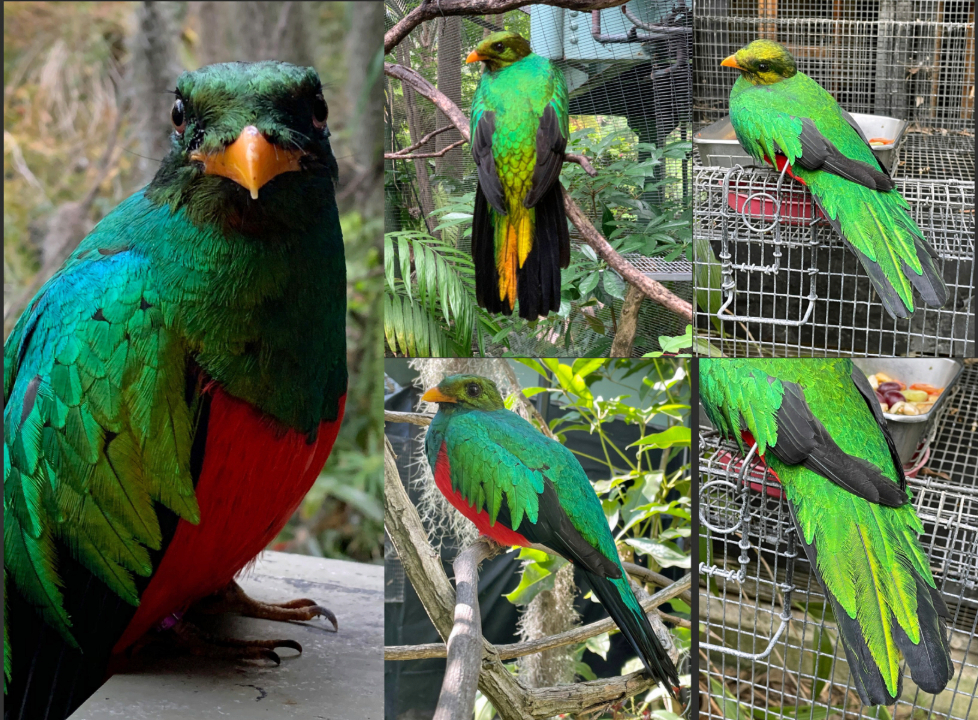
Figure 17. Like Resplendent Quetzals, Golden-headed Quetzal males help to incubate their eggs, and they share equally with the female in caring for their nestlings. (Their exquisite plumage can look a bit frazzled by the end of breeding season.) Source: Paul Colo, ornithologist, bird lover, retired birdkeeper from the San Diego Zoo, and caring guardian of numerous birds.
Chapter 9. Dissimulation
Killdeer parents and many other bird parents (from Ostriches to songbirds) use dissimulation to distract a predator that seems to be approaching their eggs or their nestlings. Specifically, when the parent bird sees a predator, the parent notes whether the predator is close enough to pose a threat and whether the predator could be distracted by the prospect of a tasty meal elsewhere. If the parent bird believes that the predator is both a threat and distractible, the parent will fly a distance from the nest, then vocalize and flutter in ways to lead the predator to believe the parent is injured and would be easy prey to catch. Once it has the attention of the predator, the parent continues to lure the predator as far from the nest as possible, then as the predator is ready to pounce, the parent flies off, farther away from the nest, not returning to the nest until far out of view of the predator.
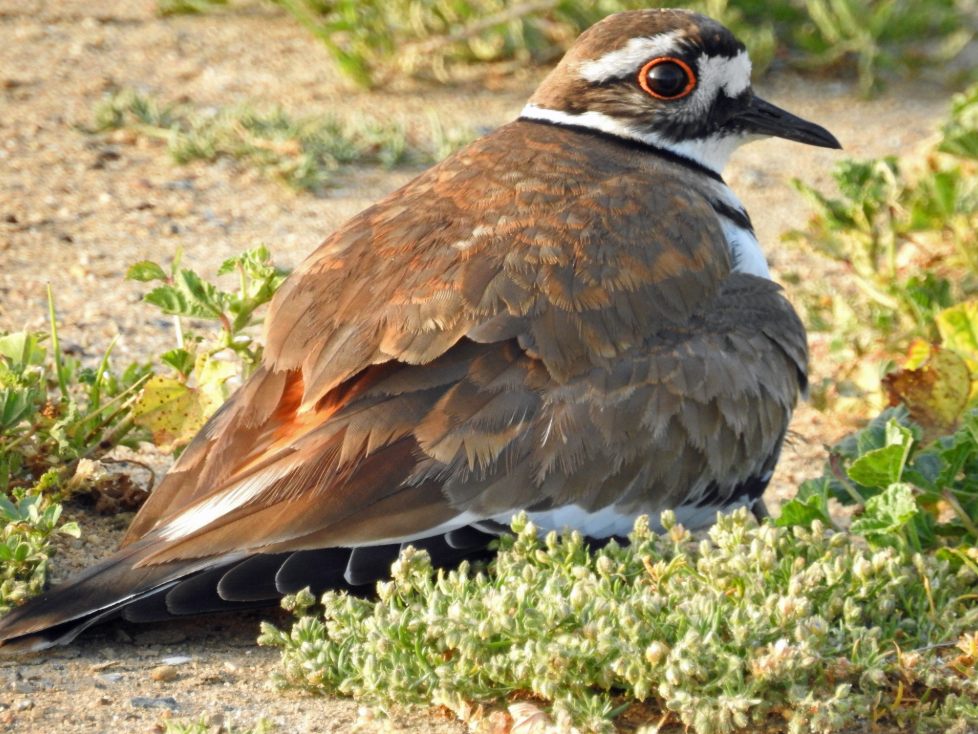
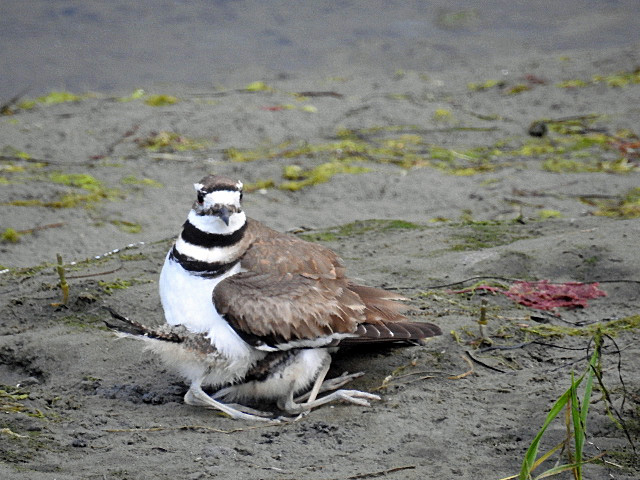
Figure 18. (a) Killdeer parents will feign an injury to lure a perceived predator away from the nestlings. (b) Crafty Killdeer parents can deceive predators in other ways, too. “Chicks, what chicks? I don’t see any chicks.” (Killdeer also sometimes try to trick predators by pretending to brood in a location away from where the actual nestlings are located.)
Bird parents also tailor their response based on the proximity of the predator, the type of predator (e.g., dog vs. cow vs. snake), and the availability of other strategies (e.g., mobbing the predator with the help of nearby birds). Because of the spontaneous variations in its use, dissimulation is probably learned or invented behavior. Skutch didn’t say this, but his observations led me to believe that a bird’s use of dissimulation to distract a predator indicates that the bird has a “theory of mind” — that is, the dissimulating bird can imagine the predator’s viewpoint and determine whether it could be distracted away from the parent’s nestlings.
Chapter 10. Mental Conflicts
Skutch gives several examples of when birds appear to be suffering from mental conflicts, such as whether to stay and try to protect their nestlings from a predator or to leave to save their own lives. For instance, “a threatened bird cannot escape with eggs or nestlings; it must either abandon them or risk its life shielding them” (p. 111). When birds are experiencing these mental conflicts, they show signs of extreme distress. Parent birds are devoted to their young, typically losing weight during the breeding season, as they forgo foraging while incubating, and they sacrifice their own food to offer it to their young.
Figure 19. As soon as the Wattled Jacana mom lays the eggs, her parental duties end, but the father’s begin. He tenderly incubates the eggs and attends to the nestlings. For a time, at the San Diego Zoo’s Hummingbird Aviary, the dad had been so overworked due to the mom’s fecundity that the zoo separated him from her temporarily, so he could recover.
Chapter 11. Intelligent Birds
In addition to tool use and the other evidence of intelligence Skutch has described in earlier chapters, he gives several more examples of his own observations of birds’ intelligence. They opportunistically take advantage of situations, such as when a flycatcher took over an abandoned cup nest to build her own domed nest, rather than starting from scratch. Some birds follow large mammals (including humans), who stir up tasty insects from the ground. Birds also observe and understand human behavior, knowing how to nudge a human to feed them, how to get food, how to enter and exit a house, human routines and timing, and more.
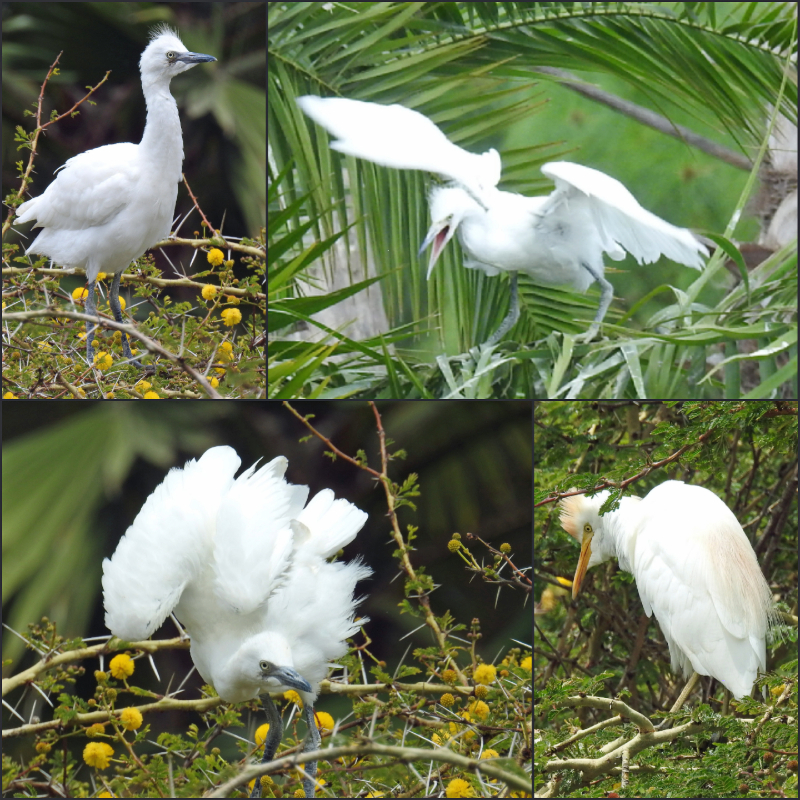
Figure 20. Most of these Cattle Egrets are chicks, but they’ll soon learn that if they forage with cattle or other large mammals, they’ll more easily nab an abundance of insects.
Physically impaired birds may find ways to adapt to their disability, remediate their disability, or get help from their mates or other companions, to survive.
Experimenters have found evidence that domestic pigeons and chickens can solve complex puzzles. Corvids (e.g., crows, ravens, magpies, jays) have shown superlative intelligence in numerous varied experimental conditions. Pigeons also show great flexibility in their ability to form and to apply categories. Wild pigeons apply these skills to categorizing other animals as threats, helpers, prey, or none of the above.
More impressive, however, is the intelligence shown by wild birds in their natural environments. For instance, frugivorous birds must know which fruits to find where, which are ripe at what times, and so on. Insectivores are presented with even greater complexity in finding and choosing a movable feast. Birds must also develop a wide array of tactics for avoiding predators whose threats vary widely.
Though the basic ability to weave an intricate nest is partly innate, birds show remarkable intelligence in learning how to improve and perfect their construction skills. Songsters likewise perfect their songs with practice and experience. Even parenting improves with experience.
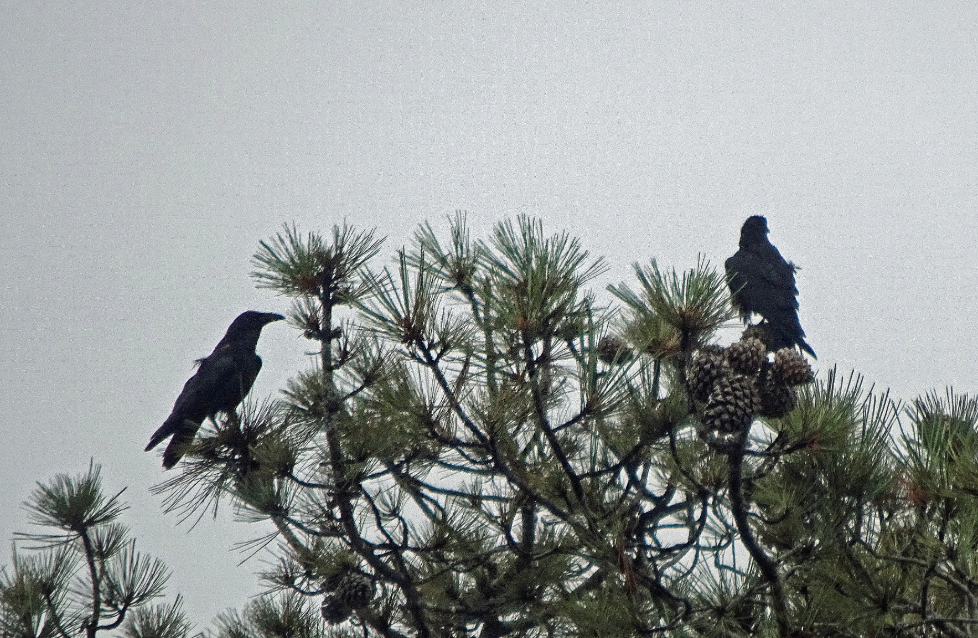
Figure 21. Researchers in bird intelligence often take a special interest in corvids—ravens, crows, jays, jackdaws, rooks, and so on. Many of these birds not only excel at cognitive tasks but also seem to enjoy doing them.
It’s impossible to compare the intelligence of a puzzle-solving corvid with a songster showing a complex repertoire of songs with a weaver who constructs an intricate nest with a migrant who travels thousands of miles and manages to find the right small plot of land. Nonetheless, some characteristics seem to foster greater intelligence:
- Birds who are dietary generalists must find a wide variety of foods using diverse strategies, which makes their thought processes more flexible than those of dietary specialists.
- Birds who live in highly cooperative social groups must figure out complex social relationships with large numbers of other individuals, requiring greater intelligence than solitary birds.
- Birds who must navigate over thousands of miles of terrain must constantly adjust their bearings based on an array of stimuli.
Skutch wondered whether birds’ intelligence could be even greater if they had hands with which to apply their intelligence.
Chapter 12. Apparently Stupid Behavior
Often, we humans see birds do things that seem incredibly stupid to us, but their behavior makes sense in their natural environments. For instance, when a bird accidentally enters a building, it will continually fly upward seeking escape, whereas if it flew lower and toward a door or open window, it could escape. In the wild, birds can always escape by flying upward; they have no reason to look elsewhere. Likewise, they have no reason to comprehend that glass isn’t penetrable and that mirrors are reflecting images of themselves.
Figure 22. These Victoria Crowned Pigeons are flummoxed by their reflections in the glass at an aquarium. They don’t fear the reflection or try to attack it, but it’s confounding to them.
Chapter 13. Freedom and Altruism
Freedom of Choice
Observers of birds have seen many ways in which birds are free to behave in many ways that are free from instinctive, innate behavior. For instance, mimetic birds (who mimic various sounds they hear) freely choose which songs or other sounds to imitate. Among other songsters, birds with large repertoires of songs freely vary the sequence of the songs they sing, such that many rarely or never repeat the exact same sequence of songs.
Figure 23. European Starlings were once a common household pet in part because of their singing. Mozart once had a pet starling, whom he considered his muse. (If interested, please see my blog about it, https://bird-brain.org/2025/01/19/mozarts-starling/)
Among most non-monogamous birds, females freely choose with whom to mate, usually based on the female’s aesthetic sensibility in choosing a particular bird’s appearance, song, courtship display, or courtship pavilion, bower, or court. Among monogamous birds, each female chooses the male who appeals to her most; perhaps he offers the best territory, sings the most melodiously, or looks the best in her eyes. She may even choose a nonmonogamous male with a superior territory over a monogamous male with an inferior one.
Once it’s time to build a nest, one or both parents choose the site they think will best provide the resources needed for their young — the safest hiding place, the best climatic temperature, the proximity of drinking water and access to food. Some birds even start numerous nests in two or more spots until they find the one they prefer most. That done, they may rely on instincts for how to build a nest, but even so, over time, they’ll try various improvements to the nest to make it more comfortable, safer, or more appealing.
Figure 24. This male Taveta Golden Weaver seems to have a definite idea about his nest and what he needs to do to make it, sometimes taking a breath to think about what’s next.
In these and other examples, birds delay taking action while considering alternative possibilities: a different sequence of songs, a different choice of mate, a different nesting site, and so on. Also, when birds have extra time, beyond the time needed for finding food and caring for youngsters, they may find ways to play, apparently enjoying themselves — clearly involving free choice in what they do.
Altruism
Birds who live and breed in cooperative-breeding groups freely help the others in their community, and the nonbreeding helpers may seem to be altruistic. It may be said, however, that they’re ultimately helping to sustain the community that will continue to sustain the helpers, who may be breeders in the future.
Far clearer is the altruism of birds who are seen to provide food for the nestlings of neighboring birds of different species than their own. Skutch gives examples of a Gray Catbird feeding the nestlings of a Northern Cardinal, a House Wren giving food to Black-headed Grosbeak parents, who fed it to their young, and several other instances he personally observed.
Figure 25. This House Wren probably weighs about 0.4 ounces and is less than 5″, including that perky tail. Black-headed Grosbeaks weigh 4× as much — 1.6 ounces — and are more than 8″ long. Yet a House Wren has been seen giving food to nesting parents, for no obvious reason than the wren wanted to do so.
Skutch further said, “I suspect that every species of bird occasionally helps every other species of similar size and habits that nests nearby” (p. 133). In some instances, the altruistic bird is awaiting the arrival of its own nestlings, is grieving the loss of its own nestlings, or is feeling the emptiness of a nest for which the fledglings have flown off. According to Skutch, altruism is another “application of energy in excess of vital needs to intrinsically satisfying activities” (p. 134).
Chapter 14. The Brain and Senses
“A bird’s brain is ten or more times larger than that of a reptile of similar body size. In both birds and mammals, the size of the brain increases with that of the body. . . . However, the brain’s weight does not increase proportionally to that of the body” (p. 136). Also, for birds, every body part or fluid it carries must justify its weight, which must be minimized for flight, so bird brains must be as light as possible. Nonetheless, comparing the brains of birds and of mammals of the same weight, bird brains are comparable in size. Though bird brains differ from mammal brains in some ways, they have functional equivalency to mammal brains.
Birds’ eyes are “about as large as their heads can accommodate. Eyes on opposite sides are almost in contact inside the head, and together they may weigh almost as much as the brain” (p. 138). Birds’ eyes are directed sideward, not forward, giving them a wider field of vision, but with limited binocular vision. The visual fields of the two eyes do overlap in front for all species, but most raptors and insectivorous birds have much more overlap than herbivorous birds. Two features of bird eyes enhance their visual acuity: Each eye has two foveae (fovea, retinal area with greatest acuity), and each contains a pecten (a structure behind the eye’s lens, which provides extra nourishment to the retina). In addition, the photoreceptor cone cells in bird retinas are much more densely packed than in mammal eyes, which further enhances their visual acuity.
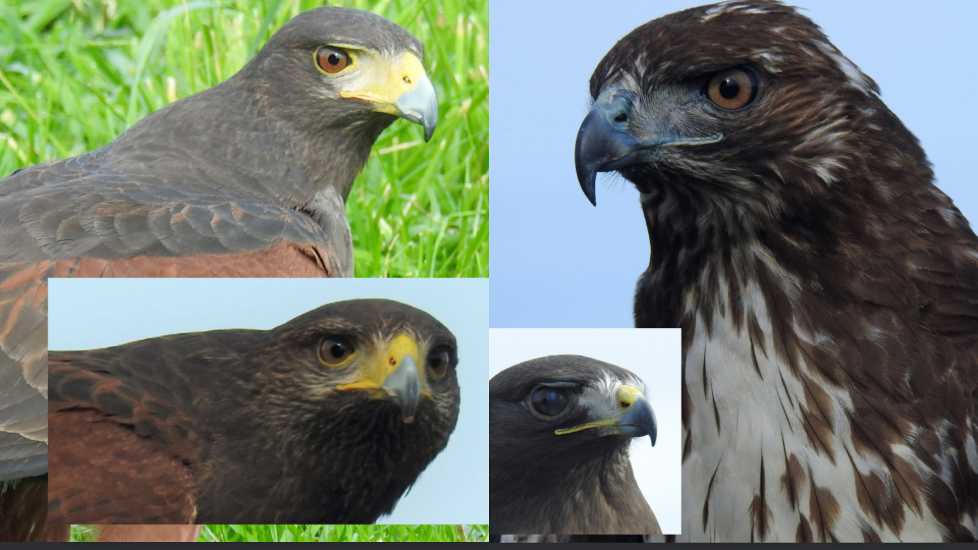
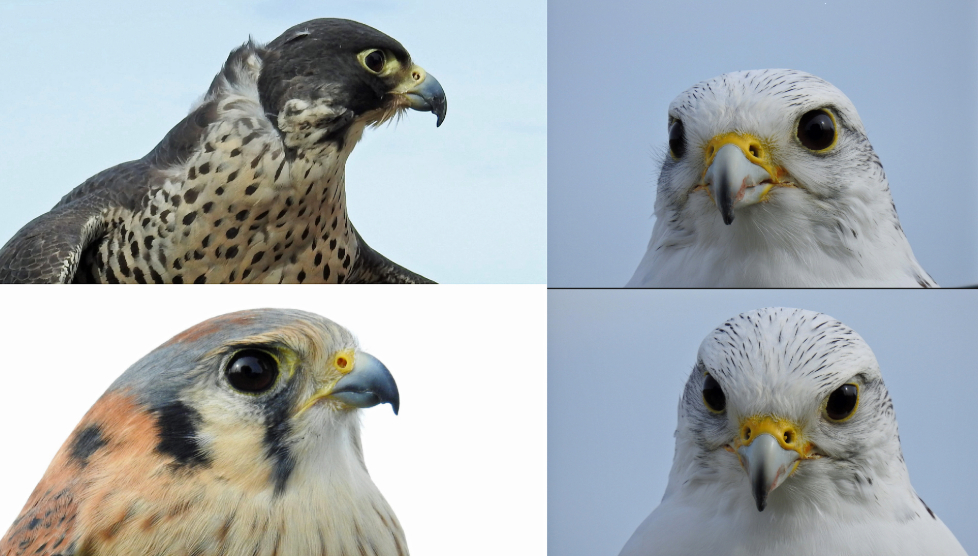
Figure 26. Raptors have exquisite eyesight, for spotting prey from high above. Both (a) hawks and (b) falcons have better binocular vision (both eyes working together, to detect distance and perceive depth) than most other birds. Pictured here are (a) Harris Hawks (left) and Red-tailed Hawks (right); (b) falcons (clockwise, starting top left), Peregrine Falcon, Gyrfalcons (×2), American Kestrel.
The color vision of diurnal birds also benefits from structural enhancements. In addition, pigeons and at least some hummingbirds see not only red, green, and blue, as we do, but also ultraviolet light. Pigeons (and probably other birds) also can see polarized light. Many animals generally use polarized light for navigation, “since the linear polarization of sky light is always perpendicular to the direction of the sun” (Wikipedia, (https://en.wikipedia.org/wiki/Polarization_(waves)#Polarization_and_vision)
In birds with feathered heads, ear-covert feathers cover their ears; their ears can aid in balance, can hear sounds of about the same frequency, duration, and intensity as human ears can, and can localize sounds. At least two birds (Oilbirds and Cave Swiftlets) can also echolocate in the dark.
Birds vary widely in their ability to detect smell, with some birds (tube-nosed seabirds such as albatrosses and petrels, various Kiwis, most vultures of the Americas) able to detect smell readily. Ostriches, emus, and rheas also have large olfactory bulbs for detecting odors, and it’s thought that homing pigeons use olfactory cues as one aspect of their ability to find their way home. Pigeons also seem to be able to detect taste, as do many frugivorous (fruit-eating) birds. Other birds seem less sensitive to taste. For all birds, their existing taste buds mostly line their palate and mouth, not their tongue.
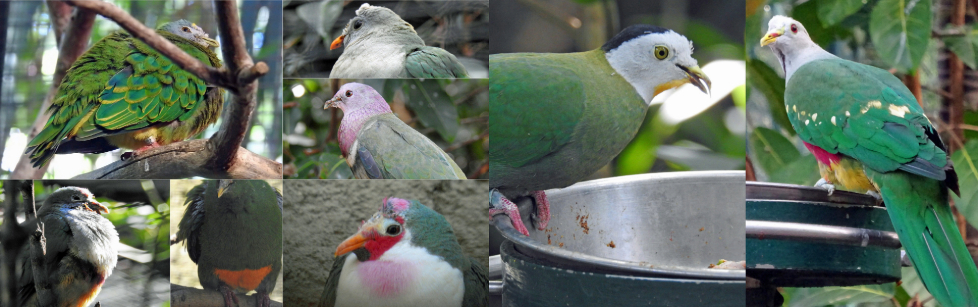
Figure 27. Not all birds have a keen sense of taste, but many fruit-eaters, such as Fruit-Doves and many other pigeons, can detect taste and seem to relish doing so. The Fruit-Doves shown here, left to right across the top: Coroneted, Black-chinned (above) Pink-headed (below), Black-naped, Wompoo; across the bottom, Beautiful, Orange-bellied, Jambu.
A bird’s skin connecting to its feathers is highly sensitive to movement and touch, and its palate and tongue also have receptors sensitive to touch. Woodpecker tongues are especially sensitive to touch. The bill tips of ducks and shorebirds are densely packed with tactile receptors. Birds also detect both pain and temperature. When they’re too warm, they can compress their feathers against their skin to conduct heat away, and when they’re too cold, they can fluff out their feathers to create an insulating layer of warm air against their skin.
Perhaps the most impressive temperature detectors are on the heads of megapodes, birds who incubate their eggs in mounds of volcanic ash, hot sand, or decaying plant matter. After creating their mounds, they push their whole head (Brush-Turkey) or just their bill (Mallee-Fowl) into the mound to take its temperature. They then make adjustments based on their “temperature reading.” Observers have found that megapode parents keep the incubation temperature at “the optimum of [92̊ F.] (33̊ C).”
Most uncanny to human observers are the magnetic sense of many birds. In these birds, “minute crystals of magnetite, an oxide of iron, are being found in the heads and necks” (p. 143). This sensory ability may help guide them during migration.
Skutch marvels both in the sensory abilities of birds and in the ways they use these abilities, such as in the flight of a hummingbird, the migration of a tern, or the song repertoire of a mimetic bird.
Chapter 15. Homing and Migration
Tube-nosed seabirds, such as shearwaters, petrels, and albatrosses have been documented to travel many thousands of miles to find their way home to breed, typically traveling more than 200 miles/day to do so. On a smaller scale, Rock Pigeons have been known to find their way home from hundreds of miles away. Perhaps the most impressive migrants are Arctic Terns, who travel about 11,000 miles (17,703 km) from their summer homes to their winter homes, and vice versa. “After a circuitous trip of about 25,000 miles (40,234 km), many return to their nest sites of the preceding year. No other bird enjoys so many hours of daylight” (p. 148).
Observers marvel at the ability of migratory birds to correct their course when they’re blown off course or otherwise stray from their normal migratory route. Nocturnal migrants who suspect they’re off course will descend until dawn, when they can better gain their bearings. Then, rather than simply take the most direct route to their destination, they fly directly to the desired route, even if it means flying south briefly to get to a northbound route. Once back on the desired route, they continue to their destination. No innate clock or intrinsic map could guide this course correction; birds rely on previous experience and thought processes to do so.

Figure 28. The Pacific Flyway is one of the migration routes of three species of loons; some of them visit San Diego, California, during migration. By April 25, 2025, eBird had this total number of reported observations for San Diego: Common Loons (top right), 7,251 reported observations, mostly in winter, between sub-Arctic Canada and California coast; Pacific Loon (top left), 4,638, mostly in winter, between the Arctic and Mexico; Red-throated Loon (bottom): 3,390, almost entirely in winter, to and from Arctic, southward along the Pacific coast.
While navigating, birds use various cues during daytime migration:
- visual cues, such as landscape details, recalled from previous migrations
- “leading lines,” such as rivers, seacoasts, mountain ranges; even nocturnal migrants can follow these
- combining information from the sun’s position and their own internal clocks (e.g., the sun’s on the right at dawn, overhead midday, on the left at sunset)
Some of these visual cues may also be useful at night when starlight or moonlight are adequate and dense clouds don’t obscure them. Many birds migrate at night, when they’re less likely to be attacked by raptors or to suffer dehydration in bright sunlight. Many of these birds are also guided by their magnetic sensitivity, as well as their knowledge of the night sky and the position of Polaris (the North Star).
Chapter 16. The Mind of a Parrot
Bird mimicry of human speech doesn’t necessarily indicate bird comprehension of human speech. Nonetheless, at least one parrot, the African Gray Parrot Alex, trained by Irene Pepperberg and her collaborators, clearly comprehended much of human spoken language. Pepperberg used a distinctive pairing of a human “trainer” and a human “learner” with Alex, who would increasingly join in on these training sessions. Initially, he could name numerous objects, then he learned seven colors, then five shapes, then various materials (wood, plastic, etc.), and after some training, “He could combine all his vocal labels to identify correctly, request, refuse, and categorize about [100] diverse things. . . . His accuracy averaged about 80[%] and might have been higher if he had not occasionally been recalcitrant” (p. 157). He also added “I want” to make a request, and he later showed his ease in categorizing items, using conceptual categories. He could recognize relative sizes, too, identifying larger or smaller items.
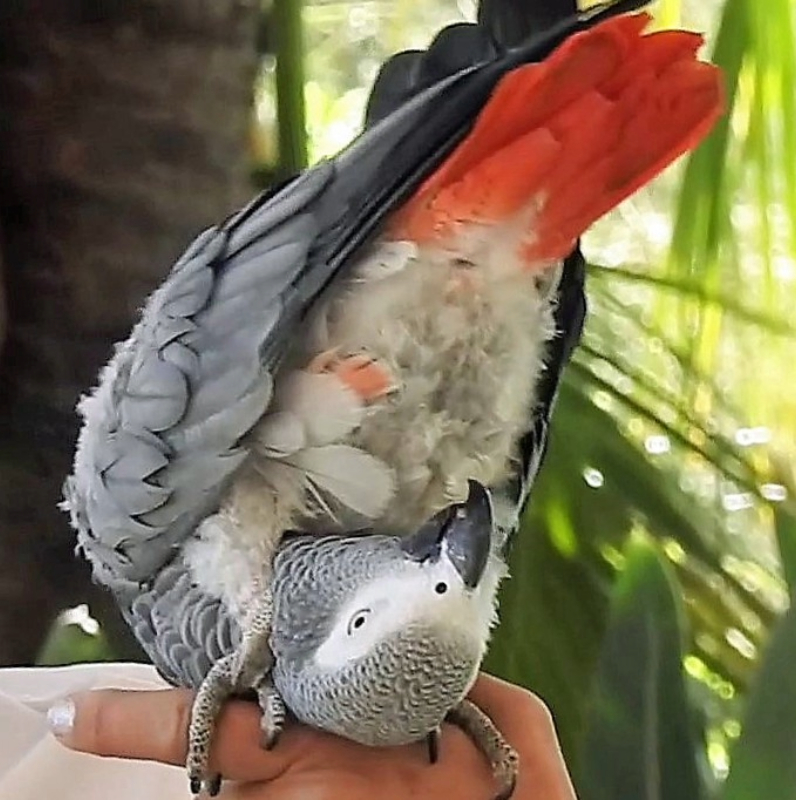
Figure 29. African Gray Parrots are prized for their intelligence, which makes them well suited both to showing off and to performing cognitive tests.
Alex could also count up to six, but other birds have counted up to eight. Other parrots have also shown remarkable intelligence in responding to training tasks. One reason parrots may show greater intelligence than many other birds is that they live a long time, so later training can build on earlier training. Perhaps a bird with a large song repertoire or a complexly intricate nest or a sophisticated society would be able to do likewise, given an extraordinarily long lifespan.
Chapter 17. Summary and Conclusions
Skutch reviewed some of the evidence of the amazing ways in which birds’ minds work:
- Their remarkable recognition of individual birds among their own group, their own species, and even of neighboring species, as well as of humans with whom they interact
- Their memory for songs, nest-building techniques, and migration routes, which can extend over great distances, and can require them to figure out how to correct their navigation when blown off course
- Their emotional attachment to their mate (often lifelong) and to their eggs and nestlings, as well as their devotion as parents
- Their altruistic behavior not only toward their own family, but also to their own group and even toward other birds with whom they have no particular ties
- Their ability to form and maintain complex societies offering one another mutual support and communal aid
- Their inventiveness in figuring out how best to defend themselves and their young from potential threats, including dissimulations of feigned injury
- Their capacity for enjoyment and play
- Their aesthetic sensibility in perfecting their own songs, nests, courtship displays, and dances, as well as a female’s sensibility in choosing a mate with the finest plumage, song, courtship display, or other demonstration of his genetic fitness
- Their performance on cognitive tasks, such as counting, solving puzzles, developing conceptual categories
- Their keen sense of time, as a guide to other actions
- Their use of tools
Of course, not all birds show all of these mental aptitudes, but across the array of bird species, all seem to show one or more of them. Skutch also wonders what else birds might be able to do if all species lived as long as parrots or if any species had hands with which to implement their ideas. He concludes his book by noting, that we humans should do all we can “to protect the birds, whose minds are among nature’s greatest wonders” (p. 164).
Resources
Birds of the World (online paid subscription)
- Cattle-Egret, Western (Ardea ibis) — Telfair II, R. C. (2024). Western Cattle-Egret (Ardea ibis), version 1.1. In Birds of the World (P. G. Rodewald, B. K. Keeney, S. M. Billerman, and M. A. Bridwell, Editors). Cornell Lab of Ornithology, Ithaca, NY, USA. https://doi.org/10.2173/bow.categr1.01.1
- Cockatoo, Palm (Probosciger aterrimus) — Rowley, I. and G. M. Kirwan (2020). Palm Cockatoo (Probosciger aterrimus), version 1.0. In Birds of the World (J. del Hoyo, A. Elliott, J. Sargatal, D. A. Christie, and E. de Juana, Editors). Cornell Lab of Ornithology, Ithaca, NY, USA. https://doi.org/10.2173/bow.palcoc1.01
- Egret, Great (Ardea alba) — McCrimmon Jr., D. A., J. C. Ogden, G. T. Bancroft, A. Martínez-Vilalta, A. Motis, G. M. Kirwan, and P. F. D. Boesman (2020). Great Egret (Ardea alba), version 1.0. In Birds of the World (S. M. Billerman, Editor). Cornell Lab of Ornithology, Ithaca, NY, USA. https://doi.org/10.2173/bow.greegr.01
- Fruit-Dove, Beautiful (Ptilinopus pulchellus) — Baptista, L. F., P. W. Trail, H. M. Horblit, and E. Garcia (2020). Beautiful Fruit-Dove (Ptilinopus pulchellus), version 1.0. In Birds of the World (J. del Hoyo, A. Elliott, J. Sargatal, D. A. Christie, and E. de Juana, Editors). Cornell Lab of Ornithology, Ithaca, NY, USA. https://doi.org/10.2173/bow.befdov1.01
- Fruit-Dove, Black-chinned (Ptilinopus leclancheri) — Baptista, L. F., P. W. Trail, H. M. Horblit, G. M. Kirwan, P. F. D. Boesman, and E. Garcia (2025). Black-chinned Fruit-Dove (Ptilinopus leclancheri), version 1.1. In Birds of the World (J. del Hoyo, A. Elliott, J. Sargatal, D. A. Christie, E. de Juana, and N. D. Sly, Editors). Cornell Lab of Ornithology, Ithaca, NY, USA. https://doi.org/10.2173/bow.bcfdov1.01.1
- Fruit-Dove, Black-naped (Ptilinopus melanospilus) — Baptista, L. F., P. W. Trail, H. M. Horblit, P. F. D. Boesman, and E. Garcia (2020). Black-naped Fruit-Dove (Ptilinopus melanospilus), version 1.0. In Birds of the World (J. del Hoyo, A. Elliott, J. Sargatal, D. A. Christie, and E. de Juana, Editors). Cornell Lab of Ornithology, Ithaca, NY, USA. https://doi.org/10.2173/bow.bknfrd1.01
- Fruit-Dove, Coroneted (Ptilinopus coronulatus) — Baptista, L. F., P. W. Trail, H. M. Horblit, and E. Garcia (2020). Coroneted Fruit-Dove (Ptilinopus coronulatus), version 1.0. In Birds of the World (J. del Hoyo, A. Elliott, J. Sargatal, D. A. Christie, and E. de Juana, Editors). Cornell Lab of Ornithology, Ithaca, NY, USA. https://doi.org/10.2173/bow.cofdov1.01
- Fruit-Dove, Jambu (Ptilinopus jambu) — Baptista, L. F., P. W. Trail, H. M. Horblit, P. F. D. Boesman, and E. Garcia (2020). Jambu Fruit-Dove (Ptilinopus jambu), version 1.0. In Birds of the World (J. del Hoyo, A. Elliott, J. Sargatal, D. A. Christie, and E. de Juana, Editors). Cornell Lab of Ornithology, Ithaca, NY, USA. https://doi.org/10.2173/bow.jafdov1.01
- Fruit-Dove, Orange-bellied (Ptilinopus iozonus) — Baptista, L. F., P. W. Trail, H. M. Horblit, and E. Garcia (2020). Orange-bellied Fruit-Dove (Ptilinopus iozonus), version 1.0. In Birds of the World (J. del Hoyo, A. Elliott, J. Sargatal, D. A. Christie, and E. de Juana, Editors). Cornell Lab of Ornithology, Ithaca, NY, USA. https://doi.org/10.2173/bow.obfdov1.01
- Fruit-Dove, Pink-headed (Ptilinopus porphyreus) — Baptista, L. F., P. W. Trail, H. M. Horblit, P. F. D. Boesman, and E. Garcia (2020). Pink-headed Fruit-Dove (Ptilinopus porphyreus), version 1.0. In Birds of the World (J. del Hoyo, A. Elliott, J. Sargatal, D. A. Christie, and E. de Juana, Editors). Cornell Lab of Ornithology, Ithaca, NY, USA. https://doi.org/10.2173/bow.phfdov1.01
- Fruit-Dove, Wompoo (Ptilinopus magnificus) — Baptista, L. F., P. W. Trail, H. M. Horblit, and E. Garcia (2020). Wompoo Fruit-Dove (Ptilinopus magnificus), version 1.0. In Birds of the World (J. del Hoyo, A. Elliott, J. Sargatal, D. A. Christie, and E. de Juana, Editors). Cornell Lab of Ornithology, Ithaca, NY, USA. https://doi.org/10.2173/bow.wofdov1.01
- Grebe, Clark’s (Aechmophorus clarkii) — LaPorte, N., R. W. Storer, and G. L. Nuechterlein (2020). Clark’s Grebe (Aechmophorus clarkii), version 1.0. In Birds of the World (P. G. Rodewald, Editor). Cornell Lab of Ornithology, Ithaca, NY, USA. https://doi.org/10.2173/bow.clagre.01
- Grebe, Western (Aechmophorus occidentalis) LaPorte, N., R. W. Storer, and G. L. Nuechterlein (2020). Western Grebe (Aechmophorus occidentalis), version 1.0. In Birds of the World (P. G. Rodewald, Editor). Cornell Lab of Ornithology, Ithaca, NY, USA. https://doi.org/10.2173/bow.wesgre.01
- Heron, Green (Butorides virescens) — Davis Jr., W. E. and J. A. Kushlan (2020). Green Heron (Butorides virescens), version 1.0. In Birds of the World (A. F. Poole and F. B. Gill, Editors). Cornell Lab of Ornithology, Ithaca, NY, USA. https://doi.org/10.2173/bow.grnher.01
- Jacana, Wattled (Jacana jacana) — Jenni, D. A. and G. M. Kirwan (2020). Wattled Jacana (Jacana jacana), version 1.0. In Birds of the World (J. del Hoyo, A. Elliott, J. Sargatal, D. A. Christie, and E. de Juana, Editors). Cornell Lab of Ornithology, Ithaca, NY, USA. https://doi.org/10.2173/bow.watjac1.01
- Killdeer (Charadrius vociferus) — Jackson, B. J. and J. A. Jackson (2020). Killdeer (Charadrius vociferus), version 1.0. In Birds of the World (A. F. Poole and F. B. Gill, Editors). Cornell Lab of Ornithology, Ithaca, NY, USA. https://doi.org/10.2173/bow.killde.01
- Loon, Common (Gavia immer) — Paruk, J. D., D. C. Evers, J. W. McIntyre, J. F. Barr, J. Mager, and W. H. Piper (2021). Common Loon (Gavia immer), version 2.0. In Birds of the World (P. G. Rodewald and B. K. Keeney, Editors). Cornell Lab of Ornithology, Ithaca, NY, USA. https://doi.org/10.2173/bow.comloo.02
- Loon, Pacific (Gavia pacifica) — Russell, R. W. (2020). Pacific Loon (Gavia pacifica), version 1.0. In Birds of the World (P. G. Rodewald, Editor). Cornell Lab of Ornithology, Ithaca, NY, USA. https://doi.org/10.2173/bow.pacloo.01
- Loon, Red-throated (Gavia stellata) — Rizzolo, D. J., C. E. Gray, J. A. Schmutz, J. F. Barr, C. Eberl, and J. W. McIntyre (2020). Red-throated Loon (Gavia stellata), version 2.0. In Birds of the World (P. G. Rodewald and B. K. Keeney, Editors). Cornell Lab of Ornithology, Ithaca, NY, USA. https://doi.org/10.2173/bow.retloo.02
- Parrot, Gray (Psittacus erithacus) — Kirwan, G. M., C. J. Sharpe, N. Moura, and P. F. D. Boesman (2023). Gray Parrot (Psittacus erithacus), version 1.2. In Birds of the World (G. M. Kirwan, P. G. Rodewald, B. K. Keeney, and S. M. Billerman, Editors). Cornell Lab of Ornithology, Ithaca, NY, USA. https://doi.org/10.2173/bow.grepar.01.2
- Penguin, African (Spheniscus demersus) Martínez, I., D. A. Christie, F. Jutglar, and E. Garcia (2020). African Penguin (Spheniscus demersus), version 1.0. In Birds of the World (J. del Hoyo, A. Elliott, J. Sargatal, D. A. Christie, and E. de Juana, Editors). Cornell Lab of Ornithology, Ithaca, NY, USA. https://doi.org/10.2173/bow.jacpen1.01
- Phoebe, Black (Sayornis nigricans) — Wolf, B. O. (2020). Black Phoebe (Sayornis nigricans), version 1.0. In Birds of the World (A. F. Poole and F. B. Gill, Editors). Cornell Lab of Ornithology, Ithaca, NY, USA. https://doi.org/10.2173/bow.blkpho.01
- Plover, Black-bellied (Pluvialis squatarola) — Poole, A. F., P. Pyle, M. A. Patten, and D. R. Paulson (2020). Black-bellied Plover (Pluvialis squatarola), version 1.0. In Birds of the World (S. M. Billerman, Editor). Cornell Lab of Ornithology, Ithaca, NY, USA. https://doi.org/10.2173/bow.bkbplo.01
- Quetzal, Golden-headed (Pharomachrus auriceps) — Collar, N. and A. Bonan (2020). Golden-headed Quetzal (Pharomachrus auriceps), version 1.0. In Birds of the World (J. del Hoyo, A. Elliott, J. Sargatal, D. A. Christie, and E. de Juana, Editors). Cornell Lab of Ornithology, Ithaca, NY, USA. https://doi.org/10.2173/bow.gohque1.01
- Also, Wikipedia, https://en.wikipedia.org/wiki/Golden-headed_quetzal
- Raven, Common (Corvus corax) — Boarman, W. I. and B. Heinrich (2020). Common Raven (Corvus corax), version 1.0. In Birds of the World (S. M. Billerman, Editor). Cornell Lab of Ornithology, Ithaca, NY, USA. https://doi.org/10.2173/bow.comrav.01
- Starling, European (Sturnus vulgaris) — Cabe, P. R. (2020). European Starling (Sturnus vulgaris), version 1.0. In Birds of the World (S. M. Billerman, Editor). Cornell Lab of Ornithology, Ithaca, NY, USA. https://doi.org/10.2173/bow.eursta.01
- Starling, Metallic (Aplonis metallica) — Craig, A. J. F. and C. J. Feare (2020). Metallic Starling (Aplonis metallica), version 1.0. In Birds of the World (J. del Hoyo, A. Elliott, J. Sargatal, D. A. Christie, and E. de Juana, Editors). Cornell Lab of Ornithology, Ithaca, NY, USA. https://doi.org/10.2173/bow.metsta1.01
- Tern, Caspian (Hydroprogne caspia) — Cuthbert, F. J. and L. R. Wires (2020). Caspian Tern (Hydroprogne caspia), version 1.0. In Birds of the World (S. M. Billerman, Editor). Cornell Lab of Ornithology, Ithaca, NY, USA. https://doi.org/10.2173/bow.caster1.01
- Tern, Elegant (Thalasseus elegans) — Burness, G. P., K. L. Lefevre, and C. T. Collins (2020). Elegant Tern (Thalasseus elegans), version 1.0. In Birds of the World (A. F. Poole and F. B. Gill, Editors). Cornell Lab of Ornithology, Ithaca, NY, USA. https://doi.org/10.2173/bow.eleter1.01
- Tern, Forster’s (Sterna forsteri) — McNicholl, M. K., P. E. Lowther, and J. A. Hall (2020). Forster’s Tern (Sterna forsteri), version 1.0. In Birds of the World (A. F. Poole and F. B. Gill, Editors). Cornell Lab of Ornithology, Ithaca, NY, USA. https://doi.org/10.2173/bow.forter.01
- Willet (Tringa semipalmata) — Lowther, P. E., H. D. Douglas III, and C. L. Gratto-Trevor (2020). Willet (Tringa semipalmata), version 1.0. In Birds of the World (A. F. Poole and F. B. Gill, Editors). Cornell Lab of Ornithology, Ithaca, NY, USA. https://doi.org/10.2173/bow.willet1.01
- Woodpecker, Acorn (Melanerpes formicivorus) — Koenig, W. D., E. L. Walters, P. B. Stacey, M. T. Stanback, and R. L. Mumme (2020). Acorn Woodpecker (Melanerpes formicivorus), version 1.0. In Birds of the World (P. G. Rodewald and B. K. Keeney, Editors). Cornell Lab of Ornithology, Ithaca, NY, USA. https://doi.org/10.2173/bow.acowoo.01
Other Resource
Polarized light and navigation — https://en.wikipedia.org/wiki/Polarization_(waves)#Polarization_and_vision
Photos of Golden-headed Quetzal by Paul Colo; all other photos and all text by Shari Dorantes Hatch. Copyright © 2025. All rights reserved.
 Bird Brain
Leave a comment