
*
- Galliformes
- Description
- Sounds and Vocalizations
- Distribution and Habitat
- Locomotion
- Diet and Foraging
- Breeding
- Lifespan
- Numididae
- Description
- Sounds and Vocalizations
- Distribution
- Habitat
- Locomotion
- Diet and Foraging
- Breeding
- Conservation Status
- Human interactions
- Helmeted Guineafowl (Numida meleagris)
- Description
- Sounds and Vocalizations
- Distribution
- Habitat
- Locomotion
- Diet and Foraging
- Social Behavior
- Breeding
- Conservation Status
- Lifespan
- Eastern Crested Guineafowl (Guttera pucherani)
- Description
- Sounds and Vocalizations
- Distribution and Locomotion
- Habitat
- Diet and Foraging
- Social Behavior
- Breeding
- Conservation Status
- Resources
- Books on Birds
- Online Resources
- Etymology
- General Resources
Galliformes
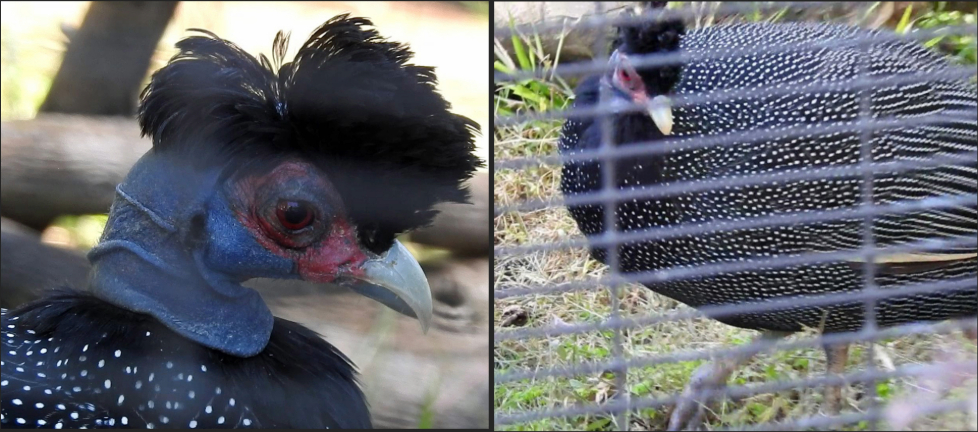
Figure 00. Guineafowl, such as this Eastern Crested Guineafowl, are members of the Numidae family, one of five families in the order Galliformes. These widespread, much beloved birds have a distinctive rotund appeal.
Scientists group birds (and other animals) into a hierarchy, to more easily see which birds are more closely related to one another. Here’s the hierarchy for two species of guineafowl: Helmeted Guineafowl and Eastern Crested Guineafowl:
- kingdom Animalia
- phylum Chordata
- class Aves, all living birds (about 45 orders of birds)
- order Galliformes (5 families, about 290 of the 10,000 bird species)
- family Numididae (4 genera; 8 species)
- Numida genus (1 species, Numida meleagris)
- Guttera genus (4 species, including Guttera pucherani)
- family Numididae (4 genera; 8 species)
- order Galliformes (5 families, about 290 of the 10,000 bird species)
- class Aves, all living birds (about 45 orders of birds)
- phylum Chordata
Galliformes birds spend most of their time on the ground, where they feed. Gallinaceous birds (Gallus, Latin, chicken “cock”) typically have a shape similar to chickens (which are within this order). Most can be called “game birds,” vulnerable to predation by human hunters; also, many species are raised for their meat or eggs, as food for humans, a relationship that has continued for centuries.
The five families within the Galliformes order are
- Megapodiidae, megapodes, known for creating giant mounds for incubating their young, such as malleefowl and brush-turkeys
- Cracidae, guans, including chachalacas and curassows
- Odontophoridae, New World quails, such as California Quail (Callipepla californica) and Gambel’s Quail (Callipepla gambelii)
- Phasianidae, pheasants and allies, including chickens (“junglefowl”), quails (of Africa, Asia, Australia, etc.), partridges, pheasants, tragopans, monals, ptarmigans, francolins, turkeys, peafowl, and grouses
- Numididae (8 species of guineafowls)
Description
Galliformes have heavy, plump, rounded bodies, making them attractive for human consumption. They have long necks and longish legs, with anisodactyl toes (three pointing forward, one facing backward), like perching birds. Some species are sexually dimorphic, with the males more colorful than the females. Also, the adult males of some species grow one or more sharp spurs on the back of each leg, which can be used as weapons for fighting. In general, species that must move around a great deal to find food show less sexual dimorphism than species that are more sedentary. The rounded, short, wide wings of gallinaceous birds are best suited to flying short distances. Their sizes range widely, from the 5″ 1-ounce Blue-breasted Quail (Synoicus chinensis) to the 49″ 384-oz. male North American Wild Turkey (Meleagris gallopavo, up to 125 cm tall, 11 kg, 24 pounds).

Figure 01. This Helmeted Guineafowl illustrates the body shape of gallinaceous birds: big rounded bodies, thick, strong legs and toes.
Sounds and Vocalizations
Gallinaceous birds use visual displays and vocalizations for communication, courtship, fighting, territoriality, and brooding.
Distribution and Habitat
Almost ubiquitous (inhabiting every continent except Antarctica), gallinaceous birds have adapted to almost any environment other than desert extremes and year-round ice. Most species are not migratory, but some species (e.g., quails) do migrate. Most species are terrestrial, but some are arboreal. The large, rounded body shapes and thick plumage of gallinaceous birds are well suited to cold climates, though their young may be more vulnerable in chilly weather.

Figure 02. Like other gallinaceous birds, the large rounded body of this Eastern Crested Guineafowl makes it highly adaptable to a wide variety of environments.
Locomotion
Gallinaceous birds can fly, having powerful flight muscles. Nonetheless, most of these species are more likely to run than to fly when evading predators, and they typically walk to move from one place to another. Some species routinely walk many miles each day.
Diet and Foraging
Gallinaceous birds have varied dietary preferences. Some species are mostly herbivorous ground-feeding seed eaters, who play important roles in their ecosystems, dispersing seeds wherever they go. Species with short, thick bills are well suited to plucking rootlets and other plant materials from the ground; other herbivorous species forage in the forest canopy. In wintry conditions, some species can extract enough energy and nutrients from densely fibrous plant materials such as twigs and conifer needles, as well as any plant buds available. Some species can feed on plants containing chemicals aversive to other herbivores.
A few species extract invertebrates from rotting wood, whereas others snag invertebrates from sand, shallow water, or leaf litter. Many species are omnivorous, eating fruits, seeds, leaves, shoots, flowers, tubers, roots, insects and larvae, snails, worms, other invertebrates (e.g., mollusks, crustaceans), lizards, snakes (a favorite of peafowl), amphibians, small rodents, and eggs. In short, many omnivorous gallinaceous birds feed opportunistically, taking advantage of whatever food sources are available at the time.
Breeding
Mating strategies among Galliformes vary widely, with some species monogamous, others polygynous or otherwise polygamous. Non-monogamous species tend to show more sexual dimorphism. Also, the males of some species have elaborate courtship displays, including specialized vocalizations and movements, strutting and showing off their plumage. These birds breed seasonally, choosing a time when food is most readily and widely available, and making nests on the ground or in trees. Highly prolific, gallinaceous species lay clutches of 3–16 eggs/year. When their eggs hatch, the hatchlings are precocious and able to follow their parent (or parents in monogamous pairs) within hours after hatching.
The most unusual breeding strategy is that of the Megapodiidae, who build mounds that will provide adequate heat for incubating their eggs (from rotting vegetation or hot ash or sand). Upon hatching, the fully feathered youngsters must dig their way out of the mound, but by the time they emerge, they can already fly quite a distance.
Lifespan
Gallinaceous birds live 5–8 years in the wild and up to 30 years in captivity.
Numididae
The Numididae family includes four genera (with eight species) of guineafowl, all of which are social, typically living either in smaller groups or in larger flocks. Numida (Greek, “nomad”) describes the habitual wandering of these birds, often for many miles each day, foraging for food.
Description
Guineafowl are fairly large birds, about 15.5–28″ long (bill to tail; 40–71 cm), weighing about 1½–3½ pounds (700–1,600 g; 24.7–56.5 ounces), with females generally weighing more than males. Females may weigh more because of their larger reproductive organs, needed to produce large clutches of eggs. Their bodies are ovoid, similar to partridges, with rump and tail sloped downward. Their legs are thick and somewhat long, with thick, long-clawed anisodactyl toes (3 frontward, 1 backward). Most have short wings and short tails. In some species, the top half of their long neck is unfeathered, and in all species, the head is all or mostly unfeathered. Some species have a feather plume or a crest atop the head, and some have a wattle or a comb. The guineafowl bill is of medium length, stout, and slightly decurved.
Figure 03. Guineafowl, such as this Eastern Crowned Guineafowl, have compact, rounded bodies, sloping rump and tail, thick longish legs.
Sounds and Vocalizations
The vocalizations of males and females are different enough that their calls can be used to distinguish which is which. See https://xeno-canto.org/explore?query=numididae for a variety of guineafowl calls.
Distribution
In the wild, they can be found across sub-Saharan Africa, as well in some areas of west-central Africa and northeast Africa. The name “guineafowl” points to these birds having been endemic to Guinea, in west Africa.
Habitat
In the wild, many guineafowl species can be found on open savannas and arid grasslands, whereas others prefer wooded areas such as dense tropical forests and other woodlands, sometimes seen perching high atop trees.
Locomotion
Unlike other Galliformes families, wild guineafowl are strong, capable flyers, whose powerful breast muscles enable them to fly long distances if they need to. In open savannas, fires frequently threaten them, so their flying abilities probably save their lives on occasion.
Diet and Foraging
Guineafowl species can be herbivorous, eating plant matter (roots, bulbs, seeds, nuts, leaves, buds, and fruit), or carnivorous, eating various invertebrates, or both. Like other Galliformes, guineafowl forage mostly on the ground, using both their long-clawed toes and their decurved bills to root out both plant matter and insects. Guineafowl also follow herds of large mammals while foraging. These mammals stir up insects for the guineafowl to eat, and the guineafowl return the favor by eating ticks, flies, locusts, scorpions, and other invertebrates that pester the mammals. Guineafowl also forage beneath monkey troops, plucking maggots from the monkey manure or eating other tidbits dropped by the monkeys.
Breeding
Guineafowl are both sexually monomorphic (males and females look similar) and monogamous (forming mated pairs), either for life or serially during each breeding season. Prospective parents look for nest sites that are hidden by grass or are near the base of a tree. Nests are typically just shallow scrapes, which the parents may line with leaves or feathers. Females lay anywhere from 4 to 19 eggs; the females typically incubate the eggs most of the time, but males stand guard, nearby. After 23–28 days of incubation, both parents brood and feed the precocial chicks (feathered, able to locomote, and able to regulate their own body temperature). The chicks can leave the nest soon after hatching, and both parents defend the chicks from predators while leading them to forage for their own food. Young guineafowl are highly vulnerable to cold temperatures. At night, the female typically broods the chicks, but if temperatures drop below freezing, the male may join her to keep them warm.
Conservation Status
Most guineafowl species are abundant — 87.5% being categorized as “LC, Least Concern.” Only one species is listed as “VU, Vulnerable,” due to hunting and to rapid habitat destruction.
Human Interactions
Around the world, farmers keep guineafowl chiefly to eat as game fowl (said to be leaner than turkey or chicken; eggs are much richer than chicken eggs). Farmers also keep guineafowl for what the birds eat — their prodigious consumption of tick pests, which can otherwise spread diseases. Some also may deter fox predators, and they serve as companionable pets.
Visitors to zoos relish seeing guineafowl, too, and the two species pictured here are from the San Diego Zoo’s Safari Park.
Helmeted Guineafowl
(Numida meleagris)
The Helmeted Guineafowl (Numida meleagris) is perhaps the best known of the Numididae (guineafowl) family, and it’s the only member of the genus Numida. Numida refers to this guineafowl’s tendency to wander long distances each day; meleagris (Greek, “speckled”) highlights the intricate patterns of its feathers. A Greek legend may also be related, in that the sisters of Meleagros, whose father was king of a Greek city-state, were transformed into guineafowl when Meleagros died. “Helmeted” points to the bony casque or “helmet” atop the heads of both males and females.

Figure 04. All of this bird’s names aptly describe it: “Helmeted,” “Guineafowl” (originally from western Africa), Numida (wandering), and meleagris (“speckled”).
Description
Helmeted Guineafowl are biggish birds, about 21–25″ long (53–63 cm, bill to tail), with females and males similar in length and weight, 40–64 ounces (1135–1823 g; 2.5–4 lb.). A short tail and short, rounded wings suit its compact round body, atop which is a small featherless head and long neck. Most of the neck is light-blue to bluish-white bare skin, but black feathers extend upward on the back of the neck, from the shoulders to the head; these black feathers are wispy filoplumes (with few or no barbs, typically bare on most of their length). The front of the neck may also appear black. Red facial ornaments adorn the front of the face, adjoining its sharp decurved bill. The “helmet” on its crown is a brownish casque or “knob.” Its thick longish legs are black or dark gray. Its striking plumage is dark-gray to black, with contrasting white speckles that look more like spots on the upper wing and vermiculated stripes on the lower wing. Various subspecies show distinctive variations in facial adornments and coloration.
Sounds and Vocalizations
Flocks of Helmeted Guineafowl stay in contact with one another through their vocalizations, which can vary in length and intensity. Male and female vocalizations differ. See https://xeno-canto.org/explore?query=Helmeted%20Guineafowl for examples of their vocalizations. When alarmed, they call loudly and harshly.
Distribution
Native to sub-Saharan Africa, Helmeted Guineafowl have been widely introduced around the world as a domesticated species (e.g., North America, Australia, Europe, India, and South America), mostly as food, but also as pets. In addition, feral populations, offspring of domestic flocks, are now widely distributed around the areas where domestic populations exist.
Habitat
Though Helmeted Guineafowl adapt readily to various habitats, from savannahs to scrub to forest edges, they require access to drinking water and to suitable roosting sites in trees or shrubs, so they’re rarely seen in open grasslands. They’re not known to migrate.
Locomotion
Helmeted Guineafowl routinely walk 6 miles (10 km) or more daily. When threatened, they’re more likely to run than to fly, but they do fly. They have an explosive takeoff that leads to short-lived flight, and they count on gliding when they need to fly long distances.
Figure 05. Helmeted Guineafowl mostly walk, sometimes run, and rarely fly, to get wherever they want to go, especially when searching for food.
Diet and Foraging
Helmeted Guineafowl mostly eat plant matter (tubers, seeds, bulbs, roots, flowers), but they actually prefer to eat invertebrates (insects, snails, ticks, millipedes, etc.) whenever available; this preferred food, however, makes up only about 12% of their food intake, by volume. When breeding, they make an extra effort to obtain 80% of their food from invertebrates. One source of food is ticks picked from the backs of warthogs and other mammals, a diet that endears them to mammals, including humans.
Most of their foraging is done by scratching the ground with their powerful toes and strong claws.
Social Behavior
Outside of breeding season, Helmeted Guineafowl form gregarious flocks of about 25 birds, though flock size varies with the type of habitat and the associated territory size. Most flocks have relatively stable populations, with little turnover among birds. Their social organization includes a dominance hierarchy, with the highest-ranking male determining the daily activities of the group. Males may be aggressive toward one another, sometimes even physically fighting. The highest-ranking males are also charged with repelling any intruders threatening the group. The group roosts communally in places near access to drinking water.
Breeding
Though Helmeted Guineafowl are monogamous, they don’t maintain their pair-bond outside of breeding season (almost always during or just after seasonal rains, typically in summer). Females choose a well-hidden nest site, usually somewhere with long grass or beneath a bush or other dense cover. There, a simple scrape in the ground, lined with grass or feathers, suffices as a nest.
Typically, the mom lays 6–12 eggs, on 6–12 successive days. Observers have seen nests with larger numbers of eggs (20–50), but those probably include the eggs of more than one female. Once the clutch is complete, the female starts incubating all the eggs for 24–30 days, and hatching is almost synchronous. (Under managed care, the male may also incubate the eggs.) Within the first 2 weeks after hatching, the male broods the chicks for 80% of the time. By the end of 2 weeks, the chicks can flutter and fly awkwardly, and within 4 weeks, they have fully fledged. When the chicks are 1–3 months old, the whole family joins larger flocks of their species. Chicks are particularly vulnerable to cold wet weather, and chick mortality is high during the first year of life.
Conservation Status
Helmeted Guineafowl have an IUCN Red List status of LC, Least Concern. World population may be much more than 1 million individuals, with a generally stable population.
Lifespan
Helmeted Guineafowl live for up to 12 years in the wild.
Eastern Crested Guineafowl
(Guttera pucherani)
Like the Helmeted Guineafowl, part of the scientific name for the Eastern Crested Guineafowl (Guttera pucherani) refers to its plumage pattern — Guttera (Latin, “speckled”).
Description
The plumage of the Eastern Crested Guineafowl is black with tiny bluish-white polka-dots, and a long, lush, bushy black crest perches atop its head. The bare skin of its head and neck are mostly blue, with a large area of red skin surrounding its eyes and extending toward its bill. Each iris is intensely red. Its dark legs and toes are long and thick. Females are similar in size to males (but their average sizes are slightly smaller), about 19″ long (bill to tail, 48–50 cm) and 40 ounces (1149 g; 2.5 lb.).

Figure 06a-b. The Eastern Crested Guineafowl’s distinctive plumage and facial coloration call attention to this otherwise humble bird.
Sounds and Vocalizations
When compared with the Helmeted Guineafowl, the Eastern Crested Guineafowl is both less vocal and less raucous, but it’s not silent. Please check https://xeno-canto.org/species/Guttera-pucherani to hear its vocalizations.
Distribution and Locomotion
The Eastern Crested Guineafowl currently is distributed from southeastern Kenya to eastern Tanzania; it also inhabits southeastern Somalia, but its population there is diminishing. The Eastern Crested Guineafowl doesn’t migrate, though it does wander considerable distances each day. Like other guineafowl, it probably prefers walking and running to flying.
Habitat
The Eastern Crested Guineafowl inhabits various woodlands, such as forest edges, secondary forests, gallery forests, and mosaics of forests and savannas, as well as primary forests sometimes.
Diet and Foraging
The Eastern Crested Guineafowl omnivorously consumes plant matter (seeds, fruits, shoots, stems, leaves, bulbs, roots) and various invertebrates (larval and adult insects, as well as millipedes, spiders, and small snails). It does eat fruits from trees, but it forages mostly on the ground, using its feet to scratch debris, including leaf litter.
Figure 07. The formidable toes and bills of Eastern Crested Guineafowl ably forage and find food.
Social Behavior
Outside of breeding season, families of Eastern Crested Guineafowl form gregarious flocks of about 10‒30 birds, occasionally up to 50. These guineafowl may also be seen in small family groups or even in pairs, or as single birds.
Breeding
In the wet season, these monogamous guineafowl nest on the ground, hidden under dense cover, under a bush, or next to a log or tree roots. Each nest is a sparsely lined scrape on the ground. The female lays 4–5 eggs (but possibly 3–7), which she incubates for about 23 days. After their chicks hatch, both parents care for them. Within 14–21 days, the chicks can fly.
Conservation Status
The Eastern Crested Guineafowl is rated as “LC, Least Concern” IUCN Red List status. Its reclusive behavior may cause population estimates to be underestimates.
Resources
Books on Birds
- Winkler, David W., Shawn M. Billerman, Irby J. Lovette. (2015). Bird Families of the World: An Invitation to the Spectacular Diversity of Birds. Lynx, Cornell Lab of Ornithology.
- Galliformes, p. 43
- Numididae, pp. 48–49
- Galliformes, p. 43
- Elphick, Jonathan. (2014). The World of Birds. Firefly Books.
- Galliformes, pp. 277–284
- Guineafowl, Numididae, pp. 280–281
- Galliformes, pp. 277–284
Online Resources
- Birds of the World online paid subscription, Cornell Lab of Ornithology, Ithaca, NY
- Guineafowl (Numididae) — Winkler, D. W., S. M. Billerman, and I. J. Lovette (2020). Guineafowl (Numididae), version 1.0. In Birds of the World (S. M. Billerman, B. K. Keeney, P. G. Rodewald, and T. S. Schulenberg, Editors). Cornell Lab of Ornithology, Ithaca, NY, USA. https://doi.org/10.2173/bow.numidi1.01
- Eastern Crested Guineafowl (Guttera pucherani) — del Hoyo, J., I. Martínez, G. M. Kirwan, N. Collar, and D. A. Christie (2022). Eastern Crested Guineafowl (Guttera pucherani), version 1.0. In Birds of the World (P. G. Rodewald and S. M. Billerman, Editors). Cornell Lab of Ornithology, Ithaca, NY, USA. https://doi.org/10.2173/bow.cregui3.01
- Helmeted Guineafowl (Numida meleagris) — Martínez, I. and G. M. Kirwan (2020). Helmeted Guineafowl (Numida meleagris), version 1.0. In Birds of the World (J. del Hoyo, A. Elliott, J. Sargatal, D. A. Christie, and E. de Juana, Editors). Cornell Lab of Ornithology, Ithaca, NY, USA. https://doi.org/10.2173/bow.helgui.01
- Guineafowl (Numididae) — Winkler, D. W., S. M. Billerman, and I. J. Lovette (2020). Guineafowl (Numididae), version 1.0. In Birds of the World (S. M. Billerman, B. K. Keeney, P. G. Rodewald, and T. S. Schulenberg, Editors). Cornell Lab of Ornithology, Ithaca, NY, USA. https://doi.org/10.2173/bow.numidi1.01
- Wikipedia
- Galliformes — https://en.wikipedia.org/wiki/Galliformes
- Guineafowl, Numididae — https://en.wikipedia.org/wiki/Guineafowl
- Helmeted Guineafowl — https://en.wikipedia.org/wiki/Helmeted_guineafowl
- Eastern Crested Guineafowl — https://en.wikipedia.org/wiki/Eastern_crested_guineafowl
- Guineafowl, Numididae — https://en.wikipedia.org/wiki/Guineafowl
- Galliformes — https://en.wikipedia.org/wiki/Galliformes
Etymology
- Gotch, A. F. (Arthur Frederick). Birds—Their Latin Names Explained. Dorset, UK: Blandford Press.
- Gruson, Edward S. (1972). Words for Birds: A Lexicon of North American Birds with Biographical Notes. New York: Quadrangle Books.
- Lederer, Roger, & Carol Burr. (2014). Latin for Bird Lovers: Over 3,000 Bird Names Explored and Explained. Portland, OR: Timber Press.
General Resources
- Lovette, Irby, & John Fitzpatrick (Eds.). (2016). Handbook of Bird Biology. Cornell Lab of Ornithology.
- Morrison, Michael, Amanda Rodewald, Gary Voelker, Melanie Colón, & Jonathan Prather (Eds.). (2018). Ornithology: Foundation, Analysis, and Application. Johns Hopkins Press.
Text and photos by Shari Dorantes Hatch. Copyright © 2025. All rights reserved.
* In case you were wondering about the 18-day delay between this current blog and my previous blog (April 2), I’ve been undergoing extensive medical testing. With just two more tests forthcoming (assessing respiration capacity and checking the control of my sleep apnea), I think that I can confidently say that my main medical issue is that I’m old. I realize that I’m quite privileged to have lived long enough to have this medical issue.
I hope not to have many major delays in the future, but it’s possible that I may be unable to post much in late June or early July, while I’m recovering from surgery on both eyes to remove cataracts, possibly relieve my glaucoma, and improve my visual acuity. Again, I’m a lucky gal to be able to have these issues remediated, even if the process is less than blissful.
 Bird Brain
Leave a comment