
Contents
- Piciformes
- Ramphastidae
- Distribution and Habitat
- Description
- Diet and Foraging
- Breeding
- Keel-billed Toucan, Ramphastos sulfuratus
- Distribution and Habitat
- Description
- Vocalizations
- Behavior
- Locomotion
- Diet and Foraging
- Sociability and Breeding
- Predation
- Conservation Status
- Toco Toucan, Ramphastos toco
- Distribution and Habitat
- Description
- Vocalizations and Other Sounds
- Behavior
- Locomotion
- Diet and Foraging
- Sociability and Breeding
- Predation
- Conservation Status
- Toucans, compared with other birds in the S.D. Zoo’s Parker Aviary
- Resources
- General References
- Order-, Family-, Species-specific Information
- Etymology
- Generation Length
- IUCN Red List Status
- Longevity Data and Life Histories
- Vocalizations
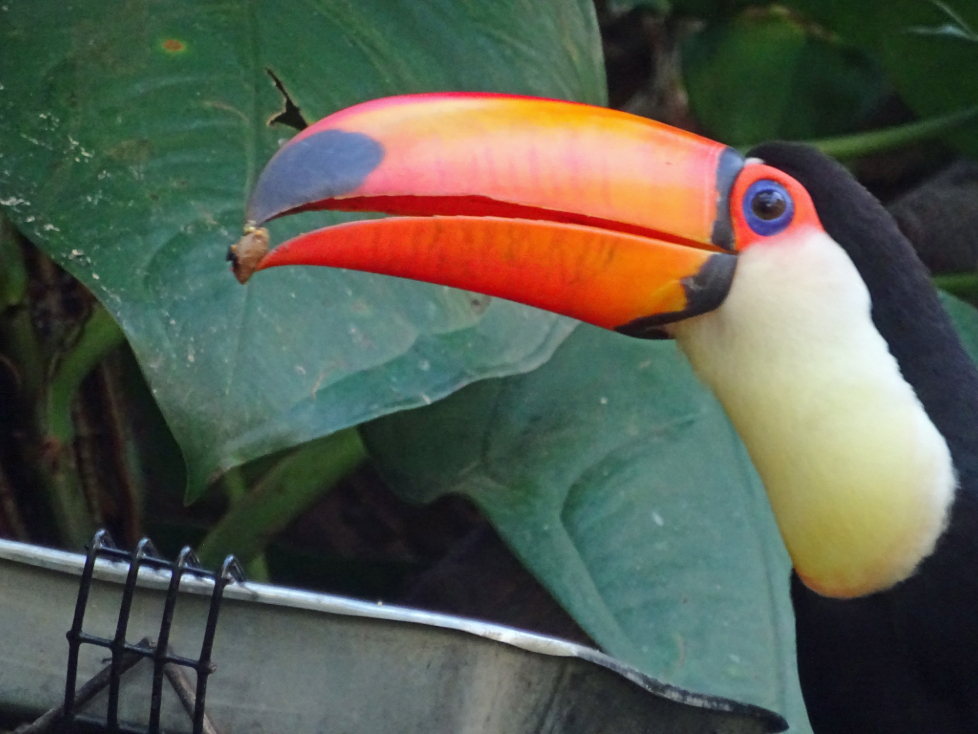

What’s not to love about a toucan — or a juvenile toucan?
Scientists group birds (and other animals) into a hierarchy, to more easily see which birds are more closely related to one another. Here’s the hierarchy for toucans:
- kingdom Animalia
- phylum Chordata
- class Aves, all living birds (about 45 orders of birds)
- order Piciformes (9 families, about 450 of the 10,000 bird species)
- family Ramphastidae (36 species, 5 genera)
- genus Ramphastos (7 species)
- family Ramphastidae (36 species, 5 genera)
- order Piciformes (9 families, about 450 of the 10,000 bird species)
- class Aves, all living birds (about 45 orders of birds)
- phylum Chordata
Piciformes
Piciformes include more than 450 species, in 9 families of mostly tree-dwelling birds. For more information about this order, please see my blog about another Piciformes bird, the Black-spotted Barbet: https://bird-brain.org/2025/02/24/exotic-birds-black-spotted-barbet/#Piciformes
Ramphastidae
The Ramphastidae family (36 species, 5 genera) well deserves its name: rhamphos, “beak” (Greek), and -astus, suffix for “huge.” A toucan beak can be more than half the length of the body in some species. The name “toucan” is Tupi (an indigenous Brazilian language) for its croaking call.

Figure 01. You can’t miss the ginormous bill of this juvenile Toco Toucan.
Distribution and Habitat
Neotropical toucans can be found in various woodlands from southern Mexico to northern Argentina. Most prefer lowland tropics, but some live in temperate climates high in the Andes. The Toco Toucan is the only toucan who prefers open woodlands or savannahs with forest patches. Like other Piciformes, when breeding, toucans need to be near trees with dead wood for their nest cavities. They don’t migrate.
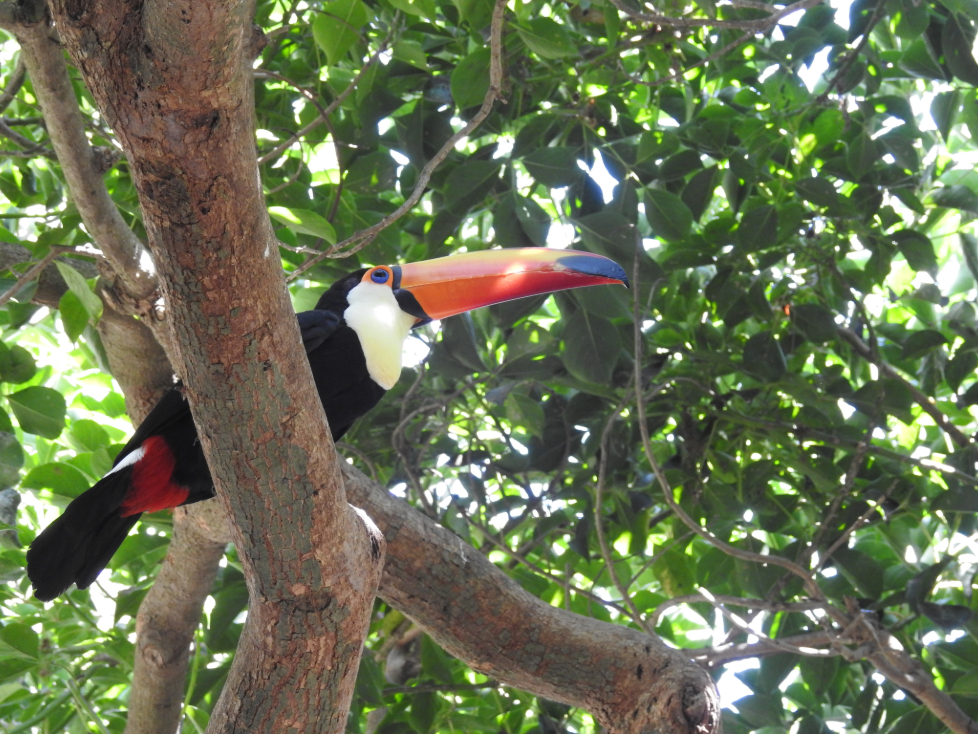
Figure 02. Toucans feel most at home in woodlands and other arboreal landscapes.
Description
The toucan’s most distinctive feature is its enormous, colorful, often decorative bill, with nostrils atop the base of the bill. Lightweight, with a spongy interior, a tough thin keratin sheath wraps around it. Inside the edge of the bill are forward-facing serrations for tearing food. The bill’s large surface area can radiate excess tropical heat, especially when it’s windy. Toucans may be able to modify the blood flow to their bills, increasing or decreasing the radiant effect. When sleeping, a toucan can minimize heat loss by tucking its bill under its wings. Other purposes of the big bill include eating, reaching (deep into tree-holes, out to distant branches), courting, preening, and defense. Toucans also have long, narrow, highly sensitive tongues (up to almost 6″ long). (For more about toucan bills, see my blog, “Big Bills,” https://bird-brain.org/2025/01/10/big-bills/)
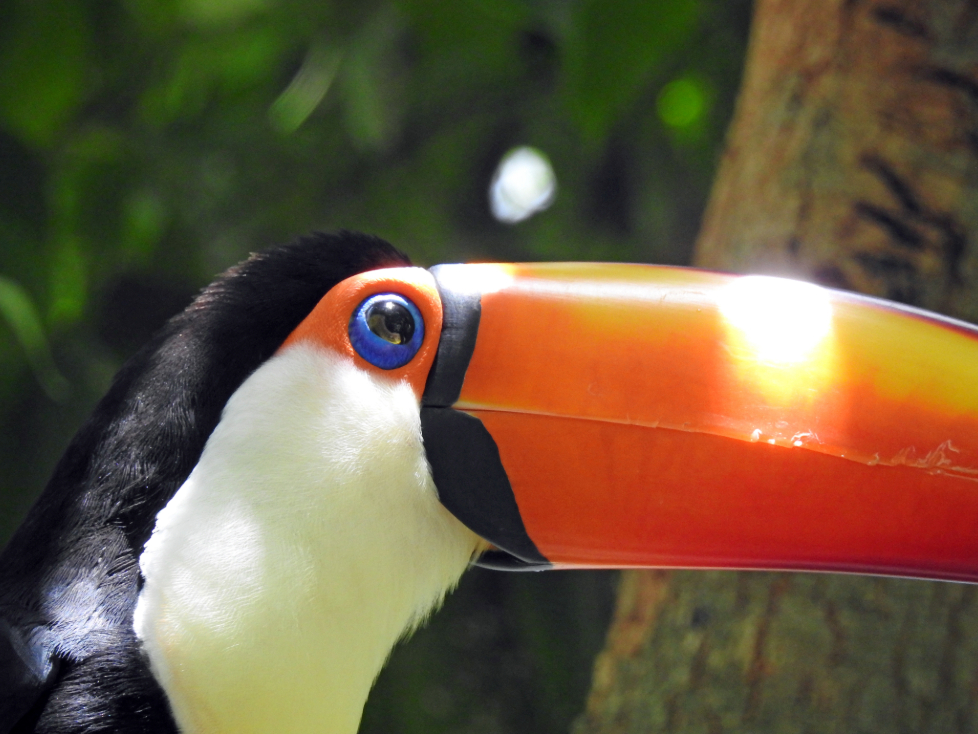
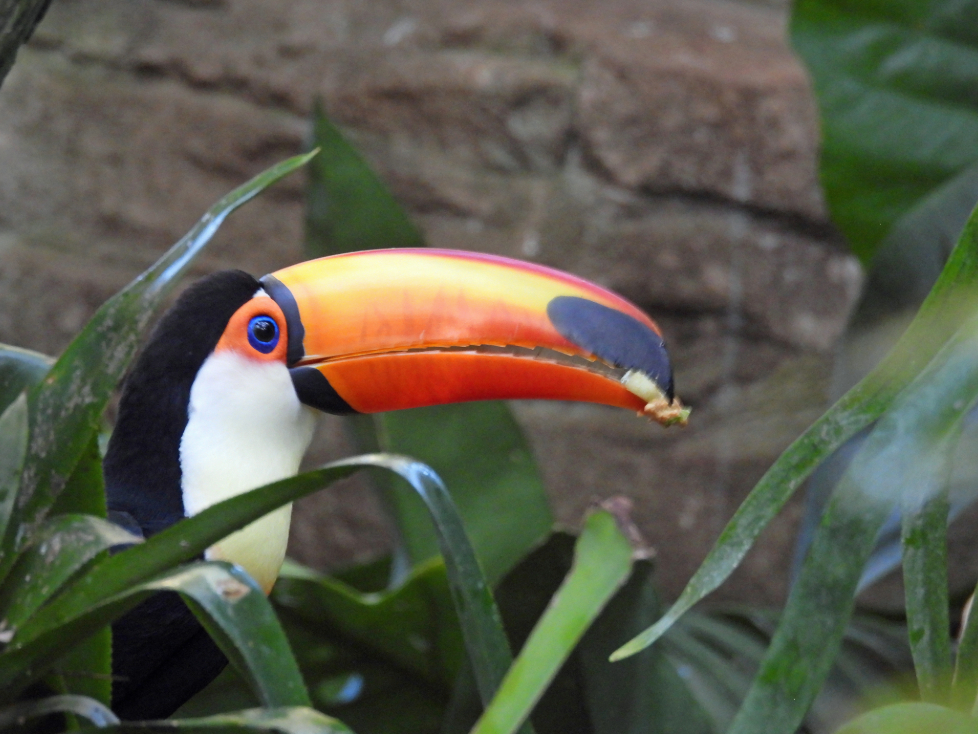
Figure 03(a,b). Toucan bills serve many important functions: cooling, grabbing food, eating, preening, wooing, defending, and more.
Toucan size varies greatly. The Lettered Aracari (Pteroglossus inscriptus), is about 11″ long and weighs about 4.6 ounces; the male Toco Toucan (Ramphastos toco) is about 22″ long and weighs about 28 ounces. The male Keel-billed Toucan (Ramphastos sulfuratus) is also about 22″ long but weighs just 15 ounces. The females of both toucan species weigh less than the males, and they have shorter, deeper bills, but their plumage looks like the males’. Toucan necks are short and thick, and their wings are small, which is fine for forest dwellers who travel only short distances. They have short, strong legs and zygodactyl toes (first and fourth toes pointing backward).


Figure 04(a,b). Toucans are beautifully adapted to their forest lifestyle, including their zygodactyl toes, making it easy to land on and to grasp tree branches.
In addition to the croaking call that gives them their Tupi name, toucans make growling or barking sounds, and they clatter or tap their bills.
Diet and Foraging
Toucans eat mostly fruit, readily dispersing fruit seeds around the forest. In addition, toucans eat arthropods (e.g., insects) and small vertebrates (e.g., frogs, lizards). They also prey on the eggs and chicks of other birds (much to the chagrin of other birds!). Toucans are especially predatory when feeding chicks of their own.
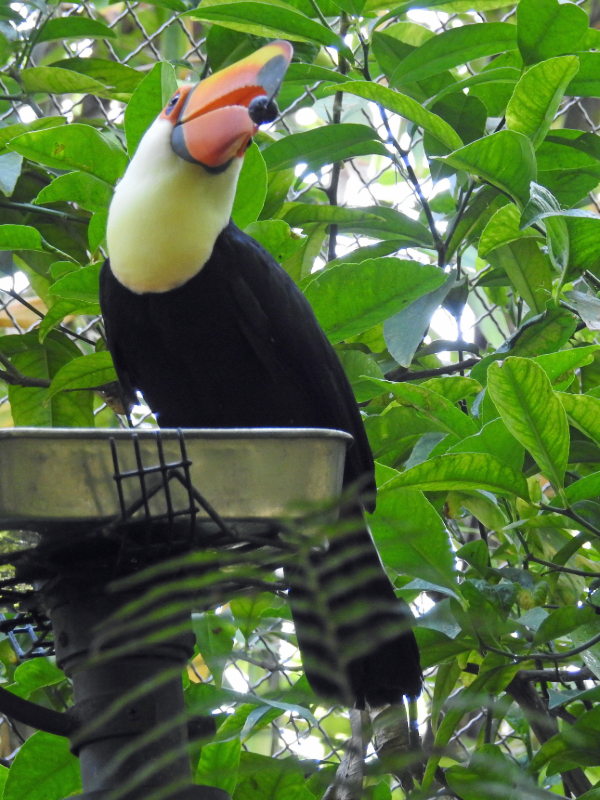
Figure 05. Fruits figure prominently in the toucan diet, and their huge bills easily manipulate fruits, tossing them back to be swallowed.
To eat, a toucan positions the food in the tip of its bill, then tosses the food back into its throat to swallow. When eating prey too large to be swallowed whole, a toucan holds it with its feet and uses its bill to pull off bits, tossing the bits back into its throat.
Breeding
Toucans are usually found in pairs or in flocks of up to 20 birds. During the breeding season, toucans may settle down into pairs, returning to the group later with their offspring. All toucans nest in cavities, but just a few excavate their own nests in soft, rotted wood, which they usually line with wood chips and regurgitated fruit seeds.
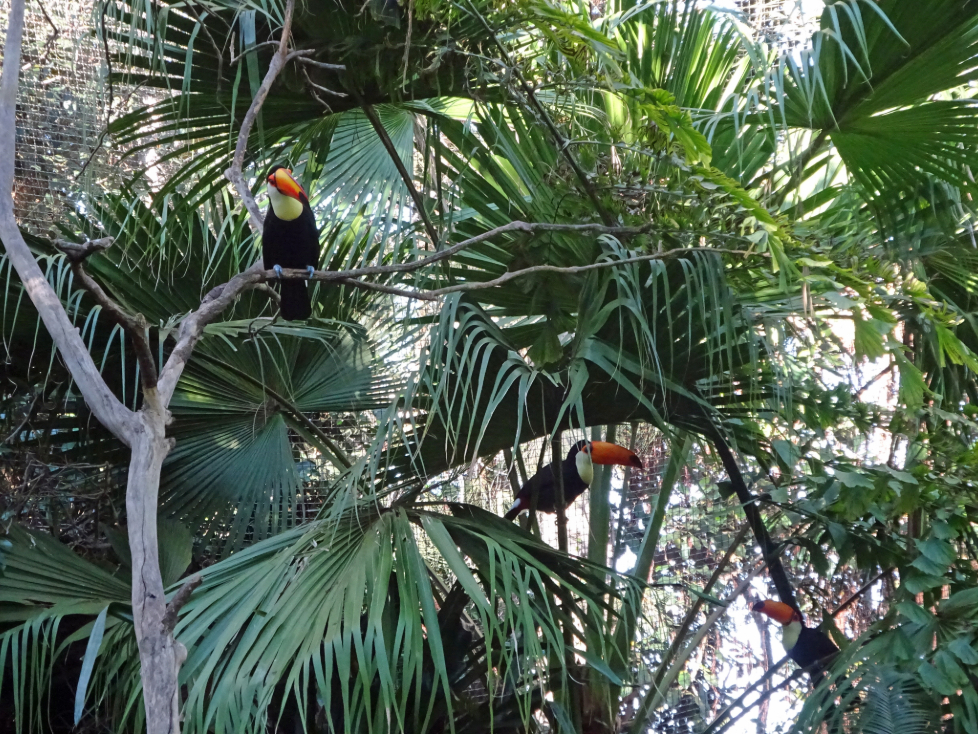
Figure 06. Toucans enjoy hanging out with other toucans.
Toucans are monogamous. Both parents incubate their eggs (1–5 eggs, 15–20 days) and care for their young. Their altricial chicks hatch blind, featherless (no down), and helpless, and they stay in the nest 40–60 days. Even after leaving the nest, chicks are still fed by both parents for up to 6 weeks more. Some toucan species breed cooperatively, with helpers for the breeding pair.
Keel-billed Toucan,
Ramphastos sulfur
OOPS! I have just learned (TODAY, right after posting this!) that the Parker Aviary NO LONGER hosts a Keel-billed Toucan! YIKES! But it’s still fun to find out about this cool bird, right? I hope you think so!
Distribution and Habitat
The national bird of Belize, the Keel-billed Toucan chiefly inhabits humid lowland (up to 5000 feet), tropical jungles, and evergreen forests from southern Mexico to northwestern South America. It lives mostly in the canopy of open rain forests and second-growth woodlands, but it can sometimes be found in drier forests along rivers and streams or even among the trees in coffee or cacao plantations.
Description
The bill of the Keel-billed Toucan—chartreuse with red, orange, and turquoise accents—is more than one fourth of its total length: 5–6″ bill, 20″ total length. Males are longer, heavier, and have longer bills than females, but their coloration is similar. Ramphastos sulfuratus (“sulfur,” yellow) has a bright yellow face, throat, and bib. Unfeathered chartreuse skin surrounds its shiny dark eyes (with greenish irises), complemented by black plumage over its back, wings, belly, and tail. Add to that some white rump feathers, red undertail feathers, blue legs and toes, and black claws, it earns being called the most colorful toucan.
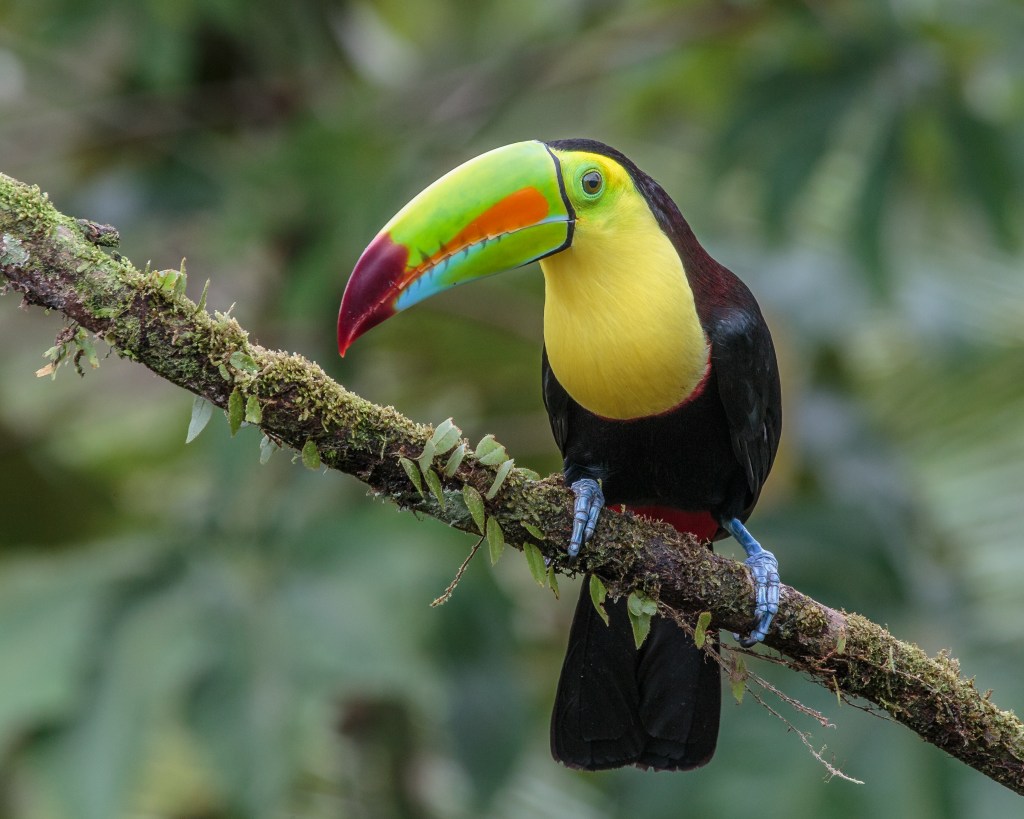
Figure 07. The Keel-billed Toucan has been called the most colorful toucan, with its blue toes, its red undertail, chartreuse eye rims, yellow face and bib, and vividly multicolored bill. Source: Andy Morffew from Itchen Abbas, Hampshire, UK; licensing w:en:Creative Commons; this file is licensed under the Creative Commons Attribution 2.0 Generic license; may be shared if attribution is given.
Vocalizations
Early in the breeding season, these toucans may vocalize loudly and distinctively between dawn and dusk. Both sexes call and occasionally duet, but the female’s call is higher pitched. Hatchlings sometimes hum-buzz, and juveniles may whine or wail. To hear their calls, visit https://xeno-canto.org/species/Ramphastos-sulfuratus .
Behavior
Locomotion
This toucan easily hops branch to branch, grasping with its zygodactyl toes. In flight, these toucans beat their wings 6–10 times then glide, slowly undulating. Their wings whoosh if passing closely. In flight, they extend their bill forward and slightly downward, holding their feet forward, ready to land.

Figure 08. Keel-billed Toucans’ undulating style of flight is as distinctive as its appearance. Source: Charles J. Sharp (1951–) wikidata:Q54800218, Sharp Photography, sharpphotography.co.uk. This file is licensed under the Creative Commons Attribution-Share Alike 4.0 International license. It may be shared if attribution is given.
Diet and Foraging
Keel-billed Toucans eat lots of fruits, as well as seeds, invertebrates (insects and other arthropods), and vertebrates (lizards, snakes, even bird eggs and hatchlings). A group of 6–22 toucans will leap to branches, each bird finding an outermost branch that will support its weight. Then each perches, using its bill to reach fruits inaccessible to other birds. It uses its bill not just to grasp fruit, but also to toss the fruit into its throat, to dehusk fruits with tough peels, to dissect large fruits to be eaten, and to break open hard seeds. For fruits with indigestible pits, these toucans swallow the whole fruit then regurgitate the pits.
Sociability and Breeding
Highly sociable, Keel-billed Toucans usually fly in flocks of 6–12 birds, rarely alone. When roosting, they prefer to be near one another in neighboring trees, often sharing the same tree holes when nesting. Outside their tree cavities, they frequently interact, tossing fruits to one another.

Figure 09. Like most other toucans, the Keel-billed Toucan is highly sociable, and they’re quite chatty, especially when courting. Source: Mike’s Birds from Riverside, CA, US. Licensing w:en:Creative Commons, attribution share alike. This file is licensed under the Creative Commons Attribution-Share Alike 2.0 Generic license. You are free to share if attribution is given.
These toucans form monogamous pairs who stay together even after the breeding season. Males vocalize, display, and feed their mates when courting. The female lays 1–4 white eggs, 1 per day, in the tree cavity (20 feet or so above the ground), lined with regurgitated fruit pits and fresh green leaves (replaced daily).
After all 4 eggs are laid, both parents take turns (for minutes, up to 2 hours) incubating the eggs. The altricial chicks hatch, featherless and blind, in about 15–20 days. Both parents take turns feeding the chicks and removing the fecal matter. About 7 or more weeks later, the chicks have fully formed bills and can fly. The following year, the pair returns to the same nest about 6 weeks before the female lays the next clutch. Sexual maturity for females (earliest recorded breeding age, 21 months) differs from males (earliest, 34 months).
Predation
When nesting, these toucans are vulnerable to mammal, snake, and raptor predation. Adults probably aren’t afflicted by parasites, but hatchlings may be.

Figure 10. The Keel-billed Toucan has been a target of the pet trade, one of the many threats to its continued existence. Source: Photograph by Chris Down; hyperlink, chrisdown.photo — an e-mail to usage@chrisdown.name would be appreciated on use.
Conservation Status
IUCN Red List status is NT, Near Threatened. Global population estimated at 50,000–499,999, but population trend is declining. Threats: habitat loss (main threat), hunting, and the pet trade. The maximum recorded longevity for is 16.4 years, probably in managed care; generation length is about 5.5 (Avibase) to 6.1 years (IUCN).
Toco Toucan, Ramphastos toco
Toco comes from Guarani (indigenous language of Paraguay, related to Tupi) for “toucan,” either Tucá or Tucán.
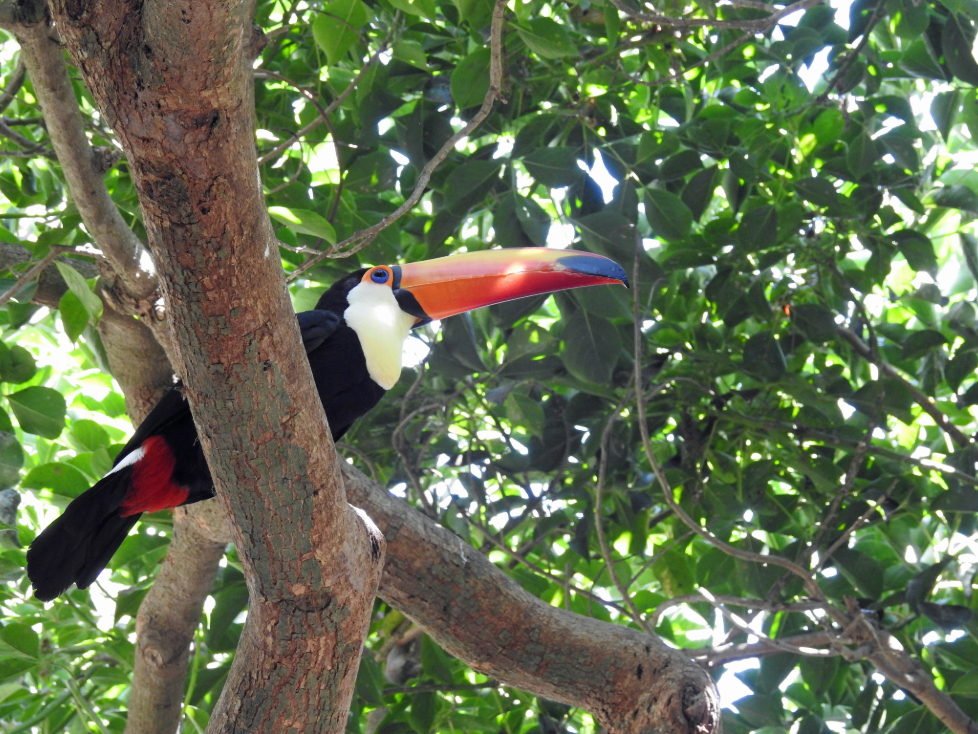
Figure 11. Toco Toucans are content to skirt the edges of forests and patchy woodlands.
Distribution and Habitat
Unlike other toucans, the Toco Toucan prefers inhabiting forest edges, forest corridors alongside rivers and other waterways, palm groves, cultivated orchards, and other patches of woodlands in northeastern South America, up to almost 6000 feet. These toucans don’t truly migrate, but they will move nomadically looking for food. Their home range can average more than 200 acres.
Description
The largest species of toucan, Tocos weigh about 23 ounces (with males weighing more, females less). Males are about 22″ long, with black-tipped red-orange-yellow serrated bills about 7–8″ long; females are about 20″ long, with 6–7″ bills. The flat tongue is almost as long as the bill. This toucan has glossy black feathers on its back, wings, tail, and upper legs; red and white feathers on its undertail and rump, respectively; and bluish feet and toes. Its throat and bib are white, and its eyes are encircled by bare blue skin, surrounded by bare orange skin. (For more information about their bills, see the preceding information about the Ramphastidae family.)


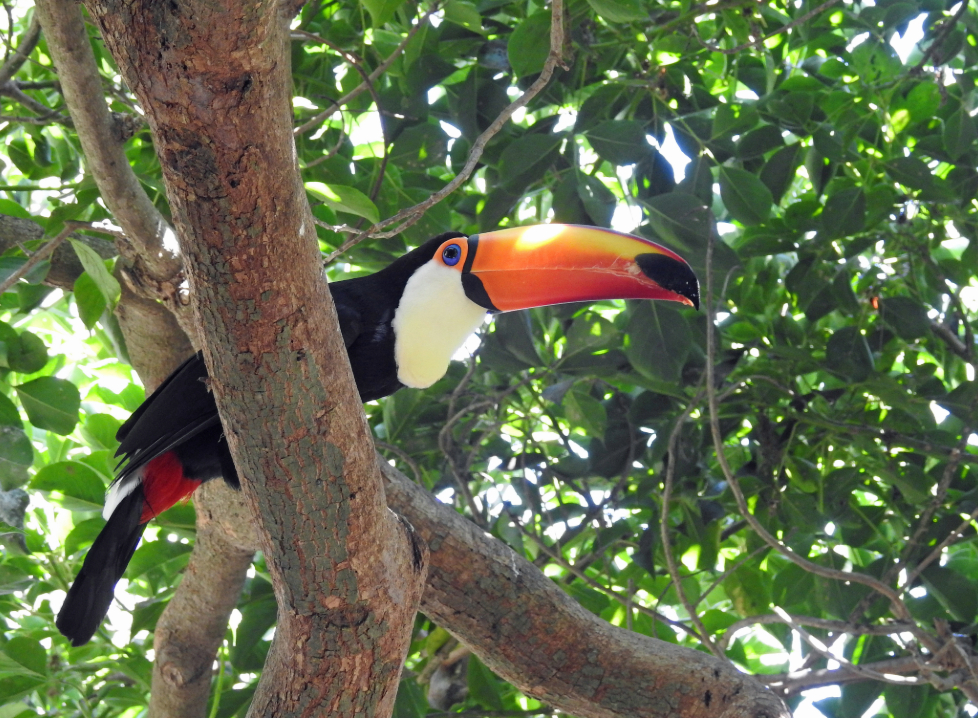
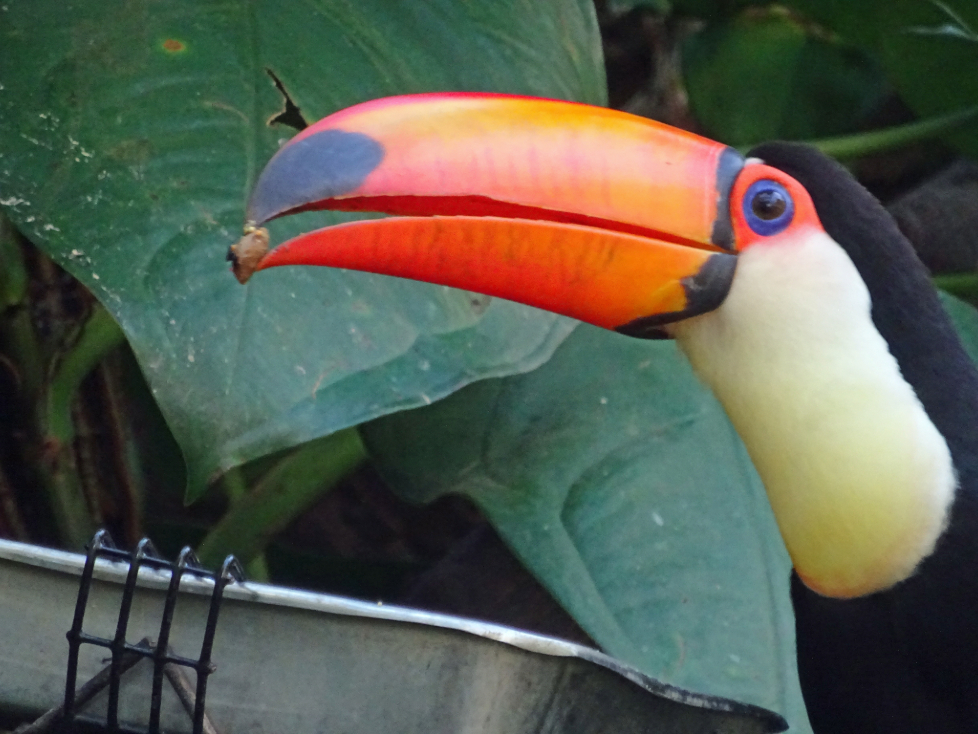
Figure 12. (a,b) The Toco Toucan’s serrated bill comes to a sharp point in the front, making it easy to grab fruits. (c) The Toco Toucan’s appearance may be less colorful than the Keel-billed, but its striking red undertail and dramatic black-and-white plumage can still make observers take a deep breath.
Vocalizations and Other Sounds
Toco Toucans sound off with assorted grunts, croaks, or snorts, which can be heard at https://xeno-canto.org/species/Ramphastos-toco . They sometimes thump their bills against a branch or clack their bills together, too.
Behavior
Locomotion
These toucans typically hop from branch to branch, but when flying, they make several heavy wingbeats then glide, creating an undulating flight pattern. Able flyers, they can cross rivers more than 2.5 miles wide.

Figure 13. Toco Toucans hop more often than they fly, but they fly ably when they choose to.
Diet and Foraging
Like other toucans, they eat mostly fruit, supplemented by arthropods (e.g., insects, especially caterpillars and termites) and small vertebrates (frogs, lizards, etc.), including the eggs and chicks of other birds (e.g., Yellow-rumped Caciques). Though less gregarious than other toucans, they typically forage in small groups, flying single-file from tree to tree, but they also snatch fallen fruits from the ground.
Figure 14(a,b). Toco Toucans can deftly manipulate food, tossing it back into their throats.
Sociability and Breeding
When not breeding, members of a toucan group will preen one another, as well as their mates. Once breeding and egg-laying starts, toucan pairs preen one another, and they’ll tap together their bills. These toucans nest mostly in tree cavities but sometimes in termite mounds or in burrows in stream banks. The female lays 2–4 eggs, and both parents incubate the eggs for about 17–18 days. After the nestlings hatch, both parents feed them, usually mostly insects at first, then increasingly fruits as the chicks mature. The chicks fledge at about 43–52 days. Age at sexual maturity is about 2.3 years.
Figure 15. Like other toucans, Toco Toucans enjoy interacting with one another.
Predation
Toco toucans don’t have any known predators, but it’s thought that monkeys and large raptors may target them. In addition, chewing lice and other external parasites plague them.
Conservation Status
IUCN Red List status is LC, Least Concern; global population isn’t known, but the population trend is declining. Threats: hunting and the pet trade. Typical life expectancy: wild, unknown; managed care, 8–9 years. Maximum recorded longevity, 16.2 years, managed care; IUCN generation length is about 11.5 years.
Figure 16(a,b). Juvenile Toco Toucans can seem so charming to predatory pet traders, but they’re wholly unsuitable as pets. They seek the companionship of fellow toucans, not humans.
Toucans, compared with other birds
in the S.D. Zoo’s Parker Aviary

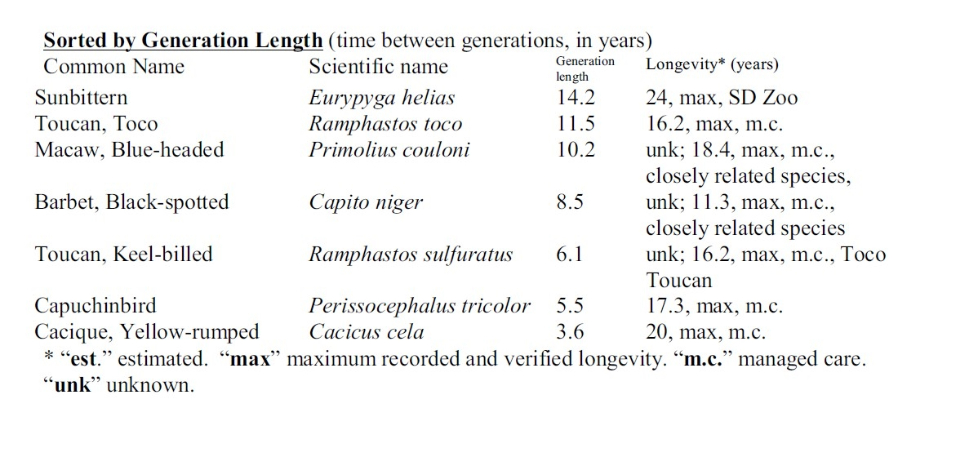
We can hope that the deep appeal of toucans leads more to their conservation and protection than to their demise through the scandalously cruel pet trade.
Resources
General References
- Elphick, Jonathan. (2014). The World of Birds. Buffalo, NY: Firefly Books.
- pp. 32–35, feet and toes
- Lovette, Irby, & John Fitzpatrick (eds.), (2016). The Cornell Lab of Ornithology Handbook of Bird Biology (3rd ed.). Hoboken, NJ: Wiley.
- General
- p. 178–183, skeleton, feet, toes, dactyly
- p. 274–286, foraging, diet
- pp. 43–59, bird orders and families
- Morrison, Michael, Amanda Rodewald, Gary Voelker, Melanie Colón, & Jonathan Prather (eds.), (2018). Ornithology: Foundation, Analysis, and Application. Baltimore: Johns Hopkins Press.
- p. 147, dactyly, toes
Order-, Family-, Species-specific Information
- Piciformes
- Elphick, Jonathan. (2014). The World of Birds. Buffalo, NY: Firefly Books. (Pp. 434–439)
- Winkler, David W., Shawn M. Billerman, & Irby J. Lovette. (2015). Bird Families of the World: An Invitation to the Spectacular Diversity of Birds. Barcelona, Spain: Lynx, Cornell Lab of Ornithology.
- pp. 233, 239, 240–241, Piciformes
- https://birdsoftheworld.org/bow/species, “Orders and Families,” 11,017 species
- Ramphastidae
- Wheelwright, Nathaniel T. (1991). “How Long do Fruit-Eating Birds Stay in the Plants Where They Feed?” Biotropica, Vol. 23, No. 1 (Mar., 1991), pp. 29-40. https://www.jstor.org/stable/2388685?origin=crossref. https://doi.org/10.2307/2388685. Published By: Association for Tropical Biology and Conservation
- Winkler, D. W., S. M. Billerman, & I. J. Lovette (2020). Toucans (Ramphastidae), version 1.0. In Birds of the World (S. M. Billerman, B. K. Keeney, P. G. Rodewald, & T. S. Schulenberg, Editors). Cornell Lab of Ornithology, Ithaca, NY, USA. https://doi.org/10.2173/bow.rampha1.01
- Keel-billed Toucan, Ramphastos sulfuratus
- Jones, R. & C. S. Griffiths (2020). Keel-billed Toucan (Ramphastos sulfuratus), version 1.0. In Birds of the World (T. S. Schulenberg, Editor). Cornell Lab of Ornithology, Ithaca, NY, USA. https://doi.org/10.2173/bow.kebtou1.01
- https://avibase.bsc-eoc.org/species.jsp?lang=EN&avibaseid=BB0FBBA4DEE10E3C&sec=lifehistory
- https://genomics.senescence.info/species/entry.php?species=Ramphastos_toco
- https://www.iucnredlist.org/species/22682102/168670038
- https://xeno-canto.org/species/Ramphastos-sulfuratus
- https://en.wikipedia.org/wiki/Keel-billed_toucan
- https://en.wikipedia.org/wiki/Keel-billed_toucan#/media/File:Keel-billed_toucan_in_Costa_Rica.jpg
- Please attribute as follows: Photograph by Chris Down. A hyperlink to chrisdown.photo would be appreciated, but is not mandatory. If you have other licensing/attribution requirements, email me at licensing@chrisdown.name and we can work out what’s possible. An e-mail to usage@chrisdown.name would be appreciated on use — I love to see how my images have been used!
- https://en.wikipedia.org/wiki/Keel-billed_toucan#/media/File:Keel-billed_Toucan_(16563767291).jpg
- Description, Belcampo Lodge, Belize. Date, 17 February 2015, 15:59. Source, Keel-billed Toucan. Author, Mike’s Birds from Riverside, CA, US. Camera location 16° 09 59.88″ N, 88° 48 43.27″ W Kartographer map based on OpenStreetMap. View this and other nearby images on: OpenStreetMap info. Licensing w:en:Creative Commons, attribution share alike. This file is licensed under the Creative Commons Attribution-Share Alike 2.0 Generic license. You are free: to share – to copy, distribute and transmit the work; to remix – to adapt the work. Under the following conditions: attribution – You must give appropriate credit, provide a link to the license, and indicate if changes were made. You may do so in any reasonable manner, but not in any way that suggests the licensor endorses you or your use. share alike – If you remix, transform, or build upon the material, you must distribute your contributions under the same or compatible license as the original.
- https://en.wikipedia.org/wiki/Keel-billed_toucan#/media/File:Keel-billed_Toucan_(47081220814).jpg
- Taken in Costa Rica. Date, 20 January 2015, 20:50. Source, Keel-billed Toucan. Author, Andy Morffew from Itchen Abbas, Hampshire, UK. Licensing w:en:Creative Commons. attribution: This file is licensed under the Creative Commons Attribution 2.0 Generic license. You are free: to share – to copy, distribute and transmit the work, to remix – to adapt the work. Under the following conditions: attribution – You must give appropriate credit, provide a link to the license, and indicate if changes were made. You may do so in any reasonable manner, but not in any way that suggests the licensor endorses you or your use.
- https://en.wikipedia.org/wiki/Keel-billed_toucan#/media/File:Keel-billed_toucan_(Ramphastos_sulfuratus_sulfuratus)_in_flight_Peten.jpg
- Description, English: Keel-billed toucan (Ramphastos sulfuratus sulfuratus) in flight, Peten, Guatemala. Date, 24 February 2023, 08:21:23. Source, Own work, from Sharp Photography, sharpphotography.co.uk. Author, Charles J. Sharp (1951–) wikidata:Q54800218. Camera location 16° 55 12″ N, 89° 48 36″ W Kartographer map based on OpenStreetMap. View this and other nearby images on: OpenStreetMap info. Licensing: I, the copyright holder of this work, hereby publish it under the following license: w:en:Creative Commons. attribution share alike. This file is licensed under the Creative Commons Attribution-Share Alike 4.0 International license.
- https://en.wikipedia.org/wiki/Keel-billed_toucan#/media/File:Keel-billed_toucan_in_Costa_Rica.jpg
- Toco Toucan, Ramphastos toco
- Sedgwick, C. W. (2020). Toco Toucan (Ramphastos toco), version 1.0. In Birds of the World (T. S. Schulenberg, Editor). Cornell Lab of Ornithology, Ithaca, NY, USA. https://doi.org/10.2173/bow.toctou1.01
- https://avibase.bsc-eoc.org/species.jsp?lang=EN&avibaseid=D42641C0E83A2C10&sec=lifehistory
- https://genomics.senescence.info/species/entry.php?species=Ramphastos_toco
- https://www.iucnredlist.org/species/22682164/113557535
- https://xeno-canto.org/species/Ramphastos-toco
Etymology
- Gotch, Arthur Frederick. (1980). Birds—Their Latin Names Explained. Dorset, UK: Blandford Press.
- Gruson, Edward S. (1972). Words for Birds: A Lexicon of North American Birds with Biographical Notes. New York: Quadrangle Books. 305 pp., including Bibliography (279–282), Index of Common Names (283–291), Index of Generic Names (292–295), Index of Scientific Species Names (296–303), Index of People for Whom Birds Are Named (304–305).
- Lederer, Roger & Carol Burr. (2014). Latin for Bird Lovers: Over 3,000 Bird Names Explored and Explained. Portland: Timber.
Generation Length
IUCN Red List Status
Longevity Data and Life Histories
Vocalizations
Copyright © 2025, text and photos (except as noted — Figures 7, 8, 9, and 10), Shari Dorantes Hatch. All rights reserved.
As always, I welcome your suggestions, comments, tips, ideas. I look forward to hearing from you.
 Bird Brain

.jpg)
.jpg)
_in_flight_Peten.jpg)
Leave a comment