
Contents
- The Rise of Codex Books
- Making Medieval Manuscripts
- The Manuscripts Club
- Chapter 1. The Monk: Saint Anselm, pp. 11–49
- Chapter 2. The Prince: The Duc de Berry, pp. 50–91
- Chapter 3. The Bookseller: Vespasiano da Bisticci, pp. 93–129
- Chapter 4. The Illuminator: Simon Bening, pp. 131–169
- Chapter 5. The Antiquary: Sir Robert Cotton, pp. 171–211
- Chapter 6. The Rabbi: David Oppenheim, pp. 213–253
- Chapter 7. The Savant: Jean-Joseph Rive, pp. 254–293
- Chapter 8. The Librarian: Sir Frederic Madden, pp. 295–337
- Chapter 9. The Forger: Constantine Simonides, pp. 339–375
- Chapter 10 . The Editor: Theodor Mommsen, pp. 376–409
- Chapter 11. The Collector: Sir Sydney Cockerell, pp. 411–455
- Chapter I2. The Curator: Belle da Costa Greene, pp. 456–505
- Back Matter
- Additional Resources
- Wikipedia
- Merriam-Webster’s Dictionary
- Preparing to Write
- Ink
- Bookbinding

Figure 1. For more than a millennium, books were written by hand. Christopher de Hamel wrote two exquisitely illustrated books about these medieval manuscripts. Discussed in this blog are his 2018 book, Making Medieval Manuscripts, and his 2023 book, The Manuscripts Club: The People behind a Thousand Years of Medieval Manuscripts.
Note. In this blog, I don’t attempt to critique de Hamel’s two books. Rather, I highlight what I consider to be the most interesting information in each book, and I supplement his information with what I was able to find through additional research, purely out of my own curiosity.
It takes a village—or at least a community—to make an illuminated manuscript. By definition, a manuscript (manus-, “hand,” Latin; scriptum, from scribere, “to write”) is written by hand. Before the advent of movable-type printing c. 1450 in Europe (by Johannes Gutenberg), all books were written by hand. In fact, the first known use of the term manuscript wasn’t until 1571, long after printing had been widely in use. (Likewise, before online shopping was commonplace, no one said “brick-and-mortar stores”.)
The Rise of Codex Books
We generally consider books to be in codex format: a stack of multiple pages or leaves, which are bound together on one side and loose on the other three sides. Before codex books became popular, writing was done on scrolls, usually made of papyrus, a reed. The tough outer rind of the papyrus was removed, leaving a sticky fibrous pith (spongy interior). The pithy fibers could be cut lengthwise into long skinny strips (usually about 16″/40cm). These strips may have been immersed in water to enhance their stickiness. While still moist, the strips were laid side by side, slightly overlapping, then a second layer of overlapping strips were laid at right angles to the first layer. Next, the two layers of strips were hammered together until they formed a single sheet. Each sheet was then dried under pressure. The sheets were then glued together, side by side, creating a long scroll. Some scrolls were wound around one dowel, others had one dowel at each end (like a Torah scroll).
While scrolls were being used for more permanent written records, various cultures were using wax tablets for more ephemeral writing. A wooden tablet would be constructed with an outer rim, then wax would be poured in, to cover the wood with a smooth layer. A pointed stylus could be used to carve into the soft wax, and marks could be erased with a flat-edged tool, making a tabula rasa (“clean slate”). Two such tablets could be bound together with a leather thong, making them easy to carry.
It’s thought that the convenient format of the wax tablet may have prompted the idea for making books in a codex format. Over the first six centuries (A.D./C,E.), codex books gradually replaced scrolls, coinciding with the rise of Christianity and the desire for more Bibles. With a codex book, a reader can quickly and easily flip to any page, rather than searching through a long scroll. A marvelous innovation!

Figure 2. Codex books are made from stacks of multiple pages (leaves), which are bound together on one side but are loose on the other three sides, allowing for easy reading, scanning, searching.
Making Medieval Manuscripts
The Middle Ages are the period of European history from about A.D./C.E. 500 to 1500; we refer to events and objects from this period as medieval. During this period, European monasteries were using the codex book format to create medieval manuscripts of Bibles and other religious texts. In addition, by about 1100, private collectors were commissioning other texts for their own perusal or simply their enjoyment.
Within a century, most of the medieval manuscripts were being created outside of monasteries. Scribes in monasteries typically wrote 3–4 average-sized manuscripts per year. Later on, professional scribes, who wrote manuscripts for a living, frequently wrote many more, often within weeks and sometimes even more quickly, so the volume of volumes increased dramatically. Note. The time the scribe needed for writing a manuscript does not include the time needed for illustration and illumination or for bookbinding.
Christopher de Hamel, a former librarian of Cambridge’s Parker Library, “catalogued and handled a vast number of medieval manuscripts” at Sotheby’s (back jacket flap, Making Medieval Manuscripts). De Hamel wrote two exquisitely illustrated books celebrating the creation, collection, and enjoyment of medieval manuscripts:
- de Hamel, Christopher. (2018). Making Medieval Manuscripts. Oxford: Bodleian Library.
- de Hamel, Christopher. (2023). The Manuscripts Club: The People behind a Thousand Years of Medieval Manuscripts. New York: Penguin Press.
In his first book, de Hamel uses rich illustrations and descriptive texts to show how medieval manuscripts were made. The contents of de Hamel’s Making Medieval Manuscripts: Introduction, pp. 9–21. Chapter I. Paper and Parchment, pp. 23–59. Chapter II. Ink and Script, pp. 61–93. Chapter III. Illumination and Binding, pp. 95–145. Glossary, p. 147. Select Bibliography, pp. 148–149. Acknowledgements, p. 150. Picture Credits, p. 151. Index, pp. 152–153
Perhaps the most important element needed for a scribe to create a manuscript was an exemplar, an existing text from which the scribe could copy the new manuscript. Many monasteries had existing libraries used for making additional copies, and monasteries often loaned one another copies of manuscripts to use as exemplars. Once professional scribes were employed, part of the contractual arrangement specified how the exemplar was to be acquired (usually, borrowed). Often, an agent or a bookseller arranged to obtain the exemplar, as well as hiring the scribe, the illuminator, and the bookbinder. (The bookbinder was often on the bookseller’s premises.)

Figure 3. Manuscript scribes needed exemplars to copy in order to create new manuscripts. Source: https://en.wikipedia.org/wiki/Bookbinding, “Early medieval bookcase containing about ten codices depicted in the Codex Amiatinus (c. 700)”; Meister des Codex Amiatinus – The Yorck Project (2002) 10.000 Meisterwerke der Malerei (DVD-ROM), distributed by DIRECTMEDIA Publishing GmbH. ISBN: 3936122202. Now in the public domain.
Making the Parchment
Briefly, here are the steps needed to make enough vellum for a few pages of a manuscript (about four leaves/eight pages for a typical-sized book).
- Someone must raise cattle, sheep, or goats suitable for making parchment or vellum. (Parchment is any prepared animal skin used for writing; vellum is a higher quality of parchment, typically made from the skins of lambs, calves, or kids.) The animal cannot be diseased, riddled with bugs or parasites, or show other flaws that will spoil the vellum. What’s more, darker wool or hair created darker vellum than lighter wool or hair, so a light-colored breed would be preferred. Among cattle (and calves), the white skin of Charolais was prized for making vellum (parchment). Occasionally, the skins of brindled or spotted animals were chosen, for aesthetic effects.
- Slaughter the animal, and prepare the animal skin. Rather than tanning the hide, it is soaked in water or washed in cold clear running water for about 24 hours. Note. This process literally stinks.
- During this time, the skin starts to rot, and hair/wool naturally starts falling away from the skin. In warmer climates, this process doesn’t need nudging, but in cooler locations, the process is expedited by soaking the skin in a vat of lime-and-water solution. This might take 3–10 days, or even longer in colder weather, all the while the vats must be stirred several times/day, using a wooden pole.
- Eventually, the soggy, hairy, slippery skin is ready to be scooped out and draped over a large curved wooden beam, grain (hairy) side facing up. The parchmenter, parchment maker, stands behind the beam, and grasps a long, curved two-handled knife with both hands, to start scraping off the hair from the grain side of the skin. If the skin has been prepared well, the hair easily sloughs off onto the ground. Ideally, the parchmenter also scrapes off an outer filmy layer.
- As needed, the parchmenter may return the skin to the lime solution again. Next, the parchmenter returns the skin to the wooden beam, but this time, with the grain side down, the flesh side up. Using the same knife, the parchmenter scrapes off the remaining flesh, being very careful not to nick or otherwise damage the skin.
To watch how parchment is actually made, see PBS’s Nova superlative episode on parchment making, available here: https://www.pbs.org/video/how-medieval-parchment-made-guqxke/
- To remove the lime solution and further prepare the parchment, it’s rinsed in fresh water for 48 hours.
- The parchmenter removes the clean wet skin and ties it to adjustable pegs on a frame (usually rectangular but sometimes circular). To attach the skin to the pegs, the parchmenter uses fingernail-sized pebbles. First, the parchmenter places each pebble under the skin at one of the desired stretch points. Next, the skin is wrapped around the pebble, and a piece of string is tied around the skin-wrapped pebble, completely encircling the bottom of the pebble. The other end of the string is tied to one of the pegs. That’s done about every 4 inches, for each of the stretch points.
- Once all of the stretch points are attached to pegs, the pegs can be turned to make the skin taut within the frame. A hammer taps in the pegs, as needed.
- Before doing more work on the parchment, the parchmenter looks for nicks, gashes, or any other flaws. These can be stitched up at this point, to avoid having increasingly large holes in the parchment.
- Once the parchment has been checked and stitched, as needed, the parchmenter ladles scoops of scalding hot water onto the top of the stretched skin. The water runs off the skin, puddling on the ground. The parchmenter stands, holding a stable stance, and grasps a lunellum (crescent-bladed knife with the handle in the middle of the flat blunt edge). With the lunellum, the parchmenter can vigorously scrape the skin, at a steep angle, taking care not to cut the skin. After finishing the flesh side, the parchmenter does the same to the grain side, scraping away any of its glossy finish. The parchmenter may return a second time to the flesh side, for special attention. Meanwhile, the parchmenter continually tightens the pegs and taps them, as needed.
- After the skin has been thoroughly scraped and cleaned, it is allowed to dry, as quickly as possible, so ideally in the sun. As it dries, it shrinks and tightens further.
- Once the skin is dry and taut, the parchmenter uses the lunellum again, to scrape and shave more. Finer parchment requires more scraping.
- When the parchmenter is satisfied with the finished skin, it can be removed from the pegs and rolled up to be stored.
Unsurprisingly, vellum was extraordinarily expensive and a large part of the cost of a medieval manuscript. Toward the end of the medieval period, some manuscripts were being written on paper, which is less luxurious, less expensive, and less time-consuming to prepare. (Papyrus wasn’t used for codex books, as it couldn’t tolerate the repeated folding needed for codex books.)
Making Quill Pens and Ink
Quill pens are best made from the outer flight feathers of a goose or swan. Smaller feathers, from smaller birds, are much less easy to hold and to use. Theoretically, turkey feathers would have been usable, too, but turkeys didn’t reside in medieval Europe. Swans and geese readily drop their feathers, so it wasn’t usually necessary to pluck feathers for use as quills. Fresh feathers are too supple, so they must be hardened either by being left to dry for months or by being soaked in water then plunged into hot sand. The feather’s barbs and its outer skin can be scraped or rubbed away, and the pith inside the tip can be removed, leaving a strong translucent tube.
A skillful scribe can then use a short sharp knife to quickly shape the tip into a nib (like that of a fountain pen), with a crisp squared tip. (Contemporary images of this process show scribes pulling the knife toward them, rather than pushing it away from them.) To facilitate the quill’s ability to transport ink up into the barrel, the scribe cuts a slit up through the center of the nib. Due to the relentless pressure of writing, the nib wears down, or the slit widens too much, so the scribe must repeatedly slice off the tip in infinitesimal increments. De Hamel observed that a busy scribe might need to sharpen a quill about 60 times/day. Some scribes prepared multiple quills in advance of beginning for the day.
Medieval quills and inks required that the quill be held at right angles to the text (not at the low angle we use these days). For that reason, they held their quills differently than we do. They pointed the quill downward with the first two fingers and braced it with the tip of the thumb. (Try it, to see how that affects the angle of writing.) This way of holding the quill requires movement of the whole hand (and arm) to write, but the light quill makes doing so effortless.
Some scribes dipped their quills into inkhorns that fitted into holes in their desks or that hung from hooks at the sides of their desks. Other scribes used inkpots, which were kept on a separate stand, to minimize the likelihood of spilling ink onto the desk or the manuscript. During the first several centuries of the medieval period, scribes used mostly carbon ink, made from charcoal or other black carbon, mixed with a gum. Carbon ink is somewhat gritty and, unfortunately, can be rubbed off of parchment fairly easily.
Scribes increasingly used iron-gall inks by the 1100s. The source of the iron galls was a marble-sized ball-shaped tumor, created by gall wasp eggs, laid on the buds of oak trees. After the larvae inside the galls developed into insects, they bored out of their gall cocoons and flew away. The remaining galls can be crushed up and then boiled repeatedly, in water, or perhaps in white wine or vinegar. The resulting solution is then added to copperas, ferrous sulphate. Copperas is mined or is manufactured by pouring sulphuric acid over iron nails, mixed with alcohol. A bit of ground gum arabic (made from dried sap of acacia trees) is then added, mostly to thicken the ink but also to make it more adhesive. Iron-gall ink readily soaks into parchment, so it can’t be rubbed off easily, and it darkens on exposure to air on the manuscript’s pages.
For a recipe for iron-gall ink and a photo of the galls, see
https://travelingscriptorium.com/2013/03/21/iron-gall-ink/
Though scribes weren’t illuminators, they did have use for one extra color of ink: red ink, used for “red-letter days” on calendars, for headings, titles, and initials, as well as for rubrics (ruber, “red,” Latin), text glosses such as commentaries or explanations. Red might also be used for text corrections, to show off how thoroughly the text had been checked. Red ink was made with ground vermillion (powdered cinnabar, a mercuric sulfide), mixed with egg white and gum arabic.
The Scriptorium
When most scribes were monks, the monastery included a scriptorium, a room dedicated to the writing (and illuminating) of manuscripts. It needed to be as well lit as possible with natural light overlooking the shoulder of each scribe. Though candle-lit writing and illuminating were certainly possible, natural light was easier on the eyes. Each scribe needed a straight-backed chair or bench, a steeply sloping desk for propping the manuscript, a place for the exemplar to be seen easily, an easily reachable container for quills, and a container for ink.
Less evident to contemporary writers is that the scribe also needed a knife. Vellum is springy, not as flat as paper. The scribe needs to wield a knife in the nondominant hand, to hold the manuscript precisely, while writing with a quill in the dominant hand. A knife was also needed to quickly scrape off mistakes (before the ink sinks in) and to sharpen the quill. In addition, the scribe needed a plummet (now called a “plumb bob”), a heavy piece of lead on a string, to rule a page accurately. The scribe also kept some fine pumice (chalk-like powder), to rub over the manuscript page, smoothing its surface before beginning to write.
Illumination
Though illumination originally referred only to adornment with lustrous gold, we commonly consider an “illuminated manuscript” to be any manuscript that is decorated or illustrated in some way. Not all medieval manuscripts are illuminated with gold, but most are decorative enough to be considered illuminated manuscripts. At a minimum, the first letter of text in a manuscript is usually oversized and filled in with colored pigment of some sort. Most manuscripts also included enlarged initial letters at chapter headings or other major parts of a book, though these letters weren’t as huge as the first letter of the entire book.
Many manuscripts also included lavish illustrations, some taking up all or most of multiple pages. Some manuscripts had elegant borders, illustrated with plants, animals, grotesquery, or patterns. Finer manuscripts did include gold illuminations, created by applying gold leaf (made from infinitesimally thin sheets of pounded gold) onto embossed letters or figures. Because gold never tarnishes, it was far preferred to silver, and it could be pounded to almost microscopic thinness without crumbling, making it affordable to many who could afford to pay for a manuscript.
All of the illumination, illustration, and decoration had to be added after completion of the written text, so the scribe had to plan for these additions while writing the text, leaving the precise amount of space needed for them. Often, the scribe not only left a space, but also specified what was to be painted, the colors to be used, and so on. Some scribes even lightly sketched in an initial letter, especially if it had an unusual shape.
Though the illuminator (or illustrator/decorator) had artistic talent, he or she didn’t have carte blanche to express an artistic vision for illustrations or even for decorations. Illuminators also often copied images from one text (e.g., an angel speaking to a saint) into an entirely different context (e.g., a master speaking to an apprentice). An illuminator’s workshop would also have samples and pattern books as guides for illumination. Illuminators usually gained their artistic skills through apprenticeship, often within families, such as grandfather, father, and son. (Outside of monasteries, it wasn’t rare for women to write or illustrate manuscripts, too.)
Typically, illuminators are given unbound gatherings of pages (bifolium, two leaves, four pages; perhaps four leaves/eight pages; occasionally more leaves/pages, in multiples of 2-4-8). Illuminators might work on multiple manuscripts, working on gatherings as they arrived. Likewise, for a large work, multiple illuminators might be hired to work on various gatherings, to expedite completion of the manuscript.
On receiving a gathering, the illuminator would need to prepare the parchment’s surface to make it ready to receive the pigment. Just as the scribe did earlier, the illuminator rubs the surface with powdered pumice or some other chalky substance. Unlike the scribe, however, the illuminator works on a completely flat desk, with no slope; otherwise, the pigments might drip down.
For illustrations of illuminated manuscript pages, see https://en.wikipedia.org/wiki/Manuscript.
If there are to be gold illuminations, they are applied at this time, so the gold doesn’t inadvertently stick to the pigment. Also, the gold must be vigorously burnished, which would be challenging if it was surrounded by colorful paint. Before the gold leaf is added, the illuminator embosses the location with gesso (a pasty substance), creating a raised surface for the gold. The gesso must be left to dry, then later, it can be carved and smoothed. To apply the gold leaf, the illuminator needs only to breathe moisture onto the gesso, pick up a brush, pick up the gold leaf, and lower the gold into place. Next, the illuminator presses the gold into place, using a scrap of silk or other fabric, then it’s forcefully burnished.
At last, the illuminator is ready to decorate or illustrate the text. First, the illuminator roughly sketches the illustration or decoration, using a narrow-tipped metal stylus; as needed, a compass is used for making perfect circles or arcs, and rulers used for making straight lines. After corrections or changes were made, thin lines of ink would outline the sketch. (Artists didn’t sketch with charcoal or graphite, which might leave granules on the page.) The artist then used either a thin brush or a quill pen to paint the illustrations or decorations.

Figure 4. Manuscript illustrations took many forms, such as elaborate borders and initial letters. Source: https://en.wikipedia.org/wiki/Manuscript, Meister_des_Codex_Amiatus_001.jpg, “Christ Pantocrator seated in a capital ‘U’ in an illuminated manuscript from the Badische Landesbibliothek, Germany (from c. 1220).” “Evangelistar von Speyer, um 1220 Manuscript in the Badische Landesbibliothek, Karlsruhe, Germany Detail from Cod. Bruchsal 1, Bl. 68r. ” In the public domain.
Color choices included reds (from minerals such as vermillion or cinnabar or from plants such as madder or Brazilwood), blues (from minerals such as azurite or lapis lazuli, or from plants such as turnsole), greens (from malachite or verdigris), yellows (from orpiment, arsenic sulfide, or from saffron), white (from white lead). Any of these pigments might be ground then mixed with egg white (“egg glair”) or egg yolk (“egg tempera”), or with any of various gums (e.g., made from fish or other animals). The mixed pigments were usually kept in shells (e.g., oysters or mussels) near the artist’s desk.
Binding
After all of the gatherings have been written, illuminated, and decorated, they are ready to be bound into a codex book. First, the gatherings had to be placed into proper sequence. Scribes had various means of indicating the sequence of gatherings, such as by using letters or numerals. Perhaps the most effective way to ensure the gatherings were sequenced correctly was by using catchwords. Very simply, in the bottom margin of the last page of a gathering, the scribe wrote a single word, then at the top of the page of the next gathering, the scribe wrote the same exact word. The binder needed only to match words to correctly sequence the gatherings.
Early manuscripts were simply bound with stitching: Each gathering was stitched down the center of the middle pair of pages, then the stitching was linked around the spine of that gathering to the spine of the next gathering, creating a stack of gatherings joined with stitches. Then the first gathering was knotted to the front cover and the last gathering was knotted to the back cover.
Most medieval manuscripts, however, were bound more durably. Pairs of bands (e.g., thongs or cords) were attached to a wooden frame, so that the frame held the paired bands vertically, snugly perpendicular to the gatherings, which were on a horizontal platform within the frame. The first gathering was placed on the platform, and the gathering was stitched through the center and then around each pair of bands. Once the first gathering was securely attached to the bands, the next gathering was placed atop it and firmly pressed onto the first. This gathering was likewise stitched through the center and around each pair of bands. That process continued until all of the gatherings had been securely stitched to the bands and thereby to each other, along their spine. The bands were then untied from the frame, tightened, and sewn to headbands along the top and bottom edge of the book’s spine. By the 1100s or so, a sewing frame made this job easier, though sewing was always a time-consuming process throughout the medieval period.
For videos on how this is done, see
- https://www.youtube.com/watch?v=GBn76DTAGw8
- (Bookbinding) Creating A Medieval Leather-bound Book with Clasps
- At about 4 minutes, he shows how to use an awl to poke holes for the sewing, then he shows how to set up the frame for binding each of the gatherings to the cords. The process continues for the remaining gatherings by about 6 minutes in. He then continues, adding multiple finer details (e.g., sewing on the headbands, attaching boards, spine, leather cover), but ads interrupt.
- https://www.youtube.com/watch?v=iFuWfhESpFc
- Making A Medieval Book By Hand – Part 1 – Folding Pages, Endpapers, Piercing & Sewing
- The first 25 minutes show how this binder prepares a manuscript for binding, using a process that differs from those in some other videos. Nonetheless, the same basic idea applies (stack and align the gatherings, mark the gatherings, and poke holes into the center fold of each gathering, so the holes will align). At about 25 minutes into the video, you can see how the sewing frame is set up with cords (thongs, in this case), which are used for sewing each gathering to each of the cords. One gathering after another is sewn to the thongs/cords. The video shows how it’s done from both sides: the interior of the gathering and the exterior wraps around the cords.
Most books were then attached to covers, usually wooden boards, by hammering in wooden pegs or nails. Over time, pasteboards (cardboard made from discarded paper or parchment, which has been glued together) were often used as a cheaper alternative to wood. Initially, the edges of the boards were flush with the edges of the book pages, but after about 1200, bookbinders began to have the boards extend outward past the edges of the book pages. Some manuscripts had vellum flyleaves added to the front and back, between the book and the boards. In addition, most books were covered with leather, which might be dyed or stamped, bejeweled (rarely), or otherwise adorned.
That wasn’t the end of it, though. Folded parchment doesn’t remain flat, like paper. It still has a springiness allowing it to bend, curl, and so on, in response to changes in temperature or humidity. To keep the book from deforming out of shape, it needs to be firmly clasped shut.
In addition, many medieval books were also wrapped by chemises, to protect them from dust and other elements. A chemise might simply extend from the book’s cover, wrapping around the far edge, partially enclosing the book. The leather or fabric covering the book might be made long enough to wrap the far edge, or separate leather or fabric might be stitched or otherwise stuck to the book cover to serve this function. Alternatively, a chemise could be a separate slip-cover, fully enclosing the manuscript.
Glossary
The author offers a brief glossary, defining 18 words, from bifolium to watermark, including 3 synonyms: gathering, quire, and signature.
The Manuscripts Club
In Christopher de Hamel’s second book, The Manuscripts Club: The People behind a Thousand Years of Medieval Manuscripts, he focuses on 12 people involved with medieval manuscripts: a scribe (Saint Anselm), an illuminator (Simon Bening), a forger (Constantine Simonides), and 9 others involved in collecting, cataloging, and owning medieval manuscripts. His second book is probably even more richly illustrated than his first. The book’s contents are as follows:
Introduction, pp. 1–9
Chapter 1. The Monk: Saint Anselm, pp. 11–49
Anselm (c. 1033–1109), Benedictine monk and abbot, was initially a scribe, but as he was moved up in the church hierarchy, he became more of a mentor, a teacher, and a manager and supervisor of scribes. This chapter illustrates and describes being a scribe, and it discusses some of the difficulties faced by Anselm in trying to arrange to obtain manuscript exemplars, and to supervise scribes and illuminators at work, correcting their work, as needed. The scribes were expected to be both speedy and highly accurate, often copying in languages with which they weren’t familiar. Anselm also wrote original manuscripts on religious and philosophical themes.

Figure 5. Anselm, a monk, a scribe, and an abbot, also authored original texts, such as the volume of meditations from which this page was taken, “A 12th-century illumination from the Meditations of St. Anselm,” by an unnamed miniaturist. Source: https://en.wikipedia.org/wiki/Anselm_of_Canterbury. Now in the public domain.
Chapter 2. The Prince: The Duc de Berry, pp. 50–91
Jean, Duc de Berry (1340–1416), was a wealthy royal who spent large amounts of his prodigious fortune commissioning and acquiring richly illuminated manuscripts. At one time he owned about 300 such manuscripts, and about 75 still exist today.
Chapter 3. The Bookseller: Vespasiano da Bisticci, pp. 93–129
Vespasiano da Bisticci (c. 1422–1498) was first an employee in a bookshop, then he opened his own bookshop, specializing in high-quality manuscripts. During his lifetime, the printing press was invented (arriving in Italy in 1464), and its use became widespread. Pretty soon afterward, printed books were much more common than manuscripts. He closed his bookshop and retired in 1478. When a patron wanted a manuscript, Vespasiano would contract with the patron to arrange to obtain an exemplar of the book, and he would commission one or more scribes and one or more illuminators. On completion, the scribe would turn in the manuscript to Vespasiano, who would also carefully edit the manuscript, correcting any mistakes made by the scribe. Vespasiano also wrote brief biographies of his contemporaries.
Chapter 4. The Illuminator: Simon Bening, pp. 131–169
Simon Bening (c. 1484–1561), illuminator and illustrator, was born after printed books were largely supplanting manuscripts. The son of a prominent illuminator, Simon readily learned his father’s craft. Luckily for Bening and his artistic family, clients in Spain and Portugal, as well as Italy and Germany, were still willing to pay handsomely to buy illuminated manuscripts. He and his father also belonged to a well-established guild of artists, artisans, and book-related workers in their home in Bruges, Belgium. Bening continued to be employed as an illuminator until 1545, when he probably illuminated his last manuscript. Interestingly, de Hamel also offers some insights into how Bening worked and created his illustrations.

Figure 6. Though Bening was born after printed books were much more common than manuscripts, through Bening’s exquisite artistry and clever business skills, he managed to support his family as an illuminator of manuscripts. Source: https://en.wikipedia.org/wiki/Simon_Bening, “Self-portrait, tempera on parchment (8.5 cm × 5.7 cm), Metropolitan Museum of Art, New York. The inscription in Latin reads “Simon Bennik. Alexandri. [F]ilius Se Ipsu. Pi[n]gebat. Ano. Aetatis. 75. 1558.” (“Simon Bennik, the son of Alexander, painted this himself at the age of 75 in 1558”).[1]” Now in the public domain.
Chapter 5. The Antiquary: Sir Robert Cotton, pp. 171–211
Robert Cotton (1571–1631) collected many hundreds of manuscripts, most of which still exist and can be found in the British Library in London. Unlike previous collectors, Cotton focused more on history texts and other works exalting the British nation. For instance, he owned two of the original copies of the Magna Carta, only four copies of which exist today, and he had an early copy of Beowulf.
Chapter 6. The Rabbi: David Oppenheim, pp. 213–253
David ben Abraham Oppenheim (1664–1736) had a lifelong passion for acquiring and preserving Hebrew manuscripts. At age 11, he was given his first manuscript, igniting his passion. Unlike most other manuscript collectors, Oppenheim was more interested in the text than in the physical object of the manuscript.
Chapter 7. The Savant: Jean-Joseph Rive, pp. 254–293
Jean-Joseph Rive (1730–1791) believed himself to be more knowledgeable about medieval manuscripts than any of his contemporaries, and he had little patience with anyone who knew less, especially with anyone who questioned his knowledge. Rive came to medieval manuscripts relatively late in life, having his first experience with one in 1767, when he found one in a monastic library. He soon established himself as an expert buyer and seller of manuscripts on behalf of a series of wealthy patrons. He also wrote catalogs of collections, had an extensive collection of references on manuscripts, and was in the process of writing about “manuscript connoisseurship” when he died.
Chapter 8. The Librarian: Sir Frederic Madden, pp. 295–337
Frederic Madden (1801–1873) was one of two key librarians of the British Museum from 1826 until his retirement in 1866. His archrival, Antonio Panizzi (1797–1879), eventually headed the printed books department, and Madden became the keeper of manuscripts. According to de Hamel, “Madden as Keeper became probably the most important public acquisitor of manuscripts in any country or period of history. . . . he . . . added more than 30,000 items to the collections of his department, more than doubling their size in three decades.” (p. 315)
Chapter 9. The Forger: Constantine Simonides, pp. 339–375
In the 1800s, it wasn’t extraordinarily unusual for people to have an uncertain birthdate, but Simonides’s death date was also announced as being in 1867, after which he was resurrected and finally died in 1890. His name is similarly not certain. In 1853, he arrived at the Bodleian Library (at Oxford University) with a satchel of manuscripts presumably from a monastery in Greece. Many were fooled by his forgeries, but others were not.
Chapter 10 . The Editor: Theodor Mommsen, pp. 376–409
The top floor of the home of Theodor Mommsen (1817–1903), a celebrated university professor, housed a vast library of reference books, which spilled onto the floor and into corridors. Mommsen also wrote histories of the Roman Empire and edited a liberal newspaper, and he and his wife raised 16 children. In 1854, the Berlin Academy appointed him to direct its Corpus Inscriptorium Latinarum. He passionately advocated for “antiquity science,” using evidence from multiple disciplines (e.g., literature, archeology, numismatics, eyewitness manuscripts) to reveal insights into ancient civilizations. Sadly, in 1880, his library caught fire, and he lost many of his books. From then on, he traveled to numerous libraries in Italy, France, England, and elsewhere. He would arrive at each library before it opened and would leave only after it closed. Like Oppenheim, for Mommsen, the texts of the manuscripts held more allure than the physical objects. He continued to write prodigiously (e.g., 42 titles in 1868), and he won the Nobel Prize for Literature in 1902, at a time when Leo Tolstoy, Henry James, and Émile Zola were other contenders.
Chapter 11. The Collector: Sir Sydney Cockerell, pp. 411–455
Sydney Cockerell (1867–1962) was inspired to his love of medieval manuscripts by two mentors: William Morris, craftsperson and founder of Kelmscott Press; and John Ruskin, writer, educator, art critic, and philanthropist. Cockerell helped Ruskin to acquire about 90 medieval manuscripts. Morris collected more than 100 medieval manuscripts, and he founded his Kelmscott Press to celebrate the artistry and beauty of medieval book production. Morris employed Cockerell at the Press and as cataloguer of his personal manuscript library. The two also shared in the joy of finding medieval manuscripts all over Europe, and after Morris’s death, Cockerell started buying his own medieval manuscripts. Cockerell helped other wealthy patrons to acquire and catalog their medieval manuscripts, too. He also arranged a spectacular exhibit of medieval manuscripts and was appointed as director of the prestigious Fitzwilliam Museum. Many of Cockerell’s experiences and insights can be uncovered in his daily diaries, which he kept throughout his life.
Chapter I2. The Curator: Belle da Costa Greene, pp. 456–505
Belle da Costa Greene (1879–1949) was born Belle Greener, daughter of Richard (a Harvard graduate) and Genevieve Greener, prominent African Americans living near Washington, D.C., then later in New York City. Richard left Genevieve and their daughter and son, so Genevieve reinvented them as the Greenes, whose ancestry was entirely European. In the 1900 census, Belle Greene listed her occupation as a librarian, and that summer, she attended summer school courses in librarianship at Amherst College, where the Dewey Decimal System had been invented. By the following year, Greene was employed as an assistant librarian in the library of Princeton University, where Junius Morgan, nephew of Pierpont Morgan, was a benefactor. Pierpont (one of the richest men in the world at that time) had been having Junius supervise the acquisition and cataloguing of innumerable medieval manuscripts. In 1905, Junius invited Greene to meet Pierpont, hoping that she could become the curator and organizer of the exponentially increasing manuscript collection. She was hired, and she spent the next 8 years as Pierpont’s invaluable aide in managing his collection, until his death. Pierpont left her a large bequest and strongly recommended that she continue to steward his library. She developed it further into a magnificent library, and she oversaw the move to make it a public collection. In 1924, the Pierpont Morgan Library was formally incorporated, and she was appointed the library’s director. She continued in that role until 1948, when she retired, leaving Morgan’s legacy well established.

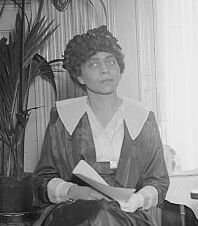
Figures 7 and 8. Born an African-American named Belle Greener, by the time she was a young woman, she was Belle da Costa Greene, a woman of European descent. After being introduced to wealthy patron Pierpont Morgan, Greene curated and organized his extensive manuscript collection, building the collection to become the Pierpont Morgan Library (now the Morgan Library & Museum), a public library in New York City. Sources: https://en.wikipedia.org/wiki/Belle_da_Costa_Greene. (left) “Belle da Costa Greene, pastel portrait by Paul César Helleu, ca. 1913.” Now in the public domain. (right) Bain News Service,, publisher. Belle DeAcosta Green – Alice Carpenter – Kath. Davis – Maude Wetmore [no date recorded on caption card] 1 negative : glass ; 5 x 7 in. or smaller. http://www.loc.gov/rr/print/res/274_bain.html Repository: Library of Congress, Prints and Photographs Division, Washington, D.C. 20540 USA, hdl.loc.gov/loc.pnp/pp.print Part Of: Bain News Service photograph collection (DLC) 2005682517 General information about the George Grantham Bain Collection is available at hdl.loc.gov/loc.pnp/pp.ggbain Higher resolution image is available (Persistent URL): hdl.loc.gov/loc.pnp/ggbain.50224 Call Number: LC-B2- 3977-9.
Back Matter
- Epilogue: An Evening at the Morgan, pp. 507–509
- An imaginary meeting of the Manuscript Club
- Bibliographies and Notes, pp. 510–585
- Extensive notes on the research done for each chapter
- List of Illustrations, pp. 586–592
- Hundreds of exquisite illustrations of medieval manuscripts, as well as some portraits of the Manuscript Club’s members
- Index of Manuscripts, pp. 593–601
- Admont . . . to . . . Wroclaw
- Index of People, pp. 602–616
- Aaron ben Gabriel, scribe, . . . to . . . Zumpt, August Wilhelm
Additional Resources
Wikipedia
- https://en.wikipedia.org/wiki/Anselm_of_Canterbury
- https://en.wikipedia.org/wiki/Belle_da_Costa_Greene
- https://en.wikipedia.org/wiki/Bookbinding
- https://en.wikipedia.org/wiki/Codex
- https://en.wikipedia.org/wiki/Coptic_binding
- https://en.wikipedia.org/wiki/Ethiopian_binding
- https://en.wikipedia.org/wiki/Girdle_book
- https://en.wikipedia.org/wiki/Limp_binding
- https://en.wikipedia.org/wiki/Long-stitch_bookbinding
- https://en.wikipedia.org/wiki/Manuscript
- https://en.wikipedia.org/wiki/Papyrus
- https://en.wikipedia.org/wiki/Printing
- https://en.wikipedia.org/wiki/Printing_press
- https://en.wikipedia.org/wiki/Pumice
- https://en.wikipedia.org/wiki/Simon_Bening
- https://en.wikipedia.org/wiki/Theodor_Mommsen
- https://en.wikipedia.org/wiki/Vellum
- https://en.wikipedia.org/wiki/Wax_tablet
Merriam-Webster’s Dictionary
- https://www.merriam-webster.com/dictionary/
- manuscript
- medieval
Preparing to Write
Ink
- https://travelingscriptorium.com/2013/03/21/iron-gall-ink/
- Iron Gall Ink
- https://travelingscriptorium.com/2013/01/17/verdigris/
- Verdigris
- https://travelingscriptorium.com/2012/02/29/a-small-booklet-containing-medieval-ink-pigment-recipes/
- A Small Booklet Containing Ink & Pigment Recipes
Bookbinding
- https://blog.papercraftpanda.com/overview-how-to-create-a-book-using-the-medieval-binding-method/
- Complete Overview of the Medieval Binding Method: Bookbinding Methods, Medieval Binding
- https://www.cabinet.ox.ac.uk/chemise-binding
- Making a Chemise Binding
- https://coblaith.net/BookDisguises/ChemiseBinding/default.html
- https://heraldry.sca.org/kwhss/2017/The%20Art%20of%20Bookbinding.pdf
- “The Art of Bookbinding: An Overview of the Evolution of pre-1600 Bindings,” Antonio de Navarra, 2017
- https://blogs.bl.uk/digitisedmanuscripts/2019/12/medieval-bookbindings-from-precious-gems-to-sealskin.html
- Medieval Bookbindings: From Precious Gems to Sealskin
- https://travelingscriptorium.com/bindings-materials/historical-images-manuscript-and-binding/
- Historical Images, Manuscript and Binding
Bookbinding Videos
- https://www.youtube.com/watch?v=GBn76DTAGw8
- (Bookbinding) Creating A Medieval Leather-bound Book with Clasps
- https://www.youtube.com/watch?v=iFuWfhESpFc
- Making A Medieval Book By Hand – Part 1 – Folding Pages, Endpapers, Piercing & Sewing
Copyright © 2025, Shari Dorantes Hatch. All rights reserved.
 Bird Brain
Leave a comment