
Amazonian Motmot
(not local to San Diego, California)

Figure 00. The Amazonian Motmot looks similar to other Blue-crowned Motmots; it’s distinguished by its circular black cap atop its blue crown.
Contents
- Coraciiformes
- Momotidae
- Diet and Foraging
- Predator Signaling
- Breeding
- Amazonian Motmot, Momotus momota, a Blue-crowned Motmot
- Description
- Vocalizations
- Distribution and Habitat
- Diet and Foraging
- Breeding
- Conservation Status
- Amazonian Motmot, compared with other birds in the S.D. Zoo’s Parker Aviary
- Length (bill to tail, not height when standing)
- Weight
- Generation Length
- Momotidae
- Resources
- General References
- Coraciiformes
- Additional Resources
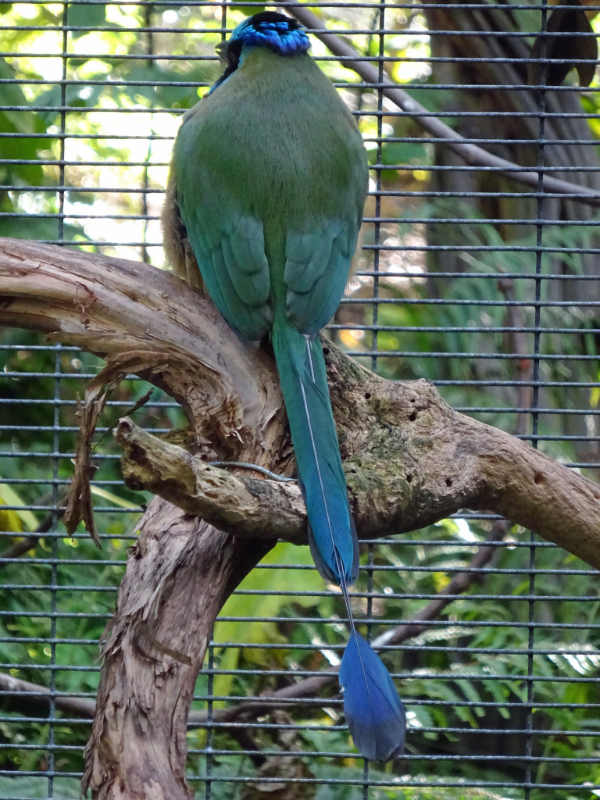
Figure 01. Like other motmots, Amazonian Motmots are ambush predators, who watchfully wait for their chance to snatch their prey. Despite their bright colors, they can be hard to spot because they hold so still, watching for prey.
Scientists group animals and other living things into hierarchies, to more easily see which ones are more closely related to each other. Here’s the hierarchy for the Amazonian Motmot (Momotus momota), one of several Blue-crowned Motmots.
- kingdom: Animalia
- phylum: Chordata (vertebrates, a subphylum of chordates, include birds, mammals, fish, reptiles, and amphibians)
- class: Aves, all living birds (includes about 45 orders of birds)
- order: Coraciiformes (order names end in –iformes)
- includes 6 families: Momotidae, Meropidae, Brachypteraciidae, Coraciidae, Todidae, Alcedinidae (family names end in -idae)
- family: Momotidae
- includes 6 genera: Momotus, Aspatha, Baryphthengus, Electron, Eumomota, Hylomanes
- genus (1 genus, 2 genera; always capitalized): Momotus
- includes 7 species (1 species, 2 species; never capitalized)
- species: momota
- order: Coraciiformes (order names end in –iformes)
- class: Aves, all living birds (includes about 45 orders of birds)
- phylum: Chordata (vertebrates, a subphylum of chordates, include birds, mammals, fish, reptiles, and amphibians)
Coraciiformes
Coraciiformes include motmots, kingfishers, todies, bee-eaters, and rollers. “Coraciiformes” comes from corax, “raven” (Latin), indicating the raven-like silhouette of these birds. Most coraciiformes have anisodactyl toes (three forward, one backward).
A distinctive behavior of coraciiformes is that after they catch their prey, they hold it sideways in their bill and beat it senseless until it’s ready to be swallowed whole. (If you’re lucky enough to see kingfishers catch a fish, you can watch them do this — with gusto!)
Momotidae
The 14 species of Momotidae live in neotropical forests and other woodlands. Almost all motmots have two distinctive long tail feathers (called “retrices”), which serve as a sexual signal to potential mates. In most species, the tail feathers have a racquet-shaped tip, which forms naturally.
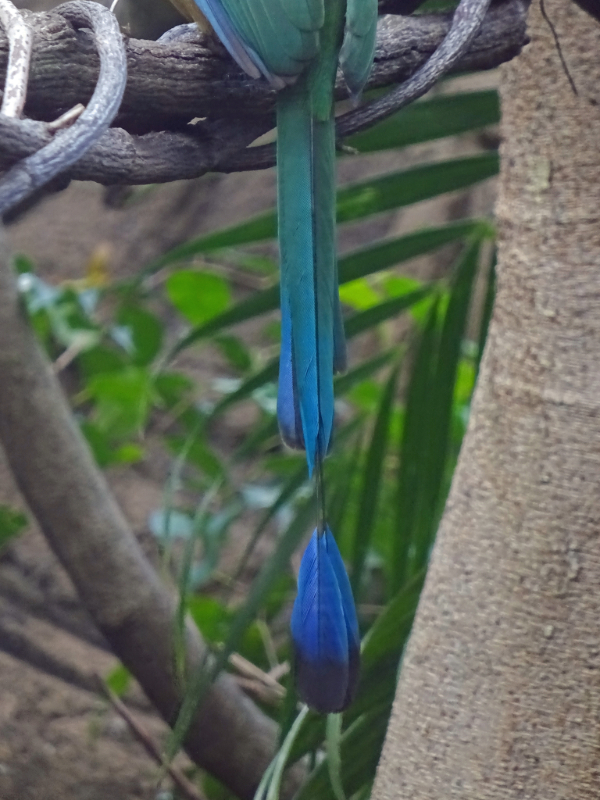
Figure 02. Observers have come up with wacky reasons why the motmot’s tail has a racket shape: “The bird plucks its own feathers,” “rivals pluck its feathers,” and so on. In truth, it’s due to genes (and evolution). Each of the motmot’s two tail feathers has weak barbs in one area. Under normal conditions, the weak barbs easily fall off the feather shaft, creating a barbless area above the “racquet.”
Diet and Foraging
Most motmots eat mainly large arthropods (insects, spiders, crabs, etc.), but they also snatch lizards and other small vertebrates (fish, frogs, etc.) when available. They eat fruits sometimes, too. Motmots typically perch, watchfully wait, then sally out to catch their prey. Though brightly colorful, these ambush predators can be hard to spot because they hold so still, watching for prey.
Predator Signaling
While motmots are watching for potential prey, they must also watch for predators. When a motmot notices a predator eyeing it, the motmot will wag its tail feathers. This “wag-display” signals to the predator, “I see you,” which tells the predator that it won’t be easy to capture the motmot. In this way, the predator avoids a needless chase, and the motmot avoids a needless flight. In a study of Turquoise-browed Motmots, the motmots used the wag-display more often to signal ambush predators than other kinds of predators. Smart birds!
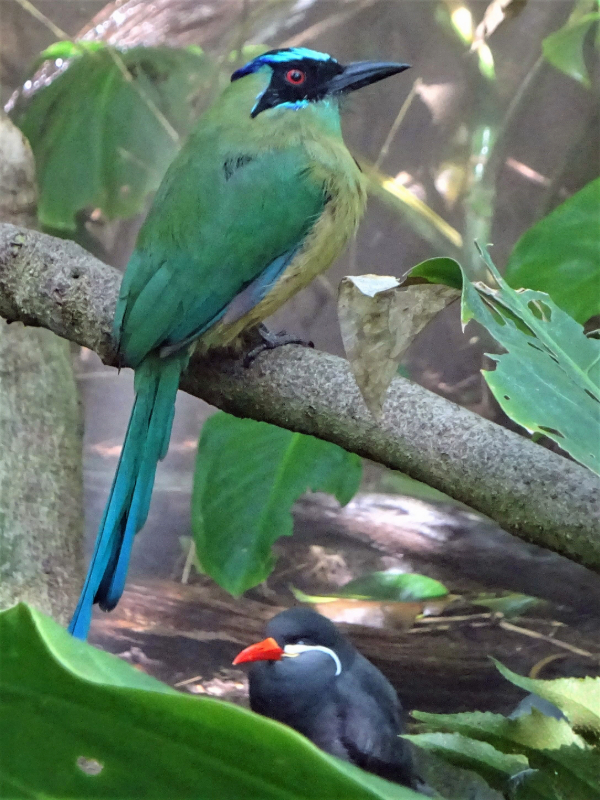
Figure 03. Motmots prey on large arthropods (e.g., insects, spiders) and small vertebrates (e.g., lizards, fish), but they must also watch for other predators interested in eating them. To catch their prey, they watchfully wait, holding still. To alert a potential predator that they are aware of its presence, they wag their tail feathers, as a subtle cue, “I see you, and I’m ready to flee quickly.” (This Inca Tern may be watching those feathers, too.)
Breeding
Motmots are monogamous, with some species forming long-term pair bonds. Motmot parents look for earthen banks to dig into for their deep nesting burrows (often 15 feet or more). The female typically lays 4 eggs, then both parents take one or two long turns at incubation each day. Incubation takes 18–22 days, then both parents tend to the hatchlings for an additional 21 or more days. Some species of motmots nest in colonies.
Amazonian Motmot, Momotus momota, a Blue-crowned Motmot
Scientists have reconsidered the species label “Blue-crowned Motmot,” after noticing distinctive differences among a few different birds called “Blue-crowned Motmot.” They now recognize this group as including several separate species, such as the Amazonian Motmot.
Description
Males and females are mostly shades of green and blue, with blackish-gray legs and toes. Atop its head is a bright blue crown, stretching from the top of its black bill to the back of its head, with a small black cap on the top of its crown. Its red eyes are surrounded by a black mask extending from its bill. Its two long tail feathers have the characteristic motmot racquet shape.
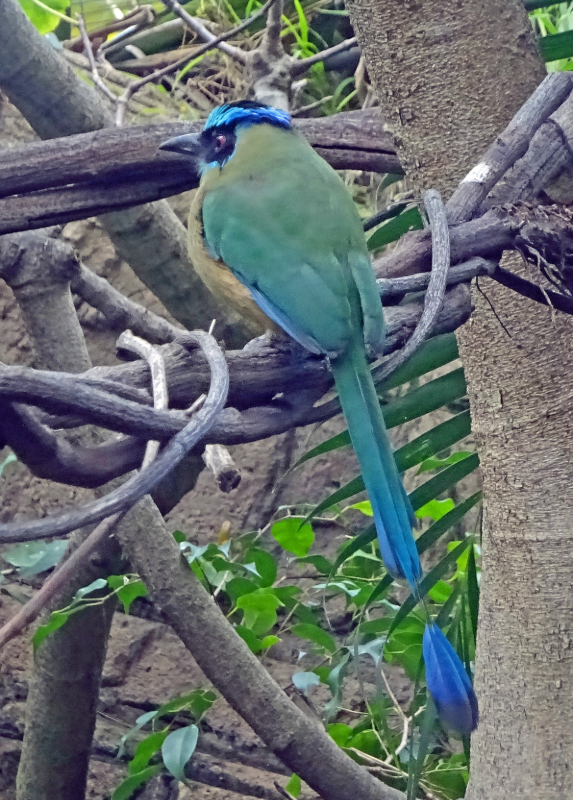
Figure 04. From bill to tail, the Amazonian Motmot is about 18.5″ long. It weighs a bit more than 5 ounces, about as much as 1 “D” battery (or 2 “C” batteries, or 4 “AA” batteries)—probably much less than your cellphone. The motmot’s bill extends about 1.7″, almost 1/10th of its total length, including its long tail. (For comparison, if you’re 6 feet tall, your nose would extend out about 7″ from your face.)
Vocalizations
Birds of the World (Cornell Lab of Ornithology) describes its vocalization as a “double-noted hooting call.” To hear for yourself, link to https://xeno-canto.org/species/Momotus-momota.
Distribution and Habitat
The Amazonian Motmot resides in South America, east of the Andes. It thrives in humid lowland forests but can be found up to more than 5000 feet above sea level.
Diet and Foraging
Blue-crowned Motmots perch upright, vigilant, and still, then they quickly sally out to grab their prey, mostly large arthropods (insects, spiders, etc.) or small vertebrates (e.g., mammals, reptiles). They sometimes add fruits to their diets.
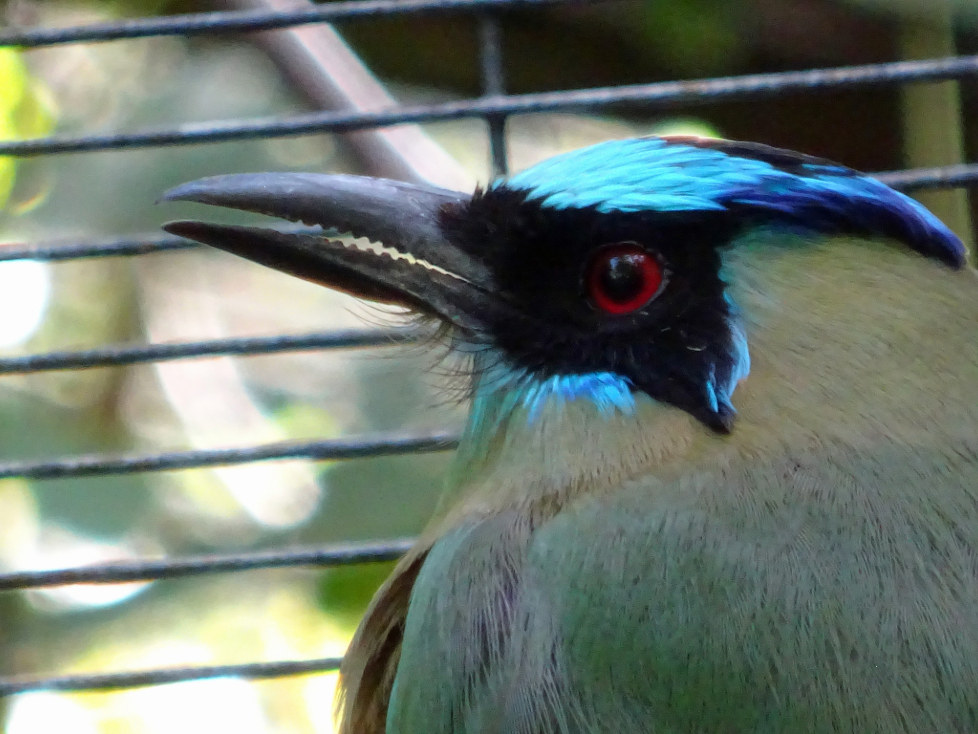
Figure 05. The serrations on the bills of Amazonian Motmots can readily grab and grasp their prey.
Breeding
These motmots spend most of their time alone or with just one other motmot. Like other motmots, they’re monogamous and both parents care for their young. They dig deep burrows into earthen banks for incubating and raising their young. Little else is known about this motmot species’ breeding, but it’s probably similar to other motmots in terms of clutch size, incubation length, and length of nesting.

Figure 06. Little is known about exactly when Amazonian Motmots breed or when they molt, but if they’re like most birds, they molt after the breeding season, after they finish raising their chicks. Amazonian Motmots can look a bit ragged while molting, but they soon have brilliant new plumage.
Conservation Status
IUCN Red List status is LC, Least Concern. This motmot enjoys wide geographical distribution, a large and stable population size (20,000–50,000), but the population trend is decreasing. Threats: pet and display trade, horticulture. Maximum recorded longevity, 20.3 years, in managed care; IUCN generation length is 3.9 years.
Amazonian Motmot
(Compared with other birds in the San Diego Zoo’s Parker Aviary)
Length (bill to tail, not height when standing)
| Common Name | Scientific name | Length (inches) |
| Barbet, Black-spotted | Capito niger | 6.9 |
| Sunbittern | Eurypyga helias | 17.9 |
| Motmot, Amazonian (Blue-crowned) | Momotus momota | 18.5 |
| Oropendola, Crested | Psarocolius decumanus | 18.5 |
| Toucan, Toco | Ramphastos toco | 22.1 |

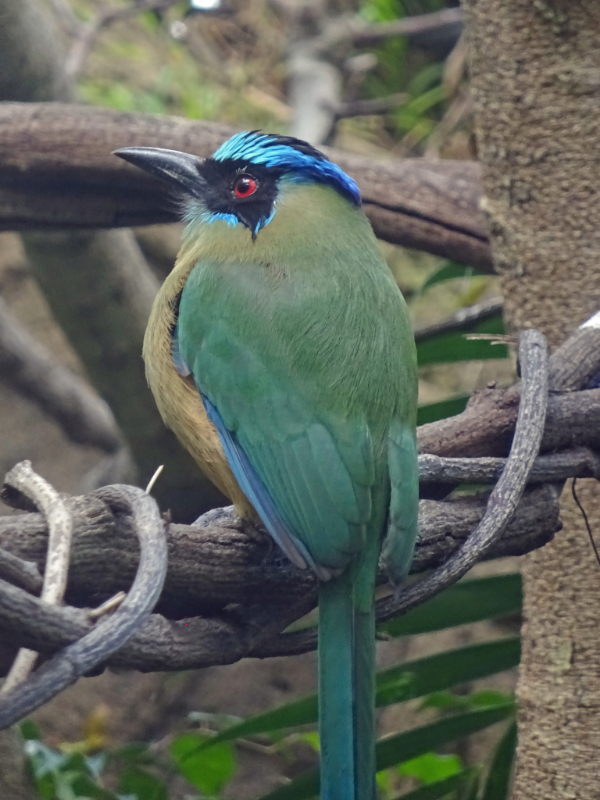
Figure 07 (a, b). Amazonian Motmots aren’t unusually large or small birds, but their appearance sets them apart.
Weight
| Common Name | Scientific name | Weight (oz.) male & female (or m) | Weight (oz.) female |
| Barbet, Black-spotted | Capito niger | 1.5 | — |
| Jay, Plush-crested | Cyanocorax chrysops | 4.9 | — |
| Motmot, Amazonian (Blue-crowned) | Momotus momota | 5.1 | — |
| Tern, Inca | Larosterna inca | 6.9 | — |
| Trumpeter, Grey-winged | Psophia crepitans | 32 | 40 |
Generation Length
| Common Name | Scientific name | Generation length | Longevity* (years) |
| Sunbittern | Eurypyga helias | 14.2 | 24, max, S.D. Zoo |
| Oropendola, Crested | Psarocolius decumanus | 5.3 | 15, max, m.c. |
| Motmot, Amazonian (Blue-crowned) | Momotus momota | 3.9 | 20.3, max, m.c. |
| Cacique, Yellow-rumped | Cacicus cela | 3.6 | 20, max, m.c. |
* “max” maximum recorded and verified longevity. “m.c.” managed care.
Resources
General References
- Elphick, Jonathan. (2014). The World of Birds. Buffalo, NY: Firefly Books.
- pp. 32–35, feet and toes
- Lovette, Irby, & John Fitzpatrick (eds.), (2016). The Cornell Lab of Ornithology Handbook of Bird Biology (3rd ed.). Hoboken, NJ: Wiley.
- General
- p. 178–183, skeleton, feet, toes, dactyly
- p. 274–286, foraging, diet
- pp. 43–59, bird orders and families
- Morrison, Michael, Amanda Rodewald, Gary Voelker, Melanie Colón, & Jonathan Prather (eds.), (2018). Ornithology: Foundation, Analysis, and Application. Baltimore: Johns Hopkins Press.
- p. 147, dactyly, toes
- Winkler, David W., Shawn M. Billerman, & Irby J. Lovette. (2015). Bird Families of the World: An Invitation to the Spectacular Diversity of Birds. Barcelona, Spain: Lynx, Cornell Lab of Ornithology.
Coraciiformes
- Winkler, David W., Shawn M. Billerman, & Irby J. Lovette. (2015). Bird Families of the World: An Invitation to the Spectacular Diversity of Birds. Barcelona, Spain: Lynx, Cornell Lab of Ornithology.
- pp. 220, 228–229, Coraciiformes
- https://birdsoftheworld.org/bow/species, “Orders and Families,” 11,017 species
- https://en.wikipedia.org/wiki/Dactyly#In_birds
- https://www.hummingbirdsplus.org/nature-blog-network/the-versatility-and-ecological-role-of-bird-feet/
Momotidae
- Elphick, Jonathan. (2014). The World of Birds. Buffalo, NY: Firefly Books. (Pp. 424–425)
- Winkler, D. W., S. M. Billerman, & I. J. Lovette (2020). Motmots (Momotidae), version 1.0. In Birds of the World (S. M. Billerman, B. K. Keeney, P. G. Rodewald, & T. S. Schulenberg, Editors). Cornell Lab of Ornithology, Ithaca, NY, USA. https://doi.org/10.2173/bow.momoti1.01
- https://animalia.bio/index.php/turquoise-browed-motmot
Blue-crowned Motmot, Momotus momota (e.g., Amazonian Motmot)
- Murphy, Troy G. (2006). “Predator-elicited visual signal: why the turquoise-browed motmot wag-displays its racketed tail.” Behavioral Ecology, Vol. 17, Issue 4, July/August 2006, pp. 547–553
- Orzechowski, S. C., & T. S. Schulenberg (2020). Amazonian Motmot (Momotus momota), version 1.0. In Birds of the World (T. S. Schulenberg, Editor). Cornell Lab of Ornithology, Ithaca, NY, USA. https://doi.org/10.2173/bow.bucmot4.01 https://doi.org/10.1093/beheco/arj064
- https://avibase.bsc-eoc.org/species.jsp?lang=EN&avibaseid=7CE7EB2FD1FB6F96&sec=lifehistory
- https://genomics.senescence.info/species/entry.php?species=Momotus_momota
- https://www.iucnredlist.org/species/61634591/163627466
- https://xeno-canto.org/species/Momotus-momota
Additional Resources
Etymology
- Gotch, Arthur Frederick. (1980). Birds—Their Latin Names Explained. Dorset, UK: Blandford Press.
- Gruson, Edward S. (1972). Words for Birds: A Lexicon of North American Birds with Biographical Notes. New York: Quadrangle Books. 305 pp., including Bibliography (279–282), Index of Common Names (283–291), Index of Generic Names (292–295), Index of Scientific Species Names (296–303), Index of People for Whom Birds Are Named (304–305).
- Lederer, Roger, & Carol Burr. (2014). Latin for Bird Lovers: Over 3,000 Bird Names Explored and Explained. Portland: Timber.
Generation length
IUCN Red List status
Longevity data and life histories
Vocalizations
Copyright © 2025, text and photos, Shari Dorantes Hatch. All rights reserved..

 Bird Brain
Leave a comment